Amazon-style
shopping cart analysis
  using MapReduce
 on a Hadoop cluster


      Dan Şerban
Agenda
:: Introduction
   - Real-world uses of MapReduce
   - The origins of Hadoop
   - Hadoop facts and architecture
:: Part 1
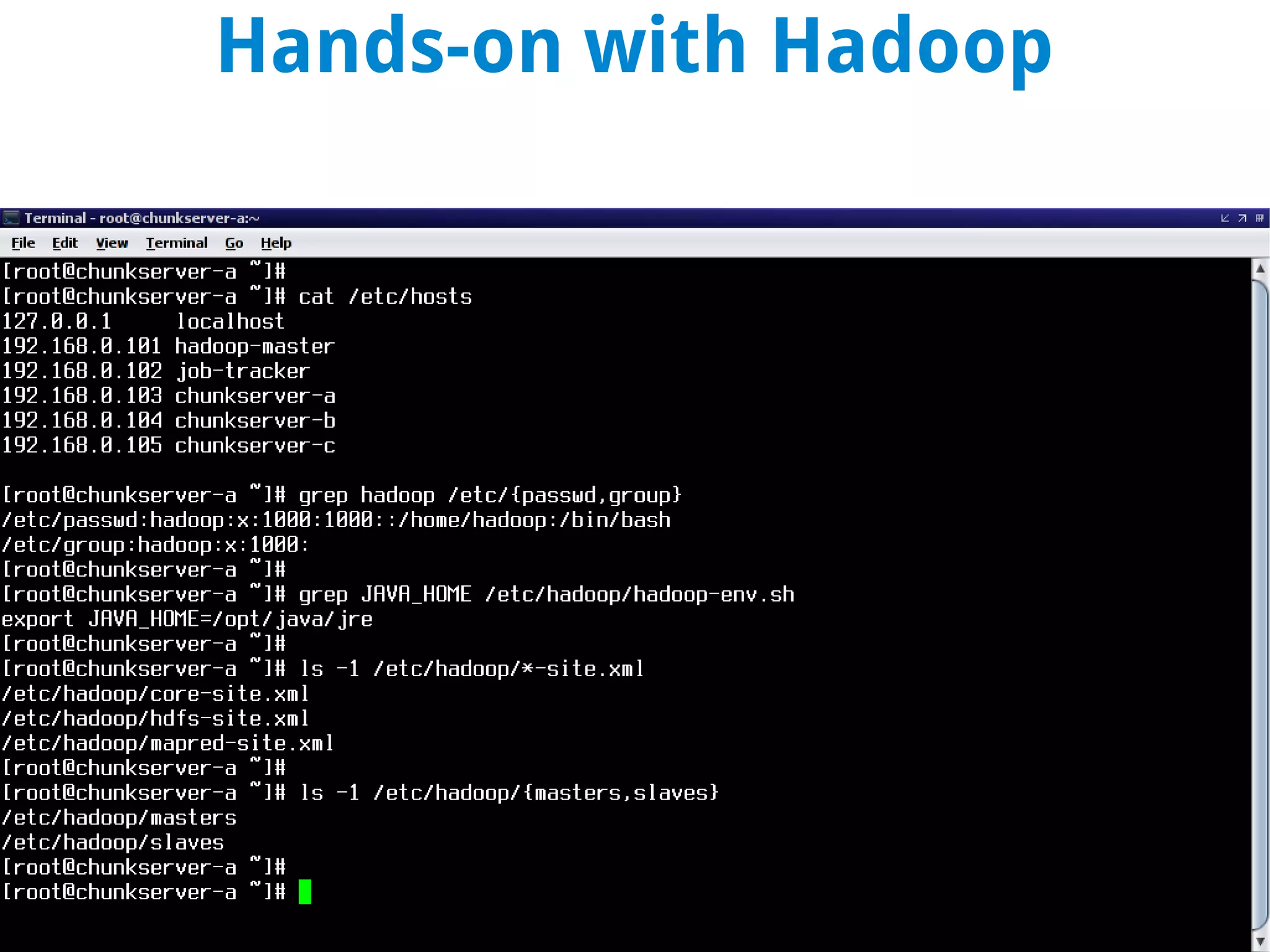
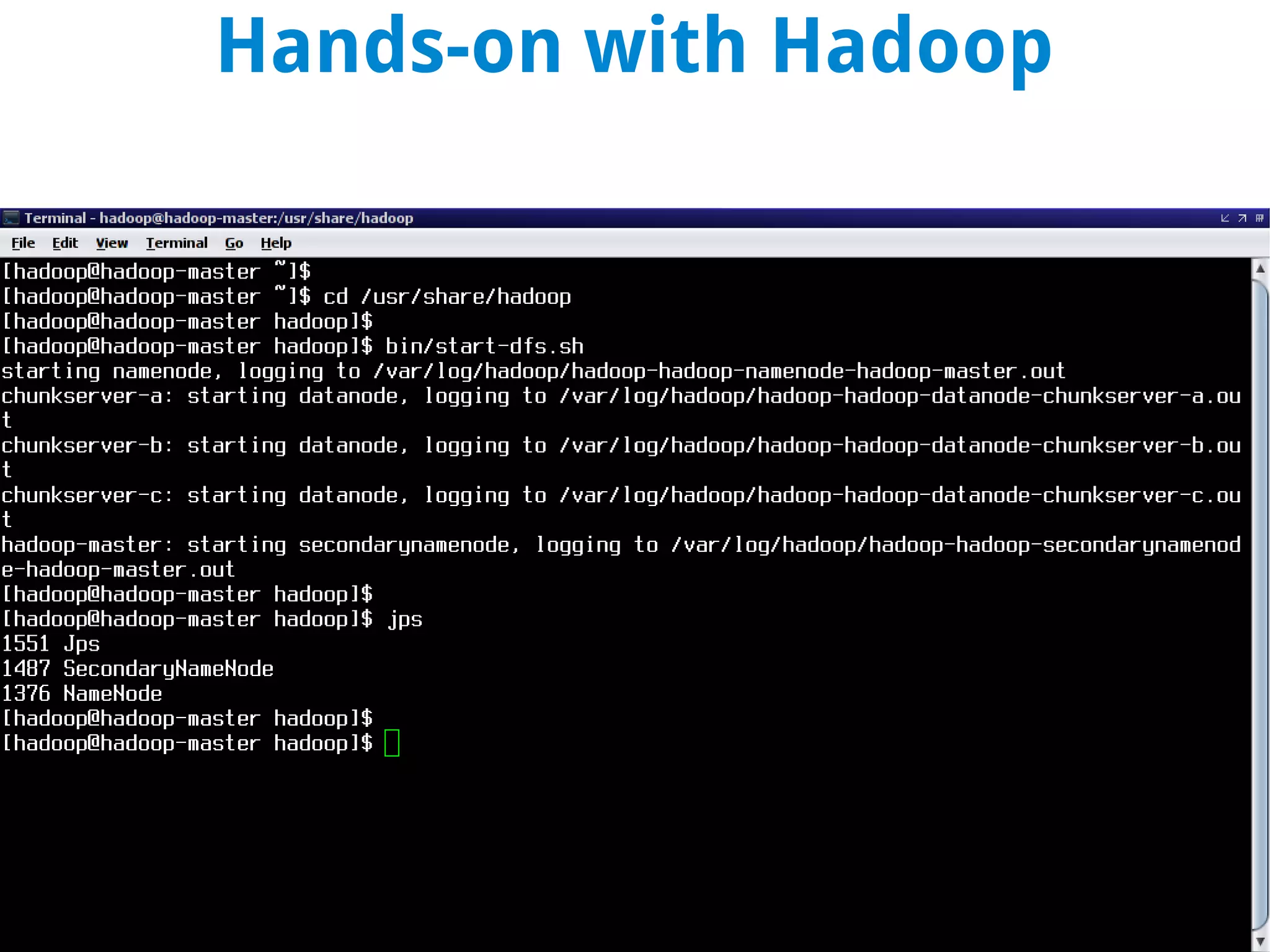
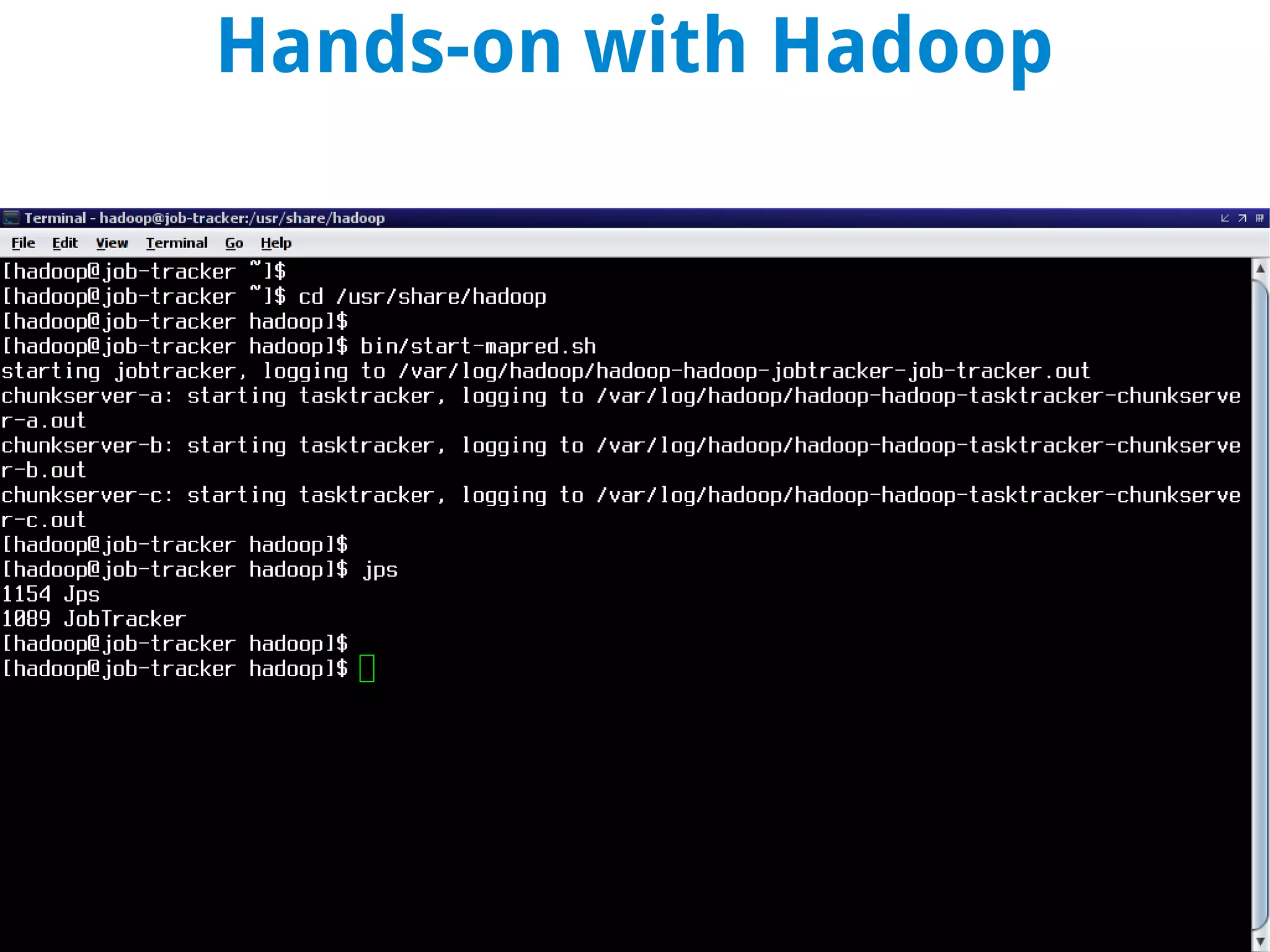
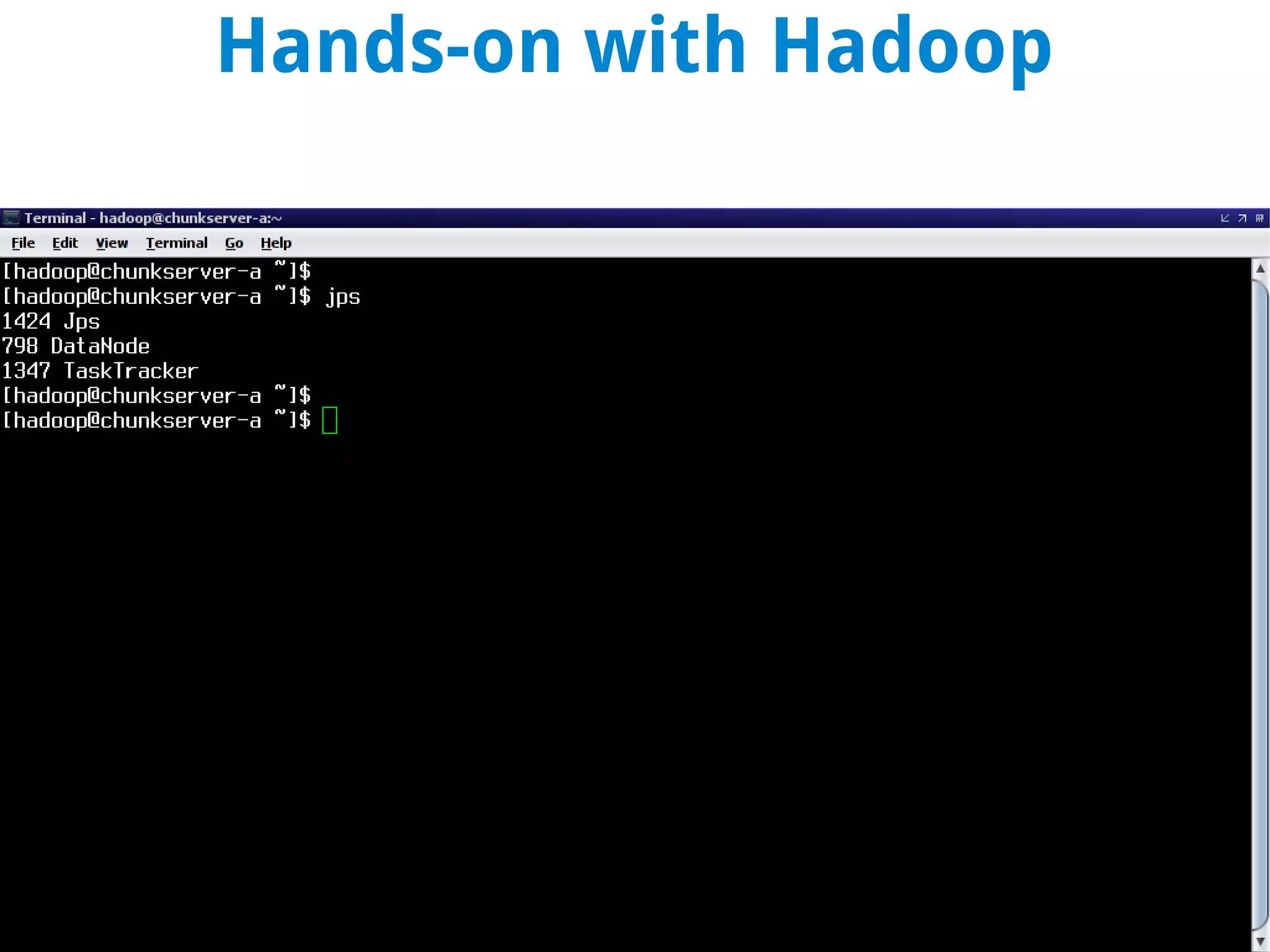
   - Deploying Hadoop
:: Part 2
   - MapReduce is machine learning
:: Q&A
Why shopping cart analysis
 is useful to amazon.com
Linkedin and Google Reader
The origins of Hadoop
:: Hadoop got its start in Nutch
:: A few enthusiastic developers were attempting
   to build an open source web search engine
   and having trouble managing computations
   running on even a handful of computers
:: Once Google published their GoogleFS and MapReduce
   whitepapers, the way forward became clear
:: Google had devised systems to solve precisely
   the problems the Nutch project was facing
:: Thus, Hadoop was born
Hadoop facts
:: Hadoop is a distributed computing platform
   for processing extremely large amounts of data
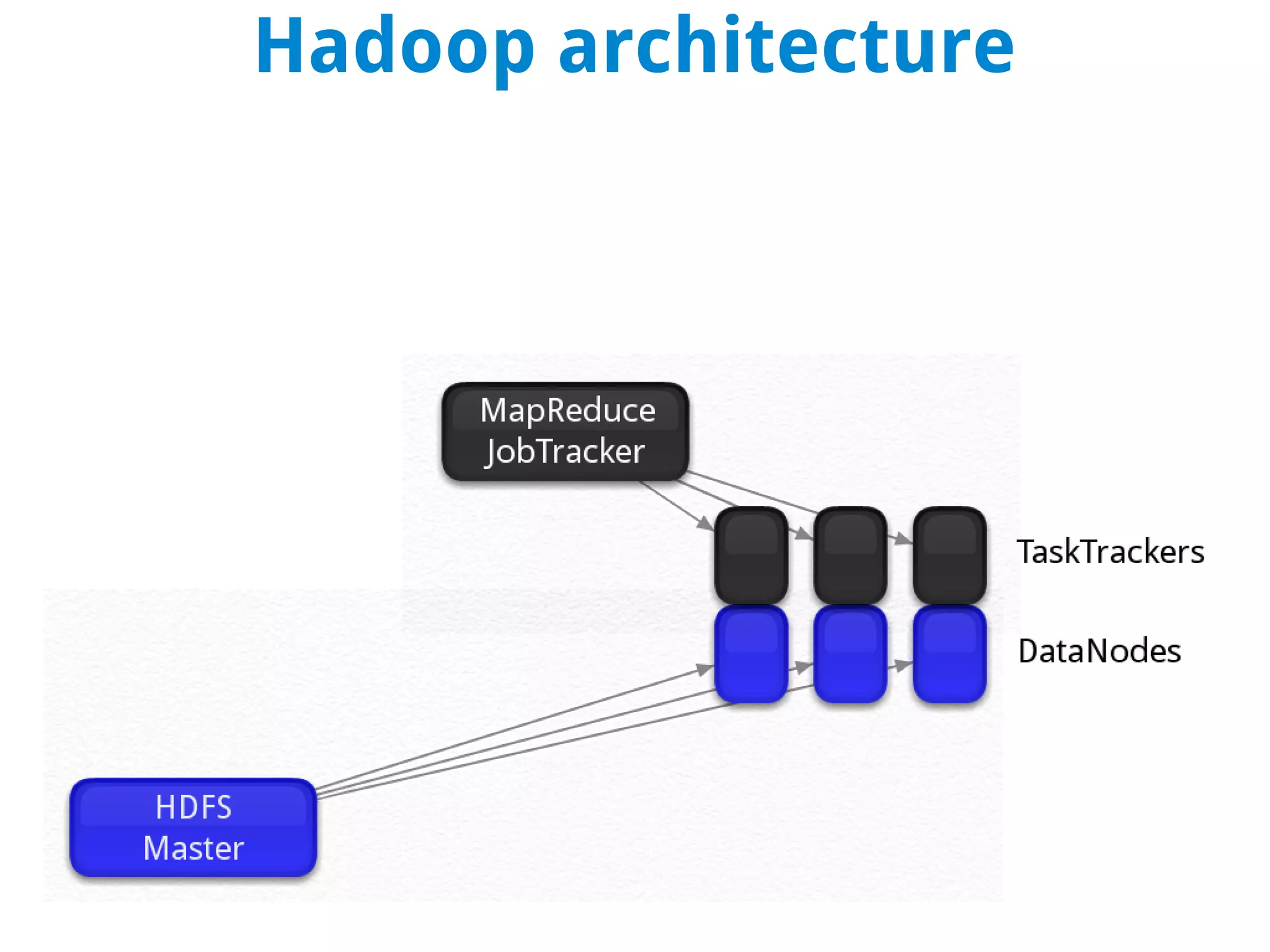
:: Hadoop is divided into two main components:
   - the MapReduce runtime
   - the Hadoop Distributed File System (HDFS)
:: The MapReduce runtime allows the user to submit
   MapReduce jobs
:: The HDFS is a distributed file system that provides
   a logical interface for persistent and redundant
   storage of large data
:: Hadoop also provides the HadoopStreaming library
   that leverages STDIN and STDOUT so you can write
   mappers and reducers in your programming language
   of choice
Hadoop facts
:: Hadoop is based on the principle
   of moving computation to where the data is
:: Data stored on the Hadoop Distributed File System
   is broken up into chunks and replicated across
   the cluster providing fault tolerant parallel processing
   and redundancy for both the data and the jobs
:: Computation takes the form of a job which consists
   of a map phase and a reduce phase
:: Data is initially processed by map functions which run
   in parallel across the cluster
:: Map output is in the form of key-value pairs
:: The reduce phase then aggregates the map results
:: The reduce phase typically happens in multiple
   consecutive waves until the job is complete
Hadoop architecture
Part 1:
Configuring and deploying
   the Hadoop cluster
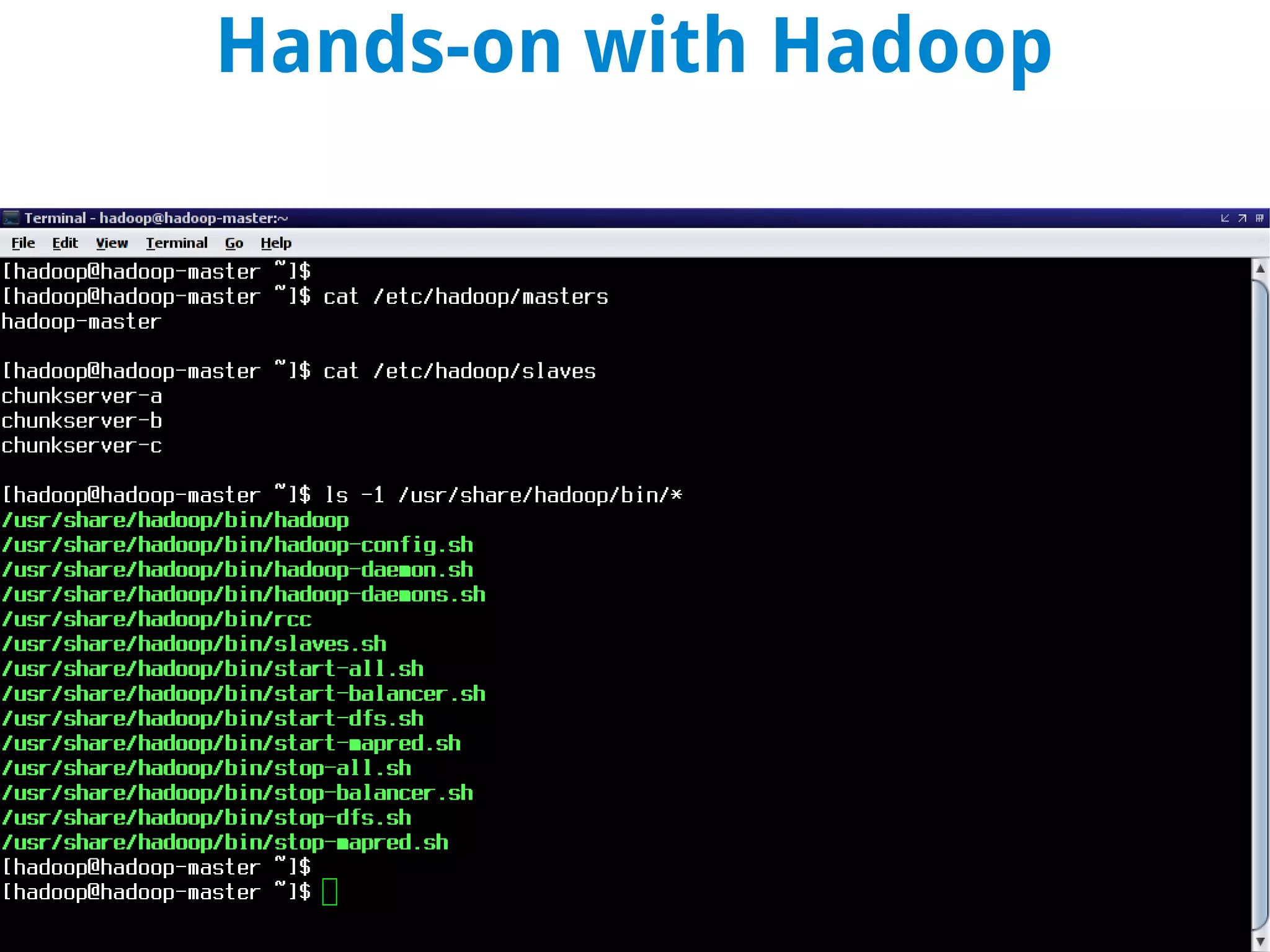
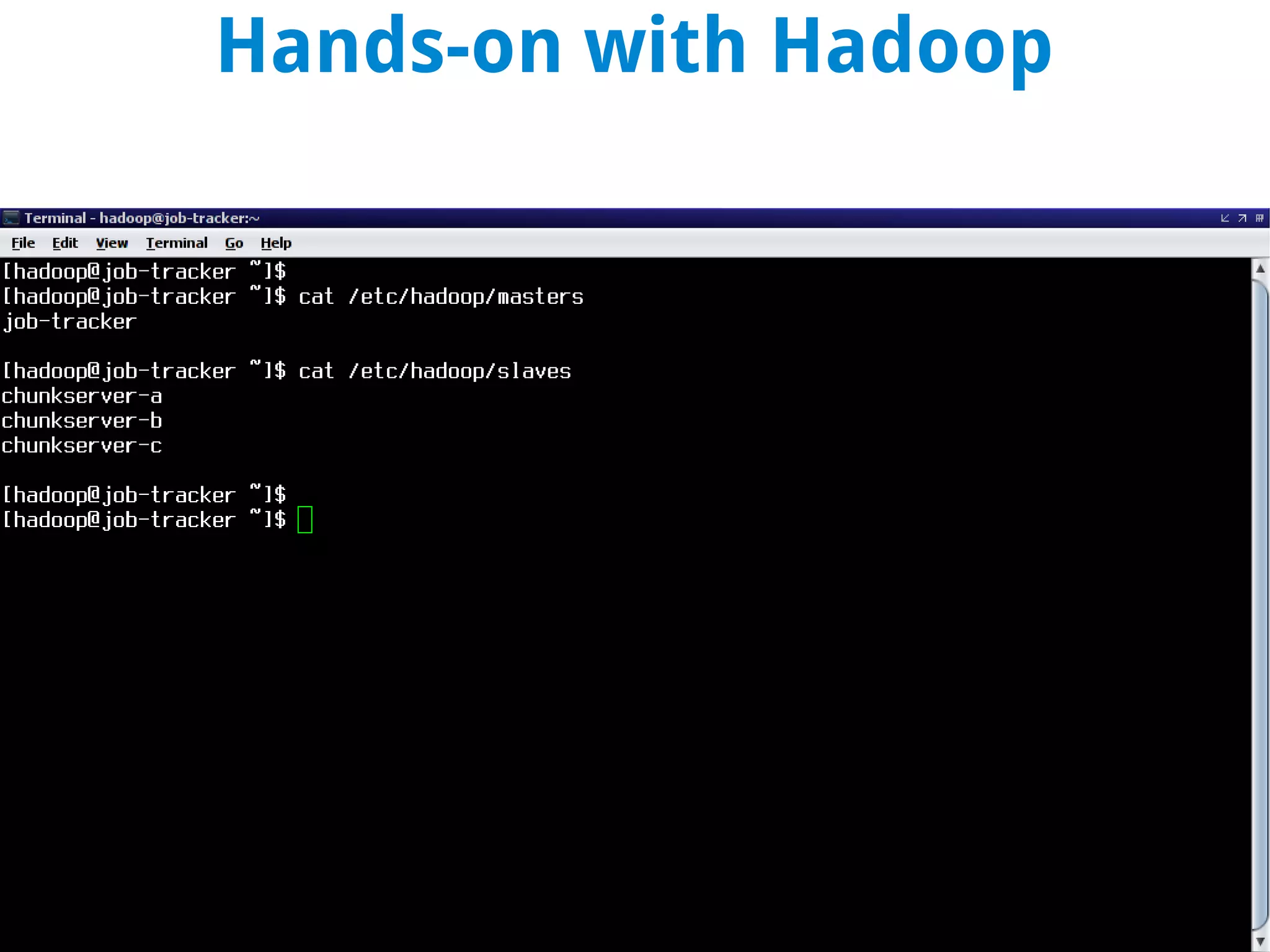
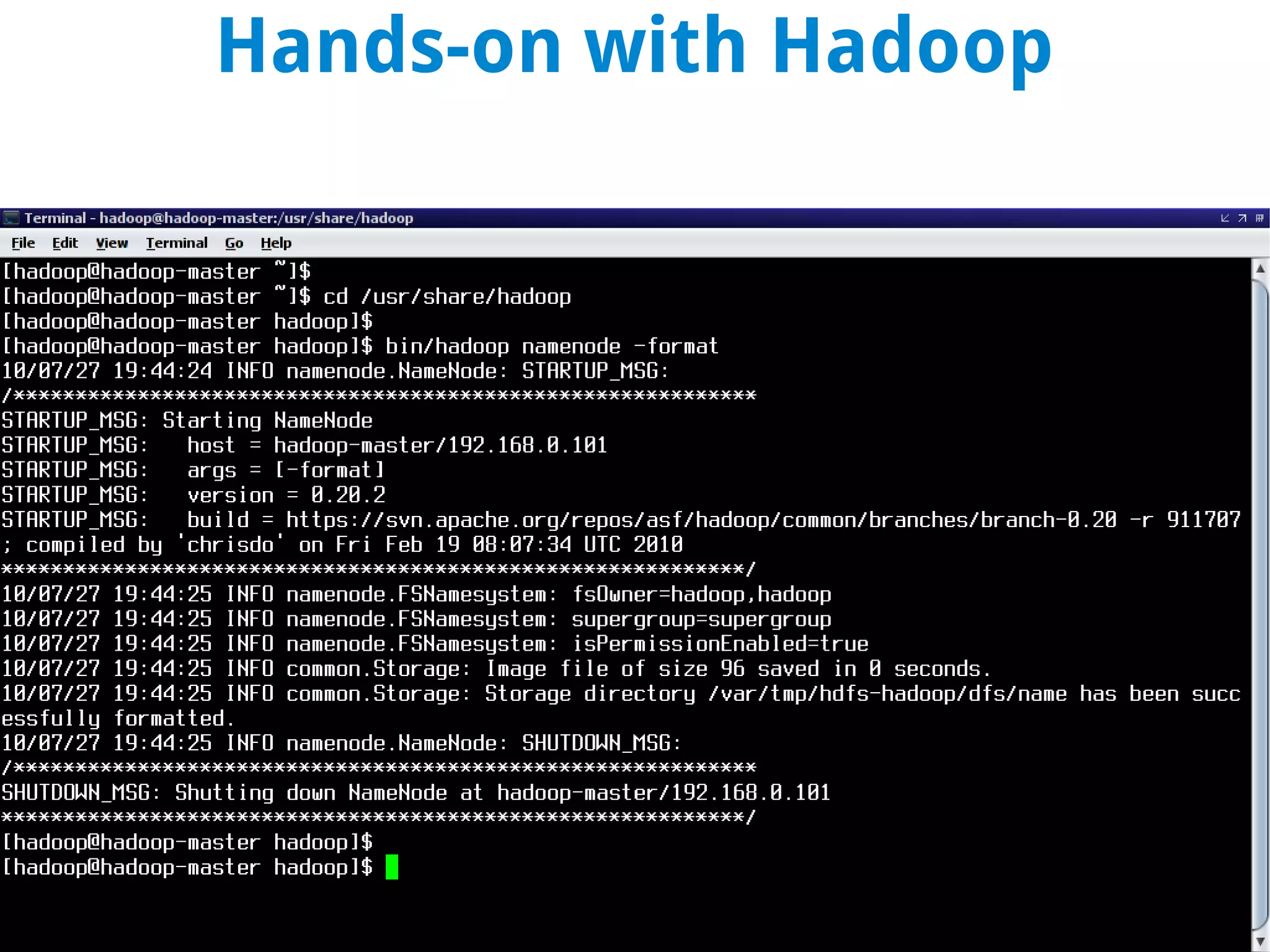
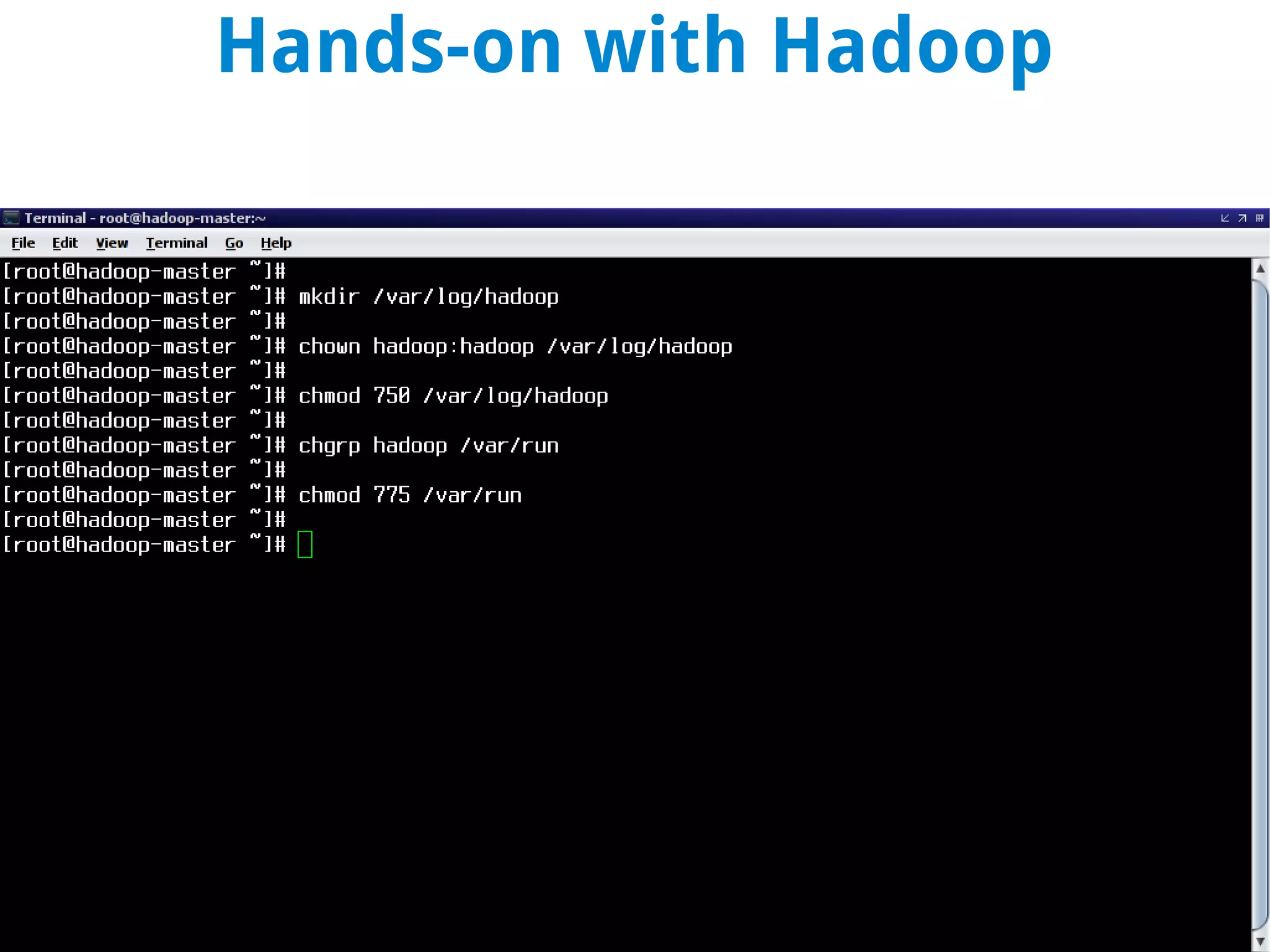
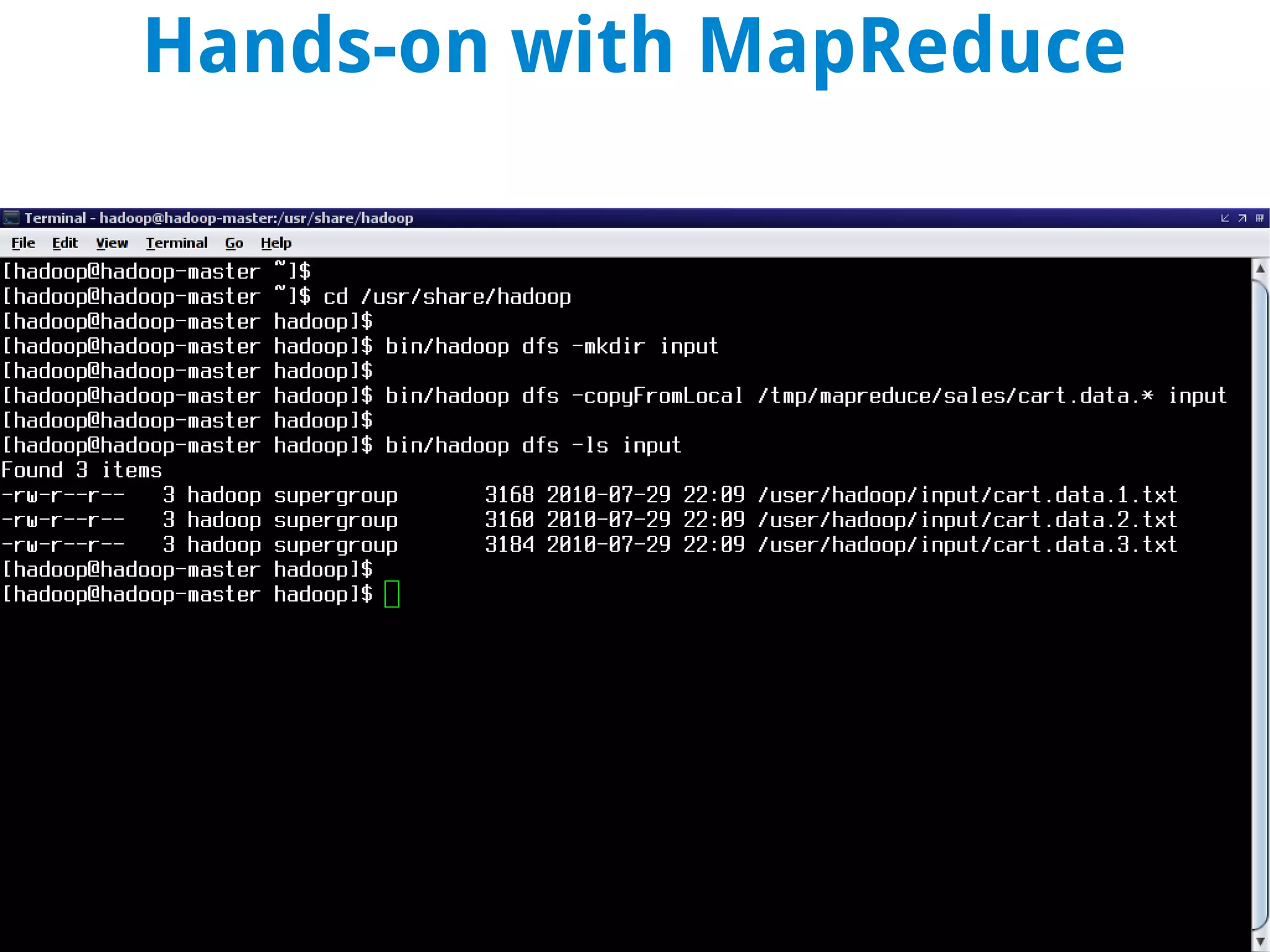
Hands-on with Hadoop
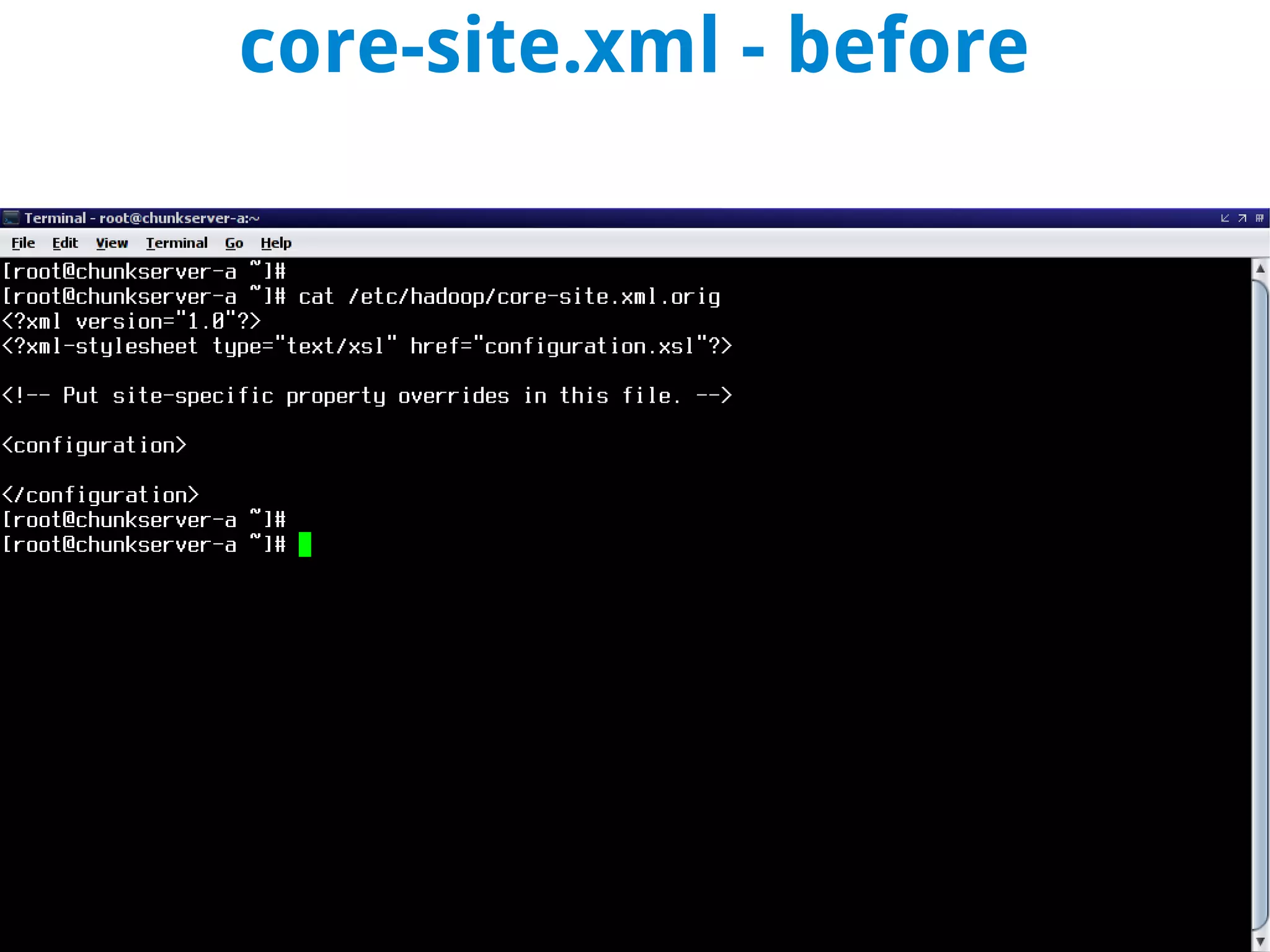
core-site.xml - before
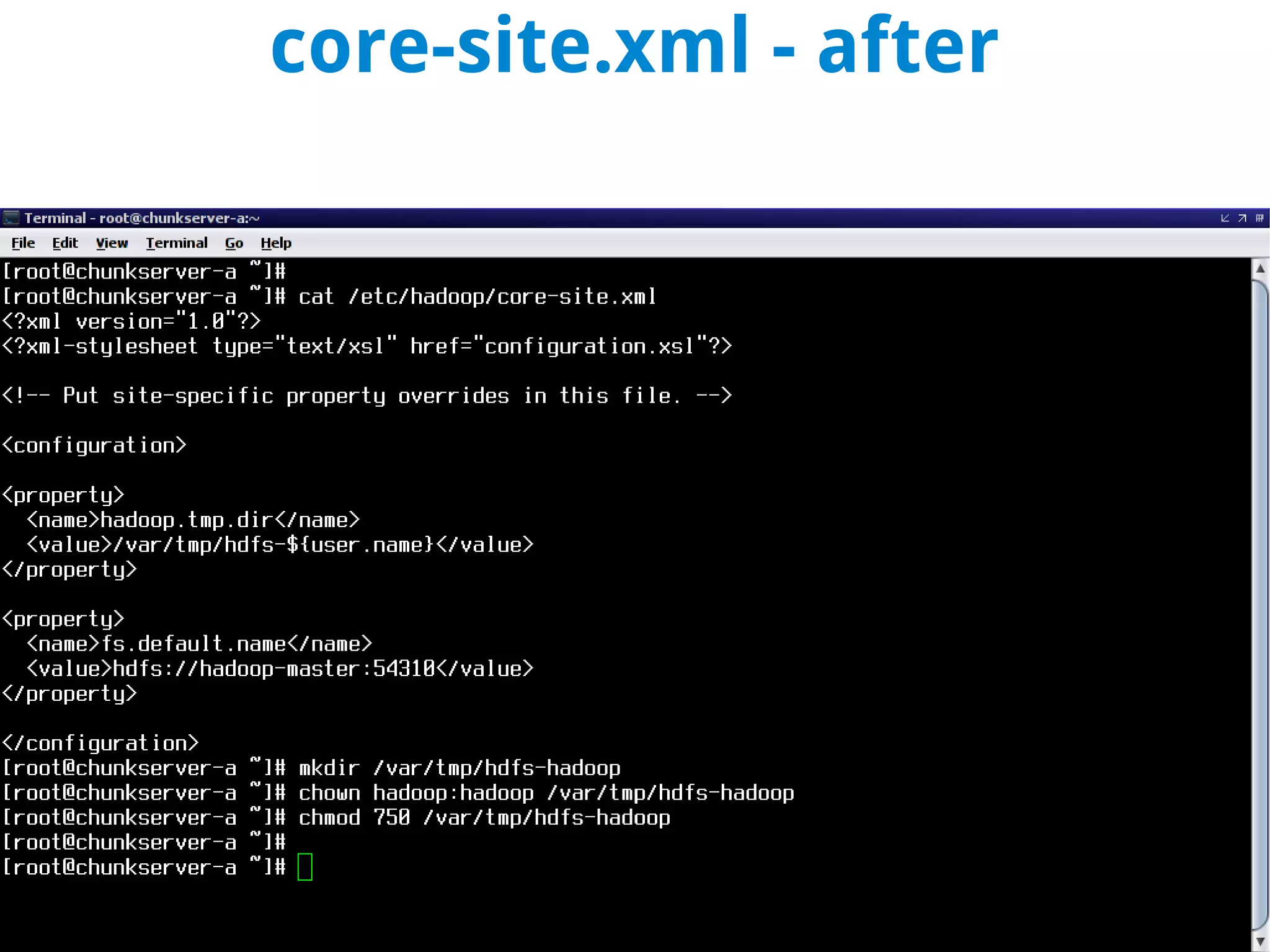
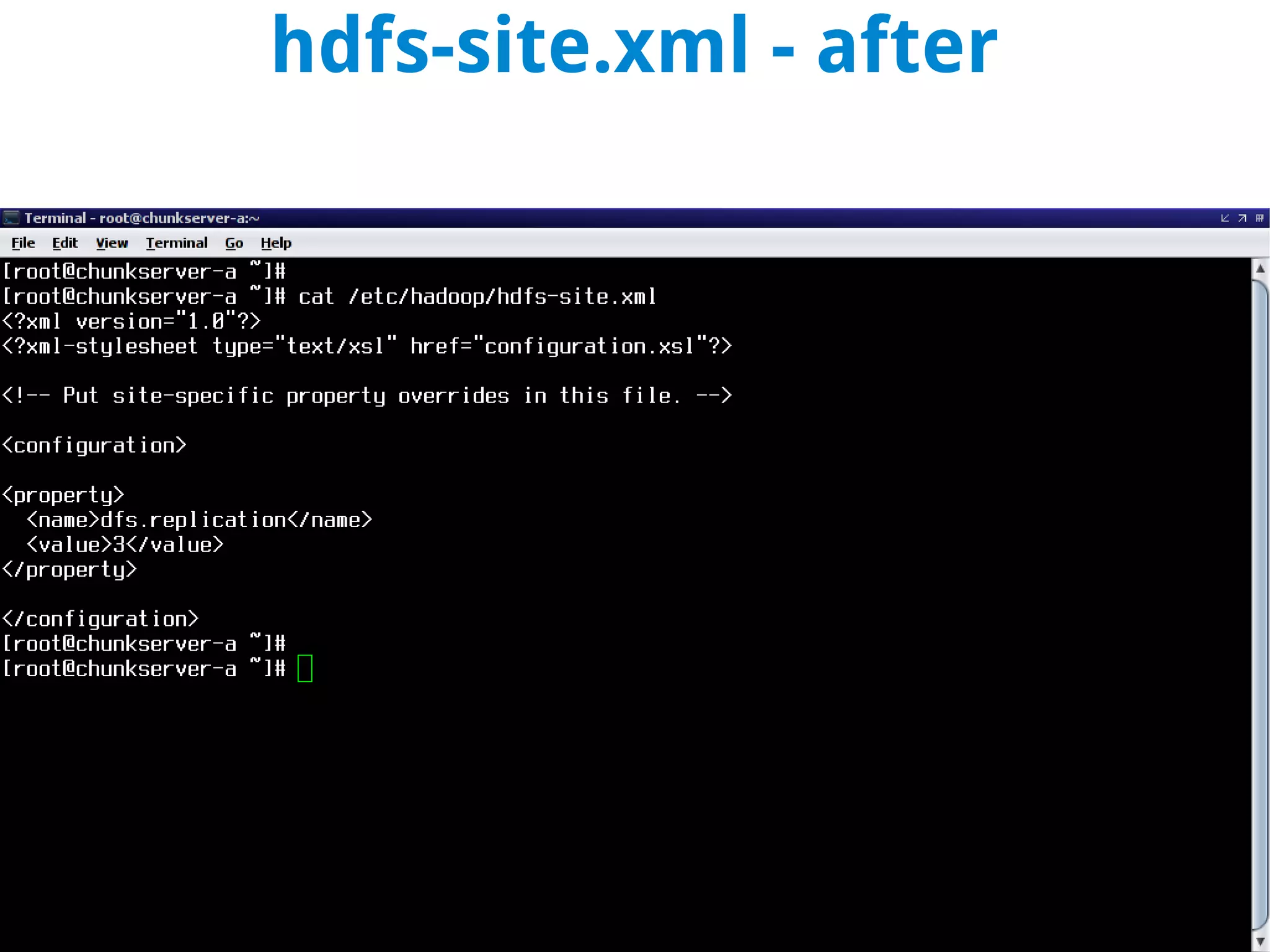
core-site.xml - after
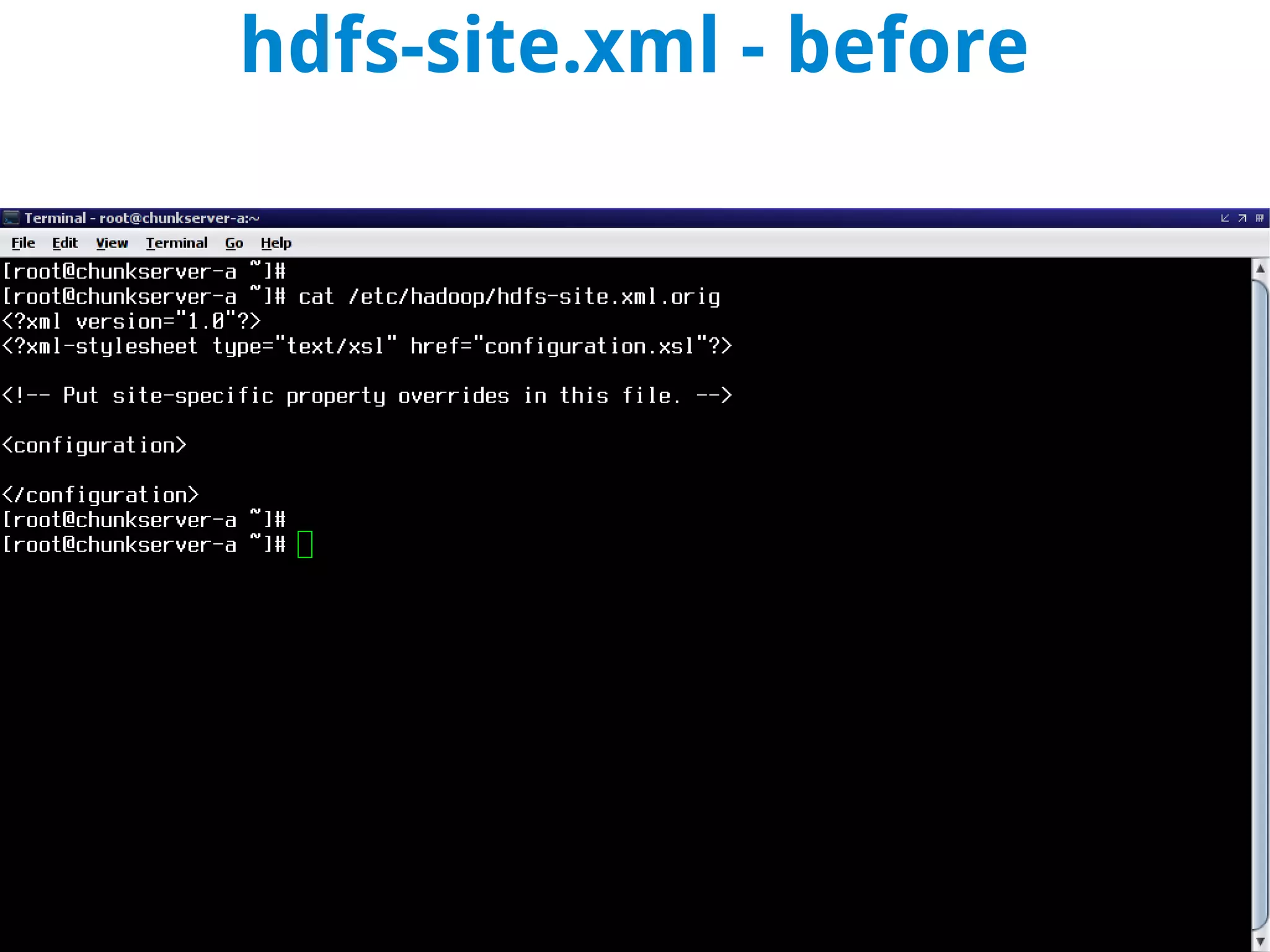
hdfs-site.xml - before
hdfs-site.xml - after
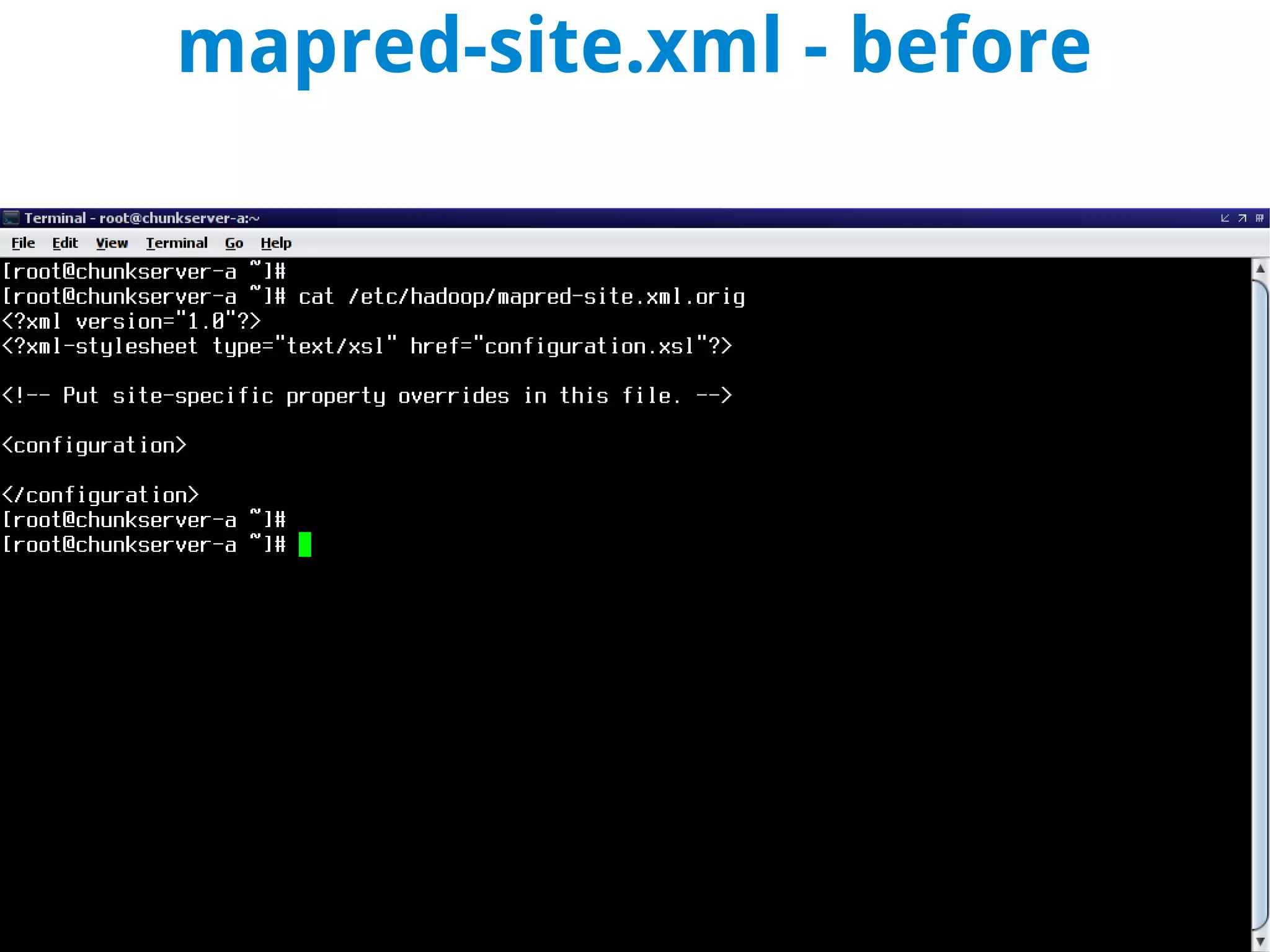
mapred-site.xml - before
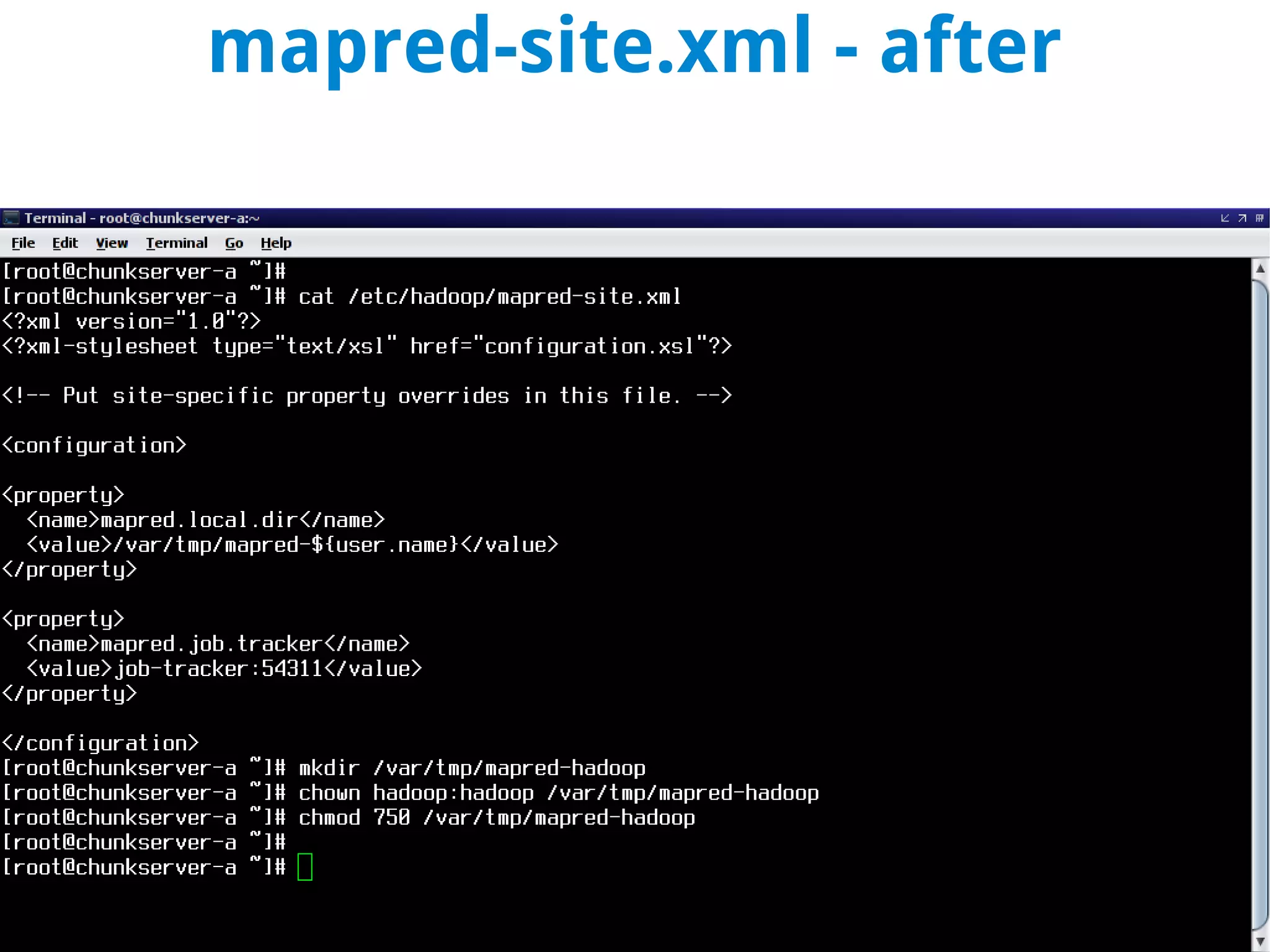
mapred-site.xml - after
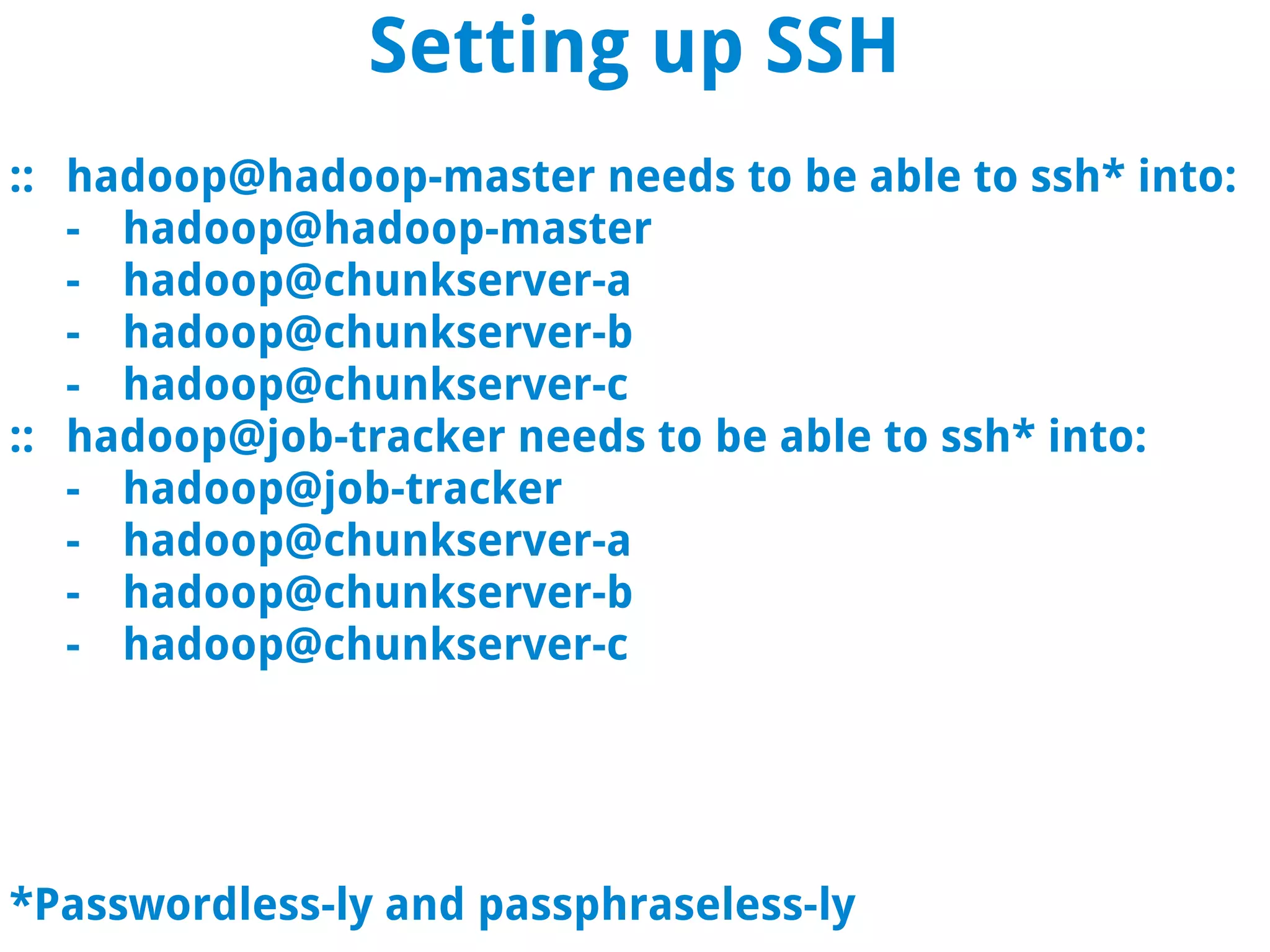
Setting up SSH
:: hadoop@hadoop-master needs to be able to ssh* into:
   - hadoop@hadoop-master
   - hadoop@chunkserver-a
   - hadoop@chunkserver-b
   - hadoop@chunkserver-c
:: hadoop@job-tracker needs to be able to ssh* into:
   - hadoop@job-tracker
   - hadoop@chunkserver-a
   - hadoop@chunkserver-b
   - hadoop@chunkserver-c


*Passwordless-ly and passphraseless-ly
Hands-on with Hadoop
Part 2:
    MapReduce
is machine learning
Rolling your own
self-hosted alternative to ...
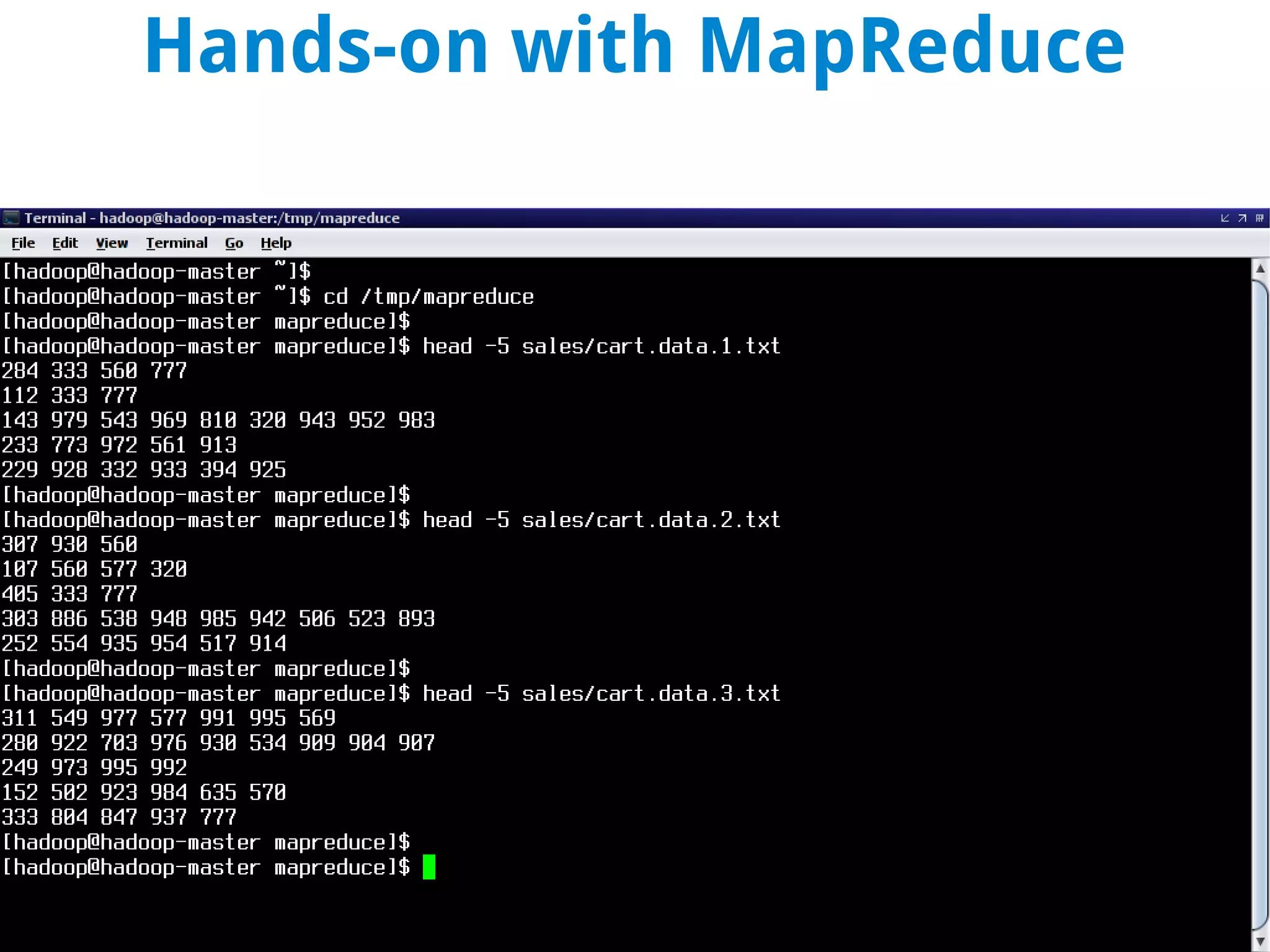
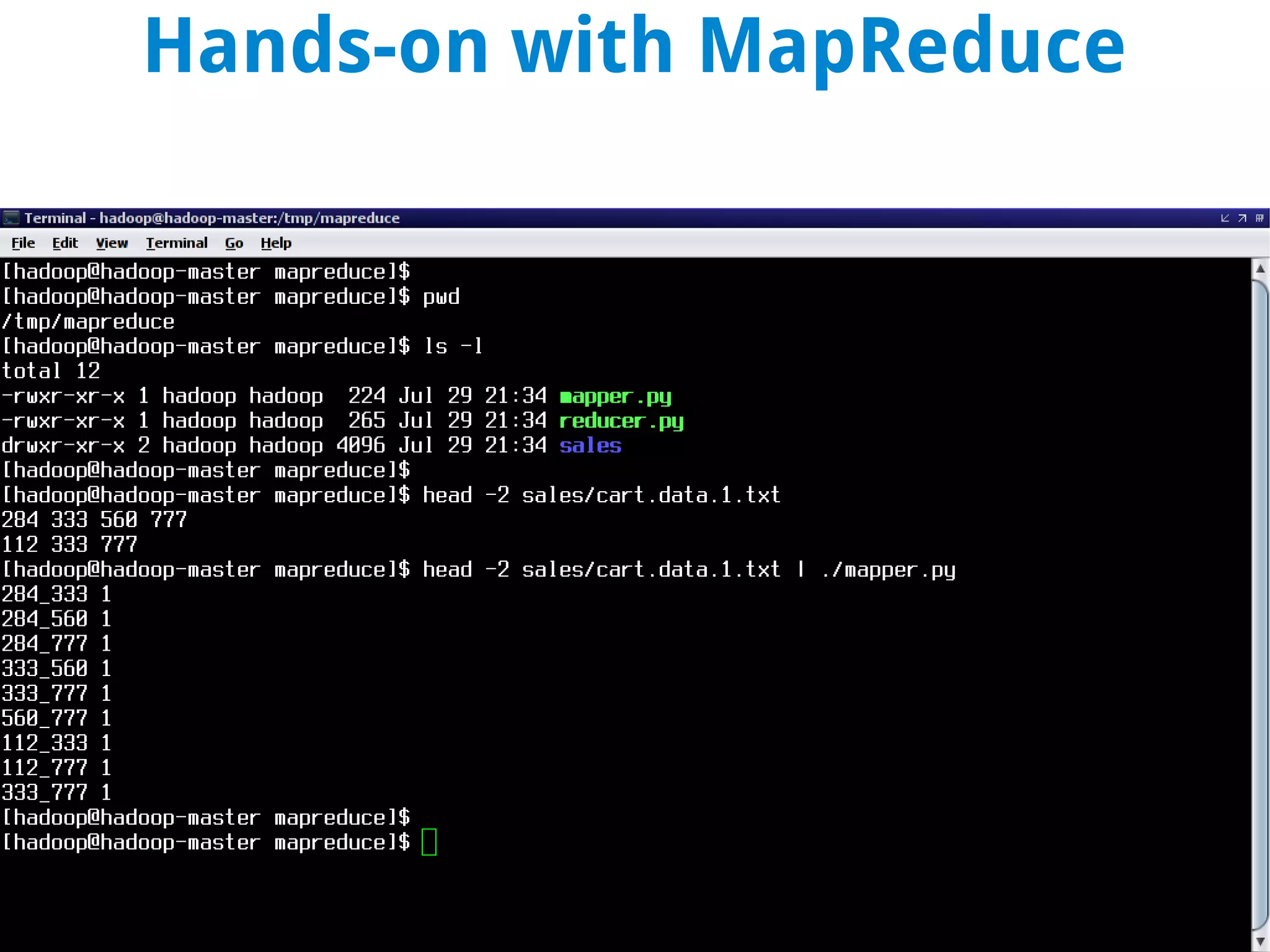
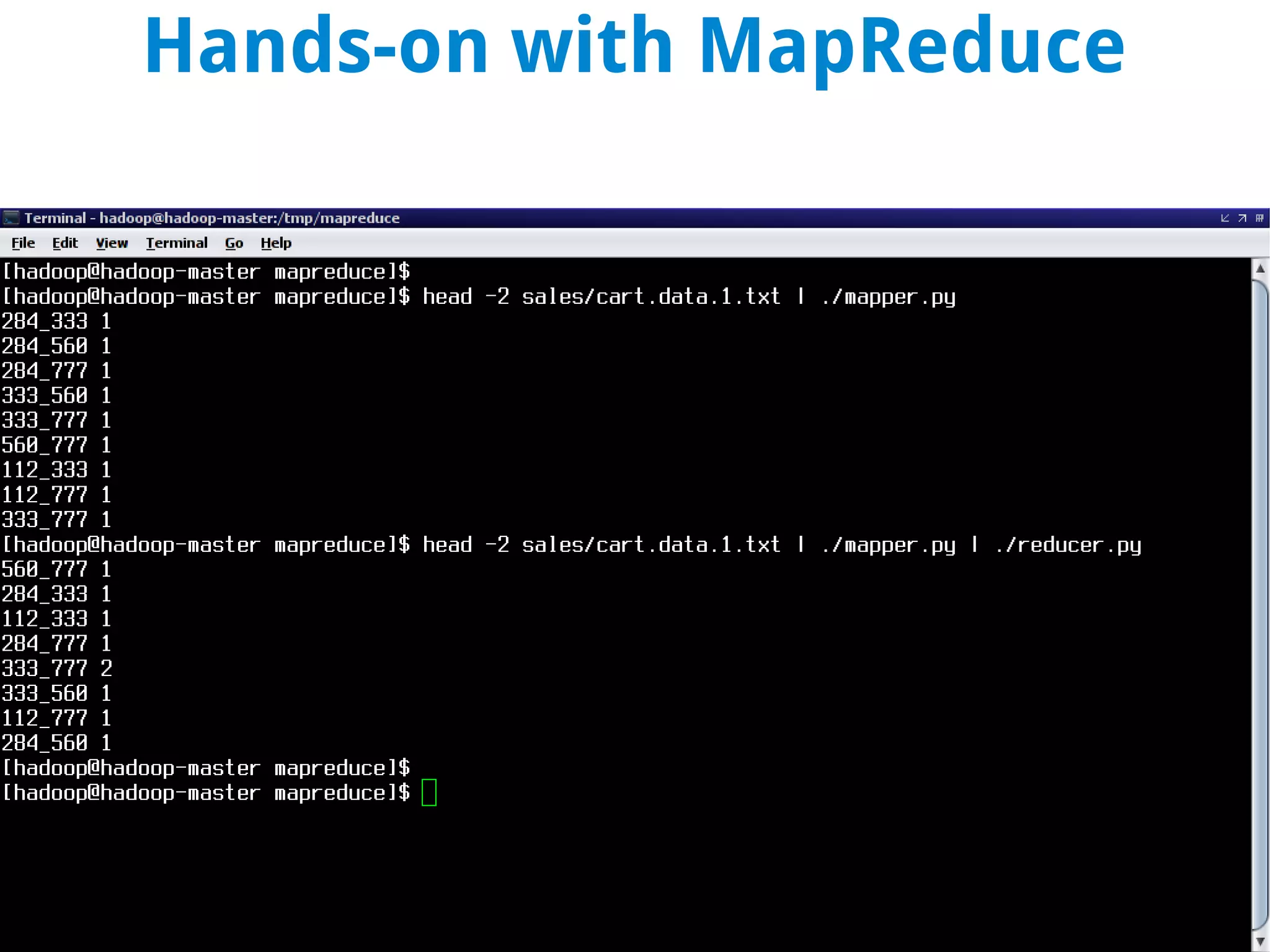
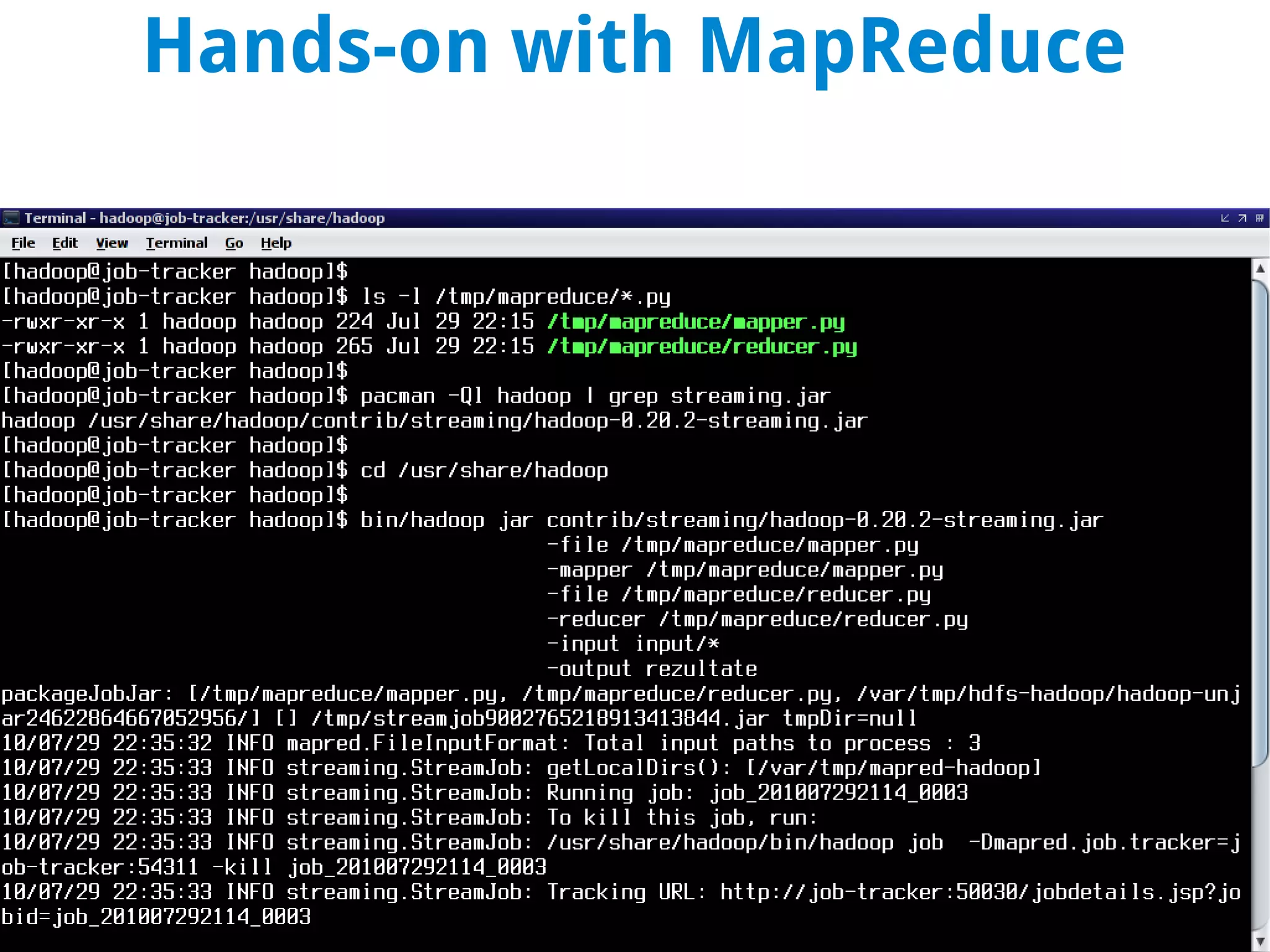
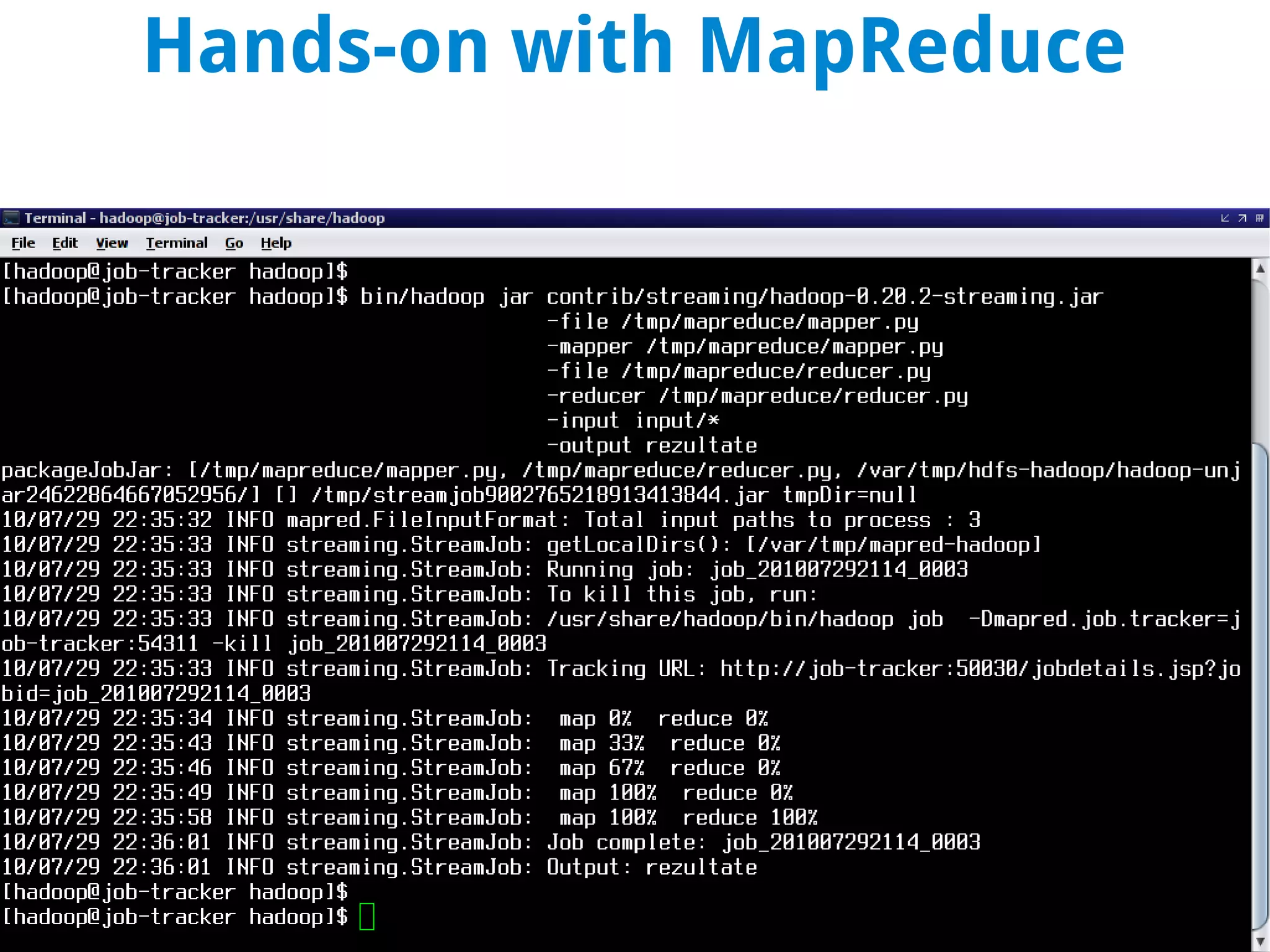
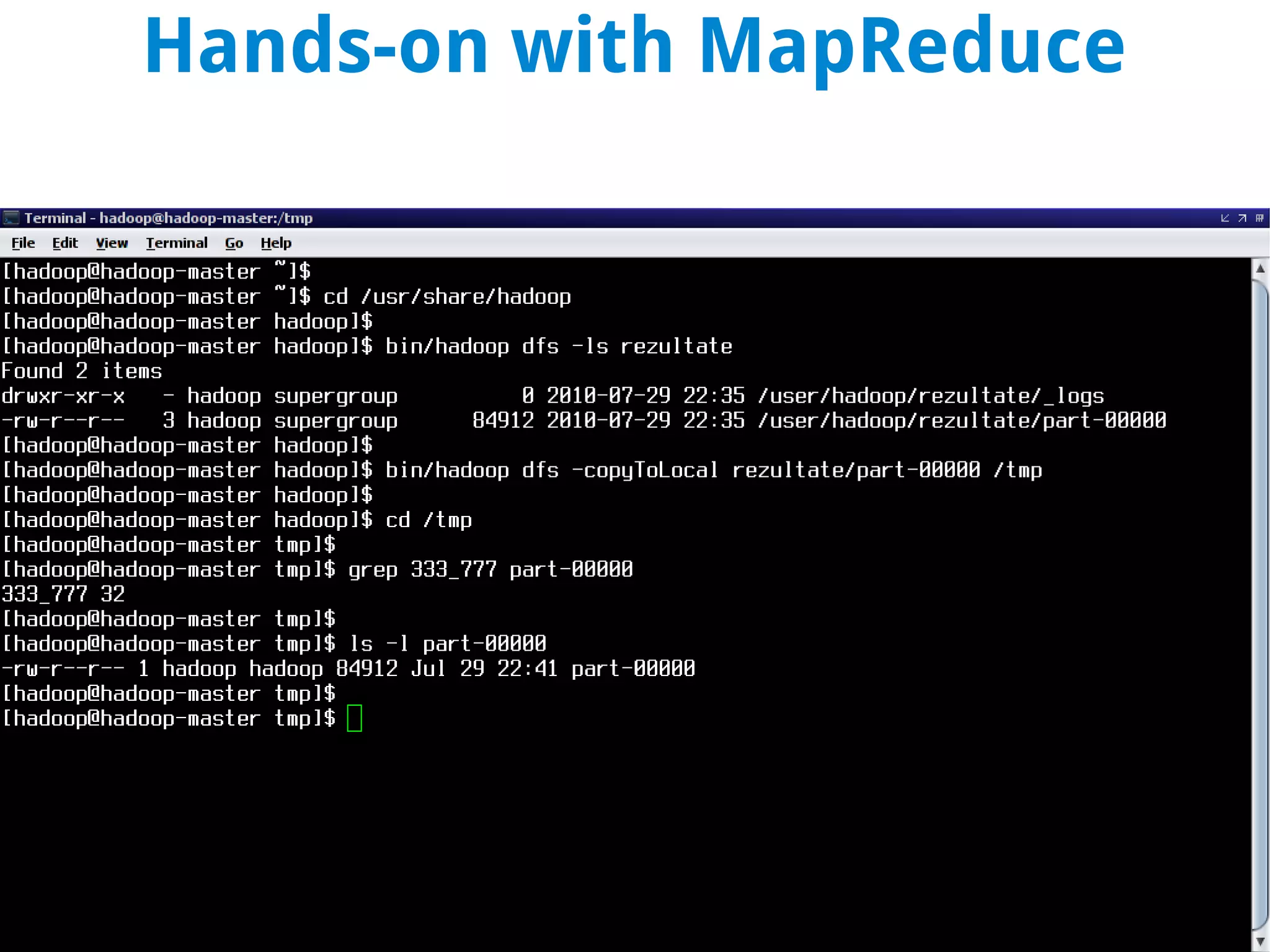
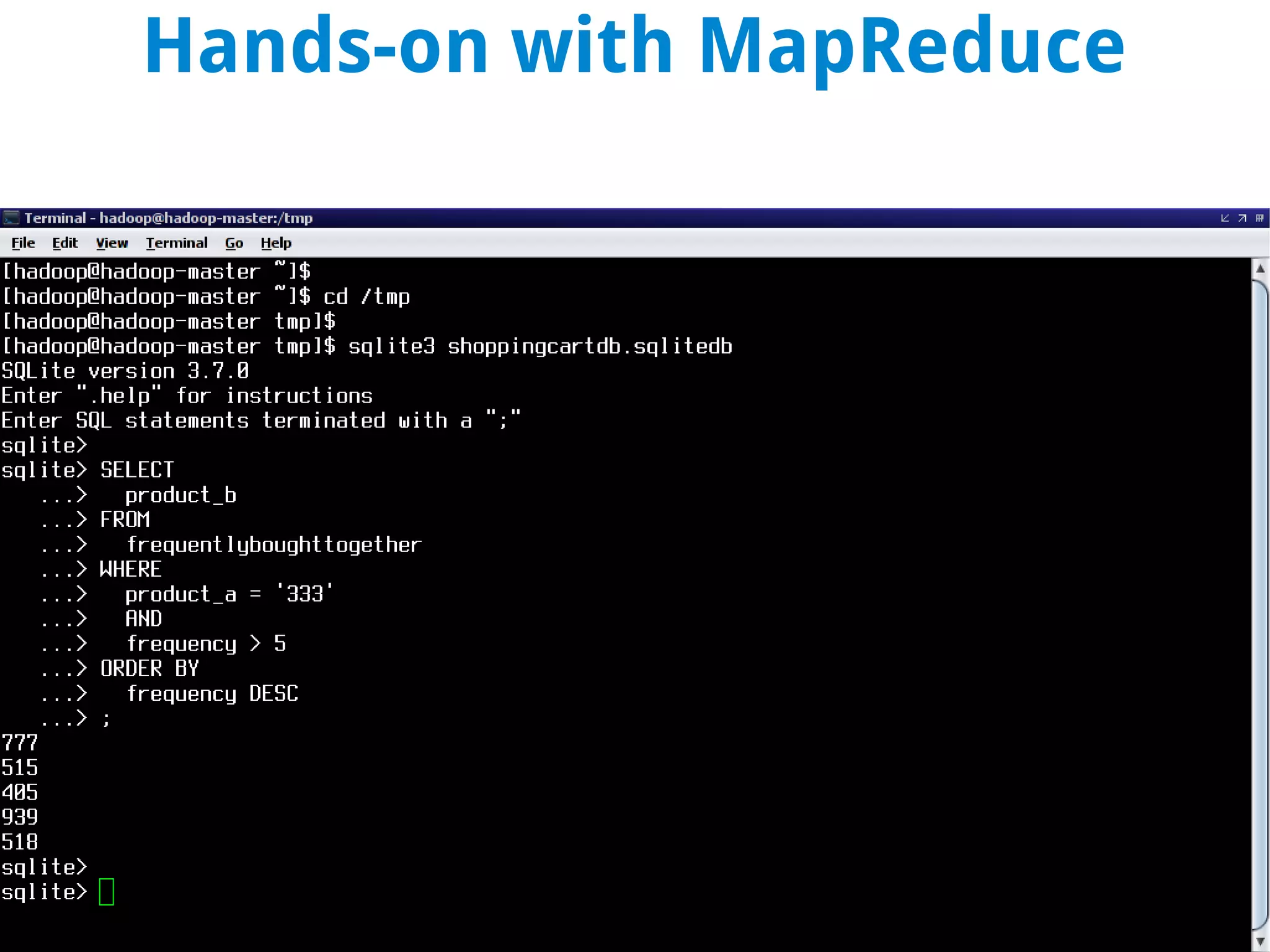
Hands-on with MapReduce
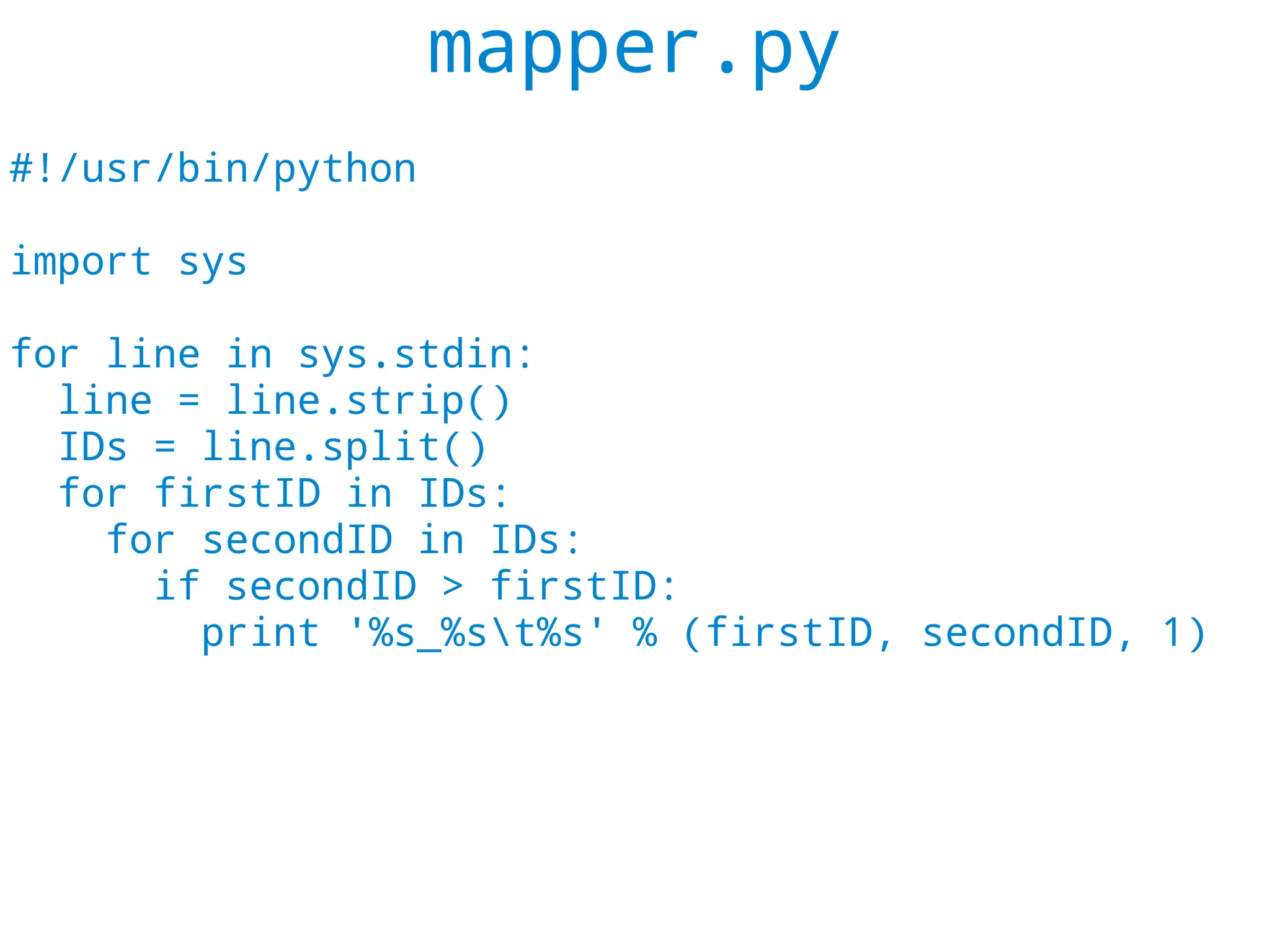
mapper.py
#!/usr/bin/python

import sys

for line in sys.stdin:
  line = line.strip()
  IDs = line.split()
  for firstID in IDs:
    for secondID in IDs:
      if secondID > firstID:
        print '%s_%st%s' % (firstID, secondID, 1)
reducer.py
#!/usr/bin/python

import sys

subTotals = {}
for line in sys.stdin:
  line = line.strip()
  word = line.split('t')[0]
  count = int(line.split('t')[1])
  subTotals[word] = subTotals.get(word, 0) + count
for k, v in subTotals.items():
  print "%st%s" % (k, v)
Hands-on with MapReduce
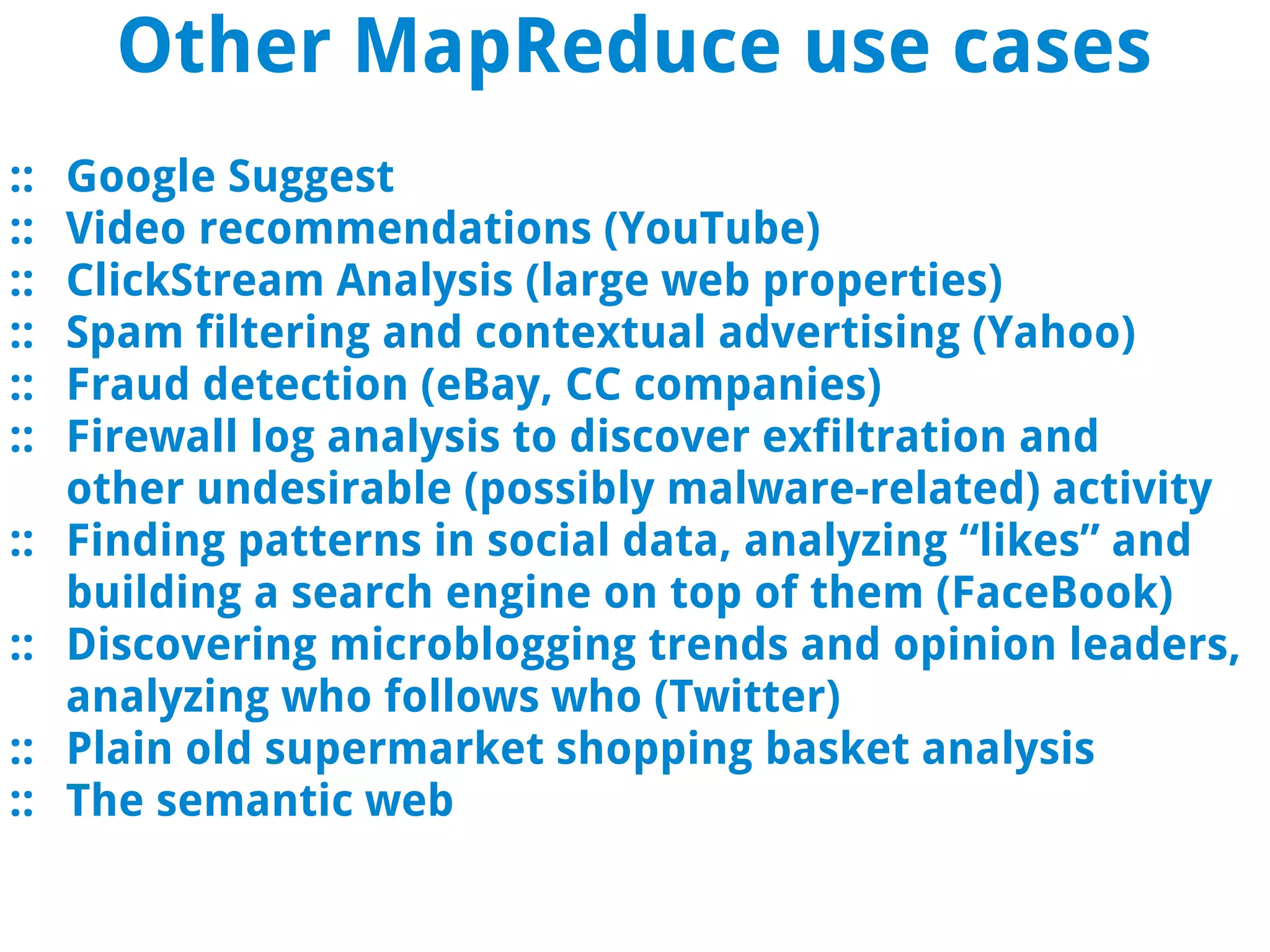
Other MapReduce use cases
::   Google Suggest
::   Video recommendations (YouTube)
::   ClickStream Analysis (large web properties)
::   Spam filtering and contextual advertising (Yahoo)
::   Fraud detection (eBay, CC companies)
::   Firewall log analysis to discover exfiltration and
     other undesirable (possibly malware-related) activity
::   Finding patterns in social data, analyzing “likes” and
     building a search engine on top of them (FaceBook)
::   Discovering microblogging trends and opinion leaders,
     analyzing who follows who (Twitter)
::   Plain old supermarket shopping basket analysis
::   The semantic web
Questions / Feedback
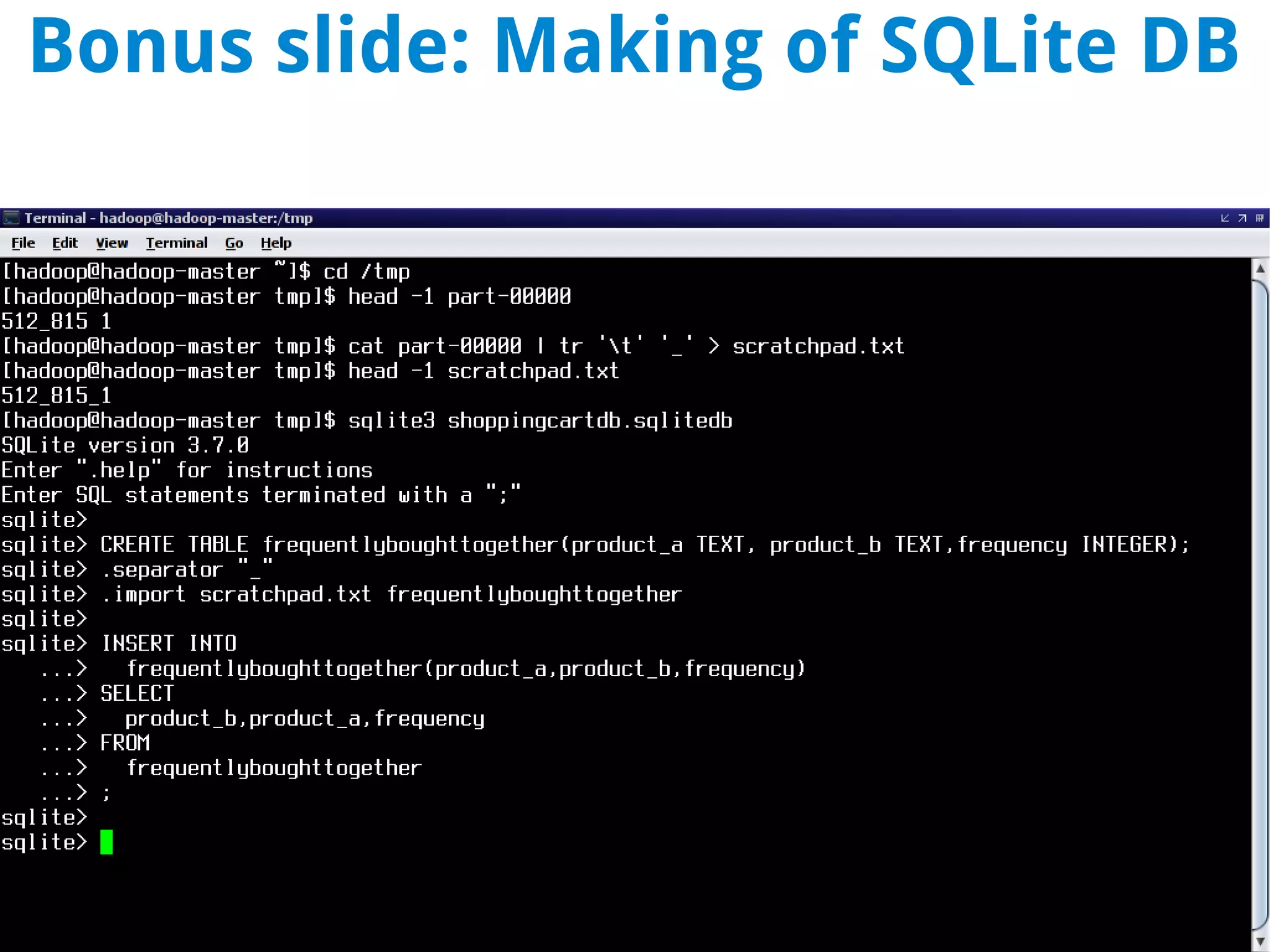
Bonus slide: Making of SQLite DB

Amazon-style shopping cart analysis using MapReduce on a Hadoop cluster