 BARASAT GOVT.
COLLEGE
 WEST BENGAL
STATE UNIVERSITY
 MSC. 2nd SEM
 Reg no.-002559 of
2013
 ROLL : Bgc/zool NO:
14105
 Year-2014
Introduced fish frequently alter the aquatic
ecology and now Invasive alien species
(IAS) are the second major cause of
extinctions of native and endemic species (
Wilcove et al. 1998).
 The black
markings on the
middle of the both
lateral sides are
called ‘Flowers’.
 And the hump on
the head formed by
the deposition of
fat is called ‘Horn’.
 So its name is
Flower-Horn.
 Common name: Flowerhorn fish
 Distribution :None, not a naturally occurring
species. Parent stock from South America
 Taxonomic position: none as it is not a natural
species.
 Size : Up to 12" (30cm)
 Life Span: 10-12 YEARS
 Strata : Bottom-middle
 PH:7.0 to 8.0
 Temperature:27°-32°C
 The most beautiful freshwater fish
 This fish has made a storm in the hobby
 the fish bring GOOD LUCK and
prosperity to the owner
according to feng-shui.
 A single specimen
flowerhorn has reached a
price of US$319,790.
GOLDEN MONKEY KAMFA GOLDEN BASE
TAN KING ELVIS STRAIN
MALE FEMALE
The similarity between the two fish is
remarkable and it illustrates how
flowerhorns could be mistaken for true
species cichlids.
Fig: Lateral view of an adult
flowerhorn cichlid taken from
Lake Matano on June
16, 2010.
 Local aquarium shops
draining directly to the
water bodies.
 Humpless , low
quality flowerhorns
are thrown into the
water bodies by many
owners and breeders.
Map of Lake Matano showing sites where flowerhorn cichlid were captured or
observed in 2010 and 2012, based on 134 sampling locations covering the
shoreline at 500 m intervals in 2010 and nine locations re-visited in 2012.
Maps by T. von Rintelen, modified (with permission).
 Stomach
contents (in
percent) of
15
flowerhorn
cichlid taken
from different
sites in Lake
Matano.
Values on
the x-axis
are standard
length (cm)
of each
individual
fish.
1.It is a notoriously aggressive fish.
2. carnivorous and predatory fish.
3. intelligent and interactive fish
4. they are extremely territorial and
reproduce by the thousands every year
5.HYPOXIC RESPONSE:hypoxia is one of
water pollutant problems. Can cope with
hypoxic condition.
Competition for Resources
Predation
Transfer Diseases and Parasites
Genetic Impacts
Fish Community Alteration
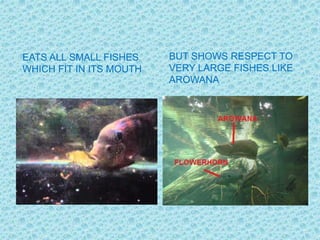
EATS ALL SMALL FISHES
WHICH FIT IN ITS MOUTH
BUT SHOWS RESPECT TO
VERY LARGE FISHES LIKE
AROWANA
 Figure: flowerhorn
cichlid feeding on
eggs of the endemic
goby Glossogobius
matanensis in Lake
Matano. The clutch
consisted of
numerous small,
yellowish eggs (yellow
arrow) deposited on a
rock in approx. 0.8 m
depth, guarded by the
male goby(black
arrow).
The IUCN guidelines on IAS specifically
emphasizes the following:
 - improving understanding and awareness;
 - strengthening the management response
(including prevention, eradication and
control);
 - providing appropriate legal and
institutional mechanisms;
 - enhancing knowledge and research
efforts (IUCN 2000).
 NEVER THROW
genetically redesigned
species INTO ANY
WATERSHED.
 STOP BUYING
HYBRIDS. when the
buying stops, the
production will too.
 Aquatic Invasions (2012) Volume 7, Issue 4: 521–535 doi:
http://dx.doi.org/10.3391/ai.2012.7.4.009 © 2012 The
Author(s). Journal compilation © 2012 REABIC
 Arnold W (2003) Singapore's 'lucky' pet Luohan can
outnumber people in homes. International Herald Tribune. July
1.
 "The Flowerhorn Fish - Fish Facts - Environmental Impacts” .
Library.thinkquest.org. Retrieved 2012-07-05.
 February 14, 2003 at 04:04pm (2003-02-14). "Killer fish
unleashed in Malaysia - IOL SciTech". IOL.co.za. Retrieved
2012-07-05.
 "Flowerhorns alias Nightmares, by Madhu Soodhanan".
Aquarticles.com. Retrieved 2012-07-05.
 Monster fish Arlina Arshad, The Straits Times, November 2,
2003
 Sincere thanks to Dr. Debajyoty Chakraborty, the
Head of the Dept. of Zoology, Barasat Govt. College
for providing infrastructure facilities.
 Thanks to Dr. Tuhin Saha, Dr. Madhumita Manna,
Dr. Debjani Sarkar, Dr. Sanjoy Poddar,Dr.Tanaya
Dey, Dr. Srikanta Guria, for providing
encouragements.
 Lastly, the co-operation received from the classmates
is also acknowledged.
Flowerhorn Fish and Its Ecological Impacts

Flowerhorn Fish and Its Ecological Impacts

  • 1.
     BARASAT GOVT. COLLEGE WEST BENGAL STATE UNIVERSITY  MSC. 2nd SEM  Reg no.-002559 of 2013  ROLL : Bgc/zool NO: 14105  Year-2014
  • 2.
    Introduced fish frequentlyalter the aquatic ecology and now Invasive alien species (IAS) are the second major cause of extinctions of native and endemic species ( Wilcove et al. 1998).
  • 4.
     The black markingson the middle of the both lateral sides are called ‘Flowers’.  And the hump on the head formed by the deposition of fat is called ‘Horn’.  So its name is Flower-Horn.
  • 6.
     Common name:Flowerhorn fish  Distribution :None, not a naturally occurring species. Parent stock from South America  Taxonomic position: none as it is not a natural species.  Size : Up to 12" (30cm)  Life Span: 10-12 YEARS  Strata : Bottom-middle  PH:7.0 to 8.0  Temperature:27°-32°C
  • 7.
     The mostbeautiful freshwater fish  This fish has made a storm in the hobby  the fish bring GOOD LUCK and prosperity to the owner according to feng-shui.  A single specimen flowerhorn has reached a price of US$319,790.
  • 8.
  • 9.
  • 10.
  • 12.
    The similarity betweenthe two fish is remarkable and it illustrates how flowerhorns could be mistaken for true species cichlids.
  • 14.
    Fig: Lateral viewof an adult flowerhorn cichlid taken from Lake Matano on June 16, 2010.  Local aquarium shops draining directly to the water bodies.  Humpless , low quality flowerhorns are thrown into the water bodies by many owners and breeders.
  • 15.
    Map of LakeMatano showing sites where flowerhorn cichlid were captured or observed in 2010 and 2012, based on 134 sampling locations covering the shoreline at 500 m intervals in 2010 and nine locations re-visited in 2012. Maps by T. von Rintelen, modified (with permission).
  • 16.
     Stomach contents (in percent)of 15 flowerhorn cichlid taken from different sites in Lake Matano. Values on the x-axis are standard length (cm) of each individual fish.
  • 17.
    1.It is anotoriously aggressive fish. 2. carnivorous and predatory fish. 3. intelligent and interactive fish 4. they are extremely territorial and reproduce by the thousands every year 5.HYPOXIC RESPONSE:hypoxia is one of water pollutant problems. Can cope with hypoxic condition.
  • 18.
    Competition for Resources Predation TransferDiseases and Parasites Genetic Impacts Fish Community Alteration
  • 21.
    EATS ALL SMALLFISHES WHICH FIT IN ITS MOUTH BUT SHOWS RESPECT TO VERY LARGE FISHES LIKE AROWANA
  • 24.
     Figure: flowerhorn cichlidfeeding on eggs of the endemic goby Glossogobius matanensis in Lake Matano. The clutch consisted of numerous small, yellowish eggs (yellow arrow) deposited on a rock in approx. 0.8 m depth, guarded by the male goby(black arrow).
  • 25.
    The IUCN guidelineson IAS specifically emphasizes the following:  - improving understanding and awareness;  - strengthening the management response (including prevention, eradication and control);  - providing appropriate legal and institutional mechanisms;  - enhancing knowledge and research efforts (IUCN 2000).
  • 26.
     NEVER THROW geneticallyredesigned species INTO ANY WATERSHED.  STOP BUYING HYBRIDS. when the buying stops, the production will too.
  • 27.
     Aquatic Invasions(2012) Volume 7, Issue 4: 521–535 doi: http://dx.doi.org/10.3391/ai.2012.7.4.009 © 2012 The Author(s). Journal compilation © 2012 REABIC  Arnold W (2003) Singapore's 'lucky' pet Luohan can outnumber people in homes. International Herald Tribune. July 1.  "The Flowerhorn Fish - Fish Facts - Environmental Impacts” . Library.thinkquest.org. Retrieved 2012-07-05.  February 14, 2003 at 04:04pm (2003-02-14). "Killer fish unleashed in Malaysia - IOL SciTech". IOL.co.za. Retrieved 2012-07-05.  "Flowerhorns alias Nightmares, by Madhu Soodhanan". Aquarticles.com. Retrieved 2012-07-05.  Monster fish Arlina Arshad, The Straits Times, November 2, 2003
  • 28.
     Sincere thanksto Dr. Debajyoty Chakraborty, the Head of the Dept. of Zoology, Barasat Govt. College for providing infrastructure facilities.  Thanks to Dr. Tuhin Saha, Dr. Madhumita Manna, Dr. Debjani Sarkar, Dr. Sanjoy Poddar,Dr.Tanaya Dey, Dr. Srikanta Guria, for providing encouragements.  Lastly, the co-operation received from the classmates is also acknowledged.