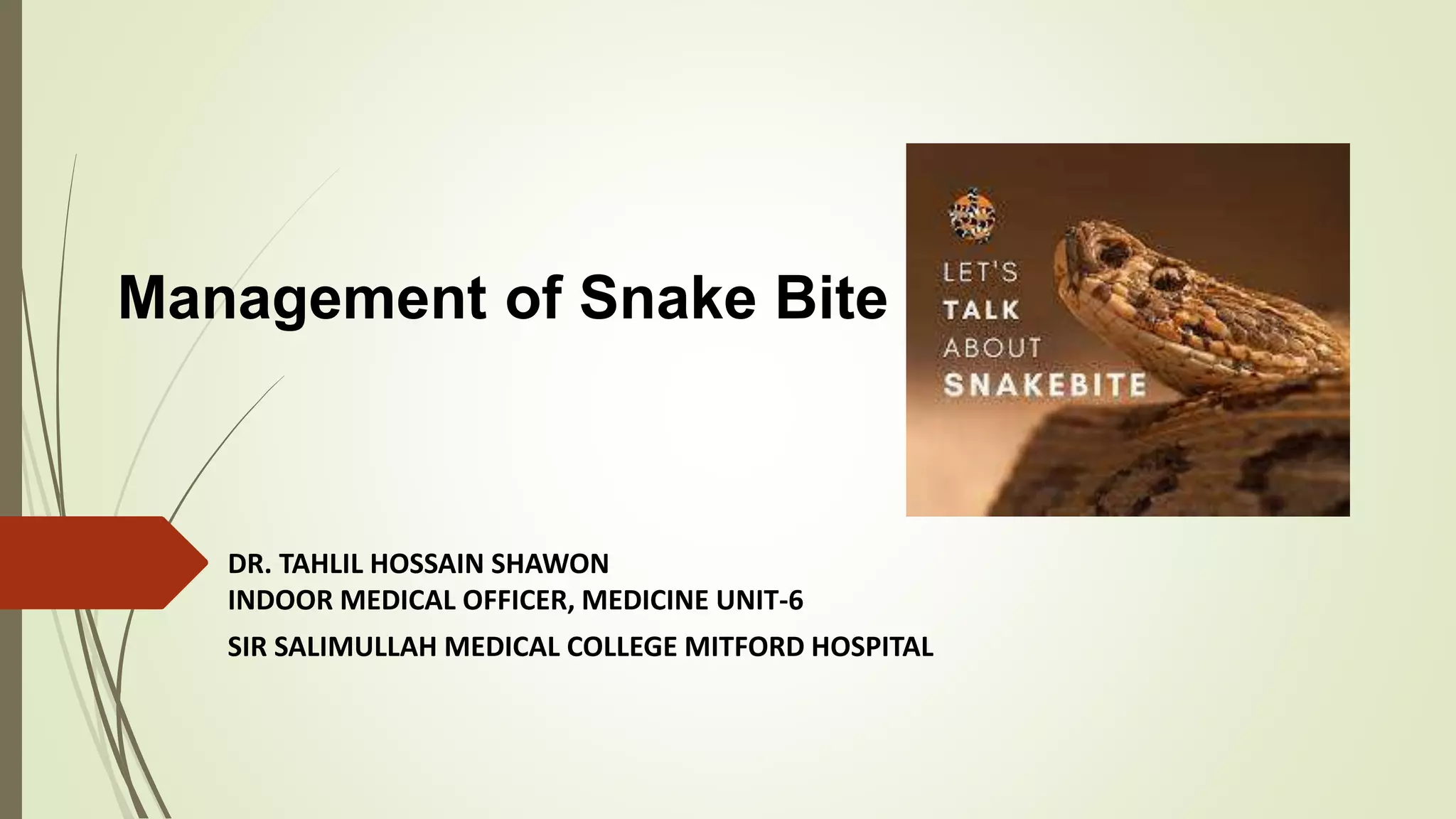
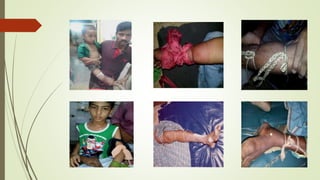
Management of Snake Bite
DR. TAHLIL HOSSAIN SHAWON
INDOOR MEDICAL OFFICER, MEDICINE UNIT-6
SIR SALIMULLAH MEDICAL COLLEGE MITFORD HOSPITAL
6,041
What is the annual
mortality from snake
bite in Bangladesh?
623/100,000
What is the annual
incidence of Snake
bite in Bangladesh?
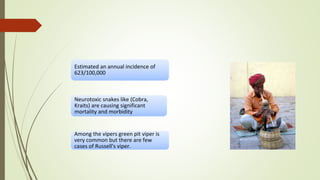
Estimated an annual incidence of
623/100,000
Neurotoxic snakes like (Cobra,
Kraits) are causing significant
mortality and morbidity
Among the vipers green pit viper is
very common but there are few
cases of Russell's viper.
Let’s introduce with the snakes
Poisonous snake belongs to 3 families on
the basis of poison secrated:
Elapidae : Neurotoxic
Viperidae: Hemotoxic
Hydrophidae: Myotoxic
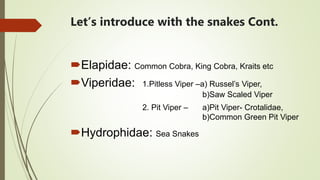
Elapidae: Common Cobra, King Cobra, Kraits etc
Viperidae: 1.Pitless Viper –a) Russel’s Viper,
b)Saw Scaled Viper
2. Pit Viper – a)Pit Viper- Crotalidae,
b)Common Green Pit Viper
Hydrophidae: Sea Snakes
Let’s introduce with the snakes Cont.
Common Poisonous Snakes in
Bangladesh
Cobra
Viper
Krait
Green Snake
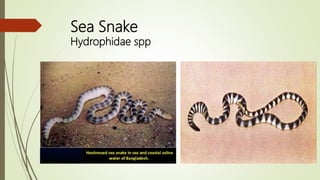
Sea Snake
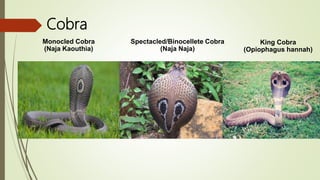
Cobra
Monocled Cobra
(Naja Kaouthia)
Spectacled/Binocellete Cobra
(Naja Naja)
King Cobra
(Opiophagus hannah)
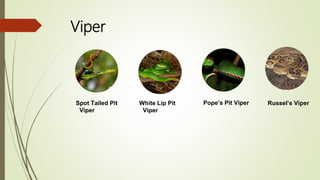
Viper
Spot Tailed Pit
Viper
White Lip Pit
Viper
Pope’s Pit Viper Russel’s Viper
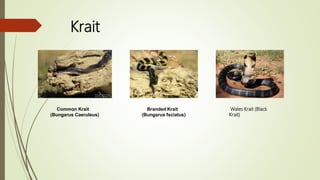
Krait
Common Krait
(Bungarus Caeruleus)
Branded Krait
(Bungarus fsciatus)
Wales Krait (Black
Krait)
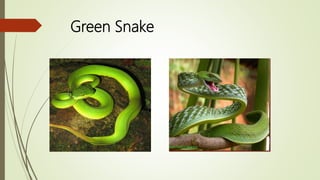
Green Snake
Sea Snake
Hydrophidae spp
What is venomous
snake bite?
 When a snake bites, it may excrete venom but this is dependent on
the type of snakes – venomous or nonvenomous
 Snake venom is a varied form of saliva and excreted through
modified parotid salivary gland located each side of skull, behind the
eye, produced through a pumping mechanism of sac that store
venom.
 Snake Venom is a toxin with combination of proteins and enzymes.
Venoms have 25 different enzymes found in various venoms and 10
of these occurs frequently in most venoms. Most common type of
enzymes are proteolytic enzymes which digests protein,
phospholipases which degrade lipids and hyaluronidases which
facilitates venom spread.
Snake Bite and Snake Venom
 A venomous snake may not and do not always features of
envenoming.
 50% of bites by Russell’s viper, 30% of bite by cobras and 5-
10% of bites by saw scaled viper do not result in any
symptoms or signs of envenoming.
 A victim may develop some features due to anxiety or
apprehension in case of bite by a venomous as well as NV
snake.
 Neurotoxic envenoming by Kraits and Cobra are the
principal Cause of Snake bite mortality in our country.
Snake Bite and Snake Venom cont.
History taking
Site of bite, circumstances of bite, time of bite how did
it happen?
Site
Face and limbs- Green pit
Limbs- Cobra
Any site- Krait
Forearm- Sea snake
Time:
Night time bite especially in Krait bite
Non specific symptoms: Headache, Nausea, vomiting,
abdominal pain, loss of consciousness, difficulty in
vision, convulsions
 Neurological symptoms: Muscle paralysis, difficulty in moving
jaw, tongue, eye, heaviness of eye lids (ptosis), weakness of
neck muscles (broken neck sign), difficulty in swallowing,
dribbling of saliva, nasal regurgitation, nasal voice, difficulty in
respiration, extreme generalized weakness
 Hematological symptoms: Spontaneous bleeding from gum,
vomiting out of blood, Coughing out of blood, passage of
blood per urethra, persistent bleeding from bite site,
venipuncture site and inflicted wound if any.
History taking Cont.
 Others: Severe muscle pain, dark urine, scanty micturition,
collapse.
 Concomitant Medical Illness: H/O allergy, Bronchial asthma, kidney
disease, heart disease, bleeding disorders, neurological disease,
limb swelling. In Female: Whether the victim is pregnant or not,
whether the victim menstruating or not.
 H/O pre hospital treatment: Home treatment, Treatment from
traditional healers (Ozha or Baiddya), Application of tourniquet, H/O
immunization against tetanus, Treatment by initial attending
physician.
History taking Cont.
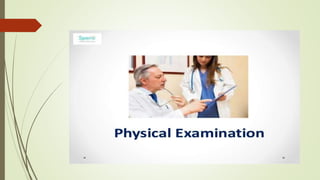
1.Rapid clinical assessment especially vitals: Pulse, BP,
Respiration, Temp
2.Systemic signs of envenoming: Chronology of onset and
progression of signs.
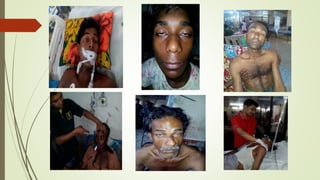
A. Neurotoxic sign:
• Ptosis(Partial or complete) usually symmetrical and
progressive
• Diplopia, external ophthalmoplegia
• Bulbar palsy
• Nasal voice
• Facial paralysis
• Inability to open the mouth and to protrude the tongue
• Paralysis of chest muscle and diaphragm (Shallow breathing)
• Broken neck sign, Weak grip, diminished reflexes
B. Signs of haematological abnormality:
• Persistent bleeding from bite site, venipuncture site and
or inflicted wound if any
• Multiple bruise or large blood collection
• Haemorrhagic blisters
• Bleeding from gingival sulci
• Haemoptysis
• Haematuria
• Epistaxis
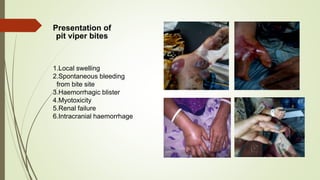
Presentation of
pit viper bites
1.Local swelling
2.Spontaneous bleeding
from bite site
3.Haemorrhagic blister
4.Myotoxicity
5.Renal failure
6.Intracranial haemorrhage
C. Signs of Renal failure:
Scanty or no micturition, dark urine
Clinical uremic syndrome, Nausea, vomiting, hiccups,
fetor, drowsiness, coma, flapping tremor, muscle
twitching, convulsion, pericardial friction rub, signs of
fluid over load
D. Signs of myotoxicity:
Muscle tenderness, weakness, respiratory failure,
black urine, renal failure
E. Signs of local envenoming:
Swelling, tenderness, bleeding, ulceration, necrosis,
local lymph node enlargement
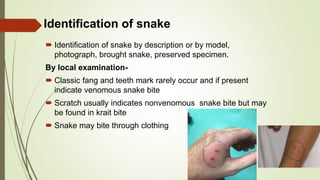
 Identification of snake by description or by model,
photograph, brought snake, preserved specimen.
By local examination-
 Classic fang and teeth mark rarely occur and if present
indicate venomous snake bite
 Scratch usually indicates nonvenomous snake bite but may
be found in krait bite
 Snake may bite through clothing
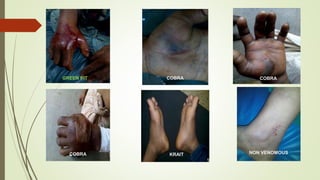
Identification of snake
GREEN PIT COBRA COBRA
COBRA KRAIT NON VENOMOUS
Syndromic approach
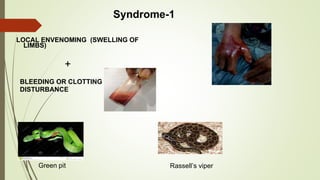
Syndrome-1
LOCAL ENVENOMING (SWELLING OF
LIMBS)
+
BLEEDING OR CLOTTING
DISTURBANCE
Green pit Rassell’s viper
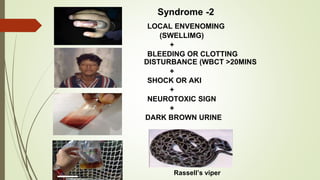
Syndrome -2
LOCAL ENVENOMING
(SWELLIMG)
+
BLEEDING OR CLOTTING
DISTURBANCE (WBCT >20MINS
+
SHOCK OR AKI
+
NEUROTOXIC SIGN
+
DARK BROWN URINE
Rassell’s viper
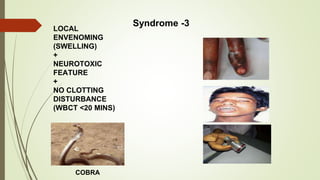
LOCAL
ENVENOMING
(SWELLING)
+
NEUROTOXIC
FEATURE
+
NO CLOTTING
DISTURBANCE
(WBCT <20 MINS)
Syndrome -3
COBRA
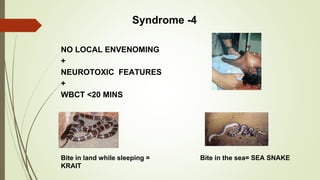
Syndrome -4
NO LOCAL ENVENOMING
+
NEUROTOXIC FEATURES
+
WBCT <20 MINS
Bite in land while sleeping =
KRAIT
Bite in the sea= SEA SNAKE
Syndrome-5
PARALYSIS
+
DARK BROWN URINE
+
NO LOCAL SWELLING
+
WBCT <20 MINS
+
SEVERE MUSCLE PAIN
Bite in the sea=
SEA SNAKE
Bite in the land=
BRANDED KRAIT
Local swelling and tissue damage:
• First sign of envenoming
• Exceptions kraits sometimes in cobras
• Blister necrosis
• Systemic features.
KEEP IT IN MIND: Identification of snake from fang mark is
impossible.
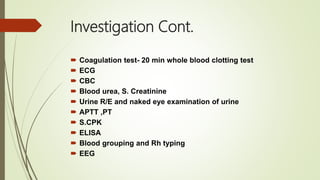
Laboratory Investigations
Investigation Cont.
 Coagulation test- 20 min whole blood clotting test
 ECG
 CBC
 Blood urea, S. Creatinine
 Urine R/E and naked eye examination of urine
 APTT ,PT
 S.CPK
 ELISA
 Blood grouping and Rh typing
 EEG
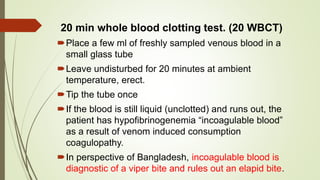
20 min whole blood clotting test. (20 WBCT)
Place a few ml of freshly sampled venous blood in a
small glass tube
Leave undisturbed for 20 minutes at ambient
temperature, erect.
Tip the tube once
If the blood is still liquid (unclotted) and runs out, the
patient has hypofibrinogenemia “incoagulable blood”
as a result of venom induced consumption
coagulopathy.
In perspective of Bangladesh, incoagulable blood is
diagnostic of a viper bite and rules out an elapid bite.
The Management of Snake Bites
Recommended First Aid
Reassurance
 Immobilization
Lower limb- DO NOT WALK
 Upper limb- DO NOT MOVE The Limb
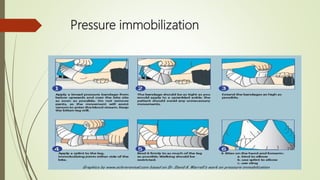
 Pressure Immobilization should not be used for
Viper Bites.
Quick transfer to a hospital UHC/District Hospital/
Medical College Hospital where anti venom is
available.
Pressure immobilization
Please Keep in Mind
 DO NOT WASTE TIME TO ANY OZHA OR TRADITIONAL
HEALERS as it is not scientific. Waste of time. May cause
infection, bleeding, gangrene. May damage to artery and
vein. May cause loss of life and above all always harmful.
 HARMFUL- NOT RECOMMENDED ACTS ARE Tight
tourniquets, Incision at the bite site, Local suction,
Cauterization by chemicals,Application of materials, Ingestion
of herbal products to induce vomiting, Unnecessary delaying
Treatment in hospital
 Rapid clinical assessment and resuscitation (ABC)
 Detailed clinical assessment
(Local, Neurological, Haematological)
 Identification of species
(Brought snake live, dead or description, photograph
20 min WBCT, Syndromic approach)
Treatment in hospital Cont.
Treatment:
A. Antibiotic
B. Tetanus prophylaxis
C. Antivenom
D. NBM
Polyvalent Antivenom:
In our country now only Polyvalent antivenom from VINS
(INDIA) is available in lyophilized powder form. Each vial
contain 10 mg of antivenom, which is effective against
systemic envenoming by Cobra, Krait, Russell's Viper
and Saw scaled viper only (there is no evidence of Saw
scaled viper in Bangladesh). So, this type of antivenom
should not be used in bites by Green snake, Sea snakes
and identified non-venomous snake.
Adult and children should receive same dose of AV. Before initiating
AV, prophylactic subcutaneous adrenaline (dose - adult 0.25 ml of
0.1% solution and in children 0.005 mg/kg) should be given to the
victim (T).
Adrenaline is available in market as 0.1% (1 in 1000) solution, 1
ampoule containing 1 ml. Draw adrenaline in an Insulin syringe (100
unit) up to mark 25 (for adult). Then administer this Subcutaneously
(in case of premedication).
In case of treatment of Anaphylaxis, draw 0.5 ml of Adrenaline (for
adult) in a 3 ml syringe and administer intramuscularly.
Antivenom treatment
Indication /criteria for using antivenom:
(Not indicated in Green snake and sea snake)
 Neurotoxic signs.
 Rapid extension of swelling (more than half of the bitten limb).
N.B- not due to green snake bite or tight tourniquet.
 AKI (not due to sea snake).
 Cardiovascular abnormalities
 Bleeding abnormalities.
 Haemoglobinuria/myoglobinuria not due to sea snake
( Best outcome if given within 4 hours of bite
but effective up to 24 hours)
Antivenom treatment Cont.
 Dose:
Each dose consists of 10 vial of polyvalent antivenom
irrespective of age and sex of the victim.
 Time and administration:
Each vial is diluted with 10 ml. of distilled water. 10 such vials
(100 ml) is further diluted or mixed with 100 ml of fluid
(Dextrose water or saline). Then it is administered with
intravenous infusion within 40-60 min (2ml/min).
 Observation and monitoring:
Continuous observation and frequent monitoring of vital signs
should be ensured during antivenom therapy and few hours
after its completion. Careful clinical assessment for appearance
of signs and symptoms of antivenom (A/V) reaction should be
performed.
Antivenom treatment Cont.
Criteria for repeating the initial dose of antivenom:
Persisting or deteriorating signs of systemic antivenom.eg.
 If no improvement or deterioration of neurotoxic features
(cobra or krait) 1-2 hours completion of antivenom.
 Persistence or recurrence of blood incoagulopathy after 6
hours of antivenom treatment.
Antivenom reaction
Three types of reaction occurs
 Early anaphylaxis
 Pyrogenic reaction
 Late reaction (serum sickness type)
Antivenom reaction Cont.
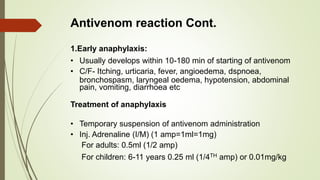
1.Early anaphylaxis:
• Usually develops within 10-180 min of starting of antivenom
• C/F- Itching, urticaria, fever, angioedema, dspnoea,
bronchospasm, laryngeal oedema, hypotension, abdominal
pain, vomiting, diarrhoea etc
Treatment of anaphylaxis
• Temporary suspension of antivenom administration
• Inj. Adrenaline (I/M) (1 amp=1ml=1mg)
For adults: 0.5ml (1/2 amp)
For children: 6-11 years 0.25 ml (1/4TH amp) or 0.01mg/kg
Antivenom reaction Cont.
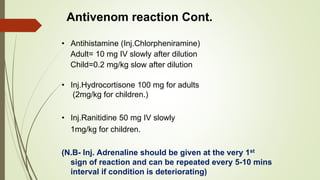
• Antihistamine (Inj.Chlorpheniramine)
Adult= 10 mg IV slowly after dilution
Child=0.2 mg/kg slow after dilution
• Inj.Hydrocortisone 100 mg for adults
(2mg/kg for children.)
• Inj.Ranitidine 50 mg IV slowly
1mg/kg for children.
(N.B- Inj. Adrenaline should be given at the very 1st
sign of reaction and can be repeated every 5-10 mins
interval if condition is deteriorating)
Antivenom reaction Cont.
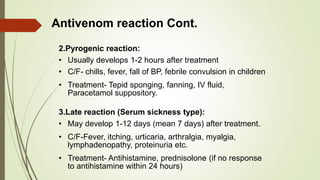
2.Pyrogenic reaction:
• Usually develops 1-2 hours after treatment
• C/F- chills, fever, fall of BP, febrile convulsion in children
• Treatment- Tepid sponging, fanning, IV fluid,
Paracetamol suppository.
3.Late reaction (Serum sickness type):
• May develop 1-12 days (mean 7 days) after treatment.
• C/F-Fever, itching, urticaria, arthralgia, myalgia,
lymphadenopathy, proteinuria etc.
• Treatment- Antihistamine, prednisolone (if no response
to antihistamine within 24 hours)
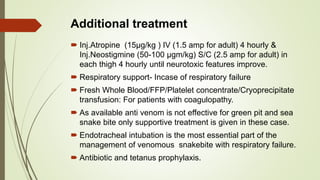
Additional treatment
 Inj.Atropine (15µg/kg ) IV (1.5 amp for adult) 4 hourly &
Inj.Neostigmine (50-100 µgm/kg) S/C (2.5 amp for adult) in
each thigh 4 hourly until neurotoxic features improve.
 Respiratory support- Incase of respiratory failure
 Fresh Whole Blood/FFP/Platelet concentrate/Cryoprecipitate
transfusion: For patients with coagulopathy.
 As available anti venom is not effective for green pit and sea
snake bite only supportive treatment is given in these case.
 Endotracheal intubation is the most essential part of the
management of venomous snakebite with respiratory failure.
 Antibiotic and tetanus prophylaxis.
Drugs not recommended
 Antihistamine except for antivenom reaction
 Corticosteroid except antivenom reaction
 Sedative
 Antifibrinolytic agent
 Heparin
 Traditional medicines (from ozahs)
Treatment of bitten part
 Elevation of limb with rest.
 Simple washing with antiseptic solution
 Broad spectrum antibiotic (When there is features of
contamination, multiple incisions)
 In case of local necrosis and gangrene:
Broad spectrum antibiotic
Surgical debridement and split thickness skin grafting is
indicated.
Follow up:
Local envenomation: The snake bite cases with Local
envenomation (commonly in cobra cases) need to follow up for at
least 5- 7 days to see the sequential changes of color changes,
blisters, ulceration, necrosis and desquamation. In viper bites, the
haemorrhagic manifestation should also follow up to see complete
recovery. A comprehensive approach with advice from surgeons
are important in this regard
Children : The neurotoxic snake bite cases should be followed up
to observe any neurological residual deficit present or not with also
attention to neurocognitive function.
Pregnancy: The pregnancy outcome after a venomous bite with
long term follow up of children is also needed to see the
neurological cognitive function
Rehabilitation
Physiotherapy
Reconstructive surgery
What should we do when no antivenom
is available?
Incase of neurotoxity:
• Assisted ventilation via ambu bag or mechanical ventilation
• Inj.Atropine and Neostigmine:
In case of Haematological abnormality:
• Strict bed rest to avoid even minor trauma
• I/M injection must be avoided
• Fresh whole blood or FFP transfusion should be given
Take Home Massage
 Don’t waste time to traditional healers.
 All cases of snake bite should be referred to hospital.
 Identification of snake is integral part of treatment.
 Pressure immobilization is important but should not be
applied in case of viper bite.
 Available anti venom is not effective in case of green pit
viper and sea snake bite.
 Prophylactic S/C Adrenaline should always be given
before starting anti venom.
 Supportive treatments are also important.
 Follow up is required in all case of snake bite.
THANK YOU

Snake Bite Management Bangladesh.pptx

  • 1.
    Management of SnakeBite DR. TAHLIL HOSSAIN SHAWON INDOOR MEDICAL OFFICER, MEDICINE UNIT-6 SIR SALIMULLAH MEDICAL COLLEGE MITFORD HOSPITAL
  • 3.
    6,041 What is theannual mortality from snake bite in Bangladesh?
  • 4.
    623/100,000 What is theannual incidence of Snake bite in Bangladesh?
  • 5.
    Estimated an annualincidence of 623/100,000 Neurotoxic snakes like (Cobra, Kraits) are causing significant mortality and morbidity Among the vipers green pit viper is very common but there are few cases of Russell's viper.
  • 6.
    Let’s introduce withthe snakes Poisonous snake belongs to 3 families on the basis of poison secrated: Elapidae : Neurotoxic Viperidae: Hemotoxic Hydrophidae: Myotoxic
  • 7.
    Elapidae: Common Cobra,King Cobra, Kraits etc Viperidae: 1.Pitless Viper –a) Russel’s Viper, b)Saw Scaled Viper 2. Pit Viper – a)Pit Viper- Crotalidae, b)Common Green Pit Viper Hydrophidae: Sea Snakes Let’s introduce with the snakes Cont.
  • 9.
    Common Poisonous Snakesin Bangladesh Cobra Viper Krait Green Snake Sea Snake
  • 10.
    Cobra Monocled Cobra (Naja Kaouthia) Spectacled/BinocelleteCobra (Naja Naja) King Cobra (Opiophagus hannah)
  • 11.
    Viper Spot Tailed Pit Viper WhiteLip Pit Viper Pope’s Pit Viper Russel’s Viper
  • 12.
    Krait Common Krait (Bungarus Caeruleus) BrandedKrait (Bungarus fsciatus) Wales Krait (Black Krait)
  • 13.
  • 14.
  • 15.
  • 16.
     When asnake bites, it may excrete venom but this is dependent on the type of snakes – venomous or nonvenomous  Snake venom is a varied form of saliva and excreted through modified parotid salivary gland located each side of skull, behind the eye, produced through a pumping mechanism of sac that store venom.  Snake Venom is a toxin with combination of proteins and enzymes. Venoms have 25 different enzymes found in various venoms and 10 of these occurs frequently in most venoms. Most common type of enzymes are proteolytic enzymes which digests protein, phospholipases which degrade lipids and hyaluronidases which facilitates venom spread. Snake Bite and Snake Venom
  • 17.
     A venomoussnake may not and do not always features of envenoming.  50% of bites by Russell’s viper, 30% of bite by cobras and 5- 10% of bites by saw scaled viper do not result in any symptoms or signs of envenoming.  A victim may develop some features due to anxiety or apprehension in case of bite by a venomous as well as NV snake.  Neurotoxic envenoming by Kraits and Cobra are the principal Cause of Snake bite mortality in our country. Snake Bite and Snake Venom cont.
  • 18.
    History taking Site ofbite, circumstances of bite, time of bite how did it happen? Site Face and limbs- Green pit Limbs- Cobra Any site- Krait Forearm- Sea snake Time: Night time bite especially in Krait bite Non specific symptoms: Headache, Nausea, vomiting, abdominal pain, loss of consciousness, difficulty in vision, convulsions
  • 19.
     Neurological symptoms:Muscle paralysis, difficulty in moving jaw, tongue, eye, heaviness of eye lids (ptosis), weakness of neck muscles (broken neck sign), difficulty in swallowing, dribbling of saliva, nasal regurgitation, nasal voice, difficulty in respiration, extreme generalized weakness  Hematological symptoms: Spontaneous bleeding from gum, vomiting out of blood, Coughing out of blood, passage of blood per urethra, persistent bleeding from bite site, venipuncture site and inflicted wound if any. History taking Cont.
  • 20.
     Others: Severemuscle pain, dark urine, scanty micturition, collapse.  Concomitant Medical Illness: H/O allergy, Bronchial asthma, kidney disease, heart disease, bleeding disorders, neurological disease, limb swelling. In Female: Whether the victim is pregnant or not, whether the victim menstruating or not.  H/O pre hospital treatment: Home treatment, Treatment from traditional healers (Ozha or Baiddya), Application of tourniquet, H/O immunization against tetanus, Treatment by initial attending physician. History taking Cont.
  • 22.
    1.Rapid clinical assessmentespecially vitals: Pulse, BP, Respiration, Temp 2.Systemic signs of envenoming: Chronology of onset and progression of signs. A. Neurotoxic sign: • Ptosis(Partial or complete) usually symmetrical and progressive • Diplopia, external ophthalmoplegia • Bulbar palsy • Nasal voice • Facial paralysis • Inability to open the mouth and to protrude the tongue • Paralysis of chest muscle and diaphragm (Shallow breathing) • Broken neck sign, Weak grip, diminished reflexes
  • 24.
    B. Signs ofhaematological abnormality: • Persistent bleeding from bite site, venipuncture site and or inflicted wound if any • Multiple bruise or large blood collection • Haemorrhagic blisters • Bleeding from gingival sulci • Haemoptysis • Haematuria • Epistaxis
  • 25.
    Presentation of pit viperbites 1.Local swelling 2.Spontaneous bleeding from bite site 3.Haemorrhagic blister 4.Myotoxicity 5.Renal failure 6.Intracranial haemorrhage
  • 26.
    C. Signs ofRenal failure: Scanty or no micturition, dark urine Clinical uremic syndrome, Nausea, vomiting, hiccups, fetor, drowsiness, coma, flapping tremor, muscle twitching, convulsion, pericardial friction rub, signs of fluid over load D. Signs of myotoxicity: Muscle tenderness, weakness, respiratory failure, black urine, renal failure E. Signs of local envenoming: Swelling, tenderness, bleeding, ulceration, necrosis, local lymph node enlargement
  • 27.
     Identification ofsnake by description or by model, photograph, brought snake, preserved specimen. By local examination-  Classic fang and teeth mark rarely occur and if present indicate venomous snake bite  Scratch usually indicates nonvenomous snake bite but may be found in krait bite  Snake may bite through clothing Identification of snake
  • 28.
    GREEN PIT COBRACOBRA COBRA KRAIT NON VENOMOUS
  • 29.
  • 30.
    Syndrome-1 LOCAL ENVENOMING (SWELLINGOF LIMBS) + BLEEDING OR CLOTTING DISTURBANCE Green pit Rassell’s viper
  • 31.
    Syndrome -2 LOCAL ENVENOMING (SWELLIMG) + BLEEDINGOR CLOTTING DISTURBANCE (WBCT >20MINS + SHOCK OR AKI + NEUROTOXIC SIGN + DARK BROWN URINE Rassell’s viper
  • 32.
  • 33.
    Syndrome -4 NO LOCALENVENOMING + NEUROTOXIC FEATURES + WBCT <20 MINS Bite in land while sleeping = KRAIT Bite in the sea= SEA SNAKE
  • 34.
    Syndrome-5 PARALYSIS + DARK BROWN URINE + NOLOCAL SWELLING + WBCT <20 MINS + SEVERE MUSCLE PAIN Bite in the sea= SEA SNAKE Bite in the land= BRANDED KRAIT
  • 35.
    Local swelling andtissue damage: • First sign of envenoming • Exceptions kraits sometimes in cobras • Blister necrosis • Systemic features. KEEP IT IN MIND: Identification of snake from fang mark is impossible.
  • 36.
  • 37.
    Investigation Cont.  Coagulationtest- 20 min whole blood clotting test  ECG  CBC  Blood urea, S. Creatinine  Urine R/E and naked eye examination of urine  APTT ,PT  S.CPK  ELISA  Blood grouping and Rh typing  EEG
  • 38.
    20 min wholeblood clotting test. (20 WBCT) Place a few ml of freshly sampled venous blood in a small glass tube Leave undisturbed for 20 minutes at ambient temperature, erect. Tip the tube once If the blood is still liquid (unclotted) and runs out, the patient has hypofibrinogenemia “incoagulable blood” as a result of venom induced consumption coagulopathy. In perspective of Bangladesh, incoagulable blood is diagnostic of a viper bite and rules out an elapid bite.
  • 39.
    The Management ofSnake Bites
  • 40.
    Recommended First Aid Reassurance Immobilization Lower limb- DO NOT WALK  Upper limb- DO NOT MOVE The Limb  Pressure Immobilization should not be used for Viper Bites. Quick transfer to a hospital UHC/District Hospital/ Medical College Hospital where anti venom is available.
  • 41.
  • 42.
    Please Keep inMind  DO NOT WASTE TIME TO ANY OZHA OR TRADITIONAL HEALERS as it is not scientific. Waste of time. May cause infection, bleeding, gangrene. May damage to artery and vein. May cause loss of life and above all always harmful.  HARMFUL- NOT RECOMMENDED ACTS ARE Tight tourniquets, Incision at the bite site, Local suction, Cauterization by chemicals,Application of materials, Ingestion of herbal products to induce vomiting, Unnecessary delaying
  • 44.
    Treatment in hospital Rapid clinical assessment and resuscitation (ABC)  Detailed clinical assessment (Local, Neurological, Haematological)  Identification of species (Brought snake live, dead or description, photograph 20 min WBCT, Syndromic approach)
  • 45.
    Treatment in hospitalCont. Treatment: A. Antibiotic B. Tetanus prophylaxis C. Antivenom D. NBM Polyvalent Antivenom: In our country now only Polyvalent antivenom from VINS (INDIA) is available in lyophilized powder form. Each vial contain 10 mg of antivenom, which is effective against systemic envenoming by Cobra, Krait, Russell's Viper and Saw scaled viper only (there is no evidence of Saw scaled viper in Bangladesh). So, this type of antivenom should not be used in bites by Green snake, Sea snakes and identified non-venomous snake.
  • 46.
    Adult and childrenshould receive same dose of AV. Before initiating AV, prophylactic subcutaneous adrenaline (dose - adult 0.25 ml of 0.1% solution and in children 0.005 mg/kg) should be given to the victim (T). Adrenaline is available in market as 0.1% (1 in 1000) solution, 1 ampoule containing 1 ml. Draw adrenaline in an Insulin syringe (100 unit) up to mark 25 (for adult). Then administer this Subcutaneously (in case of premedication). In case of treatment of Anaphylaxis, draw 0.5 ml of Adrenaline (for adult) in a 3 ml syringe and administer intramuscularly.
  • 47.
    Antivenom treatment Indication /criteriafor using antivenom: (Not indicated in Green snake and sea snake)  Neurotoxic signs.  Rapid extension of swelling (more than half of the bitten limb). N.B- not due to green snake bite or tight tourniquet.  AKI (not due to sea snake).  Cardiovascular abnormalities  Bleeding abnormalities.  Haemoglobinuria/myoglobinuria not due to sea snake ( Best outcome if given within 4 hours of bite but effective up to 24 hours)
  • 48.
    Antivenom treatment Cont. Dose: Each dose consists of 10 vial of polyvalent antivenom irrespective of age and sex of the victim.  Time and administration: Each vial is diluted with 10 ml. of distilled water. 10 such vials (100 ml) is further diluted or mixed with 100 ml of fluid (Dextrose water or saline). Then it is administered with intravenous infusion within 40-60 min (2ml/min).  Observation and monitoring: Continuous observation and frequent monitoring of vital signs should be ensured during antivenom therapy and few hours after its completion. Careful clinical assessment for appearance of signs and symptoms of antivenom (A/V) reaction should be performed.
  • 49.
    Antivenom treatment Cont. Criteriafor repeating the initial dose of antivenom: Persisting or deteriorating signs of systemic antivenom.eg.  If no improvement or deterioration of neurotoxic features (cobra or krait) 1-2 hours completion of antivenom.  Persistence or recurrence of blood incoagulopathy after 6 hours of antivenom treatment.
  • 50.
    Antivenom reaction Three typesof reaction occurs  Early anaphylaxis  Pyrogenic reaction  Late reaction (serum sickness type)
  • 51.
    Antivenom reaction Cont. 1.Earlyanaphylaxis: • Usually develops within 10-180 min of starting of antivenom • C/F- Itching, urticaria, fever, angioedema, dspnoea, bronchospasm, laryngeal oedema, hypotension, abdominal pain, vomiting, diarrhoea etc Treatment of anaphylaxis • Temporary suspension of antivenom administration • Inj. Adrenaline (I/M) (1 amp=1ml=1mg) For adults: 0.5ml (1/2 amp) For children: 6-11 years 0.25 ml (1/4TH amp) or 0.01mg/kg
  • 52.
    Antivenom reaction Cont. •Antihistamine (Inj.Chlorpheniramine) Adult= 10 mg IV slowly after dilution Child=0.2 mg/kg slow after dilution • Inj.Hydrocortisone 100 mg for adults (2mg/kg for children.) • Inj.Ranitidine 50 mg IV slowly 1mg/kg for children. (N.B- Inj. Adrenaline should be given at the very 1st sign of reaction and can be repeated every 5-10 mins interval if condition is deteriorating)
  • 53.
    Antivenom reaction Cont. 2.Pyrogenicreaction: • Usually develops 1-2 hours after treatment • C/F- chills, fever, fall of BP, febrile convulsion in children • Treatment- Tepid sponging, fanning, IV fluid, Paracetamol suppository. 3.Late reaction (Serum sickness type): • May develop 1-12 days (mean 7 days) after treatment. • C/F-Fever, itching, urticaria, arthralgia, myalgia, lymphadenopathy, proteinuria etc. • Treatment- Antihistamine, prednisolone (if no response to antihistamine within 24 hours)
  • 54.
    Additional treatment  Inj.Atropine(15µg/kg ) IV (1.5 amp for adult) 4 hourly & Inj.Neostigmine (50-100 µgm/kg) S/C (2.5 amp for adult) in each thigh 4 hourly until neurotoxic features improve.  Respiratory support- Incase of respiratory failure  Fresh Whole Blood/FFP/Platelet concentrate/Cryoprecipitate transfusion: For patients with coagulopathy.  As available anti venom is not effective for green pit and sea snake bite only supportive treatment is given in these case.  Endotracheal intubation is the most essential part of the management of venomous snakebite with respiratory failure.  Antibiotic and tetanus prophylaxis.
  • 55.
    Drugs not recommended Antihistamine except for antivenom reaction  Corticosteroid except antivenom reaction  Sedative  Antifibrinolytic agent  Heparin  Traditional medicines (from ozahs)
  • 56.
    Treatment of bittenpart  Elevation of limb with rest.  Simple washing with antiseptic solution  Broad spectrum antibiotic (When there is features of contamination, multiple incisions)  In case of local necrosis and gangrene: Broad spectrum antibiotic Surgical debridement and split thickness skin grafting is indicated.
  • 57.
    Follow up: Local envenomation:The snake bite cases with Local envenomation (commonly in cobra cases) need to follow up for at least 5- 7 days to see the sequential changes of color changes, blisters, ulceration, necrosis and desquamation. In viper bites, the haemorrhagic manifestation should also follow up to see complete recovery. A comprehensive approach with advice from surgeons are important in this regard Children : The neurotoxic snake bite cases should be followed up to observe any neurological residual deficit present or not with also attention to neurocognitive function. Pregnancy: The pregnancy outcome after a venomous bite with long term follow up of children is also needed to see the neurological cognitive function
  • 58.
  • 59.
    What should wedo when no antivenom is available? Incase of neurotoxity: • Assisted ventilation via ambu bag or mechanical ventilation • Inj.Atropine and Neostigmine: In case of Haematological abnormality: • Strict bed rest to avoid even minor trauma • I/M injection must be avoided • Fresh whole blood or FFP transfusion should be given
  • 60.
    Take Home Massage Don’t waste time to traditional healers.  All cases of snake bite should be referred to hospital.  Identification of snake is integral part of treatment.  Pressure immobilization is important but should not be applied in case of viper bite.  Available anti venom is not effective in case of green pit viper and sea snake bite.  Prophylactic S/C Adrenaline should always be given before starting anti venom.  Supportive treatments are also important.  Follow up is required in all case of snake bite.
  • 61.