Course Objectives
Understand the basic concepts of professional hazards
Gives maximal concern to minimize professional
hazards of anaesthesia
prepared by mengistu 1
Why hazards to Anaesthetist?
• It is impossible to practice anesthesia without
exposure to a number of potentially harmful
environmental factors.
• Escape of anesthetic vapors into the operating room
atmosphere is unavoidable
• Exposure to inhalation agents, transmissible
diseases, and radiation are unavoidable in the
operating room environment.
• Occupational exposure to radiation comes primarily
from x-rays scattered by the patient and surrounding
equipment.
prepared by mengistu 2
Cont…
• Fortunately, the past several decades have produced
a number of technical advancements and guidelines
that serve to minimize the adverse effects of these
occupational exposures.
• Efficient gas scavenger systems, needle-less systems,
protect IVs, and post-exposure prophylaxis (PEP)
protocols are now commonplace in anesthesia
practice.
• But while these measures all serve to minimize
occupational exposure and risk, they do not
completely eliminate them.
prepared by mengistu 3
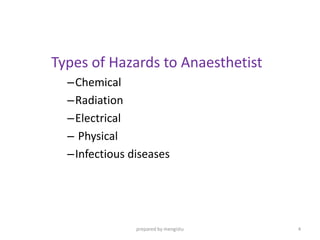
Types of Hazards to Anaesthetist
–Chemical
–Radiation
–Electrical
– Physical
–Infectious diseases
prepared by mengistu 4
Discus on
Physical hazards to anaesthetist
prepared by mengistu 5
Chemical hazards
• Trace amounts of waste gases enter the operating
room atmosphere each time an inhaled anesthetic is
delivered.
• Waste nitrous oxide and halogenated anesthetics in
the absence of scavenging may approach
concentrations as high as 3000 and 50 ppm,
respectively.
• Mask inductions, circuit disconnects, the use of
laryngeal mask airways and cuffless endotracheal
tubes all contribute to operating room contamination.
prepared by mengistu 6
Cont…
• While the exposure to anesthetic gases is more
common in pediatric anesthesia .
• Mask inductions and uncuffed endotracheal tubes are
the standard of care in pediatric anesthesia .
• The introduction of the laryngeal mask to anesthesia
practice has increased operating room exposure to
waste gases in adult cases as well.
• The universal use of scavenging systems can lead to a
false sense of security among operating room
personnel.
prepared by mengistu 7
Cont…
• Because anesthesia machines are not equipped to
recognize unconnected scavenging systems, a failure
of the system may not be readily apparent.
• Simply transferring the p/t from the operating room
to the PACU does not eliminate the risk of exposure to
waste gases, as p/ts continue to exhale trace amounts
of N2O for 5 to 8 hours after arrival in the PACU.
• If the anesthetic can be smelled, concentration of
volatile agents is well above the maximum
recommended level.
prepared by mengistu 8
Cont…
• Thus it is important to accurately detect, measure, and
limit ambient anesthetic levels in order to minimize
passive exposure of operating room personnel to
waste gases.
• The National Institute for Occupational Safety and
Health (NIOSH) does not currently regulate exposure
to N2O and halogenated agents, the agency does
provide guidelines designed to minimize workplace
exposure
prepared by mengistu 9
• The possibility that chronic exposure to
anesthetic waste gases could result in adverse
health effects
• Health Risks
• Fatigue
• Effect on Performance
• Impact on physician well-being
• Infection
• Latex Allergy
• Additional Stressors
• Chemical Dependence
prepared by mengistu 10
Health Risks
• Chronic exposure to anesthetic waste gases could
result in adverse health effects was first appreciated
in the late 1960s when a report of potential harm
appeared in the Russian literature
• In 1967, Vaisman reported an increased
incidence of abortions among female
anesthetists.
• Specifically, this study noted 18 spontaneous
abortions in 31 pregnancies
prepared by mengistu 11
Effect on Performance
• There are many researches done on effect of
concentrations of nitrous oxide and other
inhalational agents using volunteers but many of
them disprove the decrement of psychomotor
performance.
• Thus there is no definitive cut-off in which
psychomotor performance is depressed
prepared by mengistu 12
Radiation
• There is routine exposure to both ionizing and non
ionizing electromagnetic radiation in OR
• Ionizing radiation has enough energy to create both
free radicals and ionized molecules which are
enough, to destroy tissues or chromosomal changes
may cause malignant growth.
• Non ionizing radiation may excite electrons to move
from the ground state to higher orbitals in molecules,
but the electrons remain in the molecule.
• In this case, damage to tissues may result from the
heat produced by the absorbed radiation.
prepared by mengistu 13
Ionizing Radiation: X-rays
• Exposure to radiation occurred mostly in the
operating room with the use of portable fluoroscopy
and x-ray machines
• Occupational exposure to radiation comes primarily
from x-rays scattered by the patient and the
surrounding equipment.
• The advancement of endovascular surgery has led to
an explosion of procedures performed in the
radiology suite, significantly increasing exposure of
anesthesia personnel to ionizing radiation.
• The amount of radiation generated during
fluoroscopy depends on how long the x-ray beam is
on.
prepared by mengistu 14
Cont…
• To a minimize use Film badges, although not protective,
provide a means of monitoring exposure.
• Because the intensity of scattered radiation is inversely
proportional to the square of the distance from the
source, the best protection is physical separation.
• A distance of at least 3 feet from the patient is
recommended. Six feet of air provides protection the
equivalent of 9 inches of concrete or 2.5 mm of lead.
• Although they are uncomfortable, aprons containing the
equivalent of 0.25 to 0.5 mm of lead sheet are effective in
blocking most scattered radiation and such devices are
recommended to be worn whenever there is an exposu
prepared by mengistu 15
Non ionizing Radiation: Lasers
• Lasers- acronym for light amplification by stimulated
emission of radiation.
• Lasers produce infrared, visible, or ultraviolet light.
• Although the radiation from lasers is non ionizing, it is
potentially unsafe both because of its intensity and
because of the matter released from tissues during
treatment.
• Lasers are used in many surgical specialties,
including ophthalmology, plastic surgery,
gynecology, neurosurgery, urology, head and
neck surgery, and gastrointestinal surgery.
prepared by mengistu 16
Cont…
• The radiation is usually infrared or visible light and is
created in a “laser medium” that is stimulated by
high-intensity energy to release photons of identical
wavelength.
• Eye injuries are the greatest risk to personnel working
near lasers.
• To minimize risks Protective eyewear is designed to
filter out the radiation produced by a specific type of
laser while still permitting vision.
prepared by mengistu 17
Cont…
• The type of protection provided by a given filter is
marked on the frame of the goggles and should be
checked before use.
• Filters that are scratched should not be used.
• Protective eyewear is recommended for all personnel
because reflected radiation can be as hazardous as
direct radiation and the intensity is not diminished
significantly in the distances traveled in the average
operating room.
prepared by mengistu 18
Infection
• Minor finger cuts and scratches increases the risk of
transmission of Blood-Borne Pathogens
• Exposure to blood and other body fluids containing
• HB and C virus
• HIV
• Tuberculosis
• Precaution and treatment
• Vaccination and post exposure prophylaxis
prepared by mengistu 19
Cont…
• Intact DNA from (HPV), Human immunodeficiency
virus (HIV), proviral DNA has been found in laser
smoke produced by vaporizing cultures of HIV-
positive cells DNA.
• Although these experiments, which used tissue
cultures, do not replicate the clinical situation, they
stress the importance of strict attention to smoke
removal.
prepared by mengistu 20
Cont…
• With adequate evacuation and filtration using
equipment specifically designed to scavenge such
vapors, it is unlikely that operating room personnel
will be contaminated by laser-dispersed HPV.
• Though not conclusive, the Tissue from the
surgeon's laryngeal tumors contained HPV DNA
types 6 and 11, was found that suggest the laryngeal
papillomas may have been caused by inhaled virus
particles.
• Hence, it is prudent to scavenge all vaporized debris.
prepared by mengistu 21
Standard precautions in infection prevention
• Physical: Personal protective equipment
(gloves, face masks, goggles, gowns, aprons, and
drapes)
• Mechanical: High-level disinfection (HLD) by boiling
or steaming and sterilization by autoclaving or dry heat
ovens
• Chemical: Antiseptics (alcohol-based antiseptic
agents) and high-level disinfectants (chlorine and
glutaraldehydes)
prepared by mengistu 22
Transmission-Based Precautions
• Transmission-based precautions should be followed
when p/ts are known to be or are suspected of being
infected with highly transmissible or epidemiologically
important pathogens.
• These precautions are based on the properties of
specific pathogens and are to be used in addition to
standard precautions.
prepared by mengistu 23
1.Airborne precautions are to be used when
transmission of small particles or droplets (< 5 µm) is
likely.
• Because these particles can be carried for long
distances, special filtration and air handling are
necessary.
• Diseases in this category include
– measles,
– varicella, and
– tuberculosis.
prepared by mengistu 24
2. Droplet precautions apply to diseases transmitted by
large particles (> 5 µm).
• Because of their size and the droplets do not remain
suspended in air, transmission is limited to short
distances; a meter or less.
• Examples are
– Invasive Haemophilus influenzae type b
– Meningitis and epiglottitis,
– Mycoplasma pneumoniae pneumonia,
– Streptococcal pharyngitis, and
– Rubella.
prepared by mengistu 25
3. Contact precautions apply to direct skin-to-skin
contact, including hands.
• Indirect contact may also occur if surfaces in an
infected patient's environment are contaminated.
• Included are
– Colonies of antibiotic-resistant organisms,
– Hepatitis A virus,
– Herpes simplex virus,
– Viral conjunctivitis, and major abscesses.
prepared by mengistu 26
Fatigue and Physician Well-Being
• Sleep deprivation has been shown to have an
impact on physician well-being.
• Long and grueling work hours result in fatigue
• Well-defined periods of vulnerability to sleep have
been identified in humans.
• Sleep, and Public Policy of the Association of
Professional Sleep Societies has made the following
recommendations
prepared by mengistu 27
Cont…
1. Management should be made aware that
performance errors are more common between 1
and 8 AM.
2. Programs should be developed to identify signs of
sleep-related error.
3. Because inadequate sleep or irregular sleep
patterns enhance the tendency for error, work
hours should be limited to permit adequate sleep.
prepared by mengistu 28
Cont….
• In the practice of anesthesia, sleep deprivation may
have subtle effects on vigilance in the operating
room and may contribute to critical incidents.
• Regulation of Work Hours and regular vacation
should be considered as management in addition to
the other recommendation and standard
precaution .
prepared by mengistu 29
Additional Stressors
• Stress in the workplace continues
• Special causes included
– Professional relationships
– Work overload,
– Threats of litigation,
– Peer review,
– Increasing administrative responsibilities.
– Difficult anesthetic cases,
– The threat of professional liability, and the stress of
night call were all considered to be significant
causes of stress
prepared by mengistu 30
Cont…
• Perhaps more than any other medical specialty, the
practice of anesthesia requires uninterrupted
vigilance with immediate reaction to life-threatening
situations.
• An inappropriate response can prove to be acutely
fatal to an otherwise healthy patient.
• Management of stress is rarely addressed in
continuing medical education seminars for
anesthesiologists, but it should be.
prepared by mengistu 31
Cont….
• Stress is a universal phenomenon to which no one is
immune.
• Vital to our interactions with others is the ability to
recognize stressed behavior, not only in them but also
in ourselves.
• Healthy means of coping with stress include an ability
to communicate, appropriate assertiveness,
interactive management of conflicts, adequate time
with family, and time for recreational pastimes totally
unrelated to professional activities.
prepared by mengistu 32
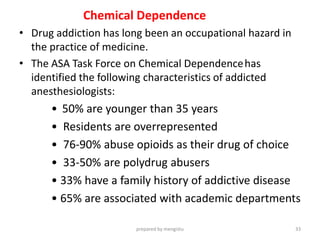
Chemical Dependence
• Drug addiction has long been an occupational hazard in
the practice of medicine.
• The ASA Task Force on Chemical Dependencehas
identified the following characteristics of addicted
anesthesiologists:
• 50% are younger than 35 years
• Residents are overrepresented
• 76-90% abuse opioids as their drug of choice
• 33-50% are polydrug abusers
• 33% have a family history of addictive disease
• 65% are associated with academic departments
prepared by mengistu 33
“Drugs can not only lead to jail but it also does
harm to your health, We only have one body so
lets take care of it.
http://www.thinkslogans.com/slogans/anti-
drug-slogans/
prepared by mengistu 34
Why anaesthetist exposed to drug abuse?
• In addition to environmental exposures, the access to
potent opioids, the extended work hours, and the
unique role the anesthetist plays in critical clinical
situations contribute to the anesthetist's risk of
chemical dependence, and emotional distress.
Availability of drugs
Drug Potency
Previous use of drugs
Family history of drug abuse, as a risk factor
Genetic predisposition may contribute to the
progression from abuse to addiction
prepared by mengistu 35
Signs and Symptoms of Chemical
Dependence
• Pinpoint pupils, Weight loss, Found comatose and
found dead in addition they have signs and
symptoms
At work
• Unusual changes in behavior
• Anger , euphoria, depression
• Gossip by others
• Progressive increase in apparent narcotic use for
anesthetic management
• Preference for working alone
• Careless charting
prepared by mengistu 36
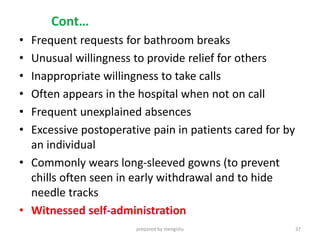
Cont…
• Frequent requests for bathroom breaks
• Unusual willingness to provide relief for others
• Inappropriate willingness to take calls
• Often appears in the hospital when not on call
• Frequent unexplained absences
• Excessive postoperative pain in patients cared for by
an individual
• Commonly wears long-sleeved gowns (to prevent
chills often seen in early withdrawal and to hide
needle tracks
• Witnessed self-administration
prepared by mengistu 37
At home
• Withdrawal from family, friends, and leisure activities
• Changes in behavior (e.g., wide mood swings)
• Fights and arguments at home
• Frequent unexplained illness (common in alcoholism)
• Gambling
• Extramarital affairs
• Legal problems (e.g., arrests for driving while
intoxicated)
• Decrease in sexual drive
• Drugs and syringes found in the home
• Odor of alcohol on breath
• Symptoms of withdrawal
prepared by mengistu 38
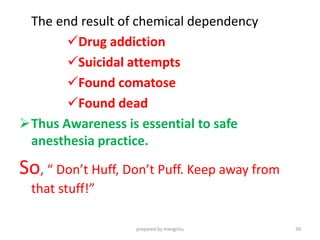
The end result of chemical dependency
Drug addiction
Suicidal attempts
Found comatose
Found dead
Thus Awareness is essential to safe
anesthesia practice.
So, “ Don’t Huff, Don’t Puff. Keep away from
that stuff!”
prepared by mengistu 39
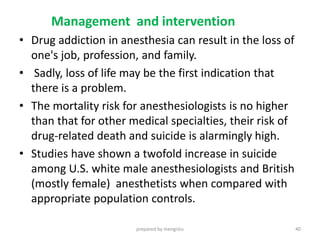
Management and intervention
• Drug addiction in anesthesia can result in the loss of
one's job, profession, and family.
• Sadly, loss of life may be the first indication that
there is a problem.
• The mortality risk for anesthesiologists is no higher
than that for other medical specialties, their risk of
drug-related death and suicide is alarmingly high.
• Studies have shown a twofold increase in suicide
among U.S. white male anesthesiologists and British
(mostly female) anesthetists when compared with
appropriate population controls.
prepared by mengistu 40
• A recent study in the U .S reported the relative risk
of suicide in anesthesiologists to be 1.45 when
compared to internists.
• The relative risk of a drug-related death was even
higher at 2.79.
• All these studies identify drug-related death as a
significant occupational hazard in the practice of
anesthesia.
• Anesthetists are overrepresented in drug treatment
center.
prepared by mengistu 41
Management
• Management of physicians who are chemically
dependent includes
• Identification,
• Intervention,
• Referral for treatment, and
• Help with reentry.
• The department should have an established
mechanism in place to deal with impaired
Anaesthetist and anaesthesiologist.
prepared by mengistu 42
• Although many recovered anesthesiologists return to
the practice of anesthesia, there is a significant
relapse rate.
• The chance of relapse is highest in physicians who
become addicted to potent narcotics early in their
career.
• Successful recovery requires a lifelong commitment
to treatment.
• In some cases, a change in specialty is the only
solution.
prepared by mengistu 43
References:
• Clinical anaesthesia (Paul G. Barash
1989,1992)
• Anesthesia (Ronald D. Miller)
• Infection Prevention and Patient Safety Training
Resource Package Federal Ministry of Health,
Ethiopia, October, 2011
prepared by mengistu 44
Take care!!
“Half the modern drugs could well be thrown
out the window except that the birds might
eat them.” ~Martin H. Fischer, Fischerisms
prepared by mengistu 45

part II-Pr Hazard prin.pptx

  • 1.
    Course Objectives Understand thebasic concepts of professional hazards Gives maximal concern to minimize professional hazards of anaesthesia prepared by mengistu 1
  • 2.
    Why hazards toAnaesthetist? • It is impossible to practice anesthesia without exposure to a number of potentially harmful environmental factors. • Escape of anesthetic vapors into the operating room atmosphere is unavoidable • Exposure to inhalation agents, transmissible diseases, and radiation are unavoidable in the operating room environment. • Occupational exposure to radiation comes primarily from x-rays scattered by the patient and surrounding equipment. prepared by mengistu 2
  • 3.
    Cont… • Fortunately, thepast several decades have produced a number of technical advancements and guidelines that serve to minimize the adverse effects of these occupational exposures. • Efficient gas scavenger systems, needle-less systems, protect IVs, and post-exposure prophylaxis (PEP) protocols are now commonplace in anesthesia practice. • But while these measures all serve to minimize occupational exposure and risk, they do not completely eliminate them. prepared by mengistu 3
  • 4.
    Types of Hazardsto Anaesthetist –Chemical –Radiation –Electrical – Physical –Infectious diseases prepared by mengistu 4
  • 5.
    Discus on Physical hazardsto anaesthetist prepared by mengistu 5
  • 6.
    Chemical hazards • Traceamounts of waste gases enter the operating room atmosphere each time an inhaled anesthetic is delivered. • Waste nitrous oxide and halogenated anesthetics in the absence of scavenging may approach concentrations as high as 3000 and 50 ppm, respectively. • Mask inductions, circuit disconnects, the use of laryngeal mask airways and cuffless endotracheal tubes all contribute to operating room contamination. prepared by mengistu 6
  • 7.
    Cont… • While theexposure to anesthetic gases is more common in pediatric anesthesia . • Mask inductions and uncuffed endotracheal tubes are the standard of care in pediatric anesthesia . • The introduction of the laryngeal mask to anesthesia practice has increased operating room exposure to waste gases in adult cases as well. • The universal use of scavenging systems can lead to a false sense of security among operating room personnel. prepared by mengistu 7
  • 8.
    Cont… • Because anesthesiamachines are not equipped to recognize unconnected scavenging systems, a failure of the system may not be readily apparent. • Simply transferring the p/t from the operating room to the PACU does not eliminate the risk of exposure to waste gases, as p/ts continue to exhale trace amounts of N2O for 5 to 8 hours after arrival in the PACU. • If the anesthetic can be smelled, concentration of volatile agents is well above the maximum recommended level. prepared by mengistu 8
  • 9.
    Cont… • Thus itis important to accurately detect, measure, and limit ambient anesthetic levels in order to minimize passive exposure of operating room personnel to waste gases. • The National Institute for Occupational Safety and Health (NIOSH) does not currently regulate exposure to N2O and halogenated agents, the agency does provide guidelines designed to minimize workplace exposure prepared by mengistu 9
  • 10.
    • The possibilitythat chronic exposure to anesthetic waste gases could result in adverse health effects • Health Risks • Fatigue • Effect on Performance • Impact on physician well-being • Infection • Latex Allergy • Additional Stressors • Chemical Dependence prepared by mengistu 10
  • 11.
    Health Risks • Chronicexposure to anesthetic waste gases could result in adverse health effects was first appreciated in the late 1960s when a report of potential harm appeared in the Russian literature • In 1967, Vaisman reported an increased incidence of abortions among female anesthetists. • Specifically, this study noted 18 spontaneous abortions in 31 pregnancies prepared by mengistu 11
  • 12.
    Effect on Performance •There are many researches done on effect of concentrations of nitrous oxide and other inhalational agents using volunteers but many of them disprove the decrement of psychomotor performance. • Thus there is no definitive cut-off in which psychomotor performance is depressed prepared by mengistu 12
  • 13.
    Radiation • There isroutine exposure to both ionizing and non ionizing electromagnetic radiation in OR • Ionizing radiation has enough energy to create both free radicals and ionized molecules which are enough, to destroy tissues or chromosomal changes may cause malignant growth. • Non ionizing radiation may excite electrons to move from the ground state to higher orbitals in molecules, but the electrons remain in the molecule. • In this case, damage to tissues may result from the heat produced by the absorbed radiation. prepared by mengistu 13
  • 14.
    Ionizing Radiation: X-rays •Exposure to radiation occurred mostly in the operating room with the use of portable fluoroscopy and x-ray machines • Occupational exposure to radiation comes primarily from x-rays scattered by the patient and the surrounding equipment. • The advancement of endovascular surgery has led to an explosion of procedures performed in the radiology suite, significantly increasing exposure of anesthesia personnel to ionizing radiation. • The amount of radiation generated during fluoroscopy depends on how long the x-ray beam is on. prepared by mengistu 14
  • 15.
    Cont… • To aminimize use Film badges, although not protective, provide a means of monitoring exposure. • Because the intensity of scattered radiation is inversely proportional to the square of the distance from the source, the best protection is physical separation. • A distance of at least 3 feet from the patient is recommended. Six feet of air provides protection the equivalent of 9 inches of concrete or 2.5 mm of lead. • Although they are uncomfortable, aprons containing the equivalent of 0.25 to 0.5 mm of lead sheet are effective in blocking most scattered radiation and such devices are recommended to be worn whenever there is an exposu prepared by mengistu 15
  • 16.
    Non ionizing Radiation:Lasers • Lasers- acronym for light amplification by stimulated emission of radiation. • Lasers produce infrared, visible, or ultraviolet light. • Although the radiation from lasers is non ionizing, it is potentially unsafe both because of its intensity and because of the matter released from tissues during treatment. • Lasers are used in many surgical specialties, including ophthalmology, plastic surgery, gynecology, neurosurgery, urology, head and neck surgery, and gastrointestinal surgery. prepared by mengistu 16
  • 17.
    Cont… • The radiationis usually infrared or visible light and is created in a “laser medium” that is stimulated by high-intensity energy to release photons of identical wavelength. • Eye injuries are the greatest risk to personnel working near lasers. • To minimize risks Protective eyewear is designed to filter out the radiation produced by a specific type of laser while still permitting vision. prepared by mengistu 17
  • 18.
    Cont… • The typeof protection provided by a given filter is marked on the frame of the goggles and should be checked before use. • Filters that are scratched should not be used. • Protective eyewear is recommended for all personnel because reflected radiation can be as hazardous as direct radiation and the intensity is not diminished significantly in the distances traveled in the average operating room. prepared by mengistu 18
  • 19.
    Infection • Minor fingercuts and scratches increases the risk of transmission of Blood-Borne Pathogens • Exposure to blood and other body fluids containing • HB and C virus • HIV • Tuberculosis • Precaution and treatment • Vaccination and post exposure prophylaxis prepared by mengistu 19
  • 20.
    Cont… • Intact DNAfrom (HPV), Human immunodeficiency virus (HIV), proviral DNA has been found in laser smoke produced by vaporizing cultures of HIV- positive cells DNA. • Although these experiments, which used tissue cultures, do not replicate the clinical situation, they stress the importance of strict attention to smoke removal. prepared by mengistu 20
  • 21.
    Cont… • With adequateevacuation and filtration using equipment specifically designed to scavenge such vapors, it is unlikely that operating room personnel will be contaminated by laser-dispersed HPV. • Though not conclusive, the Tissue from the surgeon's laryngeal tumors contained HPV DNA types 6 and 11, was found that suggest the laryngeal papillomas may have been caused by inhaled virus particles. • Hence, it is prudent to scavenge all vaporized debris. prepared by mengistu 21
  • 22.
    Standard precautions ininfection prevention • Physical: Personal protective equipment (gloves, face masks, goggles, gowns, aprons, and drapes) • Mechanical: High-level disinfection (HLD) by boiling or steaming and sterilization by autoclaving or dry heat ovens • Chemical: Antiseptics (alcohol-based antiseptic agents) and high-level disinfectants (chlorine and glutaraldehydes) prepared by mengistu 22
  • 23.
    Transmission-Based Precautions • Transmission-basedprecautions should be followed when p/ts are known to be or are suspected of being infected with highly transmissible or epidemiologically important pathogens. • These precautions are based on the properties of specific pathogens and are to be used in addition to standard precautions. prepared by mengistu 23
  • 24.
    1.Airborne precautions areto be used when transmission of small particles or droplets (< 5 µm) is likely. • Because these particles can be carried for long distances, special filtration and air handling are necessary. • Diseases in this category include – measles, – varicella, and – tuberculosis. prepared by mengistu 24
  • 25.
    2. Droplet precautionsapply to diseases transmitted by large particles (> 5 µm). • Because of their size and the droplets do not remain suspended in air, transmission is limited to short distances; a meter or less. • Examples are – Invasive Haemophilus influenzae type b – Meningitis and epiglottitis, – Mycoplasma pneumoniae pneumonia, – Streptococcal pharyngitis, and – Rubella. prepared by mengistu 25
  • 26.
    3. Contact precautionsapply to direct skin-to-skin contact, including hands. • Indirect contact may also occur if surfaces in an infected patient's environment are contaminated. • Included are – Colonies of antibiotic-resistant organisms, – Hepatitis A virus, – Herpes simplex virus, – Viral conjunctivitis, and major abscesses. prepared by mengistu 26
  • 27.
    Fatigue and PhysicianWell-Being • Sleep deprivation has been shown to have an impact on physician well-being. • Long and grueling work hours result in fatigue • Well-defined periods of vulnerability to sleep have been identified in humans. • Sleep, and Public Policy of the Association of Professional Sleep Societies has made the following recommendations prepared by mengistu 27
  • 28.
    Cont… 1. Management shouldbe made aware that performance errors are more common between 1 and 8 AM. 2. Programs should be developed to identify signs of sleep-related error. 3. Because inadequate sleep or irregular sleep patterns enhance the tendency for error, work hours should be limited to permit adequate sleep. prepared by mengistu 28
  • 29.
    Cont…. • In thepractice of anesthesia, sleep deprivation may have subtle effects on vigilance in the operating room and may contribute to critical incidents. • Regulation of Work Hours and regular vacation should be considered as management in addition to the other recommendation and standard precaution . prepared by mengistu 29
  • 30.
    Additional Stressors • Stressin the workplace continues • Special causes included – Professional relationships – Work overload, – Threats of litigation, – Peer review, – Increasing administrative responsibilities. – Difficult anesthetic cases, – The threat of professional liability, and the stress of night call were all considered to be significant causes of stress prepared by mengistu 30
  • 31.
    Cont… • Perhaps morethan any other medical specialty, the practice of anesthesia requires uninterrupted vigilance with immediate reaction to life-threatening situations. • An inappropriate response can prove to be acutely fatal to an otherwise healthy patient. • Management of stress is rarely addressed in continuing medical education seminars for anesthesiologists, but it should be. prepared by mengistu 31
  • 32.
    Cont…. • Stress isa universal phenomenon to which no one is immune. • Vital to our interactions with others is the ability to recognize stressed behavior, not only in them but also in ourselves. • Healthy means of coping with stress include an ability to communicate, appropriate assertiveness, interactive management of conflicts, adequate time with family, and time for recreational pastimes totally unrelated to professional activities. prepared by mengistu 32
  • 33.
    Chemical Dependence • Drugaddiction has long been an occupational hazard in the practice of medicine. • The ASA Task Force on Chemical Dependencehas identified the following characteristics of addicted anesthesiologists: • 50% are younger than 35 years • Residents are overrepresented • 76-90% abuse opioids as their drug of choice • 33-50% are polydrug abusers • 33% have a family history of addictive disease • 65% are associated with academic departments prepared by mengistu 33
  • 34.
    “Drugs can notonly lead to jail but it also does harm to your health, We only have one body so lets take care of it. http://www.thinkslogans.com/slogans/anti- drug-slogans/ prepared by mengistu 34
  • 35.
    Why anaesthetist exposedto drug abuse? • In addition to environmental exposures, the access to potent opioids, the extended work hours, and the unique role the anesthetist plays in critical clinical situations contribute to the anesthetist's risk of chemical dependence, and emotional distress. Availability of drugs Drug Potency Previous use of drugs Family history of drug abuse, as a risk factor Genetic predisposition may contribute to the progression from abuse to addiction prepared by mengistu 35
  • 36.
    Signs and Symptomsof Chemical Dependence • Pinpoint pupils, Weight loss, Found comatose and found dead in addition they have signs and symptoms At work • Unusual changes in behavior • Anger , euphoria, depression • Gossip by others • Progressive increase in apparent narcotic use for anesthetic management • Preference for working alone • Careless charting prepared by mengistu 36
  • 37.
    Cont… • Frequent requestsfor bathroom breaks • Unusual willingness to provide relief for others • Inappropriate willingness to take calls • Often appears in the hospital when not on call • Frequent unexplained absences • Excessive postoperative pain in patients cared for by an individual • Commonly wears long-sleeved gowns (to prevent chills often seen in early withdrawal and to hide needle tracks • Witnessed self-administration prepared by mengistu 37
  • 38.
    At home • Withdrawalfrom family, friends, and leisure activities • Changes in behavior (e.g., wide mood swings) • Fights and arguments at home • Frequent unexplained illness (common in alcoholism) • Gambling • Extramarital affairs • Legal problems (e.g., arrests for driving while intoxicated) • Decrease in sexual drive • Drugs and syringes found in the home • Odor of alcohol on breath • Symptoms of withdrawal prepared by mengistu 38
  • 39.
    The end resultof chemical dependency Drug addiction Suicidal attempts Found comatose Found dead Thus Awareness is essential to safe anesthesia practice. So, “ Don’t Huff, Don’t Puff. Keep away from that stuff!” prepared by mengistu 39
  • 40.
    Management and intervention •Drug addiction in anesthesia can result in the loss of one's job, profession, and family. • Sadly, loss of life may be the first indication that there is a problem. • The mortality risk for anesthesiologists is no higher than that for other medical specialties, their risk of drug-related death and suicide is alarmingly high. • Studies have shown a twofold increase in suicide among U.S. white male anesthesiologists and British (mostly female) anesthetists when compared with appropriate population controls. prepared by mengistu 40
  • 41.
    • A recentstudy in the U .S reported the relative risk of suicide in anesthesiologists to be 1.45 when compared to internists. • The relative risk of a drug-related death was even higher at 2.79. • All these studies identify drug-related death as a significant occupational hazard in the practice of anesthesia. • Anesthetists are overrepresented in drug treatment center. prepared by mengistu 41
  • 42.
    Management • Management ofphysicians who are chemically dependent includes • Identification, • Intervention, • Referral for treatment, and • Help with reentry. • The department should have an established mechanism in place to deal with impaired Anaesthetist and anaesthesiologist. prepared by mengistu 42
  • 43.
    • Although manyrecovered anesthesiologists return to the practice of anesthesia, there is a significant relapse rate. • The chance of relapse is highest in physicians who become addicted to potent narcotics early in their career. • Successful recovery requires a lifelong commitment to treatment. • In some cases, a change in specialty is the only solution. prepared by mengistu 43
  • 44.
    References: • Clinical anaesthesia(Paul G. Barash 1989,1992) • Anesthesia (Ronald D. Miller) • Infection Prevention and Patient Safety Training Resource Package Federal Ministry of Health, Ethiopia, October, 2011 prepared by mengistu 44
  • 45.
    Take care!! “Half themodern drugs could well be thrown out the window except that the birds might eat them.” ~Martin H. Fischer, Fischerisms prepared by mengistu 45