SHRI MATA VAISHNO DEVI UNIVERSITY
CASE STUDY
Introduction
The Shri Mata Vaishno Devi University (SMVDU), is a statutory
university located near Katra,
Jammu and Kashmir. It is situated near the
Shrine of the Mata Vaishno Devi, after which it is
named. The University
became functional on August 2004.
Client : Shree Mata Vaishno Devi Shrine Board
Board Architect : Sharat Das & Associates and
B.V. Sharma & Associates
Building Type: Institute
Site Area: 470 acres
Location
University is situated in Reasi district of Jammu
division of J&K state. It is 45kms away from
Jammu along the National Highway no. 1 joining
Jammu and Srinagar. Nearest town is Katra,
which is 12 kms from the campus.
Climate
The climate of the region has hot summers, rainy
monsoon and mildly cold winters.
Site plan
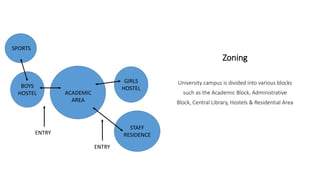
Zoning
University campus is divided into various blocks
such as the Academic Block, Administrative
Block, Central Library, Hostels & Residential Area
ACADEMIC
AREA
BOYS
HOSTEL
SPORTS
GIRLS
HOSTEL
STAFF
RESIDENCEENTRY
ENTRY
Circulation
University is designed along a central symmetrical axis (Shrine Axis). This axis faces mata Vaishnu Devi Shrine and is totally
pedestrian. It connects different buildings landscaped areas and zones through pedestrian pathways
Design Composition of the University
Academic Area
• It includes academic blocks, library, auditorium, central plaza, administration bock, lecture halls and cafeteria.
• It has 8 academic blocks. 4 of them in front are connected at the ground as well as at the first floors. 4 in the
inner side are individual blocks but well connected with each other through covered walkways.
• All these academic blocks are well connected with library, lecture halls, cafeteria and administration block
through sky bridges and covered pathways.
• Central core has a fountain and huge landscape area with ample seating which makes it highly interactive
space and encourages the interaction between students of different programs.
Academic blocks
• All the blocks have central courtyards. Two big blocks even have two central courtyards.
• These blocks have several entries at different levels which make them look lively and encourages inter
disciplinary interactions.
• This also allows students to use the facilities of other departments.
• These blocks are either two or three stories high.
• Open to sky courtyards provides ample sunshine and ventilation.
Library
• It has two entries, one from the main road (vehicular) and other from the inner core.
• The building is three story high with a central courtyard with sky light.
• It lit the interiors with natural day light. The shape in plan is octagonal.
• Ground floor has two entrances, reception, cloak room, toilets, offices and newspaper reading area.
• G-1 floor has stack area. First floor has reading halls and journal section.
Auditorium
• It has unique design with pyramidal shaped roof.
• Main entrance has a beautiful landscaped plaza.
• Main entrance faces the outer road but has a pedestrian connectivity from
the inner core.
Hostels
Administration area divides the girl’s hotels area from boy’s hostel area.
Both the area lies on the central axis and area at a walkable distance from the academic area.
There are 4 boy’s hostel and 2 girl’s hostel.
All the hostels have central courtyards and spaces for small outdoor games. Sports area is near to the boy’s
hostel but a bit far from girl’s hostels. All the hostels have ample gathering spaces at all the levels.
BOYS HOSTEL GIRLS HOSTEL
Landscape
The campus is a lush green campus with huge and well maintained landscaped areas. Central courtyards in the
academic blocks are landscaped and also these courtyards opens to the central core which is also a green area.
This combination give a feel of closeness to nature and eliminates the feeling of interior or exterior.
Different variety of flower and trees keeps on changing the colors of the surroundings with changing seasons.
Inferences
Pros
 The concept of strong central symmetrical axis is well
maintained.
 Also the concept of joining the buildings with
courtyards and sky bridges gives the whole campus a
unified feeling.
 The central core of academic area acts as heart of
the campus and almost every other building is at a
walkable distance from it.
 Residential area for the staff is kept at a far end
which provides security and privacy to the residents.
 All the buildings are very well connected with the
walk ways as well as with roads.
Cons
× Playing grounds are kept at the far end of the campus
which makes them approachable only by the boy’s
hostels and not by the girl’s hostel or the staff’s
residences.
× Absence of metaled service roads till the store room of
messes of the hostels.
× Size of the cafeteria is very small then required in the
central core.

Smvdu j&k

  • 1.
    SHRI MATA VAISHNODEVI UNIVERSITY CASE STUDY
  • 2.
    Introduction The Shri MataVaishno Devi University (SMVDU), is a statutory university located near Katra, Jammu and Kashmir. It is situated near the Shrine of the Mata Vaishno Devi, after which it is named. The University became functional on August 2004. Client : Shree Mata Vaishno Devi Shrine Board Board Architect : Sharat Das & Associates and B.V. Sharma & Associates Building Type: Institute Site Area: 470 acres
  • 3.
    Location University is situatedin Reasi district of Jammu division of J&K state. It is 45kms away from Jammu along the National Highway no. 1 joining Jammu and Srinagar. Nearest town is Katra, which is 12 kms from the campus. Climate The climate of the region has hot summers, rainy monsoon and mildly cold winters.
  • 4.
  • 5.
    Zoning University campus isdivided into various blocks such as the Academic Block, Administrative Block, Central Library, Hostels & Residential Area ACADEMIC AREA BOYS HOSTEL SPORTS GIRLS HOSTEL STAFF RESIDENCEENTRY ENTRY
  • 6.
    Circulation University is designedalong a central symmetrical axis (Shrine Axis). This axis faces mata Vaishnu Devi Shrine and is totally pedestrian. It connects different buildings landscaped areas and zones through pedestrian pathways
  • 7.
    Design Composition ofthe University Academic Area • It includes academic blocks, library, auditorium, central plaza, administration bock, lecture halls and cafeteria. • It has 8 academic blocks. 4 of them in front are connected at the ground as well as at the first floors. 4 in the inner side are individual blocks but well connected with each other through covered walkways. • All these academic blocks are well connected with library, lecture halls, cafeteria and administration block through sky bridges and covered pathways. • Central core has a fountain and huge landscape area with ample seating which makes it highly interactive space and encourages the interaction between students of different programs.
  • 8.
    Academic blocks • Allthe blocks have central courtyards. Two big blocks even have two central courtyards. • These blocks have several entries at different levels which make them look lively and encourages inter disciplinary interactions. • This also allows students to use the facilities of other departments. • These blocks are either two or three stories high. • Open to sky courtyards provides ample sunshine and ventilation.
  • 9.
    Library • It hastwo entries, one from the main road (vehicular) and other from the inner core. • The building is three story high with a central courtyard with sky light. • It lit the interiors with natural day light. The shape in plan is octagonal. • Ground floor has two entrances, reception, cloak room, toilets, offices and newspaper reading area. • G-1 floor has stack area. First floor has reading halls and journal section.
  • 10.
    Auditorium • It hasunique design with pyramidal shaped roof. • Main entrance has a beautiful landscaped plaza. • Main entrance faces the outer road but has a pedestrian connectivity from the inner core.
  • 11.
    Hostels Administration area dividesthe girl’s hotels area from boy’s hostel area. Both the area lies on the central axis and area at a walkable distance from the academic area. There are 4 boy’s hostel and 2 girl’s hostel. All the hostels have central courtyards and spaces for small outdoor games. Sports area is near to the boy’s hostel but a bit far from girl’s hostels. All the hostels have ample gathering spaces at all the levels. BOYS HOSTEL GIRLS HOSTEL
  • 12.
    Landscape The campus isa lush green campus with huge and well maintained landscaped areas. Central courtyards in the academic blocks are landscaped and also these courtyards opens to the central core which is also a green area. This combination give a feel of closeness to nature and eliminates the feeling of interior or exterior. Different variety of flower and trees keeps on changing the colors of the surroundings with changing seasons.
  • 13.
    Inferences Pros  The conceptof strong central symmetrical axis is well maintained.  Also the concept of joining the buildings with courtyards and sky bridges gives the whole campus a unified feeling.  The central core of academic area acts as heart of the campus and almost every other building is at a walkable distance from it.  Residential area for the staff is kept at a far end which provides security and privacy to the residents.  All the buildings are very well connected with the walk ways as well as with roads. Cons × Playing grounds are kept at the far end of the campus which makes them approachable only by the boy’s hostels and not by the girl’s hostel or the staff’s residences. × Absence of metaled service roads till the store room of messes of the hostels. × Size of the cafeteria is very small then required in the central core.