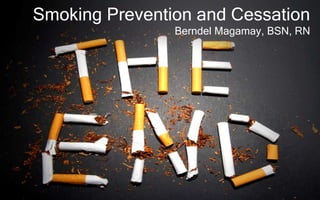

Smoking Prevention and Cessation
                Berndel Magamay, BSN, RN
National Cancer Institute
   • A smoker's risk of cancer is 2-10
     times greater than a nonsmoker's
     risk, depending on how much a
     person has smoked

   • Lung cancer is the leading cause of
     cancer deaths for both men and
     women.
American Lung Association
   • Nearly 4,000 children under the age
     of 18 begin smoking each day in the
     United States

   • Nearly 1,100 of these will become
     regular smokers
Smoking is a risk factor for:
    • Hypertension
    • Heart disease
    • Peripheral vascular disease
    • Chronic obstructive pulmonary disease
      (COPD)
    • Cancer of the:
        – lung, colon, larynx, oral cavity,
          esophagus, bladder, pancreas, kidney.
• Smoking worsens such conditions as
  –   Respiratory infections
  –   Peptic ulcers
  –   Hiatal hernia
  –   Gastroesophageal reflux
Not Smoking
   • Promotes health by:
     –   Increasing exercise tolerance
     –   Enhancing taste bud function
     –   Avoiding facial wrinkles
     –   Avoiding bad breath
Smoking Prevention Education
   • Should begin during childhood

   • Should be stressed during
     adolescence (a time when peer
     modeling and confusion over self-
     image may lead to smoking)
• Smoking cessation can be
  accomplished through an
  individualized, multidimensional
  program.
Smoking Cessation
     • Information on the short- and long-
       term health effects of smoking
Smoking Cessation
    • Practical behavior-modification
      techniques to help break the habit
Providing Oral Stimulation
– Gum chewing

– Snacking on carrot and celery
  sticks

– Sucking on mints and hard candy
Providing Tactile Stimulation
– Working modeling clay

– Knitting
– Avoiding coffee shops, bars, or
  other situations that smokers
  frequent

– Delaying each cigarette and
  recording each cigarette in a log
  before it is smoked
Incentive Plans
• Saving money for each cigarette
  not smoked

• Rewarding oneself when a goal
  is reached
Smoking Cessation
    • Use of medications designed to reduce
      physical dependence and minimize
      withdrawal symptoms
       – Nicotine chewing gum
       – Nasal spray
       – Inhaler system
       – Transdermal patches
Smoking Cessation
      – Oral medication (bupropion)
        • Acts on neurotransmitters in the central
          nervous system, and varenicline, a
          selective nicotinic acetylcholine receptor
          partial agonist
Smoking Cessation
    • Use of support groups
    • Frequent reinforcement
    • Follow-up
    • Encourage additional attempts if relapse
      occurs
References:
•   National Cancer Institute. (2007). Prevention and cessation of
    cigarette smoking: Control of tobacco use. U.S. National
    Institutes of Health.

•   Available:
    www.cancer.gov/cancertopics/pdq/prevention/control-of-
    tobacco-use/patient/allpages

•   Substance Abuse and Mental Health Services Administration.
    (2005). Results from the 2004 National Survey on Drug Use
    and Health: (Office of Applied Studies, NSDUH Series H-27,
    DHHS Publication No. SMA 05-4061).

•   Available:
    http://oas.samhsa.gov/NSDUH/2k4nsduh/2k4Results/2k4Resul
    ts/pdf
Smoking prevention and cessation

Smoking prevention and cessation

  • 1.
    Smoking Prevention andCessation Berndel Magamay, BSN, RN
  • 2.
    National Cancer Institute • A smoker's risk of cancer is 2-10 times greater than a nonsmoker's risk, depending on how much a person has smoked • Lung cancer is the leading cause of cancer deaths for both men and women.
  • 3.
    American Lung Association • Nearly 4,000 children under the age of 18 begin smoking each day in the United States • Nearly 1,100 of these will become regular smokers
  • 4.
    Smoking is arisk factor for: • Hypertension • Heart disease • Peripheral vascular disease • Chronic obstructive pulmonary disease (COPD) • Cancer of the: – lung, colon, larynx, oral cavity, esophagus, bladder, pancreas, kidney.
  • 5.
    • Smoking worsenssuch conditions as – Respiratory infections – Peptic ulcers – Hiatal hernia – Gastroesophageal reflux
  • 6.
    Not Smoking • Promotes health by: – Increasing exercise tolerance – Enhancing taste bud function – Avoiding facial wrinkles – Avoiding bad breath
  • 7.
    Smoking Prevention Education • Should begin during childhood • Should be stressed during adolescence (a time when peer modeling and confusion over self- image may lead to smoking)
  • 8.
    • Smoking cessationcan be accomplished through an individualized, multidimensional program.
  • 9.
    Smoking Cessation • Information on the short- and long- term health effects of smoking
  • 10.
    Smoking Cessation • Practical behavior-modification techniques to help break the habit
  • 11.
    Providing Oral Stimulation –Gum chewing – Snacking on carrot and celery sticks – Sucking on mints and hard candy
  • 12.
    Providing Tactile Stimulation –Working modeling clay – Knitting
  • 13.
    – Avoiding coffeeshops, bars, or other situations that smokers frequent – Delaying each cigarette and recording each cigarette in a log before it is smoked
  • 14.
    Incentive Plans • Savingmoney for each cigarette not smoked • Rewarding oneself when a goal is reached
  • 15.
    Smoking Cessation • Use of medications designed to reduce physical dependence and minimize withdrawal symptoms – Nicotine chewing gum – Nasal spray – Inhaler system – Transdermal patches
  • 16.
    Smoking Cessation – Oral medication (bupropion) • Acts on neurotransmitters in the central nervous system, and varenicline, a selective nicotinic acetylcholine receptor partial agonist
  • 17.
    Smoking Cessation • Use of support groups • Frequent reinforcement • Follow-up • Encourage additional attempts if relapse occurs
  • 18.
    References: • National Cancer Institute. (2007). Prevention and cessation of cigarette smoking: Control of tobacco use. U.S. National Institutes of Health. • Available: www.cancer.gov/cancertopics/pdq/prevention/control-of- tobacco-use/patient/allpages • Substance Abuse and Mental Health Services Administration. (2005). Results from the 2004 National Survey on Drug Use and Health: (Office of Applied Studies, NSDUH Series H-27, DHHS Publication No. SMA 05-4061). • Available: http://oas.samhsa.gov/NSDUH/2k4nsduh/2k4Results/2k4Resul ts/pdf