The hazards of smoking
and the benefits of stopping
SAURAV RANJAN (19BCE0455)
RIIJU JAGETIYA (19BCE0507)
SATYANSH TEWARI (19BCE0520)
MONIL MODI (19BCE0463)
Basically Smoking is a practice in which a substance
is burned and the resulting smoke breathed in to be
tasted and absorbed into the bloodstream. Most
commonly, the substance used is the dried leaves of
the tobacco plant.
What is smoking?
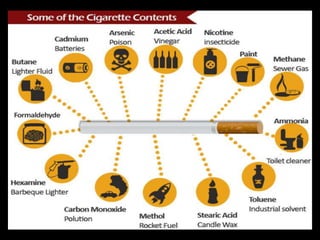
Cigarette contains
• Acetone
• Aluminum
• Ammonia
• Arsenic
• Benzene
• Butane
• Cadmium
• Carbon monoxide
• Carban dioxide
• chloroform
• Cyanide
• DDT
• Ethanol
• Formaldehyde
• Hydrogen cyanide
• Lead
• Methanol
• Nicotine
• Tar
• Vinyl Chloride
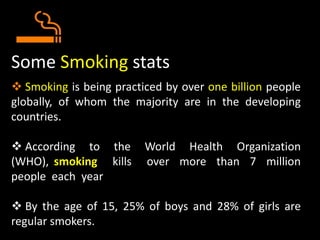
Some Smoking stats
 Smoking is being practiced by over one billion people
globally, of whom the majority are in the developing
countries.
 According to the World Health Organization
(WHO), smoking kills over more than 7 million
people each year
 By the age of 15, 25% of boys and 28% of girls are
regular smokers.
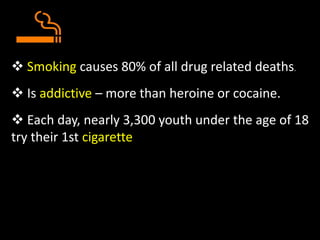
 Smoking causes 80% of all drug related deaths.
 Is addictive – more than heroine or cocaine.
 Each day, nearly 3,300 youth under the age of 18
try their 1st cigarette
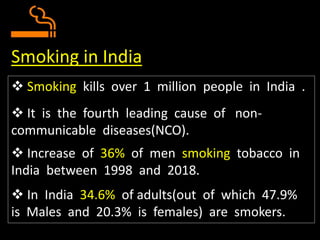
 Smoking kills over 1 million people in India .
 It is the fourth leading cause of non-
communicable diseases(NCO).
 Increase of 36% of men smoking tobacco in
India between 1998 and 2018.
 In India 34.6% of adults(out of which 47.9%
is Males and 20.3% is females) are smokers.
Smoking in India
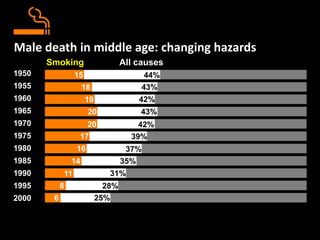
Male death in middle age: changing hazards
1950
1955
1960
1965
1970
1975
1980
1985
1990
1995
2000
44%
43%
42%
43%
42%
39%
37%
35%
31%
28%
25%
All causes
15
18
19
20
20
17
16
14
11
8
6
Smoking
why do some people smoke???
 lose weight
 you feel happy
 feeling relaxed
 Amuse your friends and be the life of the party
by blowing smoke rings
 you will look cool and modern with your friends
Peer Pressure
Short Term Effects of Smoking
• Every puff of cigarette contains a mixture of
nicotine and carbon monoxide and each time you
smoke, it temporarily increases your
• 1. Heart rate and
• 2. Blood pressure.
• 3. It also injures your heart and blood vessels.
• bad breath (caused by the chemicals found in the
cigarette)
• Yellow teeth (stained by the nicotine and tar)
• smelly clothes
• Difficulty keeping up with friends when playing
sports
• Empty wallet
• Causes air pollution
Long term effects of smoking
• Loss of Appetite
• Yellowing of teeth
• Yellowing of facial hair
• Halitosis (bad breath)
• Lung cancer
• Other cancers of the mouth and throat
Long term effects of smoking
• Heart disease
• Memory Loss with the passage of time
• Premature Aging
• Premature death
• Emphysema
• COPD
• Wrinkles
• Lung Cancer
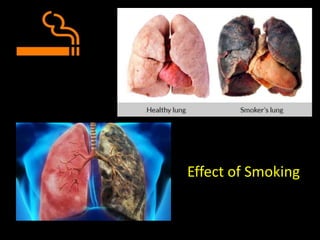
Lung Cancer
• The world over, Lung Cancer is said to be the
second most common cancer with low survival rates
and it is strongly linked to smoking. If you contact
Lung cancer from smoking, just know that it is as a
result of the tar in tobacco smoke. Men and women
who smoke are ten times more likely to die from
lung cancer than non-smokers.
Effect of Smoking
Effects of Smoking on Environment
Forest fires (Wildfires)
Air pollution through smoking
Takes 25 years to be discomposed into the land
Cigarette pollution in the environment also
affects the lives of animals
A single cigarette butt release enough toxins to
kill 50 percent of fish exposed to it for 96 hours
Case Study
Barack Obama
President Obama struggled to quit smoking during
his 2008 campaign. He had taken up the habit as a
teenager and didn’t successfully kick it until 2011,
according to reports from the White House and
Obama’s personal physician. Although he was
finally able to quit, it wasn’t easy. The president has
acknowledged that he still gets the urge to smoke
now and then and that he sometimes chews
nicotine gum to help quell the craving.
Case study II
Laura is a 51 year old healthy mother of two
adopted boys and a former cigarette smoker. Laura
smoked for 30 years. During that time she
attempted to quit several times and succeeded
once for two years. Laura quits 4 years ago and
since then has been using nicotine gum. This case
study tells about how she managed to quit
smoking
How Smoking works and Why It’s Hard to
Stop
Smoking affects mainly the function of the brain
Just 10 seconds after smoking a cigarette, nicotine is absorbed and
travels through the bloodstream to the brain. It stimulates adrenal
glands to produce epinephrine, a hormone and neurotransmitter you
also know as adrenaline. This increases heart rate and blood pressure
while constricting blood vessels; it also stimulates the production of
dopamine, a neurotransmitter that controls the brain's pleasure center
Why is it so hard to quit smoking?
Stopping or cutting back on tobacco causes symptoms of
nicotine withdrawal. Withdrawal is both physical and
mental. Physically, your body is reacting to the absence of
nicotine. Mentally, you are faced with giving up a habit,
which calls for a major change in behavior. Emotionally, you
might feel like as if you’ve lost your best friend.
•Dizziness
•Depression
•Frustration and anger
•Anxiety
•Irritability
•Trouble sleeping,
•Trouble concentrating
•Restlessness or boredom
•Headaches
•Tiredness
•Increased appetite
•Weight gain
•Slower heart rate
•Cough, dry mouth, sore
throat
•Chest tightness
Nicotine withdrawal symptoms can include any of
the following:
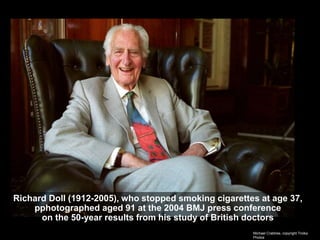
Richard Doll (1912-2005), who stopped smoking cigarettes at age 37,
pphotographed aged 91 at the 2004 BMJ press conference
on the 50-year results from his study of British doctors
Michael Crabtree, copyright Troika
Photos
Conclusion
• It is easy to become a smoker, but it is difficult to quit.
• If you are not started till now, a vow not to light your first
cigarette at any time in your life.
• If you are smoker, never to touch the next cigarette, and
avoid the company of your friends who still smokers.
• Never again light a cigarette for your entire lifetime,
because the difference between a chain smoker and
occasional is too thin to cross.
Thank You

Smoking

  • 1.
    The hazards ofsmoking and the benefits of stopping SAURAV RANJAN (19BCE0455) RIIJU JAGETIYA (19BCE0507) SATYANSH TEWARI (19BCE0520) MONIL MODI (19BCE0463)
  • 2.
    Basically Smoking isa practice in which a substance is burned and the resulting smoke breathed in to be tasted and absorbed into the bloodstream. Most commonly, the substance used is the dried leaves of the tobacco plant. What is smoking?
  • 3.
    Cigarette contains • Acetone •Aluminum • Ammonia • Arsenic • Benzene • Butane • Cadmium • Carbon monoxide • Carban dioxide • chloroform • Cyanide • DDT • Ethanol • Formaldehyde • Hydrogen cyanide • Lead • Methanol • Nicotine • Tar • Vinyl Chloride
  • 5.
    Some Smoking stats Smoking is being practiced by over one billion people globally, of whom the majority are in the developing countries.  According to the World Health Organization (WHO), smoking kills over more than 7 million people each year  By the age of 15, 25% of boys and 28% of girls are regular smokers.
  • 6.
     Smoking causes80% of all drug related deaths.  Is addictive – more than heroine or cocaine.  Each day, nearly 3,300 youth under the age of 18 try their 1st cigarette
  • 7.
     Smoking killsover 1 million people in India .  It is the fourth leading cause of non- communicable diseases(NCO).  Increase of 36% of men smoking tobacco in India between 1998 and 2018.  In India 34.6% of adults(out of which 47.9% is Males and 20.3% is females) are smokers. Smoking in India
  • 8.
    Male death inmiddle age: changing hazards 1950 1955 1960 1965 1970 1975 1980 1985 1990 1995 2000 44% 43% 42% 43% 42% 39% 37% 35% 31% 28% 25% All causes 15 18 19 20 20 17 16 14 11 8 6 Smoking
  • 9.
    why do somepeople smoke???  lose weight  you feel happy  feeling relaxed  Amuse your friends and be the life of the party by blowing smoke rings  you will look cool and modern with your friends Peer Pressure
  • 10.
    Short Term Effectsof Smoking • Every puff of cigarette contains a mixture of nicotine and carbon monoxide and each time you smoke, it temporarily increases your • 1. Heart rate and • 2. Blood pressure. • 3. It also injures your heart and blood vessels.
  • 11.
    • bad breath(caused by the chemicals found in the cigarette) • Yellow teeth (stained by the nicotine and tar) • smelly clothes • Difficulty keeping up with friends when playing sports • Empty wallet • Causes air pollution
  • 12.
    Long term effectsof smoking • Loss of Appetite • Yellowing of teeth • Yellowing of facial hair • Halitosis (bad breath) • Lung cancer • Other cancers of the mouth and throat
  • 13.
    Long term effectsof smoking • Heart disease • Memory Loss with the passage of time • Premature Aging • Premature death • Emphysema • COPD • Wrinkles • Lung Cancer
  • 14.
    Lung Cancer • Theworld over, Lung Cancer is said to be the second most common cancer with low survival rates and it is strongly linked to smoking. If you contact Lung cancer from smoking, just know that it is as a result of the tar in tobacco smoke. Men and women who smoke are ten times more likely to die from lung cancer than non-smokers.
  • 15.
  • 16.
    Effects of Smokingon Environment Forest fires (Wildfires) Air pollution through smoking Takes 25 years to be discomposed into the land Cigarette pollution in the environment also affects the lives of animals A single cigarette butt release enough toxins to kill 50 percent of fish exposed to it for 96 hours
  • 17.
  • 18.
    Barack Obama President Obamastruggled to quit smoking during his 2008 campaign. He had taken up the habit as a teenager and didn’t successfully kick it until 2011, according to reports from the White House and Obama’s personal physician. Although he was finally able to quit, it wasn’t easy. The president has acknowledged that he still gets the urge to smoke now and then and that he sometimes chews nicotine gum to help quell the craving.
  • 20.
    Case study II Laurais a 51 year old healthy mother of two adopted boys and a former cigarette smoker. Laura smoked for 30 years. During that time she attempted to quit several times and succeeded once for two years. Laura quits 4 years ago and since then has been using nicotine gum. This case study tells about how she managed to quit smoking
  • 21.
    How Smoking worksand Why It’s Hard to Stop Smoking affects mainly the function of the brain Just 10 seconds after smoking a cigarette, nicotine is absorbed and travels through the bloodstream to the brain. It stimulates adrenal glands to produce epinephrine, a hormone and neurotransmitter you also know as adrenaline. This increases heart rate and blood pressure while constricting blood vessels; it also stimulates the production of dopamine, a neurotransmitter that controls the brain's pleasure center
  • 22.
    Why is itso hard to quit smoking? Stopping or cutting back on tobacco causes symptoms of nicotine withdrawal. Withdrawal is both physical and mental. Physically, your body is reacting to the absence of nicotine. Mentally, you are faced with giving up a habit, which calls for a major change in behavior. Emotionally, you might feel like as if you’ve lost your best friend.
  • 23.
    •Dizziness •Depression •Frustration and anger •Anxiety •Irritability •Troublesleeping, •Trouble concentrating •Restlessness or boredom •Headaches •Tiredness •Increased appetite •Weight gain •Slower heart rate •Cough, dry mouth, sore throat •Chest tightness Nicotine withdrawal symptoms can include any of the following:
  • 26.
    Richard Doll (1912-2005),who stopped smoking cigarettes at age 37, pphotographed aged 91 at the 2004 BMJ press conference on the 50-year results from his study of British doctors Michael Crabtree, copyright Troika Photos
  • 27.
    Conclusion • It iseasy to become a smoker, but it is difficult to quit. • If you are not started till now, a vow not to light your first cigarette at any time in your life. • If you are smoker, never to touch the next cigarette, and avoid the company of your friends who still smokers. • Never again light a cigarette for your entire lifetime, because the difference between a chain smoker and occasional is too thin to cross.
  • 28.