Dr. M. Uwais Ashraf
Department of Medicine
Centre of Cardiology
J N Medical College
AMU, Aligarh
 Introduction:
 5 million people in the world die of active smoking and more than
600000 nonsmokers die from exposure to passive smoke annually [1].
 Smoking is recognised as one of the major preventable causes of death.
 It significantly increases the chances of developing a respiratory
disorder and over half of respiratory disease related deaths are due to
smoking [2,3].
 The risk of serious disease diminishes rapidly after quitting and life-long
abstinence is known to reduce the risk of lung cancer, heart disease,
strokes, chronic lung disease and other cancers [4].
1. World Health Organization. Tobacco Factsheet. Fact sheet Nu339. Date last accessed: July 7th, 2014. Date last updated:
May 14, 2014.
2. Gibson GJ, Loddenkemper R, Sibille Y, et al., eds. European Lung White Book. 2nd Edn. Sheffield, European Respiratory
Society, 2013.
3. Ward B. www.smokehaz.eu – a review of the evidence on smoking and lung health. Eur Respir J 2014; 44: 20–22.
Health effects of smoking
Eyes Macular degeneration
Hair Hair loss
Skin Aging, wrinkles, wound infection
Brain Stroke
Mouth and
pharynx
Cancer, gum disease
Lungs Cancer, chronic obstructive pulmonary disease (emphysema and chronic bronchitis),
pneumonia, asthma
Heart Coronary artery disease, raised blood pressure
Stomach Cancer, ulcer
Pancreas Cancer, increase blood glucose levels and less control over blood glucose levels
Bladder Cancer
Women Cervical cancer, early menopause, irregular and painful periods, infertility
Men Impotence
Arteries Peripheral vascular disease
Bone Osteoporosis
Smoking Kills More Americans than
All of these Combined
AIDS
Car crashes
Heroin
Homicide
Alcohol
Fires
Cocaine
Suicide
 Each day, 1,200 Americans
die from smoking
 Each smoker who dies is
replaced by 2 young
smokers
 90% of all smokers start
before age 18
 99% of all smokers
start before age 26
The Dirty Dozen
Acetone (solvent and paint
stripper)
Ammonia (poisonous gas and
toilet bowl cleaner)
Arsenic (potent ant poison)
Benzene (poisonous toxin)
Butane (flammable chemical in
lighter fluid)
Cadmium (carcinogenic chemical
in batteries; lung & intestinal
irritant)
Carbon monoxide (poisonous
gas in auto exhaust)
Formaldehyde (dead frogs love it)
Hydrogen cyanide (deadly
ingredient in rat poison)
Methanol (jet engine and rocket fuel)
Polonium-210 (radioactive element
and spy-killer)
Toluene (poisonous industrial solvent)
Health benefits of quitting
12 hours Blood levels of carbon monoxide are significantly decreased
5 days Improvements in the sense of taste and smell
6 weeks Risk of wound infection after surgery substantially reduced
3 months Lung function is improving as cilia recover
1 year Risk of coronary heart disease is halved after one year compared to
continuing smokers
10 years Risk of lung cancer is halved and continues to decline
15 years All cause mortality falls to the same level as for those who have never
smoked
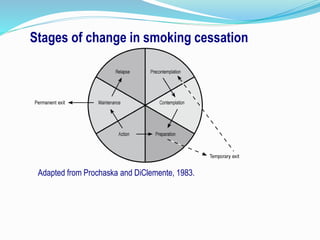
Stages of change in smoking cessation
Adapted from Prochaska and DiClemente, 1983.
Stage Behaviour Intervention Questions to ask
Precontemplation – no
thoughts about changing
behaviour
Not considering stopping
smoking in the next 6 months
Discuss negative consequences
of smoking. Provide information
rather than be judgmental.
Are you thinking of quitting
in the near future?
Contemplation –
thoughts about the need
to change but no action
taken yet
Considering quitting in the
next 6 months but no action
taken yet
Raise patient's consciousness
of smoking through information;
give emotional support and
assist in identifying people who
will be supportive (eg. offer Quit
kit literature)
Why do you want to quit?
What things have stopped
you from trying to quit?
How confident are you that
you can quit?
Who can you ask to support
you during this time?
Action – attempts made
to change behaviour and
avoid environmental
'triggers'
Attempt made to quit smoking
in the last 6 months
Provide emotional support and
encouragement; help identify
triggers for smoking and
promote new behaviours to take
the place of smoking
Are you confident you can
continue not smoking?
What situations make you
feel like smoking?
How do you deal with these
situations?
Maintenance –
behaviour has been
changed and person is
adjusting to these
changes and working to
prevent relapse
Has not smoked for at least 6
months; the person is
adjusting to change and
working to prevent relapse
Continue supportive approach;
discuss possible problems that
may lead to relapse
Do you see yourself as a
nonsmoker?
What do you do when you
feel like smoking?
What have been the benefits
of quitting?
Fagerstrom Nicotine Dependence Questionnaire
Questions Answer Score
1. How soon after you wake up do you smoke your first
cigarette?
Within 5 min
6–30 min
31–60 min
after 60 min
3
2
1
0
2. Do you find it difficult to refrain from smoking in public? Yes
No
1
0
3. Which cigarette would you hate to give up most? The first one in the morning
Any other
1
0
4. How many cigarettes a day do you smoke? 31 or more
21–30
11–20
10 or less
3
2
1
0
5. Do you smoke more frequently during the first hours after
waking than during the rest of the day?
Yes
No
1
0
Total_____
8–10 = high dependence; 5–7 moderate dependence; 1–4 = low dependence
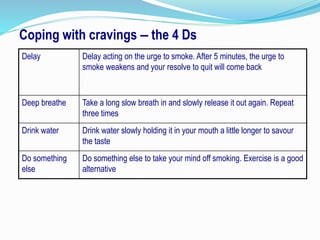
Coping with cravings – the 4 Ds
Delay Delay acting on the urge to smoke. After 5 minutes, the urge to
smoke weakens and your resolve to quit will come back
Deep breathe Take a long slow breath in and slowly release it out again. Repeat
three times
Drink water Drink water slowly holding it in your mouth a little longer to savour
the taste
Do something
else
Do something else to take your mind off smoking. Exercise is a good
alternative
Nicotine replacement therapy
• The aim of NRT is to replace nicotine from cigarettes without other harmful components of
tobacco smoke
• Reduces withdrawal symptoms.
Nicotine transdermal patch
• Usually first choice, simple to use
• Can be combined with an intermittent form of NRT
• Initial recommended dosage:
Patient group Initial dose Duration
>10 cigarettes/day or weight
>45 kg
21 mg/24 hour patch or 15 mg/16
hours
At least 8
weeks
<10 cigarettes/day or weight
<45 kg or cardiovascular
disease
14 mg/24 hour patch or 10 mg/16
hours
At least 8
weeks
•
Most common adverse effects: skin irritation
and sleep disturbance.
INHALER
• Useful for patients who miss the ‘hand to mouth’
action of smoking
• Initial recommended dosage: 6–12 cartridges/day for
12 weeks followed by 3–6/day for 2 weeks and 1–
3/day for 2 weeks
• Most common adverse effect: throat irritation.
Gum
• Useful for those who cannot tolerate patches or who require
combination therapy
• Initial recommended dosage:
•
Most common adverse effects: gastrointestinal disturbances,
dyspepsia, nausea and hiccups, occasional headache if the gum
is chewed too quickly, jaw pain and dental problems.
Patients who smoke <20
cigarettes/day
2 mg Use one piece of gum/hour. Should be tapered
over 3 months
Patients who smoke >20
cigarettes/day
4 mg Use one piece of gum/hour. Should be tapered
over 3 months
Lozenge
• Useful for patients who cannot use patches, need combination therapy
or do not wish to use nicotine gum
• Initial recommended dosage:
•
Most common adverse effects: gastric and throat irritation.
Patients who smoke their first
cigarette >30 minutes after waking
2 mg
lozenge
One lozenge can be used every 1–2
hours to a maximum of 15 20 or 4mg
lozenges/day
Patients who smoke their first
cigarette within 30 minutes of waking
4 mg
lozenge
One lozenge can be used every 1–2
hours to a maximum of 15 20 or 4mg
lozenges/day
Microtabs
• Also known as sublingual tablet
• Useful for patients who cannot use patches or those needing
combination therapy; may be particularly useful for mothers who
are breastfeeding
• Initial recommended dosage:
• Most common adverse effects: mouth and throat irritation,
gastrointestinal upset and cough.
Patients who smoke their first cigarette >30 minutes after waking 1 x 2 mg
microtab
1–2 microtabs can be used every 1–2
hours to a maximum of 40 microtabs/day
Patients who smoke their first cigarette within 30 minutes of waking 2 x 2 mg
microtabs
1–2 microtabs can be used every 1–2
hours to a maximum of 40 microtabs/day
Cut down and quit
Step When Goal
Step 1 0–6 weeks Cut down to 50% of baseline cigarette
consumption
Step 2 6 weeks to 6 months Continue to cut down; stop completely by 6
months
Step 3 6–9 months Stop smoking completely, continue NRT
Step 4 within 12 months Stop using NRT by 12 months
Nicotine replacement therapy: cautions and
contraindications
Contraindicated Nonsmokers; those with sensitivity to
nicotine; children aged less than 12
years
Use with caution under medical
supervision in hospital
Dependent smokers with recent
myocardial infarction, severe cardiac
arrhythmias or
with recent cerebrovascular accident
Use with care only when benefits
outweigh risks
Patients who weigh <45 kg; patients
with recent or planned angioplasty,
bypass grafting or stenting; patients
with unstable angina; pregnant or
lactating women
BUPROPION
• Non-nicotine oral therapy
• Unknown mechanism of action
• Helps to reduce withdrawal symptoms
• Recommended dose: 150 mg once per day for 3 days,
increasing to 150 mg twice per day with an 8 hour interval
between doses
• Main adverse effects: insomnia, headache, dry mouth,
nausea, dizziness and anxiety
• Serious adverse events: rare incidences of seizures.
Bupropion: contraindications
• allergy to bupropion
• past or current seizures
• known central nervous system tumours
• patients undergoing abrupt withdrawal from alcohol or
benzodiazepines
• current or previous history of bulimia or anorexia
nervosa
• use of monoamine oxidase inhibitors within the past
14 days.
OTHER OR FUTURE OPTIONS
• Clonidine
• Nortryptiline
• Varenicline.
ENDS
•The electronic-cigarette (e-Cigarette) is a battery-
powered electronic nicotine delivery systems (ENDS)
•Resembles a cigarette designed for the purpose of
nicotine delivery, where no tobacco or combustion is
necessary for its operation.
•The first of these devices was invented by a Chinese
pharmacist, Hon Lik, in 2003.
•Electronic cigarettes (ECs) have been introduced to
the market in recent years as an alternative-to-
smoking habit.
•They are battery-driven devices that vaporise a
liquid containing mainly nicotine, propylene glycol,
glycerine, water and flavourings (according to
manufacturers’ reports). [1]
•By using this device (commonly called ―vaping‖),
nicotine is delivered to the upper and lower
respiratory tract without any combustion involved.
1. Konstantinos E. Farsalinos 1,*, Giorgio Romagna 2, Dimitris Tsiapras 1, et al. Evaluation of Electronic
Cigarette Use (Vaping) Topography and Estimation of Liquid Consumption: Implications for Research
Protocol Standards Definition and for Public Health Authorities’ Regulation. Int. J. Environ. Res. Public
Health 2013,
 ENDS, of which electronic cigarettes are the most
common prototype, deliver an aerosol by heating a
solution that users inhale.
 The main constituents of the solution by volume, in
addition to nicotine are propylene glycol, with or
without glycerol and flavouring agents.
 US patent application – an electronic atomization
cigarette that functions as a substitute for quitting
smoking.
 E-cigarette products varied from country to country.
WHO framework convention on tobaco control.
•Although some ENDS are shaped to look like their conventional
tobacco counterparts (e.g. cigarettes, cigars, cigarillos, pipes, or
hookahs), they also take the form of everyday items such as
pens, USB memory sticks, and larger cylindrical or rectangular
devices.
•Marketing by multinationals / internet / print advertisement –
•Healthier alternative / Useful for quitting, smoking
?? Really true
 The use of ENDS is apparently booming.
 It is estimated that in 2014 there were 466 brands [1]
and that in 2013 US$ 3 billion was spent on ENDS
globally.
 Sales are forecasted to increase by a factor of 17 by
2030.
 Unanswered question about safety, efficacy for harm
reduction/smoking cessation/impact of public health.
1. Regan AK, Promoff G, Dube SR, Arrazola R. Electronic nicotine delivery systems: adult use and
awareness of the “e-cigarette” in the USA. Tob Control. 2013;22:19–23.
 E-Cigarette E-Fluid and Vapor
 Simulated e-cigarette use revealed that individual
puffs contained from 0 to 35 μg nicotine per puff
[1].
 A puff of the e-cigarette with the highest nicotine
content contained 20% of the nicotine contained
in a puff of a conventional cigarette.
 The levels of toxicants in the aerosol were 1 to 2
orders of magnitude lower than in cigarette smoke
but higher than with a nicotine inhaler [2].
 Level of nitrosamine concentration-3 order
magnitude variation.
1. Goniewicz ML, Kuma T, Gawron M, Knysak J, Kosmider L. Nicotine levels in electronic cigarettes.
Nicotine Tob Res. 2013;15:158–166.
2. Goniewicz ML, Knysak J, Gawron M, Kosmider L, Sobczak A, Kurek J, Prokopowicz A, Jablonska-Czapla
M, Rosik-Dulewska C, Havel C. Levels of selected carcinogens and toxicants in vapour from electronic
cigarettes. Tob Control. 2014;23:133–139.
E-Smoke
 Flavoring agents
 Along with availability of cigarettes and tobacco
products.
 Dual smoking
 Newer designs not properly tested
 Requirement of evidence based regulatory scheme
*WHOFCTC
E-Products (ENDS)
 Brands:
 Disposable – NJOY
 Rechargeable – Blue
 Pen Style – Vapor King
 Tank Style – Volcano
 E-Website – Popular Claims
 Healthier – 95%
 Cheaper – 93%
 Cleaner – 95%
 Smoke anywhere – 88% (before scientific evidence)
* Circulation 2014
Prevalence
 Doubled in UK, USA – 2008-2012
 Korea – 0.5% in 2008 – 9.4% in 2012
 Utah Youth – Increase 3 times – 2011-2013
 Dual Smoking – 61% increase in US Middle School
Students
 Highest rate among current smokers and former
smokers most appealing in youth
* Chai and Foster (Mid Western Young Adults).
Cytotoxicity
 Bahl et al screened 41 e-cigarette refill fluids from
4 companies - 3 cell types: human pulmonary
fibroblasts, human embryonic stem cells, and
mouse neural stem cells.
 Cytotoxicity varied among products from highly
toxic to low or no cytotoxicity.
 More cytotoxic on stem cells
 Farsalino’s – cytotoxicity on cultured rat cardiac
myoblasts.
 Cytotoxicity was related to the concentration and
number of flavorings used.
 Bahl V, Lin S, Xu N, Davis B, Wang YH, Talbot P. Comparison of electronic cigarette refill fluid
cytotoxicity using embryonic and adult models. Reprod Toxicol. 2012;34:529–537.
 The finding that the stem cells are more sensitive than
the differentiated adult pulmonary fibroblasts cells
suggests that adult lungs are probably not the most
sensitive system to assess the effects of exposure to e-
cigarette aerosol.
 These findings also raise concerns about pregnant
women who use e-cigarettes or are exposed to
secondhand e-cigarette aerosol.
*JAMA Intern Medicine - 2014
 Secondhand Exposure
 E-cigarettes do not burn or smolder the way
conventional cigarettes do, so they do not emit side-
stream smoke;
 E-cigarette aerosol is not a source of exposure to
carbon monoxide, a key combustion element of
conventional cigarette smoke.
 Schripp et al. – Low level of toxins vs. traditional –
Formaldehyde / Acetaldehyde – Isoprene/Acetone et
al.
 Czogala J, Goniewicz ML, Fidelus B, Zielinska-Danch W, Travers MJ, Sobczak A.
Secondhand exposure to vapors from electronic cigarettes [published online ahead of print
December 11, 2013]. Nicotine Tob Res. doi: 0.1093/ntr/ntt203.
Particulate Matter
 The particle size distribution and number of particles
delivered by e-cigarettes are similar to those of
conventional cigarettes, with most particles in the ultrafine
range (modes, ≈100–200 nm). [1]
 The thresholds for human toxicity of potential toxicants in
e-cigarette vapor are not known.
 Serum cotinine level similar in non-smokers
 Not a source of carbon-monooxide
 Room air contains possible carcinogens – polycyclic
aromatic hydrocarbons.
1. Zhang Y, Sumner W, Chen DR. In vitro particle size distributions in electronic and
conventional cigarette aerosols suggest comparable deposition patterns. Nicotine
Tob Res. 2013;15:501–508.
Particle number distribution from (A)mainstream aerosol in e-liquid 1 and from (B)
conventional cigarette. Reproduced from Fuoco et al55 with permission from the
publisher. Copyright © 2013 Elsevier Ltd.
 Nicotine Absorption
 Early studies of nicotine absorption in 2010 found that
e-cigarettes delivered much lower levels of plasma
nicotine than conventional cigarettes.[1]
 Several studies reported that regardless of nicotine
delivery, e-cigarettes can modestly alleviate some
symptoms of withdrawal, and participants
positively appraised the use of e-cigarettes.[2]
1. Bullen C, McRobbie H, Thornley S, Glover M, Lin R, Laugesen M. Effect of an electronic nicotine
delivery device (e cigarette) on desire to smoke and withdrawal, user preferences and nicotine delivery:
randomised cross- over trial. Tob Control. 2010;19:98–103.
2. Vansickel AR, Eissenberg T. Electronic cigarettes: effective nicotine delivery after acute
administration. Nicotine Tob Res. 2013;15:267–270.
 Health Effects
 Exposure to propylene glycol can cause eye and
respiratory irritation, and prolonged or repeated
inhalation in industrial settings may affect the central
nervous system, behavior, and the spleen [1].
 Increase dynamic airway resistance and decrease NO
 Increase WBC after smoking
 Carcinogenic
 PM – 120-165 nm – Alveoli/Arterial Delivery
Airways/Venous Delivery
1. Sciencelab.com, Inc. Material Data Safety Sheet: Propylene Glycol. Updated May 21, 2013.
Sciencelab.com, Inc., Houston, TX.
2. Chen IL. FDA summary of adverse events on electronic cigarettes. Nicotine Tob Res. 2013;15:615–
616.
Particulate Matter
 Particle number increase 400 / cm3 < 2 hrs after ENDS
Increase to 49000 – 88000 / cm3 > 2 hrs (Schober et
al.)
 Polyfil fibres on heating – metals
 Tin/Copper – Toxic to human fibroblast
 Engineering features influence nature / number / size
of pm.
 Depends on nicotine level in E-liquid not on flavors.
 Effects on Cessation of Conventional Cigarettes
 E-cigarettes are promoted as smoking cessation aids
 Many individuals who use e-cigarettes believe that they will help
them quit smoking conventional cigarettes [1].
 Adkison et al studied current and former smokers in the
International Tobacco Control study in the United States, Canada,
the United Kingdom, and Australia at baseline and 1 year later and
found that e-cigarette users had a statistically significant greater
reduction in cigarettes per day [2].
 1. Etter JF, Bullen C. Electronic cigarette: users profile, utilization, satisfaction and perceived efficacy. Addiction.
2011;106:2017–2028.
 2. Adkison SE, O’Connor RJ, Bansal-Travers M, Hyland A, Borland R, Yong HH, Cummings KM, McNeill A, Thrasher JF,
Hammond D, Fong
GT. Electronic nicotine delivery systems: international tobacco control four- country survey. Am J Prev Med.
2013;44:207–215.
Clinical Trials
 Four clinical trials (2 with very small samples) examined
the efficacy of e-cigarettes for smoking cessation.
 Taken together, these studies suggest that
 e-cigarettes are not associated with successful quitting in
general population-based samples of smokers. [1, 2]
 1. Polosa R, Caponnetto P, Morjaria JB, Papale G, Campagna D, Russo C. Effect of an electronic
nicotine delivery device (e-cigarette) on smoking reduction and cessation: a prospective 6-month
pilot study. BMC Public Health. 2011;11:786.
 2. Caponnetto P, Campagna D, Cibella F, Morjaria JB, Caruso M, Russo C, Polosa R. EffiCiency
and Safety of an eLectronic cigAreTte (ECLAT) as tobacco cigarettes substitute: a prospective 12-
month randomized control design study. PLoS One. 2013;8:e66317.
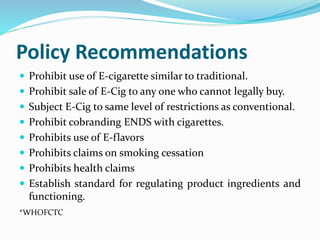
Policy Recommendations
 Prohibit use of E-cigarette similar to traditional.
 Prohibit sale of E-Cig to any one who cannot legally buy.
 Subject E-Cig to same level of restrictions as conventional.
 Prohibit cobranding ENDS with cigarettes.
 Prohibits use of E-flavors
 Prohibits claims on smoking cessation
 Prohibits health claims
 Establish standard for regulating product ingredients and
functioning.
*WHOFCTC
 The ultimate effect of e-cigarettes on public health will
depend on what happens in the policy environment.
 These policies should be implemented to protect
public health:
 Prohibit the use of e-cigarettes anywhere that use of
conventional cigarettes is prohibited.
 Prohibit the sale of e-cigarettes to anyone who cannot
legally buy cigarettes or in any venues where sale of
conventional cigarettes is prohibited.
 Subject e-cigarette marketing to the same level of
restrictions that apply to conventional cigarettes
(including no television or radio advertising).
 Prohibit cobranding e-cigarettes with cigarettes or
marketing in a way that promotes dual use.
 Prohibit the use of characterizing flavors in e-cigarettes,
particularly candy and alcohol flavors.
 Prohibit claims that e-cigarettes are effective smoking
cessation aids until e-cigarette manufacturers and
companies provide sufficient evidence that e-cigarettes
can be used effectively for smoking cessation.
 Prohibit any health claims for e-cigarette products until
and unless approved by regulatory agencies to scientific
and regulatory standards.
 Establish standards for regulating product ingredients
and functioning.
Conclusions
 Although data are limited, it is clear that e-cigarette
emissions are not merely “harmless water vapor,” as is
frequently claimed.
 These can be a source of indoor air pollution.
 Introducing e-cigarettes into clean air environments
may result in population harm
 Premature to lay claims on ENDS
 Marketing claims – No scientific evidence.
 Long term studies required
Have A Nice Day

Electronic smoking

  • 1.
    Dr. M. UwaisAshraf Department of Medicine Centre of Cardiology J N Medical College AMU, Aligarh
  • 2.
     Introduction:  5million people in the world die of active smoking and more than 600000 nonsmokers die from exposure to passive smoke annually [1].  Smoking is recognised as one of the major preventable causes of death.  It significantly increases the chances of developing a respiratory disorder and over half of respiratory disease related deaths are due to smoking [2,3].  The risk of serious disease diminishes rapidly after quitting and life-long abstinence is known to reduce the risk of lung cancer, heart disease, strokes, chronic lung disease and other cancers [4]. 1. World Health Organization. Tobacco Factsheet. Fact sheet Nu339. Date last accessed: July 7th, 2014. Date last updated: May 14, 2014. 2. Gibson GJ, Loddenkemper R, Sibille Y, et al., eds. European Lung White Book. 2nd Edn. Sheffield, European Respiratory Society, 2013. 3. Ward B. www.smokehaz.eu – a review of the evidence on smoking and lung health. Eur Respir J 2014; 44: 20–22.
  • 4.
    Health effects ofsmoking Eyes Macular degeneration Hair Hair loss Skin Aging, wrinkles, wound infection Brain Stroke Mouth and pharynx Cancer, gum disease Lungs Cancer, chronic obstructive pulmonary disease (emphysema and chronic bronchitis), pneumonia, asthma Heart Coronary artery disease, raised blood pressure Stomach Cancer, ulcer Pancreas Cancer, increase blood glucose levels and less control over blood glucose levels Bladder Cancer Women Cervical cancer, early menopause, irregular and painful periods, infertility Men Impotence Arteries Peripheral vascular disease Bone Osteoporosis
  • 5.
    Smoking Kills MoreAmericans than All of these Combined AIDS Car crashes Heroin Homicide Alcohol Fires Cocaine Suicide
  • 6.
     Each day,1,200 Americans die from smoking  Each smoker who dies is replaced by 2 young smokers  90% of all smokers start before age 18  99% of all smokers start before age 26
  • 7.
    The Dirty Dozen Acetone(solvent and paint stripper) Ammonia (poisonous gas and toilet bowl cleaner) Arsenic (potent ant poison) Benzene (poisonous toxin) Butane (flammable chemical in lighter fluid) Cadmium (carcinogenic chemical in batteries; lung & intestinal irritant) Carbon monoxide (poisonous gas in auto exhaust) Formaldehyde (dead frogs love it) Hydrogen cyanide (deadly ingredient in rat poison) Methanol (jet engine and rocket fuel) Polonium-210 (radioactive element and spy-killer) Toluene (poisonous industrial solvent)
  • 8.
    Health benefits ofquitting 12 hours Blood levels of carbon monoxide are significantly decreased 5 days Improvements in the sense of taste and smell 6 weeks Risk of wound infection after surgery substantially reduced 3 months Lung function is improving as cilia recover 1 year Risk of coronary heart disease is halved after one year compared to continuing smokers 10 years Risk of lung cancer is halved and continues to decline 15 years All cause mortality falls to the same level as for those who have never smoked
  • 9.
    Stages of changein smoking cessation Adapted from Prochaska and DiClemente, 1983.
  • 10.
    Stage Behaviour InterventionQuestions to ask Precontemplation – no thoughts about changing behaviour Not considering stopping smoking in the next 6 months Discuss negative consequences of smoking. Provide information rather than be judgmental. Are you thinking of quitting in the near future? Contemplation – thoughts about the need to change but no action taken yet Considering quitting in the next 6 months but no action taken yet Raise patient's consciousness of smoking through information; give emotional support and assist in identifying people who will be supportive (eg. offer Quit kit literature) Why do you want to quit? What things have stopped you from trying to quit? How confident are you that you can quit? Who can you ask to support you during this time? Action – attempts made to change behaviour and avoid environmental 'triggers' Attempt made to quit smoking in the last 6 months Provide emotional support and encouragement; help identify triggers for smoking and promote new behaviours to take the place of smoking Are you confident you can continue not smoking? What situations make you feel like smoking? How do you deal with these situations? Maintenance – behaviour has been changed and person is adjusting to these changes and working to prevent relapse Has not smoked for at least 6 months; the person is adjusting to change and working to prevent relapse Continue supportive approach; discuss possible problems that may lead to relapse Do you see yourself as a nonsmoker? What do you do when you feel like smoking? What have been the benefits of quitting?
  • 11.
    Fagerstrom Nicotine DependenceQuestionnaire Questions Answer Score 1. How soon after you wake up do you smoke your first cigarette? Within 5 min 6–30 min 31–60 min after 60 min 3 2 1 0 2. Do you find it difficult to refrain from smoking in public? Yes No 1 0 3. Which cigarette would you hate to give up most? The first one in the morning Any other 1 0 4. How many cigarettes a day do you smoke? 31 or more 21–30 11–20 10 or less 3 2 1 0 5. Do you smoke more frequently during the first hours after waking than during the rest of the day? Yes No 1 0 Total_____ 8–10 = high dependence; 5–7 moderate dependence; 1–4 = low dependence
  • 12.
    Coping with cravings– the 4 Ds Delay Delay acting on the urge to smoke. After 5 minutes, the urge to smoke weakens and your resolve to quit will come back Deep breathe Take a long slow breath in and slowly release it out again. Repeat three times Drink water Drink water slowly holding it in your mouth a little longer to savour the taste Do something else Do something else to take your mind off smoking. Exercise is a good alternative
  • 13.
    Nicotine replacement therapy •The aim of NRT is to replace nicotine from cigarettes without other harmful components of tobacco smoke • Reduces withdrawal symptoms.
  • 14.
    Nicotine transdermal patch •Usually first choice, simple to use • Can be combined with an intermittent form of NRT • Initial recommended dosage: Patient group Initial dose Duration >10 cigarettes/day or weight >45 kg 21 mg/24 hour patch or 15 mg/16 hours At least 8 weeks <10 cigarettes/day or weight <45 kg or cardiovascular disease 14 mg/24 hour patch or 10 mg/16 hours At least 8 weeks • Most common adverse effects: skin irritation and sleep disturbance.
  • 15.
    INHALER • Useful forpatients who miss the ‘hand to mouth’ action of smoking • Initial recommended dosage: 6–12 cartridges/day for 12 weeks followed by 3–6/day for 2 weeks and 1– 3/day for 2 weeks • Most common adverse effect: throat irritation.
  • 16.
    Gum • Useful forthose who cannot tolerate patches or who require combination therapy • Initial recommended dosage: • Most common adverse effects: gastrointestinal disturbances, dyspepsia, nausea and hiccups, occasional headache if the gum is chewed too quickly, jaw pain and dental problems. Patients who smoke <20 cigarettes/day 2 mg Use one piece of gum/hour. Should be tapered over 3 months Patients who smoke >20 cigarettes/day 4 mg Use one piece of gum/hour. Should be tapered over 3 months
  • 17.
    Lozenge • Useful forpatients who cannot use patches, need combination therapy or do not wish to use nicotine gum • Initial recommended dosage: • Most common adverse effects: gastric and throat irritation. Patients who smoke their first cigarette >30 minutes after waking 2 mg lozenge One lozenge can be used every 1–2 hours to a maximum of 15 20 or 4mg lozenges/day Patients who smoke their first cigarette within 30 minutes of waking 4 mg lozenge One lozenge can be used every 1–2 hours to a maximum of 15 20 or 4mg lozenges/day
  • 18.
    Microtabs • Also knownas sublingual tablet • Useful for patients who cannot use patches or those needing combination therapy; may be particularly useful for mothers who are breastfeeding • Initial recommended dosage: • Most common adverse effects: mouth and throat irritation, gastrointestinal upset and cough. Patients who smoke their first cigarette >30 minutes after waking 1 x 2 mg microtab 1–2 microtabs can be used every 1–2 hours to a maximum of 40 microtabs/day Patients who smoke their first cigarette within 30 minutes of waking 2 x 2 mg microtabs 1–2 microtabs can be used every 1–2 hours to a maximum of 40 microtabs/day
  • 19.
    Cut down andquit Step When Goal Step 1 0–6 weeks Cut down to 50% of baseline cigarette consumption Step 2 6 weeks to 6 months Continue to cut down; stop completely by 6 months Step 3 6–9 months Stop smoking completely, continue NRT Step 4 within 12 months Stop using NRT by 12 months
  • 20.
    Nicotine replacement therapy:cautions and contraindications Contraindicated Nonsmokers; those with sensitivity to nicotine; children aged less than 12 years Use with caution under medical supervision in hospital Dependent smokers with recent myocardial infarction, severe cardiac arrhythmias or with recent cerebrovascular accident Use with care only when benefits outweigh risks Patients who weigh <45 kg; patients with recent or planned angioplasty, bypass grafting or stenting; patients with unstable angina; pregnant or lactating women
  • 21.
    BUPROPION • Non-nicotine oraltherapy • Unknown mechanism of action • Helps to reduce withdrawal symptoms • Recommended dose: 150 mg once per day for 3 days, increasing to 150 mg twice per day with an 8 hour interval between doses • Main adverse effects: insomnia, headache, dry mouth, nausea, dizziness and anxiety • Serious adverse events: rare incidences of seizures.
  • 22.
    Bupropion: contraindications • allergyto bupropion • past or current seizures • known central nervous system tumours • patients undergoing abrupt withdrawal from alcohol or benzodiazepines • current or previous history of bulimia or anorexia nervosa • use of monoamine oxidase inhibitors within the past 14 days.
  • 23.
    OTHER OR FUTUREOPTIONS • Clonidine • Nortryptiline • Varenicline.
  • 24.
    ENDS •The electronic-cigarette (e-Cigarette)is a battery- powered electronic nicotine delivery systems (ENDS) •Resembles a cigarette designed for the purpose of nicotine delivery, where no tobacco or combustion is necessary for its operation. •The first of these devices was invented by a Chinese pharmacist, Hon Lik, in 2003.
  • 25.
    •Electronic cigarettes (ECs)have been introduced to the market in recent years as an alternative-to- smoking habit. •They are battery-driven devices that vaporise a liquid containing mainly nicotine, propylene glycol, glycerine, water and flavourings (according to manufacturers’ reports). [1] •By using this device (commonly called ―vaping‖), nicotine is delivered to the upper and lower respiratory tract without any combustion involved. 1. Konstantinos E. Farsalinos 1,*, Giorgio Romagna 2, Dimitris Tsiapras 1, et al. Evaluation of Electronic Cigarette Use (Vaping) Topography and Estimation of Liquid Consumption: Implications for Research Protocol Standards Definition and for Public Health Authorities’ Regulation. Int. J. Environ. Res. Public Health 2013,
  • 26.
     ENDS, ofwhich electronic cigarettes are the most common prototype, deliver an aerosol by heating a solution that users inhale.  The main constituents of the solution by volume, in addition to nicotine are propylene glycol, with or without glycerol and flavouring agents.  US patent application – an electronic atomization cigarette that functions as a substitute for quitting smoking.  E-cigarette products varied from country to country. WHO framework convention on tobaco control.
  • 27.
    •Although some ENDSare shaped to look like their conventional tobacco counterparts (e.g. cigarettes, cigars, cigarillos, pipes, or hookahs), they also take the form of everyday items such as pens, USB memory sticks, and larger cylindrical or rectangular devices. •Marketing by multinationals / internet / print advertisement – •Healthier alternative / Useful for quitting, smoking ?? Really true
  • 28.
     The useof ENDS is apparently booming.  It is estimated that in 2014 there were 466 brands [1] and that in 2013 US$ 3 billion was spent on ENDS globally.  Sales are forecasted to increase by a factor of 17 by 2030.  Unanswered question about safety, efficacy for harm reduction/smoking cessation/impact of public health. 1. Regan AK, Promoff G, Dube SR, Arrazola R. Electronic nicotine delivery systems: adult use and awareness of the “e-cigarette” in the USA. Tob Control. 2013;22:19–23.
  • 29.
     E-Cigarette E-Fluidand Vapor  Simulated e-cigarette use revealed that individual puffs contained from 0 to 35 μg nicotine per puff [1].  A puff of the e-cigarette with the highest nicotine content contained 20% of the nicotine contained in a puff of a conventional cigarette.  The levels of toxicants in the aerosol were 1 to 2 orders of magnitude lower than in cigarette smoke but higher than with a nicotine inhaler [2].  Level of nitrosamine concentration-3 order magnitude variation. 1. Goniewicz ML, Kuma T, Gawron M, Knysak J, Kosmider L. Nicotine levels in electronic cigarettes. Nicotine Tob Res. 2013;15:158–166. 2. Goniewicz ML, Knysak J, Gawron M, Kosmider L, Sobczak A, Kurek J, Prokopowicz A, Jablonska-Czapla M, Rosik-Dulewska C, Havel C. Levels of selected carcinogens and toxicants in vapour from electronic cigarettes. Tob Control. 2014;23:133–139.
  • 30.
    E-Smoke  Flavoring agents Along with availability of cigarettes and tobacco products.  Dual smoking  Newer designs not properly tested  Requirement of evidence based regulatory scheme *WHOFCTC
  • 31.
    E-Products (ENDS)  Brands: Disposable – NJOY  Rechargeable – Blue  Pen Style – Vapor King  Tank Style – Volcano  E-Website – Popular Claims  Healthier – 95%  Cheaper – 93%  Cleaner – 95%  Smoke anywhere – 88% (before scientific evidence) * Circulation 2014
  • 32.
    Prevalence  Doubled inUK, USA – 2008-2012  Korea – 0.5% in 2008 – 9.4% in 2012  Utah Youth – Increase 3 times – 2011-2013  Dual Smoking – 61% increase in US Middle School Students  Highest rate among current smokers and former smokers most appealing in youth * Chai and Foster (Mid Western Young Adults).
  • 33.
    Cytotoxicity  Bahl etal screened 41 e-cigarette refill fluids from 4 companies - 3 cell types: human pulmonary fibroblasts, human embryonic stem cells, and mouse neural stem cells.  Cytotoxicity varied among products from highly toxic to low or no cytotoxicity.  More cytotoxic on stem cells  Farsalino’s – cytotoxicity on cultured rat cardiac myoblasts.  Cytotoxicity was related to the concentration and number of flavorings used.  Bahl V, Lin S, Xu N, Davis B, Wang YH, Talbot P. Comparison of electronic cigarette refill fluid cytotoxicity using embryonic and adult models. Reprod Toxicol. 2012;34:529–537.
  • 34.
     The findingthat the stem cells are more sensitive than the differentiated adult pulmonary fibroblasts cells suggests that adult lungs are probably not the most sensitive system to assess the effects of exposure to e- cigarette aerosol.  These findings also raise concerns about pregnant women who use e-cigarettes or are exposed to secondhand e-cigarette aerosol. *JAMA Intern Medicine - 2014
  • 35.
     Secondhand Exposure E-cigarettes do not burn or smolder the way conventional cigarettes do, so they do not emit side- stream smoke;  E-cigarette aerosol is not a source of exposure to carbon monoxide, a key combustion element of conventional cigarette smoke.  Schripp et al. – Low level of toxins vs. traditional – Formaldehyde / Acetaldehyde – Isoprene/Acetone et al.  Czogala J, Goniewicz ML, Fidelus B, Zielinska-Danch W, Travers MJ, Sobczak A. Secondhand exposure to vapors from electronic cigarettes [published online ahead of print December 11, 2013]. Nicotine Tob Res. doi: 0.1093/ntr/ntt203.
  • 36.
    Particulate Matter  Theparticle size distribution and number of particles delivered by e-cigarettes are similar to those of conventional cigarettes, with most particles in the ultrafine range (modes, ≈100–200 nm). [1]  The thresholds for human toxicity of potential toxicants in e-cigarette vapor are not known.  Serum cotinine level similar in non-smokers  Not a source of carbon-monooxide  Room air contains possible carcinogens – polycyclic aromatic hydrocarbons. 1. Zhang Y, Sumner W, Chen DR. In vitro particle size distributions in electronic and conventional cigarette aerosols suggest comparable deposition patterns. Nicotine Tob Res. 2013;15:501–508.
  • 37.
    Particle number distributionfrom (A)mainstream aerosol in e-liquid 1 and from (B) conventional cigarette. Reproduced from Fuoco et al55 with permission from the publisher. Copyright © 2013 Elsevier Ltd.
  • 38.
     Nicotine Absorption Early studies of nicotine absorption in 2010 found that e-cigarettes delivered much lower levels of plasma nicotine than conventional cigarettes.[1]  Several studies reported that regardless of nicotine delivery, e-cigarettes can modestly alleviate some symptoms of withdrawal, and participants positively appraised the use of e-cigarettes.[2] 1. Bullen C, McRobbie H, Thornley S, Glover M, Lin R, Laugesen M. Effect of an electronic nicotine delivery device (e cigarette) on desire to smoke and withdrawal, user preferences and nicotine delivery: randomised cross- over trial. Tob Control. 2010;19:98–103. 2. Vansickel AR, Eissenberg T. Electronic cigarettes: effective nicotine delivery after acute administration. Nicotine Tob Res. 2013;15:267–270.
  • 39.
     Health Effects Exposure to propylene glycol can cause eye and respiratory irritation, and prolonged or repeated inhalation in industrial settings may affect the central nervous system, behavior, and the spleen [1].  Increase dynamic airway resistance and decrease NO  Increase WBC after smoking  Carcinogenic  PM – 120-165 nm – Alveoli/Arterial Delivery Airways/Venous Delivery 1. Sciencelab.com, Inc. Material Data Safety Sheet: Propylene Glycol. Updated May 21, 2013. Sciencelab.com, Inc., Houston, TX. 2. Chen IL. FDA summary of adverse events on electronic cigarettes. Nicotine Tob Res. 2013;15:615– 616.
  • 40.
    Particulate Matter  Particlenumber increase 400 / cm3 < 2 hrs after ENDS Increase to 49000 – 88000 / cm3 > 2 hrs (Schober et al.)  Polyfil fibres on heating – metals  Tin/Copper – Toxic to human fibroblast  Engineering features influence nature / number / size of pm.  Depends on nicotine level in E-liquid not on flavors.
  • 41.
     Effects onCessation of Conventional Cigarettes  E-cigarettes are promoted as smoking cessation aids  Many individuals who use e-cigarettes believe that they will help them quit smoking conventional cigarettes [1].  Adkison et al studied current and former smokers in the International Tobacco Control study in the United States, Canada, the United Kingdom, and Australia at baseline and 1 year later and found that e-cigarette users had a statistically significant greater reduction in cigarettes per day [2].  1. Etter JF, Bullen C. Electronic cigarette: users profile, utilization, satisfaction and perceived efficacy. Addiction. 2011;106:2017–2028.  2. Adkison SE, O’Connor RJ, Bansal-Travers M, Hyland A, Borland R, Yong HH, Cummings KM, McNeill A, Thrasher JF, Hammond D, Fong GT. Electronic nicotine delivery systems: international tobacco control four- country survey. Am J Prev Med. 2013;44:207–215.
  • 42.
    Clinical Trials  Fourclinical trials (2 with very small samples) examined the efficacy of e-cigarettes for smoking cessation.  Taken together, these studies suggest that  e-cigarettes are not associated with successful quitting in general population-based samples of smokers. [1, 2]  1. Polosa R, Caponnetto P, Morjaria JB, Papale G, Campagna D, Russo C. Effect of an electronic nicotine delivery device (e-cigarette) on smoking reduction and cessation: a prospective 6-month pilot study. BMC Public Health. 2011;11:786.  2. Caponnetto P, Campagna D, Cibella F, Morjaria JB, Caruso M, Russo C, Polosa R. EffiCiency and Safety of an eLectronic cigAreTte (ECLAT) as tobacco cigarettes substitute: a prospective 12- month randomized control design study. PLoS One. 2013;8:e66317.
  • 43.
    Policy Recommendations  Prohibituse of E-cigarette similar to traditional.  Prohibit sale of E-Cig to any one who cannot legally buy.  Subject E-Cig to same level of restrictions as conventional.  Prohibit cobranding ENDS with cigarettes.  Prohibits use of E-flavors  Prohibits claims on smoking cessation  Prohibits health claims  Establish standard for regulating product ingredients and functioning. *WHOFCTC
  • 44.
     The ultimateeffect of e-cigarettes on public health will depend on what happens in the policy environment.  These policies should be implemented to protect public health:  Prohibit the use of e-cigarettes anywhere that use of conventional cigarettes is prohibited.  Prohibit the sale of e-cigarettes to anyone who cannot legally buy cigarettes or in any venues where sale of conventional cigarettes is prohibited.
  • 45.
     Subject e-cigarettemarketing to the same level of restrictions that apply to conventional cigarettes (including no television or radio advertising).  Prohibit cobranding e-cigarettes with cigarettes or marketing in a way that promotes dual use.  Prohibit the use of characterizing flavors in e-cigarettes, particularly candy and alcohol flavors.
  • 46.
     Prohibit claimsthat e-cigarettes are effective smoking cessation aids until e-cigarette manufacturers and companies provide sufficient evidence that e-cigarettes can be used effectively for smoking cessation.  Prohibit any health claims for e-cigarette products until and unless approved by regulatory agencies to scientific and regulatory standards.  Establish standards for regulating product ingredients and functioning.
  • 47.
    Conclusions  Although dataare limited, it is clear that e-cigarette emissions are not merely “harmless water vapor,” as is frequently claimed.  These can be a source of indoor air pollution.  Introducing e-cigarettes into clean air environments may result in population harm  Premature to lay claims on ENDS  Marketing claims – No scientific evidence.  Long term studies required
  • 48.