Quitting Smoking

How to stop smoking … for good!
Live longer and healthier
20 minutes after quitting:
• Your heart rate drops
12 hours after quitting:
• Carbon monoxide levels in your
  blood drop to normal


                                       Source: CDC Office on Smoking and Health,
               National Center for Chronic Disease Prevention and Health Promotion
Live longer and healthier
2 weeks to 3 months after quitting:
• Your heart attack risk begins
  to drop
• Your lung function begins to
  improve
1 to 9 months after quitting:
• Your coughing and shortness of
  breath decrease                      Source: CDC Office on Smoking and Health,
               National Center for Chronic Disease Prevention and Health Promotion
Live longer and healthier
1 year after quitting:
• Your added risk of coronary heart
  disease is half that of a smoker’s
5 -15 years after quitting:
• Your stroke risk is reduced to that
  of a nonsmoker

                                         Source: CDC Office on Smoking and Health,
                 National Center for Chronic Disease Prevention and Health Promotion
Live longer and healthier
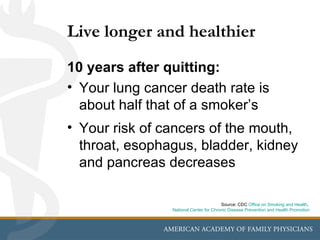
10 years after quitting:
• Your lung cancer death rate is
  about half that of a smoker’s
                              s
• Your risk of cancers of the mouth,
  throat, esophagus, bladder, kidney
  and pancreas decreases

                                        Source: CDC Office on Smoking and Health,
                National Center for Chronic Disease Prevention and Health Promotion
Live longer and healthier
15 years after quitting:
• Your risk of coronary heart disease
  is back to that of a nonsmoker’s


                                        Source: CDC Office on Smoking and Health,
                National Center for Chronic Disease Prevention and Health Promotion
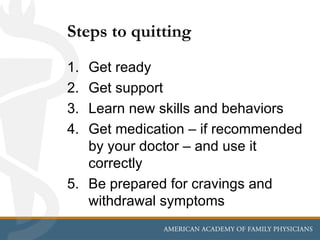
Steps to quitting
1. Get ready
2. Get support
3. Learn new skills and behaviors
4. Get medication – if recommended
   by your doctor – and use it
   correctly
5. Be prepared for cravings and
   withdrawal symptoms
Steps to quitting
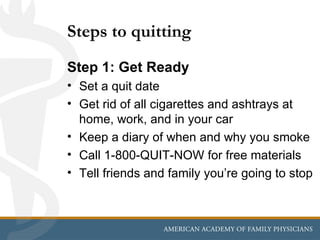
Step 1: Get Ready
• Set a quit date
• Get rid of all cigarettes and ashtrays at
  home, work, and in your car
• Keep a diary of when and why you smoke
• Call 1-800-QUIT-NOW for free materials
• Tell friends and family you’re going to stop
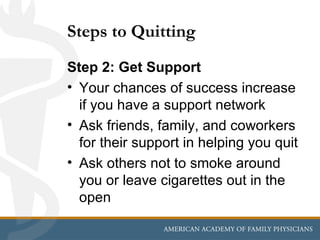
Steps to Quitting
Step 2: Get Support
• Your chances of success increase
  if you have a support network
• Ask friends, family, and coworkers
  for their support in helping you quit
• Ask others not to smoke around
  you or leave cigarettes out in the
  open
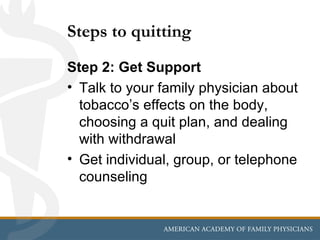
Steps to quitting
Step 2: Get Support
• Talk to your family physician about
  tobacco’s effects on the body,
  choosing a quit plan, and dealing
  with withdrawal
• Get individual, group, or telephone
  counseling
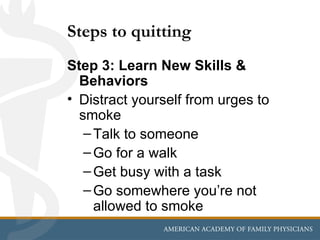
Steps to quitting
Step 3: Learn New Skills &
  Behaviors
• Distract yourself from urges to
  smoke
   – Talk to someone
   – Go for a walk
   – Get busy with a task
   – Go somewhere you’re not
     allowed to smoke
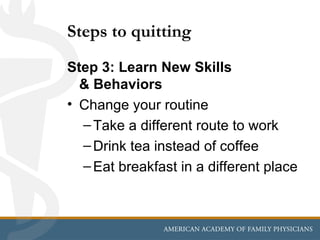
Steps to quitting
S
Step 3: Learn New Skills
  & Behaviors
• Change your routine
  – Take a different route to work
  – Drink tea instead of coffee
  – Eat breakfast in a different place
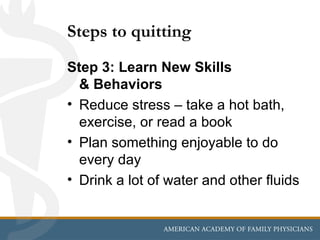
Steps to quitting
Step 3: Learn New Skills
  & Behaviors
• Reduce stress – take a hot bath,
  exercise, or read a book
• Plan something enjoyable to do
  every day
• Drink a lot of water and other fluids
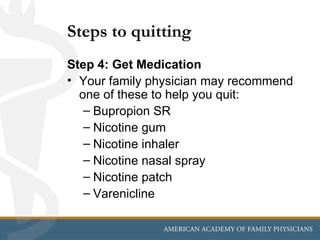
Steps to quitting
Step 4: Get Medication
• Your family physician may recommend
  one of these to help you quit:
   – Bupropion SR
   – Nicotine gum
   – Nicotine inhaler
   – Nicotine nasal spray
   – Nicotine patch
   – Varenicline
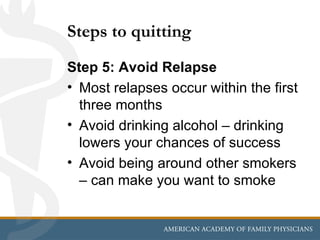
Steps to quitting
Step 5: Avoid Relapse
• Most relapses occur within the first
  three months
• Avoid drinking alcohol – drinking
  lowers your chances of success
• Avoid being around other smokers
  – can make you want to smoke
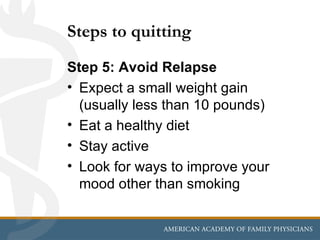
Steps to quitting
Step 5: Avoid Relapse
• Expect a small weight gain
  (usually less than 10 pounds)
• Eat a healthy diet
• Stay active
• Look for ways to improve your
  mood other than smoking
Will it work?
Successful quitters are
• Ready to change
• Motivated to quit
Managing withdrawal
Symptoms
• Most intense during the first three
  to seven days
• May continue for several weeks
  but will get less severe
• Triggers or cues associated with
  smoking can cause cravings
Managing withdrawal
• Exercise
• Reduce or avoid caffeine or other
  stimulants
• Relax before going to bed
• Make your bedroom quiet
• Keep a bedtime routine
• Drink plenty of water
• Use cough drops to relieve
  throat irritation
Managing withdrawal
If you’re having trouble
   concentrating
• Adjust your schedule to a lighter
   workload
• Lower your expectations on the
   amount of work you can do
• Understand the amount of energy
   and time it takes to stop smoking
Managing withdrawal
If your appetite has increased
• Eat healthy snacks
• Don’t delay regular meals
• Drink more water
• Exercise regularly
Managing withdrawal
If you crave a cigarette
• Wait out the craving (usually less
   than five minutes)
• Try deep breathing
• Use distractions
• Call someone in your support
   network
• Chew gum
• Brush your teeth
Renew your dedication
• Reward yourself for resisting urges
  to smoke
• Review your reasons for stopping
• Remind yourself often how well
  you’re doing
You can do it!
• Tobacco addiction is a chronic disease
  – seek advice, support, and care from
  your family physician to increase your
  chance of success
• Quitting smoking can reduce illness,
  prevent death, and increase your
  quality
  of life
• Quitting can be difficult – remember to
  ask for help
• You can do it!
Resources
Free Quitlines:
• 1-800-QUIT-NOW (1-800-784-8669)
   – You’ll be automatically routed to a
     state-run or National Cancer
     Institute quitline
   – You’ll get immediate advice on
     quitting and an offer to have
     materials mailed to you
Resources
Web Sites with helpful information:
•   familydoctor.org
•   www.smokefree.gov
•   www.surgeongeneral.gov/tobacco
•   http://www.cdc.gov/tobacco/quit_smoking
•   http://www.cancer.org/Healthy/StayAwayfrom

Aafp quit smoking

  • 1.
    Quitting Smoking How tostop smoking … for good!
  • 2.
    Live longer andhealthier 20 minutes after quitting: • Your heart rate drops 12 hours after quitting: • Carbon monoxide levels in your blood drop to normal Source: CDC Office on Smoking and Health, National Center for Chronic Disease Prevention and Health Promotion
  • 3.
    Live longer andhealthier 2 weeks to 3 months after quitting: • Your heart attack risk begins to drop • Your lung function begins to improve 1 to 9 months after quitting: • Your coughing and shortness of breath decrease Source: CDC Office on Smoking and Health, National Center for Chronic Disease Prevention and Health Promotion
  • 4.
    Live longer andhealthier 1 year after quitting: • Your added risk of coronary heart disease is half that of a smoker’s 5 -15 years after quitting: • Your stroke risk is reduced to that of a nonsmoker Source: CDC Office on Smoking and Health, National Center for Chronic Disease Prevention and Health Promotion
  • 5.
    Live longer andhealthier 10 years after quitting: • Your lung cancer death rate is about half that of a smoker’s s • Your risk of cancers of the mouth, throat, esophagus, bladder, kidney and pancreas decreases Source: CDC Office on Smoking and Health, National Center for Chronic Disease Prevention and Health Promotion
  • 6.
    Live longer andhealthier 15 years after quitting: • Your risk of coronary heart disease is back to that of a nonsmoker’s Source: CDC Office on Smoking and Health, National Center for Chronic Disease Prevention and Health Promotion
  • 7.
    Steps to quitting 1.Get ready 2. Get support 3. Learn new skills and behaviors 4. Get medication – if recommended by your doctor – and use it correctly 5. Be prepared for cravings and withdrawal symptoms
  • 8.
    Steps to quitting Step1: Get Ready • Set a quit date • Get rid of all cigarettes and ashtrays at home, work, and in your car • Keep a diary of when and why you smoke • Call 1-800-QUIT-NOW for free materials • Tell friends and family you’re going to stop
  • 9.
    Steps to Quitting Step2: Get Support • Your chances of success increase if you have a support network • Ask friends, family, and coworkers for their support in helping you quit • Ask others not to smoke around you or leave cigarettes out in the open
  • 10.
    Steps to quitting Step2: Get Support • Talk to your family physician about tobacco’s effects on the body, choosing a quit plan, and dealing with withdrawal • Get individual, group, or telephone counseling
  • 11.
    Steps to quitting Step3: Learn New Skills & Behaviors • Distract yourself from urges to smoke – Talk to someone – Go for a walk – Get busy with a task – Go somewhere you’re not allowed to smoke
  • 12.
    Steps to quitting S Step3: Learn New Skills & Behaviors • Change your routine – Take a different route to work – Drink tea instead of coffee – Eat breakfast in a different place
  • 13.
    Steps to quitting Step3: Learn New Skills & Behaviors • Reduce stress – take a hot bath, exercise, or read a book • Plan something enjoyable to do every day • Drink a lot of water and other fluids
  • 14.
    Steps to quitting Step4: Get Medication • Your family physician may recommend one of these to help you quit: – Bupropion SR – Nicotine gum – Nicotine inhaler – Nicotine nasal spray – Nicotine patch – Varenicline
  • 15.
    Steps to quitting Step5: Avoid Relapse • Most relapses occur within the first three months • Avoid drinking alcohol – drinking lowers your chances of success • Avoid being around other smokers – can make you want to smoke
  • 16.
    Steps to quitting Step5: Avoid Relapse • Expect a small weight gain (usually less than 10 pounds) • Eat a healthy diet • Stay active • Look for ways to improve your mood other than smoking
  • 17.
    Will it work? Successfulquitters are • Ready to change • Motivated to quit
  • 18.
    Managing withdrawal Symptoms • Mostintense during the first three to seven days • May continue for several weeks but will get less severe • Triggers or cues associated with smoking can cause cravings
  • 19.
    Managing withdrawal • Exercise •Reduce or avoid caffeine or other stimulants • Relax before going to bed • Make your bedroom quiet • Keep a bedtime routine • Drink plenty of water • Use cough drops to relieve throat irritation
  • 20.
    Managing withdrawal If you’rehaving trouble concentrating • Adjust your schedule to a lighter workload • Lower your expectations on the amount of work you can do • Understand the amount of energy and time it takes to stop smoking
  • 21.
    Managing withdrawal If yourappetite has increased • Eat healthy snacks • Don’t delay regular meals • Drink more water • Exercise regularly
  • 22.
    Managing withdrawal If youcrave a cigarette • Wait out the craving (usually less than five minutes) • Try deep breathing • Use distractions • Call someone in your support network • Chew gum • Brush your teeth
  • 23.
    Renew your dedication •Reward yourself for resisting urges to smoke • Review your reasons for stopping • Remind yourself often how well you’re doing
  • 24.
    You can doit! • Tobacco addiction is a chronic disease – seek advice, support, and care from your family physician to increase your chance of success • Quitting smoking can reduce illness, prevent death, and increase your quality of life • Quitting can be difficult – remember to ask for help • You can do it!
  • 25.
    Resources Free Quitlines: • 1-800-QUIT-NOW(1-800-784-8669) – You’ll be automatically routed to a state-run or National Cancer Institute quitline – You’ll get immediate advice on quitting and an offer to have materials mailed to you
  • 26.
    Resources Web Sites withhelpful information: • familydoctor.org • www.smokefree.gov • www.surgeongeneral.gov/tobacco • http://www.cdc.gov/tobacco/quit_smoking • http://www.cancer.org/Healthy/StayAwayfrom