

1
Suman Sahoo Roll No : 97/ELM/124005
By
Sumanta Kundu Roll No: 97/ELM/124013
Agniv Mukherjee Roll No : 97/ELM/124016
Raju Ray Roll No : 97/ELM/124017
Under Guidance of
Prof. Jitendra Nath Bera
Department of Applied Physics,
University College of Science & Technology,
University of Calcutta
92, A.P.C. Road, Kolkata-700009
West Bengal, India
Date: 26-05-2015
2
 Introduction
Solutions
Objectives
Theoretical Background
Experimentation
Hardware Implementation
Conclusion
Future Scope
Reference
3
Information regarding real time specific data for energy consumption and
corresponding tariff
 Remote control of different Home Appliances
 Remote notification of usage of energy consumption
 Managing and storing vast quantities of metering data
Ensuring the security of metering data
Extra energy (if generated) can be sent back to Grid
Today’s Demands
Performance degradation analysis of a particular appliance
4
Decarbonise electricity
Greater visibility to distribution network
Participation of the consumers into power system operation through Smart
Meter, Smart Plug.
Improved ICT (Information & Communication Technology) offers greater
monitoring, control, flexibility and low cost operation of power system.
Effective management of loads and reduction of losses and wasted
energy needs accurate information about the loads.
Performance comparison for same appliance of different make
Local display of information on smart plug itself
Contd.
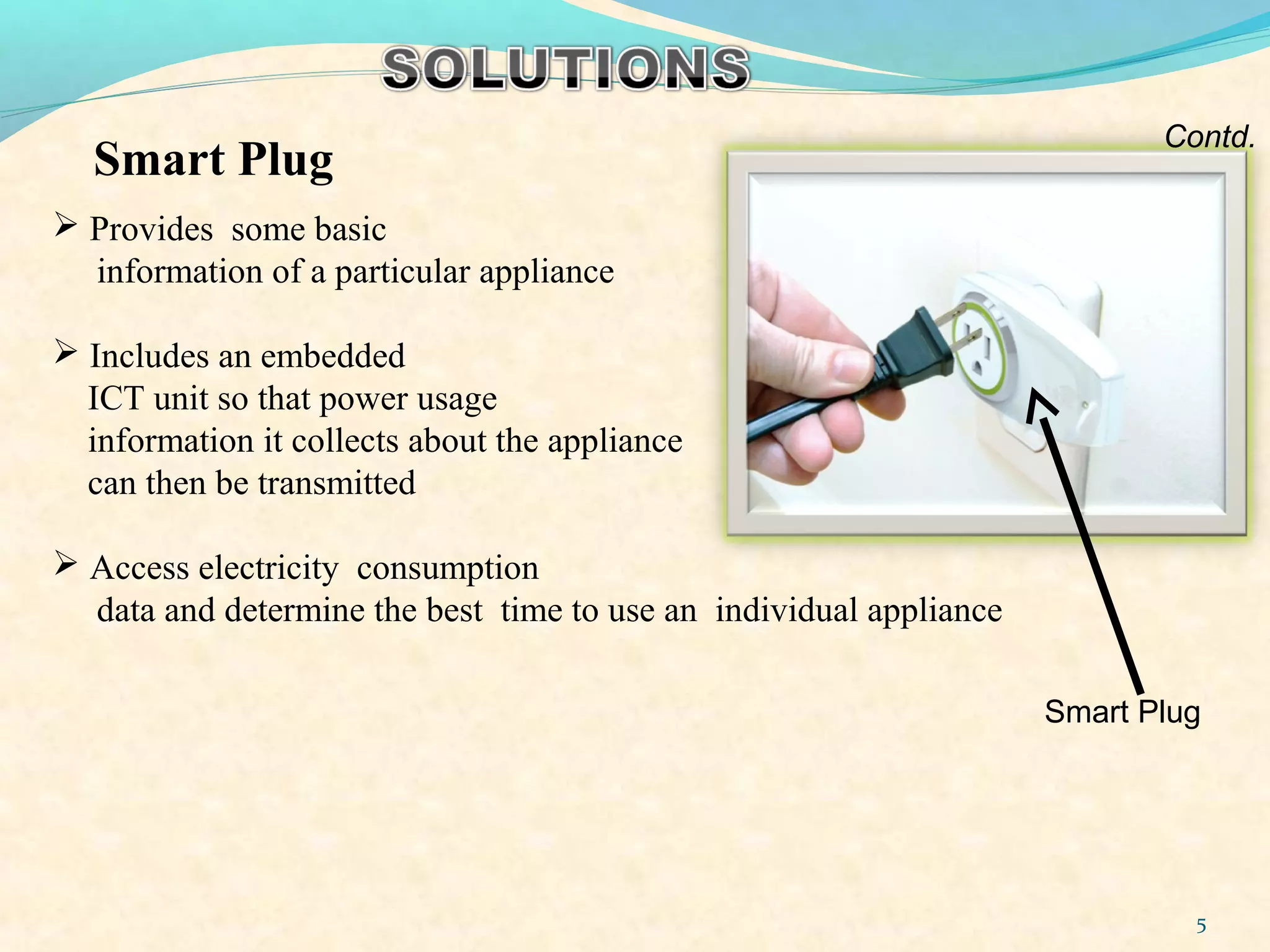
 Provides some basic
information of a particular appliance
 Includes an embedded
ICT unit so that power usage
information it collects about the appliance
can then be transmitted
 Access electricity consumption
data and determine the best time to use an individual appliance
Smart Plug
Contd.
5
Smart Plug
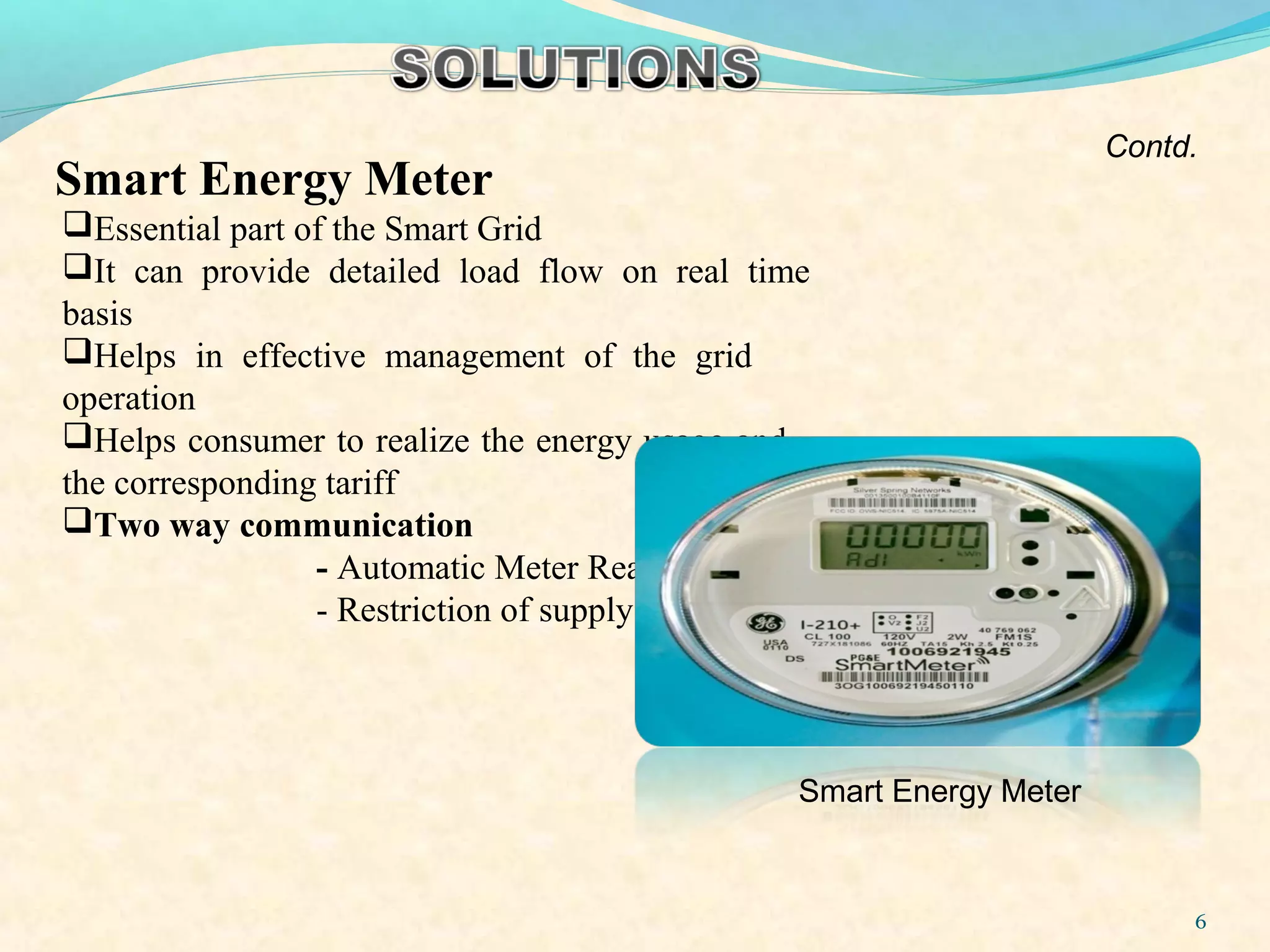
Essential part of the Smart Grid
It can provide detailed load flow on real time
basis
Helps in effective management of the grid
operation
Helps consumer to realize the energy usage and
the corresponding tariff
Two way communication
- Automatic Meter Reading
- Restriction of supply
Smart Energy Meter
6
Contd.
Smart Energy Meter
7
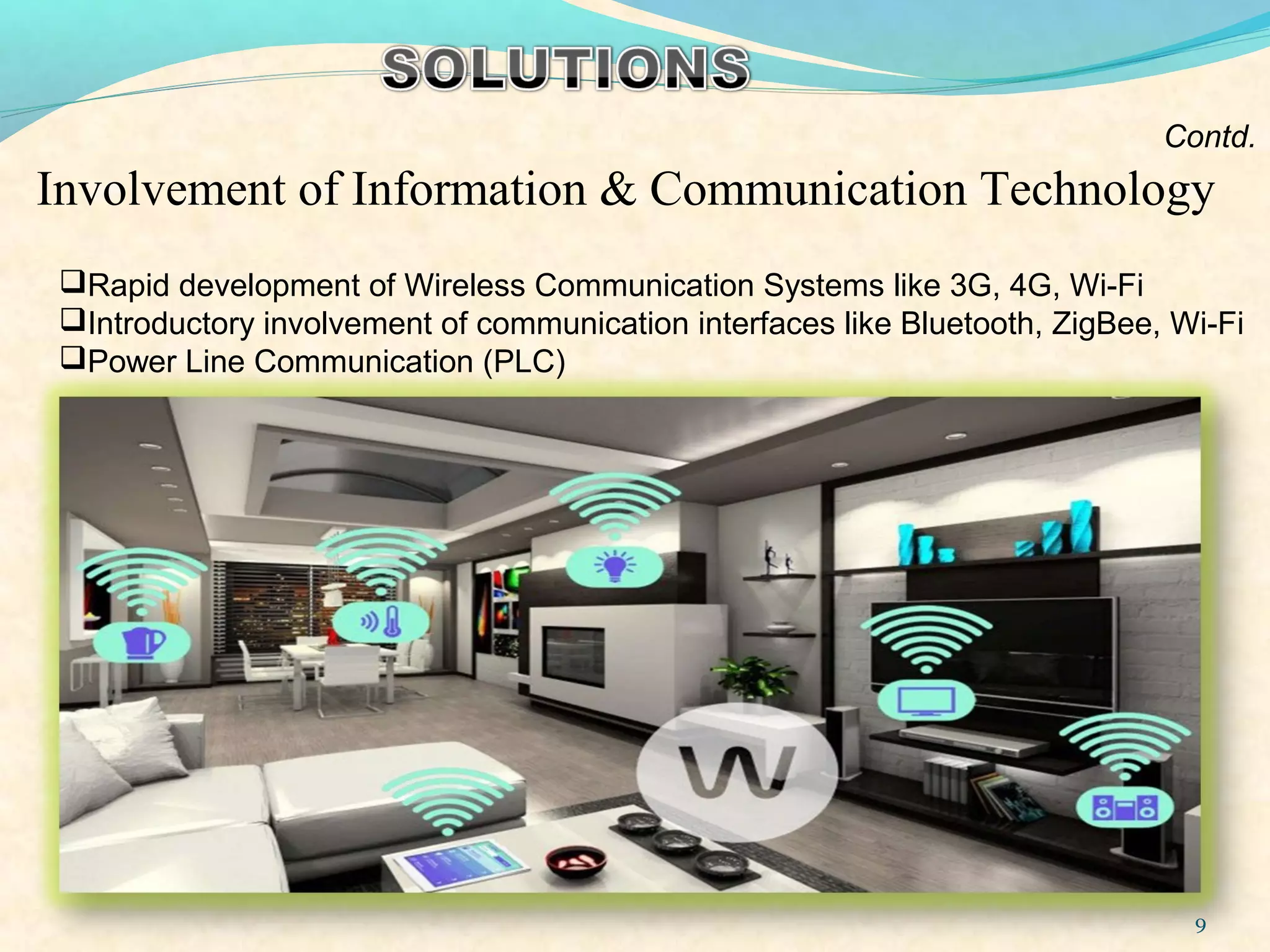
Smart Home
•A home equipped with lighting, heating, and electronic devices that can
be controlled remotely by smart phone or computer
• Smart home relate to the development of some major aspects:
(a)Capabilities of home infrastructure and controlled device
(b) Usability of mobile and stationary user interfaces
Contd.
8
Contd.
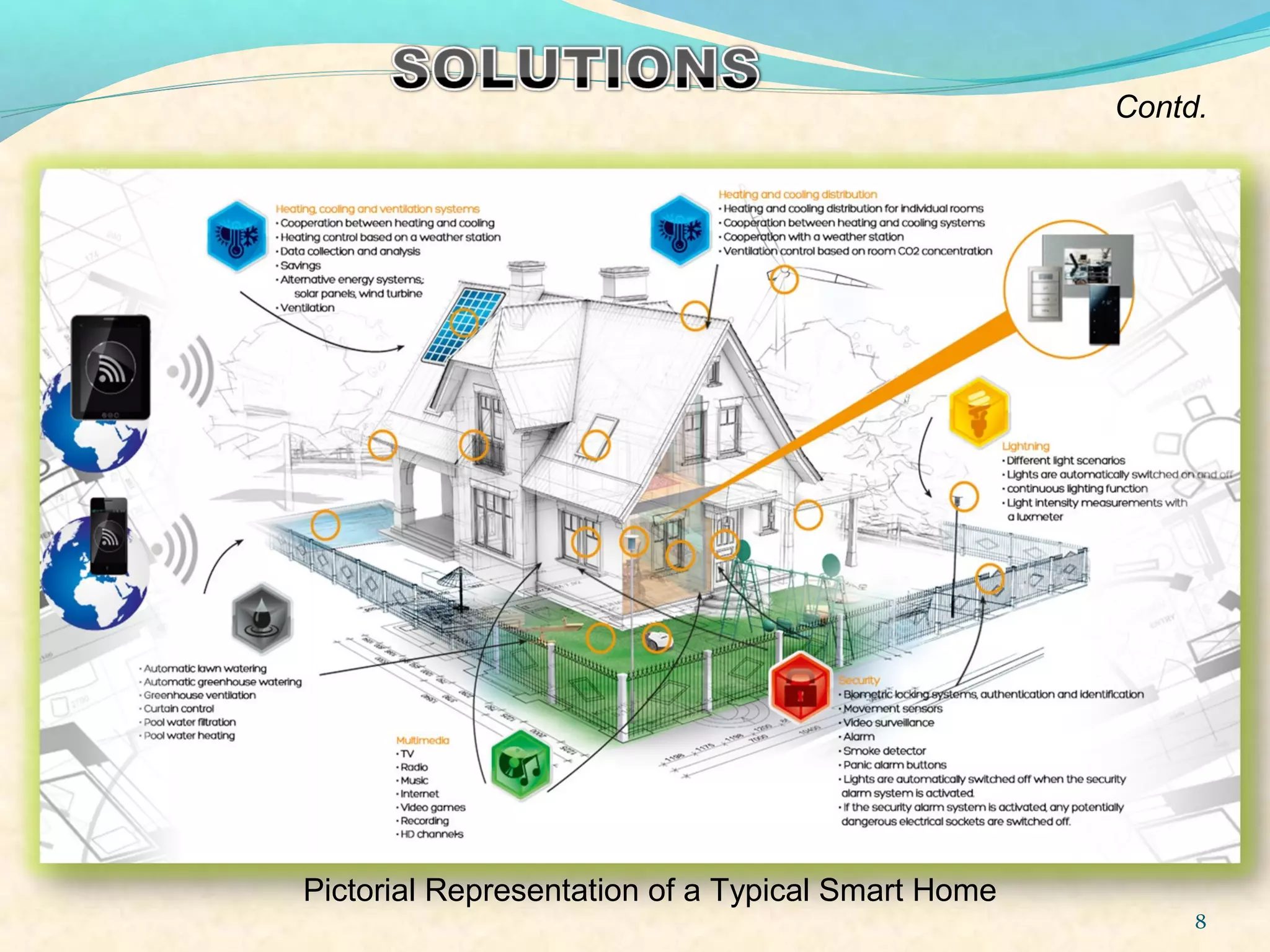
Pictorial Representation of a Typical Smart Home
9
Contd.
Involvement of Information & Communication Technology
Rapid development of Wireless Communication Systems like 3G, 4G, Wi-Fi
Introductory involvement of communication interfaces like Bluetooth, ZigBee, Wi-Fi
Power Line Communication (PLC)
10
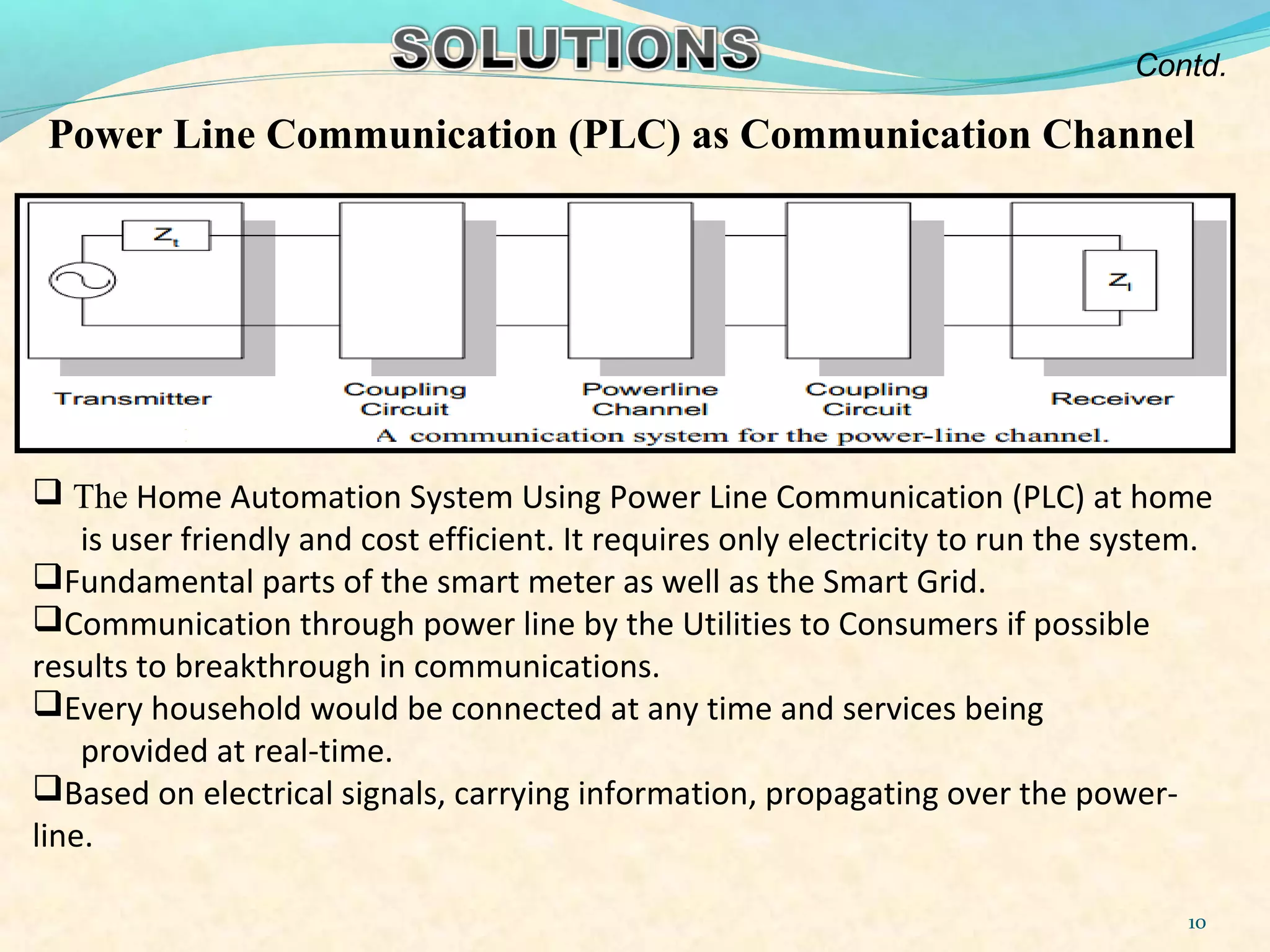
Power Line Communication (PLC) as Communication Channel
 The Home Automation System Using Power Line Communication (PLC) at home
is user friendly and cost efficient. It requires only electricity to run the system.
Fundamental parts of the smart meter as well as the Smart Grid.
Communication through power line by the Utilities to Consumers if possible
results to breakthrough in communications.
Every household would be connected at any time and services being
provided at real-time.
Based on electrical signals, carrying information, propagating over the power-
line.
Contd.
11
12
13
Classifiers
An algorithm implementing classification, especially concrete implementation
 A mathematical function , implemented by a classification algorithm, that maps
input data to a category
Bayesian
 Support Vector machine Classifier
Fuzzy Ruled Based Classifier
Artificial Neural Network
Types of Classifiers
14
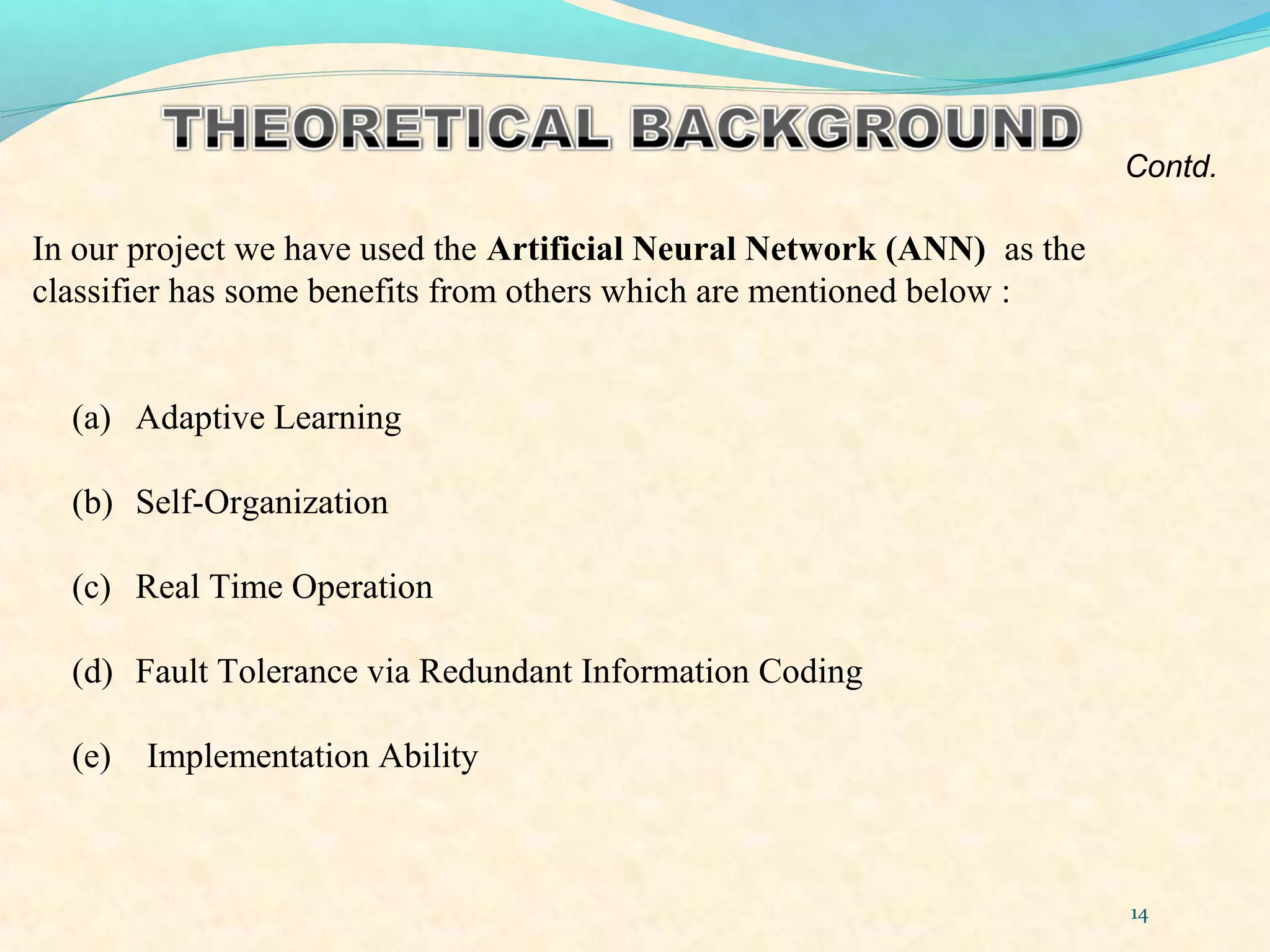
In our project we have used the Artificial Neural Network (ANN) as the
classifier has some benefits from others which are mentioned below :
(a) Adaptive Learning
(b) Self-Organization
(c) Real Time Operation
(d) Fault Tolerance via Redundant Information Coding
(e) Implementation Ability
Contd.
15
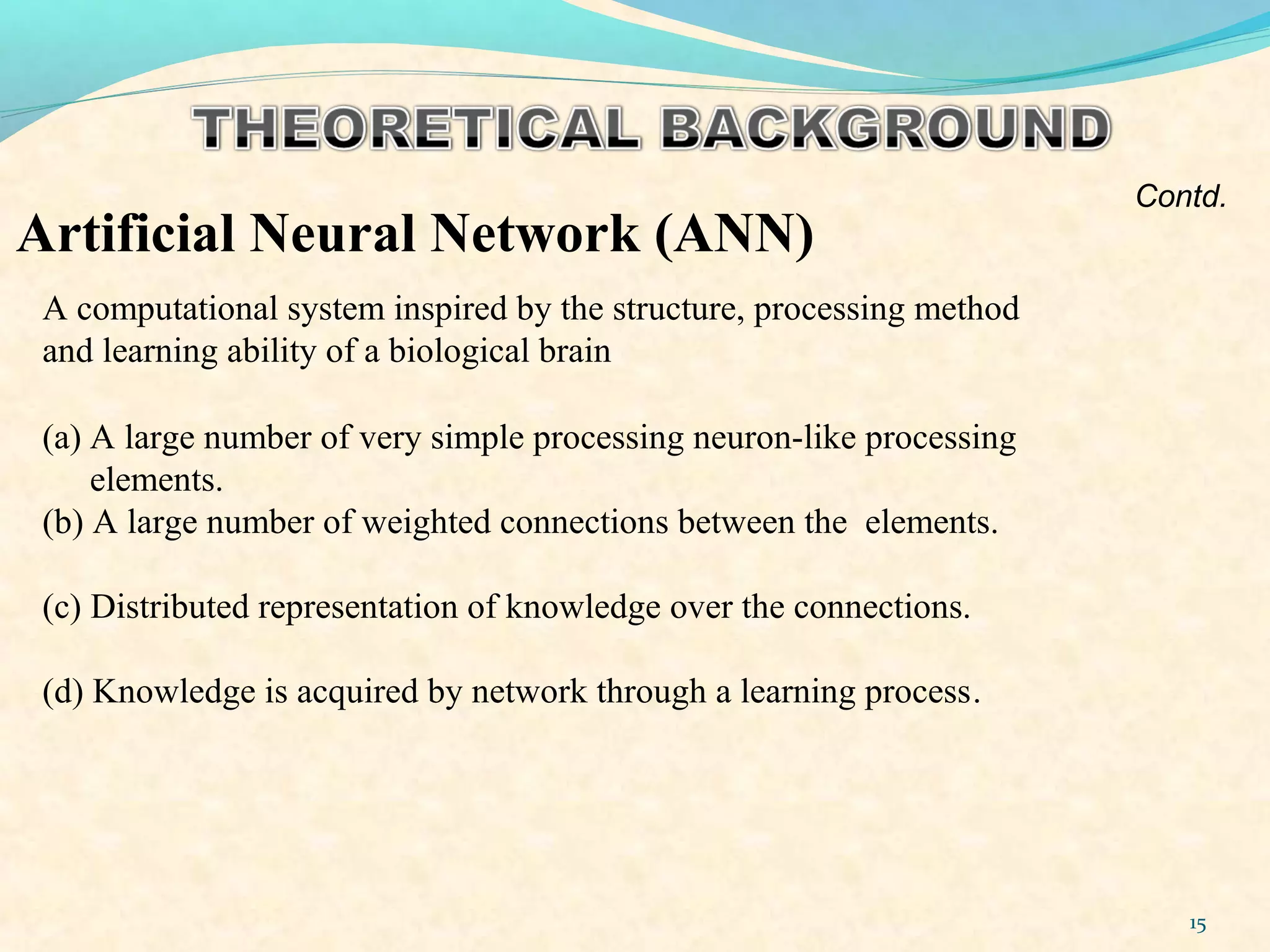
Artificial Neural Network (ANN)
A computational system inspired by the structure, processing method
and learning ability of a biological brain
Contd.
(a) A large number of very simple processing neuron-like processing
elements.
(b) A large number of weighted connections between the elements.
(c) Distributed representation of knowledge over the connections.
(d) Knowledge is acquired by network through a learning process.
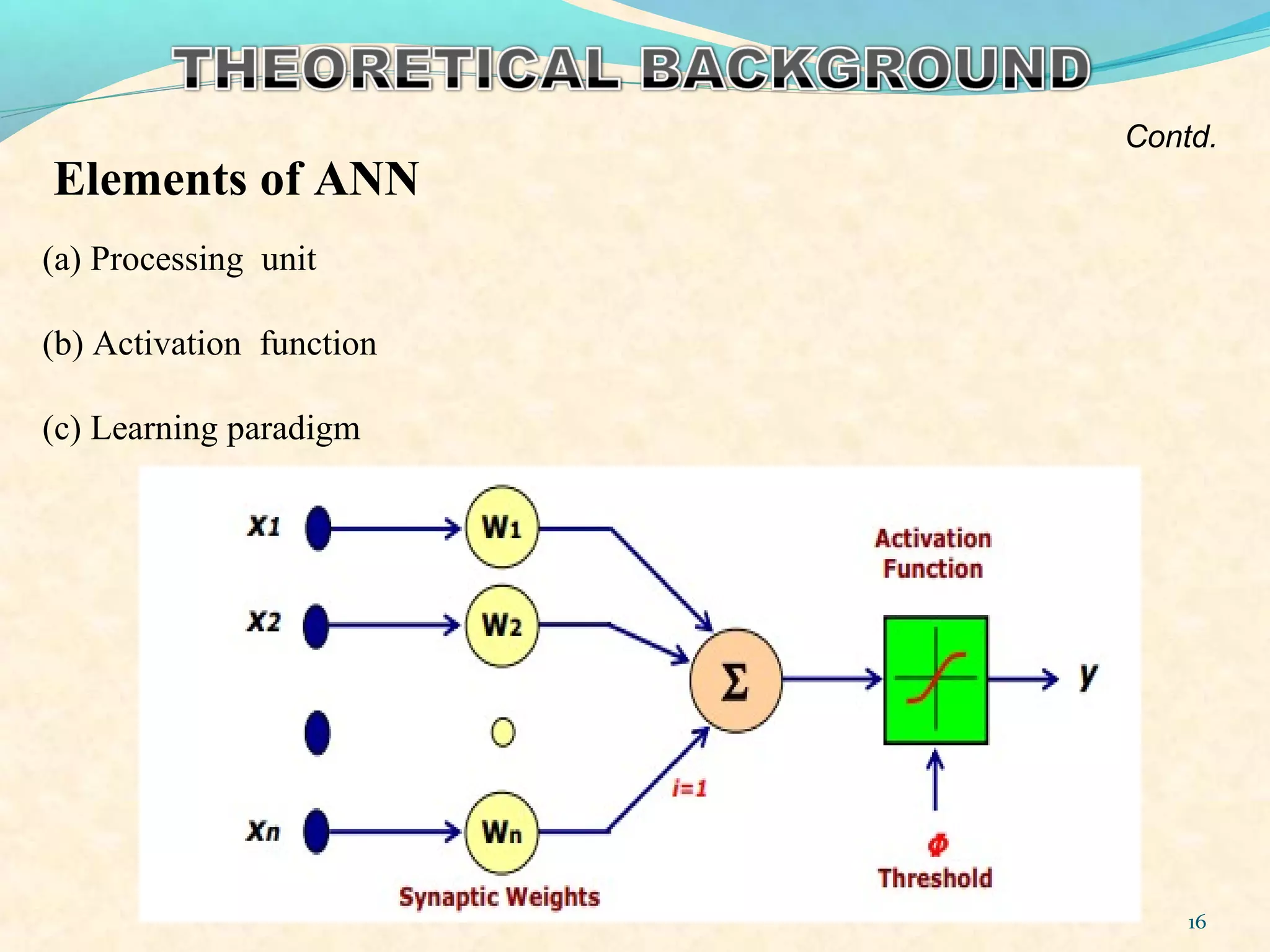
Elements of ANN
(a) Processing unit
(b) Activation function
(c) Learning paradigm
16
Contd.
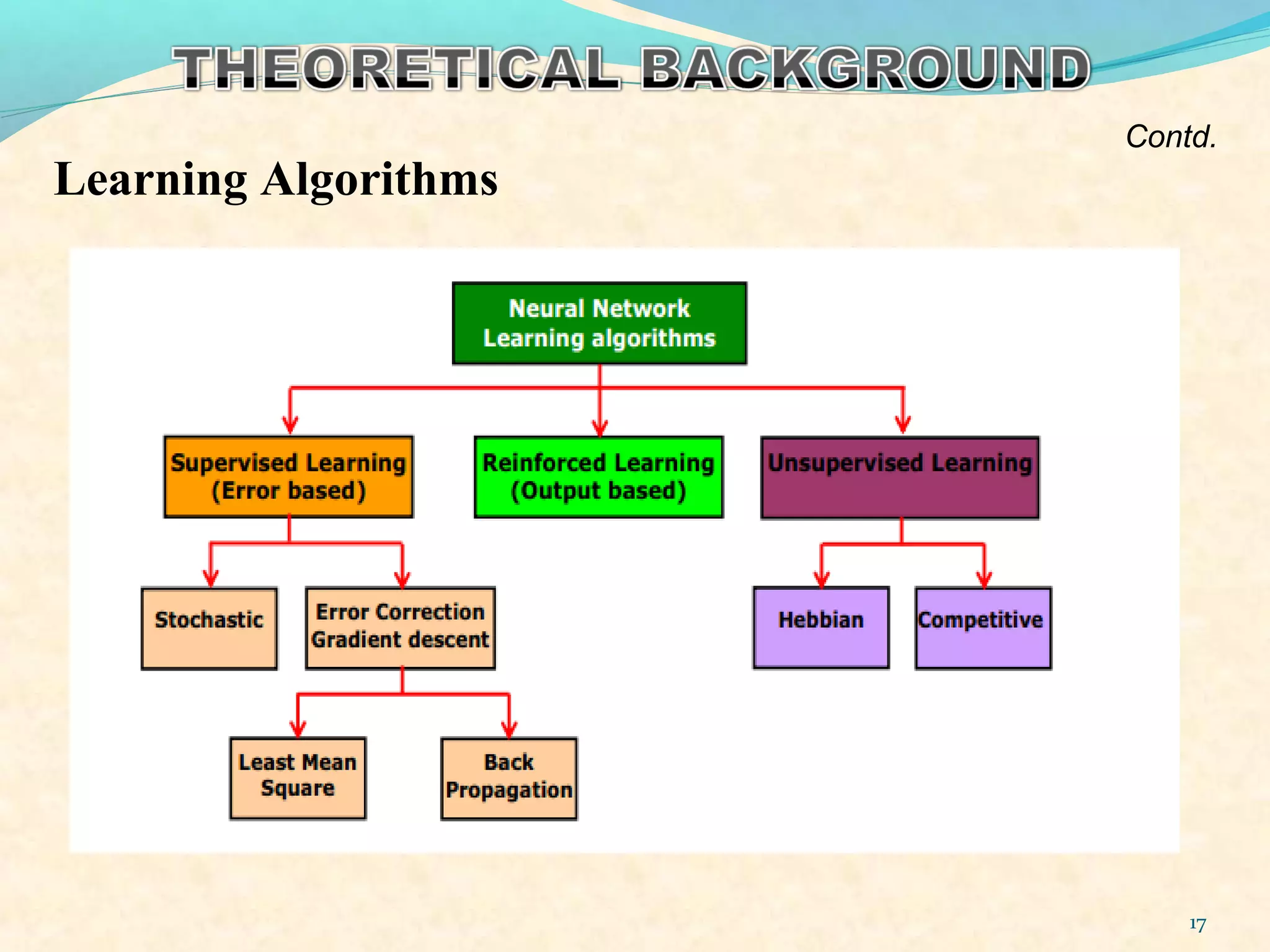
Learning Algorithms
17
Contd.
18
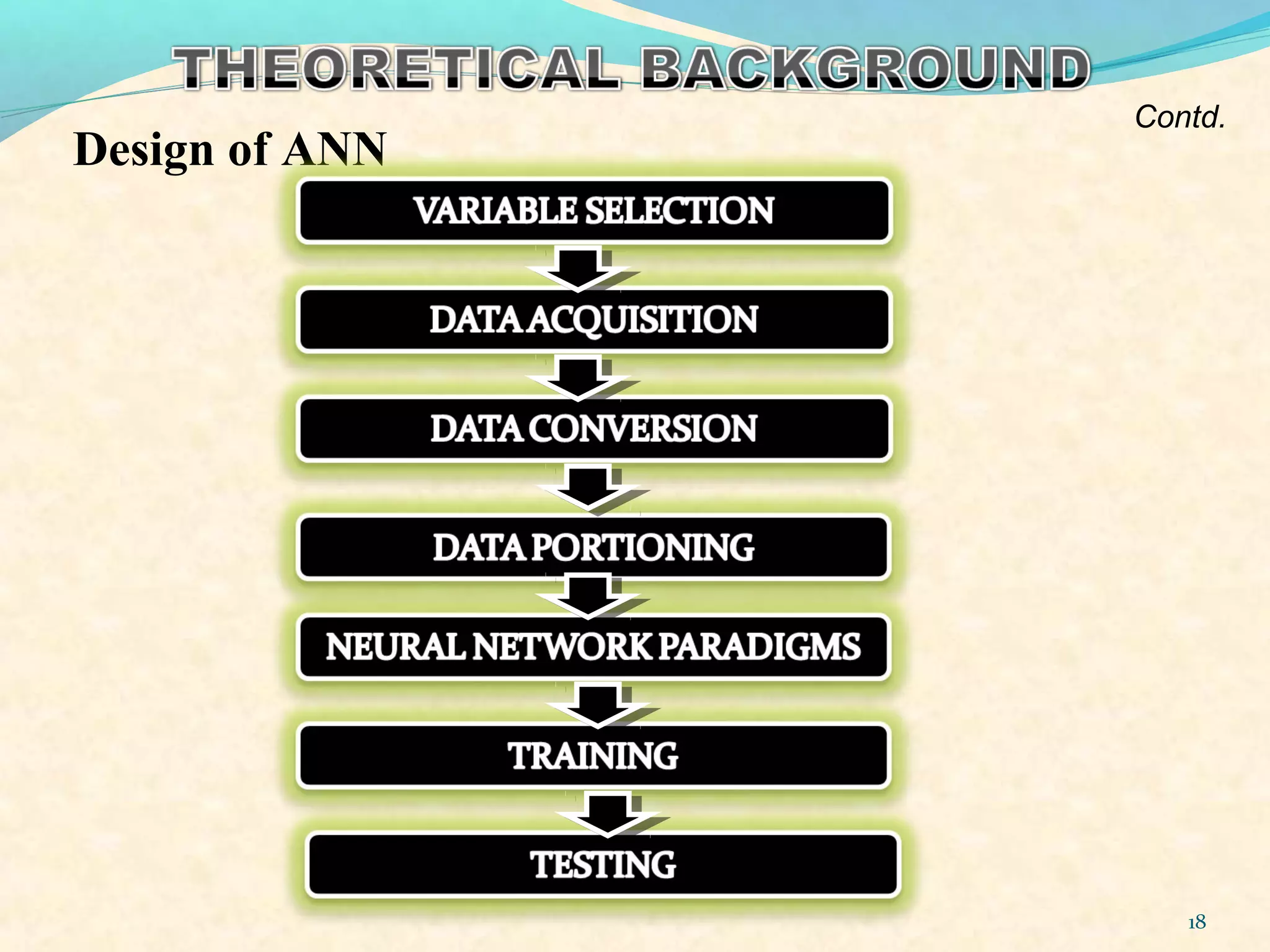
Design of ANN
Contd.
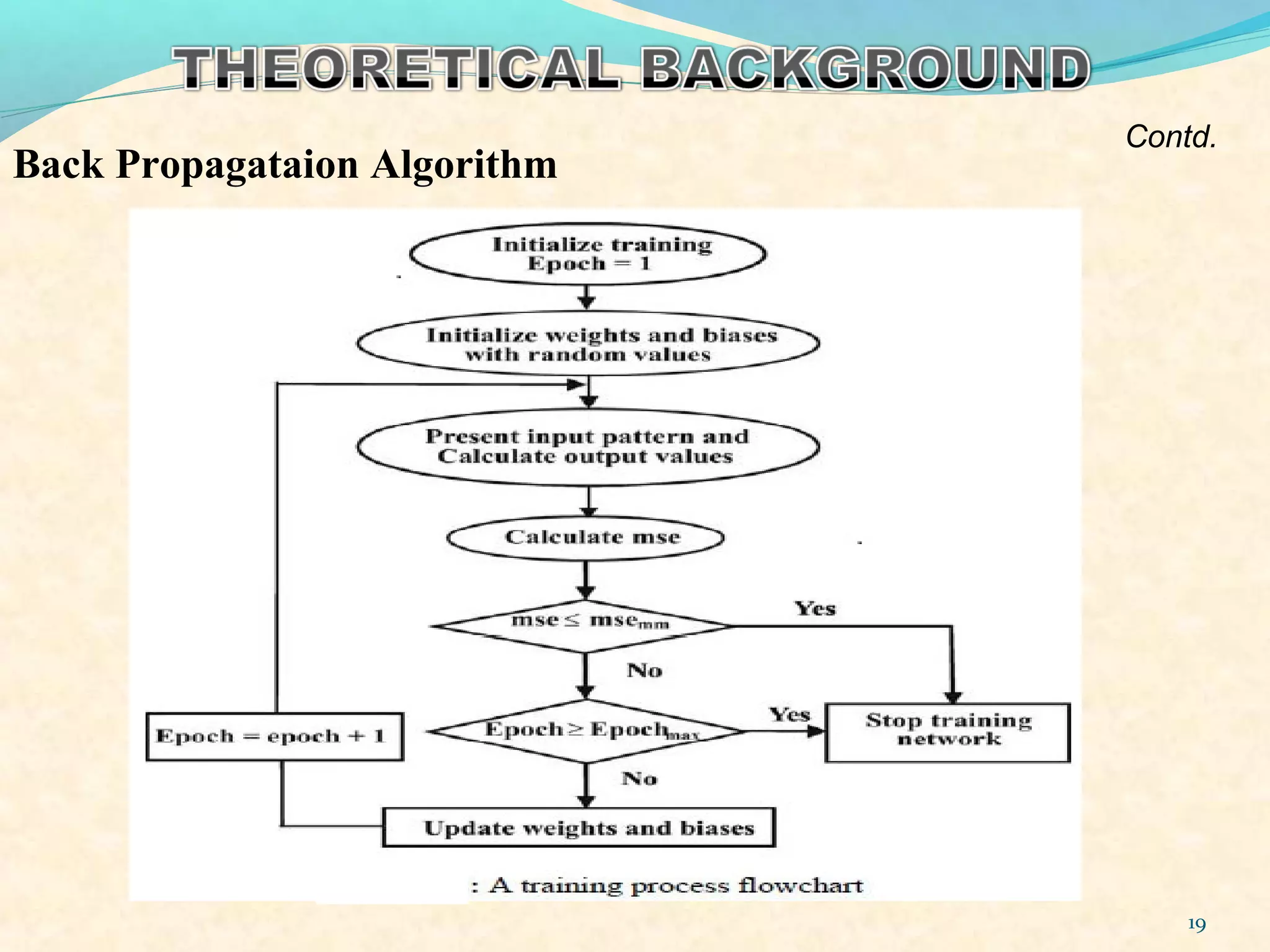
19
Back Propagataion Algorithm
Contd.
20
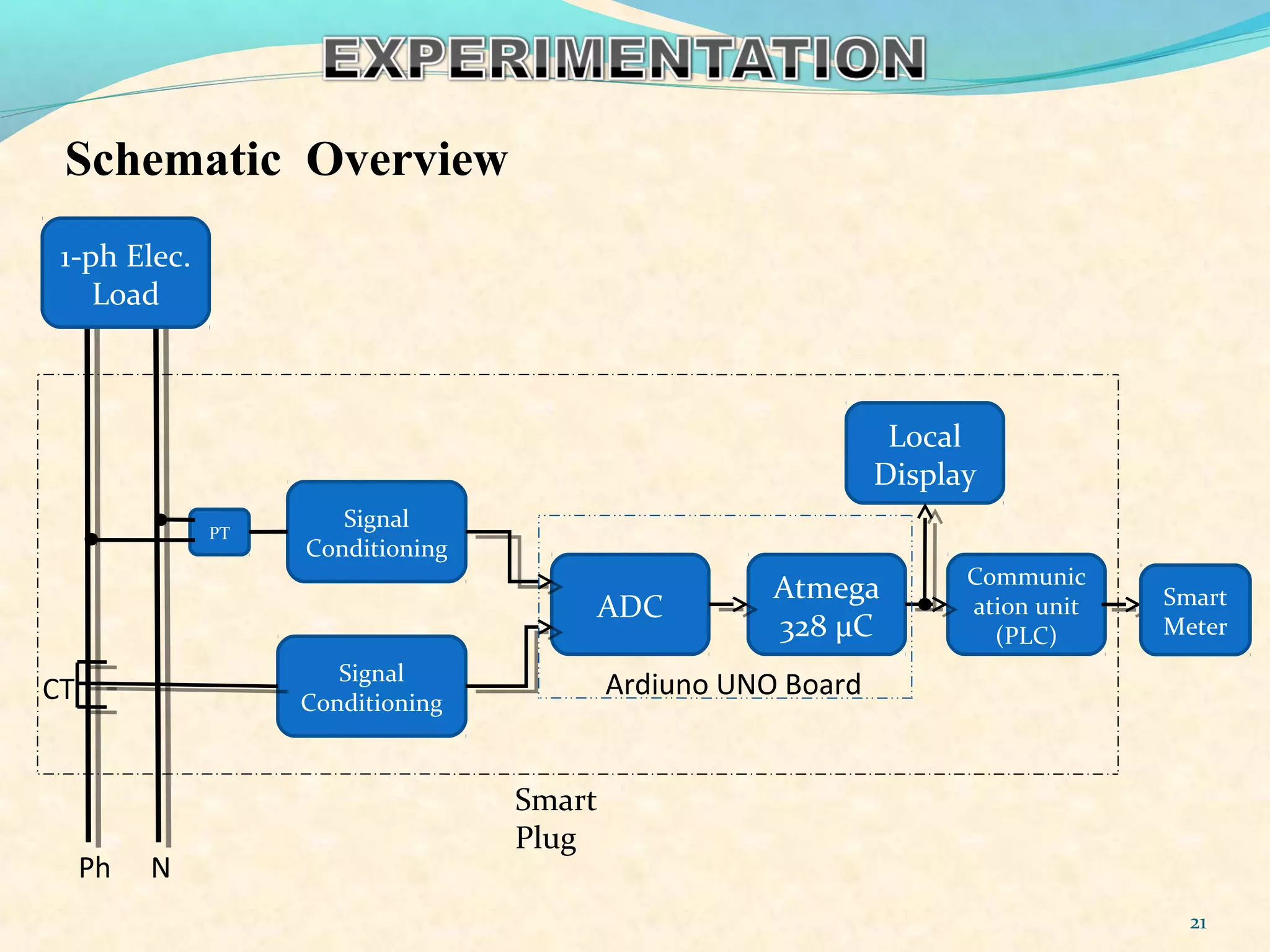
Schematic Overview
Ardiuno UNO Board
Signal
Conditioning
Signal
Conditioning
ADC
Atmega
328 µC
Communic
ation unit
(PLC)
Local
Display
Ph N
CT
1-ph Elec.
Load
PT
Smart
Plug
21
Smart
Meter
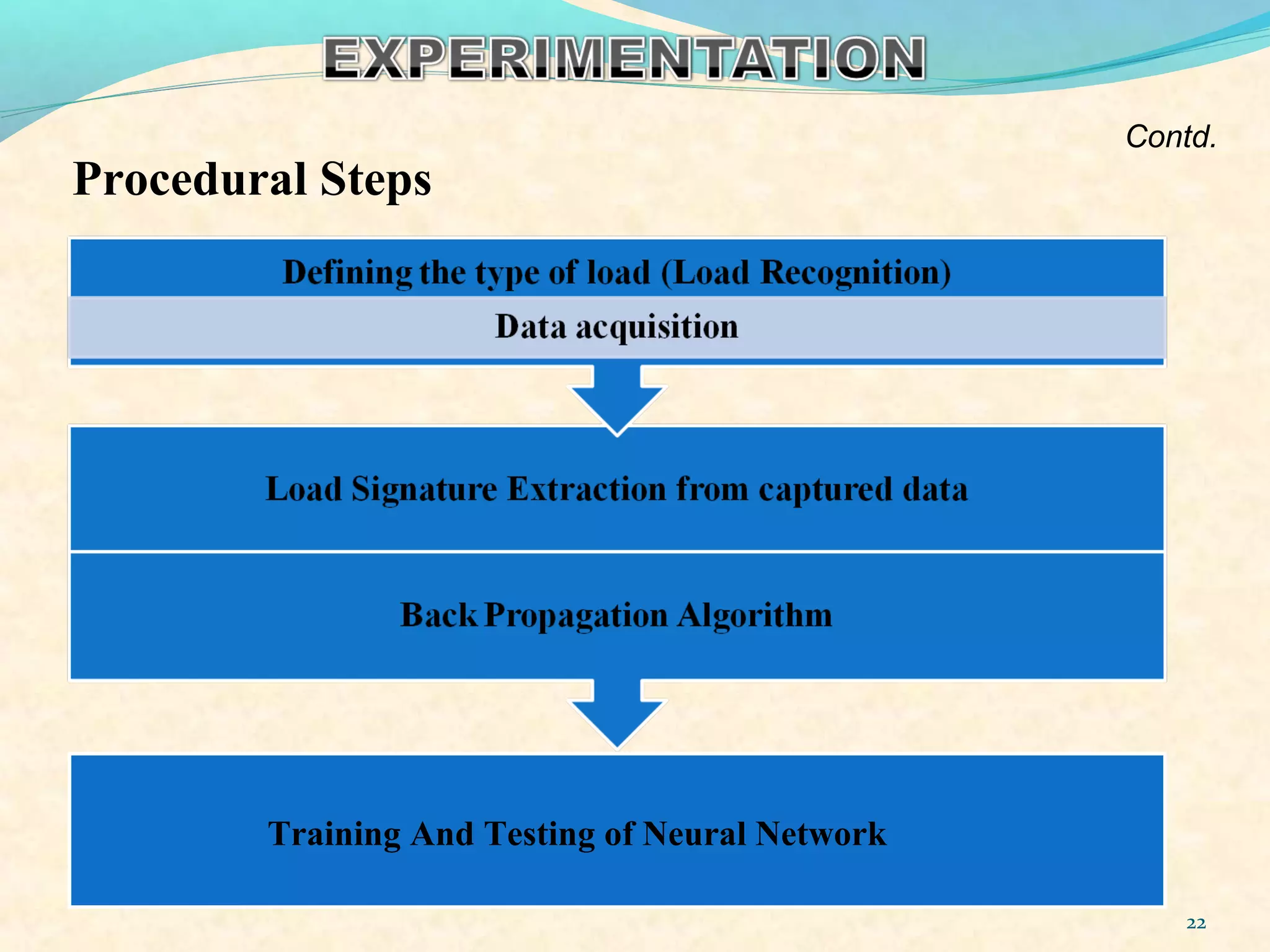
Procedural Steps
Training And Testing of Neural Network
22
Contd.
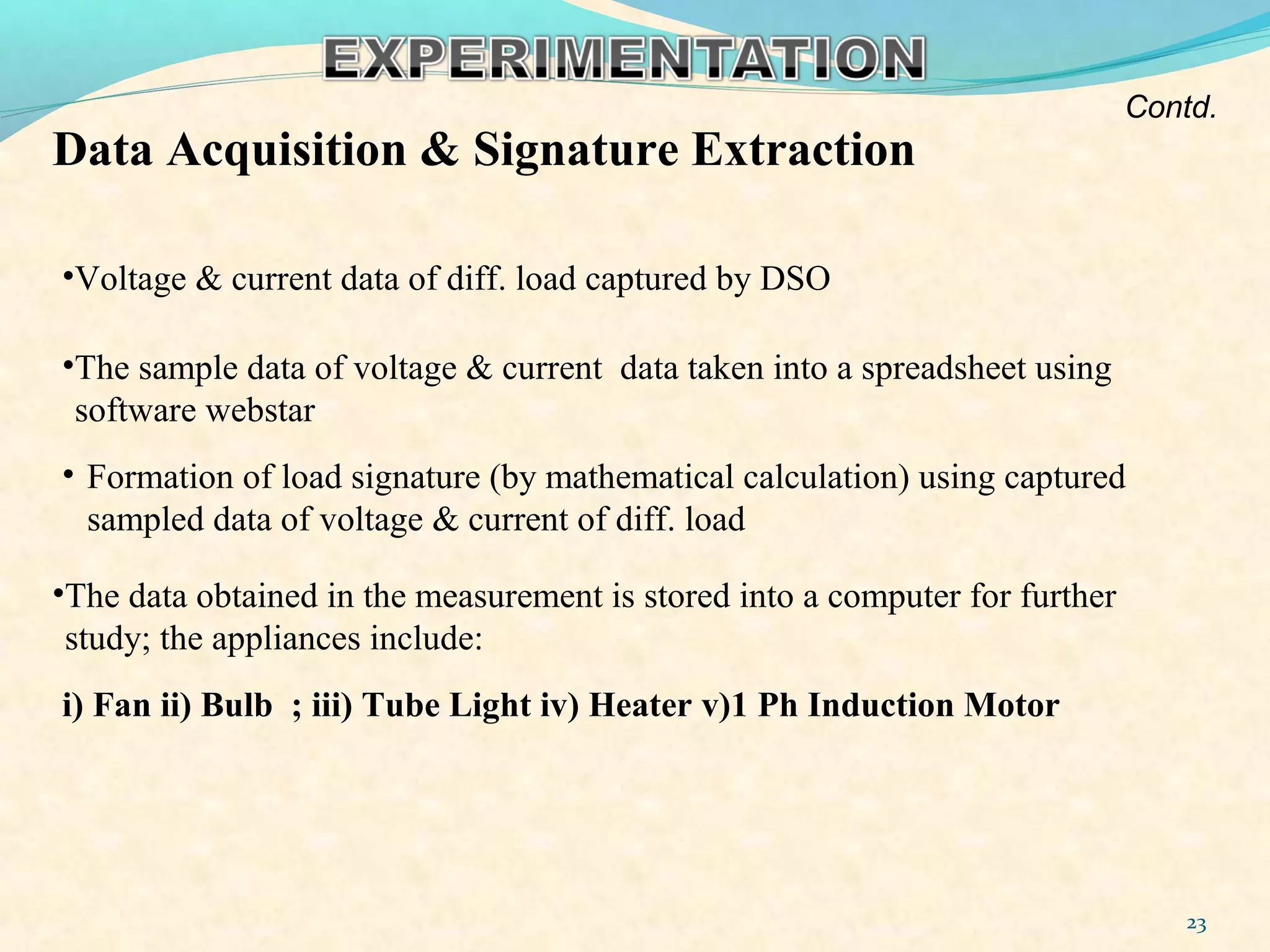
Data Acquisition & Signature Extraction
•Voltage & current data of diff. load captured by DSO
•The sample data of voltage & current data taken into a spreadsheet using
software webstar
• Formation of load signature (by mathematical calculation) using captured
sampled data of voltage & current of diff. load
23
•The data obtained in the measurement is stored into a computer for further
study; the appliances include:
i) Fan ii) Bulb ; iii) Tube Light iv) Heater v)1 Ph Induction Motor
Contd.
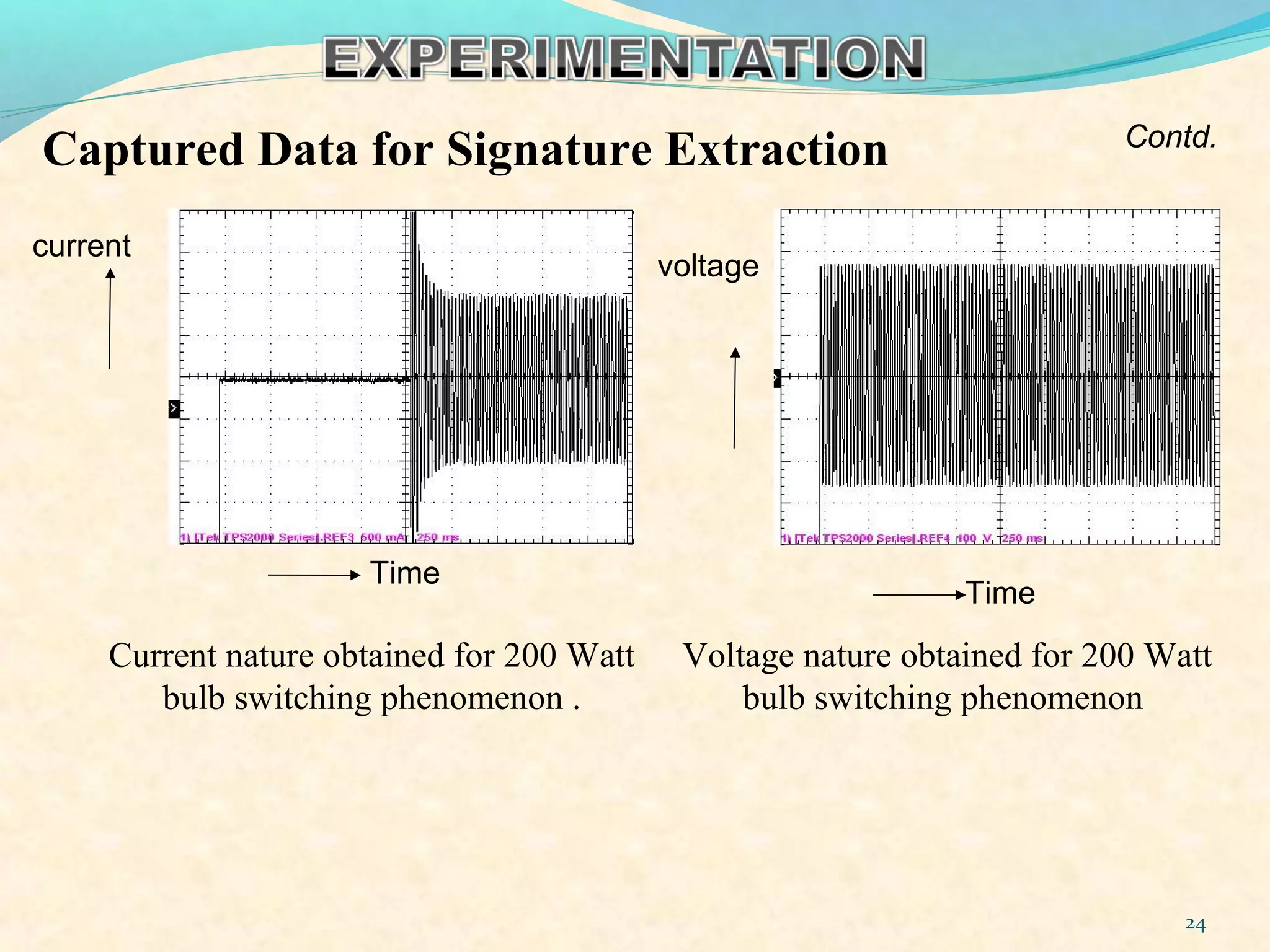
Captured Data for Signature Extraction
current
Time
Time
voltage
Current nature obtained for 200 Watt
bulb switching phenomenon .
Voltage nature obtained for 200 Watt
bulb switching phenomenon
24
Contd.
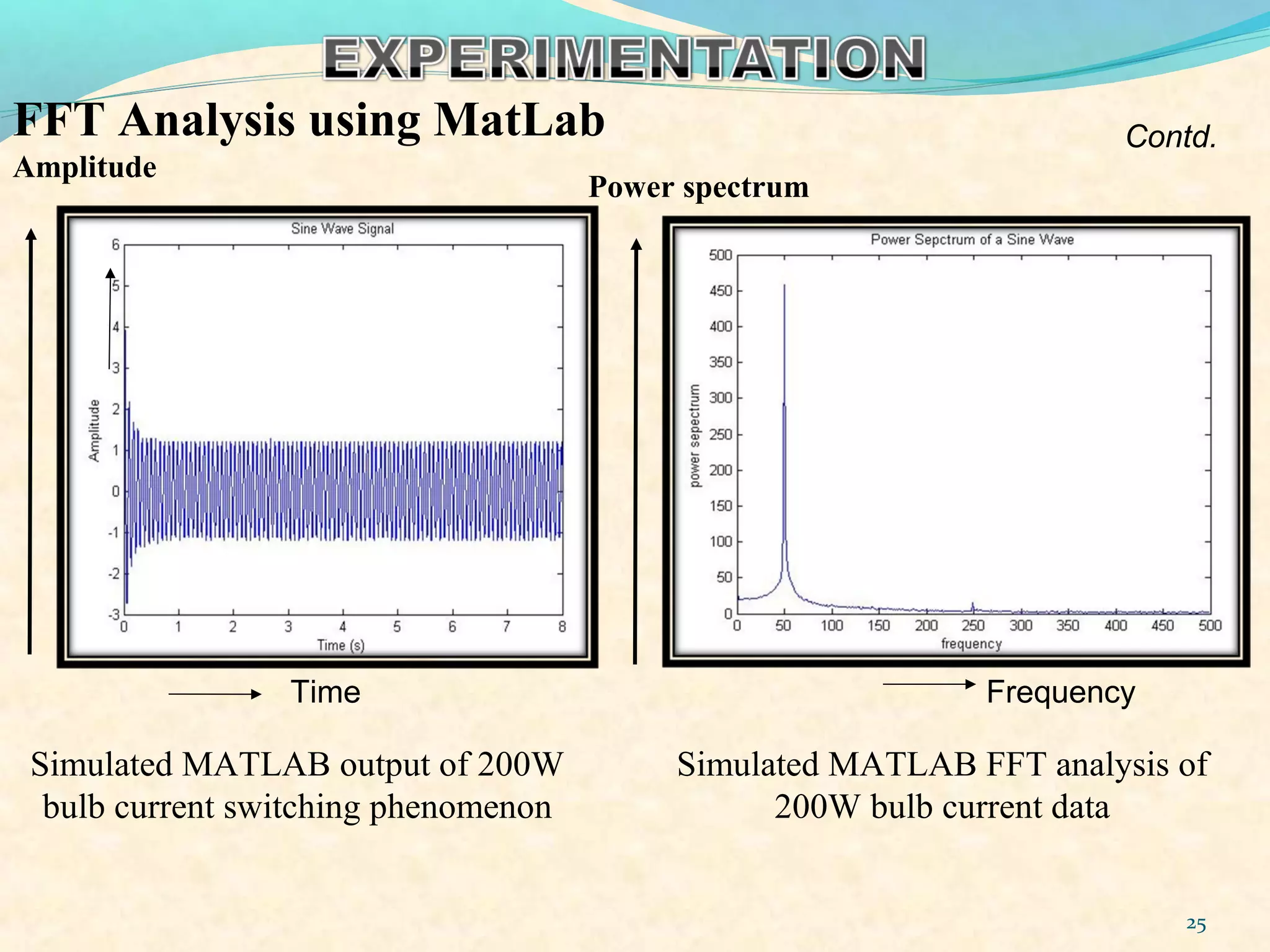
Amplitude
Power spectrum
Time Frequency
Simulated MATLAB output of 200W
bulb current switching phenomenon
FFT Analysis using MatLab
Simulated MATLAB FFT analysis of
200W bulb current data
25
Contd.
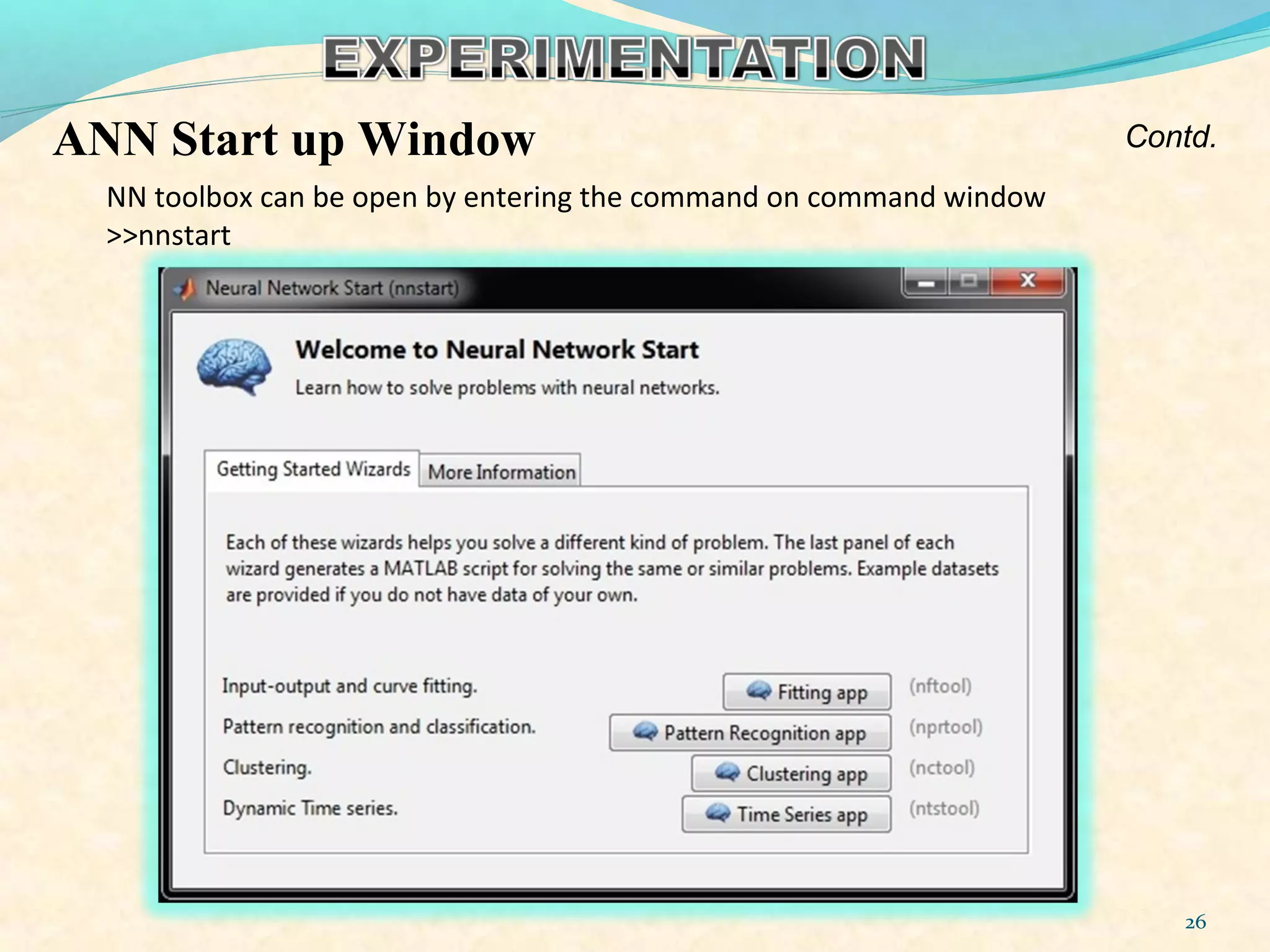
ANN Start up Window
26
NN toolbox can be open by entering the command on command window
>>nnstart
Contd.
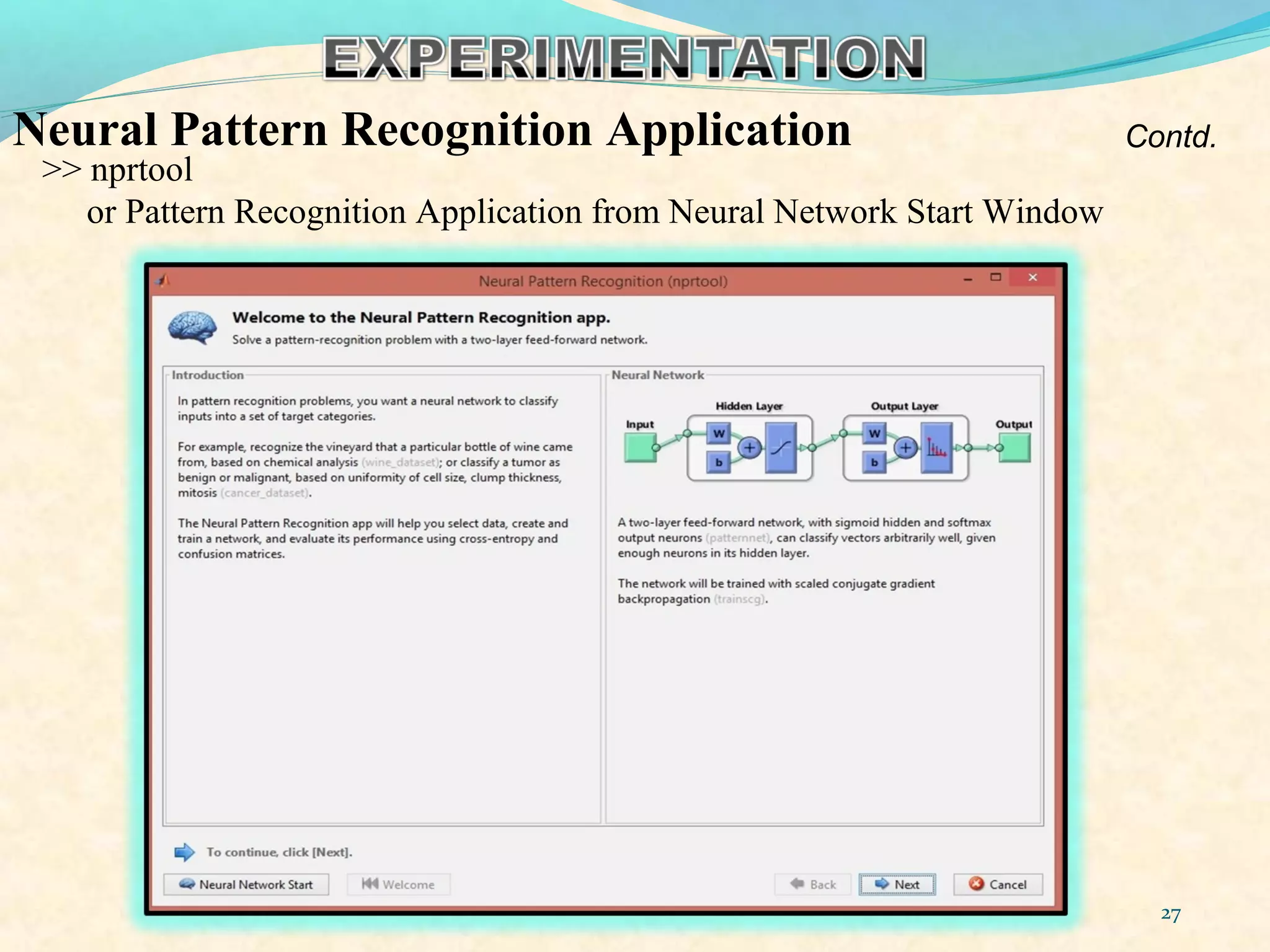
>> nprtool
or Pattern Recognition Application from Neural Network Start Window
27
Neural Pattern Recognition Application Contd.
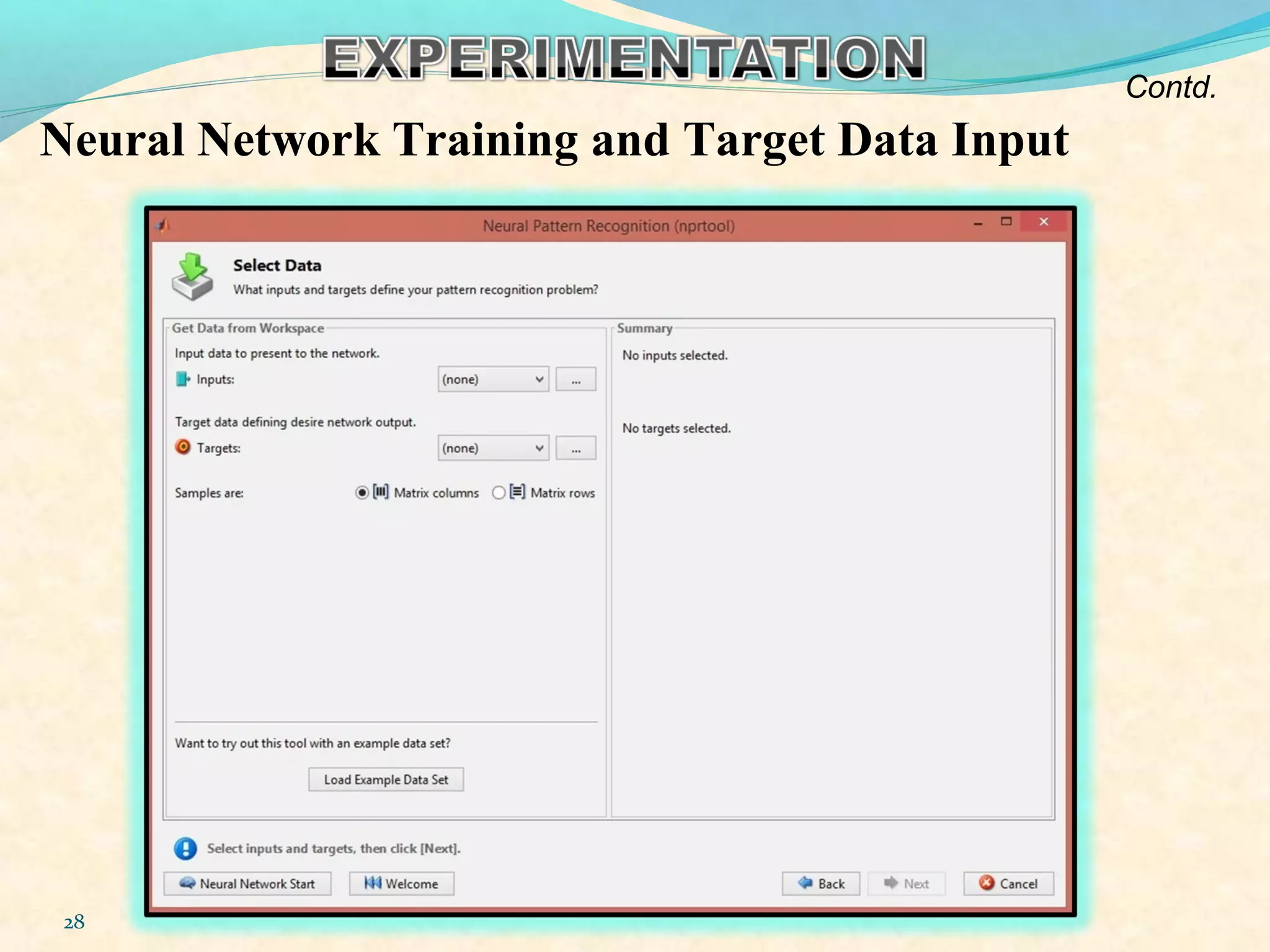
28
Neural Network Training and Target Data Input
Contd.
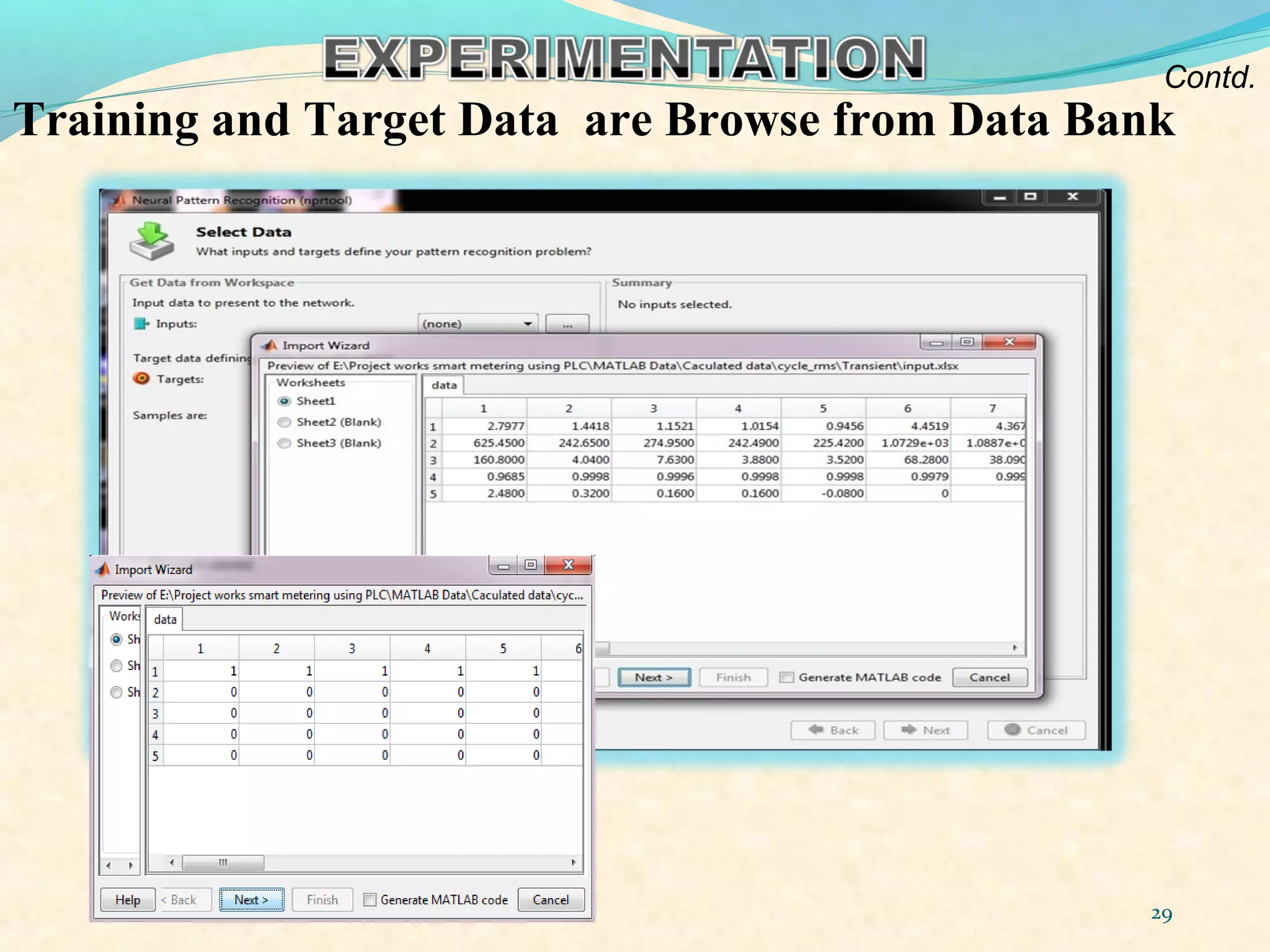
Training and Target Data are Browse from Data Bank
29
Contd.
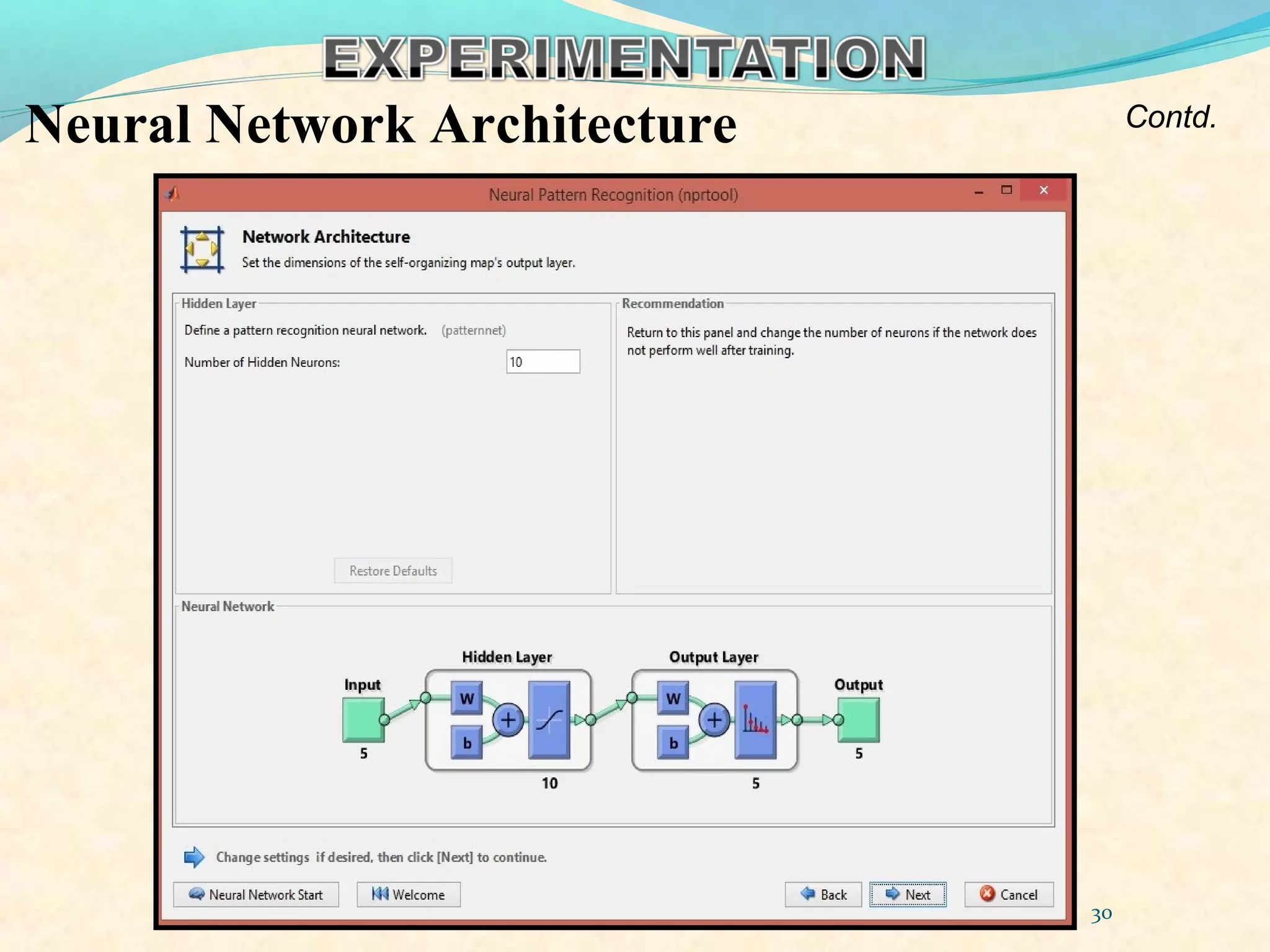
Neural Network Architecture
30
Contd.
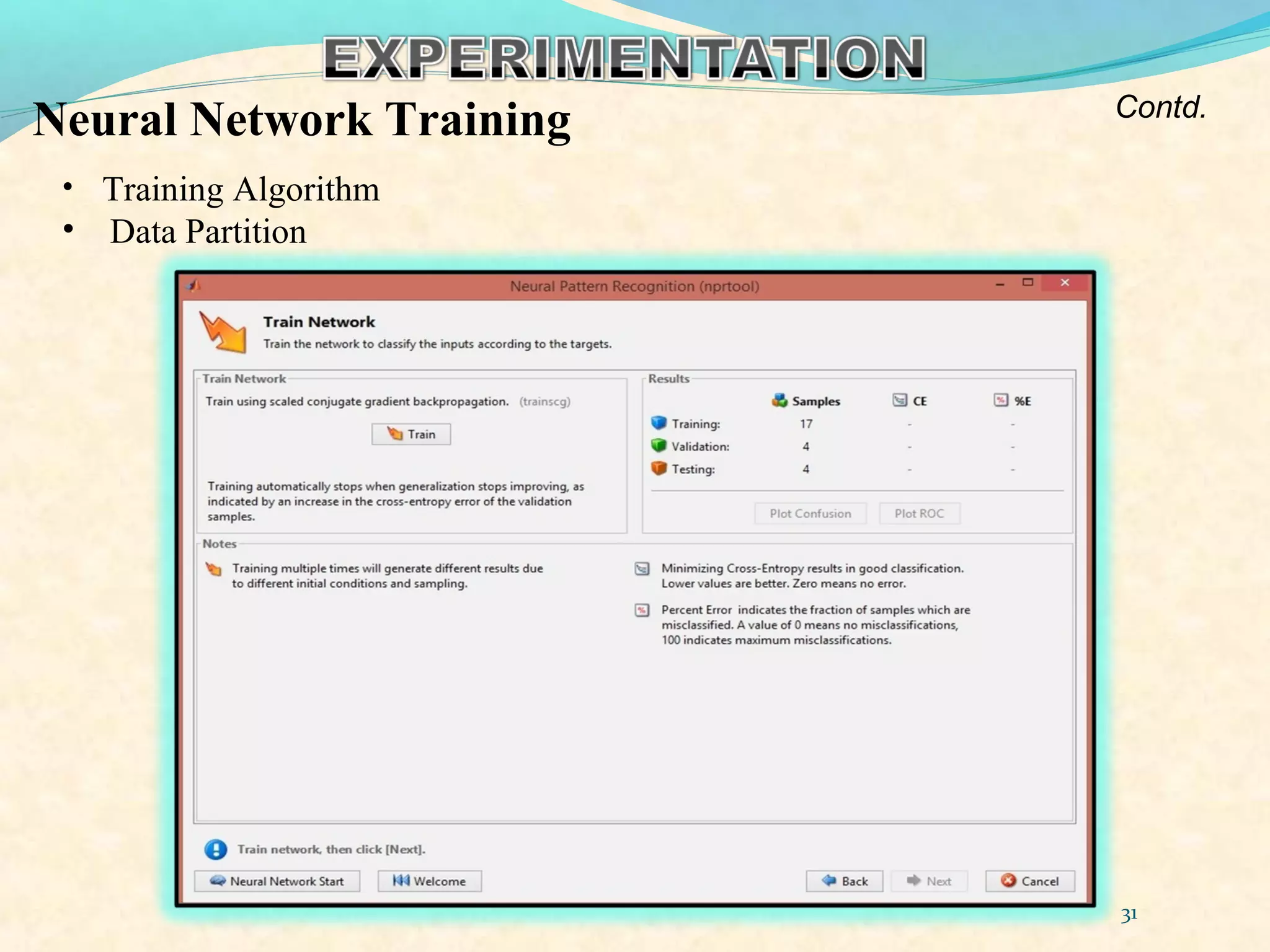
Neural Network Training
• Training Algorithm
• Data Partition
31
Contd.
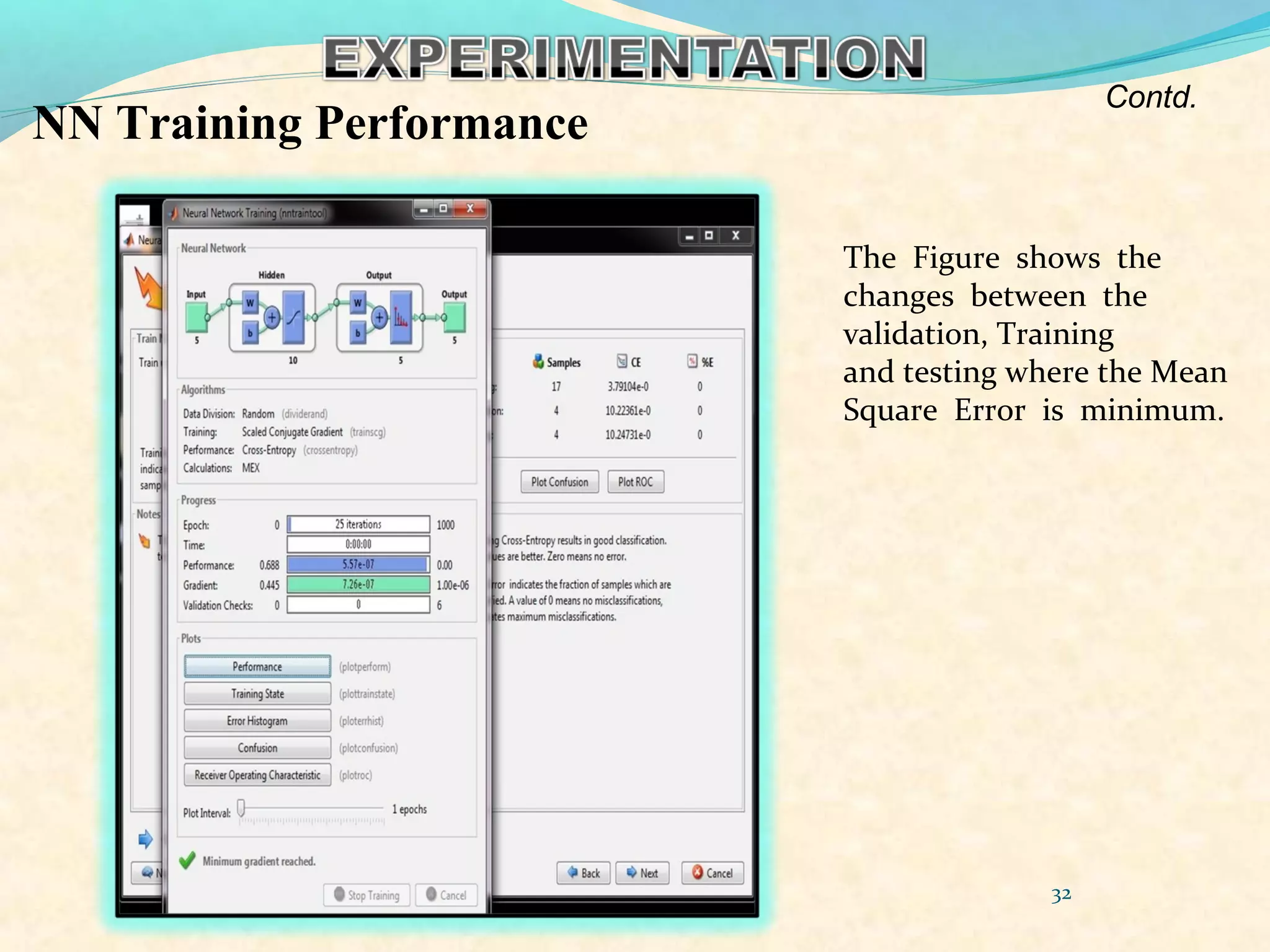
The Figure shows the
changes between the
validation, Training
and testing where the Mean
Square Error is minimum.
NN Training Performance
Contd.
32
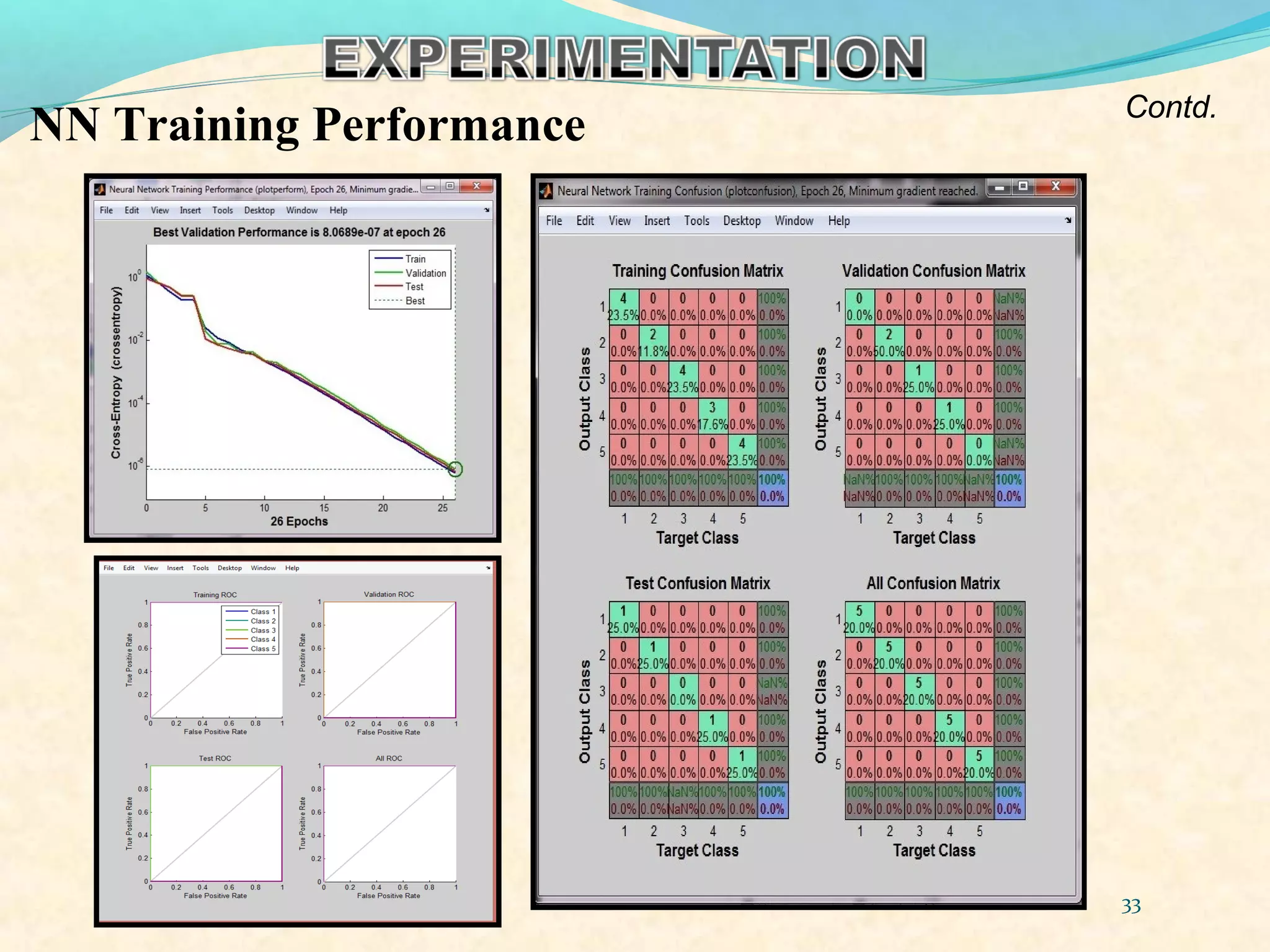
NN Training Performance
33
Contd.
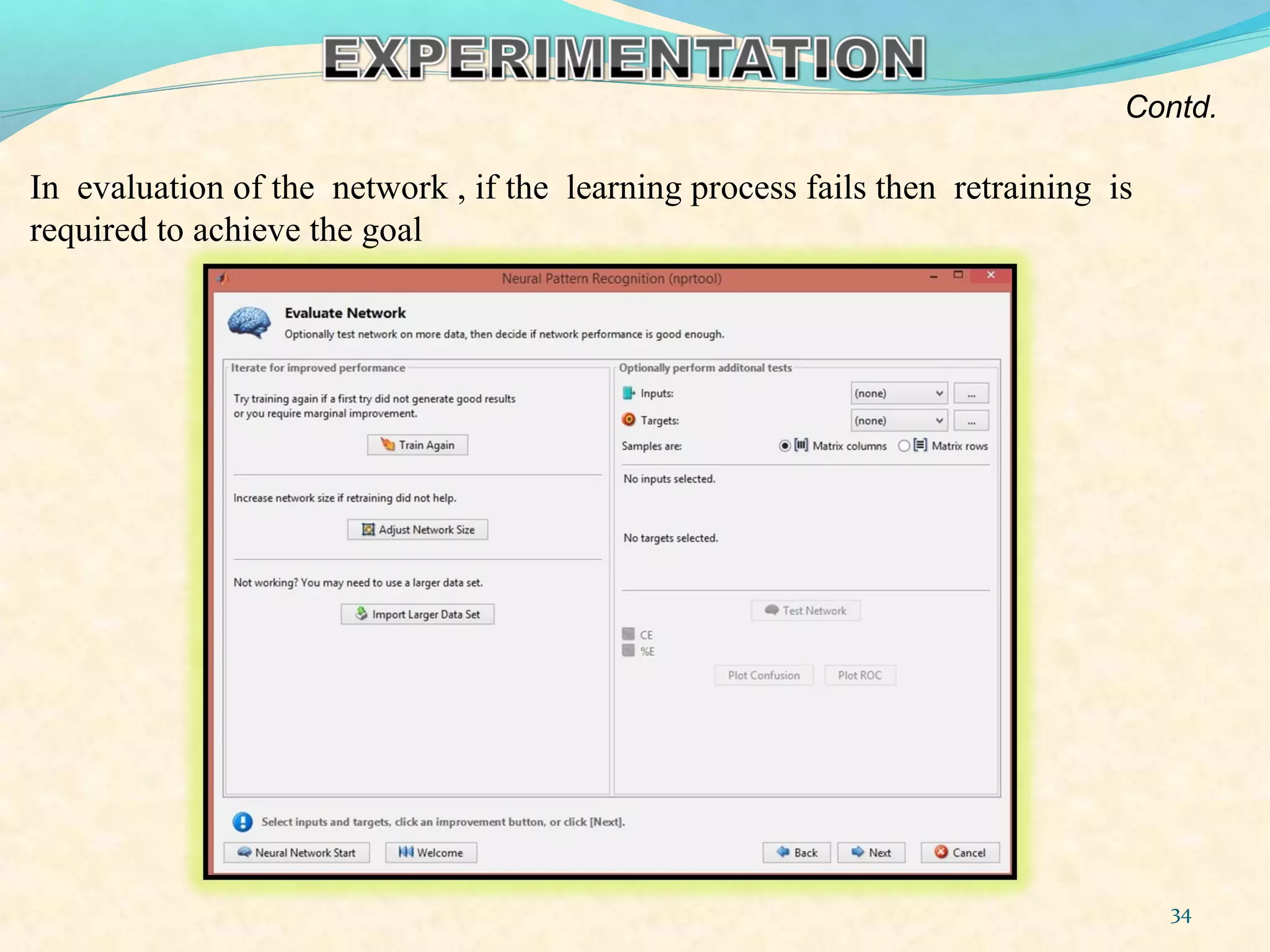
In evaluation of the network , if the learning process fails then retraining is
required to achieve the goal
34
Contd.
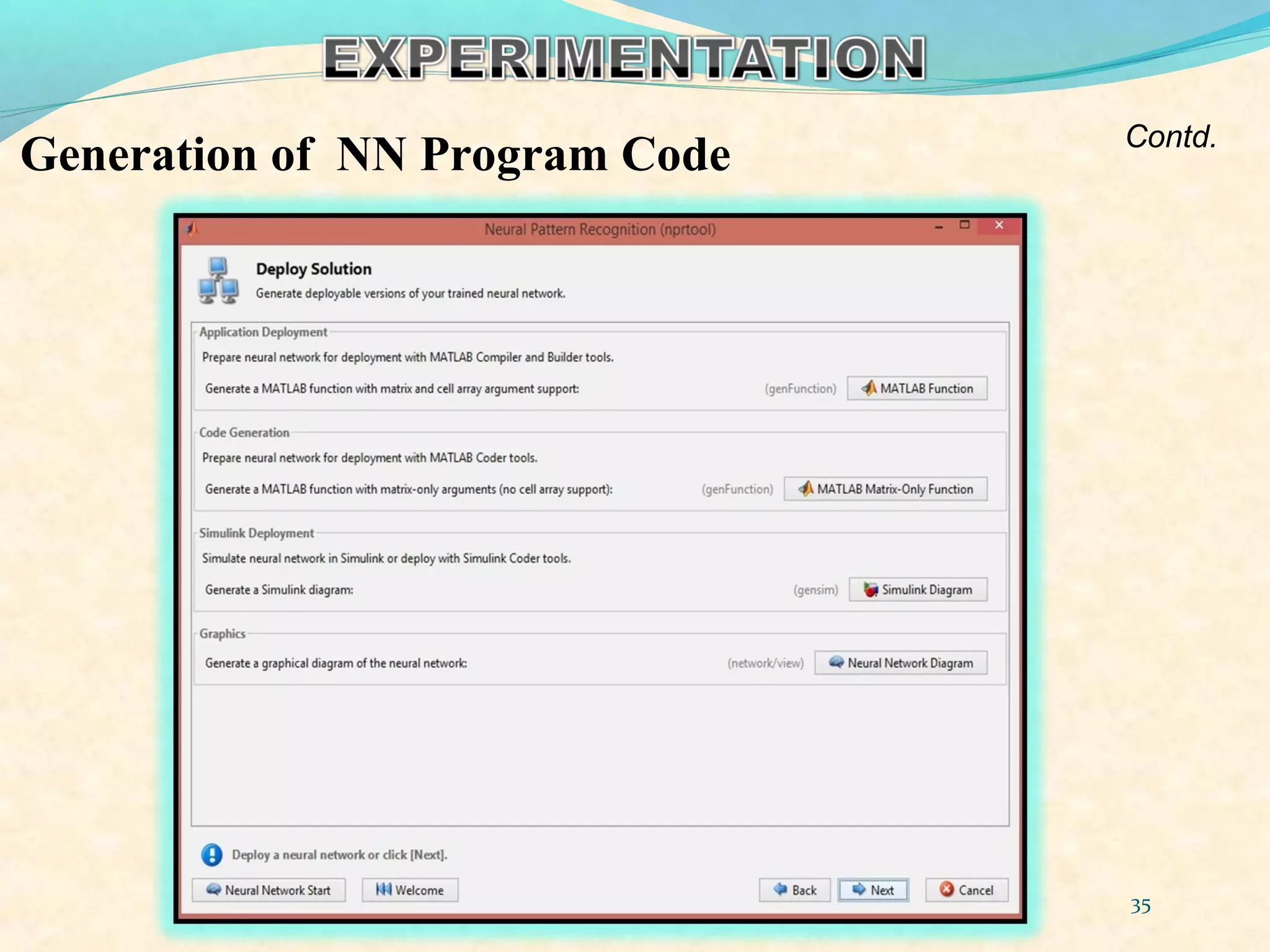
Generation of NN Program Code
35
Contd.
36
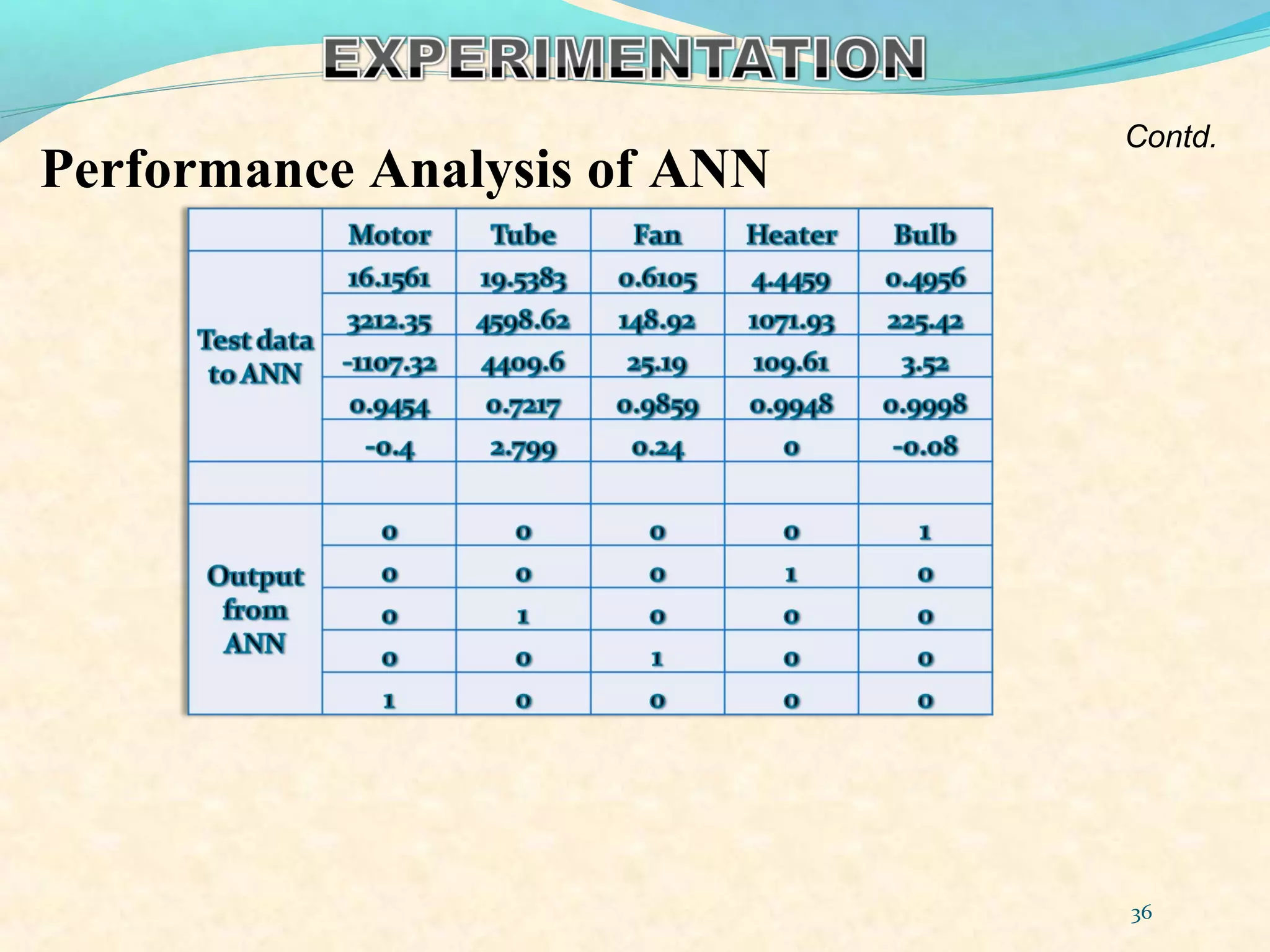
Performance Analysis of ANN
Contd.
37
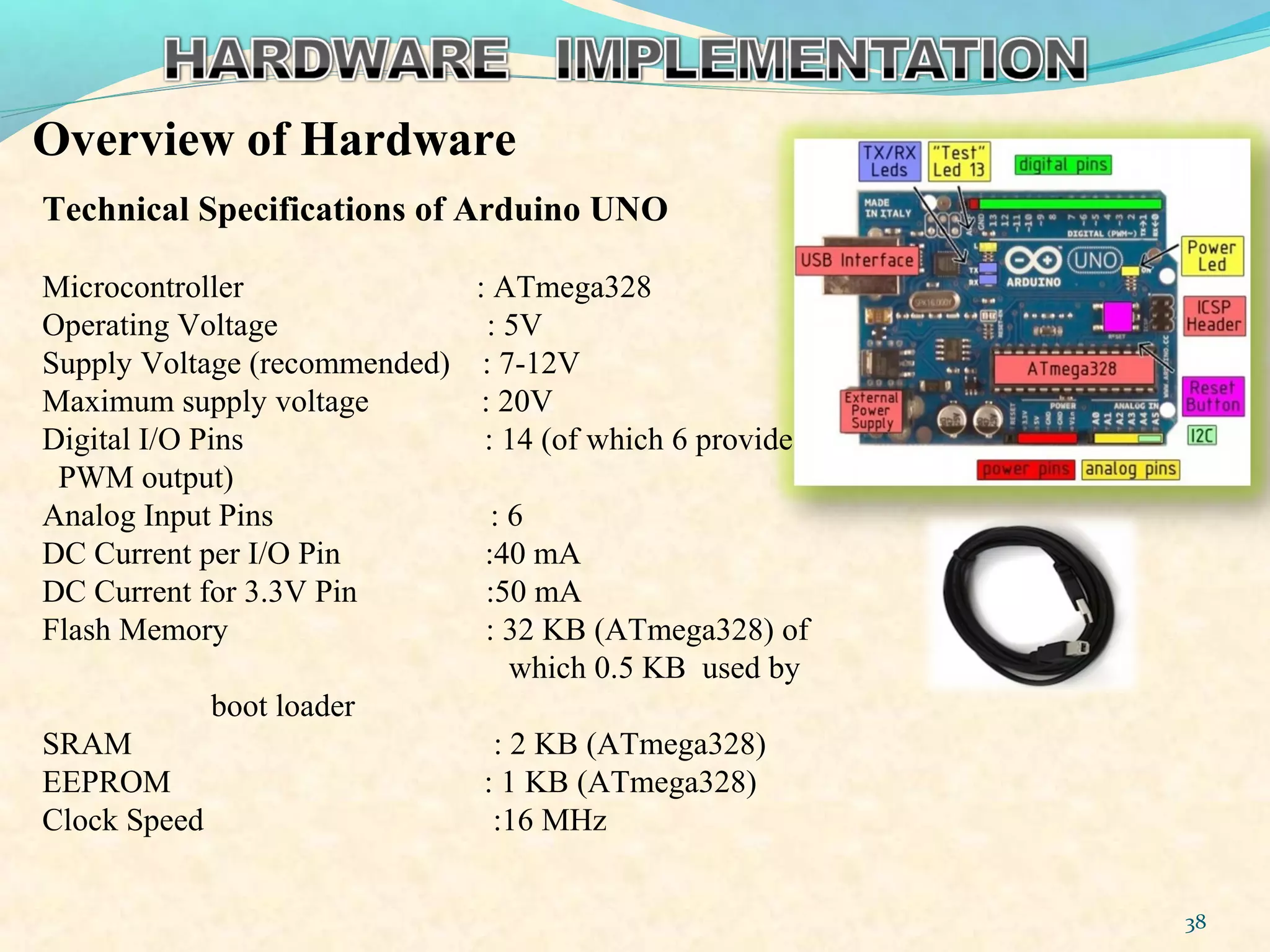
Overview of Hardware
38
Technical Specifications of Arduino UNO
Microcontroller : ATmega328
Operating Voltage : 5V
Supply Voltage (recommended) : 7-12V
Maximum supply voltage : 20V
Digital I/O Pins : 14 (of which 6 provide
PWM output)
Analog Input Pins : 6
DC Current per I/O Pin :40 mA
DC Current for 3.3V Pin :50 mA
Flash Memory : 32 KB (ATmega328) of
which 0.5 KB used by
boot loader
SRAM : 2 KB (ATmega328)
EEPROM : 1 KB (ATmega328)
Clock Speed :16 MHz
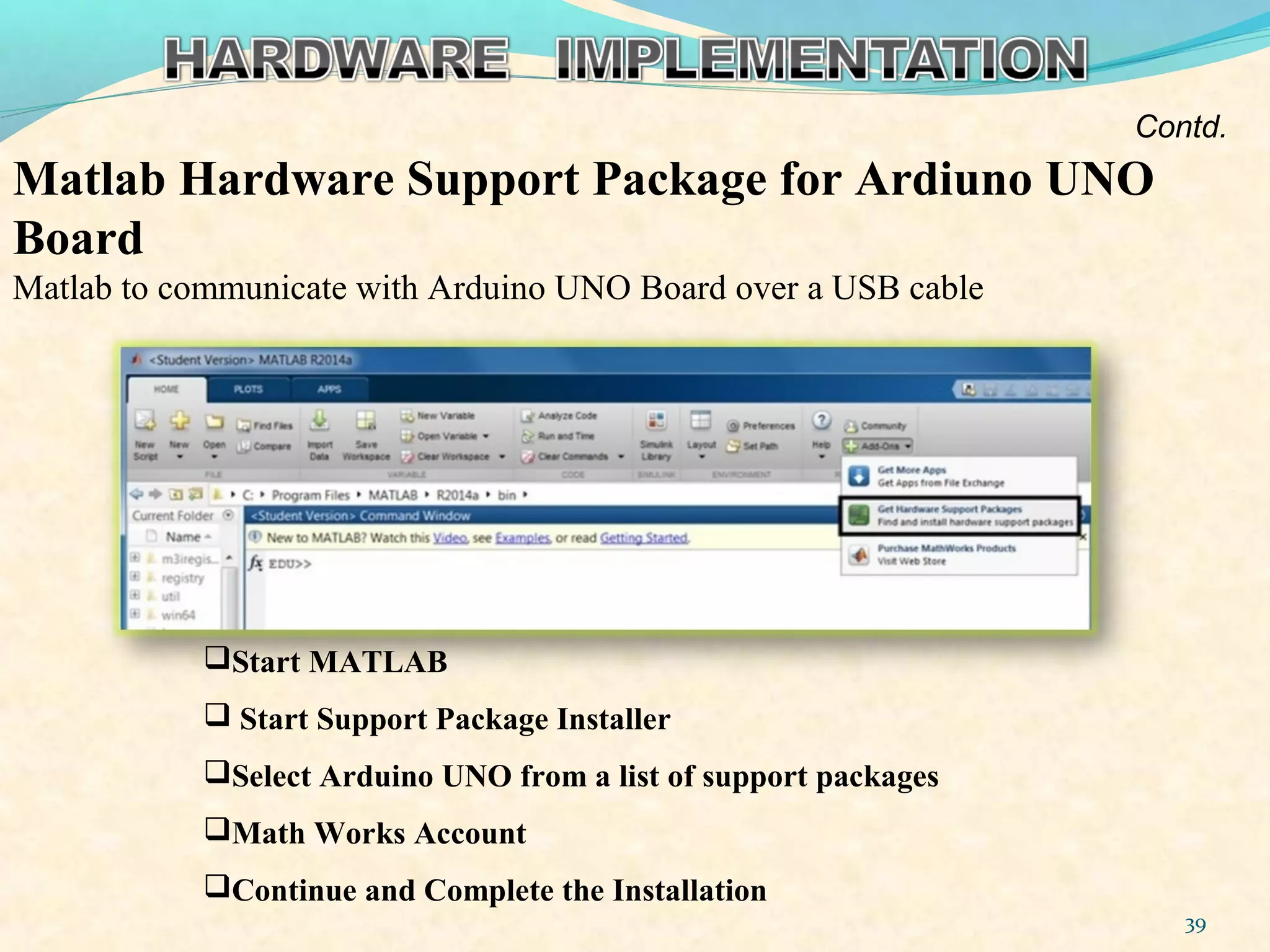
Matlab Hardware Support Package for Ardiuno UNO
Board
Matlab to communicate with Arduino UNO Board over a USB cable
39
Start MATLAB
 Start Support Package Installer
Select Arduino UNO from a list of support packages
Math Works Account
Continue and Complete the Installation
Contd.
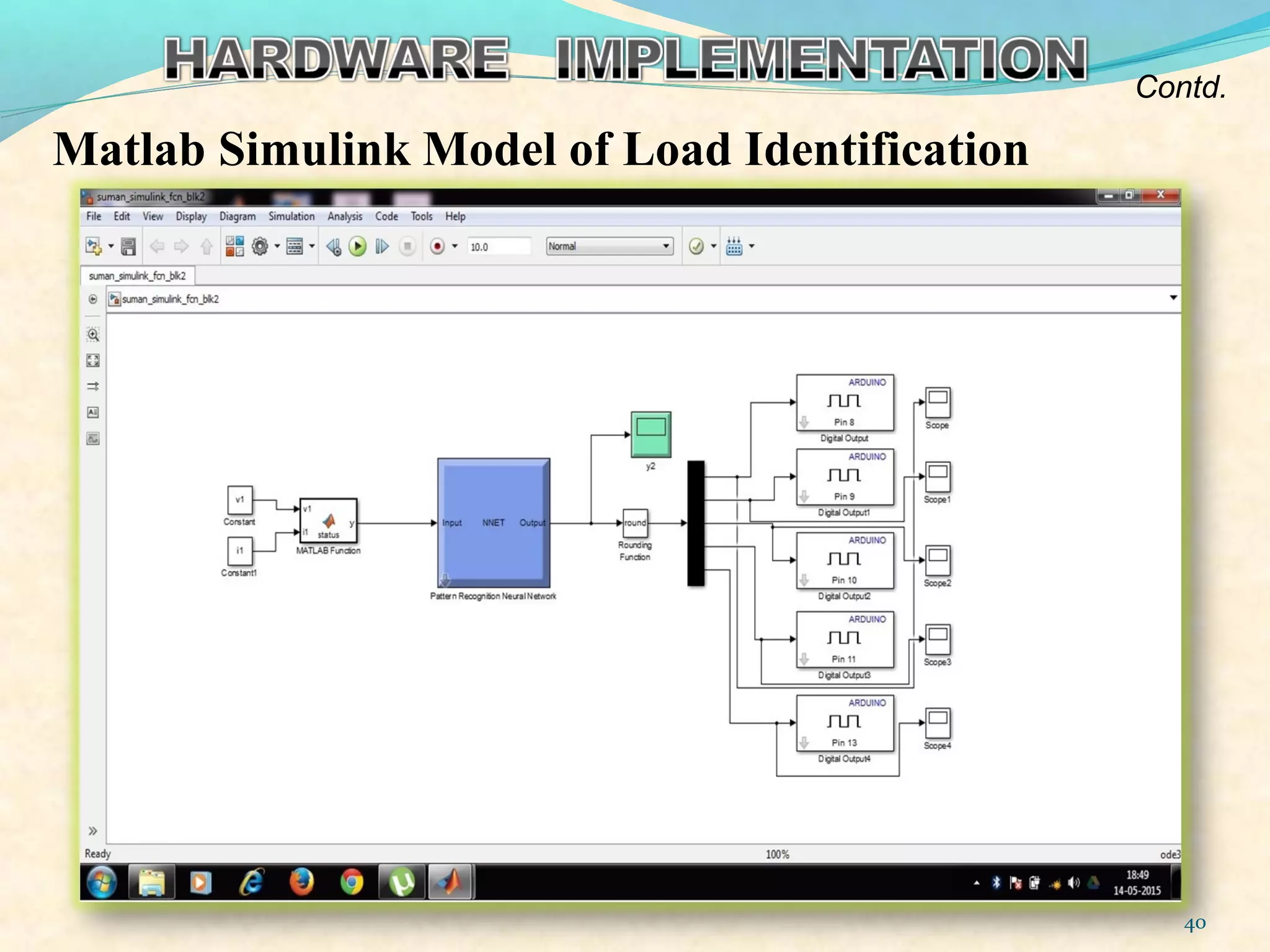
Matlab Simulink Model of Load Identification
40
Contd.
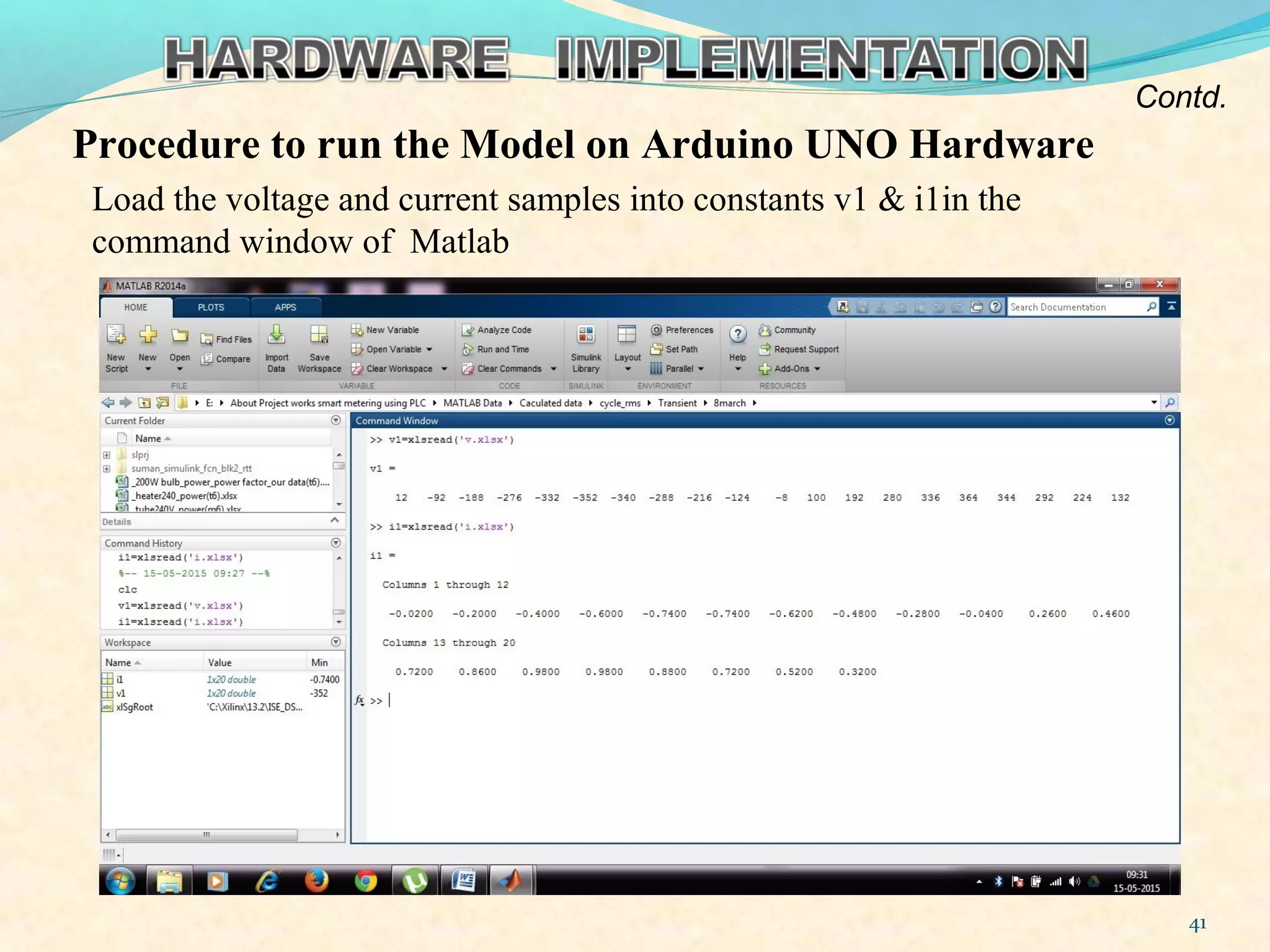
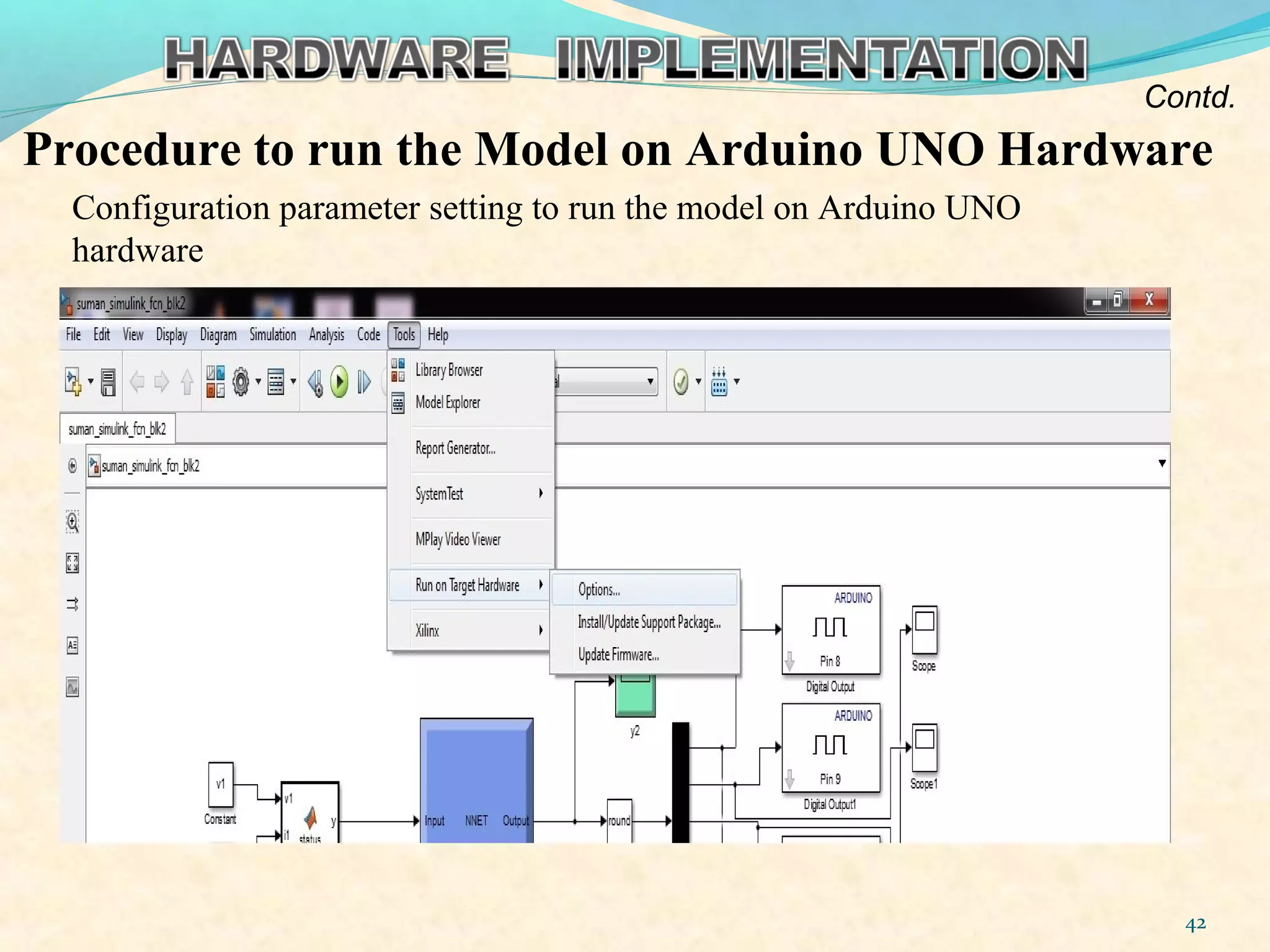
Procedure to run the Model on Arduino UNO Hardware
Load the voltage and current samples into constants v1 & i1in the
command window of Matlab
41
Contd.
Configuration parameter setting to run the model on Arduino UNO
hardware
42
Procedure to run the Model on Arduino UNO Hardware
Contd.
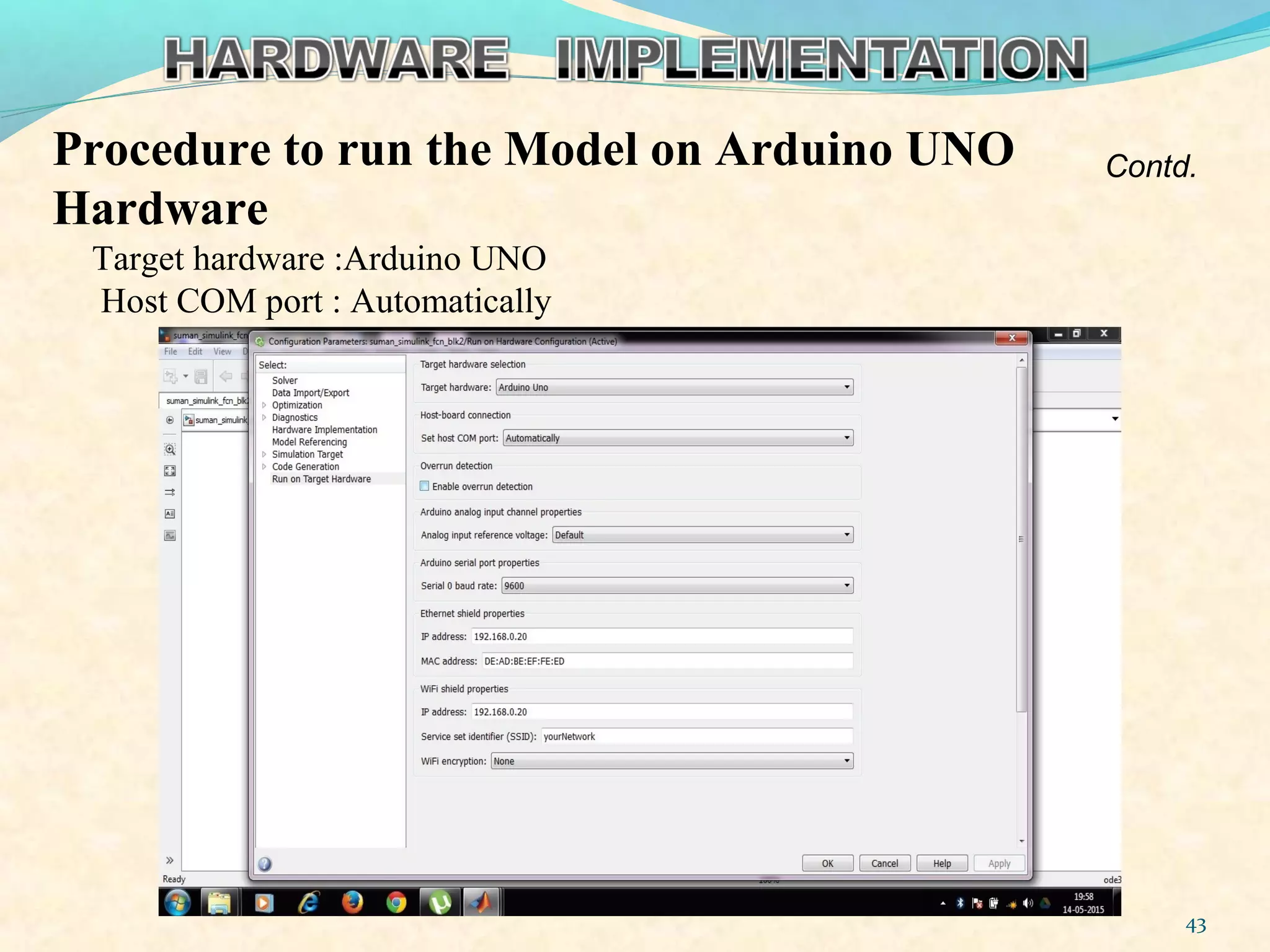
Target hardware :Arduino UNO
Host COM port : Automatically
43
Contd.Procedure to run the Model on Arduino UNO
Hardware
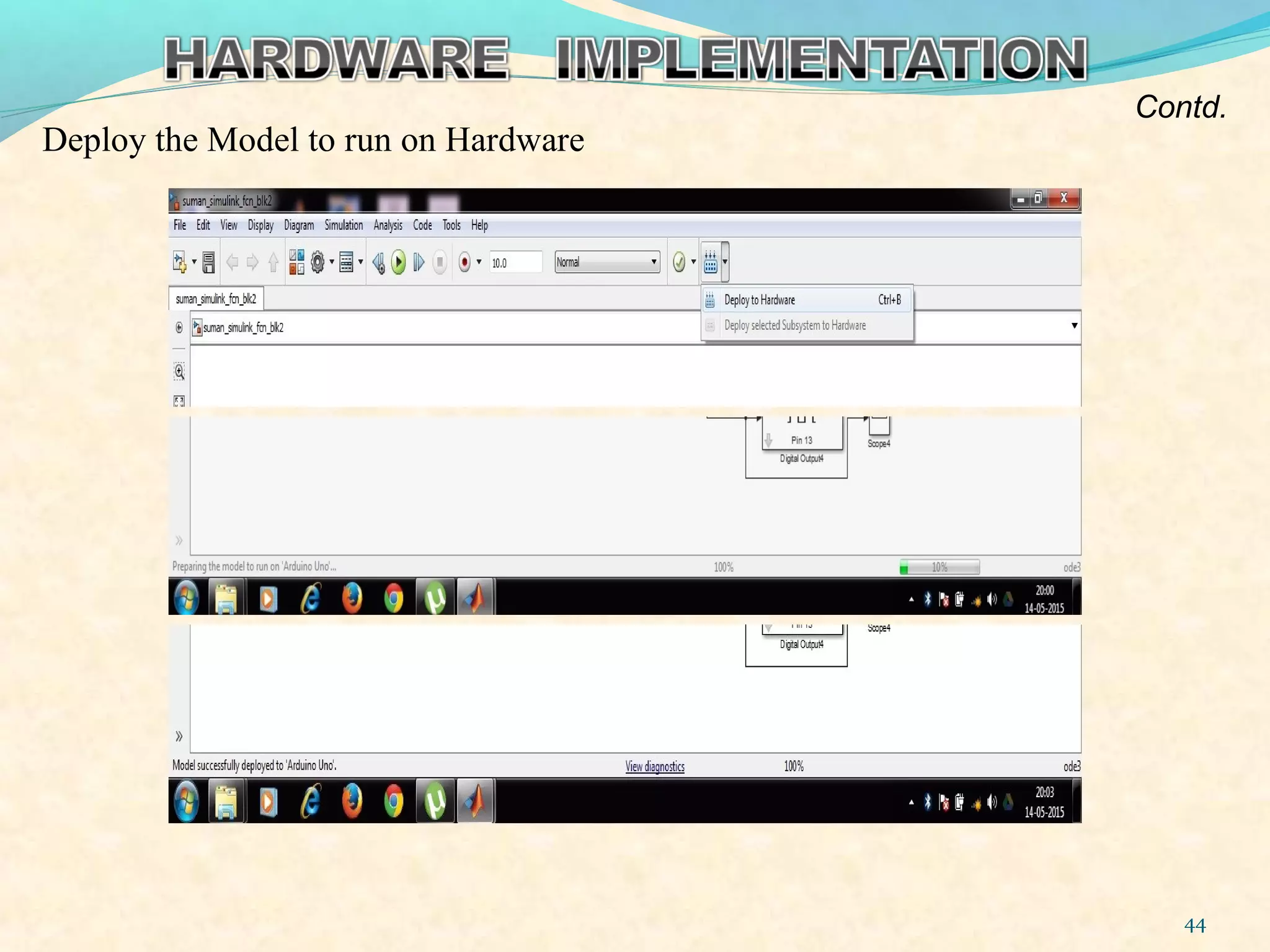
Deploy the Model to run on Hardware
44
Contd.
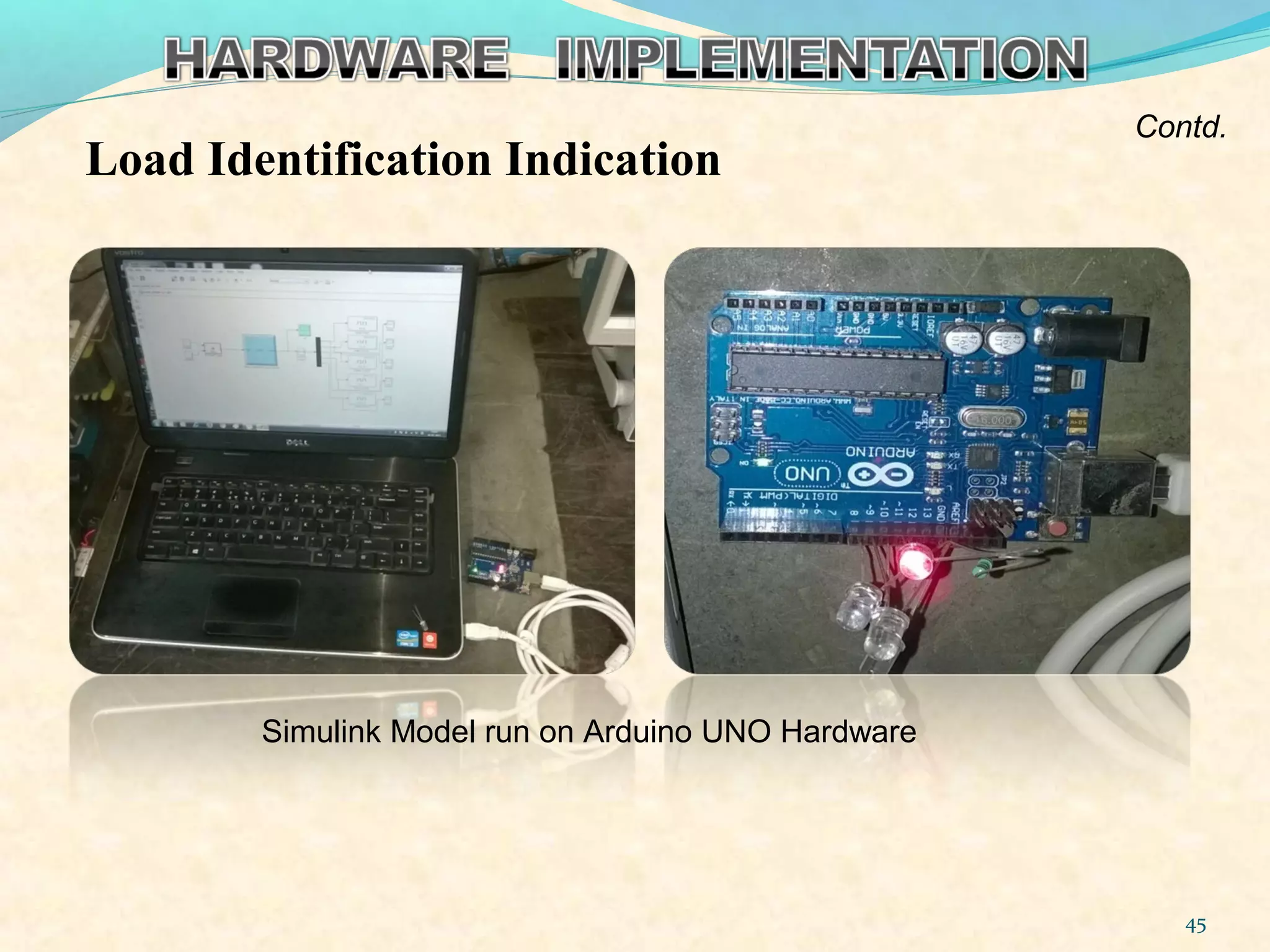
45
Load Identification Indication
Contd.
Simulink Model run on Arduino UNO Hardware
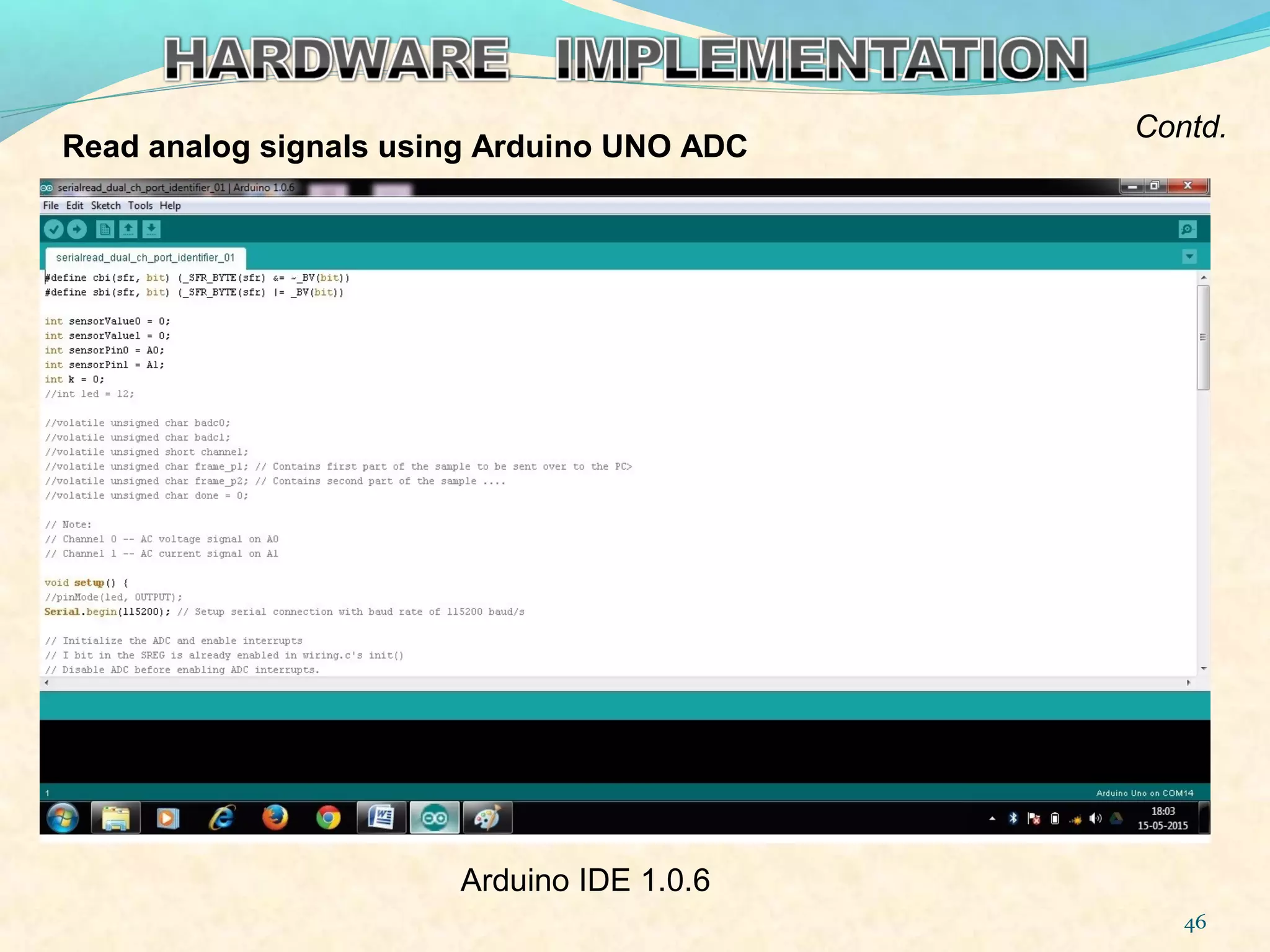
Read analog signals using Arduino UNO ADC
46
Contd.
Arduino IDE 1.0.6
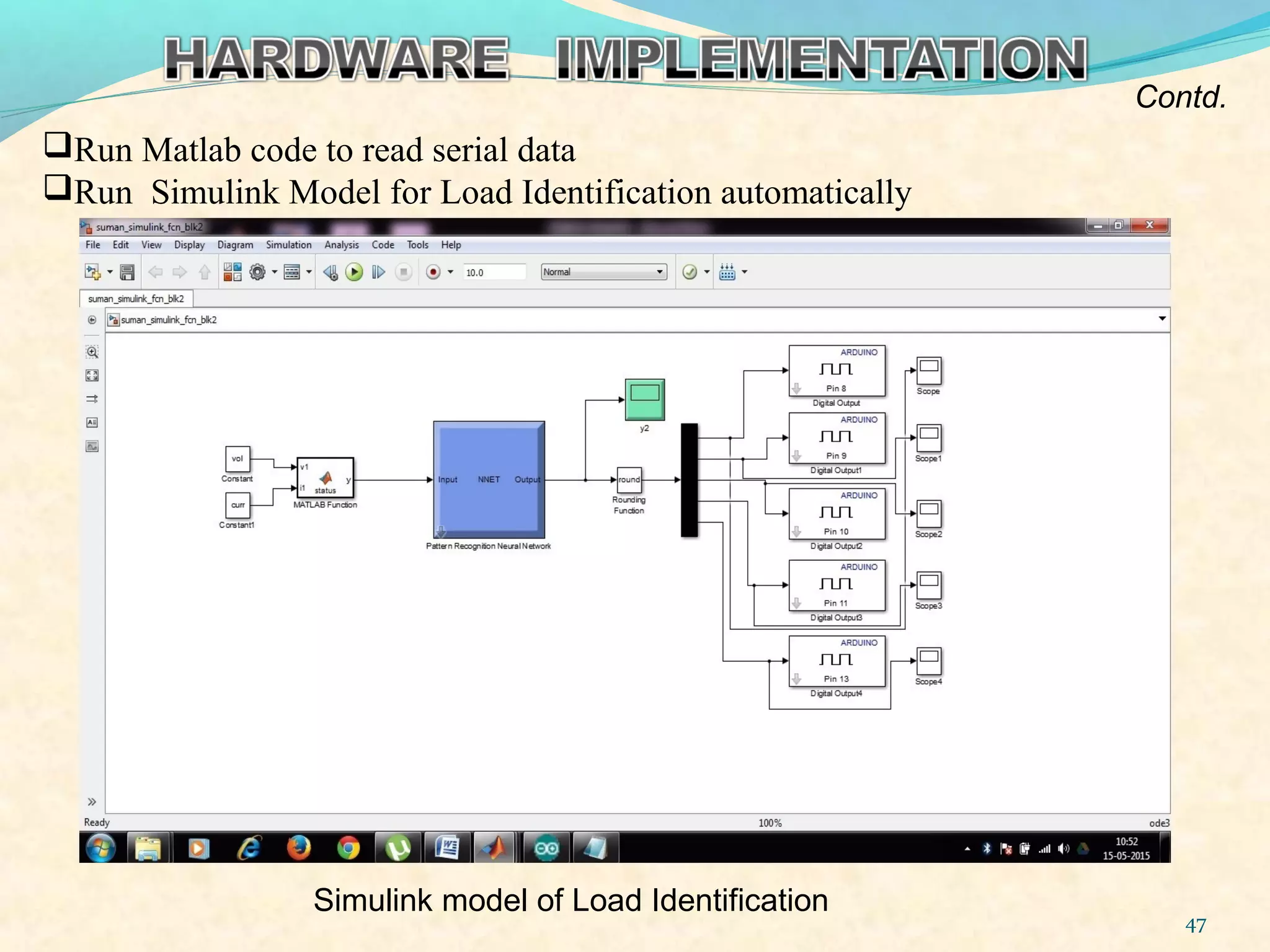
Run Matlab code to read serial data
Run Simulink Model for Load Identification automatically
47
Contd.
Simulink model of Load Identification
48
Contd.
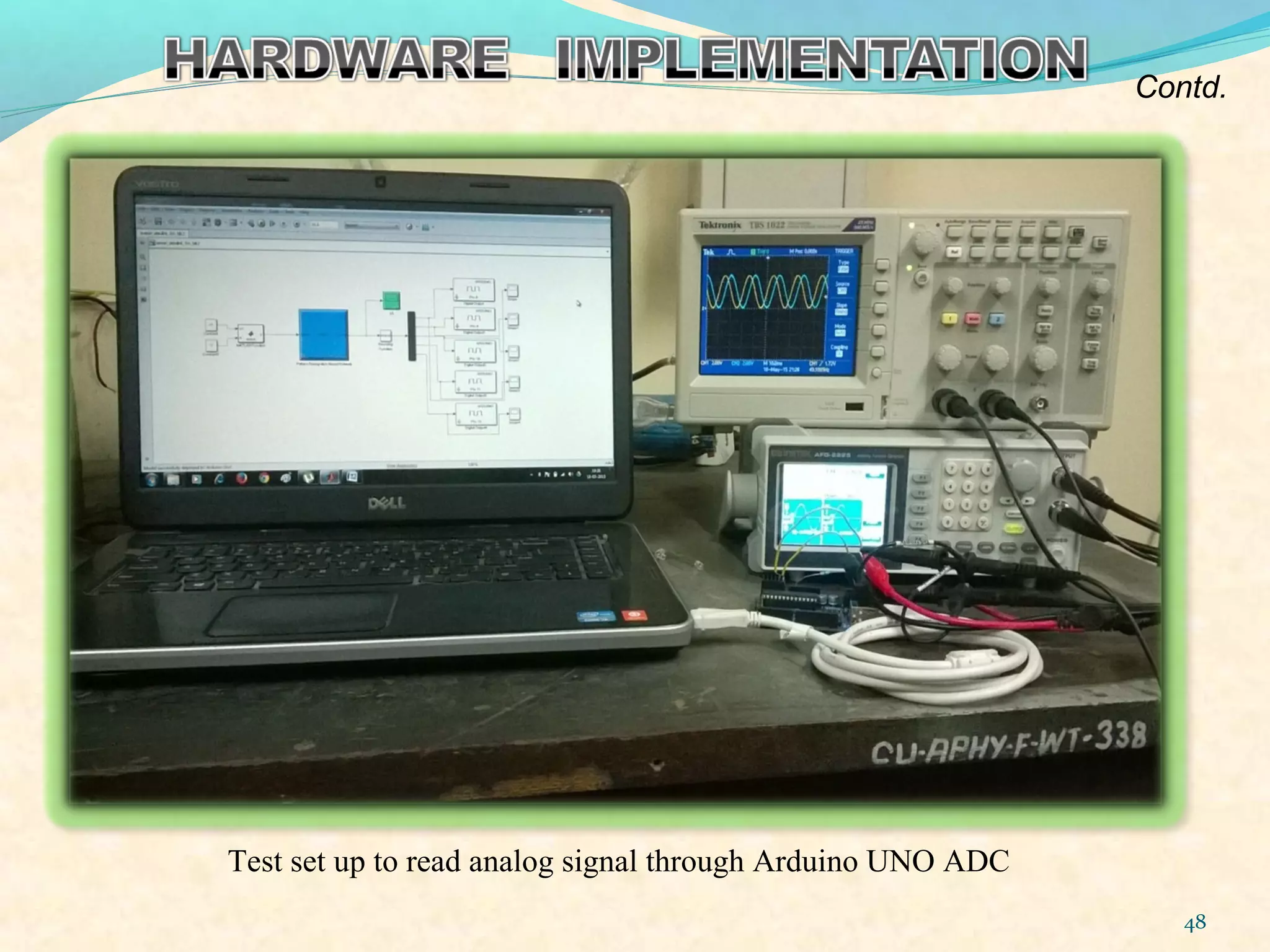
Test set up to read analog signal through Arduino UNO ADC
49
Contd.
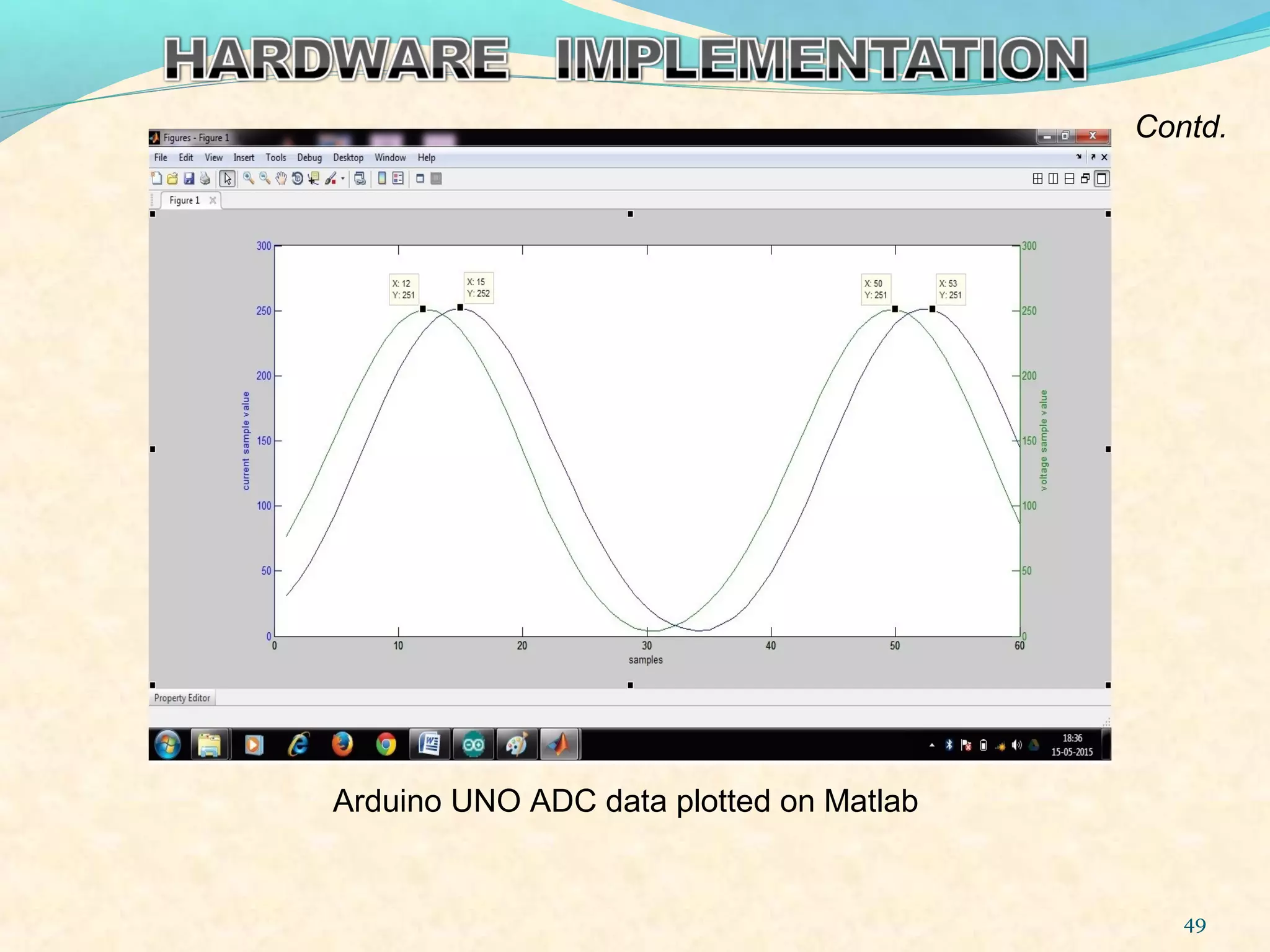
Arduino UNO ADC data plotted on Matlab
50
• Convenient and efficient use of electric appliances
• Remote access of the home electrical appliances
• Energy management strategies of Utility
• Utility to control the energy supply to a particular appliance
• Brief cost estimation of development of a Smart Plug
51
52
1. Smart Grid Technology and Applications by Janaka Ekanayake(Cardiff University, UK),
Kithsiri Liyanage(University of Peradeniya, Sri Lanka), Jianzhong Wu (Cardiff University,
UK), Akihiko Yokoyama (University of Tokyo, Japan), Nick Jenkins (Cardiff University,
UK).
2. Simulator for Smart Load Management in Home Appliances by Michael Rathmair and
Jan Haase (Vienna University of Technology, Institute of Computer Technology).
3. Smart Power Grids 2011 by Professor Ali Keyhani Department of Electrical and
Computer Engineering.
4. Experimental Study and Design of Smart Energy Meter for the Smart Grid by
Anmar Arif, Muhannad AI-Hussain, Nawaf AI-Mutairi, Essam AI-Ammar Yasin Khan and
Nazar Malik Saudi Aramco Chair in Electrical Power, Department of Electrical
Engineering, College of Engineering (King Saud University).
5. A model for generating household electricity load profiles by Jukka V. Paatero and Peter
D. Lund Advanced Energy Systems, (Helsinki University of Technology Finland).
6. Analysis and Application of Artificial Neural Network by L.P.J Veelenturf.
7. ANN Based Load Identification And Forecasting System For The Built Environment by
Hosen Hasna (University of Nebraska-Lincoln, hhasna@unomaha.ed).
8. Principles Of Artificial Neural Networks 2nd Edition by Wai-Kai Chen (Univ. Illinois,
Chicago, USA)
9. Neural Networks by M. Hajek
53

Smartplug ppt

  • 1.
    1 Suman Sahoo RollNo : 97/ELM/124005 By Sumanta Kundu Roll No: 97/ELM/124013 Agniv Mukherjee Roll No : 97/ELM/124016 Raju Ray Roll No : 97/ELM/124017 Under Guidance of Prof. Jitendra Nath Bera Department of Applied Physics, University College of Science & Technology, University of Calcutta 92, A.P.C. Road, Kolkata-700009 West Bengal, India Date: 26-05-2015
  • 2.
  • 3.
    3 Information regarding realtime specific data for energy consumption and corresponding tariff  Remote control of different Home Appliances  Remote notification of usage of energy consumption  Managing and storing vast quantities of metering data Ensuring the security of metering data Extra energy (if generated) can be sent back to Grid Today’s Demands Performance degradation analysis of a particular appliance
  • 4.
    4 Decarbonise electricity Greater visibilityto distribution network Participation of the consumers into power system operation through Smart Meter, Smart Plug. Improved ICT (Information & Communication Technology) offers greater monitoring, control, flexibility and low cost operation of power system. Effective management of loads and reduction of losses and wasted energy needs accurate information about the loads. Performance comparison for same appliance of different make Local display of information on smart plug itself Contd.
  • 5.
     Provides somebasic information of a particular appliance  Includes an embedded ICT unit so that power usage information it collects about the appliance can then be transmitted  Access electricity consumption data and determine the best time to use an individual appliance Smart Plug Contd. 5 Smart Plug
  • 6.
    Essential part ofthe Smart Grid It can provide detailed load flow on real time basis Helps in effective management of the grid operation Helps consumer to realize the energy usage and the corresponding tariff Two way communication - Automatic Meter Reading - Restriction of supply Smart Energy Meter 6 Contd. Smart Energy Meter
  • 7.
    7 Smart Home •A homeequipped with lighting, heating, and electronic devices that can be controlled remotely by smart phone or computer • Smart home relate to the development of some major aspects: (a)Capabilities of home infrastructure and controlled device (b) Usability of mobile and stationary user interfaces Contd.
  • 8.
  • 9.
    9 Contd. Involvement of Information& Communication Technology Rapid development of Wireless Communication Systems like 3G, 4G, Wi-Fi Introductory involvement of communication interfaces like Bluetooth, ZigBee, Wi-Fi Power Line Communication (PLC)
  • 10.
    10 Power Line Communication(PLC) as Communication Channel  The Home Automation System Using Power Line Communication (PLC) at home is user friendly and cost efficient. It requires only electricity to run the system. Fundamental parts of the smart meter as well as the Smart Grid. Communication through power line by the Utilities to Consumers if possible results to breakthrough in communications. Every household would be connected at any time and services being provided at real-time. Based on electrical signals, carrying information, propagating over the power- line. Contd.
  • 11.
  • 12.
  • 13.
    13 Classifiers An algorithm implementingclassification, especially concrete implementation  A mathematical function , implemented by a classification algorithm, that maps input data to a category Bayesian  Support Vector machine Classifier Fuzzy Ruled Based Classifier Artificial Neural Network Types of Classifiers
  • 14.
    14 In our projectwe have used the Artificial Neural Network (ANN) as the classifier has some benefits from others which are mentioned below : (a) Adaptive Learning (b) Self-Organization (c) Real Time Operation (d) Fault Tolerance via Redundant Information Coding (e) Implementation Ability Contd.
  • 15.
    15 Artificial Neural Network(ANN) A computational system inspired by the structure, processing method and learning ability of a biological brain Contd. (a) A large number of very simple processing neuron-like processing elements. (b) A large number of weighted connections between the elements. (c) Distributed representation of knowledge over the connections. (d) Knowledge is acquired by network through a learning process.
  • 16.
    Elements of ANN (a)Processing unit (b) Activation function (c) Learning paradigm 16 Contd.
  • 17.
  • 18.
  • 19.
  • 20.
  • 21.
    Schematic Overview Ardiuno UNOBoard Signal Conditioning Signal Conditioning ADC Atmega 328 µC Communic ation unit (PLC) Local Display Ph N CT 1-ph Elec. Load PT Smart Plug 21 Smart Meter
  • 22.
    Procedural Steps Training AndTesting of Neural Network 22 Contd.
  • 23.
    Data Acquisition &Signature Extraction •Voltage & current data of diff. load captured by DSO •The sample data of voltage & current data taken into a spreadsheet using software webstar • Formation of load signature (by mathematical calculation) using captured sampled data of voltage & current of diff. load 23 •The data obtained in the measurement is stored into a computer for further study; the appliances include: i) Fan ii) Bulb ; iii) Tube Light iv) Heater v)1 Ph Induction Motor Contd.
  • 24.
    Captured Data forSignature Extraction current Time Time voltage Current nature obtained for 200 Watt bulb switching phenomenon . Voltage nature obtained for 200 Watt bulb switching phenomenon 24 Contd.
  • 25.
    Amplitude Power spectrum Time Frequency SimulatedMATLAB output of 200W bulb current switching phenomenon FFT Analysis using MatLab Simulated MATLAB FFT analysis of 200W bulb current data 25 Contd.
  • 26.
    ANN Start upWindow 26 NN toolbox can be open by entering the command on command window >>nnstart Contd.
  • 27.
    >> nprtool or PatternRecognition Application from Neural Network Start Window 27 Neural Pattern Recognition Application Contd.
  • 28.
    28 Neural Network Trainingand Target Data Input Contd.
  • 29.
    Training and TargetData are Browse from Data Bank 29 Contd.
  • 30.
  • 31.
    Neural Network Training •Training Algorithm • Data Partition 31 Contd.
  • 32.
    The Figure showsthe changes between the validation, Training and testing where the Mean Square Error is minimum. NN Training Performance Contd. 32
  • 33.
  • 34.
    In evaluation ofthe network , if the learning process fails then retraining is required to achieve the goal 34 Contd.
  • 35.
    Generation of NNProgram Code 35 Contd.
  • 36.
  • 37.
  • 38.
    Overview of Hardware 38 TechnicalSpecifications of Arduino UNO Microcontroller : ATmega328 Operating Voltage : 5V Supply Voltage (recommended) : 7-12V Maximum supply voltage : 20V Digital I/O Pins : 14 (of which 6 provide PWM output) Analog Input Pins : 6 DC Current per I/O Pin :40 mA DC Current for 3.3V Pin :50 mA Flash Memory : 32 KB (ATmega328) of which 0.5 KB used by boot loader SRAM : 2 KB (ATmega328) EEPROM : 1 KB (ATmega328) Clock Speed :16 MHz
  • 39.
    Matlab Hardware SupportPackage for Ardiuno UNO Board Matlab to communicate with Arduino UNO Board over a USB cable 39 Start MATLAB  Start Support Package Installer Select Arduino UNO from a list of support packages Math Works Account Continue and Complete the Installation Contd.
  • 40.
    Matlab Simulink Modelof Load Identification 40 Contd.
  • 41.
    Procedure to runthe Model on Arduino UNO Hardware Load the voltage and current samples into constants v1 & i1in the command window of Matlab 41 Contd.
  • 42.
    Configuration parameter settingto run the model on Arduino UNO hardware 42 Procedure to run the Model on Arduino UNO Hardware Contd.
  • 43.
    Target hardware :ArduinoUNO Host COM port : Automatically 43 Contd.Procedure to run the Model on Arduino UNO Hardware
  • 44.
    Deploy the Modelto run on Hardware 44 Contd.
  • 45.
    45 Load Identification Indication Contd. SimulinkModel run on Arduino UNO Hardware
  • 46.
    Read analog signalsusing Arduino UNO ADC 46 Contd. Arduino IDE 1.0.6
  • 47.
    Run Matlab codeto read serial data Run Simulink Model for Load Identification automatically 47 Contd. Simulink model of Load Identification
  • 48.
    48 Contd. Test set upto read analog signal through Arduino UNO ADC
  • 49.
    49 Contd. Arduino UNO ADCdata plotted on Matlab
  • 50.
    50 • Convenient andefficient use of electric appliances • Remote access of the home electrical appliances • Energy management strategies of Utility • Utility to control the energy supply to a particular appliance • Brief cost estimation of development of a Smart Plug
  • 51.
  • 52.
    52 1. Smart GridTechnology and Applications by Janaka Ekanayake(Cardiff University, UK), Kithsiri Liyanage(University of Peradeniya, Sri Lanka), Jianzhong Wu (Cardiff University, UK), Akihiko Yokoyama (University of Tokyo, Japan), Nick Jenkins (Cardiff University, UK). 2. Simulator for Smart Load Management in Home Appliances by Michael Rathmair and Jan Haase (Vienna University of Technology, Institute of Computer Technology). 3. Smart Power Grids 2011 by Professor Ali Keyhani Department of Electrical and Computer Engineering. 4. Experimental Study and Design of Smart Energy Meter for the Smart Grid by Anmar Arif, Muhannad AI-Hussain, Nawaf AI-Mutairi, Essam AI-Ammar Yasin Khan and Nazar Malik Saudi Aramco Chair in Electrical Power, Department of Electrical Engineering, College of Engineering (King Saud University). 5. A model for generating household electricity load profiles by Jukka V. Paatero and Peter D. Lund Advanced Energy Systems, (Helsinki University of Technology Finland). 6. Analysis and Application of Artificial Neural Network by L.P.J Veelenturf. 7. ANN Based Load Identification And Forecasting System For The Built Environment by Hosen Hasna (University of Nebraska-Lincoln, hhasna@unomaha.ed). 8. Principles Of Artificial Neural Networks 2nd Edition by Wai-Kai Chen (Univ. Illinois, Chicago, USA) 9. Neural Networks by M. Hajek
  • 53.

Editor's Notes

  • #23 Back propagation algorithm is not necessary here it will be under the training & testing of ANN
  • #24 Raju Da.