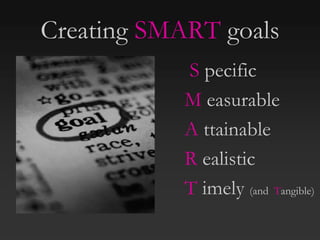
Creating SMART goals
S pecific
M easurable
A ttainable
R ealistic
T imely (and Tangible)
A specific goal has a much
greater chance of being
accomplished than a
general goal. A general goal would be,
“Implement common core state
standards.“ But a specific goal
would say, “Implement one
standard every six weeks, and
have two formative and one
summative assessment with it."
Creating specific goals
To set a specific goal you must answer the six "W"
questions:
Who: Who is involved?
What: What do I want to accomplish?
Where: Identify a location. (Science Lab)
When: Establish a time frame. (For second semester)
Which: Identify requirements and constraints.
Why: Specific reasons, purpose or benefits of
accomplishing the goal.
Creating specific goals
Creating measurable goals
When you measure your progress, you stay
on track, reach your target dates, and
experience the exhilaration of achievement
that spurs you on to continued effort
required to reach your goal.
Establish concrete criteria for
measuring progress toward the
attainment of each goal you
set.
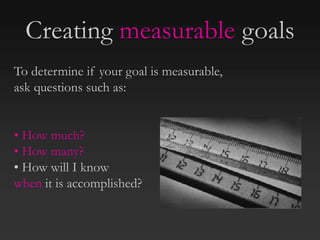
To determine if your goal is measurable,
ask questions such as:
• How much?
• How many?
• How will I know
when it is accomplished?
Creating measurable goals
Creating attainable goals
When you identify goals that are
most important to you, you begin
to figure out ways you can make
them come true.
You develop the attitudes, abilities, skills,
and financial capacity to reach them. You
begin seeing previously overlooked
opportunities to bring yourself closer to
the achievement of your goals.
Creating realistic goals
To be realistic, a goal must represent
an objective toward which you are
both willing and able to work.
A high goal is frequently easier to reach
than a low one because a low goal exerts
low motivational force. Some of the
hardest jobs you ever accomplished
actually seem easy simply because they
were a labor of love.
Creating timely goals
When do you want to accomplish your
goal? “Someday” won't work. But if
you anchor it within a timeframe (“by
May 1st”), then you have already set
your unconscious mind into motion to
begin working on the goal.
A goal should be grounded within a
time frame. With no time frame tied
to it, there is no sense of urgency.
Tcan also stand for Tangible
A goal is tangible when you can experience it
with one of the senses, that is, taste, touch,
smell, sight or hearing.
When your goal is tangible you have a better
chance of making it specific and measurable
and thus attainable.

smart_goals.ppt

  • 2.
    Creating SMART goals Specific M easurable A ttainable R ealistic T imely (and Tangible)
  • 3.
    A specific goalhas a much greater chance of being accomplished than a general goal. A general goal would be, “Implement common core state standards.“ But a specific goal would say, “Implement one standard every six weeks, and have two formative and one summative assessment with it." Creating specific goals
  • 4.
    To set aspecific goal you must answer the six "W" questions: Who: Who is involved? What: What do I want to accomplish? Where: Identify a location. (Science Lab) When: Establish a time frame. (For second semester) Which: Identify requirements and constraints. Why: Specific reasons, purpose or benefits of accomplishing the goal. Creating specific goals
  • 5.
    Creating measurable goals Whenyou measure your progress, you stay on track, reach your target dates, and experience the exhilaration of achievement that spurs you on to continued effort required to reach your goal. Establish concrete criteria for measuring progress toward the attainment of each goal you set.
  • 6.
    To determine ifyour goal is measurable, ask questions such as: • How much? • How many? • How will I know when it is accomplished? Creating measurable goals
  • 7.
    Creating attainable goals Whenyou identify goals that are most important to you, you begin to figure out ways you can make them come true. You develop the attitudes, abilities, skills, and financial capacity to reach them. You begin seeing previously overlooked opportunities to bring yourself closer to the achievement of your goals.
  • 8.
    Creating realistic goals Tobe realistic, a goal must represent an objective toward which you are both willing and able to work. A high goal is frequently easier to reach than a low one because a low goal exerts low motivational force. Some of the hardest jobs you ever accomplished actually seem easy simply because they were a labor of love.
  • 9.
    Creating timely goals Whendo you want to accomplish your goal? “Someday” won't work. But if you anchor it within a timeframe (“by May 1st”), then you have already set your unconscious mind into motion to begin working on the goal. A goal should be grounded within a time frame. With no time frame tied to it, there is no sense of urgency.
  • 10.
    Tcan also standfor Tangible A goal is tangible when you can experience it with one of the senses, that is, taste, touch, smell, sight or hearing. When your goal is tangible you have a better chance of making it specific and measurable and thus attainable.