Motivating
Employees
Prepared & Presented By:
Shaima H Sharafi
Forget Praise, Forget Punishment, Forget
Cash.
You need to make their jobs more
interesting
Highly motivated employees are successful employees.
Employees who are driven toward a goal are focused on
achieving their goal. Such employees spend the majority of their
resources obtaining their desired goals and thereby represent
value-for-money.
Managers who motivate their employees improve job
satisfaction, employee production and performance and
ultimately secure the success of their organisation.
Motivating
The simplest, surest and most direct ways to get
Someone do something:
 Ask
 Tell the employee
 Give the employee incentives
 Show the employee
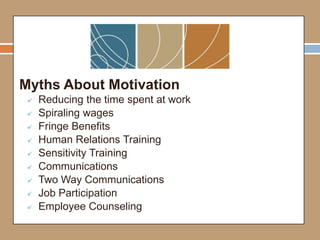
Myths About Motivation
 Reducing the time spent at work
 Spiraling wages
 Fringe Benefits
 Human Relations Training
 Sensitivity Training
 Communications
 Two Way Communications
 Job Participation
 Employee Counseling
Herzberg’s Motivator- Hygiene Theory
 Every worker has two sets of needs or
requirements: motivator needs and hygiene needs.
 Motivator needs are associated with the actual work
itself and how challenging it is.
Facets: interesting work, autonomy, responsibility
 Hygiene needs are associated with the physical and
psychological context in which the work is
performed.
Facets: physical working conditions, pay, security
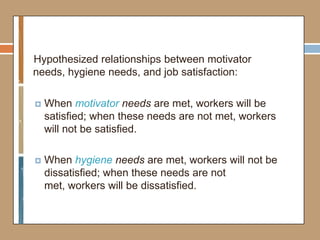
Hypothesized relationships between motivator
needs, hygiene needs, and job satisfaction:
 When motivator needs are met, workers will be
satisfied; when these needs are not met, workers
will not be satisfied.
 When hygiene needs are met, workers will not be
dissatisfied; when these needs are not
met, workers will be dissatisfied.
Herzberg’s Motivator- Hygiene Theory
Two Factor Theory
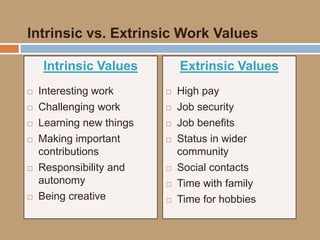
Intrinsic vs. Extrinsic Work Values
Intrinsic Values
 Interesting work
 Challenging work
 Learning new things
 Making important
contributions
 Responsibility and
autonomy
 Being creative
Extrinsic Values
 High pay
 Job security
 Job benefits
 Status in wider
community
 Social contacts
 Time with family
 Time for hobbies
Work Values
 A worker’s personal convictions about what outcomes
one should expect from work and how one should
behave at work.
 The most general and long-lasting feelings and
beliefs people have that contribute to how they
experience work.
 Values can be intrinsic (i.e., related to the nature of
work itself) or extrinsic (i.e., related to the
consequences of work).
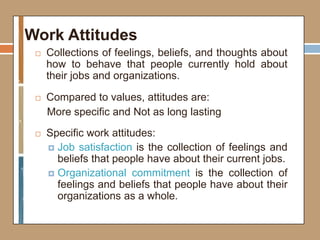
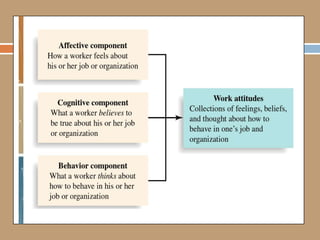
Work Attitudes
 Collections of feelings, beliefs, and thoughts about
how to behave that people currently hold about
their jobs and organizations.
 Compared to values, attitudes are:
More specific and Not as long lasting
 Specific work attitudes:
 Job satisfaction is the collection of feelings and
beliefs that people have about their current jobs.
 Organizational commitment is the collection of
feelings and beliefs that people have about their
organizations as a whole.
Work Moods
 How people feel at the time they actually perform their jobs.
 More transitory than values and attitudes.
 Can generally be categorized as positive or negative.
 Determining factors:
Personality, Work situation, Circumstances outside of work
Potential Consequences of Job
Satisfaction
 Performance: Satisfied workers are only slightly more
likely to perform at a higher level than dissatisfied
workers.
 Satisfaction is most likely to affect work behaviors
when workers are free to vary their behaviors and
when a worker’s attitude is relevant to the behavior
in question.
 Absenteeism: Satisfied workers are only slightly less
likely to be absent than dissatisfied workers.
 Turnover: Satisfied workers are less likely to leave the
organization than dissatisfied workers.
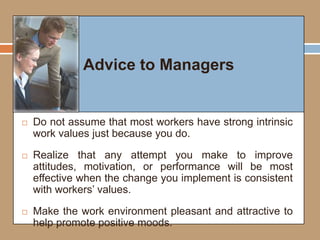
Advice to Managers
 Do not assume that most workers have strong intrinsic
work values just because you do.
 Realize that any attempt you make to improve
attitudes, motivation, or performance will be most
effective when the change you implement is consistent
with workers’ values.
 Make the work environment pleasant and attractive to
help promote positive moods.
Advice to Managers
Advice to Managers cont..
 Adopt socially responsible policies and programs such
as supporting protection of the environment and
helping out the community in which your organization
is located.
 Be committed to your employees by, for
example, showing concern for their well-
being, helping them when they have hard times, and
soliciting their input on decisions that will affect them.
Advice to Managers cont..
Summary
Both hygienic factors and motivation are important for
high performance factors
Treat people as best as you can so they have a
minimum of dissatisfaction
Use people so they get achievement, recognition for
achievement, interest, responsibility, and opportunity
for responsibility, and opportunity for advancement
and growth advancement
Thank you
Shaima H Sharafi

motivateyouremployees-12618214424617-phpapp02.pdf

  • 1.
  • 2.
    Forget Praise, ForgetPunishment, Forget Cash. You need to make their jobs more interesting
  • 3.
    Highly motivated employeesare successful employees. Employees who are driven toward a goal are focused on achieving their goal. Such employees spend the majority of their resources obtaining their desired goals and thereby represent value-for-money. Managers who motivate their employees improve job satisfaction, employee production and performance and ultimately secure the success of their organisation.
  • 4.
    Motivating The simplest, surestand most direct ways to get Someone do something:  Ask  Tell the employee  Give the employee incentives  Show the employee
  • 5.
    Myths About Motivation Reducing the time spent at work  Spiraling wages  Fringe Benefits  Human Relations Training  Sensitivity Training  Communications  Two Way Communications  Job Participation  Employee Counseling
  • 7.
    Herzberg’s Motivator- HygieneTheory  Every worker has two sets of needs or requirements: motivator needs and hygiene needs.  Motivator needs are associated with the actual work itself and how challenging it is. Facets: interesting work, autonomy, responsibility  Hygiene needs are associated with the physical and psychological context in which the work is performed. Facets: physical working conditions, pay, security
  • 8.
    Hypothesized relationships betweenmotivator needs, hygiene needs, and job satisfaction:  When motivator needs are met, workers will be satisfied; when these needs are not met, workers will not be satisfied.  When hygiene needs are met, workers will not be dissatisfied; when these needs are not met, workers will be dissatisfied.
  • 9.
    Herzberg’s Motivator- HygieneTheory Two Factor Theory
  • 10.
    Intrinsic vs. ExtrinsicWork Values Intrinsic Values  Interesting work  Challenging work  Learning new things  Making important contributions  Responsibility and autonomy  Being creative Extrinsic Values  High pay  Job security  Job benefits  Status in wider community  Social contacts  Time with family  Time for hobbies
  • 11.
    Work Values  Aworker’s personal convictions about what outcomes one should expect from work and how one should behave at work.  The most general and long-lasting feelings and beliefs people have that contribute to how they experience work.  Values can be intrinsic (i.e., related to the nature of work itself) or extrinsic (i.e., related to the consequences of work).
  • 13.
    Work Attitudes  Collectionsof feelings, beliefs, and thoughts about how to behave that people currently hold about their jobs and organizations.  Compared to values, attitudes are: More specific and Not as long lasting  Specific work attitudes:  Job satisfaction is the collection of feelings and beliefs that people have about their current jobs.  Organizational commitment is the collection of feelings and beliefs that people have about their organizations as a whole.
  • 15.
    Work Moods  Howpeople feel at the time they actually perform their jobs.  More transitory than values and attitudes.  Can generally be categorized as positive or negative.  Determining factors: Personality, Work situation, Circumstances outside of work
  • 17.
    Potential Consequences ofJob Satisfaction  Performance: Satisfied workers are only slightly more likely to perform at a higher level than dissatisfied workers.  Satisfaction is most likely to affect work behaviors when workers are free to vary their behaviors and when a worker’s attitude is relevant to the behavior in question.  Absenteeism: Satisfied workers are only slightly less likely to be absent than dissatisfied workers.  Turnover: Satisfied workers are less likely to leave the organization than dissatisfied workers.
  • 18.
    Advice to Managers Do not assume that most workers have strong intrinsic work values just because you do.  Realize that any attempt you make to improve attitudes, motivation, or performance will be most effective when the change you implement is consistent with workers’ values.  Make the work environment pleasant and attractive to help promote positive moods. Advice to Managers
  • 19.
    Advice to Managerscont..  Adopt socially responsible policies and programs such as supporting protection of the environment and helping out the community in which your organization is located.  Be committed to your employees by, for example, showing concern for their well- being, helping them when they have hard times, and soliciting their input on decisions that will affect them. Advice to Managers cont..
  • 20.
    Summary Both hygienic factorsand motivation are important for high performance factors Treat people as best as you can so they have a minimum of dissatisfaction Use people so they get achievement, recognition for achievement, interest, responsibility, and opportunity for responsibility, and opportunity for advancement and growth advancement
  • 21.