HARD WORKVS. SMART WORK
WORK HARD AND WORK SMART
INTRODUCTION
➢ The concept of “work hard and work smart” is now being advanced than solely “working
hard”.
➢ SMARTWORK IS NOT SUBSTITUTE OF HARDWORK..they go hand in hand..
➢ Working smart requires planning, proactive and not reactive
➢ Time and Cost implication of end result should always be considered.
SMART IS . . .
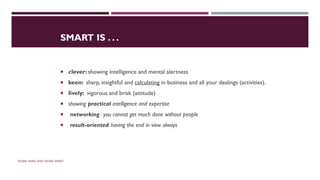
 clever: showing intelligence and mental alertness
 keen: sharp, insightful and calculating in business and all your dealings (activities).
 lively: vigorous and brisk (attitude)
 showing practical intelligence and expertise
 networking : you cannot get much done without people
 result-oriented: having the end in view always
WORK HARD AND WORK SMART
WHEN I’M WORKING SMART,
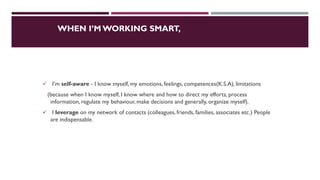
✓ I’m self-aware - I know myself, my emotions, feelings, competences(K.S.A), limitations
(because when I know myself, I know where and how to direct my efforts, process
information, regulate my behaviour, make decisions and generally, organize myself).
✓ I leverage on my network of contacts (colleagues, friends, families, associates etc.) People
are indispensable.
CONTD...
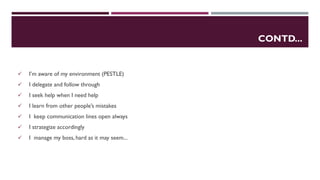
✓ I’m aware of my environment (PESTLE)
✓ I delegate and follow through
✓ I seek help when I need help
✓ I learn from other people’s mistakes
✓ I keep communication lines open always
✓ I strategize accordingly
✓ I manage my boss, hard as it may seem...
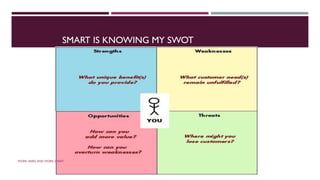
SMART IS KNOWING MY SWOT
WORK HARD AND WORK SMART
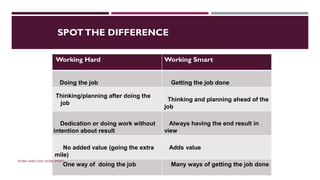
SPOTTHE DIFFERENCE
Working Hard Working Smart
Doing the job Getting the job done
Thinking/planning after doing the
job
Thinking and planning ahead of the
job
Dedication or doing work without
intention about result
Always having the end result in
view
No added value (going the extra
mile)
Adds value
One way of doing the job Many ways of getting the job done
WORK HARD AND WORK SMART
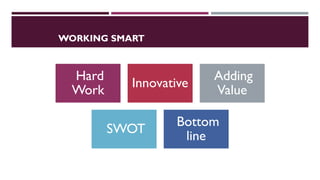
WORKING SMART
Hard
Work
Innovative
Adding
Value
SWOT
Bottom
line
WORK HARD AND WORK SMART
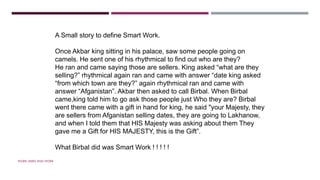
A Small story to define Smart Work.
Once Akbar king sitting in his palace, saw some people going on
camels. He sent one of his rhythmical to find out who are they?
He ran and came saying those are sellers. King asked “what are they
selling?” rhythmical again ran and came with answer “date king asked
“from which town are they?” again rhythmical ran and came with
answer “Afganistan”. Akbar then asked to call Birbal. When Birbal
came,king told him to go ask those people just Who they are? Birbal
went there came with a gift in hand for king, he said "your Majesty, they
are sellers from Afganistan selling dates, they are going to Lakhanow,
and when I told them that HIS Majesty was asking about them They
gave me a Gift for HIS MAJESTY, this is the Gift”.
What Birbal did was Smart Work ! ! ! ! !
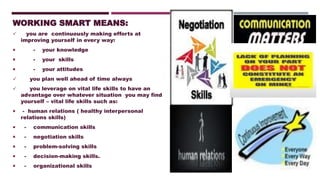
WORKING SMART MEANS:
✓ you are continuously making efforts at
improving yourself in every way:
 - your knowledge
 - your skills
 - your attitudes
✓ you plan well ahead of time always
✓ you leverage on vital life skills to have an
advantage over whatever situation you may find
yourself – vital life skills such as:
 - human relations ( healthy interpersonal
relations skills)
 - communication skills
 - negotiation skills
 - problem-solving skills
 - decision-making skills.
 - organizational skills
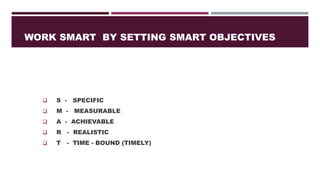
WORK SMART BY SETTING SMART OBJECTIVES
❑ S - SPECIFIC
❑ M - MEASURABLE
❑ A - ACHIEVABLE
❑ R - REALISTIC
❑ T - TIME - BOUND (TIMELY)
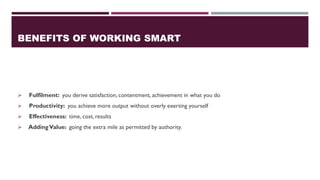
BENEFITS OF WORKING SMART
➢ Fulfilment: you derive satisfaction, contentment, achievement in what you do
➢ Productivity: you achieve more output without overly exerting yourself
➢ Effectiveness: time, cost, results
➢ AddingValue: going the extra mile as permitted by authority.
CONSEQUENCES OF NOT WORKING SMART
➢ Burn-out, Fatigue, invariably our health is affected
➢ Inability to achieve our set-goals, targets etc.
➢ Low productivity (Poor value-add)
➢ Loss of self worth, actualization
➢ Output less than our input, as such, our efforts are not being maximized.
SUMMARY/CONCLUSION
❑ Working Smart does not mean being cunning, lazy, short-changing our organizations
❑ Working Smart is applying hard work in a smart way!
❑ It is not how hard we work, but how much we get done!
❑ Setting SMART objectives, leveraging on our SWOT and achieving effective results.
REFERENCES
For Further Study:
✓ The Rule of Work by RichardTemplar
✓ http://www.google.com.ng/url?sa=t&rct=j&q=difference+between+work+hard+and+work+smart&source
=web&cd=5&ved=0CHEQFjAE&url=http%3A%2F%2Fwww.pickthebrain.com%2Fblog%2Fwhy-you-
should-work-smart-not-hard-4-ways-to-do-
it%2F&ei=6QjPT43iAs2T8gPa5L3GDA&usg=AFQjCNFkWxzmTKi2-x0AVslkHPJe19iTwQ
✓ http://www.google.com.ng/url?sa=t&rct=j&q=difference+between+work+hard+and+work+smart&source
=web&cd=8&ved=0CHgQFjAH&url=http%3A%2F%2Fwww.greatmanagement.org%2F162%2Fthe-
difference-between-working-hard-and-working-
smart%2F&ei=6QjPT43iAs2T8gPa5L3GDA&usg=AFQjCNFSyOk8y3Ijzu1wFIU4qxx8gDaeew
Key word is *Leverage*
WORK HARD AND WORK SMART
Leverage is the power to get things done: especially something that gives an advantage .
Microsoft® Encarta® 2009. © 1993-2008 Microsoft Corporation.All rights reserved.

smart work and hard work presentation ppt

  • 1.
  • 2.
    WORK HARD ANDWORK SMART
  • 3.
    INTRODUCTION ➢ The conceptof “work hard and work smart” is now being advanced than solely “working hard”. ➢ SMARTWORK IS NOT SUBSTITUTE OF HARDWORK..they go hand in hand.. ➢ Working smart requires planning, proactive and not reactive ➢ Time and Cost implication of end result should always be considered.
  • 4.
    SMART IS .. .  clever: showing intelligence and mental alertness  keen: sharp, insightful and calculating in business and all your dealings (activities).  lively: vigorous and brisk (attitude)  showing practical intelligence and expertise  networking : you cannot get much done without people  result-oriented: having the end in view always WORK HARD AND WORK SMART
  • 5.
    WHEN I’M WORKINGSMART, ✓ I’m self-aware - I know myself, my emotions, feelings, competences(K.S.A), limitations (because when I know myself, I know where and how to direct my efforts, process information, regulate my behaviour, make decisions and generally, organize myself). ✓ I leverage on my network of contacts (colleagues, friends, families, associates etc.) People are indispensable.
  • 6.
    CONTD... ✓ I’m awareof my environment (PESTLE) ✓ I delegate and follow through ✓ I seek help when I need help ✓ I learn from other people’s mistakes ✓ I keep communication lines open always ✓ I strategize accordingly ✓ I manage my boss, hard as it may seem...
  • 8.
    SMART IS KNOWINGMY SWOT WORK HARD AND WORK SMART
  • 9.
    SPOTTHE DIFFERENCE Working HardWorking Smart Doing the job Getting the job done Thinking/planning after doing the job Thinking and planning ahead of the job Dedication or doing work without intention about result Always having the end result in view No added value (going the extra mile) Adds value One way of doing the job Many ways of getting the job done WORK HARD AND WORK SMART
  • 10.
  • 11.
    WORK HARD ANDWORK SMART
  • 12.
    WORK HARD ANDWORK SMART A Small story to define Smart Work. Once Akbar king sitting in his palace, saw some people going on camels. He sent one of his rhythmical to find out who are they? He ran and came saying those are sellers. King asked “what are they selling?” rhythmical again ran and came with answer “date king asked “from which town are they?” again rhythmical ran and came with answer “Afganistan”. Akbar then asked to call Birbal. When Birbal came,king told him to go ask those people just Who they are? Birbal went there came with a gift in hand for king, he said "your Majesty, they are sellers from Afganistan selling dates, they are going to Lakhanow, and when I told them that HIS Majesty was asking about them They gave me a Gift for HIS MAJESTY, this is the Gift”. What Birbal did was Smart Work ! ! ! ! !
  • 13.
    WORKING SMART MEANS: ✓you are continuously making efforts at improving yourself in every way:  - your knowledge  - your skills  - your attitudes ✓ you plan well ahead of time always ✓ you leverage on vital life skills to have an advantage over whatever situation you may find yourself – vital life skills such as:  - human relations ( healthy interpersonal relations skills)  - communication skills  - negotiation skills  - problem-solving skills  - decision-making skills.  - organizational skills
  • 14.
    WORK SMART BYSETTING SMART OBJECTIVES ❑ S - SPECIFIC ❑ M - MEASURABLE ❑ A - ACHIEVABLE ❑ R - REALISTIC ❑ T - TIME - BOUND (TIMELY)
  • 15.
    BENEFITS OF WORKINGSMART ➢ Fulfilment: you derive satisfaction, contentment, achievement in what you do ➢ Productivity: you achieve more output without overly exerting yourself ➢ Effectiveness: time, cost, results ➢ AddingValue: going the extra mile as permitted by authority.
  • 16.
    CONSEQUENCES OF NOTWORKING SMART ➢ Burn-out, Fatigue, invariably our health is affected ➢ Inability to achieve our set-goals, targets etc. ➢ Low productivity (Poor value-add) ➢ Loss of self worth, actualization ➢ Output less than our input, as such, our efforts are not being maximized.
  • 18.
    SUMMARY/CONCLUSION ❑ Working Smartdoes not mean being cunning, lazy, short-changing our organizations ❑ Working Smart is applying hard work in a smart way! ❑ It is not how hard we work, but how much we get done! ❑ Setting SMART objectives, leveraging on our SWOT and achieving effective results.
  • 19.
    REFERENCES For Further Study: ✓The Rule of Work by RichardTemplar ✓ http://www.google.com.ng/url?sa=t&rct=j&q=difference+between+work+hard+and+work+smart&source =web&cd=5&ved=0CHEQFjAE&url=http%3A%2F%2Fwww.pickthebrain.com%2Fblog%2Fwhy-you- should-work-smart-not-hard-4-ways-to-do- it%2F&ei=6QjPT43iAs2T8gPa5L3GDA&usg=AFQjCNFkWxzmTKi2-x0AVslkHPJe19iTwQ ✓ http://www.google.com.ng/url?sa=t&rct=j&q=difference+between+work+hard+and+work+smart&source =web&cd=8&ved=0CHgQFjAH&url=http%3A%2F%2Fwww.greatmanagement.org%2F162%2Fthe- difference-between-working-hard-and-working- smart%2F&ei=6QjPT43iAs2T8gPa5L3GDA&usg=AFQjCNFSyOk8y3Ijzu1wFIU4qxx8gDaeew Key word is *Leverage* WORK HARD AND WORK SMART Leverage is the power to get things done: especially something that gives an advantage . Microsoft® Encarta® 2009. © 1993-2008 Microsoft Corporation.All rights reserved.