
Massively Interacting Systems:
Thinking & deciding in the age of Big Data

                  Chris Barrett
               Scientific Director
        Virginia Bioinformatics Institute
Part 1
What is interaction? What’s the issue?
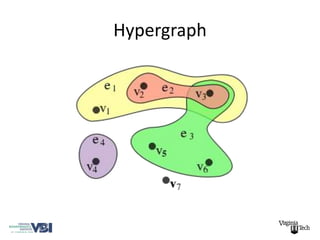
                   • A finite undirected graph Y
                   • A sequence of local maps
                   • An ordering of the vertex set of Y

                                  [FY,p] = P Fp(i)
Hypergraph
“Genuine” social entities & interactions
    “ .. [usual causal] hierarchy collapses when
   causality crosses across units and
   levels….human behavior in social setting is
   interdependent …. although … not a new
   insight, social life is interdependent in …
   spatial forms – things “go together” in and
   across distinct places …. which might be better
   described as neighborhood causal
   processes…”
            Robert J. Sampson, The Great American City, 2012
What interacts in an evolving city?
• People are entities that have
  purposes, needs, capacities and interact
• Neighborhoods are entities that have
  purposes, needs, capacities and interact, “have their
  own logic and causality.”
• Causes, causal interactions, occur across “normal”
  causal boundaries
   – People interact with people and neighborhoods
   – Neighborhoods interact with neighborhoods and people
   – E.g., self selection bias, extra neighborhood proximity
     processes etc are within and among network processes
     that do not supervene one another.
This is not entirely unique to
            neighborhood selection
• Traffic and transportation
      • Motives/goals, activities, transport resource, transport
        infrastructure, resource competition, form and function of
        infrastructure, traffic, communicated dynamics, time
        delays, goal failure/success etc…. loop and evolve
• Genetic predisposition, homophily, family and
  peer mimicry, other social functionalities affect
      •   Success, variously
      •   Suicide
      •   Smoking
      •   Obesity
      •   Healthful behaviors ……., etc.
In fact, it is seen in biology
• Suzuki, et al, 2003
• The pigmentation control gene Fox1 is defective in a
  mutant mouse and shuts down the normal process by
  which pigmentation patterns are stabilized in the skin/hair
  of the mouse.
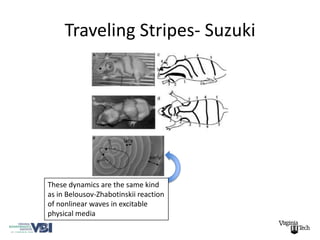
• It creates moving waves of color striping
• This gene normally can produce all solid, spot and striped
  patterns by simply activating at a particular times in
  embryonic development; the morphology of the embryo at
  that time determines the pattern created by the gene
• In the mutant case, the continued malfunction, given the
  most recent color morphology, generates a new pattern,
  and so on.
Traveling Stripes- Suzuki


These dynamics are the same kind
as in Belousov-Zhabotinskii reaction
of nonlinear waves in excitable
physical media
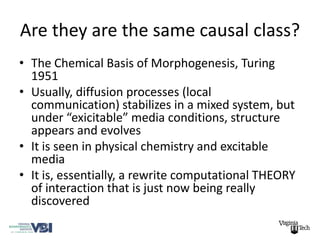
Are they are the same causal class?
• The Chemical Basis of Morphogenesis, Turing
  1951
• Usually, diffusion processes (local
  communication) stabilizes in a mixed system, but
  under “exicitable” media conditions, structure
  appears and evolves
• It is seen in physical chemistry and excitable
  media
• It is, essentially, a rewrite computational THEORY
  of interaction that is just now being really
  discovered
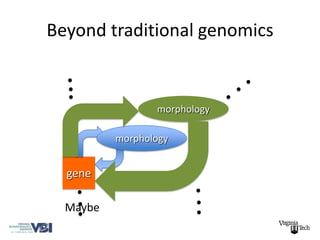
Beyond traditional genomics


                 morphology

          morphology


  gene

  Maybe
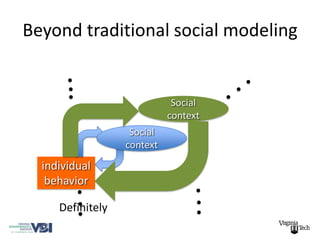
Beyond traditional social modeling


                             Social
                            context
                   Social
                  context

  individual
   behavior

     Definitely
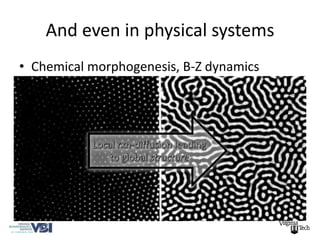
And even in physical systems
• Chemical morphogenesis, B-Z dynamics
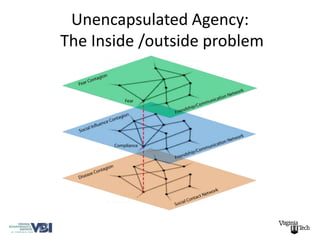
The “inside-outside” problem is a
   related issue of non-supervenance
• What is an organ?
   – Biome
• What is in an organism, what is outside of it?
• What/ where is a thought?
   – Extended mind
   – Distributed algorithmic accounts of causes
• What is an agent?
   – Is agency necessarily encapsulated?
   – Driver behavior
• What is an urban agent?
Part 2
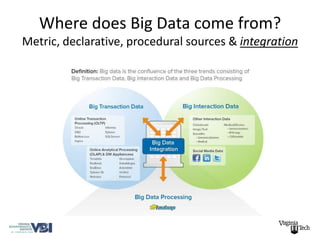
Where does Big Data come from?
Metric, declarative, procedural sources & integration
What is Big?
• The world's technological per-capita capacity
  to store information has roughly doubled
  every 40 months since the 1980s; as of
  2012, every day 2.5 quintillion (2.5×10¹⁸)
  bytes of data were created [stored].

                   Wikipedia, “Big Data”, August 2012
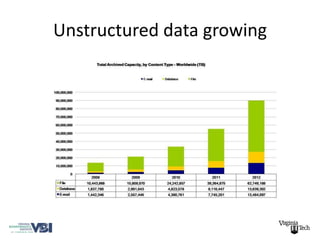
Unstructured data growing
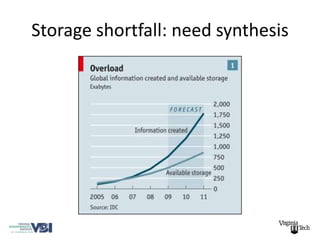
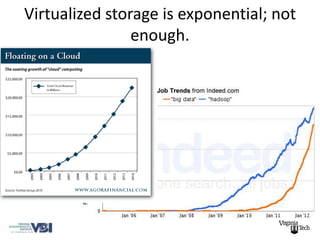
Storage shortfall: need synthesis
Virtualized storage is exponential; not
                enough.
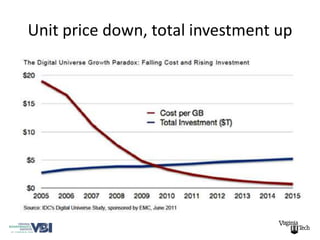
Unit price down, total investment up
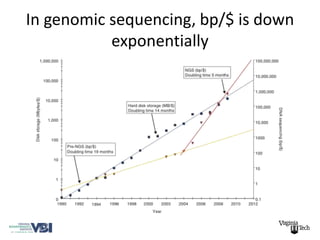
In genomic sequencing, bp/$ is down
           exponentially
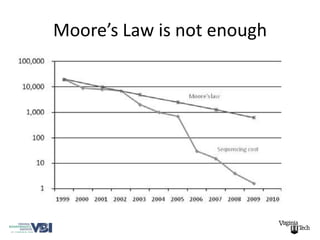
Moore’s Law is not enough
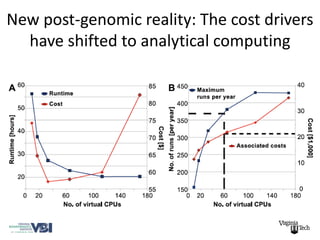
New post-genomic reality: The cost drivers
  have shifted to analytical computing
Data creation, deletion & storage
• We will know what - of all that data - it is
  possible to “forget” only when we know how
  to summarize what is possible
• That’s a big analytical problem as we will see
• Use of graph theory and graphical dynamical
  systems (networks) is essential
  – Computationally very intensive
Part 3
Who cares?
Massively Interacting Systems
• These things produce branching processes
• Sometimes they are periodic, sometimes they are not
• They do not explore the entire possible state space (all
  morphologies are not expressed)
• So even with the immense amount of underlying data
  necessary, decision analysis must produce infinitely more
• This complicates measurement as well as theory making in
  sense of acceptable explanations of observations
• It makes observed, metric, data; declarative data and
  procedural information all essential
• It is the effects of processes of composition of complex
  interactions that ultimately generates so much data, both
  measured and synthesized.
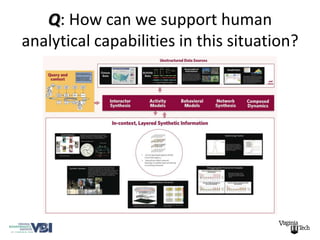
Q: How can we support human
analytical capabilities in this situation?
The end of the great man theories
         of….. decision making
• Many stakeholder synthetic information
• The analysis environment is not separated from “the
  world”
• An entirely new interaction medium will create NEW
  REALITIES
• The approach must involve human expertise and
  context, it must be a cognitive augmentation system
• It must involve distributed, social cognition
• It must follow context & allow information deletion
• It will change scientific process and assumptions
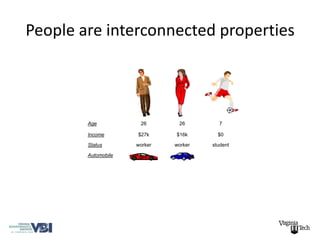
People are interconnected properties


        Age           26       26        7

        Income       $27k     $16k       $0

        Status       worker   worker   student

        Automobile
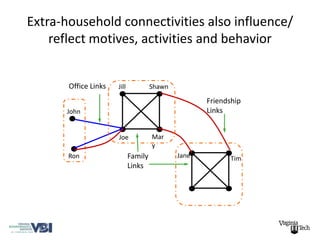
Extra-household connectivities also influence/
    reflect motives, activities and behavior


       Office Links   Jill            Shawn

                                                     Friendship
      John                                           Links


                      Joe             Mar
                                      y
       Ron                   Family           Jane          Tim
                             Links
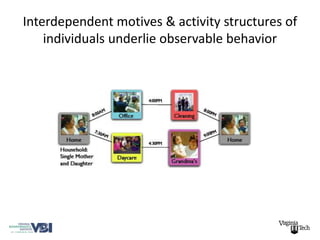
Interdependent motives & activity structures of
    individuals underlie observable behavior
Unencapsulated Agency:
The Inside /outside problem
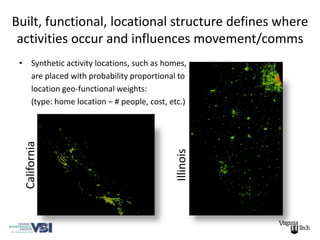
Built, functional, locational structure defines where
 activities occur and influences movement/comms
 • Synthetic activity locations, such as homes,
   are placed with probability proportional to
   location geo-functional weights:
   (type: home location – # people, cost, etc.)
  California


                                            Illinois
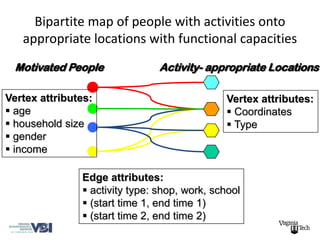
Bipartite map of people with activities onto
   appropriate locations with functional capacities
 Motivated People               Activity- appropriate Locations

Vertex attributes:                             Vertex attributes:
 age                                           Coordinates
 household size                                Type
 gender
 income

               Edge attributes:
                activity type: shop, work, school
                (start time 1, end time 1)
                (start time 2, end time 2)
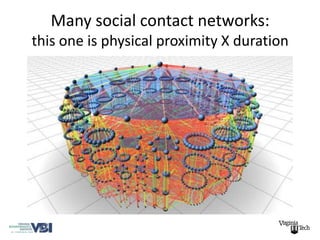
Many social contact networks:
this one is physical proximity X duration
Example: large scale socio-physical interaction

 • Attack in Washington DC
   – NPS1, a 2006-based unclassified study scenario with
     lots of people publishing and even putting lectures on
     YouTube
 • Basically we wanted to know if there really might
   be significant social behavior options in the
   immediate aftermath that could be imagined &
   that might have long term influence
 • Disaggregate, detailed socially-coupled
   simulation used combined with physical
   modeling
Technical Perspective: Socially-coupled
               systems
• Massively interacting systems generating arbitrarily much data
• Want general, re-usable, approach. Many examples:
  transport, facebook, biosystems, economic systems
• Generally, the topic of HPC based data-centric methods, network
  science/ network dynamics are central
• Socially-coupled systems display a lack of symmetries => problems
  for usual dimensional reduction approaches
• Systems are huge, details matter
• Detailed disaggregate modeling, appropriate abstractions, novel
  HPC simulation methods & statistical approaches are necessary
• Necessary source information is diverse, including process
  knowledge
• Totally different view of decision analysis necessary
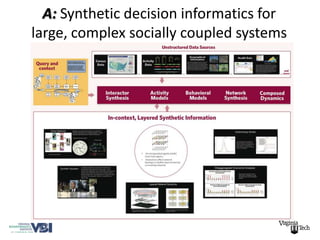
A: Synthetic decision informatics for
large, complex socially coupled systems
Contextual Synthetic Information
• The information platform is the interaction
  medium
• The only way to really deal with the massively
  interactive, branching—thus extreme data—
  world.
Part 3.1
Physical Event in a Social Context
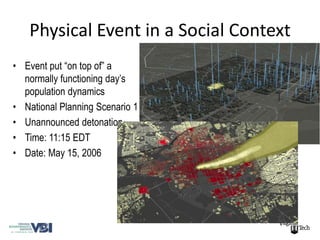
• Event put “on top of” a
  normally functioning day’s
  population dynamics
• National Planning Scenario 1
• Unannounced detonation
• Time: 11:15 EDT
• Date: May 15, 2006
Time                    Damage to power network and long
0:00
                             term power outage area


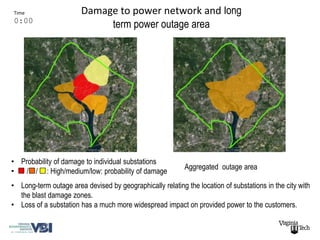
• Probability of damage to individual substations
                                                           Aggregated outage area
•  / / : High/medium/low: probability of damage
• Long-term outage area devised by geographically relating the location of substations in the city with
  the blast damage zones.
• Loss of a substation has a much more widespread impact on provided power to the customers.
Time
0:00      Infrastructure: initial laydown
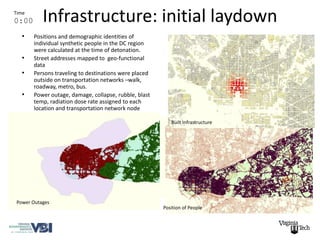
  •    Positions and demographic identities of
       individual synthetic people in the DC region
       were calculated at the time of detonation.
  •    Street addresses mapped to geo-functional
       data
  •    Persons traveling to destinations were placed
       outside on transportation networks –walk,
       roadway, metro, bus.
  •    Power outage, damage, collapse, rubble, blast
       temp, radiation dose rate assigned to each
       location and transportation network node

                                                          Built Infrastructure


Power Outages
                                                       Position of People
Time
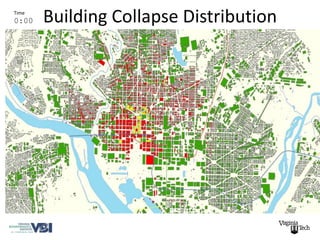
0:00   Building Collapse Distribution
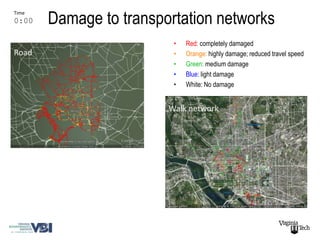
Damage to transportation networks
Time
0:00

                         •   Red: completely damaged
Road                     •   Orange: highly damage; reduced travel speed
                         •   Green: medium damage
                         •   Blue: light damage
                         •   White: No damage


                        Walk network
Part 3.2
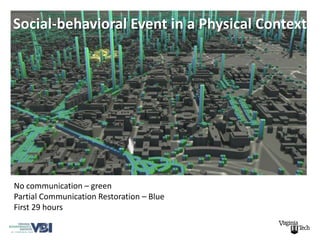
Social-behavioral Event in a Physical Context


No communication – green
Partial Communication Restoration – Blue
First 29 hours
Time
+0:00 to +0:10
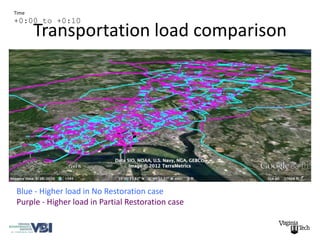
       Transportation load comparison


Blue - Higher load in No Restoration case
Purple - Higher load in Partial Restoration case
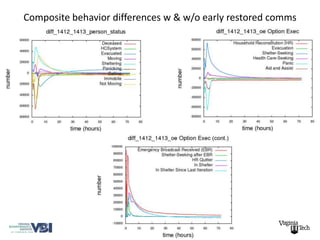
Composite behavior differences w & w/o early restored comms
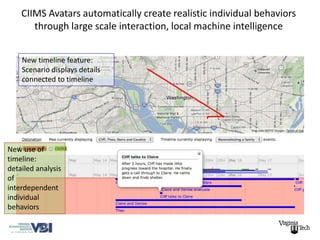
CIIMS Avatars automatically create realistic individual behaviors
       through large scale interaction, local machine intelligence


    New timeline feature:
    Scenario displays details
    connected to timeline


New use of
timeline:
detailed analysis
of
interdependent
individual
behaviors
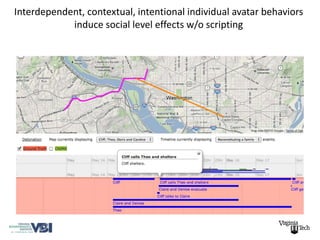
Interdependent, contextual, intentional individual avatar behaviors
            induce social level effects w/o scripting
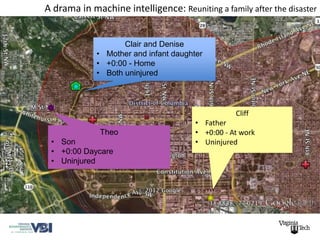
A drama in machine intelligence: Reuniting a family after the disaster


                    Clair and Denise
             • Mother and infant daughter
             • +0:00 - Home
             • Both uninjured


                                                  Cliff
                                       • Father
              Theo                     • +0:00 - At work
 • Son                                 • Uninjured
 • +0:00 Daycare
 • Uninjured
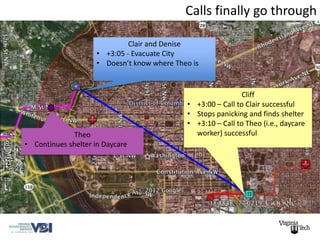
Calls finally go through

                              Clair and Denise
                     • +3:05 - Evacuate City
                     • Doesn’t know where Theo is


                                                              Cliff
                                             • +3:00 – Call to Clair successful
                                             • Stops panicking and finds shelter
                                             • +3:10 – Call to Theo (i.e., daycare
             Theo                              worker) successful
• Continues shelter in Daycare
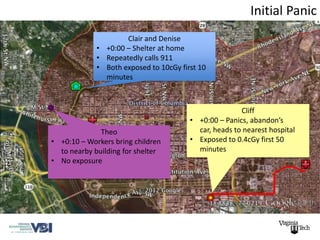
Initial Panic
                     Clair and Denise
             • +0:00 – Shelter at home
             • Repeatedly calls 911
             • Both exposed to 10cGy first 10
               minutes


                                                       Cliff
                                        • +0:00 – Panics, abandon’s
              Theo                        car, heads to nearest hospital
• +0:10 – Workers bring children        • Exposed to 0.4cGy first 50
  to nearby building for shelter          minutes
• No exposure
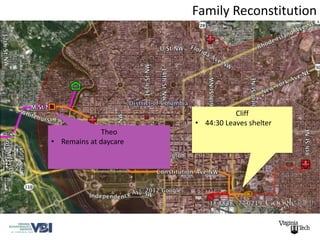
Family Reconstitution


                                  Cliff
                       • 44:30 Leaves shelter
             Theo
• Remains at daycare
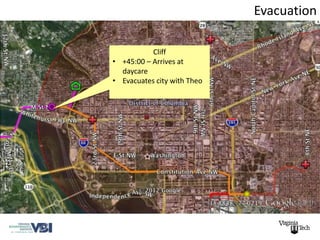
Evacuation

           Cliff
• +45:00 – Arrives at
  daycare
• Evacuates city with Theo
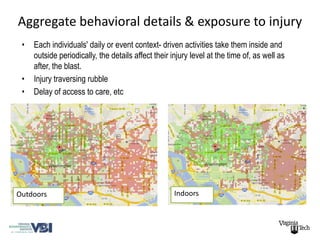
Aggregate behavioral details & exposure to injury
 •   Each individuals' daily or event context- driven activities take them inside and
     outside periodically, the details affect their injury level at the time of, as well as
     after, the blast.
 •   Injury traversing rubble
 •   Delay of access to care, etc


Outdoors                                             Indoors
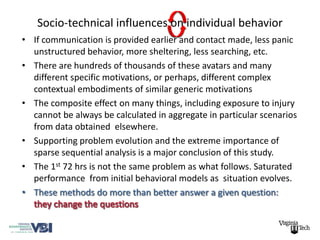
Socio-technical influences on individual behavior
• If communication is provided earlier and contact made, less panic
  unstructured behavior, more sheltering, less searching, etc.
• There are hundreds of thousands of these avatars and many
  different specific motivations, or perhaps, different complex
  contextual embodiments of similar generic motivations
• The composite effect on many things, including exposure to injury
  cannot be always be calculated in aggregate in particular scenarios
  from data obtained elsewhere.
• Supporting problem evolution and the extreme importance of
  sparse sequential analysis is a major conclusion of this study.
• The 1st 72 hrs is not the same problem as what follows. Saturated
  performance from initial behavioral models as situation evolves.
• These methods do more than better answer a given question:
Section 3.3
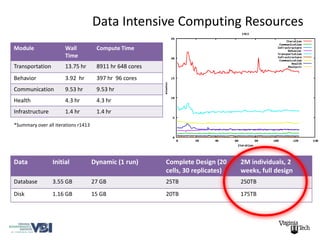
Data Intensive Computing Resources
Module        Wall
    Compute Time                      Compute Time
              Time
Transportation        13.75 hr        8911 hr 648 cores
Behavior              3.92 hr         397 hr 96 cores
Communication         9.53 hr         9.53 hr
Health                4.3 hr          4.3 hr
Infrastructure        1.4 hr          1.4 hr

*Summary over all iterations r1413


Data             Initial             Dynamic (1 run)      Complete Design (20     2M individuals, 2
                                                          cells, 30 replicates)   weeks, full design
Database         3.55 GB             27 GB                25TB                    250TB
Disk             1.16 GB             15 GB                20TB                    175TB
Thanks

SMART Seminar: Massively Interacting Systems

  • 1.
    Massively Interacting Systems: Thinking& deciding in the age of Big Data Chris Barrett Scientific Director Virginia Bioinformatics Institute
  • 2.
  • 3.
    What is interaction?What’s the issue? • A finite undirected graph Y • A sequence of local maps • An ordering of the vertex set of Y [FY,p] = P Fp(i)
  • 4.
  • 5.
    “Genuine” social entities& interactions “ .. [usual causal] hierarchy collapses when causality crosses across units and levels….human behavior in social setting is interdependent …. although … not a new insight, social life is interdependent in … spatial forms – things “go together” in and across distinct places …. which might be better described as neighborhood causal processes…” Robert J. Sampson, The Great American City, 2012
  • 6.
    What interacts inan evolving city? • People are entities that have purposes, needs, capacities and interact • Neighborhoods are entities that have purposes, needs, capacities and interact, “have their own logic and causality.” • Causes, causal interactions, occur across “normal” causal boundaries – People interact with people and neighborhoods – Neighborhoods interact with neighborhoods and people – E.g., self selection bias, extra neighborhood proximity processes etc are within and among network processes that do not supervene one another.
  • 7.
    This is notentirely unique to neighborhood selection • Traffic and transportation • Motives/goals, activities, transport resource, transport infrastructure, resource competition, form and function of infrastructure, traffic, communicated dynamics, time delays, goal failure/success etc…. loop and evolve • Genetic predisposition, homophily, family and peer mimicry, other social functionalities affect • Success, variously • Suicide • Smoking • Obesity • Healthful behaviors ……., etc.
  • 8.
    In fact, itis seen in biology • Suzuki, et al, 2003 • The pigmentation control gene Fox1 is defective in a mutant mouse and shuts down the normal process by which pigmentation patterns are stabilized in the skin/hair of the mouse. • It creates moving waves of color striping • This gene normally can produce all solid, spot and striped patterns by simply activating at a particular times in embryonic development; the morphology of the embryo at that time determines the pattern created by the gene • In the mutant case, the continued malfunction, given the most recent color morphology, generates a new pattern, and so on.
  • 9.
    Traveling Stripes- Suzuki Thesedynamics are the same kind as in Belousov-Zhabotinskii reaction of nonlinear waves in excitable physical media
  • 10.
    Are they arethe same causal class? • The Chemical Basis of Morphogenesis, Turing 1951 • Usually, diffusion processes (local communication) stabilizes in a mixed system, but under “exicitable” media conditions, structure appears and evolves • It is seen in physical chemistry and excitable media • It is, essentially, a rewrite computational THEORY of interaction that is just now being really discovered
  • 11.
    Beyond traditional genomics morphology morphology gene Maybe
  • 12.
    Beyond traditional socialmodeling Social context Social context individual behavior Definitely
  • 13.
    And even inphysical systems • Chemical morphogenesis, B-Z dynamics
  • 14.
    The “inside-outside” problemis a related issue of non-supervenance • What is an organ? – Biome • What is in an organism, what is outside of it? • What/ where is a thought? – Extended mind – Distributed algorithmic accounts of causes • What is an agent? – Is agency necessarily encapsulated? – Driver behavior • What is an urban agent?
  • 15.
  • 16.
    Where does BigData come from? Metric, declarative, procedural sources & integration
  • 17.
    What is Big? •The world's technological per-capita capacity to store information has roughly doubled every 40 months since the 1980s; as of 2012, every day 2.5 quintillion (2.5×10¹⁸) bytes of data were created [stored]. Wikipedia, “Big Data”, August 2012
  • 18.
  • 19.
  • 20.
    Virtualized storage isexponential; not enough.
  • 21.
    Unit price down,total investment up
  • 22.
    In genomic sequencing,bp/$ is down exponentially
  • 23.
    Moore’s Law isnot enough
  • 24.
    New post-genomic reality:The cost drivers have shifted to analytical computing
  • 25.
    Data creation, deletion& storage • We will know what - of all that data - it is possible to “forget” only when we know how to summarize what is possible • That’s a big analytical problem as we will see • Use of graph theory and graphical dynamical systems (networks) is essential – Computationally very intensive
  • 26.
  • 27.
  • 28.
    Massively Interacting Systems •These things produce branching processes • Sometimes they are periodic, sometimes they are not • They do not explore the entire possible state space (all morphologies are not expressed) • So even with the immense amount of underlying data necessary, decision analysis must produce infinitely more • This complicates measurement as well as theory making in sense of acceptable explanations of observations • It makes observed, metric, data; declarative data and procedural information all essential • It is the effects of processes of composition of complex interactions that ultimately generates so much data, both measured and synthesized.
  • 29.
    Q: How canwe support human analytical capabilities in this situation?
  • 30.
    The end ofthe great man theories of….. decision making • Many stakeholder synthetic information • The analysis environment is not separated from “the world” • An entirely new interaction medium will create NEW REALITIES • The approach must involve human expertise and context, it must be a cognitive augmentation system • It must involve distributed, social cognition • It must follow context & allow information deletion • It will change scientific process and assumptions
  • 31.
    People are interconnectedproperties Age 26 26 7 Income $27k $16k $0 Status worker worker student Automobile
  • 32.
    Extra-household connectivities alsoinfluence/ reflect motives, activities and behavior Office Links Jill Shawn Friendship John Links Joe Mar y Ron Family Jane Tim Links
  • 33.
    Interdependent motives &activity structures of individuals underlie observable behavior
  • 34.
  • 35.
    Built, functional, locationalstructure defines where activities occur and influences movement/comms • Synthetic activity locations, such as homes, are placed with probability proportional to location geo-functional weights: (type: home location – # people, cost, etc.) California Illinois
  • 36.
    Bipartite map ofpeople with activities onto appropriate locations with functional capacities Motivated People Activity- appropriate Locations Vertex attributes: Vertex attributes:  age  Coordinates  household size  Type  gender  income Edge attributes:  activity type: shop, work, school  (start time 1, end time 1)  (start time 2, end time 2)
  • 37.
    Many social contactnetworks: this one is physical proximity X duration
  • 38.
    Example: large scalesocio-physical interaction • Attack in Washington DC – NPS1, a 2006-based unclassified study scenario with lots of people publishing and even putting lectures on YouTube • Basically we wanted to know if there really might be significant social behavior options in the immediate aftermath that could be imagined & that might have long term influence • Disaggregate, detailed socially-coupled simulation used combined with physical modeling
  • 39.
    Technical Perspective: Socially-coupled systems • Massively interacting systems generating arbitrarily much data • Want general, re-usable, approach. Many examples: transport, facebook, biosystems, economic systems • Generally, the topic of HPC based data-centric methods, network science/ network dynamics are central • Socially-coupled systems display a lack of symmetries => problems for usual dimensional reduction approaches • Systems are huge, details matter • Detailed disaggregate modeling, appropriate abstractions, novel HPC simulation methods & statistical approaches are necessary • Necessary source information is diverse, including process knowledge • Totally different view of decision analysis necessary
  • 40.
    A: Synthetic decisioninformatics for large, complex socially coupled systems
  • 41.
    Contextual Synthetic Information •The information platform is the interaction medium • The only way to really deal with the massively interactive, branching—thus extreme data— world.
  • 42.
  • 43.
    Physical Event ina Social Context • Event put “on top of” a normally functioning day’s population dynamics • National Planning Scenario 1 • Unannounced detonation • Time: 11:15 EDT • Date: May 15, 2006
  • 44.
    Time Damage to power network and long 0:00 term power outage area • Probability of damage to individual substations Aggregated outage area • / / : High/medium/low: probability of damage • Long-term outage area devised by geographically relating the location of substations in the city with the blast damage zones. • Loss of a substation has a much more widespread impact on provided power to the customers.
  • 45.
    Time 0:00 Infrastructure: initial laydown • Positions and demographic identities of individual synthetic people in the DC region were calculated at the time of detonation. • Street addresses mapped to geo-functional data • Persons traveling to destinations were placed outside on transportation networks –walk, roadway, metro, bus. • Power outage, damage, collapse, rubble, blast temp, radiation dose rate assigned to each location and transportation network node Built Infrastructure Power Outages Position of People
  • 46.
    Time 0:00 Building Collapse Distribution
  • 47.
    Damage to transportationnetworks Time 0:00 • Red: completely damaged Road • Orange: highly damage; reduced travel speed • Green: medium damage • Blue: light damage • White: No damage Walk network
  • 48.
  • 49.
    Social-behavioral Event ina Physical Context No communication – green Partial Communication Restoration – Blue First 29 hours
  • 50.
    Time +0:00 to +0:10 Transportation load comparison Blue - Higher load in No Restoration case Purple - Higher load in Partial Restoration case
  • 51.
    Composite behavior differencesw & w/o early restored comms
  • 52.
    CIIMS Avatars automaticallycreate realistic individual behaviors through large scale interaction, local machine intelligence New timeline feature: Scenario displays details connected to timeline New use of timeline: detailed analysis of interdependent individual behaviors
  • 53.
    Interdependent, contextual, intentionalindividual avatar behaviors induce social level effects w/o scripting
  • 54.
    A drama inmachine intelligence: Reuniting a family after the disaster Clair and Denise • Mother and infant daughter • +0:00 - Home • Both uninjured Cliff • Father Theo • +0:00 - At work • Son • Uninjured • +0:00 Daycare • Uninjured
  • 55.
    Calls finally gothrough Clair and Denise • +3:05 - Evacuate City • Doesn’t know where Theo is Cliff • +3:00 – Call to Clair successful • Stops panicking and finds shelter • +3:10 – Call to Theo (i.e., daycare Theo worker) successful • Continues shelter in Daycare
  • 56.
    Initial Panic Clair and Denise • +0:00 – Shelter at home • Repeatedly calls 911 • Both exposed to 10cGy first 10 minutes Cliff • +0:00 – Panics, abandon’s Theo car, heads to nearest hospital • +0:10 – Workers bring children • Exposed to 0.4cGy first 50 to nearby building for shelter minutes • No exposure
  • 57.
    Family Reconstitution Cliff • 44:30 Leaves shelter Theo • Remains at daycare
  • 58.
    Evacuation Cliff • +45:00 – Arrives at daycare • Evacuates city with Theo
  • 59.
    Aggregate behavioral details& exposure to injury • Each individuals' daily or event context- driven activities take them inside and outside periodically, the details affect their injury level at the time of, as well as after, the blast. • Injury traversing rubble • Delay of access to care, etc Outdoors Indoors
  • 60.
    Socio-technical influences onindividual behavior • If communication is provided earlier and contact made, less panic unstructured behavior, more sheltering, less searching, etc. • There are hundreds of thousands of these avatars and many different specific motivations, or perhaps, different complex contextual embodiments of similar generic motivations • The composite effect on many things, including exposure to injury cannot be always be calculated in aggregate in particular scenarios from data obtained elsewhere. • Supporting problem evolution and the extreme importance of sparse sequential analysis is a major conclusion of this study. • The 1st 72 hrs is not the same problem as what follows. Saturated performance from initial behavioral models as situation evolves. • These methods do more than better answer a given question:
  • 61.
  • 62.
    Data Intensive ComputingResources Module Wall Compute Time Compute Time Time Transportation 13.75 hr 8911 hr 648 cores Behavior 3.92 hr 397 hr 96 cores Communication 9.53 hr 9.53 hr Health 4.3 hr 4.3 hr Infrastructure 1.4 hr 1.4 hr *Summary over all iterations r1413 Data Initial Dynamic (1 run) Complete Design (20 2M individuals, 2 cells, 30 replicates) weeks, full design Database 3.55 GB 27 GB 25TB 250TB Disk 1.16 GB 15 GB 20TB 175TB
  • 63.

Editor's Notes

  • #4 Its general, there is theoretical form to the question that is semantics-freePredecessor existence and reachability, “validation” and “prediction” are both very subtle, the systems branchThe theory is new, deeply connecting to theory of computation, maps onto HPC
  • #7 Neighborhoods have both social, functional (graphical) and spatial (different graphical) structure and these all interact
  • #9 Neither the gene or the embryonic state supervene with respect to the morphology of the pigmentation
  • #10 Normally the gene is presumed to create the color pattern. Here the gene in contact with the last color pattern makes a new one. One aspect does not supervene the other wrt the morphological state of the mouse. Only in the interaction is it possible to create the phenomenon
  • #14 Stiglitz housing patterns are a similar excitable medium with diffusive communicationTerrible story of Belousov-Zhabotinsky
  • #45 T=0State that expert opinion was used to create this slide/information
  • #46 Buildings from DTRA with red indicating areas of high casuality probability (upper right) street network (NAVTEQ) and people positions at the time of detonation in the detailed study area (lower right)Bottom left picture shows power outage area as light purple polygon. Locations in power outage area are plotted as red, locations with power are green. 730,833 persons in the DSA at time of detonationT=0146,337 locations (includes transportation nodes)Small label People, built infrasture, position of people of DSA and left power outages
  • #47 note: Green: no collapse; Yellow: sideways collapse;> Red: 100% collapse.the blue ringis 2.2km circle, different colors on the buildings represent thelevel of collapse. If needed, I can generate another one quicklytomorrow morning, maybe using the data for 3.2km circle.T=0Buildings DTRA says had collapsed
  • #48 Roadway network from NAVTEQ with damage (upper left)Road network zoomed with level of damage included (lower left)Walk network with damage (lower right)
  • #50 CloseAlive_Pairs.movPoint – you can look at the data this way – transportation system is same in both cases – lots of bars on the roads, because that is where people are…Building points are the front door – thus bar on the streetDistribution of the population -
  • #51 Blue – Cell 1 greaterPurple – Cell 2 greaterTitle:tansportaion link demand/or density
  • #60 Green is bad, red is goodAverage level of health state (ie high number, red, is Full Health) per location based on inside vs. outside. All health levels shown, so uninjured are averaged in. Move to t=0Blank spots are the sparse areas where we have very few to 0 people at the time of the blast
  • #63 Database Table sizesInput Data Tables: 3.55 GBOutput Dynamic Data for 1 cell (126 iteration, 80 hours of simulated time): 8.06 GB location tables, 19 GB person tablesDisk Usage:Input Data: 1.16 GBDynamic Data for 1 cell(126 iterations, 80 hours of simulated time): 15 GBComputation Time – for Run 1413:Behavior Module runs in about 2 minutes but uses 96 cores so time spent in computation is roughly 2*96 = 192 minutes/iterationRouter execution time varies depending on number of routes.  To compute approximately 200,000 routes, the runtime is about 8 minutes and uses 6696 nodes/12 threads node for all 124 iterations.The router uses approximately 40 nodes with 12 threads/node so computation time is roughly 40*12*10 = 4800 minutes;