Blockchain and
its applications
Willy Susilo
Institute of Cybersecurity and
Cryptology, School of
Computing and IT, UOW
wsusilo@uow.edu.au
Content
• Introduction
• Tools and Mechanisms
• Blockchain applications
• On-going Research
Document title2
Document title3
1. Introduction
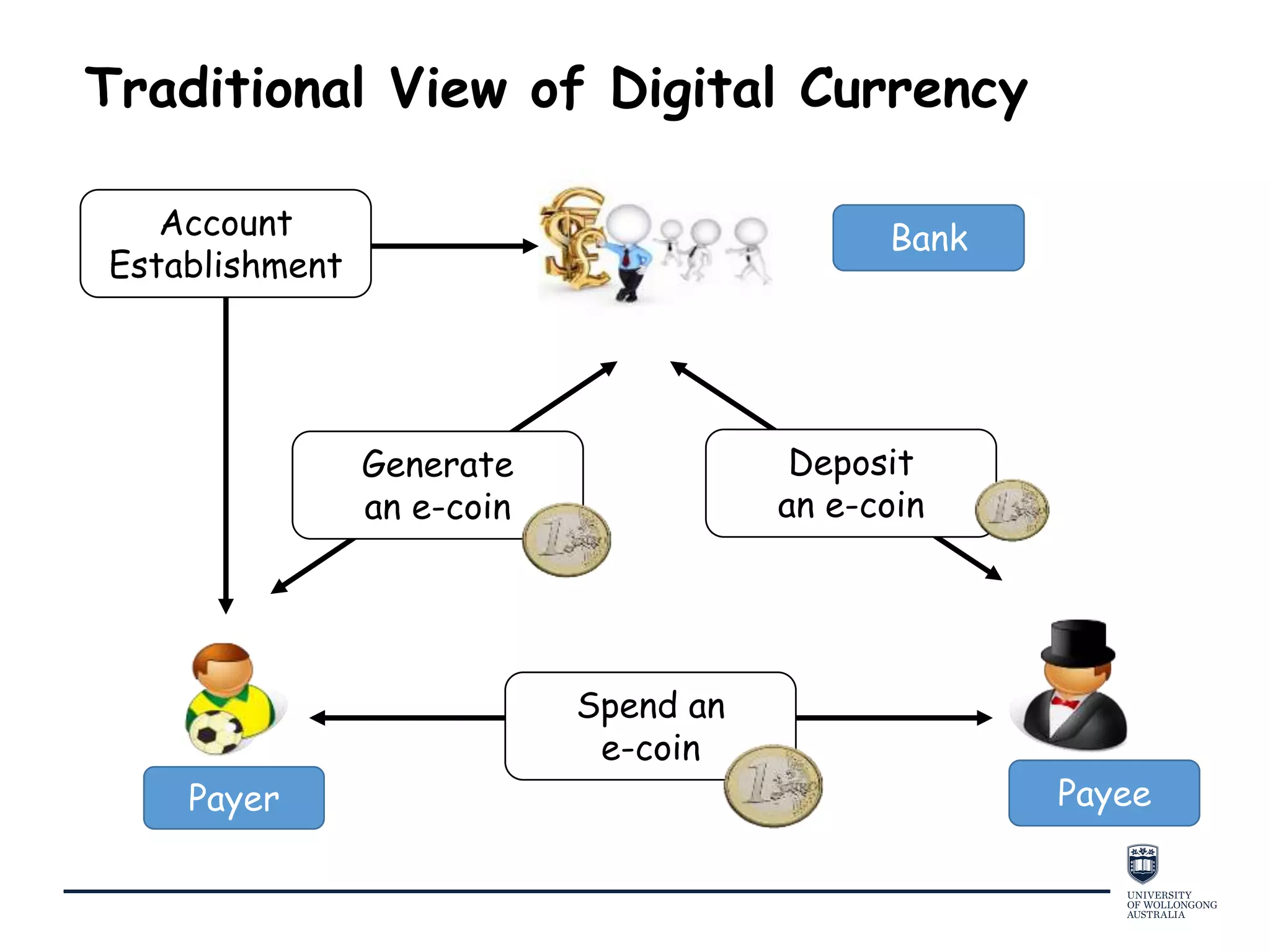
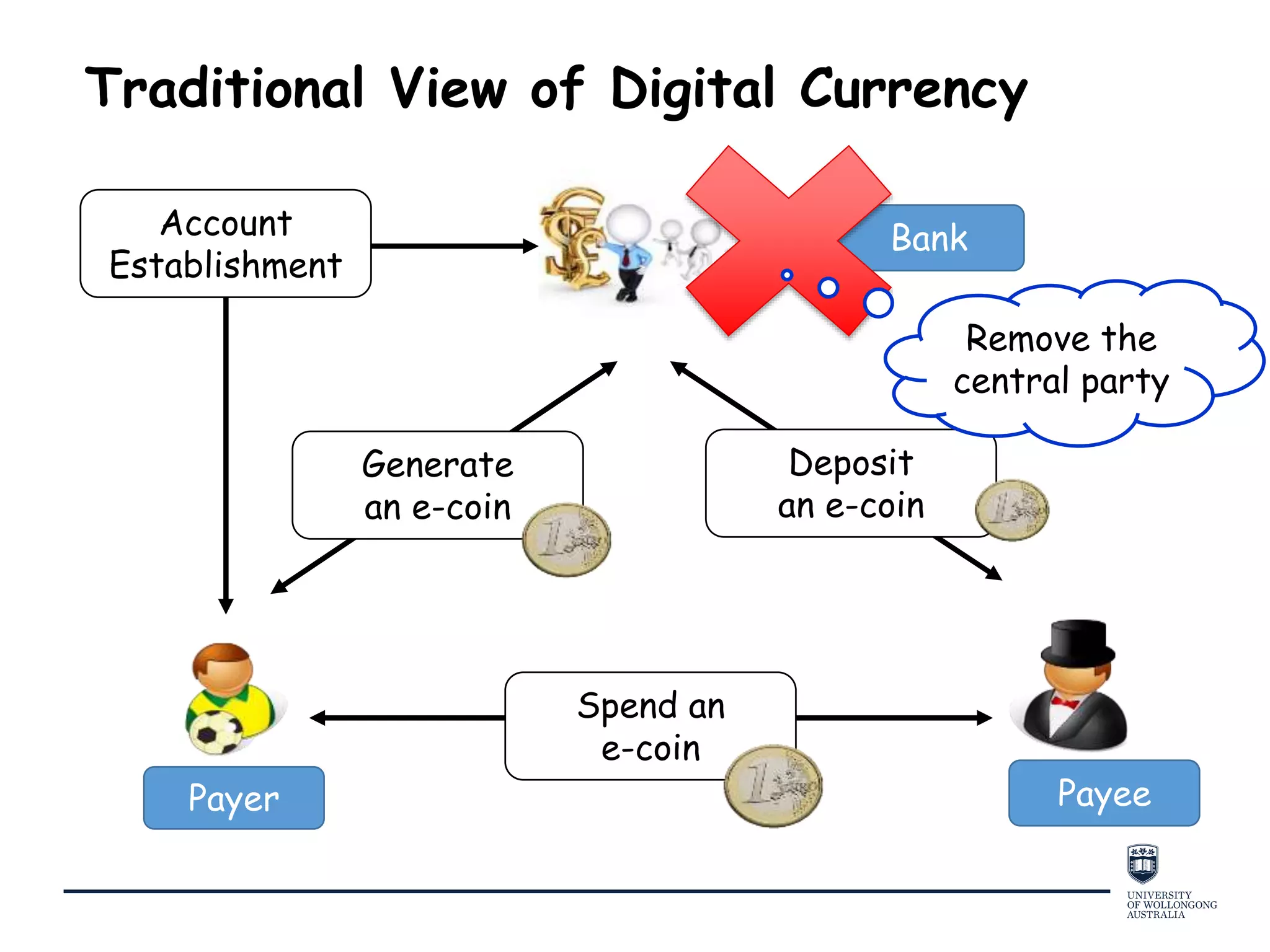
Traditional View of Digital Currency
Bank
Payer Payee
Account
Establishment
Generate
an e-coin
Spend an
e-coin
Deposit
an e-coin
Traditional View of Digital Currency
Bank
Payer Payee
Account
Establishment
Generate
an e-coin
Spend an
e-coin
Deposit
an e-coin
Remove the
central party
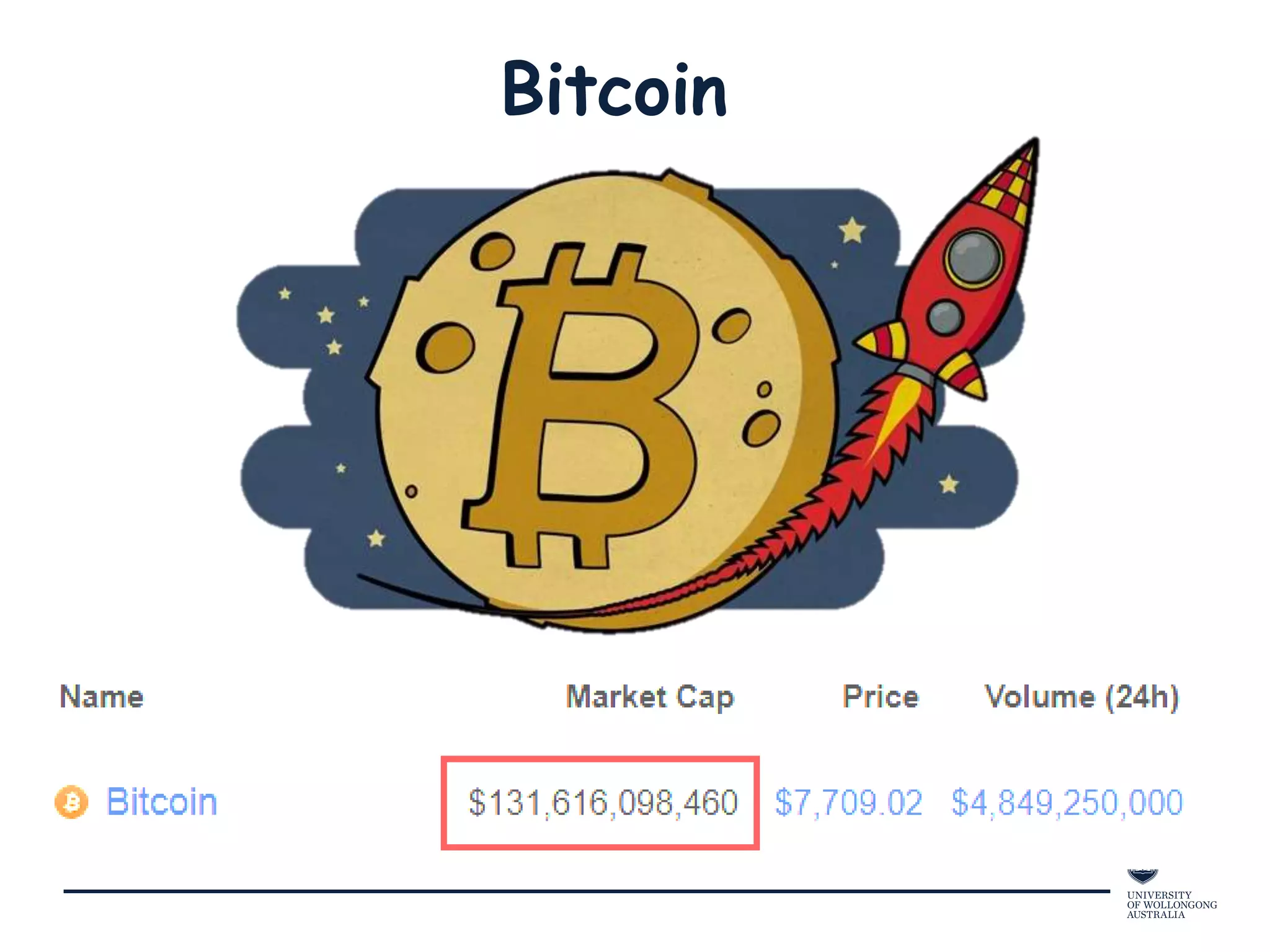
Bitcoin
Nakamoto, Satoshi. "Bitcoin: A peer-to-peer electronic cash system."
(2008): 28.
Bitcoins revisited
• Bitcoin is a cryptocurrency, existing purely in
the digital realm – first deployed in 2009.
• Cryptocurrency: a currency built upon computer
science, cryptography and economics.
• Born out of the Cypherpunk movement – a
libertarian fight for privacy and self-governance.
• The inspiration for the invention of the
blockchain.
• Created by Satoshi Nakamoto (anonymous ID)
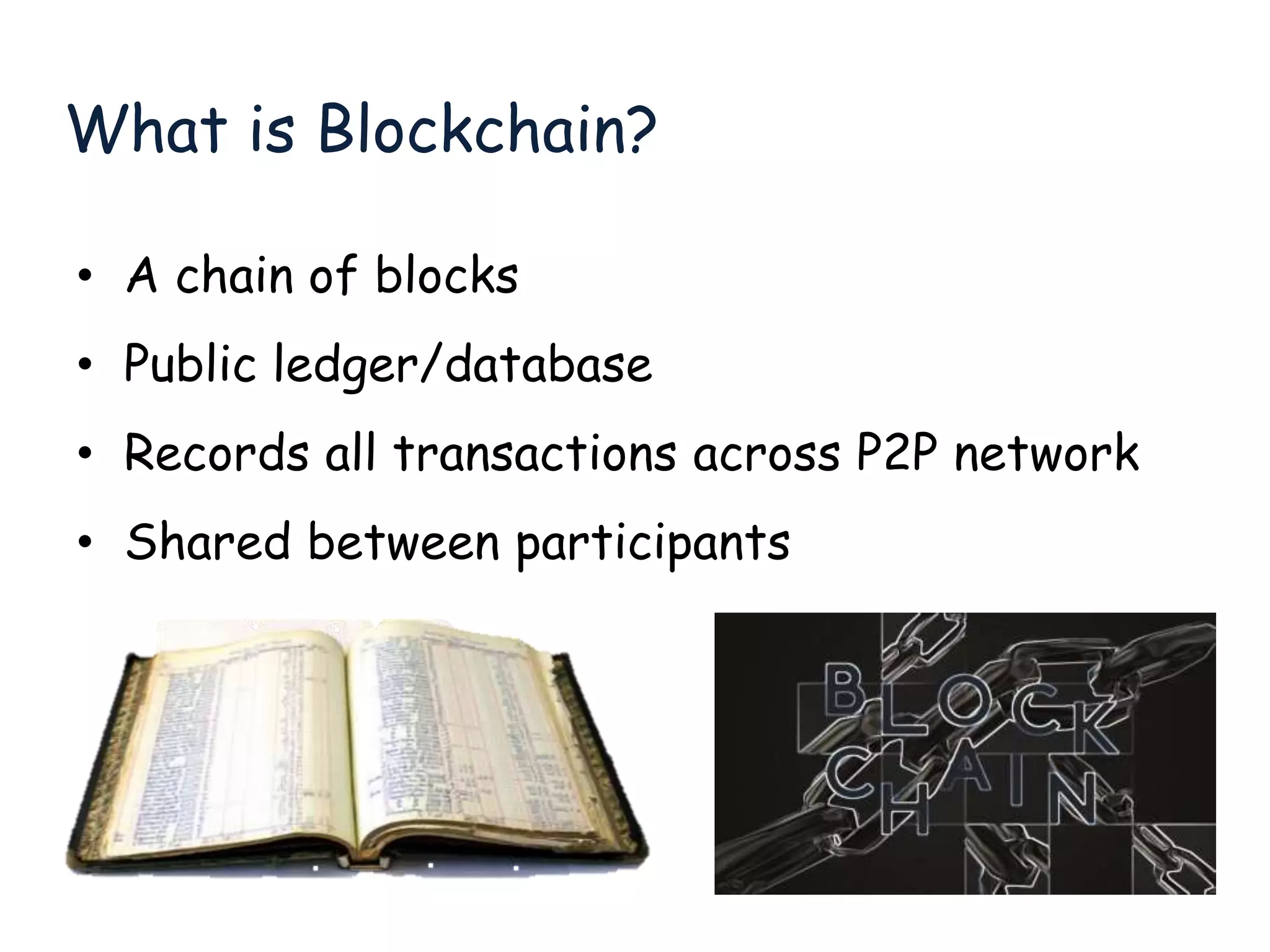
What is Blockchain?
• A chain of blocks
• Public ledger/database
• Records all transactions across P2P network
• Shared between participants
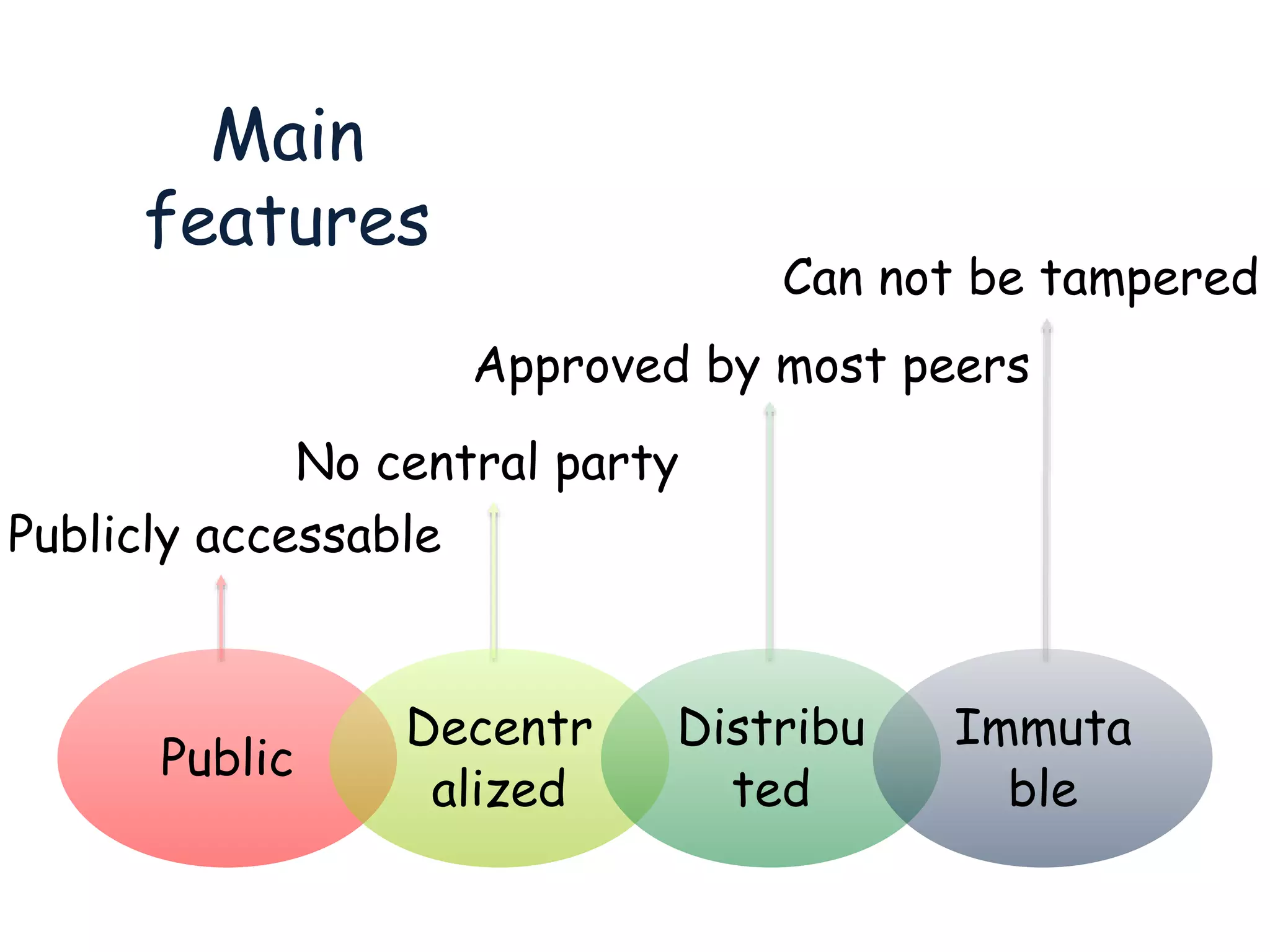
Public
Decentr
alized
Distribu
ted
Immuta
ble
Publicly accessable
No central party
Approved by most peers
Can not be tampered
Main
features
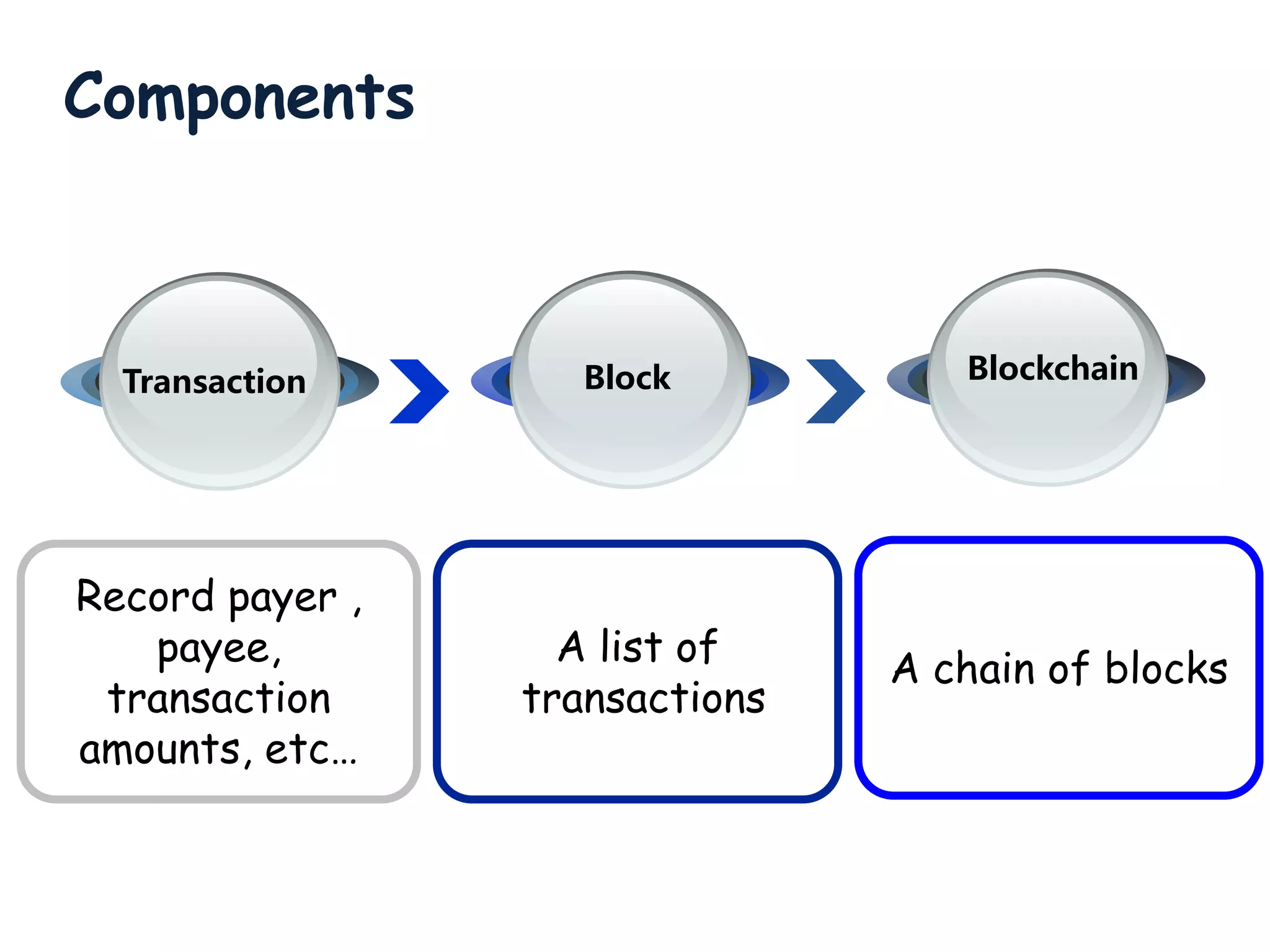
Components
Record payer ,
payee,
transaction
amounts, etc…
Transaction Block Blockchain
A chain of blocks
A list of
transactions
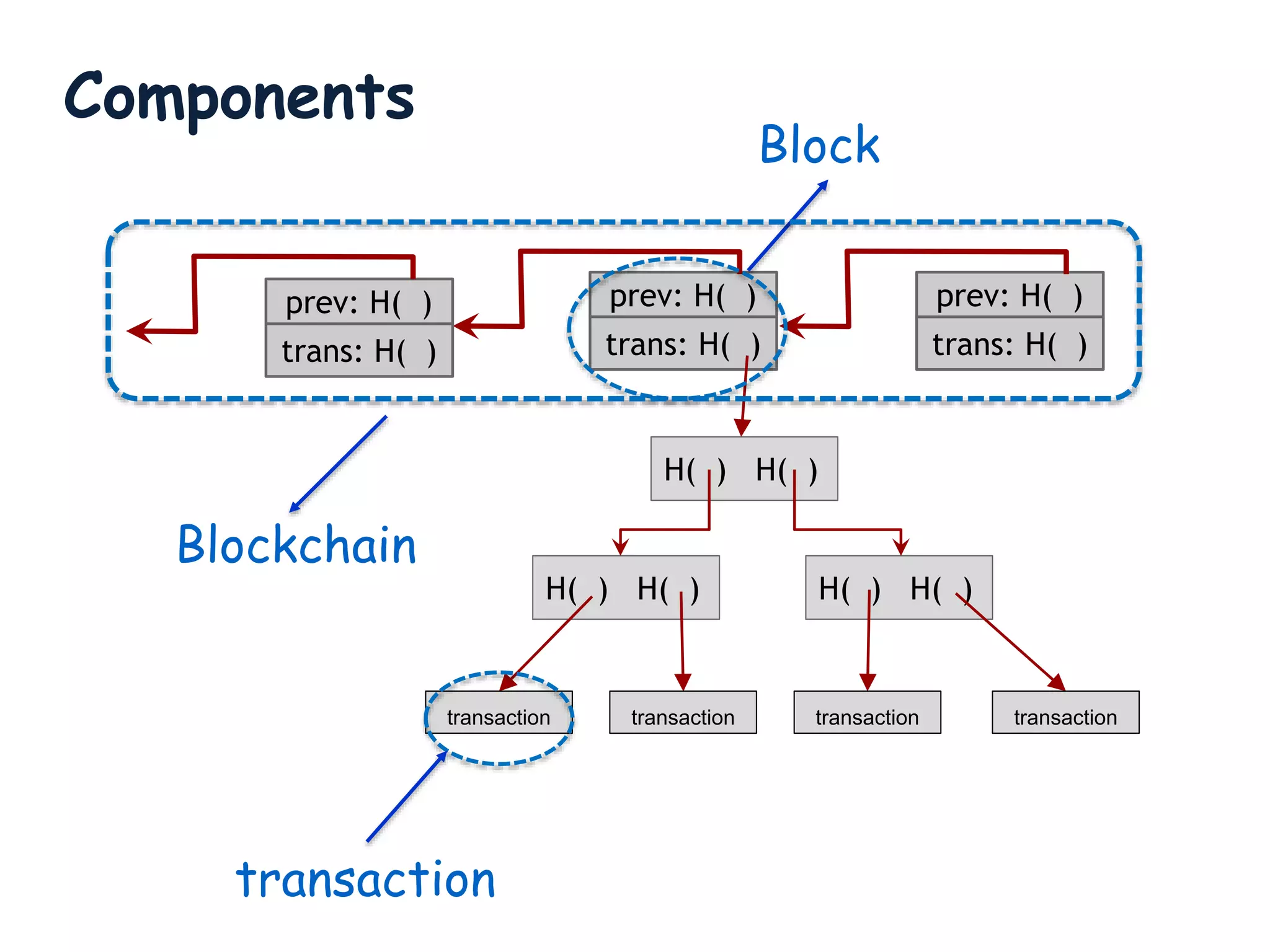
Components
trans: H( )
prev: H( )
trans: H( )
prev: H( )
trans: H( )
prev: H( )
H( ) H( )
H( ) H( ) H( ) H( )
transaction transaction transaction transaction
transaction
Block
Blockchain
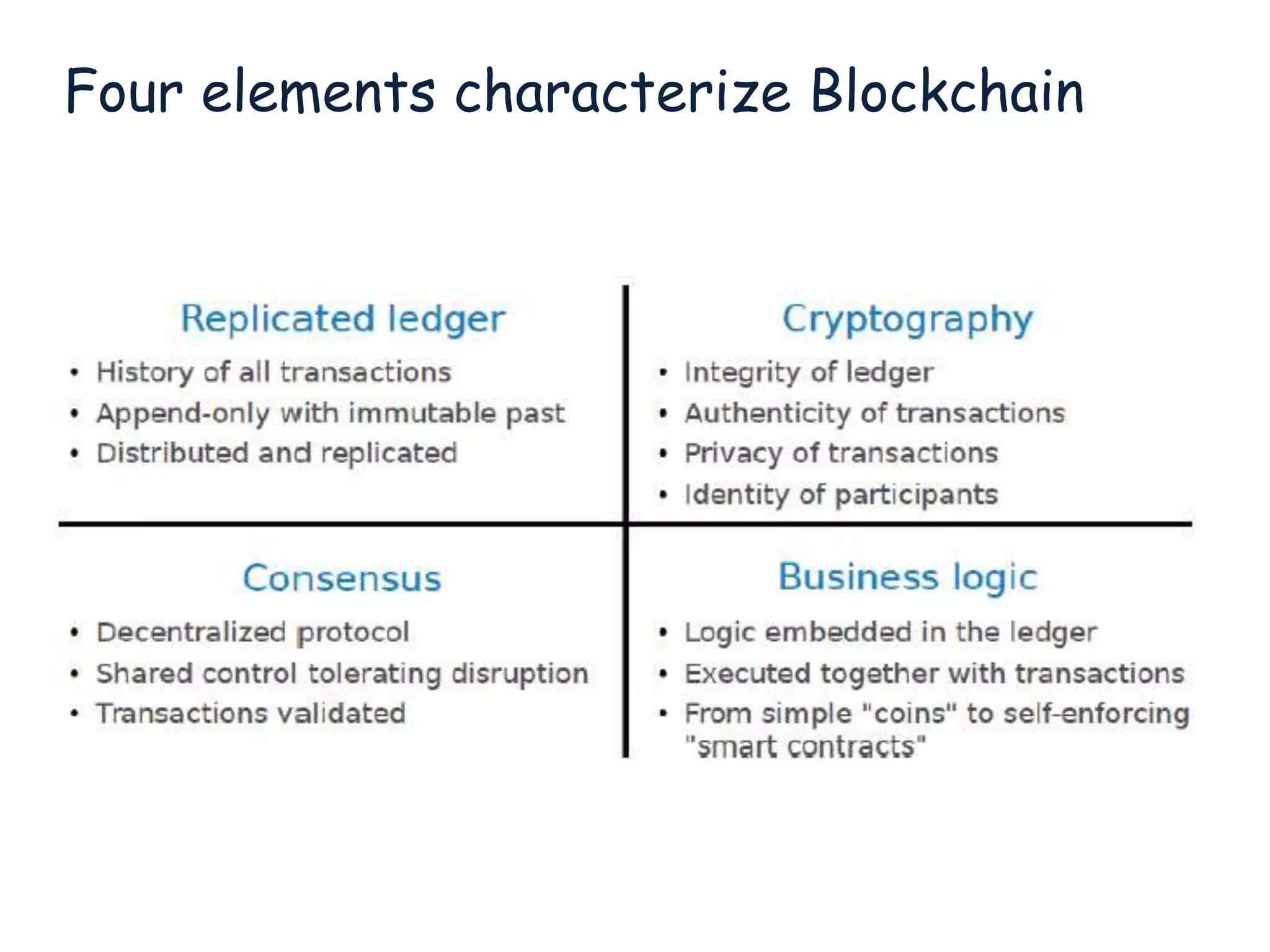
Four elements characterize Blockchain
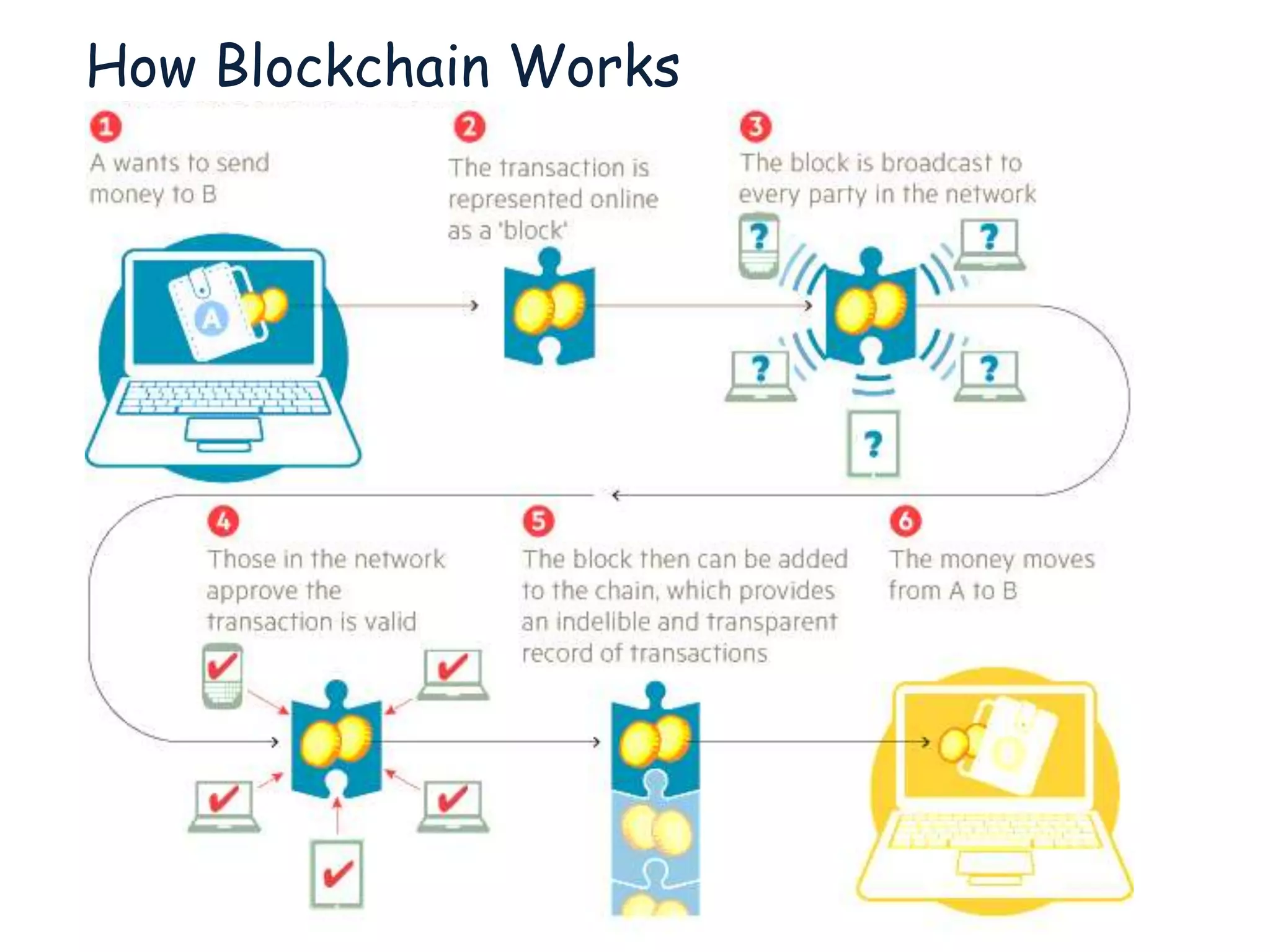
How Blockchain Works
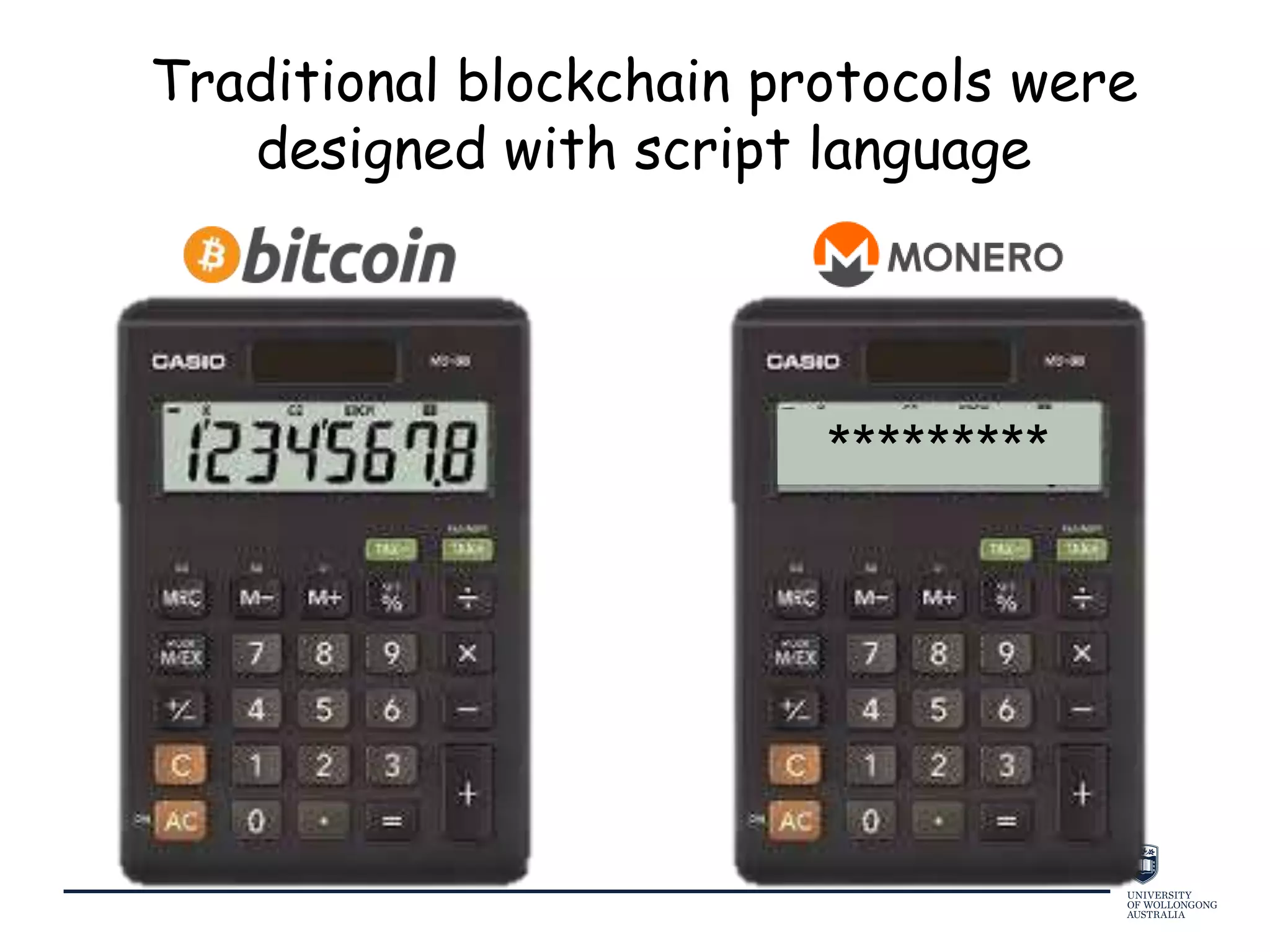
*********
Traditional blockchain protocols were
designed with script language
Document title16
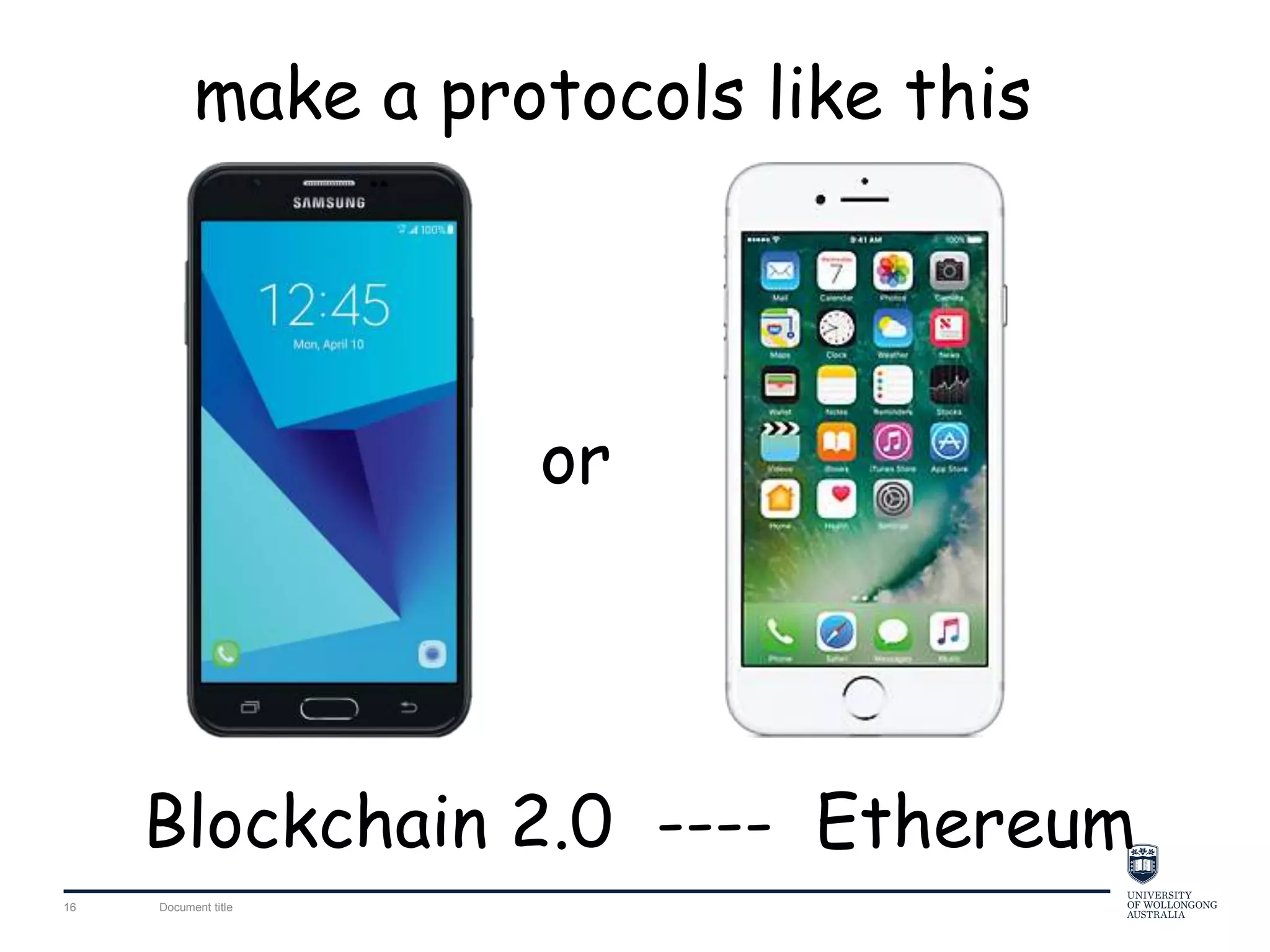
make a protocols like this
Blockchain 2.0 ---- Ethereum
or
Document title17
2. Tools & Mechnisms
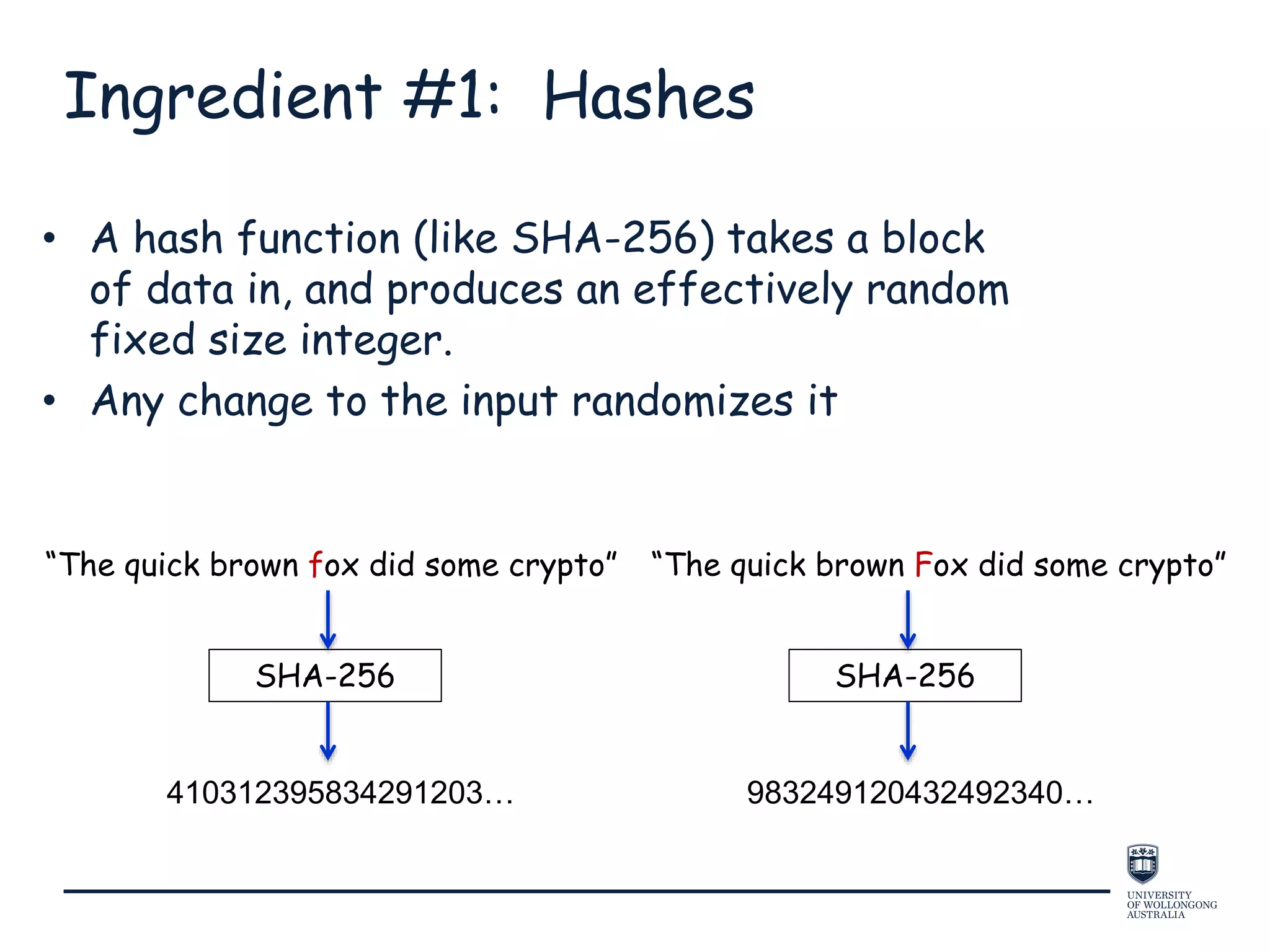
Ingredient #1: Hashes
• A hash function (like SHA-256) takes a block
of data in, and produces an effectively random
fixed size integer.
• Any change to the input randomizes it
SHA-256
“The quick brown fox did some crypto”
410312395834291203…
SHA-256
“The quick brown Fox did some crypto”
983249120432492340…
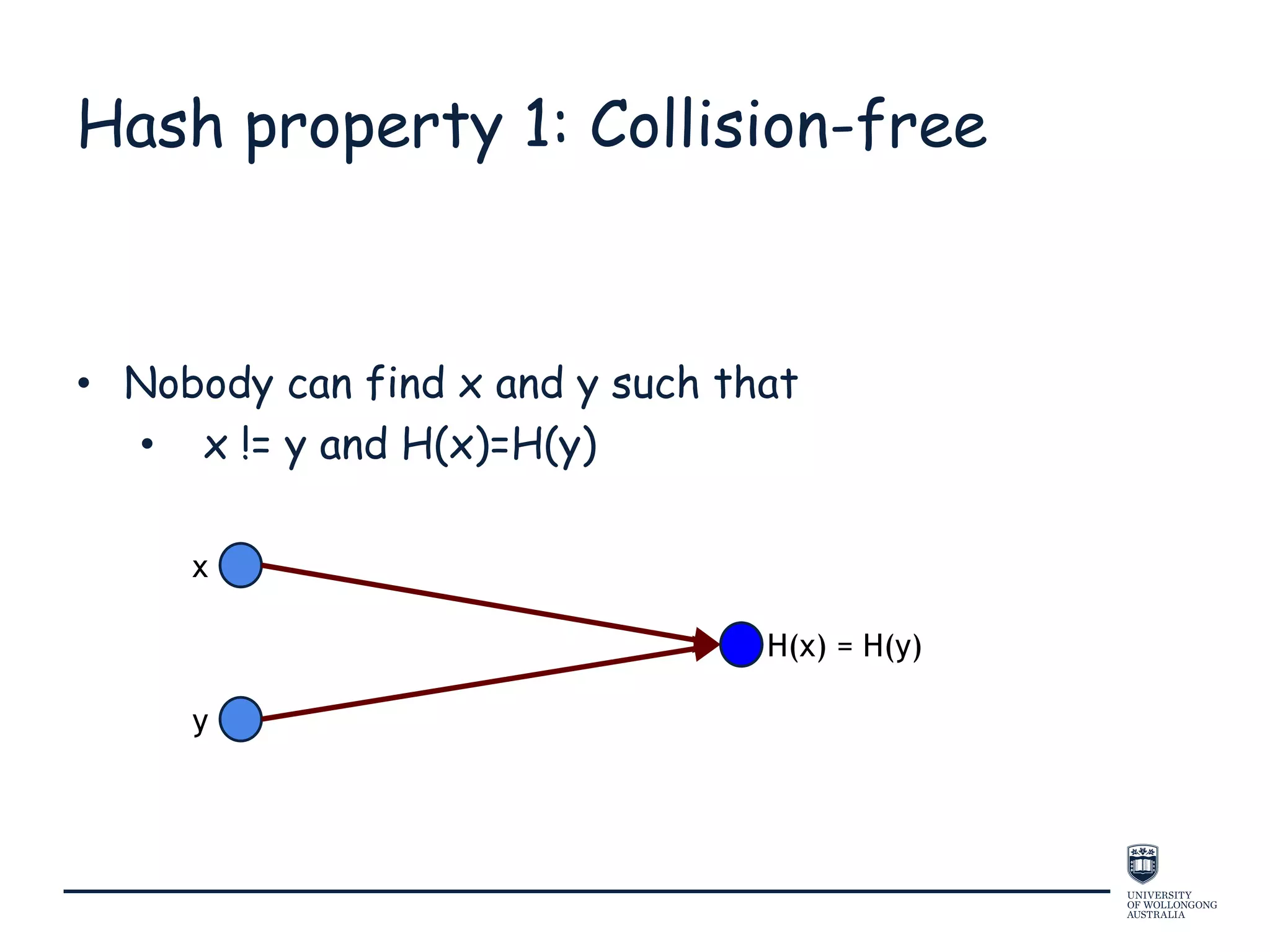
Hash property 1: Collision-free
• Nobody can find x and y such that
• x != y and H(x)=H(y)
x
y
H(x) = H(y)
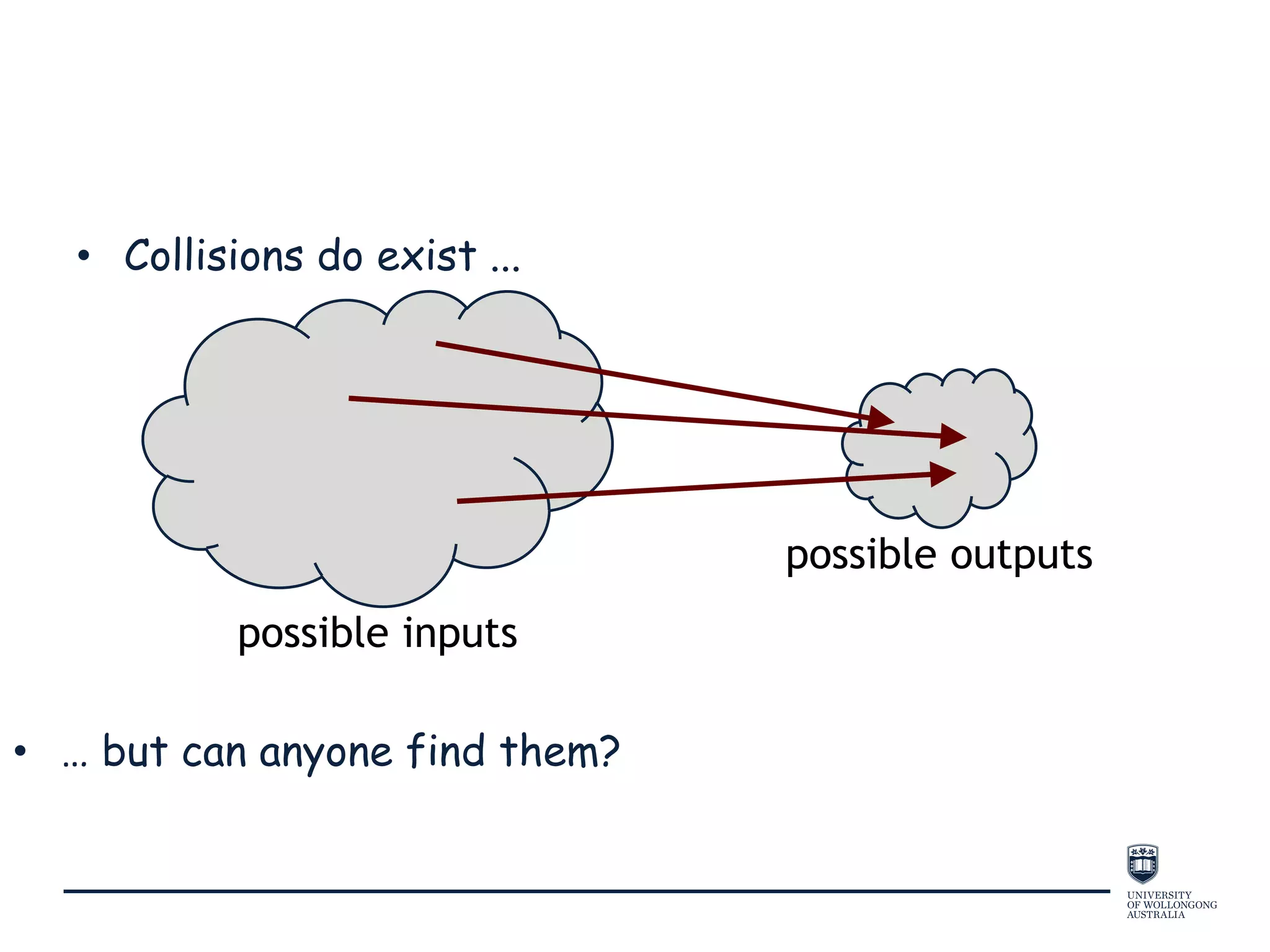
• Collisions do exist ...
• … but can anyone find them?
possible inputs
possible outputs
Hash property 2: Hiding
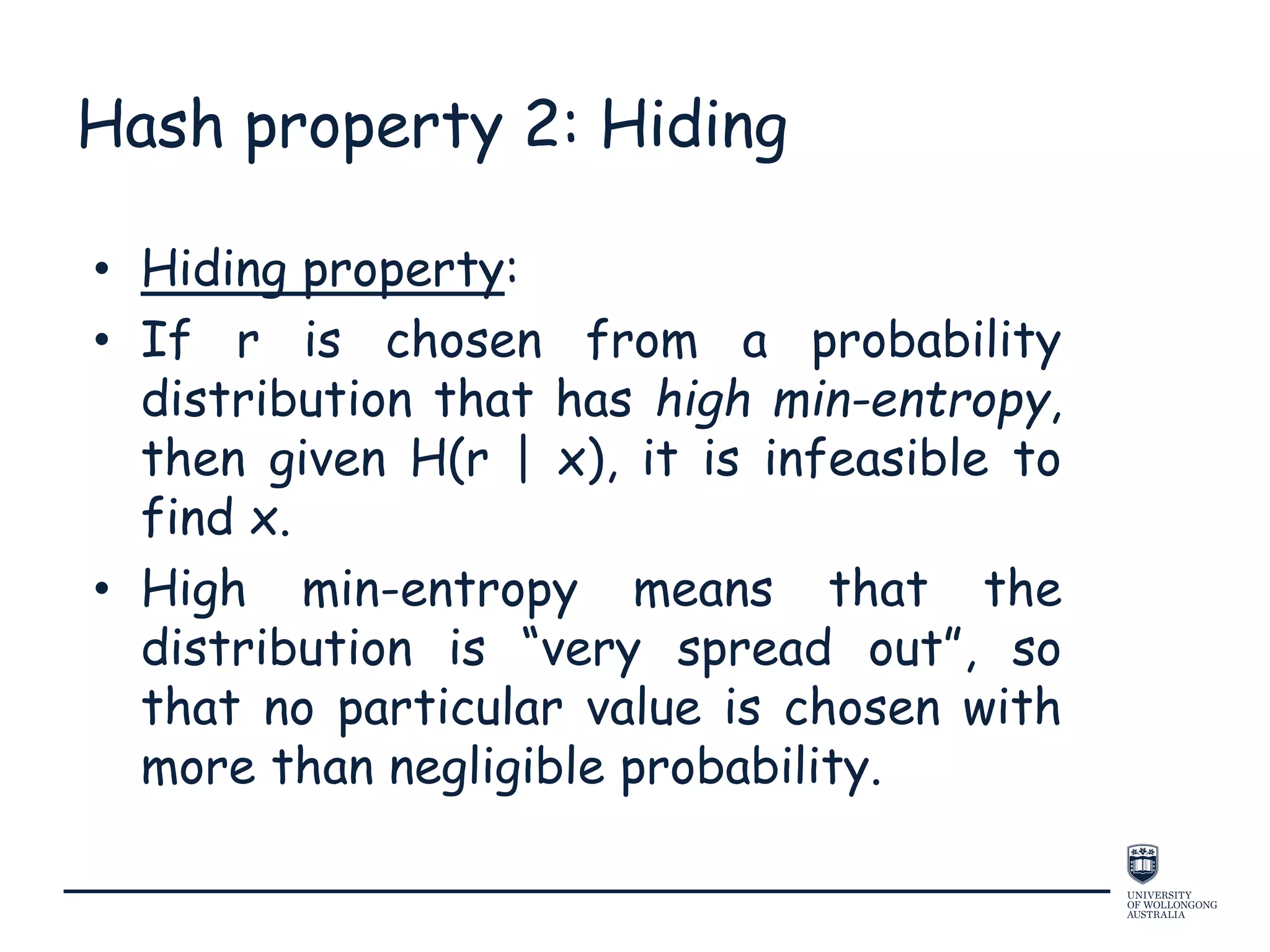
• Hiding property:
• If r is chosen from a probability
distribution that has high min-entropy,
then given H(r | x), it is infeasible to
find x.
• High min-entropy means that the
distribution is “very spread out”, so
that no particular value is chosen with
more than negligible probability.
Hash property 3: Puzzle-friendly
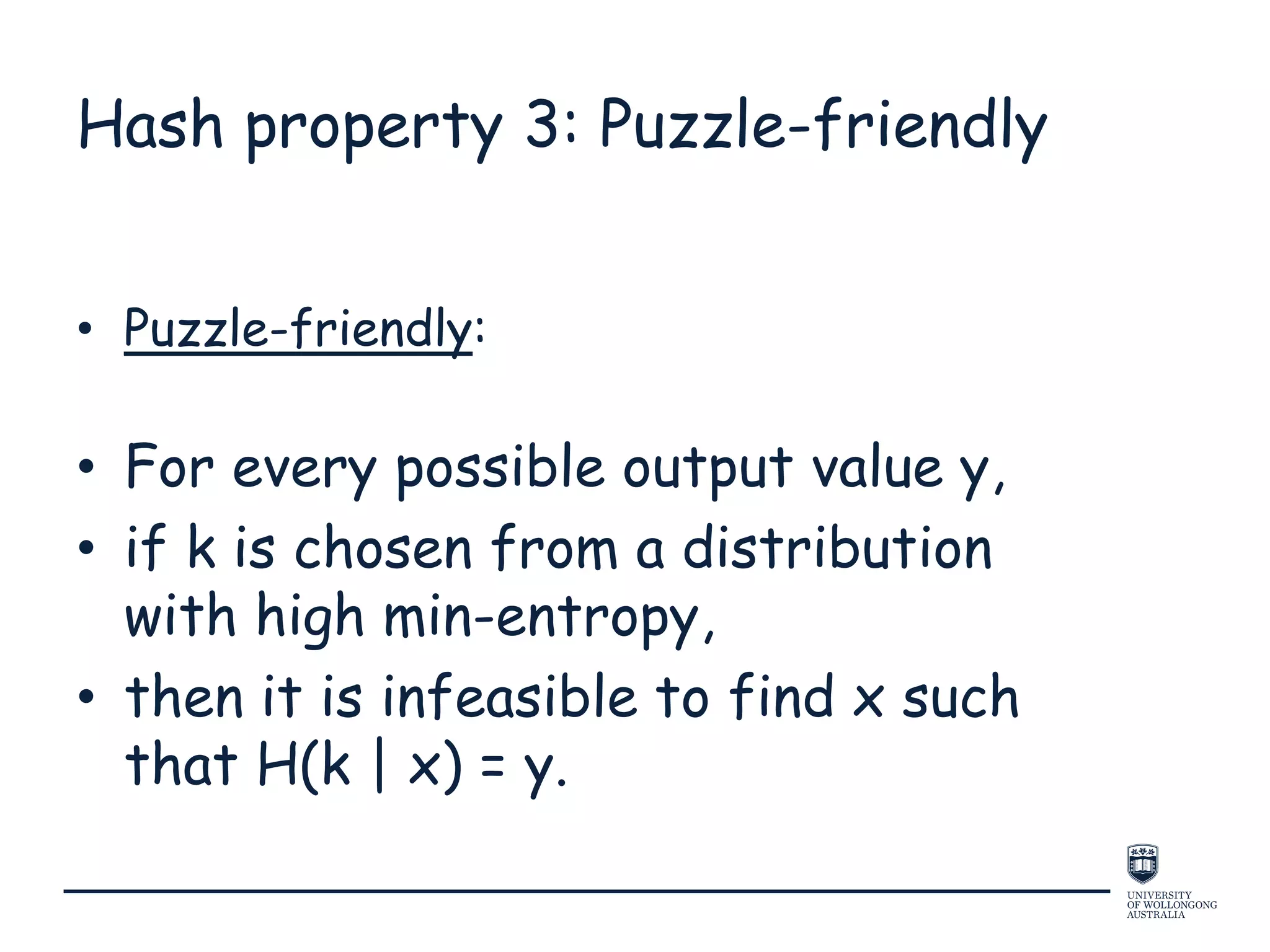
• Puzzle-friendly:
• For every possible output value y,
• if k is chosen from a distribution
with high min-entropy,
• then it is infeasible to find x such
that H(k | x) = y.
Application: Search puzzle
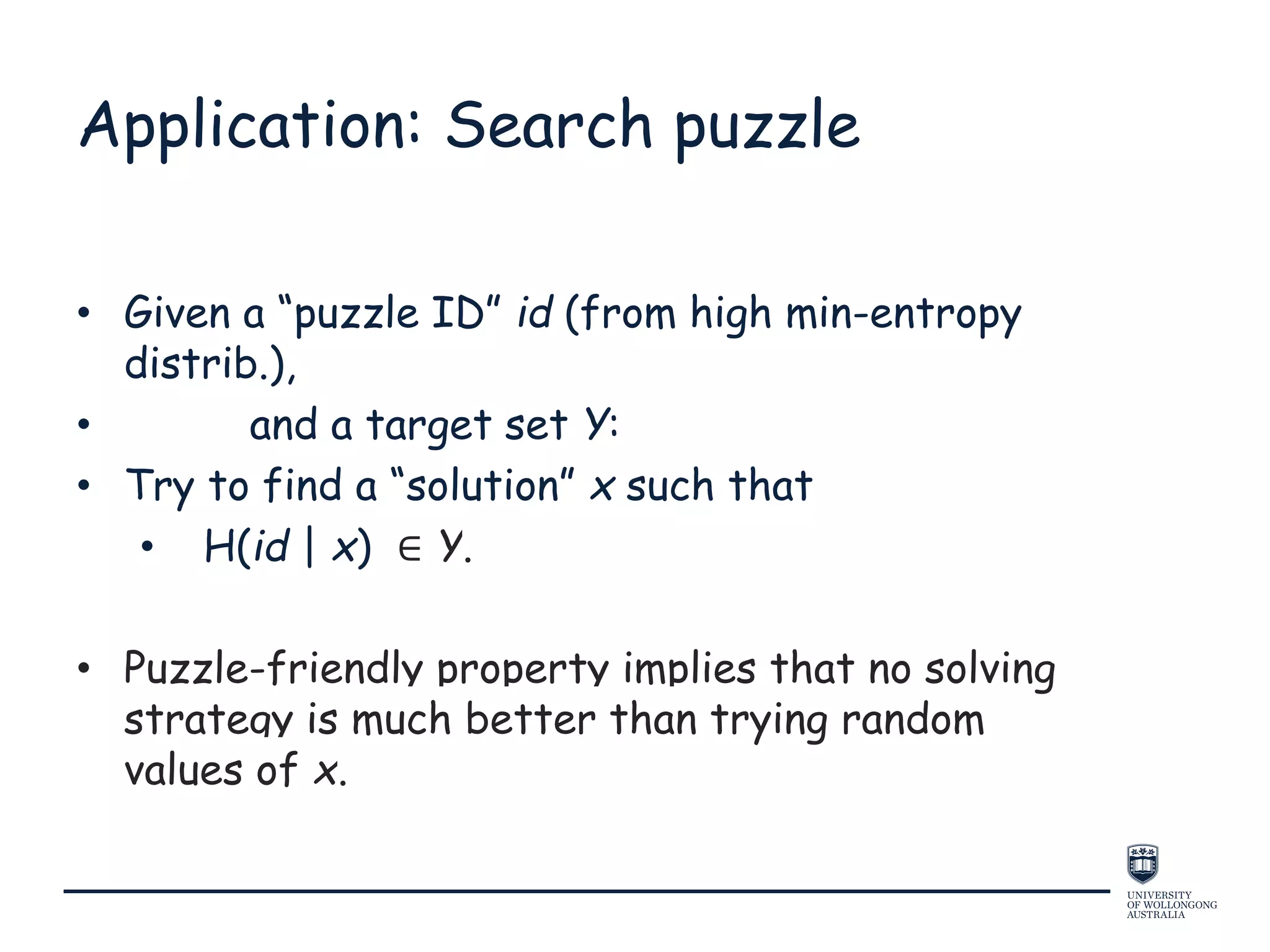
• Given a “puzzle ID” id (from high min-entropy
distrib.),
• and a target set Y:
• Try to find a “solution” x such that
• H(id | x) ∈ Y.
• Puzzle-friendly property implies that no solving
strategy is much better than trying random
values of x.
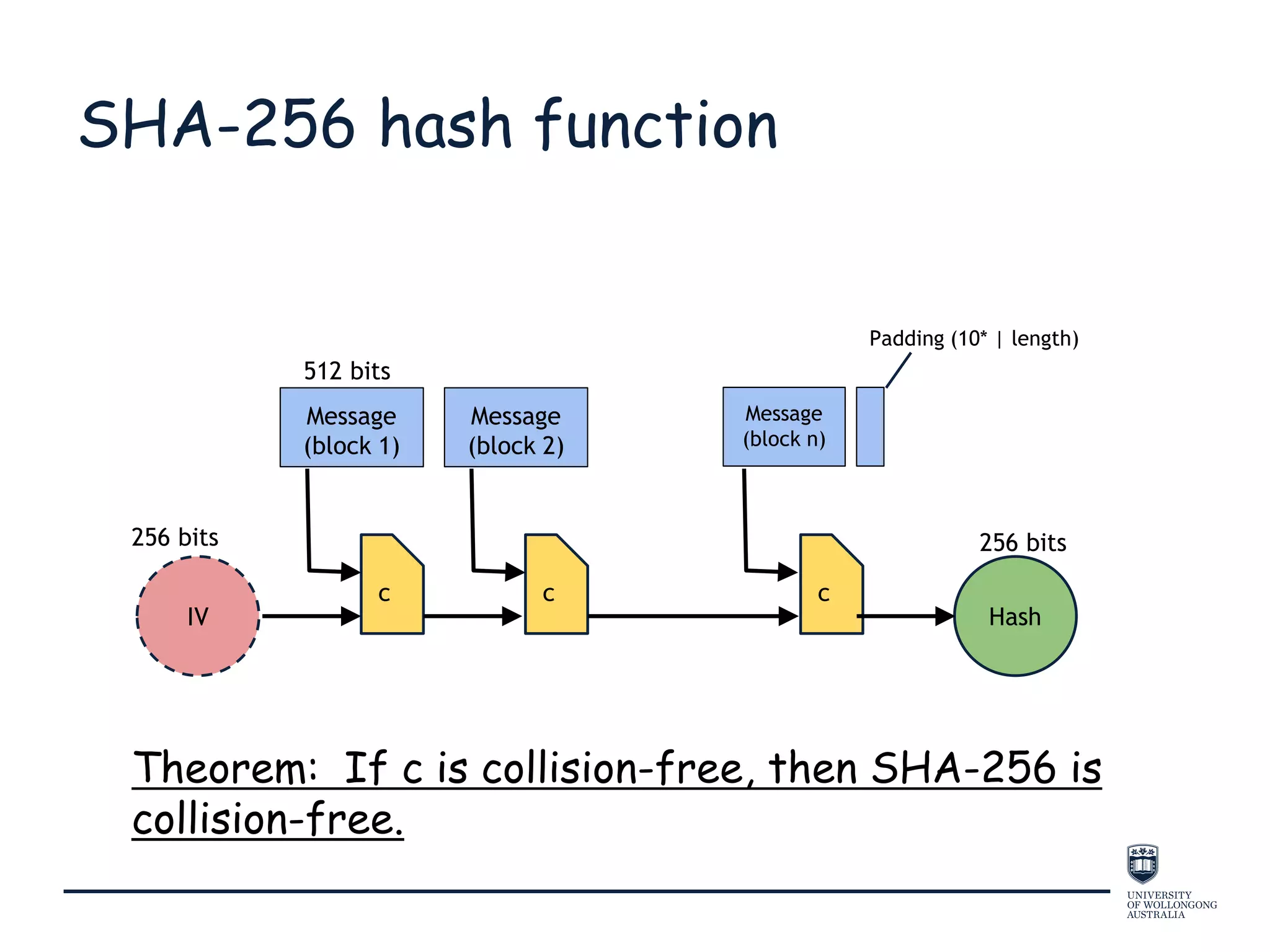
SHA-256 hash function
256 bits 256 bits
512 bits
Theorem: If c is collision-free, then SHA-256 is
collision-free.
Padding (10* | length)
IV
Message
(block 1)
Message
(block 2)
Message
(block n)
Hash
c c c
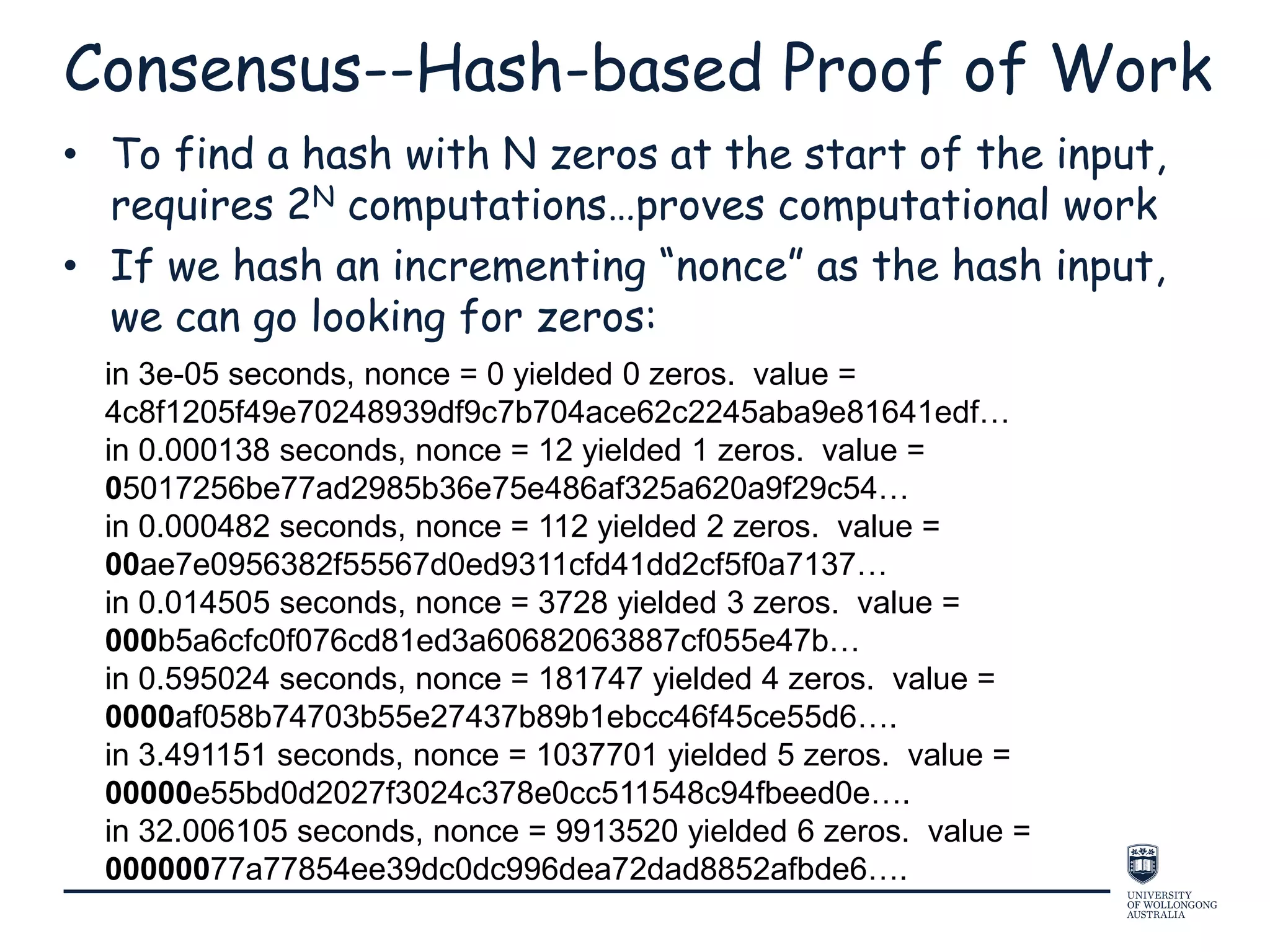
Consensus--Hash-based Proof of Work
• To find a hash with N zeros at the start of the input,
requires 2N computations…proves computational work
• If we hash an incrementing “nonce” as the hash input,
we can go looking for zeros:
in 3e-05 seconds, nonce = 0 yielded 0 zeros. value =
4c8f1205f49e70248939df9c7b704ace62c2245aba9e81641edf…
in 0.000138 seconds, nonce = 12 yielded 1 zeros. value =
05017256be77ad2985b36e75e486af325a620a9f29c54…
in 0.000482 seconds, nonce = 112 yielded 2 zeros. value =
00ae7e0956382f55567d0ed9311cfd41dd2cf5f0a7137…
in 0.014505 seconds, nonce = 3728 yielded 3 zeros. value =
000b5a6cfc0f076cd81ed3a60682063887cf055e47b…
in 0.595024 seconds, nonce = 181747 yielded 4 zeros. value =
0000af058b74703b55e27437b89b1ebcc46f45ce55d6….
in 3.491151 seconds, nonce = 1037701 yielded 5 zeros. value =
00000e55bd0d2027f3024c378e0cc511548c94fbeed0e….
in 32.006105 seconds, nonce = 9913520 yielded 6 zeros. value =
00000077a77854ee39dc0dc996dea72dad8852afbde6….
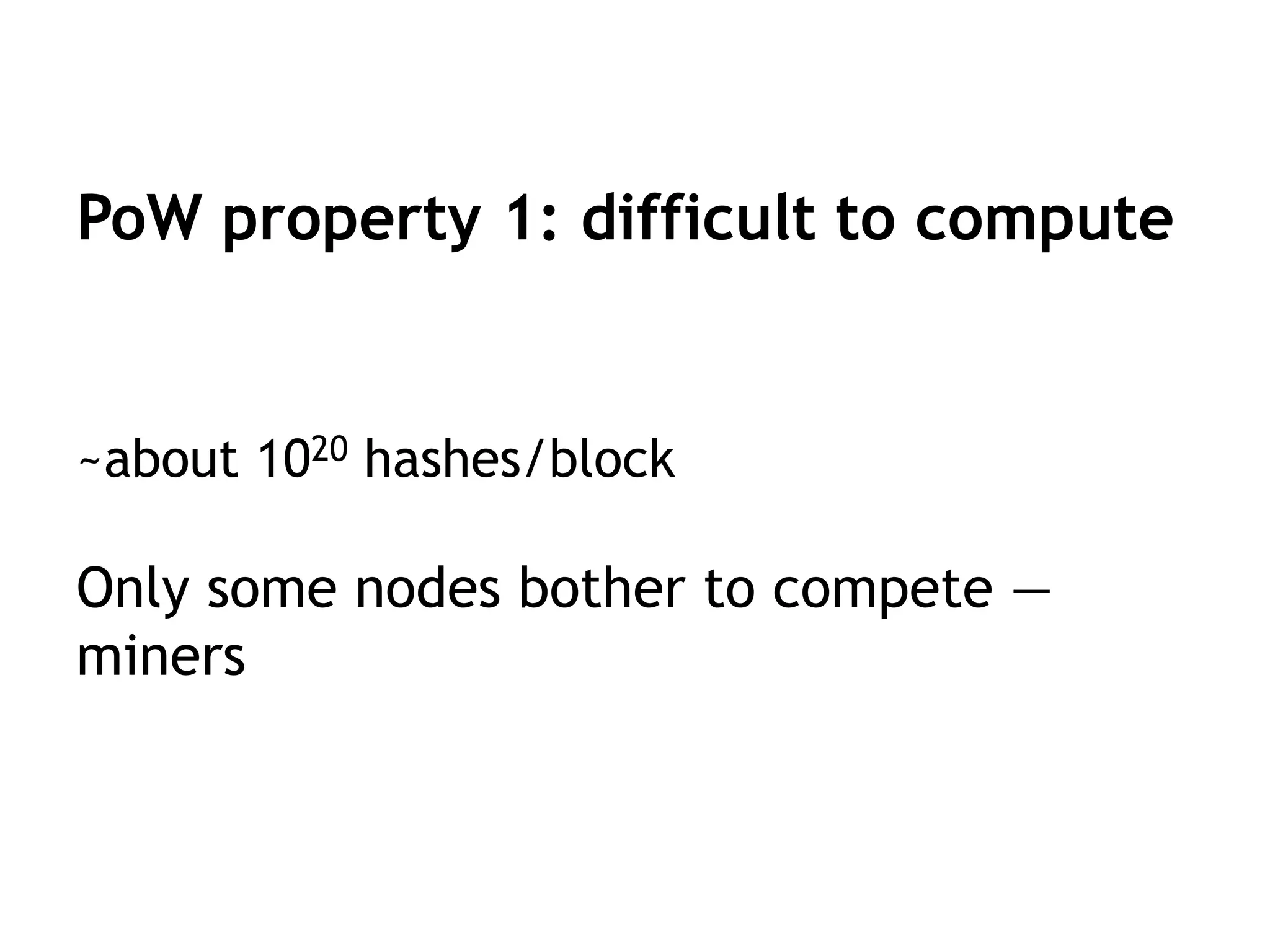
PoW property 1: difficult to compute
~about 1020 hashes/block
Only some nodes bother to compete —
miners
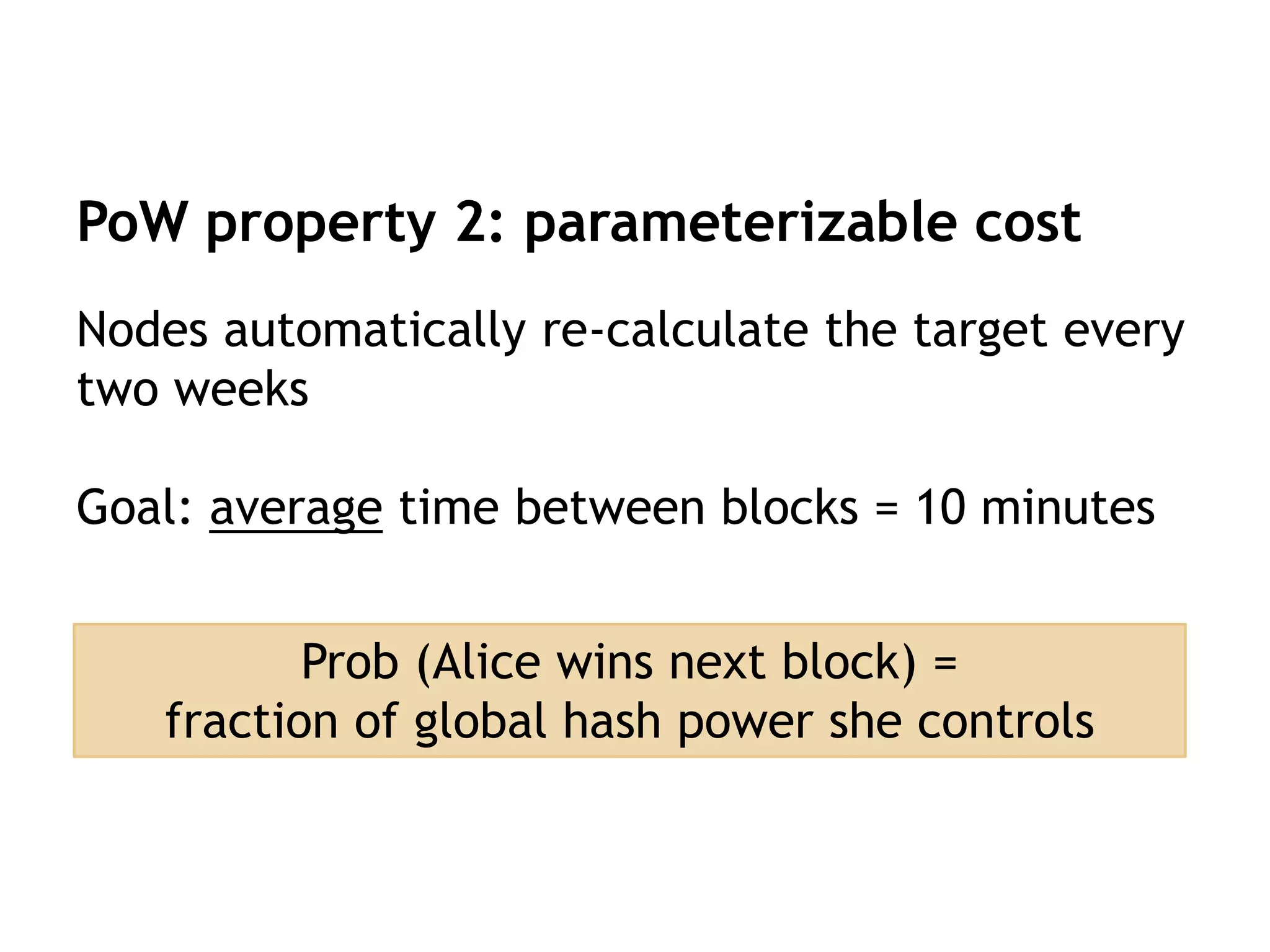
PoW property 2: parameterizable cost
Nodes automatically re-calculate the target every
two weeks
Goal: average time between blocks = 10 minutes
Prob (Alice wins next block) =
fraction of global hash power she controls
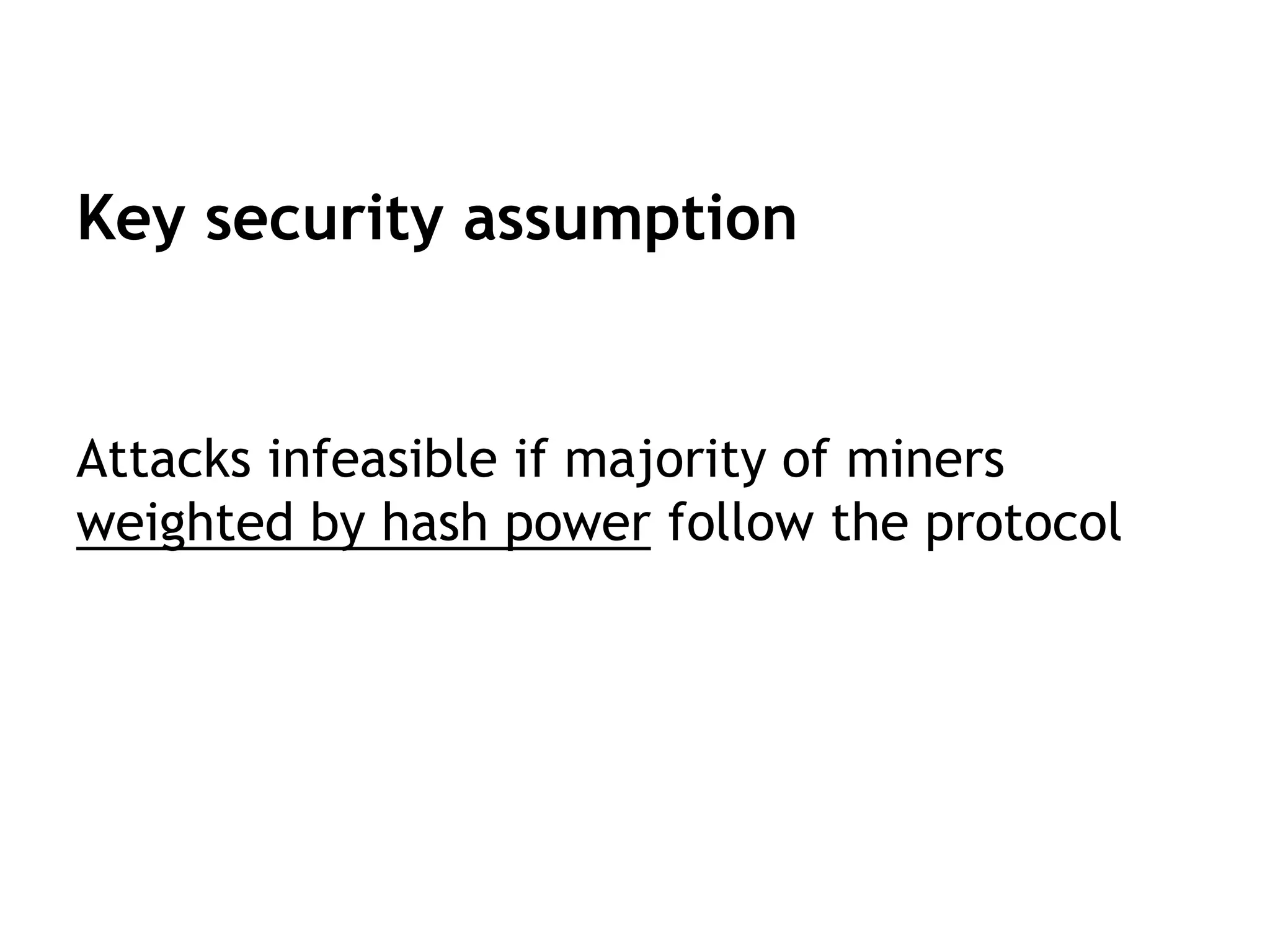
Key security assumption
Attacks infeasible if majority of miners
weighted by hash power follow the protocol
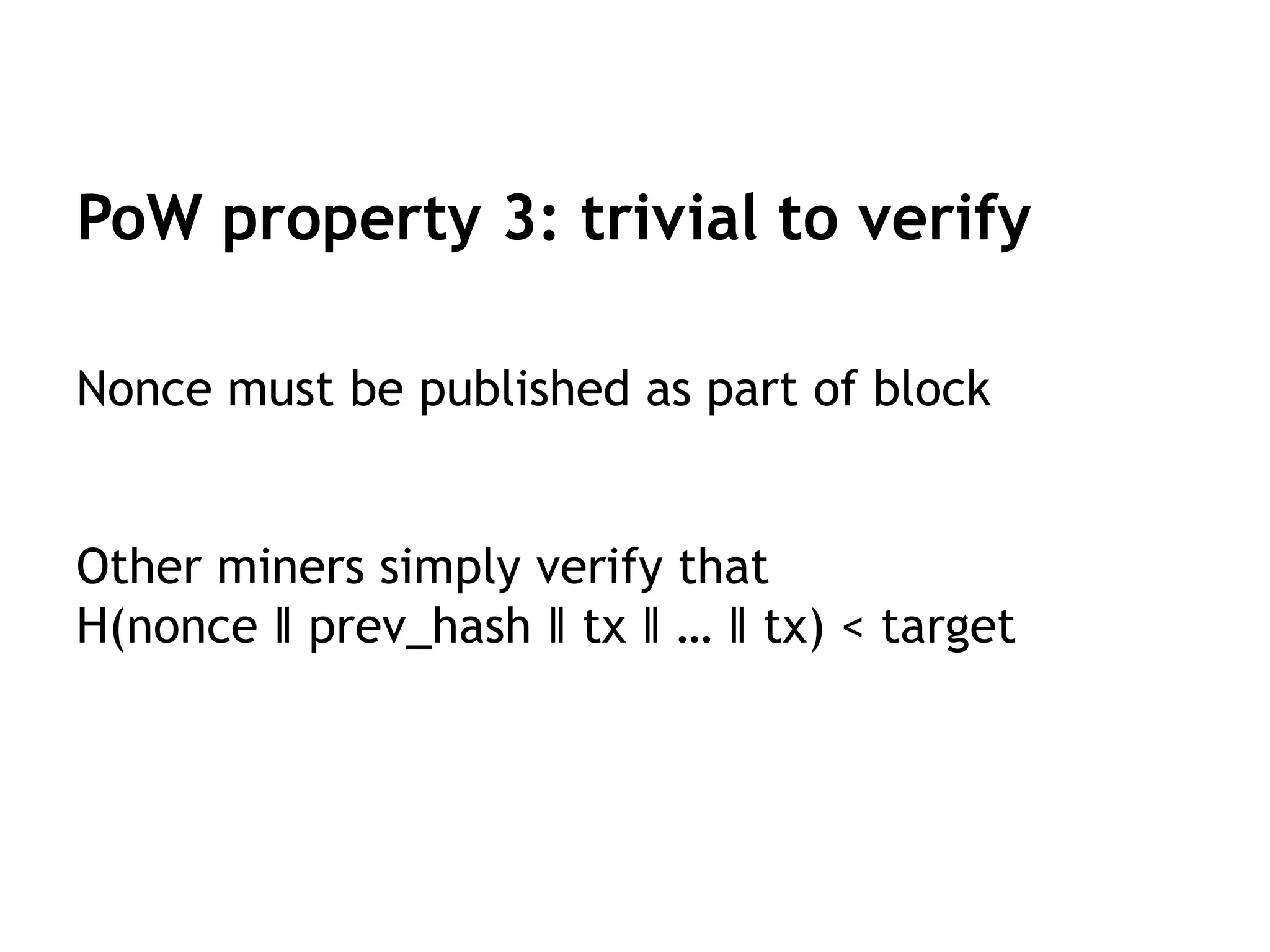
PoW property 3: trivial to verify
Nonce must be published as part of block
Other miners simply verify that
H(nonce ‖ prev_hash ‖ tx ‖ … ‖ tx) < target
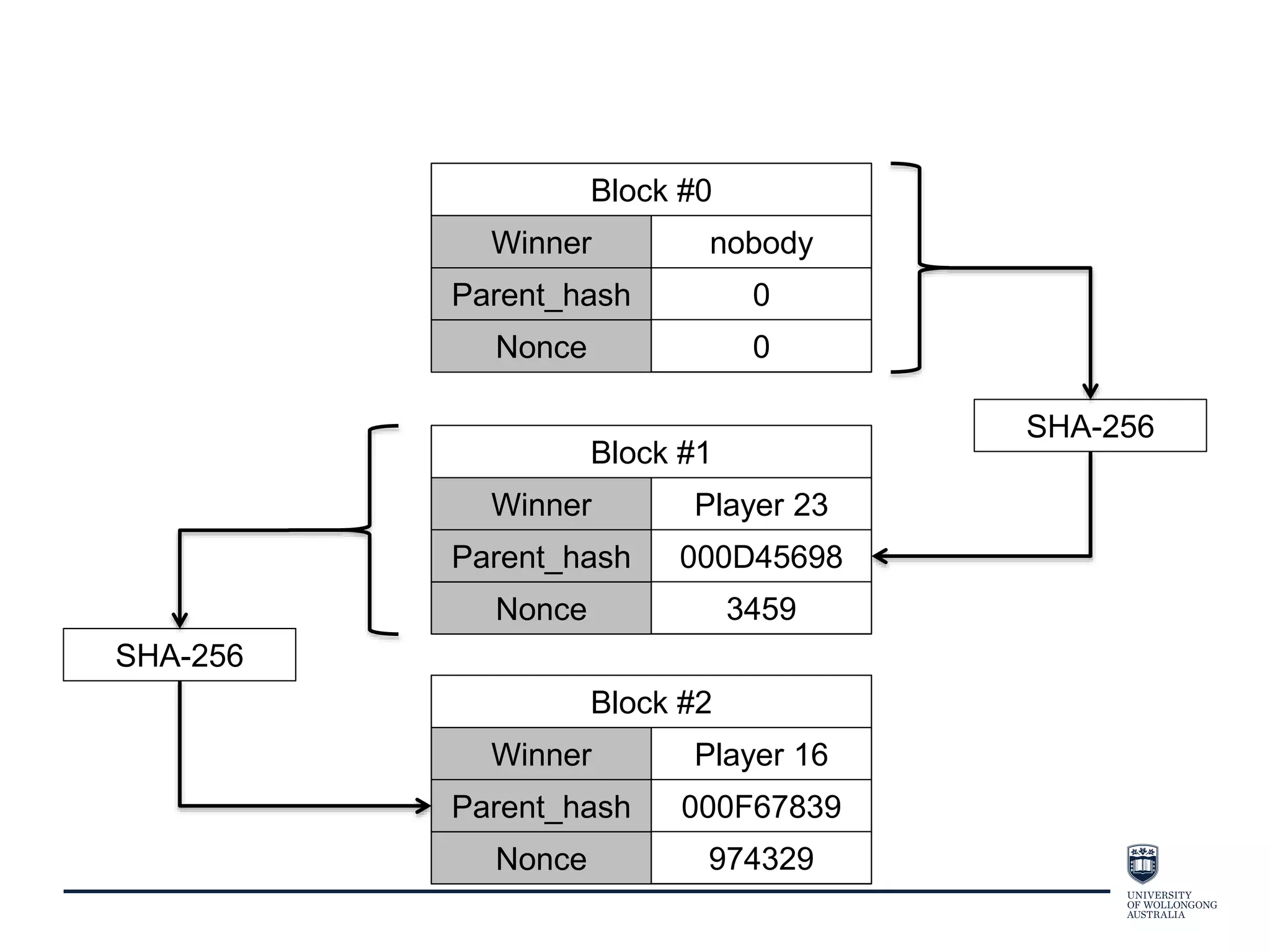
Block #0
Winner nobody
Parent_hash 0
Nonce 0
Block #1
Winner Player 23
Parent_hash 000D45698
Nonce 3459
SHA-256
Block #2
Winner Player 16
Parent_hash 000F67839
Nonce 974329
SHA-256
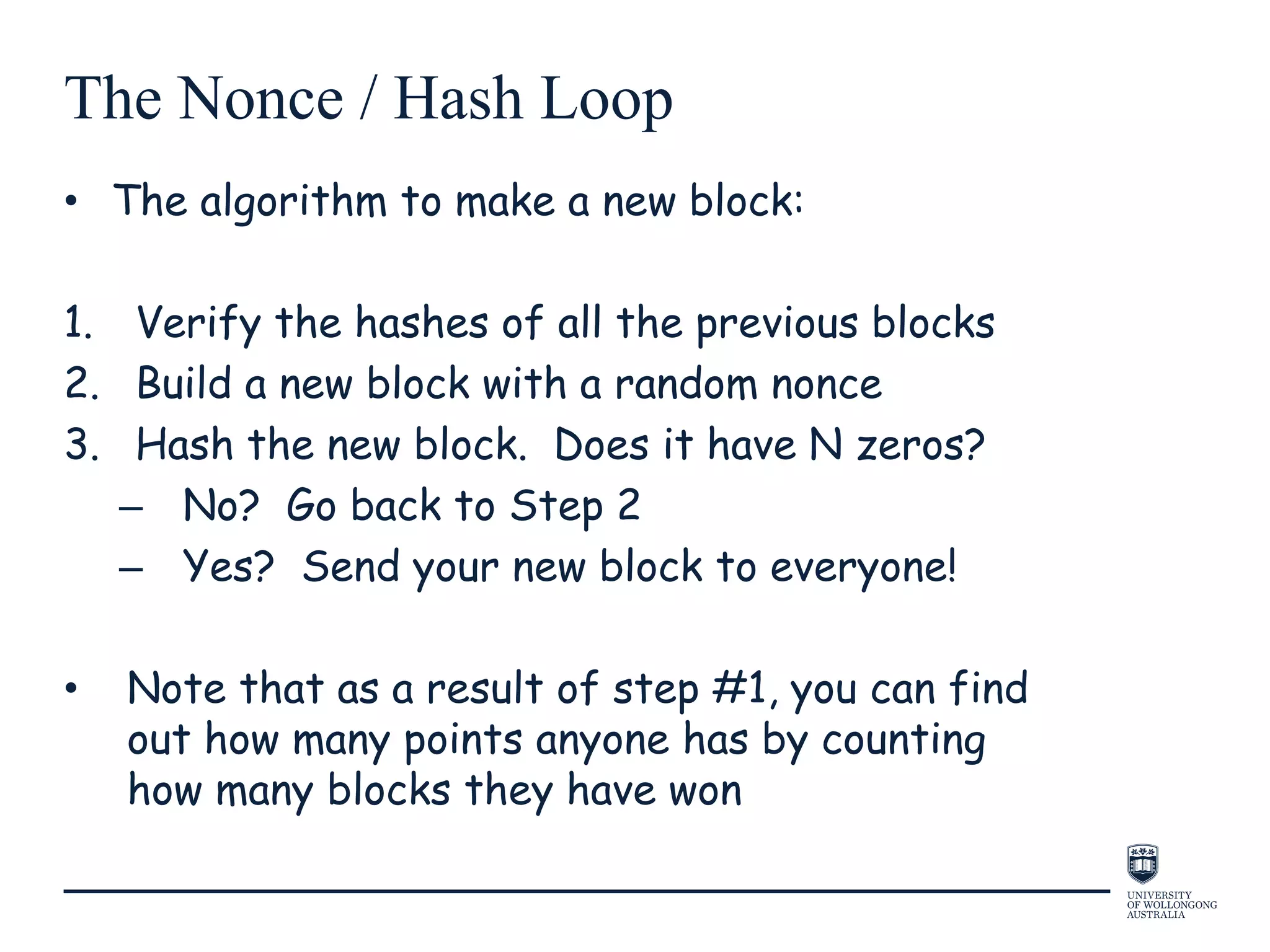
The Nonce / Hash Loop
• The algorithm to make a new block:
1. Verify the hashes of all the previous blocks
2. Build a new block with a random nonce
3. Hash the new block. Does it have N zeros?
– No? Go back to Step 2
– Yes? Send your new block to everyone!
• Note that as a result of step #1, you can find
out how many points anyone has by counting
how many blocks they have won
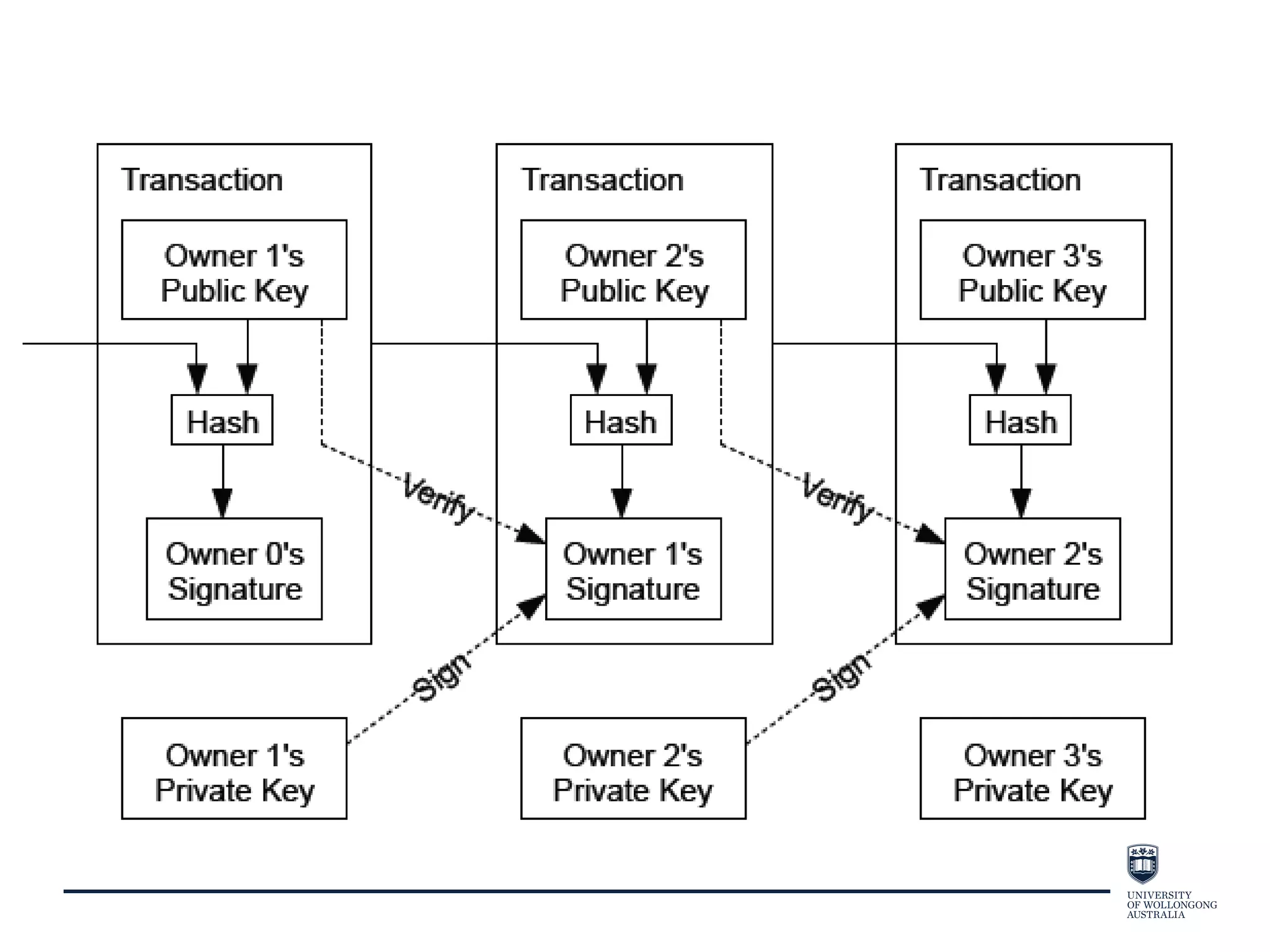
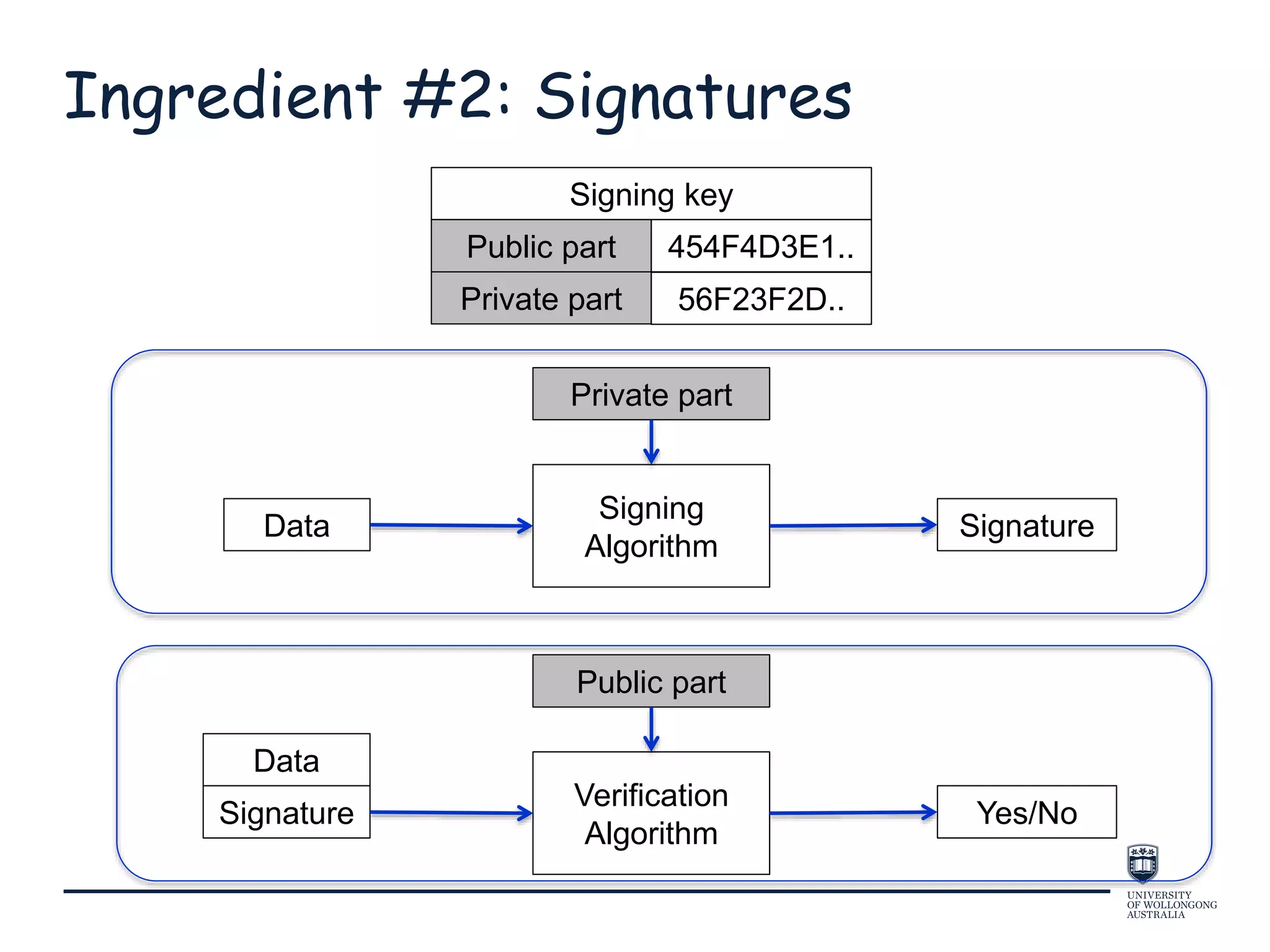
Ingredient #2: Signatures
Signing key
Public part 454F4D3E1..
Private part 56F23F2D..
Data
Signing
Algorithm
Signature
Private part
Signature
Verification
Algorithm
Yes/No
Public part
Data
What we want from signatures
• Only you can sign, but anyone can verify
• Signature is tied to a particular
document
• can’t be cut-and-pasted to another doc
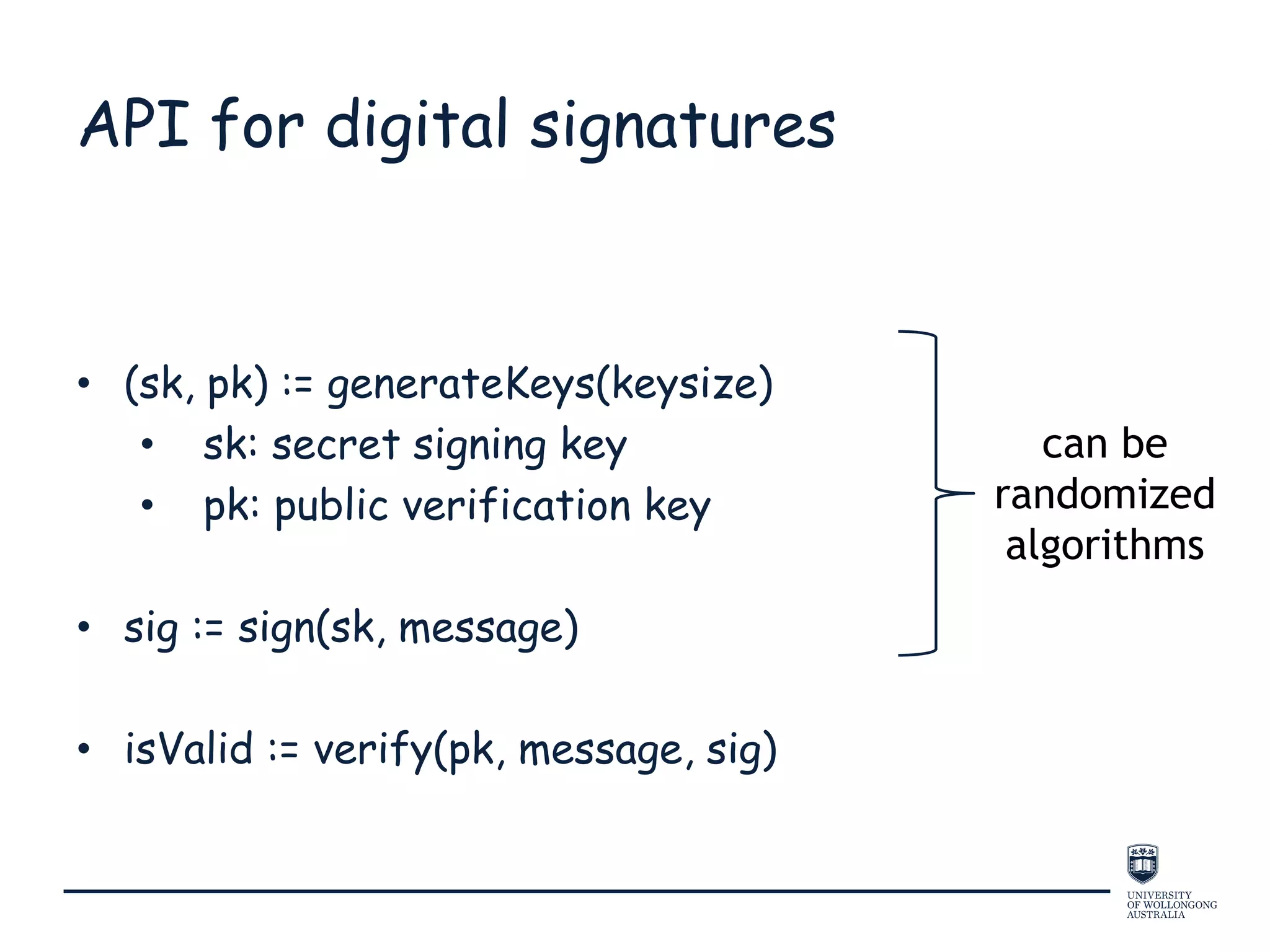
API for digital signatures
• (sk, pk) := generateKeys(keysize)
• sk: secret signing key
• pk: public verification key
• sig := sign(sk, message)
• isValid := verify(pk, message, sig)
can be
randomized
algorithms
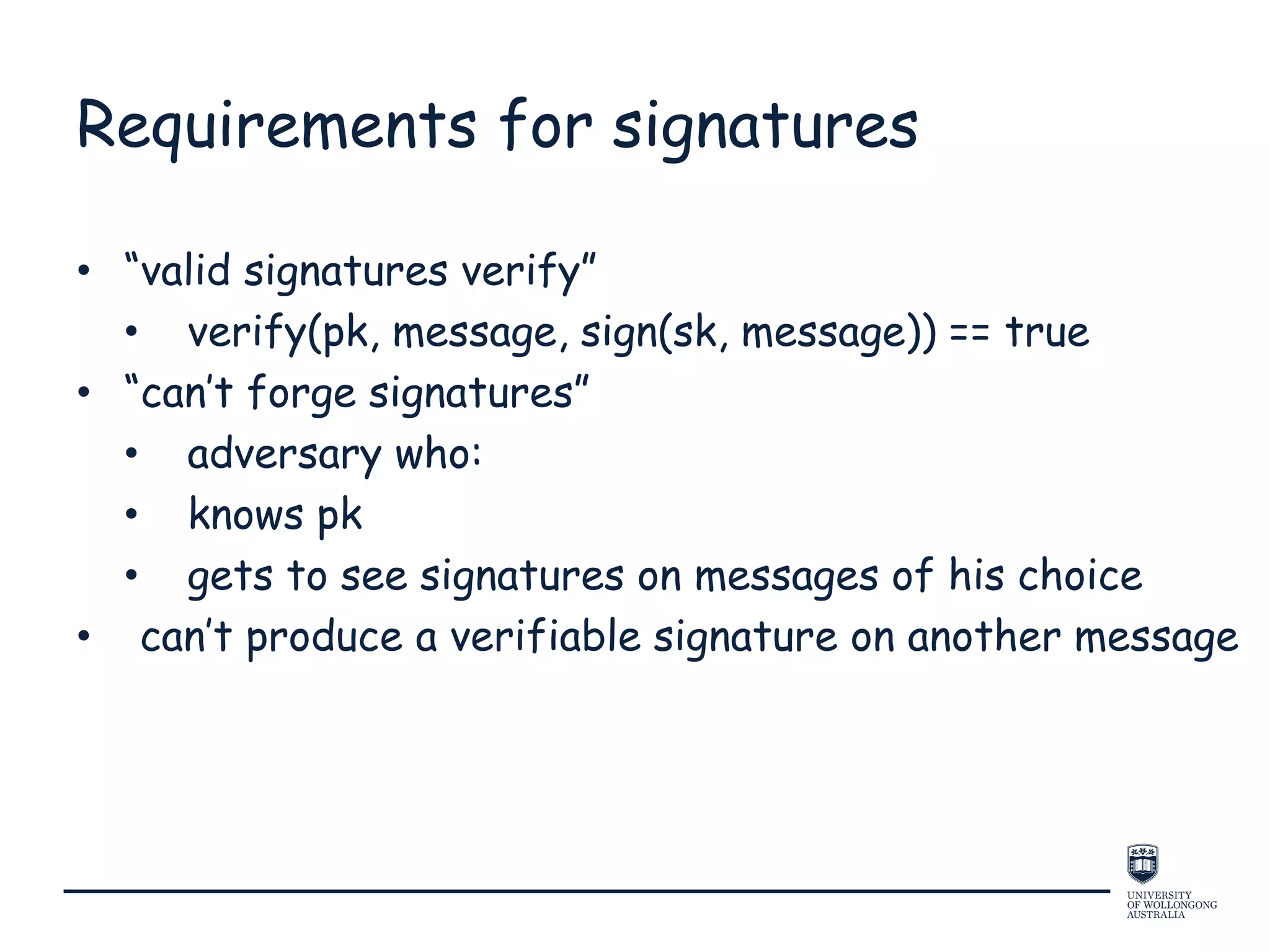
Requirements for signatures
• “valid signatures verify”
• verify(pk, message, sign(sk, message)) == true
• “can’t forge signatures”
• adversary who:
• knows pk
• gets to see signatures on messages of his choice
• can’t produce a verifiable signature on another message
• Bitcoin uses ECDSA standard
• Elliptic Curve Digital Signature Algorithm
• relies on hairy math
• will skip the details here --- look it up
if you care
Incentive 1: block reward
Creator of block gets to
• include special coin-creation transaction in the block
• choose recipient address of this transaction
Value is fixed: currently 12.5 BTC, halves every 4 years
Block creator gets to “collect” the reward only if the
block ends up on long-term consensus branch!
Mechanism: Incentive
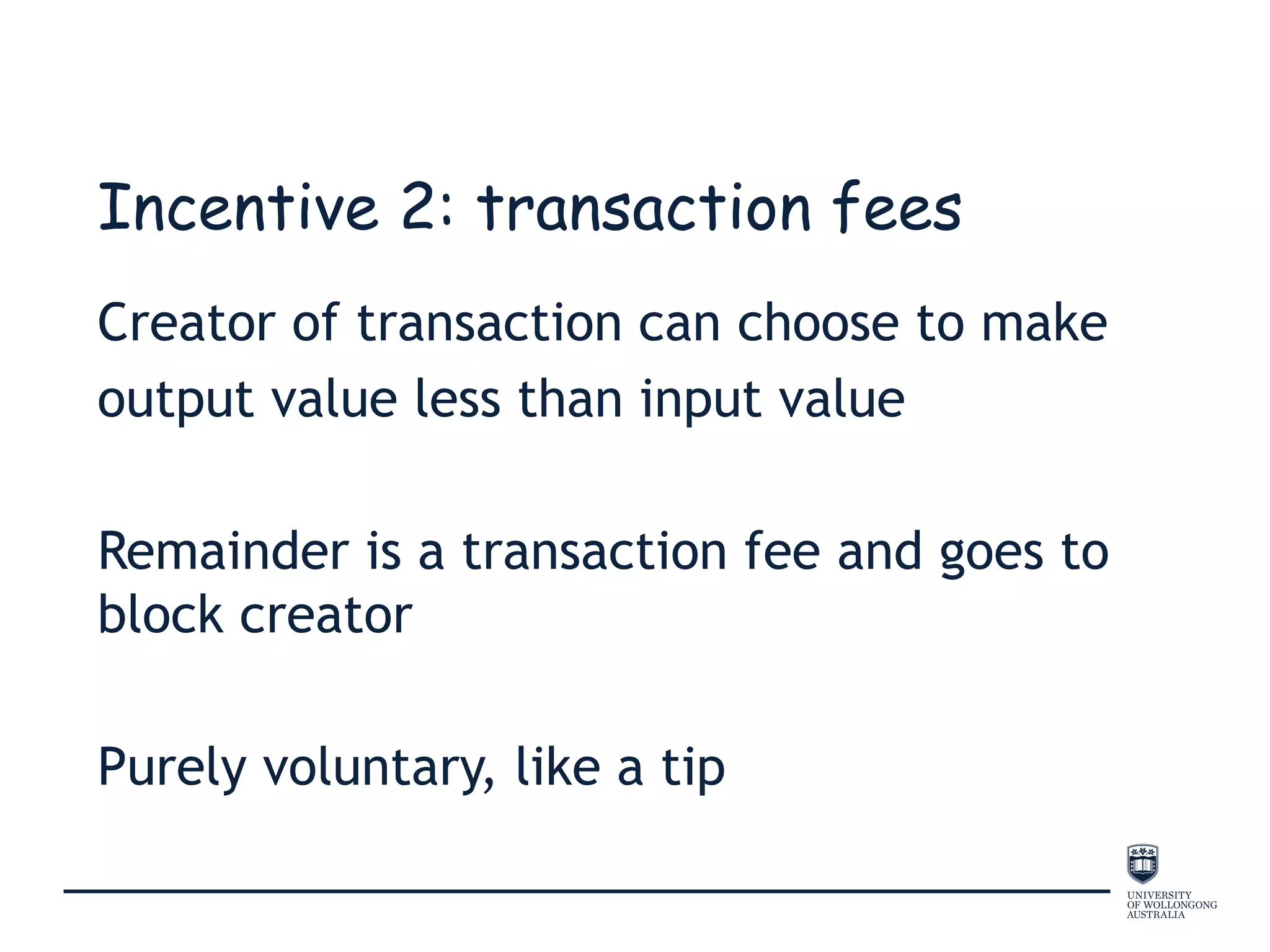
Incentive 2: transaction fees
Creator of transaction can choose to make
output value less than input value
Remainder is a transaction fee and goes to
block creator
Purely voluntary, like a tip
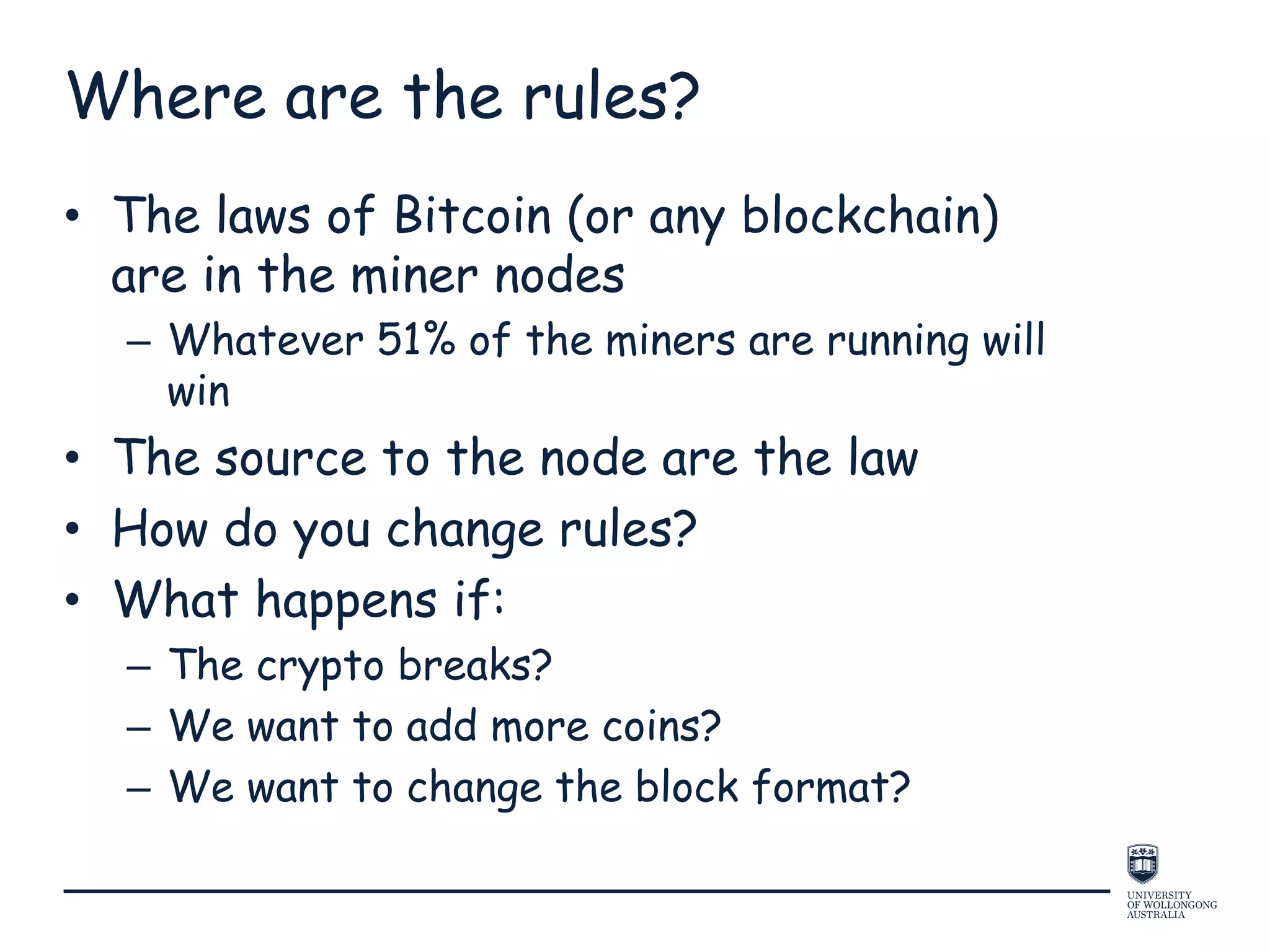
Where are the rules?
• The laws of Bitcoin (or any blockchain)
are in the miner nodes
– Whatever 51% of the miners are running will
win
• The source to the node are the law
• How do you change rules?
• What happens if:
– The crypto breaks?
– We want to add more coins?
– We want to change the block format?
Attacks
• What happens if the majority of
the players defect?
– 51% attacks – can extend bad blocks
• How large a body needs to defect?
– Depending on network, can be 30% or
less
– Sybil attacks
Document title41
3. Blockchain Applications &
Ongoing Research
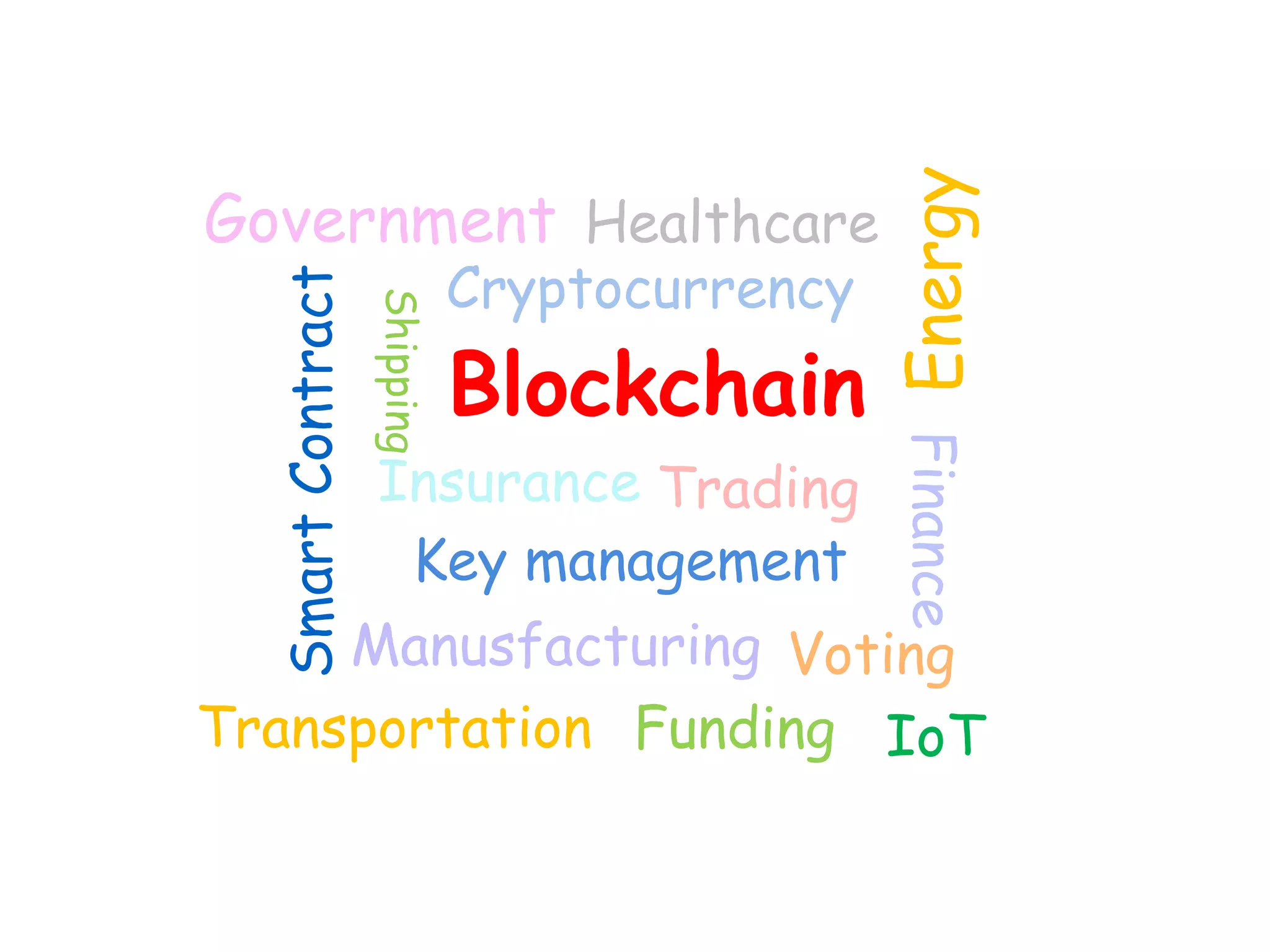
Blockchain
Cryptocurrency
Energy
Shipping
Healthcare
Trading
Voting
Government
Insurance
Finance
Key management
Manusfacturing
SmartContract
IoTTransportation Funding
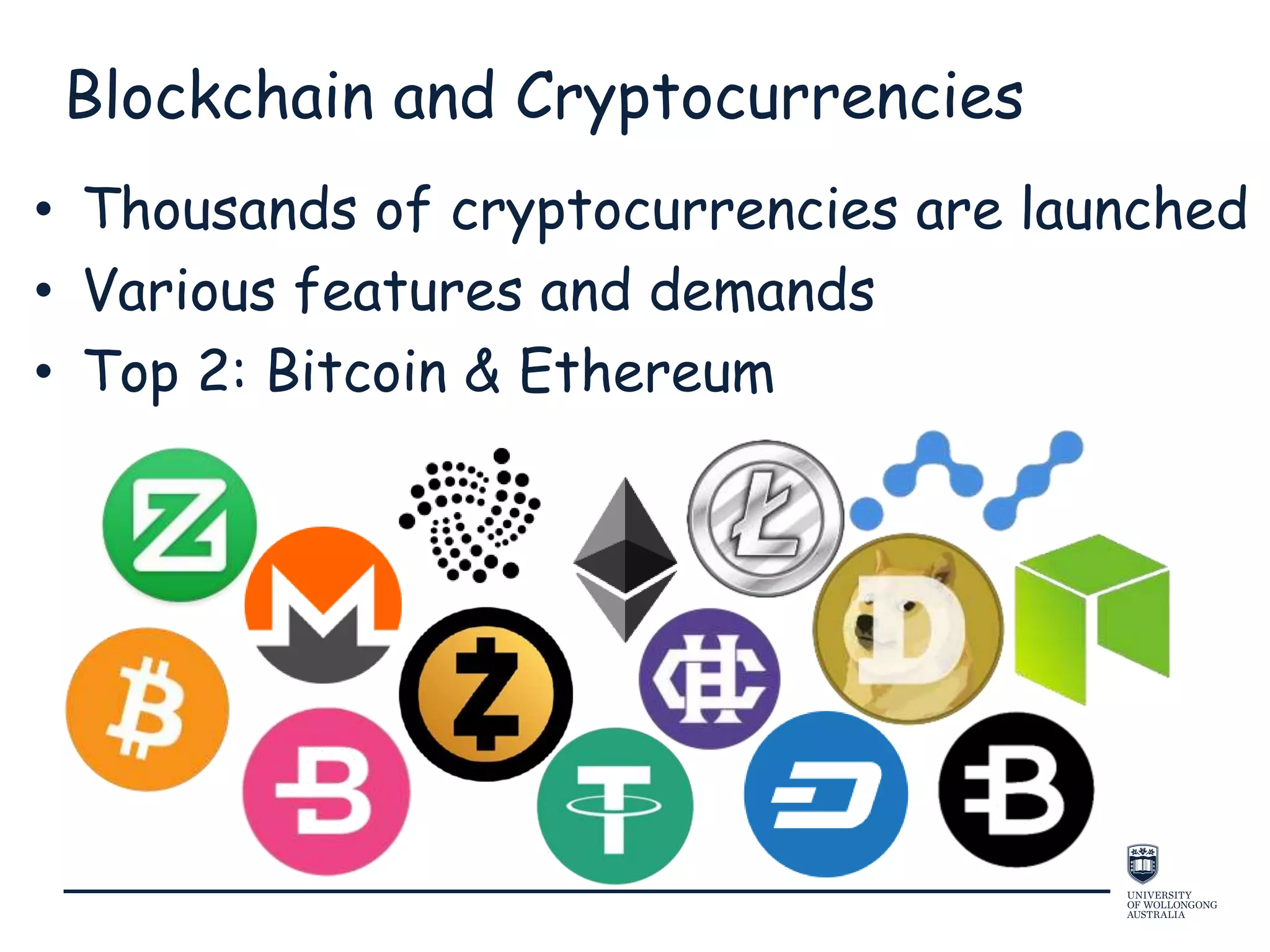
Blockchain and Cryptocurrencies
• Thousands of cryptocurrencies are launched
• Various features and demands
• Top 2: Bitcoin & Ethereum
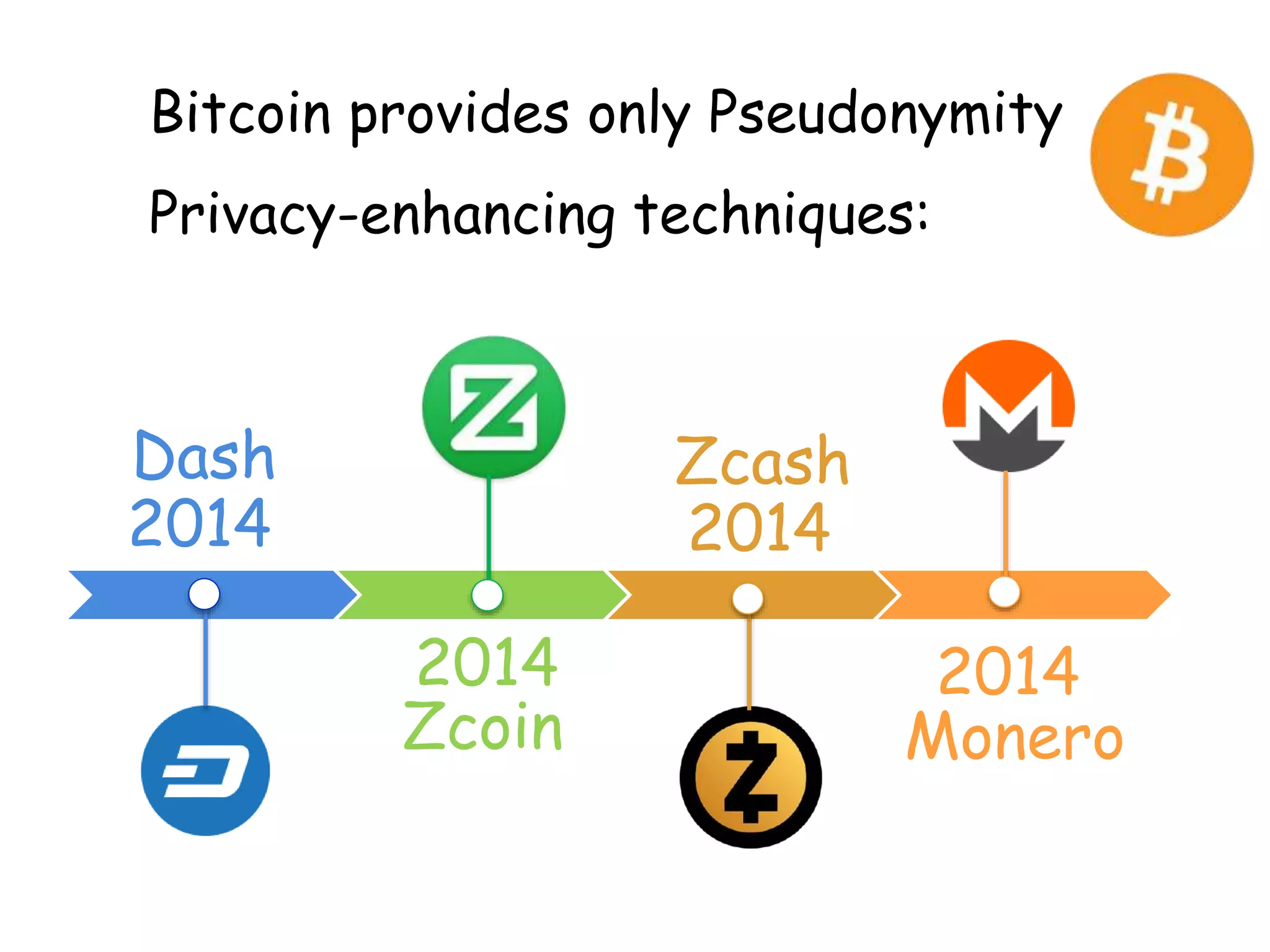
2014
2014
2014
2014
Dash
Zcoin
Zcash
Monero
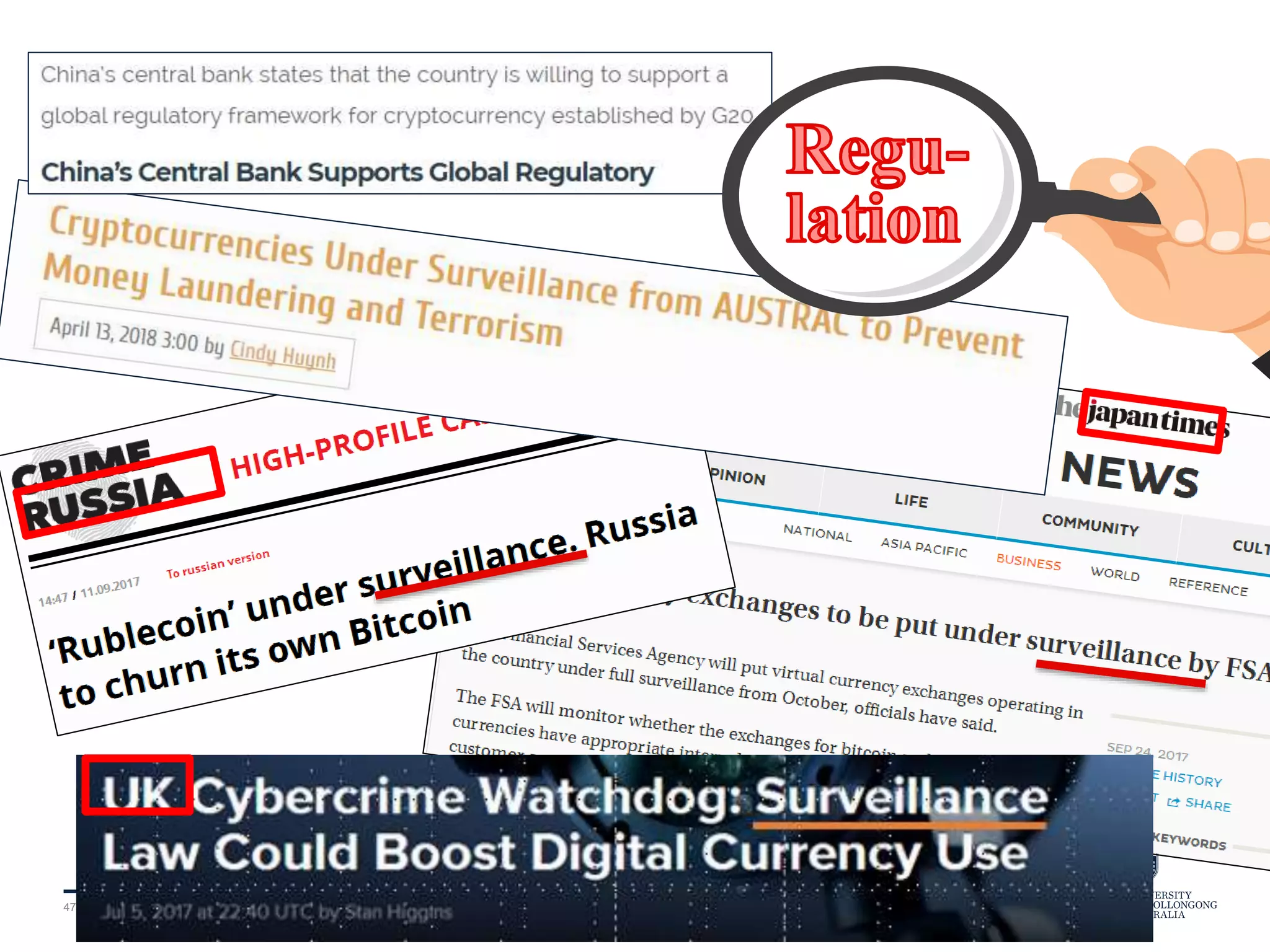
Bitcoin provides only Pseudonymity
Privacy-enhancing techniques:
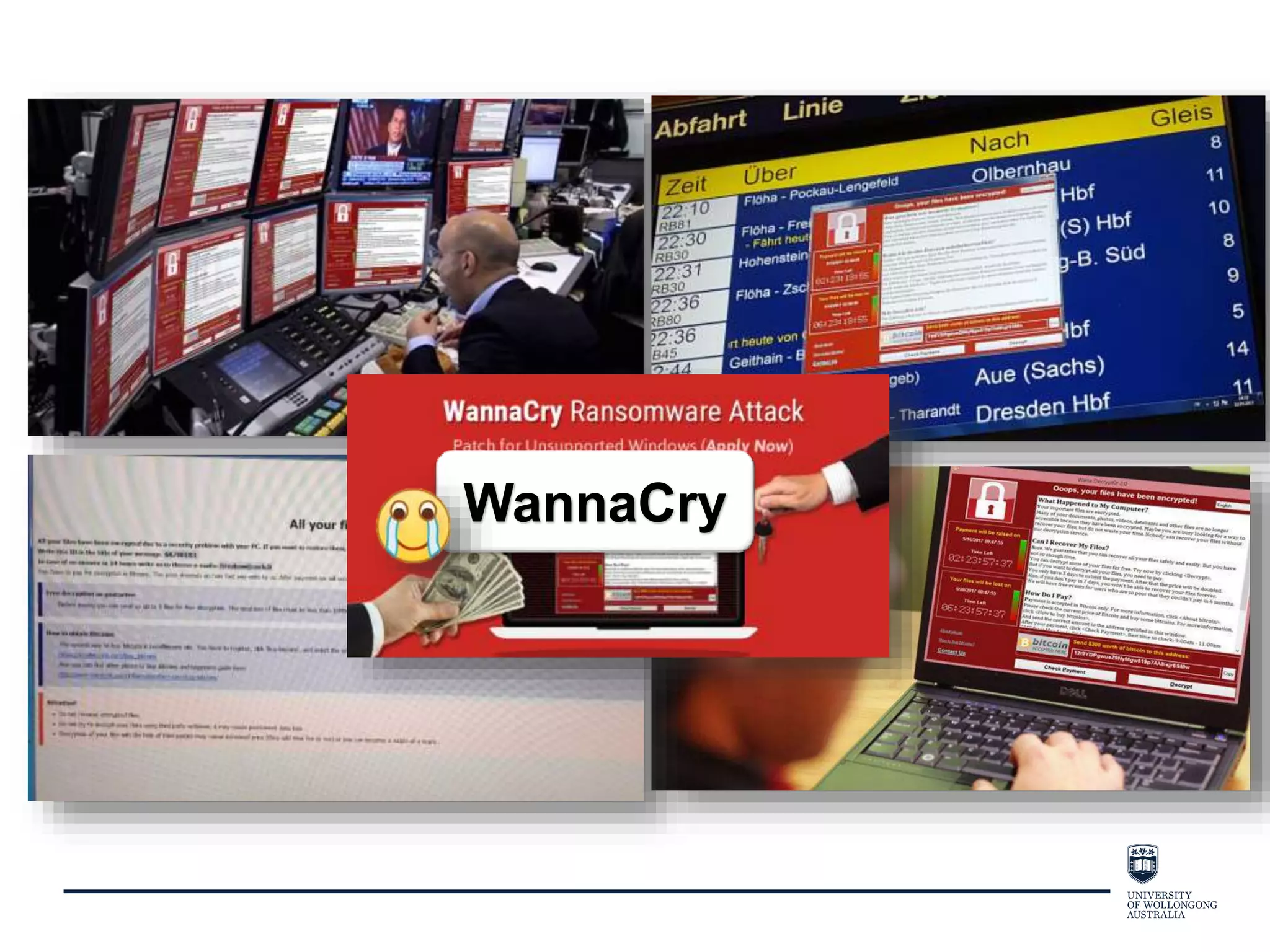
WannaCry
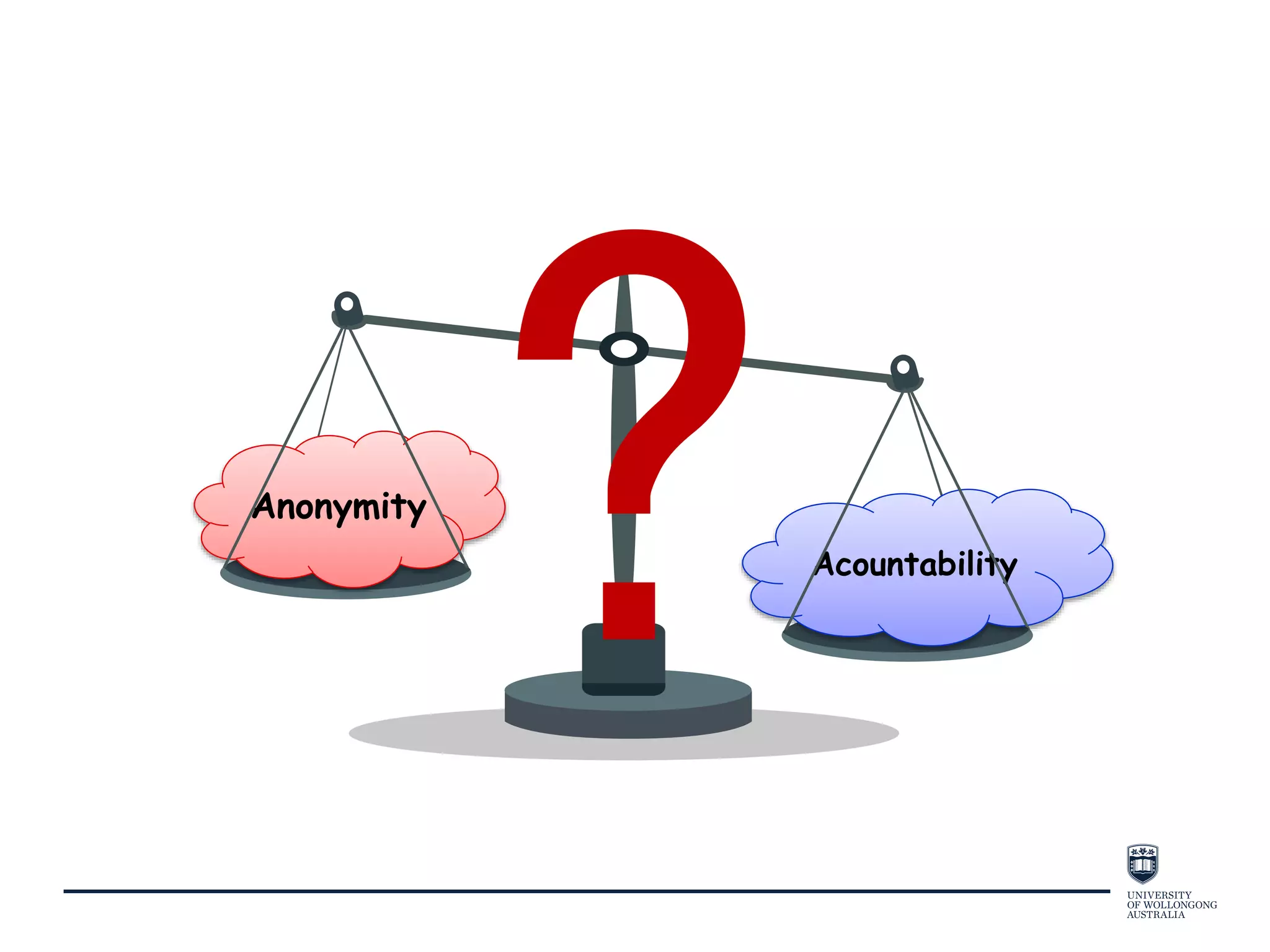
Anonymity
Acountability
47
4848
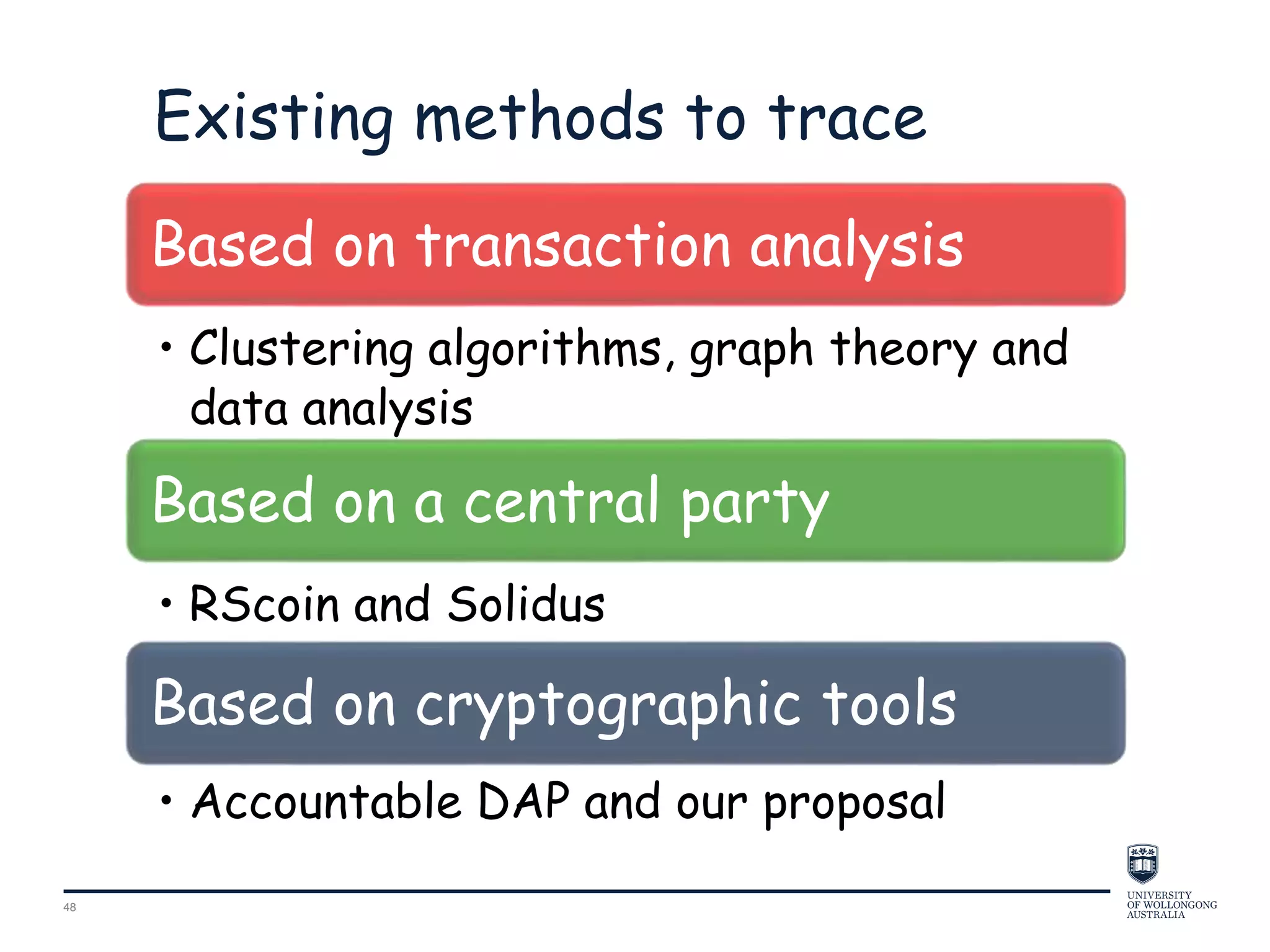
Existing methods to trace
Based on transaction analysis
• Clustering algorithms, graph theory and
data analysis
Based on a central party
• RScoin and Solidus
Based on cryptographic tools
• Accountable DAP and our proposal
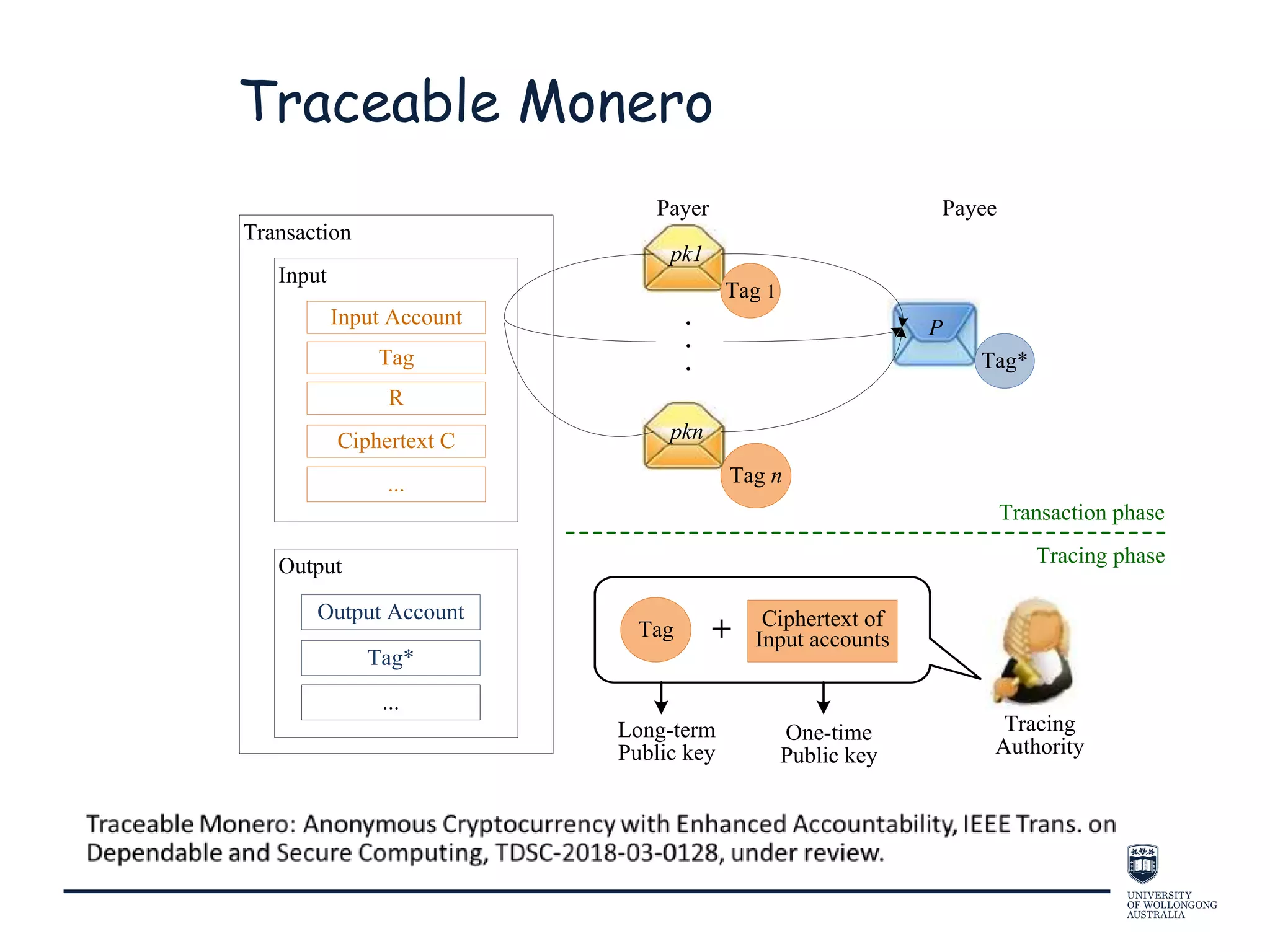
Traceable Monero
Transaction
Input
Output
...
Output Account
Tag
Tag*
Input Account
Payer Payee
pk1
pkn
Tag 1
Tag n
Tag*
.
.
.
R
P
Tracing
Authority
...
Transaction phase
Tracing phase
Tag + Ciphertext of
Input accounts
One-time
Public key
Long-term
Public key
Ciphertext C
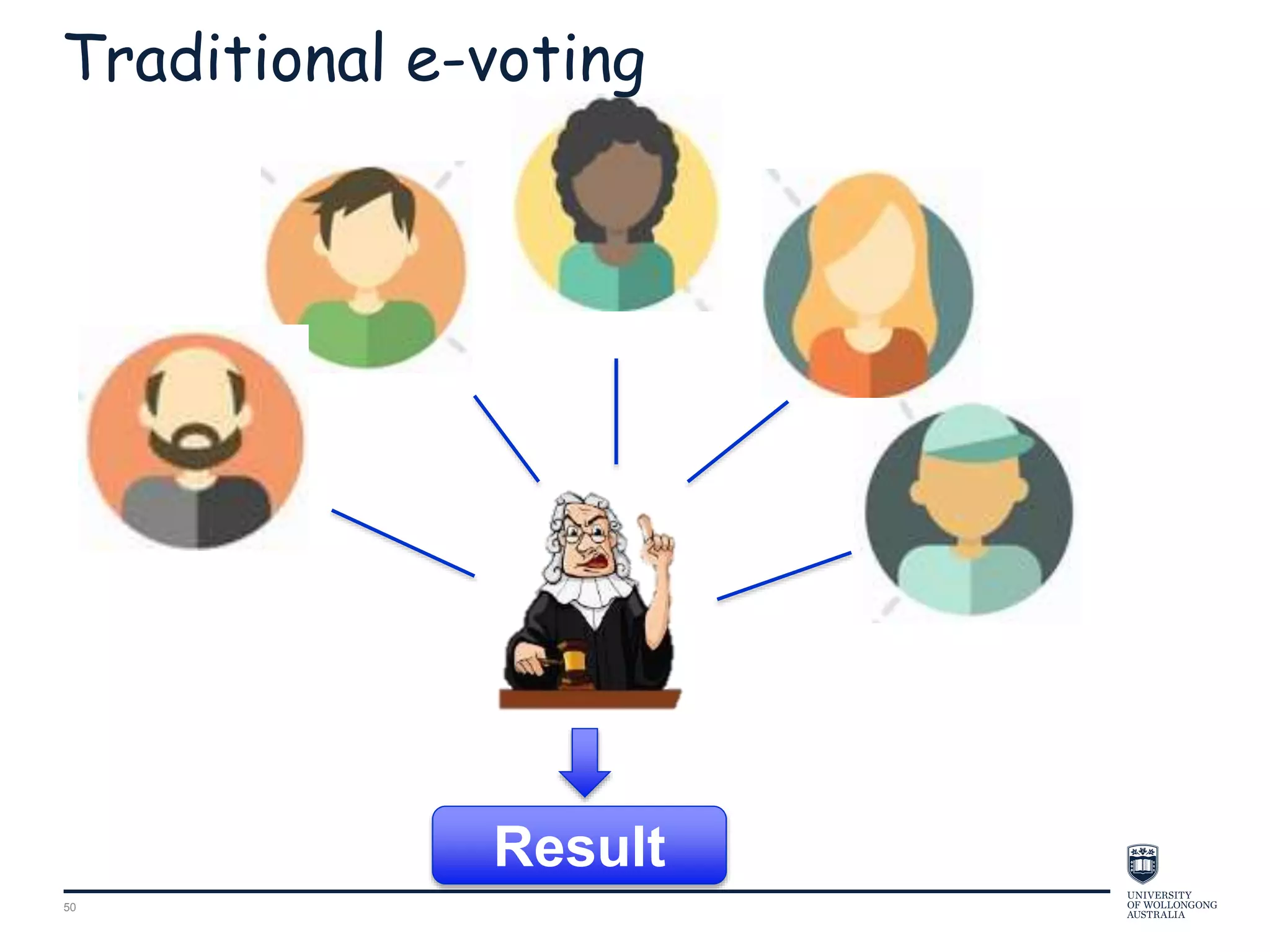
50
Result
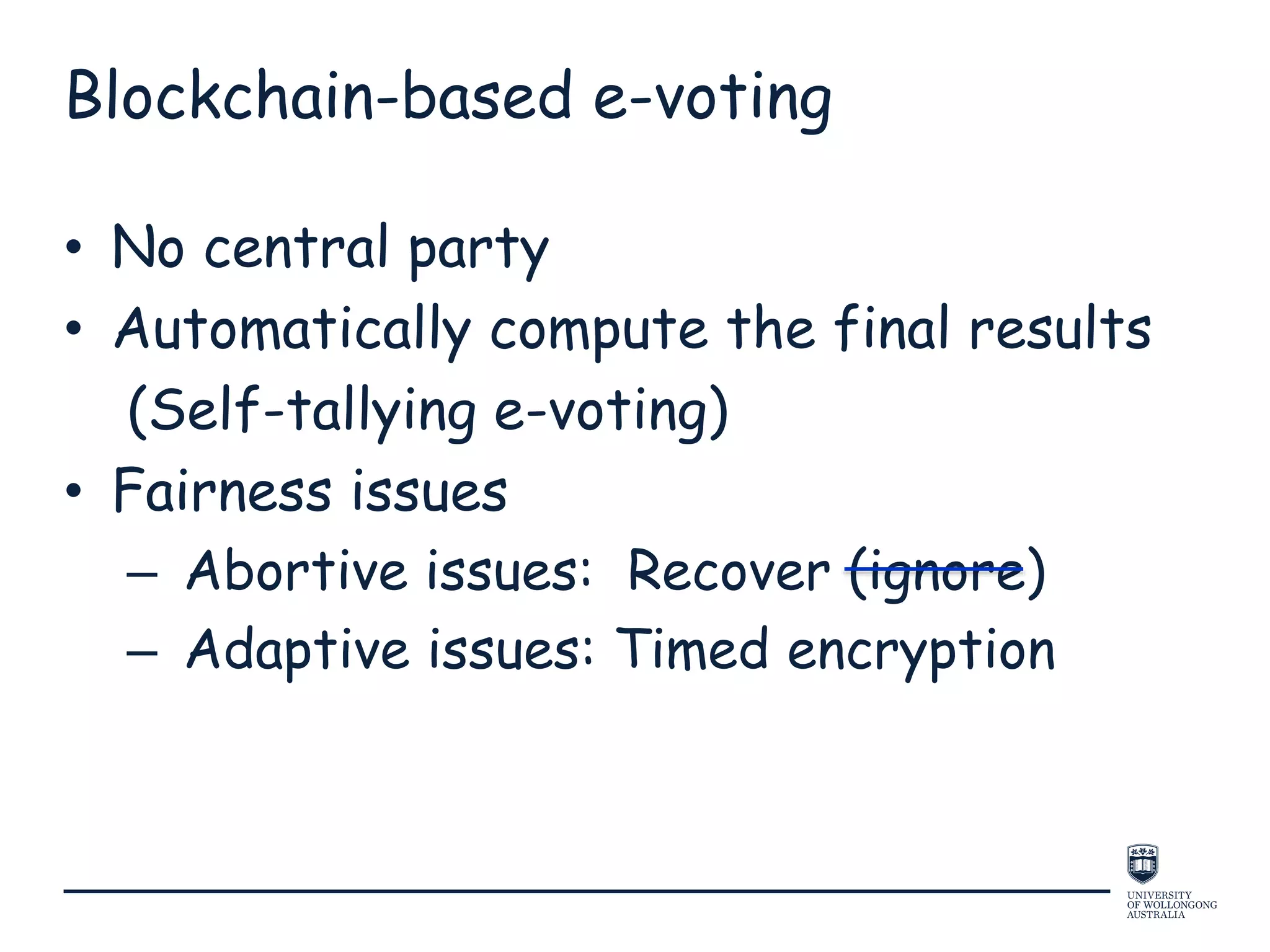
Traditional e-voting
Blockchain-based e-voting
• No central party
• Automatically compute the final results
(Self-tallying e-voting)
• Fairness issues
– Abortive issues: Recover (ignore)
– Adaptive issues: Timed encryption
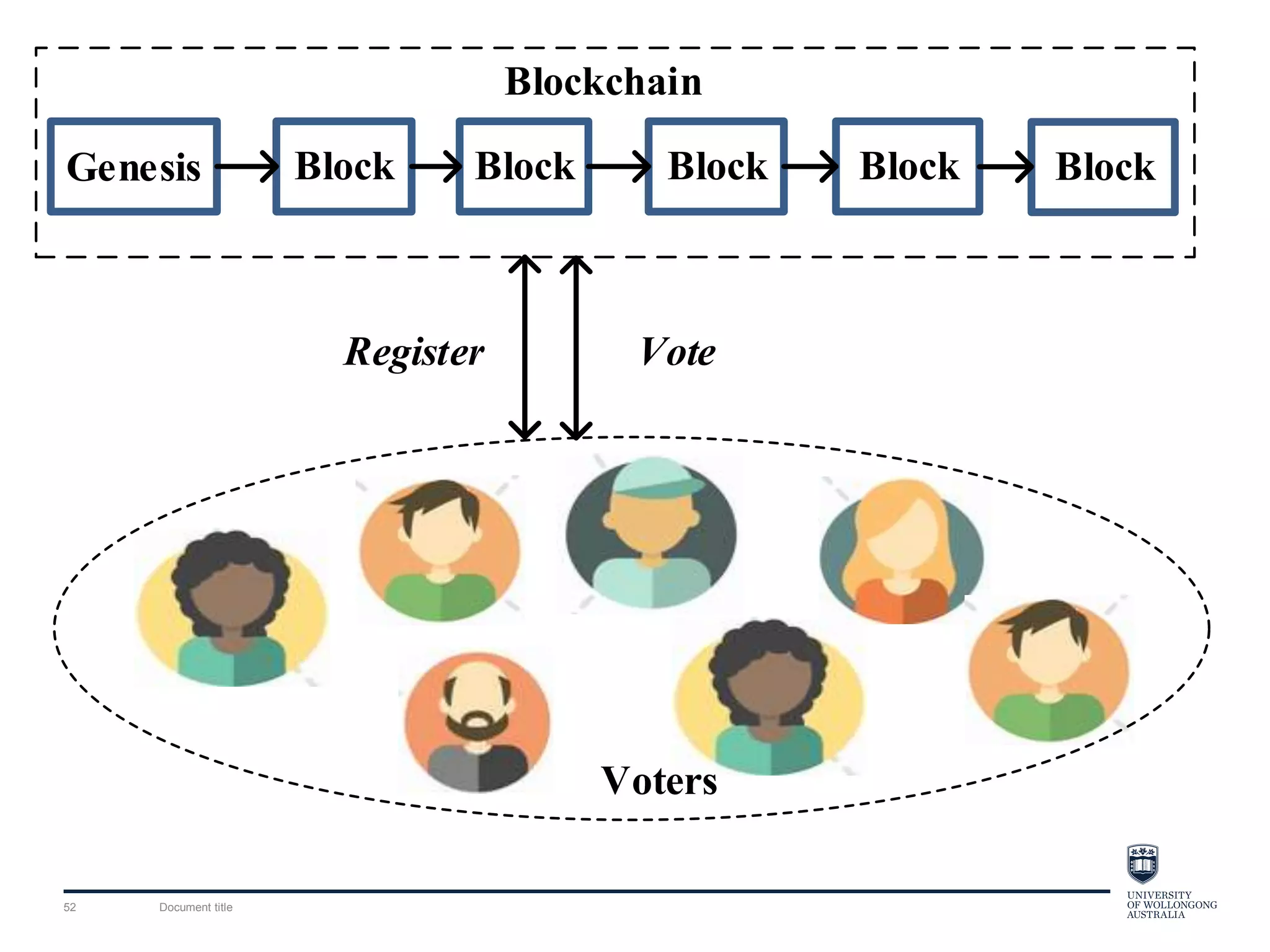
Document title52
Block Block BlockBlockGenesis
Blockchain
Register Vote
Block
Voters
Post-quantum Blockchain
• Making Cryptocurrency post-quantum resistant
• Making Blockchain post-quantum resistant
Document title53
Document title54
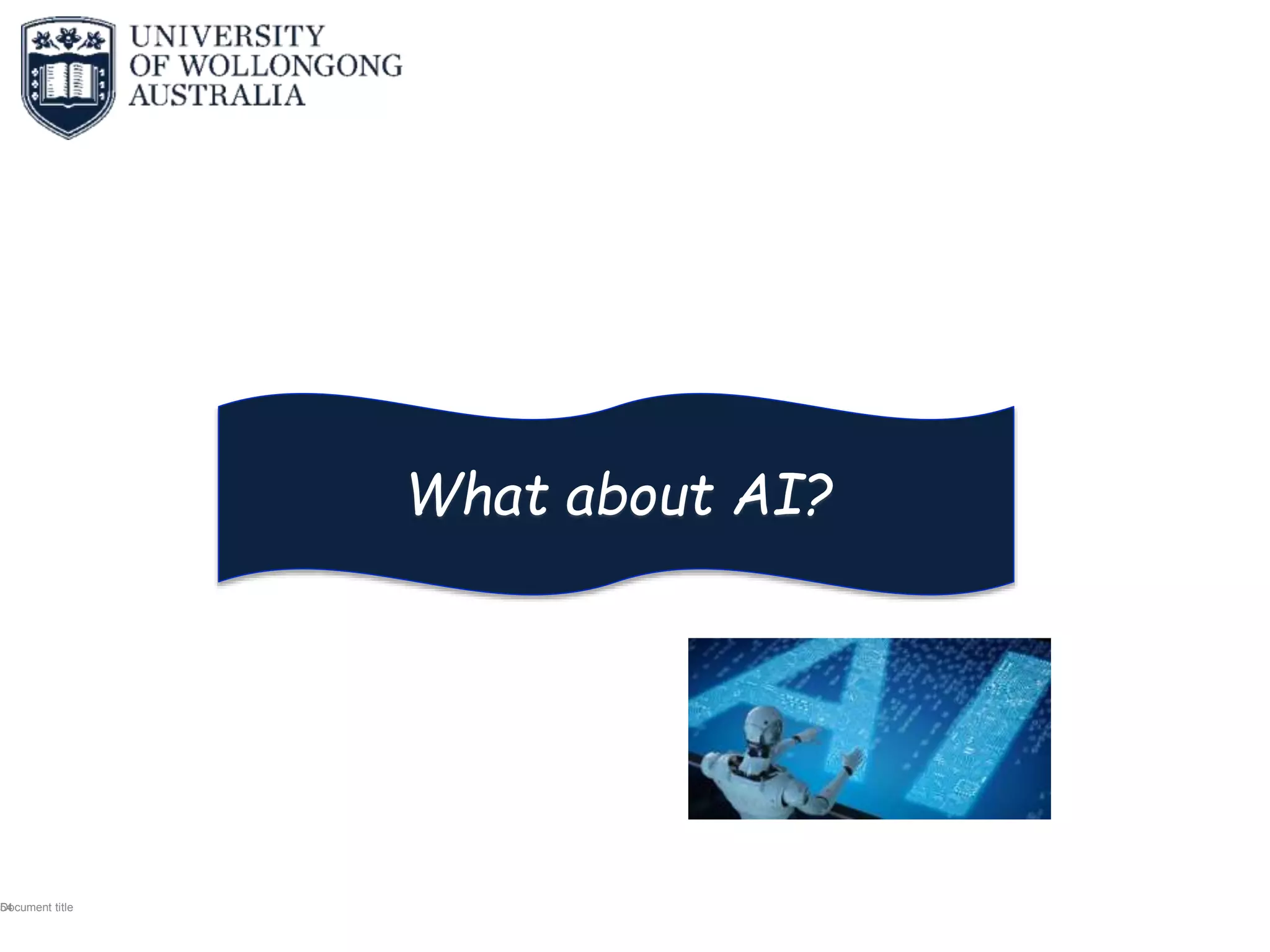
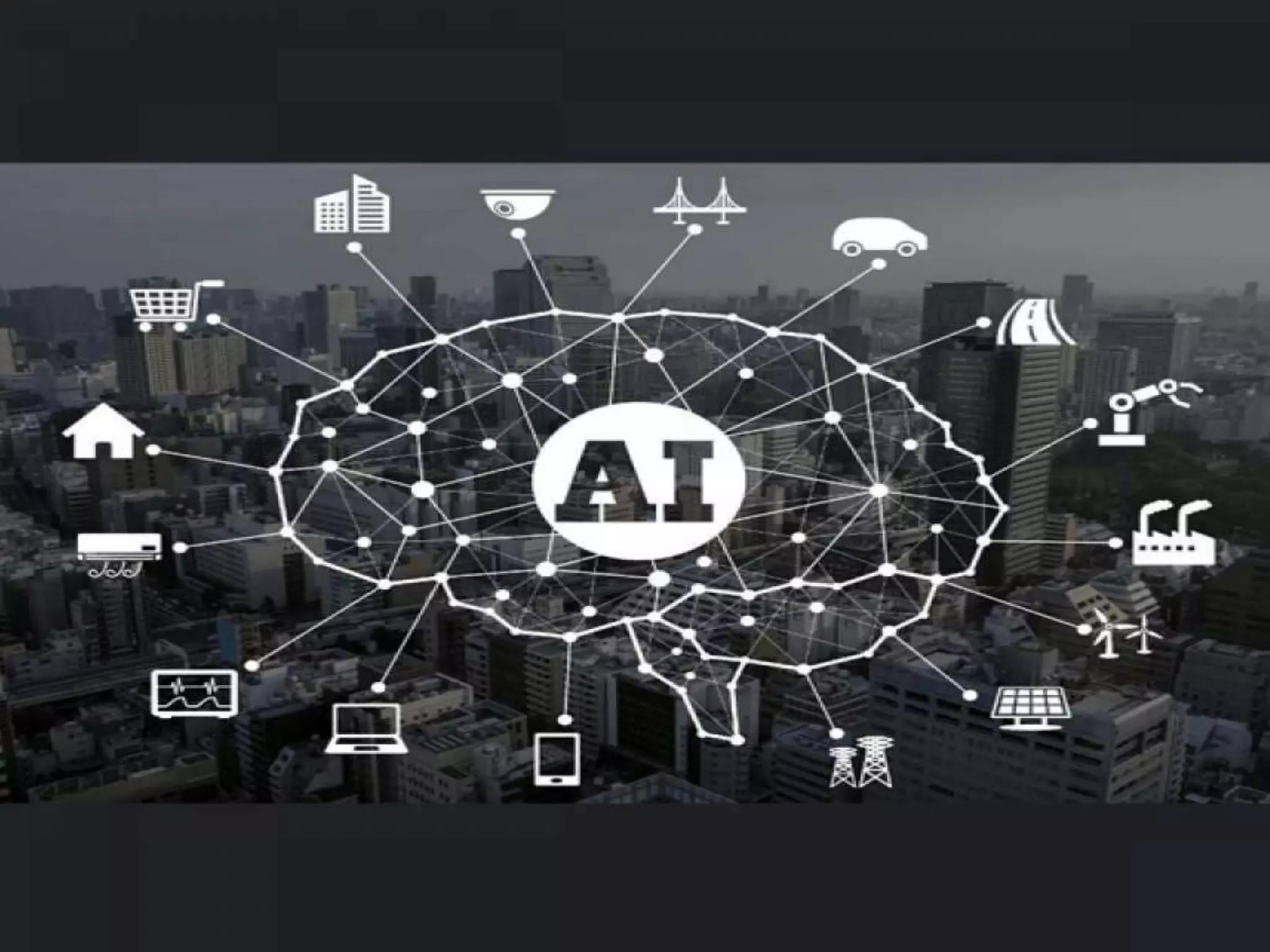
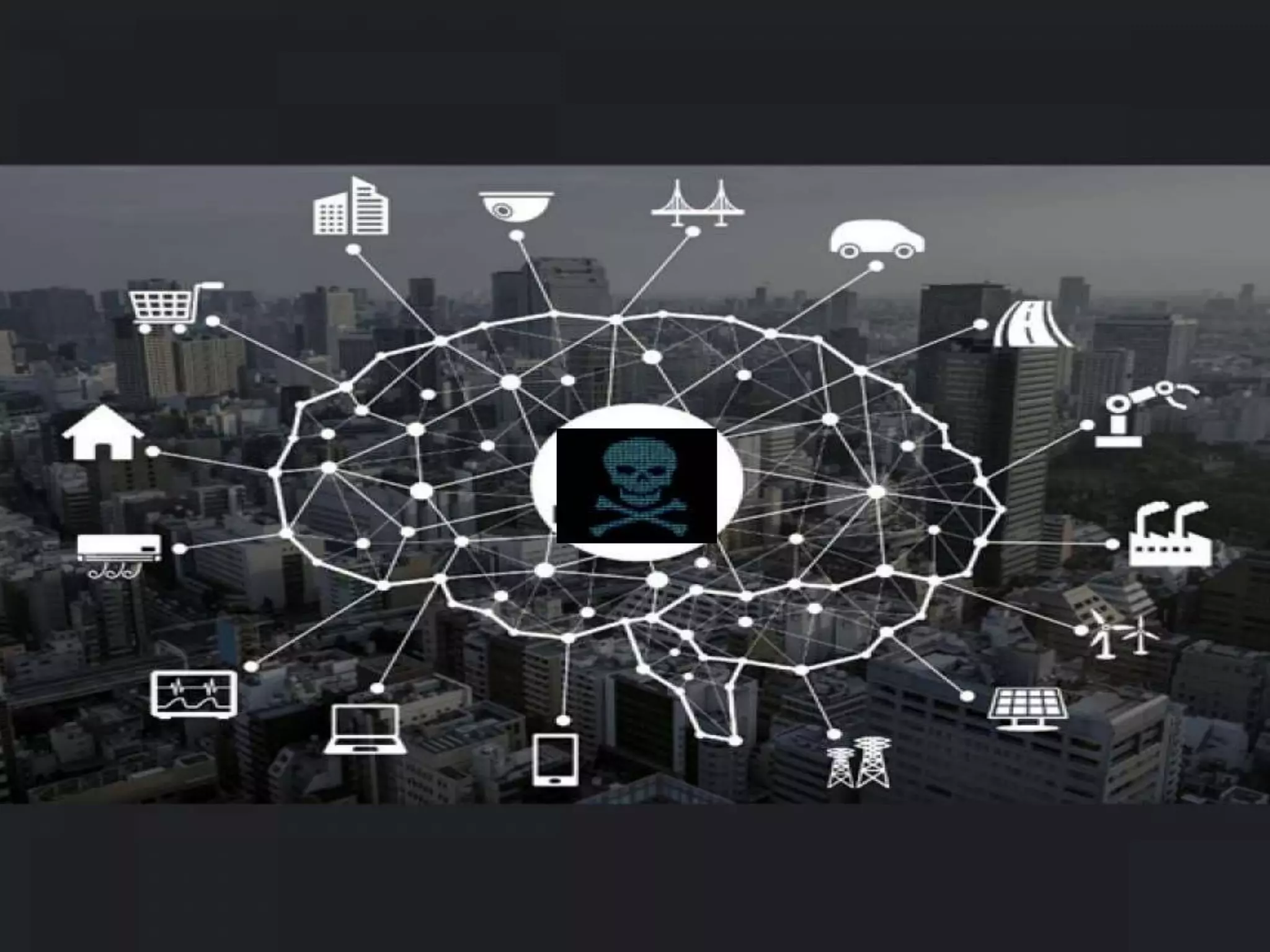
What about AI?
Document title58
4. Blockchain in Practice
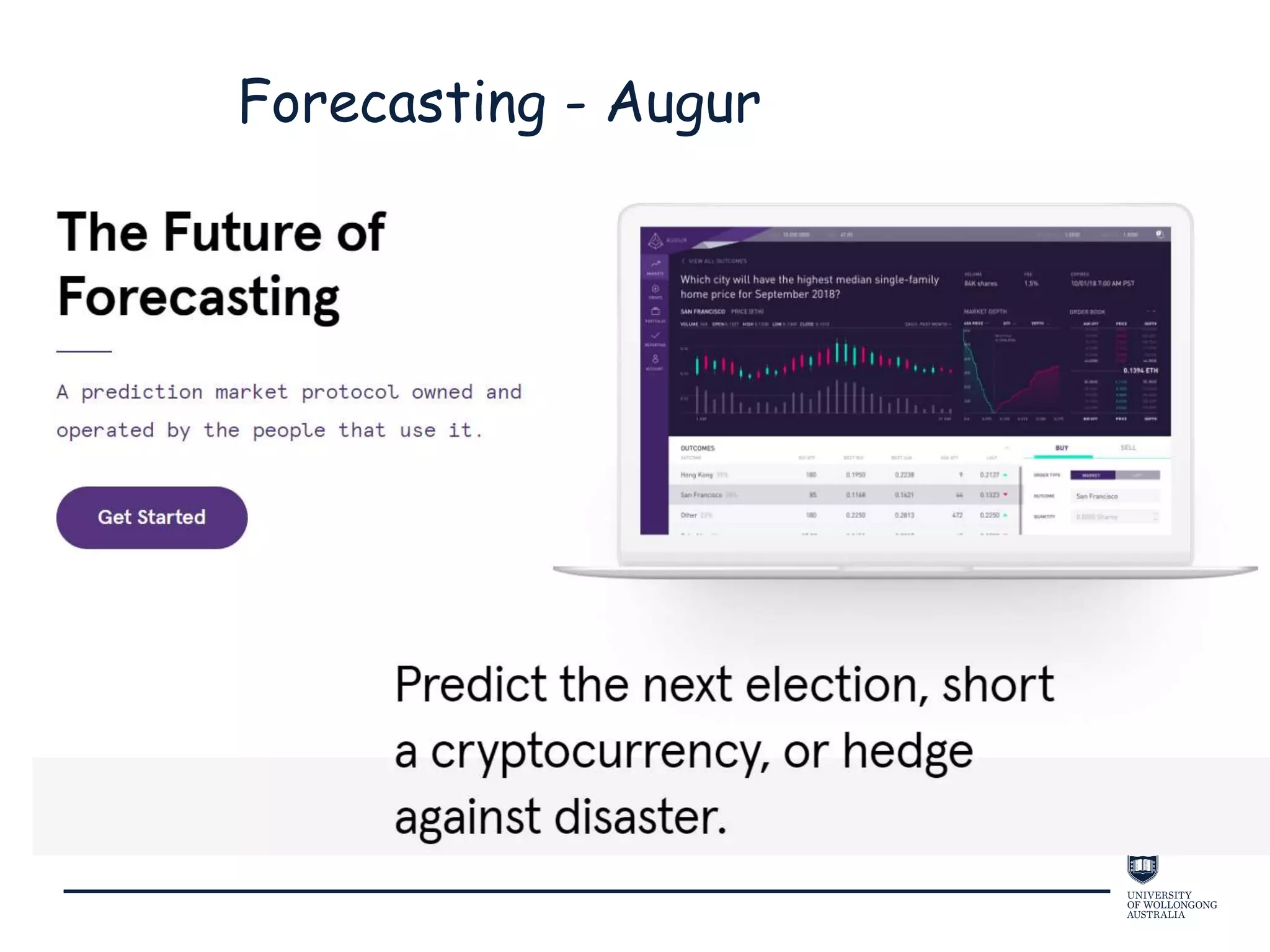
Forecasting - Augur
Healthcare
61
Document title62
What is the next killer
application?
Document title63
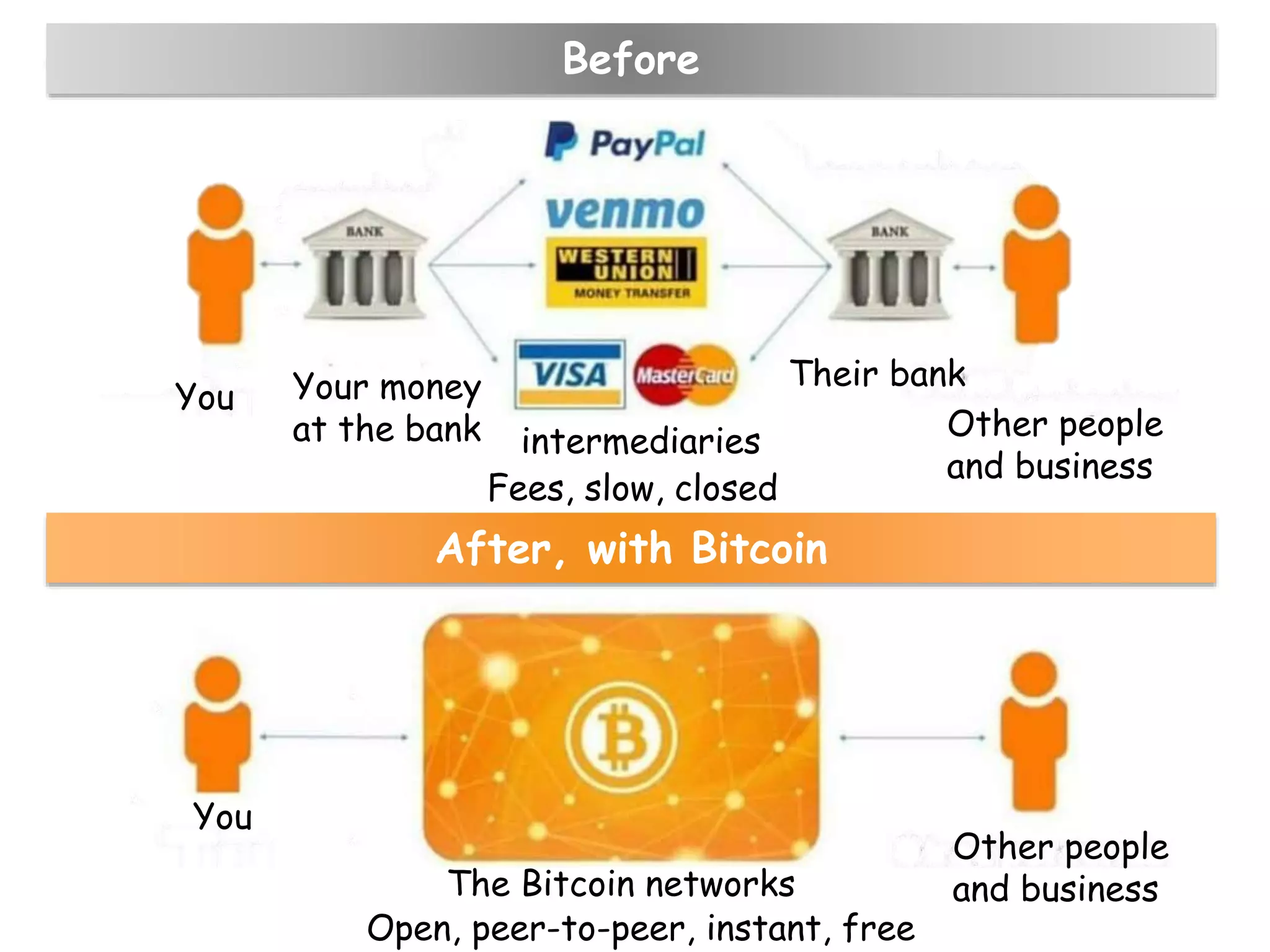
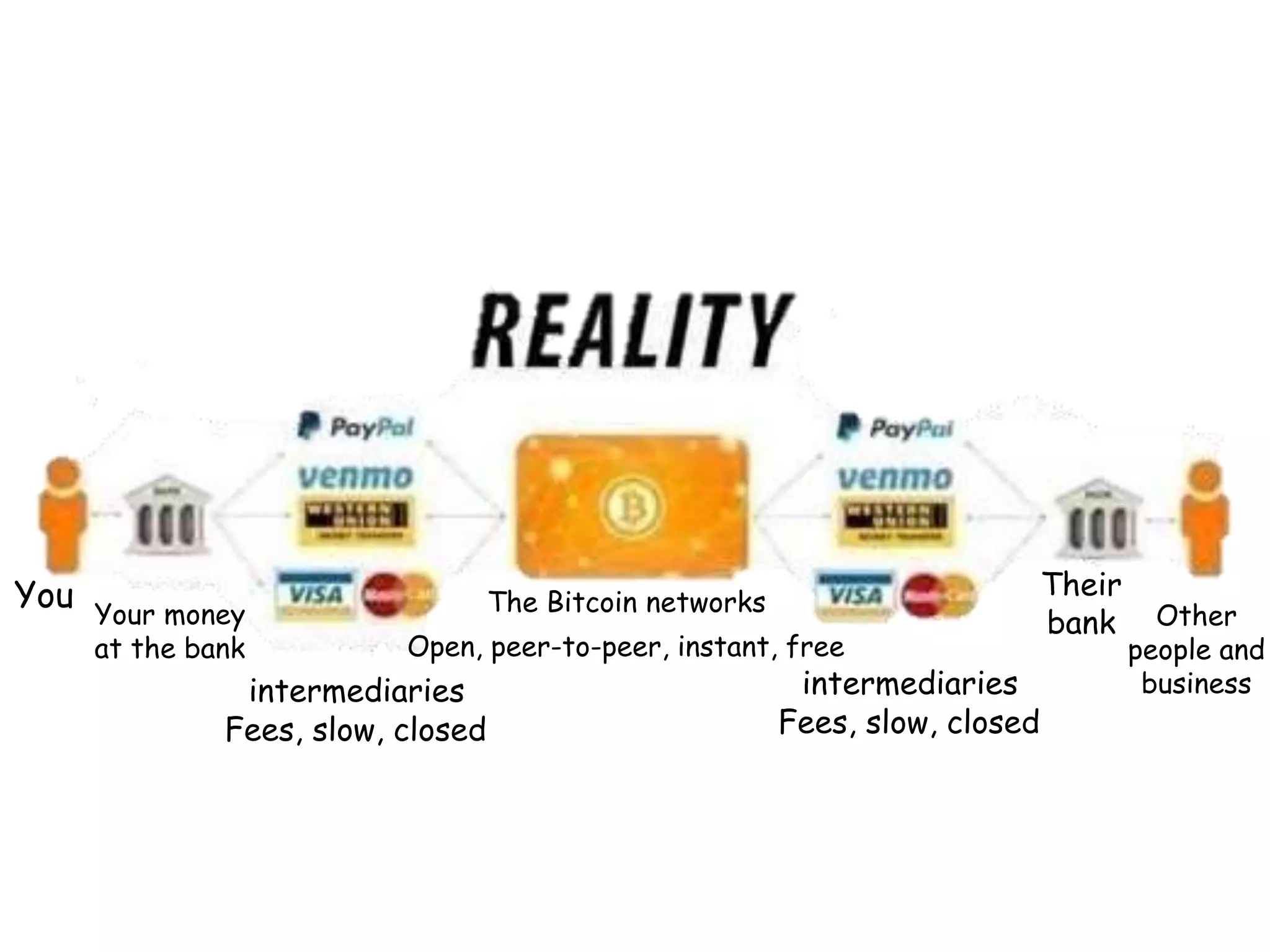
Myth vs Reality
Before
After, with Bitcoin
You Your money
at the bank intermediaries
Fees, slow, closed
Their bank
Other people
and business
You
The Bitcoin networks
Open, peer-to-peer, instant, free
Other people
and business
You Your money
at the bank
intermediaries
Fees, slow, closed
Their
bank Other
people and
business
The Bitcoin networks
Open, peer-to-peer, instant, free
intermediaries
Fees, slow, closed
Document title66
Final question: Centralized
or Decentralized?
Revisiting the design of EOS
Document title67
Thank you
for your attention!

SMART Seminar Series: "Blockchain and its Applications". Presented by Prof Willy Susilo

  • 1.
    Blockchain and its applications WillySusilo Institute of Cybersecurity and Cryptology, School of Computing and IT, UOW wsusilo@uow.edu.au
  • 2.
    Content • Introduction • Toolsand Mechanisms • Blockchain applications • On-going Research Document title2
  • 3.
  • 4.
    Traditional View ofDigital Currency Bank Payer Payee Account Establishment Generate an e-coin Spend an e-coin Deposit an e-coin
  • 5.
    Traditional View ofDigital Currency Bank Payer Payee Account Establishment Generate an e-coin Spend an e-coin Deposit an e-coin Remove the central party
  • 6.
    Bitcoin Nakamoto, Satoshi. "Bitcoin:A peer-to-peer electronic cash system." (2008): 28.
  • 7.
    Bitcoins revisited • Bitcoinis a cryptocurrency, existing purely in the digital realm – first deployed in 2009. • Cryptocurrency: a currency built upon computer science, cryptography and economics. • Born out of the Cypherpunk movement – a libertarian fight for privacy and self-governance. • The inspiration for the invention of the blockchain. • Created by Satoshi Nakamoto (anonymous ID)
  • 8.
    What is Blockchain? •A chain of blocks • Public ledger/database • Records all transactions across P2P network • Shared between participants
  • 9.
    Public Decentr alized Distribu ted Immuta ble Publicly accessable No centralparty Approved by most peers Can not be tampered Main features
  • 10.
    Components Record payer , payee, transaction amounts,etc… Transaction Block Blockchain A chain of blocks A list of transactions
  • 11.
    Components trans: H( ) prev:H( ) trans: H( ) prev: H( ) trans: H( ) prev: H( ) H( ) H( ) H( ) H( ) H( ) H( ) transaction transaction transaction transaction transaction Block Blockchain
  • 12.
  • 13.
  • 15.
    ********* Traditional blockchain protocolswere designed with script language
  • 16.
    Document title16 make aprotocols like this Blockchain 2.0 ---- Ethereum or
  • 17.
  • 18.
    Ingredient #1: Hashes •A hash function (like SHA-256) takes a block of data in, and produces an effectively random fixed size integer. • Any change to the input randomizes it SHA-256 “The quick brown fox did some crypto” 410312395834291203… SHA-256 “The quick brown Fox did some crypto” 983249120432492340…
  • 19.
    Hash property 1:Collision-free • Nobody can find x and y such that • x != y and H(x)=H(y) x y H(x) = H(y)
  • 20.
    • Collisions doexist ... • … but can anyone find them? possible inputs possible outputs
  • 21.
    Hash property 2:Hiding • Hiding property: • If r is chosen from a probability distribution that has high min-entropy, then given H(r | x), it is infeasible to find x. • High min-entropy means that the distribution is “very spread out”, so that no particular value is chosen with more than negligible probability.
  • 22.
    Hash property 3:Puzzle-friendly • Puzzle-friendly: • For every possible output value y, • if k is chosen from a distribution with high min-entropy, • then it is infeasible to find x such that H(k | x) = y.
  • 23.
    Application: Search puzzle •Given a “puzzle ID” id (from high min-entropy distrib.), • and a target set Y: • Try to find a “solution” x such that • H(id | x) ∈ Y. • Puzzle-friendly property implies that no solving strategy is much better than trying random values of x.
  • 24.
    SHA-256 hash function 256bits 256 bits 512 bits Theorem: If c is collision-free, then SHA-256 is collision-free. Padding (10* | length) IV Message (block 1) Message (block 2) Message (block n) Hash c c c
  • 25.
    Consensus--Hash-based Proof ofWork • To find a hash with N zeros at the start of the input, requires 2N computations…proves computational work • If we hash an incrementing “nonce” as the hash input, we can go looking for zeros: in 3e-05 seconds, nonce = 0 yielded 0 zeros. value = 4c8f1205f49e70248939df9c7b704ace62c2245aba9e81641edf… in 0.000138 seconds, nonce = 12 yielded 1 zeros. value = 05017256be77ad2985b36e75e486af325a620a9f29c54… in 0.000482 seconds, nonce = 112 yielded 2 zeros. value = 00ae7e0956382f55567d0ed9311cfd41dd2cf5f0a7137… in 0.014505 seconds, nonce = 3728 yielded 3 zeros. value = 000b5a6cfc0f076cd81ed3a60682063887cf055e47b… in 0.595024 seconds, nonce = 181747 yielded 4 zeros. value = 0000af058b74703b55e27437b89b1ebcc46f45ce55d6…. in 3.491151 seconds, nonce = 1037701 yielded 5 zeros. value = 00000e55bd0d2027f3024c378e0cc511548c94fbeed0e…. in 32.006105 seconds, nonce = 9913520 yielded 6 zeros. value = 00000077a77854ee39dc0dc996dea72dad8852afbde6….
  • 26.
    PoW property 1:difficult to compute ~about 1020 hashes/block Only some nodes bother to compete — miners
  • 27.
    PoW property 2:parameterizable cost Nodes automatically re-calculate the target every two weeks Goal: average time between blocks = 10 minutes Prob (Alice wins next block) = fraction of global hash power she controls
  • 28.
    Key security assumption Attacksinfeasible if majority of miners weighted by hash power follow the protocol
  • 29.
    PoW property 3:trivial to verify Nonce must be published as part of block Other miners simply verify that H(nonce ‖ prev_hash ‖ tx ‖ … ‖ tx) < target
  • 30.
    Block #0 Winner nobody Parent_hash0 Nonce 0 Block #1 Winner Player 23 Parent_hash 000D45698 Nonce 3459 SHA-256 Block #2 Winner Player 16 Parent_hash 000F67839 Nonce 974329 SHA-256
  • 31.
    The Nonce /Hash Loop • The algorithm to make a new block: 1. Verify the hashes of all the previous blocks 2. Build a new block with a random nonce 3. Hash the new block. Does it have N zeros? – No? Go back to Step 2 – Yes? Send your new block to everyone! • Note that as a result of step #1, you can find out how many points anyone has by counting how many blocks they have won
  • 32.
    Ingredient #2: Signatures Signingkey Public part 454F4D3E1.. Private part 56F23F2D.. Data Signing Algorithm Signature Private part Signature Verification Algorithm Yes/No Public part Data
  • 33.
    What we wantfrom signatures • Only you can sign, but anyone can verify • Signature is tied to a particular document • can’t be cut-and-pasted to another doc
  • 34.
    API for digitalsignatures • (sk, pk) := generateKeys(keysize) • sk: secret signing key • pk: public verification key • sig := sign(sk, message) • isValid := verify(pk, message, sig) can be randomized algorithms
  • 35.
    Requirements for signatures •“valid signatures verify” • verify(pk, message, sign(sk, message)) == true • “can’t forge signatures” • adversary who: • knows pk • gets to see signatures on messages of his choice • can’t produce a verifiable signature on another message
  • 36.
    • Bitcoin usesECDSA standard • Elliptic Curve Digital Signature Algorithm • relies on hairy math • will skip the details here --- look it up if you care
  • 37.
    Incentive 1: blockreward Creator of block gets to • include special coin-creation transaction in the block • choose recipient address of this transaction Value is fixed: currently 12.5 BTC, halves every 4 years Block creator gets to “collect” the reward only if the block ends up on long-term consensus branch! Mechanism: Incentive
  • 38.
    Incentive 2: transactionfees Creator of transaction can choose to make output value less than input value Remainder is a transaction fee and goes to block creator Purely voluntary, like a tip
  • 39.
    Where are therules? • The laws of Bitcoin (or any blockchain) are in the miner nodes – Whatever 51% of the miners are running will win • The source to the node are the law • How do you change rules? • What happens if: – The crypto breaks? – We want to add more coins? – We want to change the block format?
  • 40.
    Attacks • What happensif the majority of the players defect? – 51% attacks – can extend bad blocks • How large a body needs to defect? – Depending on network, can be 30% or less – Sybil attacks
  • 41.
    Document title41 3. BlockchainApplications & Ongoing Research
  • 42.
  • 43.
    Blockchain and Cryptocurrencies •Thousands of cryptocurrencies are launched • Various features and demands • Top 2: Bitcoin & Ethereum
  • 44.
  • 45.
  • 46.
  • 47.
  • 48.
    4848 Existing methods totrace Based on transaction analysis • Clustering algorithms, graph theory and data analysis Based on a central party • RScoin and Solidus Based on cryptographic tools • Accountable DAP and our proposal
  • 49.
    Traceable Monero Transaction Input Output ... Output Account Tag Tag* InputAccount Payer Payee pk1 pkn Tag 1 Tag n Tag* . . . R P Tracing Authority ... Transaction phase Tracing phase Tag + Ciphertext of Input accounts One-time Public key Long-term Public key Ciphertext C
  • 50.
  • 51.
    Blockchain-based e-voting • Nocentral party • Automatically compute the final results (Self-tallying e-voting) • Fairness issues – Abortive issues: Recover (ignore) – Adaptive issues: Timed encryption
  • 52.
    Document title52 Block BlockBlockBlockGenesis Blockchain Register Vote Block Voters
  • 53.
    Post-quantum Blockchain • MakingCryptocurrency post-quantum resistant • Making Blockchain post-quantum resistant Document title53
  • 54.
  • 58.
  • 59.
  • 60.
  • 61.
  • 62.
    Document title62 What isthe next killer application?
  • 63.
  • 64.
    Before After, with Bitcoin YouYour money at the bank intermediaries Fees, slow, closed Their bank Other people and business You The Bitcoin networks Open, peer-to-peer, instant, free Other people and business
  • 65.
    You Your money atthe bank intermediaries Fees, slow, closed Their bank Other people and business The Bitcoin networks Open, peer-to-peer, instant, free intermediaries Fees, slow, closed
  • 66.
    Document title66 Final question:Centralized or Decentralized? Revisiting the design of EOS
  • 67.