
1
Smart Factory
Responsive, adaptive, connected manufacturing
2
Smart Factory Overview
3
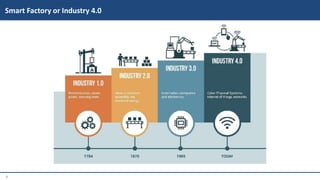
Smart Factory or Industry 4.0
4
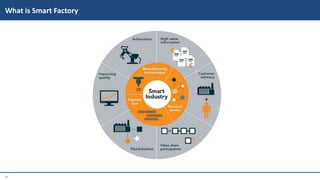
What is Smart Factory
5
 The smart factory represents a leap forward from more traditional automation to a fully connected and flexible system—one that can
use a constant stream of data from connected operations and production systems to learn and adapt to new demands.
 The smart factory is a flexible system that can self-optimize performance across a broader network, self-adapt to and learn from new
conditions in real or near-real time, and autonomously run entire production processes.
 Industry 4.0 is a name for the current trend of automation and data exchange in manufacturing technologies. It includes cyber-
physical systems, the Internet of things, cloud computing and cognitive computing. Industry 4.0 is commonly referred to as the fourth
industrial revolution.
 Industry 4.0 creates what has been called a "smart factory". Within the modular structured smart factories, cyber-physical systems
monitor physical processes, create a virtual copy of the physical world and make decentralized decisions.
 Over the Internet of Things, cyber-physical systems communicate and cooperate with each other and with humans in real time, and
via cloud computing, both internal and cross-organizational services are offered and used by participants of the value chain.
What is Smart Factory
6
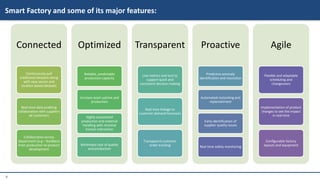
Connected
Continuously pull
traditional datasets along
with new sensor and
location based datasets
Real-time data enabling
collaboration with suppliers
ad customers
Collaboration across
department (e.g – feedback
from production to product
development
Optimized
Reliable, predictable
production capacity
Increase asset uptime and
production
Highly automated
production and material
handling with minimal
human interaction
Minimized cost of quality
and production
Transparent
Live metrics and tool to
support quick and
consistent decision making
Real time linkage to
customer demand forecasts
Transparent customer
order tracking
Proactive
Predictive anomaly
identification and resolution
Automated restocking and
replenishment
Early identification of
supplier quality issues
Real time safety monitoring
Agile
Flexible and adaptable
scheduling and
changeovers
Implementation of product
changes to see the impact
in real time
Configurable factory
layouts and equipment
Smart Factory and some of its major features:
7
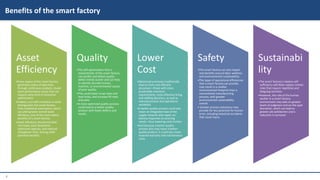
Asset
Efficiency
•Every aspect of the smart factory
generates reams of data that,
through continuous analysis, reveal
asset performance issues that can
require some kind of corrective
optimization.
•Indeed, such self-correction is what
distinguishes the smart factory
from traditional automation, which
can yield greater overall asset
efficiency, one of the most salient
benefits of a smart factory.
•Asset efficiency should translate
into lower asset downtime,
optimized capacity, and reduced
changeover time, among other
potential benefits.
Quality
•The self-optimization that is
characteristic of the smart factory
can predict and detect quality
defect trends sooner and can help
to identify discrete human,
machine, or environmental causes
of poor quality.
•This could lower scrap rates and
lead times, and increase fill rates
and yield.
•A more optimized quality process
could lead to a better-quality
product with fewer defects and
recalls.
Lower
Cost
•Optimized processes traditionally
lead to more cost-efficient
processes—those with more
predictable inventory
requirements, more effective hiring
and staffing decisions, as well as
reduced process and operations
variability.
•A better-quality process could also
mean an integrated view of the
supply network with rapid, no-
latency responses to sourcing
needs—thus lowering costs further.
•And because a better-quality
process also may mean a better-
quality product, it could also mean
lowered warranty and maintenance
costs.
Safety
•The smart factory can also impart
real benefits around labor wellness
and environmental sustainability.
•The types of operational efficiencies
that a smart factory can provide
may result in a smaller
environmental footprint than a
conventional manufacturing
process, with greater
environmental sustainability
overall.
• Greater process autonomy may
provide for less potential for human
error, including industrial accidents
that cause injury.
Sustainabi
lity
•The smart factory’s relative self-
sufficiency will likely replace certain
roles that require repetitive and
fatiguing activities.
•However, the role of the human
worker in a smart factory
environment may take on greater
levels of judgment and on-the-spot
discretion, which can lead to
greater job satisfaction and a
reduction in turnover.
Benefits of the smart factory
8
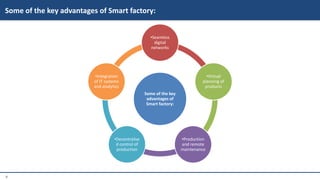
Some of the key
advantages of
Smart factory:
•Seamless
digital
networks
•Virtual
planning of
products
•Production
and remote
maintenance
•Decentralise
d control of
production
•Integration
of IT systems
and analytics
Some of the key advantages of Smart factory:
9
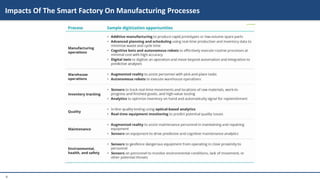
Impacts Of The Smart Factory On Manufacturing Processes
10
Step to Smart Factory
11
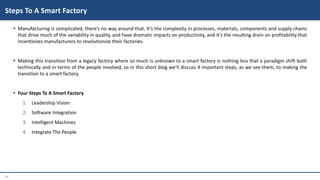
 Manufacturing is complicated, there’s no way around that. It’s the complexity in processes, materials, components and supply chains
that drive much of the variability in quality, and have dramatic impacts on productivity, and it’s the resulting drain on profitability that
incentivizes manufacturers to revolutionize their factories.
 Making this transition from a legacy factory where so much is unknown to a smart factory is nothing less that a paradigm shift both
technically and in terms of the people involved, so in this short blog we’ll discuss 4 important steps, as we see them, to making the
transition to a smart factory.
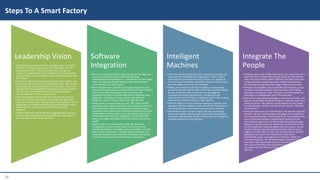
 Four Steps To A Smart Factory
1. Leadership Vision
2. Software Integration
3. Intelligent Machines
4. Integrate The People
Steps To A Smart Factory
12
Leadership Vision
• Companies that express interest in our digital work instruction
platform. “It’s really great, but we’re not anywhere close to
being ready for that.” This is a mindset that, although not
unique to manufacturing, is most destructive in manufacturing
and is probably a result of people simply not knowing what they
don’t know.
• They don’t understand the amount of clarity, data, visibility, etc.
they are missing and what that insight can provide. How the use
of that data can be transformative to the operation. They can’t
see past their own organizational weaknesses to have a vision of
the future. It’s these companies that are accepting paper
routers, and data collection using a pencil.
• They acknowledge that the little data they do collect will just
end up in a cabinet somewhere, never to be seen again. The
real question here is why. Why would this be acceptable? At the
highest level, it’s simply leadership. These organizations needs
leadership that sees the potential of the team and the
operation.
• A leader that truly understands that doing nothing is a decision
in and of itself, and that it’s the wrong decision if you want to
be competitive in the decades to come.
Software
Integration
• Once a transformative leader makes the decision to begin the
journey to a smart factory, and all of the planning,
roadmapping, benchmarking, etc. is established, the first logical
step is to integrate software solutions that allow for digital
communication and data capture.
• Most manufacturers, even those still highly dependent upon
paper and manual processes, have numerous software solutions
that all serve different purposes and most times each
application operates in it’s own little world. Integrating those
application, or bringing in newer systems that allow for
integration can be a massive step in the right direction.
• Today, there’s no reason why your ERP, LMS, QMS and MES
applications don’t talk to each other. Connecting your ERP and
MES applications will facilitate a paperless shop floor where
employees access digital work instructions, perform and record
measurements electronically, and access copious amounts of
performance data. Likewise, integrating your MES and QMS
system can trigger automated corrective actions and improve
quality.
• Digital solutions can also simplify things like document
management, version control, access restriction and will
dramatically enhance traceability and accountability. This will
likely require investments in modern software solutions and
additional hardware, but a well done ROI analysis will quickly
resolve concerns about the value of these investments.
Intelligent
Machines
• When the software applications that control and manage your
operation are modernized and integrated, it’s time to take a
closer look at your equipment, tools, sensors, etc. keeping in
mind of course that modern shop floor software solutions also
have the ability to interface with machines.
• Ideally, your machines will have the ability to communicate
across the network with the MES so that OEE, machine settings
& data, Andon and other components can be triggered,
recorded and tracked automatically. Connecting to this
Industrial Internet of Things is a significant step to fully merging
your physical machines with your cyber systems.
• With the addition of fully connected machines, Engineers and
Managers will have visibility to data that will be instrumental to
improving efficiency, and maximizing production schedules.
• Maintenance teams will gain insights into why machines go
down and be better able to predict and prevent unscheduled
downtime. Operators will be able to focus more on running the
machines and less on recording data.
Integrate The
People
• Looking at your newly modernized factory, you may think you’re
done. Far from it. People will continue to play an instrumental
role in the smart factory, albeit a different role than in the past.
In legacy factories, people have fairly straight forward jobs in
the operation but generally they trigger machines to do work.
• Although oversimplified, they essentially load machines, set up
machines, assemble products, move inventory and fix things
that break, among other tasks. The point is that the people are
operating as an independent part of the operation.
• Much of the operational knowledge is stored in their brains, and
typically none of that stored information is really the same from
person to person. The operation really depends on the people
to make decisions. When a machine sounds “weird”, call Cindy
and she’ll fix it.
• If that part measures out of specification, the operator stops the
machine, fills out a sheet of paper and pages Jim to disposition
the nonconforming part. These scenarios are real situations that
occur in factories everyday. Integrating the people into the
smart factory means their interaction with everything changes.
Operators may still set up the equipment, but they’ll do it from
the MES application following digital work instructions, but the
machine will stop automatically because the vibration sensor
triggers it to stop. When it stops, the machine talks to the MES
application and creates the maintenance ticket which
automatically sends a message to the technician. When the
technician responds, she will follow digital troubleshooting
instructions that dynamically help her make decisions on the
root cause of the failure and recommend solutions. As you can
see, people are still critical, but their role is substantially
different.
Steps To A Smart Factory
13
 Smart factories (factory 4.0) are an invisible force that are fundamentally changing the way consumers behave. Read here about 5
critical ideas behind the smart factory and how it interacts with the Internet of Things (IoT).
 Smart factories are an incredible force that is reshaping how things are made. They will fundamentally change what we can buy, how
we can make it and how we control the production. The trifecta of IoT, smart factories and mobility unlock our ability to innovate
ways that are not yet imagined.
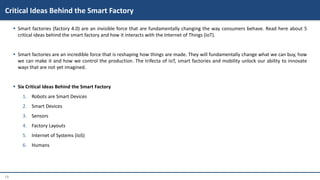
 Six Critical Ideas Behind the Smart Factory
1. Robots are Smart Devices
2. Smart Devices
3. Sensors
4. Factory Layouts
5. Internet of Systems (IoS)
6. Humans
Critical Ideas Behind the Smart Factory
14
Robots are Smart
Devices
•Smart devices are
programmed dynamically
and can very rapidly change
to alter and adapt their
output. Consider the
example of 3D printers, this
incredibly rapidly changing
space enables everything
from handguns to houses
to be printed dynamically.
•The music analogy (refer
Part 1 of the series) applies
to smart robots and we can
expect astonishing rates of
innovation in their
production. It is critical to
understand that these
smart devices will soon be
able to make nearly
anything at an affordable
price.
Smart Devices
•People want smart devices.
My favorite example of this
is my 6 year old daughter.
She did not want dolls,
books or stuffed toys. She
wanted a tablet. My
daughter loves to play
Minecraft and watch Netflix
shows. In fact, she doesn’t
even know how to use the
cable television and she
loves her android tablet.
•Smart devices customize to
meet the needs of the
consumer after they have
purchased them, then they
change and adapt. It is
critical to understand that
nearly everything that we
buy will have a chip and will
become a smart device.
Sensors
•Sensors are getting cheap,
companies like View
Technologies[1] are smart
antennas that enable very
low cost passive Radio
Frequency (RF) tags to be
read from large distances.
Add to RF tags processing
of video footage and these
days high definition footage
has become a massive
source of data.
•Video monitoring can
identify people, monitor
movement, understand
outages and dramatically
enrich the data streams
coming from the factory
floors. It is critical to
understand that factories
will be laden with sensors
directing data streams that
have never been seen
before.
Factory Layouts
•Factories are physical
places. They have layout
and they have logistics. The
other side of the factory
information is the physical
layout of the factory.
Consider the example of
the smart factory where
the data streams are joined
together (this is not an easy
task).
•However, the data has no
knowledge of the factory
floor. It is critical to
understand that smart
systems are fundamentally
unable to optimize based
on knowledge of space.
Internet of
Systems (IoS)
•The sensor and machines in
a smart factory stream
data, but behind these
sensors and machines are
systems. These systems are
used to monitor and
operate the smart devices
and collect data from the
sensors.
•To make a fully integrated
smart factory, we need to
bring the data together
from these systems and
enable the smart factory to
come to life, changing and
adapting to new needs,
technologies and
requirements.
Humans
•Humans are the creative
force, the oversight and the
exception monitoring of the
smart factory. Humans
needs to see what is going
on, they need to
understand the
ramifications of change.
•It is the quality of their
relationship with the smart
factory that will determine
its success. To make this
work the IoS humans need
to stream data to views of
the real world. Like shown
in the picture below, you
can see that the humans
need pictures to be able to
consume the data streams
in real-time.
Critical Ideas Behind the Smart Factory
15
Implementing Industry 4.0 in the Apparel Industry
16
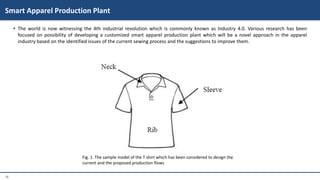
 The world is now witnessing the 4th industrial revolution which is commonly known as Industry 4.0. Various research has been
focused on possibility of developing a customized smart apparel production plant which will be a novel approach in the apparel
industry based on the identified issues of the current sewing process and the suggestions to improve them.
Smart Apparel Production Plant
Fig. 1. The sample model of the T shirt which has been considered to design the
current and the proposed production flows
17
 Current sewing process
 In the current sewing process, the raw material of the three major parts of the t shirt entered the line as a one batch.
 The production flow follows a traditional production line approach where the t shirt is being produced through a sequential
approach.
 The major issues of the current sewing process can be identified as follows,
• Considerably high number of labor shortage and the labor turnover has led to reduce the efficiency of the production lines.
• Inefficiency in the raw material reconciliation process has led to reliability issues.
 It is evident that the efficiency of this sequential sewing process is considerably low which has led to decrease the productivity. Also
to adapt automation for the clothing system is also so hard because, the complexity of this system has led to high labor intensity
Smart Apparel Production Plant Example
18
 Proposed sewing process
 Based on the issues of the current sewing process and the Volkswagen production system, the proposed sewing process has been
designed in order to meet the requirement of a customized smart apparel production plant.
 The main features of the proposed process can be identified as follows,
• Production Cells - By following the production sections concept in Volkswagen, the proposed production process consists with
the production cells where each of the major components in the t shirt manufactures and customizes in each cell before moving
to the final assembly cell. This cell cab be consisted with multi-tasking machine operators and also the automated sewing
machines.
• Real time production and part tracking - In order to track the each customized part of the garment as per the customer order
and assemble, RFID tags can be attached in each part of the garment. Having RFID tags in the garments will be beneficial to
implement the real time production tracking system in order to increase the efficiency of the raw material reconciliation process.
• Cooray and Rupasinghe have already developed a real time production tracking and decision making system for a apparel
production plant using the Bar Code technology. In their research it has been mentioned that by using RFID technology instead of
Bar Code would increase the flexibility and the capability of the system
Smart Apparel Production Plant Example
19
 Proposed sewing process
 The main features of the proposed process can be identified as follows,
• Implementing Social Manufacturing with 3D designing –
• It is proposed to implement a social manufacturing platform in the ERP system where the customers can directly place their
orders according to their requirements.
• This system will allow the customers to follow their order from inception to the end with the integration of the real time
production tracking system as well.
• Through this system, the 3D design of the garment can be tested using the virtual models and the 3D printed garment can also be
obtained by eliminating the long sample making process.
Smart Apparel Production Plant Example
20
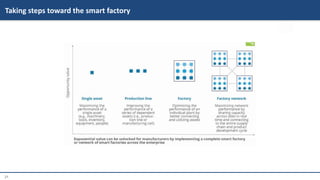
 Think Big, Start Small, And Scale Fast
 Smart factory investments often start with a focus on specific opportunities. Once identified, digitization and insight generation fuel
actions that can drive new value. Building and scaling the smart factory, however, can be as agile and flexible as the concept itself.
Manufacturers can get started down the path to a true smart factory at any level of their network—value creation can begin with and
scale from a single asset, and use an agile approach to iterate and grow.
 In fact, it can be more effective to start small, test out concepts in a manageable environment, and then scale once lessons have been
learned. Once a “win” is achieved, the solution can scale to additional assets, production lines, and factories, thus creating a
potentially exponential value creation opportunity
 But Stay Grounded In The Specific Needs Of The Factory –
 A company’s manufacturing strategy and environment will determine which specific issues to address and the way to unlock value
through smart factory solutions. Customizing the approach to each scenario and situation can help ensure the resulting smart factory
meets the needs of the manufacturer.
Taking steps toward the smart factory
21
Taking steps toward the smart factory
22
Thank You

Smart Garment Factory

  • 1.
  • 2.
  • 3.
    3 Smart Factory orIndustry 4.0
  • 4.
  • 5.
    5  The smartfactory represents a leap forward from more traditional automation to a fully connected and flexible system—one that can use a constant stream of data from connected operations and production systems to learn and adapt to new demands.  The smart factory is a flexible system that can self-optimize performance across a broader network, self-adapt to and learn from new conditions in real or near-real time, and autonomously run entire production processes.  Industry 4.0 is a name for the current trend of automation and data exchange in manufacturing technologies. It includes cyber- physical systems, the Internet of things, cloud computing and cognitive computing. Industry 4.0 is commonly referred to as the fourth industrial revolution.  Industry 4.0 creates what has been called a "smart factory". Within the modular structured smart factories, cyber-physical systems monitor physical processes, create a virtual copy of the physical world and make decentralized decisions.  Over the Internet of Things, cyber-physical systems communicate and cooperate with each other and with humans in real time, and via cloud computing, both internal and cross-organizational services are offered and used by participants of the value chain. What is Smart Factory
  • 6.
    6 Connected Continuously pull traditional datasetsalong with new sensor and location based datasets Real-time data enabling collaboration with suppliers ad customers Collaboration across department (e.g – feedback from production to product development Optimized Reliable, predictable production capacity Increase asset uptime and production Highly automated production and material handling with minimal human interaction Minimized cost of quality and production Transparent Live metrics and tool to support quick and consistent decision making Real time linkage to customer demand forecasts Transparent customer order tracking Proactive Predictive anomaly identification and resolution Automated restocking and replenishment Early identification of supplier quality issues Real time safety monitoring Agile Flexible and adaptable scheduling and changeovers Implementation of product changes to see the impact in real time Configurable factory layouts and equipment Smart Factory and some of its major features:
  • 7.
    7 Asset Efficiency •Every aspect ofthe smart factory generates reams of data that, through continuous analysis, reveal asset performance issues that can require some kind of corrective optimization. •Indeed, such self-correction is what distinguishes the smart factory from traditional automation, which can yield greater overall asset efficiency, one of the most salient benefits of a smart factory. •Asset efficiency should translate into lower asset downtime, optimized capacity, and reduced changeover time, among other potential benefits. Quality •The self-optimization that is characteristic of the smart factory can predict and detect quality defect trends sooner and can help to identify discrete human, machine, or environmental causes of poor quality. •This could lower scrap rates and lead times, and increase fill rates and yield. •A more optimized quality process could lead to a better-quality product with fewer defects and recalls. Lower Cost •Optimized processes traditionally lead to more cost-efficient processes—those with more predictable inventory requirements, more effective hiring and staffing decisions, as well as reduced process and operations variability. •A better-quality process could also mean an integrated view of the supply network with rapid, no- latency responses to sourcing needs—thus lowering costs further. •And because a better-quality process also may mean a better- quality product, it could also mean lowered warranty and maintenance costs. Safety •The smart factory can also impart real benefits around labor wellness and environmental sustainability. •The types of operational efficiencies that a smart factory can provide may result in a smaller environmental footprint than a conventional manufacturing process, with greater environmental sustainability overall. • Greater process autonomy may provide for less potential for human error, including industrial accidents that cause injury. Sustainabi lity •The smart factory’s relative self- sufficiency will likely replace certain roles that require repetitive and fatiguing activities. •However, the role of the human worker in a smart factory environment may take on greater levels of judgment and on-the-spot discretion, which can lead to greater job satisfaction and a reduction in turnover. Benefits of the smart factory
  • 8.
    8 Some of thekey advantages of Smart factory: •Seamless digital networks •Virtual planning of products •Production and remote maintenance •Decentralise d control of production •Integration of IT systems and analytics Some of the key advantages of Smart factory:
  • 9.
    9 Impacts Of TheSmart Factory On Manufacturing Processes
  • 10.
  • 11.
    11  Manufacturing iscomplicated, there’s no way around that. It’s the complexity in processes, materials, components and supply chains that drive much of the variability in quality, and have dramatic impacts on productivity, and it’s the resulting drain on profitability that incentivizes manufacturers to revolutionize their factories.  Making this transition from a legacy factory where so much is unknown to a smart factory is nothing less that a paradigm shift both technically and in terms of the people involved, so in this short blog we’ll discuss 4 important steps, as we see them, to making the transition to a smart factory.  Four Steps To A Smart Factory 1. Leadership Vision 2. Software Integration 3. Intelligent Machines 4. Integrate The People Steps To A Smart Factory
  • 12.
    12 Leadership Vision • Companiesthat express interest in our digital work instruction platform. “It’s really great, but we’re not anywhere close to being ready for that.” This is a mindset that, although not unique to manufacturing, is most destructive in manufacturing and is probably a result of people simply not knowing what they don’t know. • They don’t understand the amount of clarity, data, visibility, etc. they are missing and what that insight can provide. How the use of that data can be transformative to the operation. They can’t see past their own organizational weaknesses to have a vision of the future. It’s these companies that are accepting paper routers, and data collection using a pencil. • They acknowledge that the little data they do collect will just end up in a cabinet somewhere, never to be seen again. The real question here is why. Why would this be acceptable? At the highest level, it’s simply leadership. These organizations needs leadership that sees the potential of the team and the operation. • A leader that truly understands that doing nothing is a decision in and of itself, and that it’s the wrong decision if you want to be competitive in the decades to come. Software Integration • Once a transformative leader makes the decision to begin the journey to a smart factory, and all of the planning, roadmapping, benchmarking, etc. is established, the first logical step is to integrate software solutions that allow for digital communication and data capture. • Most manufacturers, even those still highly dependent upon paper and manual processes, have numerous software solutions that all serve different purposes and most times each application operates in it’s own little world. Integrating those application, or bringing in newer systems that allow for integration can be a massive step in the right direction. • Today, there’s no reason why your ERP, LMS, QMS and MES applications don’t talk to each other. Connecting your ERP and MES applications will facilitate a paperless shop floor where employees access digital work instructions, perform and record measurements electronically, and access copious amounts of performance data. Likewise, integrating your MES and QMS system can trigger automated corrective actions and improve quality. • Digital solutions can also simplify things like document management, version control, access restriction and will dramatically enhance traceability and accountability. This will likely require investments in modern software solutions and additional hardware, but a well done ROI analysis will quickly resolve concerns about the value of these investments. Intelligent Machines • When the software applications that control and manage your operation are modernized and integrated, it’s time to take a closer look at your equipment, tools, sensors, etc. keeping in mind of course that modern shop floor software solutions also have the ability to interface with machines. • Ideally, your machines will have the ability to communicate across the network with the MES so that OEE, machine settings & data, Andon and other components can be triggered, recorded and tracked automatically. Connecting to this Industrial Internet of Things is a significant step to fully merging your physical machines with your cyber systems. • With the addition of fully connected machines, Engineers and Managers will have visibility to data that will be instrumental to improving efficiency, and maximizing production schedules. • Maintenance teams will gain insights into why machines go down and be better able to predict and prevent unscheduled downtime. Operators will be able to focus more on running the machines and less on recording data. Integrate The People • Looking at your newly modernized factory, you may think you’re done. Far from it. People will continue to play an instrumental role in the smart factory, albeit a different role than in the past. In legacy factories, people have fairly straight forward jobs in the operation but generally they trigger machines to do work. • Although oversimplified, they essentially load machines, set up machines, assemble products, move inventory and fix things that break, among other tasks. The point is that the people are operating as an independent part of the operation. • Much of the operational knowledge is stored in their brains, and typically none of that stored information is really the same from person to person. The operation really depends on the people to make decisions. When a machine sounds “weird”, call Cindy and she’ll fix it. • If that part measures out of specification, the operator stops the machine, fills out a sheet of paper and pages Jim to disposition the nonconforming part. These scenarios are real situations that occur in factories everyday. Integrating the people into the smart factory means their interaction with everything changes. Operators may still set up the equipment, but they’ll do it from the MES application following digital work instructions, but the machine will stop automatically because the vibration sensor triggers it to stop. When it stops, the machine talks to the MES application and creates the maintenance ticket which automatically sends a message to the technician. When the technician responds, she will follow digital troubleshooting instructions that dynamically help her make decisions on the root cause of the failure and recommend solutions. As you can see, people are still critical, but their role is substantially different. Steps To A Smart Factory
  • 13.
    13  Smart factories(factory 4.0) are an invisible force that are fundamentally changing the way consumers behave. Read here about 5 critical ideas behind the smart factory and how it interacts with the Internet of Things (IoT).  Smart factories are an incredible force that is reshaping how things are made. They will fundamentally change what we can buy, how we can make it and how we control the production. The trifecta of IoT, smart factories and mobility unlock our ability to innovate ways that are not yet imagined.  Six Critical Ideas Behind the Smart Factory 1. Robots are Smart Devices 2. Smart Devices 3. Sensors 4. Factory Layouts 5. Internet of Systems (IoS) 6. Humans Critical Ideas Behind the Smart Factory
  • 14.
    14 Robots are Smart Devices •Smartdevices are programmed dynamically and can very rapidly change to alter and adapt their output. Consider the example of 3D printers, this incredibly rapidly changing space enables everything from handguns to houses to be printed dynamically. •The music analogy (refer Part 1 of the series) applies to smart robots and we can expect astonishing rates of innovation in their production. It is critical to understand that these smart devices will soon be able to make nearly anything at an affordable price. Smart Devices •People want smart devices. My favorite example of this is my 6 year old daughter. She did not want dolls, books or stuffed toys. She wanted a tablet. My daughter loves to play Minecraft and watch Netflix shows. In fact, she doesn’t even know how to use the cable television and she loves her android tablet. •Smart devices customize to meet the needs of the consumer after they have purchased them, then they change and adapt. It is critical to understand that nearly everything that we buy will have a chip and will become a smart device. Sensors •Sensors are getting cheap, companies like View Technologies[1] are smart antennas that enable very low cost passive Radio Frequency (RF) tags to be read from large distances. Add to RF tags processing of video footage and these days high definition footage has become a massive source of data. •Video monitoring can identify people, monitor movement, understand outages and dramatically enrich the data streams coming from the factory floors. It is critical to understand that factories will be laden with sensors directing data streams that have never been seen before. Factory Layouts •Factories are physical places. They have layout and they have logistics. The other side of the factory information is the physical layout of the factory. Consider the example of the smart factory where the data streams are joined together (this is not an easy task). •However, the data has no knowledge of the factory floor. It is critical to understand that smart systems are fundamentally unable to optimize based on knowledge of space. Internet of Systems (IoS) •The sensor and machines in a smart factory stream data, but behind these sensors and machines are systems. These systems are used to monitor and operate the smart devices and collect data from the sensors. •To make a fully integrated smart factory, we need to bring the data together from these systems and enable the smart factory to come to life, changing and adapting to new needs, technologies and requirements. Humans •Humans are the creative force, the oversight and the exception monitoring of the smart factory. Humans needs to see what is going on, they need to understand the ramifications of change. •It is the quality of their relationship with the smart factory that will determine its success. To make this work the IoS humans need to stream data to views of the real world. Like shown in the picture below, you can see that the humans need pictures to be able to consume the data streams in real-time. Critical Ideas Behind the Smart Factory
  • 15.
    15 Implementing Industry 4.0in the Apparel Industry
  • 16.
    16  The worldis now witnessing the 4th industrial revolution which is commonly known as Industry 4.0. Various research has been focused on possibility of developing a customized smart apparel production plant which will be a novel approach in the apparel industry based on the identified issues of the current sewing process and the suggestions to improve them. Smart Apparel Production Plant Fig. 1. The sample model of the T shirt which has been considered to design the current and the proposed production flows
  • 17.
    17  Current sewingprocess  In the current sewing process, the raw material of the three major parts of the t shirt entered the line as a one batch.  The production flow follows a traditional production line approach where the t shirt is being produced through a sequential approach.  The major issues of the current sewing process can be identified as follows, • Considerably high number of labor shortage and the labor turnover has led to reduce the efficiency of the production lines. • Inefficiency in the raw material reconciliation process has led to reliability issues.  It is evident that the efficiency of this sequential sewing process is considerably low which has led to decrease the productivity. Also to adapt automation for the clothing system is also so hard because, the complexity of this system has led to high labor intensity Smart Apparel Production Plant Example
  • 18.
    18  Proposed sewingprocess  Based on the issues of the current sewing process and the Volkswagen production system, the proposed sewing process has been designed in order to meet the requirement of a customized smart apparel production plant.  The main features of the proposed process can be identified as follows, • Production Cells - By following the production sections concept in Volkswagen, the proposed production process consists with the production cells where each of the major components in the t shirt manufactures and customizes in each cell before moving to the final assembly cell. This cell cab be consisted with multi-tasking machine operators and also the automated sewing machines. • Real time production and part tracking - In order to track the each customized part of the garment as per the customer order and assemble, RFID tags can be attached in each part of the garment. Having RFID tags in the garments will be beneficial to implement the real time production tracking system in order to increase the efficiency of the raw material reconciliation process. • Cooray and Rupasinghe have already developed a real time production tracking and decision making system for a apparel production plant using the Bar Code technology. In their research it has been mentioned that by using RFID technology instead of Bar Code would increase the flexibility and the capability of the system Smart Apparel Production Plant Example
  • 19.
    19  Proposed sewingprocess  The main features of the proposed process can be identified as follows, • Implementing Social Manufacturing with 3D designing – • It is proposed to implement a social manufacturing platform in the ERP system where the customers can directly place their orders according to their requirements. • This system will allow the customers to follow their order from inception to the end with the integration of the real time production tracking system as well. • Through this system, the 3D design of the garment can be tested using the virtual models and the 3D printed garment can also be obtained by eliminating the long sample making process. Smart Apparel Production Plant Example
  • 20.
    20  Think Big,Start Small, And Scale Fast  Smart factory investments often start with a focus on specific opportunities. Once identified, digitization and insight generation fuel actions that can drive new value. Building and scaling the smart factory, however, can be as agile and flexible as the concept itself. Manufacturers can get started down the path to a true smart factory at any level of their network—value creation can begin with and scale from a single asset, and use an agile approach to iterate and grow.  In fact, it can be more effective to start small, test out concepts in a manageable environment, and then scale once lessons have been learned. Once a “win” is achieved, the solution can scale to additional assets, production lines, and factories, thus creating a potentially exponential value creation opportunity  But Stay Grounded In The Specific Needs Of The Factory –  A company’s manufacturing strategy and environment will determine which specific issues to address and the way to unlock value through smart factory solutions. Customizing the approach to each scenario and situation can help ensure the resulting smart factory meets the needs of the manufacturer. Taking steps toward the smart factory
  • 21.
    21 Taking steps towardthe smart factory
  • 22.