SMART CRAWLER: A TWO-STAGE CRAWLER FOR EFFICIENTLY HARVESTING DEEP-WEB
INTERFACES
ABSTRACT
As deep web grows at a very fast pace, there has been increased interest in techniques that help
efficiently locate deep-web interfaces. However, due to the large volume of web resources and
the dynamic nature of deep web, achieving wide coverage and high efficiency is a challenging
issue. We propose a two-stage framework, namely Smart Crawler, for efficient harvesting deep
web interfaces. In the first stage, Smart Crawler performs site-based searching for center pages
with the help of search engines, avoiding visiting a large number of pages. To achieve more
accurate results for a focused crawl, SmartCrawlerranks websites to prioritize highly relevant
ones for a given topic. In the second stage, Smart Crawler achieves fast in-site searching by
excavating most relevant links with an adaptive link-ranking. To eliminate bias on visiting some
highly relevant links in hidden web directories, we design a link tree data structure to achieve
wider coverage for a website. Our experimental results on a set of representative domains show
the agility and accuracy of our proposed crawler framework, which efficiently retrieves deep-
web interfaces from large-scale sites and achieves higher harvest rates than other crawlers.
EXISTING SYSTEM
The existing system is a manual or semi automated system, i.e. The Textile Management System
is the system that can directly sent to the shop and will purchase clothes whatever you wanted.
The users are purchase dresses for festivals or by their need. They can spend time to purchase
this by their choice like color, size, and designs, rate and so on. They But now in the world
everyone is busy. They don’t need time to spend for this. Because they can spend whole the day
to purchase for their whole family. So we proposed the new system for web crawling.
Disadvantages:
1. Consuming large amount of data’s.
2. Time wasting while crawl in the web.
.
PROPOSED SYSTEM:
We propose a two-stage framework, namely Smart Crawler, for efficient harvesting deep web
interfaces. In the first stage, Smart Crawler performs site-based searching for center pages with
the help of search engines, avoiding visiting a large number of pages. To achieve more accurate
results for a focused crawl, SmartCrawlerranks websites to prioritize highly relevant ones for a
given topic. In the second stage, Smart Crawler achieves fast in-site searching by excavating
most relevant links with an adaptive link-ranking. To eliminate bias on visiting some highly
relevant links in hidden web directories, we design a link tree data structure to achieve wider
coverage for a website. Our experimental results on a set of representative domains show the
agility and accuracy of our proposed crawler framework, which efficiently retrieves deep-web
interfaces from large-scale sites and achieves higher harvest rates than other crawlers. Propose an
effective harvesting framework for deep-web interfaces, namely Smart-Crawler. We have shown
that our approach achieves both wide coverage for deep web interfaces and maintains highly
efficient crawling. Smart Crawler is focused crawler consisting of two stages: efficient site
locating and balanced in-site exploring. SmartCrawlerperforms site-based locating by reversely
searching the known deep web sites for center pages, which can effectively find many data
sources for sparse domains. By ranking collected sites and by focusing the crawling on a topic,
Smart Crawler achieves more accurate results
MODULE DESCRIPTION:
NUMBER OF MODULES:
After careful analysis the system has been identified to have the following modules:
1. two-stage crawler.
2. Site Ranker
3. Adaptive learning
1 Two-stage crawler.
It is challenging to locate the deep web databases, because they are not registered with any
search engines, are usually sparsely distributed, and keep constantly changing. To address this
problem, previous work has proposed two types of crawlers, generic crawlers and focused
crawlers. Generic crawlers fetch all searchable forms and cannot focus on a specific topic.
Focused crawlers such as Form-Focused Crawler (FFC) and Adaptive Crawler for Hidden-web
Entries (ACHE) can automatically search online databases on a specific topic. FFC is designed
with link, page, and form classifiers for focused crawling of web forms, and is extended by
ACHE with additional components for form filtering and adaptive link learner. The link
classifiers in these crawlers play a pivotal role in achieving higher crawling efficiency than the
best-first crawler However, these link classifiers are used to predict the distance to the page
containing searchable forms, which is difficult to estimate, especially for the delayed benefit
links (links eventually lead to pages with forms). As a result, the crawler can be inefficiently led
to pages without targeted forms.
2. Site Ranker:
When combined with above stop-early policy. We solve this problem by prioritizing highly
relevant links with link ranking. However, link ranking may introduce bias for highly relevant
links in certain directories. Our solution is to build a linktreefor a balanced link prioritizing.
Figure 2 illustrates an example of a link tree constructed from the homepage of
http://www.abebooks.com. Internal nodes of the tree represent directory paths. In this example,
servlet directory is for dynamic request; books directory is for displaying different catalogs of
books; Amdocs directory is for showing help information. Generally each directory usually
represents one type of files on web servers and it is advantageous to visit links in different
directories. For links that only differ in the query string part, we consider them as the same
URL.Because links are often distributed unevenly in server directories, prioritizing links by the
relevance can potentially bias toward some directories. For instance, the links under books might
be assigned a high priority, because “book” is an important feature word in the URL. Together
with the fact that most links appear in the books directory, it is quite possible that links in other
directories will not be chosen due to low relevance score. As a result, the crawler may miss
searchable forms in those directories.
3. Adaptive learning
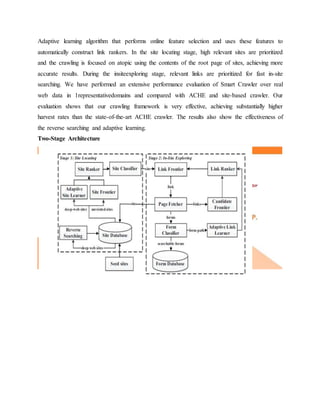
Adaptive learning algorithm that performs online feature selection and uses these features to
automatically construct link rankers. In the site locating stage, high relevant sites are prioritized
and the crawling is focused on atopic using the contents of the root page of sites, achieving more
accurate results. During the insiteexploring stage, relevant links are prioritized for fast in-site
searching. We have performed an extensive performance evaluation of Smart Crawler over real
web data in 1representativedomains and compared with ACHE and site-based crawler. Our
evaluation shows that our crawling framework is very effective, achieving substantially higher
harvest rates than the state-of-the-art ACHE crawler. The results also show the effectiveness of
the reverse searching and adaptive learning.
Two-Stage Architecture
System Configuration:
HARDWARE REQUIREMENTS:
Hardware - Pentium
Speed - 1.1 GHz
RAM - 1GB
Hard Disk - 20 GB
Key Board - Standard Windows Keyboard
Mouse - Two or Three Button Mouse
Monitor - SVGA
SOFTWARE REQUIREMENTS:
Operating System : Windows Family
Technology : Java and J2EE
Web Technologies : Html, JavaScript, CSS
Web Server : Tomcat
Database : My SQL
Java Version : J2SDK1.5

SMART CRAWLER: A TWO-STAGE CRAWLER FOR EFFICIENTLY HARVESTING DEEP-WEB INTERFACES

  • 1.
    SMART CRAWLER: ATWO-STAGE CRAWLER FOR EFFICIENTLY HARVESTING DEEP-WEB INTERFACES ABSTRACT As deep web grows at a very fast pace, there has been increased interest in techniques that help efficiently locate deep-web interfaces. However, due to the large volume of web resources and the dynamic nature of deep web, achieving wide coverage and high efficiency is a challenging issue. We propose a two-stage framework, namely Smart Crawler, for efficient harvesting deep web interfaces. In the first stage, Smart Crawler performs site-based searching for center pages with the help of search engines, avoiding visiting a large number of pages. To achieve more accurate results for a focused crawl, SmartCrawlerranks websites to prioritize highly relevant ones for a given topic. In the second stage, Smart Crawler achieves fast in-site searching by excavating most relevant links with an adaptive link-ranking. To eliminate bias on visiting some highly relevant links in hidden web directories, we design a link tree data structure to achieve wider coverage for a website. Our experimental results on a set of representative domains show the agility and accuracy of our proposed crawler framework, which efficiently retrieves deep- web interfaces from large-scale sites and achieves higher harvest rates than other crawlers. EXISTING SYSTEM The existing system is a manual or semi automated system, i.e. The Textile Management System is the system that can directly sent to the shop and will purchase clothes whatever you wanted. The users are purchase dresses for festivals or by their need. They can spend time to purchase this by their choice like color, size, and designs, rate and so on. They But now in the world everyone is busy. They don’t need time to spend for this. Because they can spend whole the day to purchase for their whole family. So we proposed the new system for web crawling. Disadvantages: 1. Consuming large amount of data’s. 2. Time wasting while crawl in the web.
  • 2.
    . PROPOSED SYSTEM: We proposea two-stage framework, namely Smart Crawler, for efficient harvesting deep web interfaces. In the first stage, Smart Crawler performs site-based searching for center pages with the help of search engines, avoiding visiting a large number of pages. To achieve more accurate results for a focused crawl, SmartCrawlerranks websites to prioritize highly relevant ones for a given topic. In the second stage, Smart Crawler achieves fast in-site searching by excavating most relevant links with an adaptive link-ranking. To eliminate bias on visiting some highly relevant links in hidden web directories, we design a link tree data structure to achieve wider coverage for a website. Our experimental results on a set of representative domains show the agility and accuracy of our proposed crawler framework, which efficiently retrieves deep-web interfaces from large-scale sites and achieves higher harvest rates than other crawlers. Propose an effective harvesting framework for deep-web interfaces, namely Smart-Crawler. We have shown that our approach achieves both wide coverage for deep web interfaces and maintains highly efficient crawling. Smart Crawler is focused crawler consisting of two stages: efficient site locating and balanced in-site exploring. SmartCrawlerperforms site-based locating by reversely searching the known deep web sites for center pages, which can effectively find many data sources for sparse domains. By ranking collected sites and by focusing the crawling on a topic, Smart Crawler achieves more accurate results MODULE DESCRIPTION: NUMBER OF MODULES: After careful analysis the system has been identified to have the following modules: 1. two-stage crawler. 2. Site Ranker 3. Adaptive learning 1 Two-stage crawler.
  • 3.
    It is challengingto locate the deep web databases, because they are not registered with any search engines, are usually sparsely distributed, and keep constantly changing. To address this problem, previous work has proposed two types of crawlers, generic crawlers and focused crawlers. Generic crawlers fetch all searchable forms and cannot focus on a specific topic. Focused crawlers such as Form-Focused Crawler (FFC) and Adaptive Crawler for Hidden-web Entries (ACHE) can automatically search online databases on a specific topic. FFC is designed with link, page, and form classifiers for focused crawling of web forms, and is extended by ACHE with additional components for form filtering and adaptive link learner. The link classifiers in these crawlers play a pivotal role in achieving higher crawling efficiency than the best-first crawler However, these link classifiers are used to predict the distance to the page containing searchable forms, which is difficult to estimate, especially for the delayed benefit links (links eventually lead to pages with forms). As a result, the crawler can be inefficiently led to pages without targeted forms. 2. Site Ranker: When combined with above stop-early policy. We solve this problem by prioritizing highly relevant links with link ranking. However, link ranking may introduce bias for highly relevant links in certain directories. Our solution is to build a linktreefor a balanced link prioritizing. Figure 2 illustrates an example of a link tree constructed from the homepage of http://www.abebooks.com. Internal nodes of the tree represent directory paths. In this example, servlet directory is for dynamic request; books directory is for displaying different catalogs of books; Amdocs directory is for showing help information. Generally each directory usually represents one type of files on web servers and it is advantageous to visit links in different directories. For links that only differ in the query string part, we consider them as the same URL.Because links are often distributed unevenly in server directories, prioritizing links by the relevance can potentially bias toward some directories. For instance, the links under books might be assigned a high priority, because “book” is an important feature word in the URL. Together with the fact that most links appear in the books directory, it is quite possible that links in other directories will not be chosen due to low relevance score. As a result, the crawler may miss searchable forms in those directories. 3. Adaptive learning
  • 4.
    Adaptive learning algorithmthat performs online feature selection and uses these features to automatically construct link rankers. In the site locating stage, high relevant sites are prioritized and the crawling is focused on atopic using the contents of the root page of sites, achieving more accurate results. During the insiteexploring stage, relevant links are prioritized for fast in-site searching. We have performed an extensive performance evaluation of Smart Crawler over real web data in 1representativedomains and compared with ACHE and site-based crawler. Our evaluation shows that our crawling framework is very effective, achieving substantially higher harvest rates than the state-of-the-art ACHE crawler. The results also show the effectiveness of the reverse searching and adaptive learning. Two-Stage Architecture
  • 5.
    System Configuration: HARDWARE REQUIREMENTS: Hardware- Pentium Speed - 1.1 GHz RAM - 1GB Hard Disk - 20 GB Key Board - Standard Windows Keyboard Mouse - Two or Three Button Mouse Monitor - SVGA SOFTWARE REQUIREMENTS: Operating System : Windows Family Technology : Java and J2EE Web Technologies : Html, JavaScript, CSS Web Server : Tomcat Database : My SQL Java Version : J2SDK1.5