Design of a Metacrawler for Web Document Retrieval
K R Remesh Babu
Assistant Professor
Department of Information Technology
Government Engineering College, Idukki, India
remeshbabu@yahoo.com
A P Arya
Department of Computer Science and Engineering
PSG College of Technology
Coimbatore, India.
aryaanil88@gmail.com
Abstract—Web Crawlers ‘browse’ the World Wide Web (WWW)
on behalf of search engine, to collect web pages from numerous
collections of billions of documents. Metacrawler is similar to that
of a meta search engine that combines the top web search results
from popular search engines. World Wide Web is growing rapidly.
This possesses great challenges to general purpose crawlers. This
paper introduces an architectural framework of a Metacrawler.
This crawler enables the user to retrieve information that is
relevant to the topic from more than one traditional web search
engines. The crawler works in such a way that it fetches only the
pages that are relevant to the topic. The PageRank algorithm is
often used in ranking web pages. But, the ranking causes the
problem of topic-drift. So, modified PageRank algorithm is used to
rank the retrieved web pages in such a way that it reduces this
problem. The clustering method is used to combine the search
results so that the user can easily select web pages from the
clustered results based upon the requirement. Experimental results
show the effectiveness of the Metacrawler.
Keywords- Search Engine, Web Crawler, Metacrawler, Ranking
Algorithms, Clustering.
I. INTRODUCTION
Users’ use web search engines to find specific information.
As the volume of web pages is increasing rapidly, it is becoming
a difficult task to retrieve information that is relevant to the
topic.
Web mining technique plays an important role in developing
an intelligent web. The useful pages from the web are retrieved
by the crawler before applying the web mining techniques. The
traditional web crawler traverses the web by following the
hyperlinks and stores the downloaded pages in a database.
There are a lot recent researches in new types of crawling
techniques such as focused crawling based on semantic web [4],
cooperative crawling [5], distributed web crawler [7] and
intelligent crawling [8].
The main objective in this paper is to propose a Metacrawler
framework. In Section 2, the works related to the web crawler is
discussed. Section 3 describes the architectural framework of the
Metacrawler. The Sequence Diagram and Activity Diagram are
explained in Section 4. In Section 5, the Performance of the
proposed System is evaluated. Finally, Section 6 presents the
conclusion and future work.
II. RELATED WORK
Agent based web mining systems can be classified into three
categories [3]: intelligent search agents, information filtering and
personalized web agents. Several intelligent web agents like
Harvest [10], ShopBot [11] have been developed to search for
relevant information using domain characteristics. Research
works based on new types of crawling techniques are as follows:
A new alternative of organizing web documents [4] which
emphasizes a direct separation between the syntactic and
semantic facets of the web information is proposed. This
approach provides a collaborative proximity-based fuzzy
clustering and shows how this type of clustering is used to
discover a structure of web information by a prudent reliance on
the structures in the spaces of semantics and data. The method
focuses on the reconciliation between the two separated facets of
web information and a combination of results leading to a
comprehensive data organization.
A scheme is proposed [5] to permit a crawler to acquire
information about the global state of a website before the
crawling process takes place. This scheme requires web server
cooperation in order to collect and publish information on its
content, useful for enabling a crawler to tune its visit strategy. If
this information is unavailable or not updated, the crawler acts in
the usual manner.
A crawler that employs canonical topic taxonomy [7] to
train a naive-Bayesian classifier, which then helps determine the
relevancy of crawled pages is proposed. The crawler also relies
on the assumption of topical locality to decide which URLs to
visit next. Another approach [2] focuses on the classification of
links instead of downloaded web pages to determine relevancy.
This method combines a Naive Bayes classifier for classification
of URLs with a simple URL scoring optimization to improve the
system performance.
A crawler with improved PageRank algorithm [3] is
proposed. In this improved PageRank algorithm, a web page is
478978-1-4673-5118-8 c 2012 IEEE
divided into several blocks by HTML document’s structure and
the most weight is given to linkages in the block that is most
relevant to given topic. The visited outlinks are regarded as a
feedback to modify blocks’ relevancy. The implementation of
this new algorithm helps in resolving the problem of topic-drift.
Another improved PageRank algorithm [2] is based on “topical
random surfer”. The experiment in focused crawler using the T-
PageRank has better performance than the Breath-first and
PageRank algorithms.
III. METACRAWLER - ARCHITECTURAL
FRAMEWORK
The proposed methodology involves the following
components: Design of Meta Search Engine, Design of web
crawler, Duplicate URL Eliminator, Ranking and Clustering the
Results.
A. Design of Meta Search Engine
Web search Engines are designed to search for information
from the web. Lots of search engines are currently available. The
most popular among them are Google and Yahoo!. All the
existing search engines have their own disadvantages. Hence,
this has resulted in the creation of numerous search engines.
In the proposed framework, the user input query is given
through the main Graphic User Interface (GUI). The search
query by the user is processed such a way that all the stop words
are removed for better processing of the query. The query is
given simultaneously in all the traditional search engines and the
results corresponding to the query are extracted from the web
database.
The designed meta search engine retrieves major results from
three different traditional search engines available. The number
of search engines can be selected by the user. The retrieved
results are extracted by using the crawler.
The system flow diagram is shown in Figure 1.
B. Web Crawler
Crawler is a means to provide up-to-date data. The web
crawler is otherwise called as spiders or robots. A search engine
cannot work properly without indexing the web pages. Crawlers
are used to create this index.
The crawler visits a web page, reads it and then follows the
links to other pages within that page. The crawler returns to the
site on a regular basis. Everything that the crawler crawls is
indexed. The index is similar to that of a giant book containing
the copy of every page that the crawler finds.
Crawler uses the crawling algorithm to crawl the pages from
all the search engines. The relevant web pages are retrieved from
the web database and are saved.
Figure 1: Architectural Framework
C. Duplicate URL Eliminator
The Duplicate URL Eliminator module determines whether
an extracted link is already in the URL list or has recently been
fetched. Finally, the URL is checked for duplicate elimination. If
the URL is already in the list, then it is not added into the list
again. And hence, this eliminates the redundant URLs.
D. Ranking
PageRank algorithm is a link analysis algorithm. It is an
algorithm for ranking web pages. This algorithm assigns a
numerical weighting to each element of a hyperlinked set of
documents. The numerical value that this algorithm assigns to
any given element E is referred to as the PageRank of E.
In general,
PR(A) = (1 – d) + d (PR(T1) / C(T1) + …. + PR(Tn) / C(Tn))
-------(1)
Where,
PR(A) is the PageRank of a page A
PR(T1) is the PageRank of a page T1
C(T1) is the number of outgoing links from the page T1
d is the damping factor in the range of 0 < d < 1
In the improved PageRank algorithm, a web page is divided
into several blocks by HTML document’s structure and the most
weight is given to linkages in the block that is most relevant to
2012 12th International Conference on Intelligent Systems Design and Applications (ISDA) 479
the given topic. The visited outlinks are regarded as feedback to
modify blocks’ relevancy. The implementation of this new
algorithm helps in resolving the problem of topic drift.
The pseudo code of the algorithm is given in Figure 2.
Assume the user interested in topic k is browsing a web page
i. For the next move, the user can either follow an outgoing link
on the current page with probability (1-d) or jump to any page
uniformly at random with probability d.
Figure 2: Improved PageRank Algorithm
The sim() function returns the cosine similarity between a
topic’s keywords and a page. The similarity value is calculated
by using the following formula.
------------ (2)
Where,
wqi is the weight of word wi in query Q
wdi is the weight of word wi in document D
E. Clustering the Results
Clustering is the act of grouping similar object into sets. One
of the most popular clustering techniques is the K-means
clustering algorithm. Starting from a random partitioning, the
algorithm repeatedly (i) computes the current cluster centers (i.e.
the average vector of each cluster in data space) and (ii)
reassigns each data item to the cluster whose centre is closest to
it. The K-means algorithm terminates when there is no more
reassignments take place.
Web users have to shift through the list to locate pages of
their interest. This is a time-consuming task when multiple sub-
topics of the given query are mixed together. A possible solution
to this problem is to cluster search results into different groups
and to enable users to identify their required group at a glance.
IV. PROTOTYPE
The section involves the sequence diagram and activity
diagram of the system along with the results.
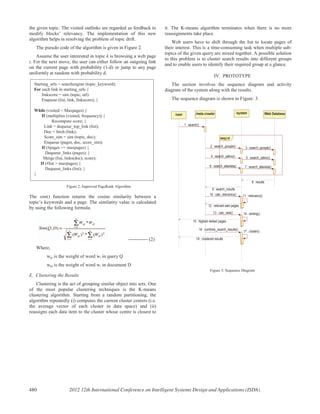
The sequence diagram is shown in Figure. 3.
parseq
/user /meta crawler /system /Web Database
1 : search()
2 : search_google() 3 : search_google()
4 : search_yahoo() 5 : search_yahoo()
6 : search_altavista() 7 : search_altavista()
8 : results
9 : search_results
10 : calc_relevancy() 11 : relevancy()
12 : relevant web pages
13 : calc_rank() 14 : ranking()
15 : highest ranked pages
16 : combine_search_results()
17 : cluster()
18 : clustered results
Figure 3: Sequence Diagram
Starting_urls = searchengine (topic_keyword);
For each link in starting_urls {
linkscore = sim (topic, url)
Enqueue (list, link, linkscore); }
While (visited < Maxpages) {
If (multiplies (visited, frequency)) {
Recompute score; }
Link = dequeue_top_link (list);
Doc = fetch (link);
Score_sim = sim (topic, doc);
Enqueue (pages, doc, score_sim);
If (#pages >= maxpages) {
Dequeue_links (pages); }
Merge (list, links(doc), score);
If (#list > maxpages) {
Dequeue_links (list); }
}
480 2012 12th International Conference on Intelligent Systems Design and Applications (ISDA)
Figure 4: Activity Diagram
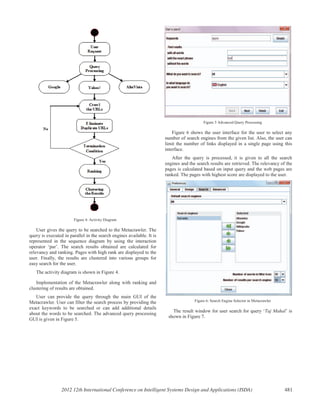
User gives the query to be searched to the Metacrawler. The
query is executed in parallel in the search engines available. It is
represented in the sequence diagram by using the interaction
operator ‘par’. The search results obtained are calculated for
relevancy and ranking. Pages with high rank are displayed to the
user. Finally, the results are clustered into various groups for
easy search for the user.
The activity diagram is shown in Figure 4.
Implementation of the Metacrawler along with ranking and
clustering of results are obtained.
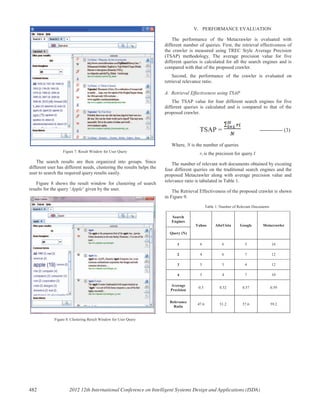
User can provide the query through the main GUI of the
Metacrawler. User can filter the search process by providing the
exact keywords to be searched or can add additional details
about the words to be searched. The advanced query processing
GUI is given in Figure 5.
Figure 5 Advanced Query Processing
Figure 6 shows the user interface for the user to select any
number of search engines from the given list. Also, the user can
limit the number of links displayed in a single page using this
interface.
After the query is processed, it is given to all the search
engines and the search results are retrieved. The relevancy of the
pages is calculated based on input query and the web pages are
ranked. The pages with highest score are displayed to the user.
Figure 6: Search Engine Selector in Metacrawler
The result window for user search for query ‘Taj Mahal’ is
shown in Figure 7.
2012 12th International Conference on Intelligent Systems Design and Applications (ISDA) 481
Figure 7: Result Window for User Query
The search results are then organized into groups. Since
different user has different needs, clustering the results helps the
user to search the required query results easily.
Figure 8 shows the result window for clustering of search
results for the query ‘Apple’ given by the user.
Figure 8: Clustering Result Window for User Query
V. PERFORMANCE EVALUATION
The performance of the Metacrawler is evaluated with
different number of queries. First, the retrieval effectiveness of
the crawler is measured using TREC Style Average Precision
(TSAP) methodology. The average precision value for five
different queries is calculated for all the search engines and is
compared with that of the proposed crawler.
Second, the performance of the crawler is evaluated on
retrieval relevance ratio.
A. Retrieval Effectiveness using TSAP
The TSAP value for four different search engines for five
different queries is calculated and is compared to that of the
proposed crawler.
TSAP = ------------- (3)
Where, N is the number of queries
ri is the precision for query I
The number of relevant web documents obtained by excuting
four different queries on the traditional search engines and the
proposed Metacrawler along with average precision value and
relevance ratio is tabulated in Table 1.
The Retrieval Effectiveness of the proposed crawler is shown
in Figure 9.
Table 1: Number of Relevant Documents
Search
Engines
Yahoo AltaVista Google Metacrawler
Query (N)
1 6 6 5 16
2 4 6 7 12
3 5 5 4 12
4 5 4 7 10
Average
Precision
0.5 0.52 0.57 0.59
Relevance
Ratio
47.6 51.2 57.6 59.2
482 2012 12th International Conference on Intelligent Systems Design and Applications (ISDA)
Figure 9: Retrieval Effectiveness
The above graph shows the average precision value
calculated using the Equation 3. The results shows that the
proposed web crawler has a higher value when compared to
three search engines Yahoo, AltaVista and Google. The
proposed Metacrawler has given the enhanced performance in
terms of retrieval effectiveness and thus it outperforms when
compared to the most popular traditional search engines.
B. Relevance Ratio
The relevance ratio of each search engine is calculated using
the equation 4 as given below.
-------------------- (4)
The graph in Figure 10 shows the relevance ratio of each of
the component search engines and the proposed Metacrawler.
The graph shows improvement in the relevance ratio by the
proposed Metacrawler against the traditional search engines. The
proposed Metacrawler has better performance and can enhance
the quality of web search results.
The Retrieval Effectiveness using TSAP and Relevance
Ratio are used to evaluate the performance of the Metacrawler.
The experimental results show that the proposed Metacrawler
performs better when compared to other traditional search
engines.
Figure 10: Relevance Ratio
VI. CONCLUSION AND FUTURE WORK
A crawler is similar to that of a program that downloads and
stores web pages mainly for a web search engine. An
architectural framework of a Metacrawler is proposed based on
service oriented architecture. The framework supports selection
of participant search engines by the user. Even though, the time
taken by the crawler to retrieve the results is a little higher when
compared to the other search engines, the proposed crawler
works better in terms of its efficiency.
Metacrawler framework can be a good choice for testing new
approaches for providing highly relevant search results.
Searching techniques can be improved to reduce the search time
of the crawler. Crawling algorithms that take structured queries
for processing can be implemented, to provide highly relevant
personalised search results for every user. Evolutionary
algorithms can be used to reduce the search time of the crawler.
REFERENCES
[1] Song Zheng, “Genetic and Ant Algorithms Based Focused Crawler
Design”, Second International Conference on Innovations in Bio-
inspired Computing and Applications, pp. 374-378, 2011.
[2] A. K Elmagarmid, P. G Iperrotis, and V. S Verykios, “Duplicate
Record Detection: A Survey”, IEEE Transactional Knowledge and
Data Engineering, vol.19, No.1, pp. 1-16, January 2011.
[3] Ling Zhang, Zheng Qin, “The Improved PageRank in Web
Crawler”, The 1st
International Conference on Information Science
and Engineering (ICISE2009), pp. 1889-1892, 2009.
[4] V. Loia, W. Pedrycz, and S. Senatore. “Semantic Web Content
Analysis: A Study in Proximity-Based Collaborative Clustering”,
Proceedings of the 18th
International Conference on Data
Engineering (ICDE’02).
2012 12th International Conference on Intelligent Systems Design and Applications (ISDA) 483
[5] V. Shkapenyuk, T. Suel, “Design and Implementation of a High-
Performance Distributed Web Crawler”, International World Wide
Web Web Conference, 2001.
[6] C. C. Aggarwal, F. Al-Garawi, and P. S. Yu, “Intelligent Crawling
on the World Wide Web with Arbitrary Predicates”, Proceedings
of the 10th
International World Wide Web Conference, May 2001.
[7] S. Altingovde and O. Ulusoy, “Exploiting Interclass Rules for
Focused Crawling”, IEEE Intelligent System, 2004.
[8] M. Buzzi. “Cooperative Crawling”, Proceedings of the First Latin
American Web Congress (LA- WEB 2003), 2003.
[9] S. K. Pal, V. Talwar, “Web Mining in Soft Computing
Framework: Relevance, State of the Art and Future Directions”,
Proceedings of IEEE Transactions on Neural Networks, Vol. 13,
No. 5, 2002.
[10] J. Srivastava, B. Mobasher, R. Cooley, “Web Mining: Information
and Pattern Discovery on the World Wide Web”, International
Conference on Tools with Artificial Intelligence, pp. 558-567,
Newport Beach, 1997.
[11] C. M. Bowman, P.B. Danzing, U. Manber, M.F. Schwartz,
“Scalable Internet Resource Discovery: Research Problems and
Approaches”, Communications of the ACM. 37(8), pp. 98-107,
1994.
[12] S. Chakrabarthi, B. Dom, S. Ravikumar, P. Aghavan, S.
Rajagopalan, A. Tomkins. “Mining Webs’ Link Structure”, IEEE
Computer, pp. 60-67, 1997.
[13] F. Gasperetti, A. Micarelli, “Swarm Intelligence: Agents for
Adaptive Web Search”, Technical Report, Department of
Information, University of ROMA, Rome, Italy, 2000.
[14] Y. Xie, D. Mundlura, V. V. Raghavan, “Incorporating Agent
Based Neural Network Model for Adaptive Meta Search”, The
Center for Advanced Computer Studies, University of Louisiana,
2004.
[15] S. Raghavan, H. G. Molina, “Crawling the Hidden Web”,
Proceedings of the 27th
VLDB Conference, 2001.
[16] L. Barbosa, J. Freire, “Searching for Hidden-Web databases”,
Eighth International Workshop on the Web and Databases, 2005.
[17] L. Barbosa, J. Freire, “An Adaptive Crawler for Locating Hidden-
Web Entry Points”, Proceedings of International WWW
Conference, pp. 441-450, 2007.
[18] Animesh Tripathy, Prashanta K Patra, “A Web Mining
Architectural Model of Distributed Crawler for Internet Searches
Using PageRank Algorithm”, IEEE Asia-Pacific Services
Computing Conference, pp. 513-518.
484 2012 12th International Conference on Intelligent Systems Design and Applications (ISDA)

Sree saranya

  • 1.
    Design of aMetacrawler for Web Document Retrieval K R Remesh Babu Assistant Professor Department of Information Technology Government Engineering College, Idukki, India remeshbabu@yahoo.com A P Arya Department of Computer Science and Engineering PSG College of Technology Coimbatore, India. aryaanil88@gmail.com Abstract—Web Crawlers ‘browse’ the World Wide Web (WWW) on behalf of search engine, to collect web pages from numerous collections of billions of documents. Metacrawler is similar to that of a meta search engine that combines the top web search results from popular search engines. World Wide Web is growing rapidly. This possesses great challenges to general purpose crawlers. This paper introduces an architectural framework of a Metacrawler. This crawler enables the user to retrieve information that is relevant to the topic from more than one traditional web search engines. The crawler works in such a way that it fetches only the pages that are relevant to the topic. The PageRank algorithm is often used in ranking web pages. But, the ranking causes the problem of topic-drift. So, modified PageRank algorithm is used to rank the retrieved web pages in such a way that it reduces this problem. The clustering method is used to combine the search results so that the user can easily select web pages from the clustered results based upon the requirement. Experimental results show the effectiveness of the Metacrawler. Keywords- Search Engine, Web Crawler, Metacrawler, Ranking Algorithms, Clustering. I. INTRODUCTION Users’ use web search engines to find specific information. As the volume of web pages is increasing rapidly, it is becoming a difficult task to retrieve information that is relevant to the topic. Web mining technique plays an important role in developing an intelligent web. The useful pages from the web are retrieved by the crawler before applying the web mining techniques. The traditional web crawler traverses the web by following the hyperlinks and stores the downloaded pages in a database. There are a lot recent researches in new types of crawling techniques such as focused crawling based on semantic web [4], cooperative crawling [5], distributed web crawler [7] and intelligent crawling [8]. The main objective in this paper is to propose a Metacrawler framework. In Section 2, the works related to the web crawler is discussed. Section 3 describes the architectural framework of the Metacrawler. The Sequence Diagram and Activity Diagram are explained in Section 4. In Section 5, the Performance of the proposed System is evaluated. Finally, Section 6 presents the conclusion and future work. II. RELATED WORK Agent based web mining systems can be classified into three categories [3]: intelligent search agents, information filtering and personalized web agents. Several intelligent web agents like Harvest [10], ShopBot [11] have been developed to search for relevant information using domain characteristics. Research works based on new types of crawling techniques are as follows: A new alternative of organizing web documents [4] which emphasizes a direct separation between the syntactic and semantic facets of the web information is proposed. This approach provides a collaborative proximity-based fuzzy clustering and shows how this type of clustering is used to discover a structure of web information by a prudent reliance on the structures in the spaces of semantics and data. The method focuses on the reconciliation between the two separated facets of web information and a combination of results leading to a comprehensive data organization. A scheme is proposed [5] to permit a crawler to acquire information about the global state of a website before the crawling process takes place. This scheme requires web server cooperation in order to collect and publish information on its content, useful for enabling a crawler to tune its visit strategy. If this information is unavailable or not updated, the crawler acts in the usual manner. A crawler that employs canonical topic taxonomy [7] to train a naive-Bayesian classifier, which then helps determine the relevancy of crawled pages is proposed. The crawler also relies on the assumption of topical locality to decide which URLs to visit next. Another approach [2] focuses on the classification of links instead of downloaded web pages to determine relevancy. This method combines a Naive Bayes classifier for classification of URLs with a simple URL scoring optimization to improve the system performance. A crawler with improved PageRank algorithm [3] is proposed. In this improved PageRank algorithm, a web page is 478978-1-4673-5118-8 c 2012 IEEE
  • 2.
    divided into severalblocks by HTML document’s structure and the most weight is given to linkages in the block that is most relevant to given topic. The visited outlinks are regarded as a feedback to modify blocks’ relevancy. The implementation of this new algorithm helps in resolving the problem of topic-drift. Another improved PageRank algorithm [2] is based on “topical random surfer”. The experiment in focused crawler using the T- PageRank has better performance than the Breath-first and PageRank algorithms. III. METACRAWLER - ARCHITECTURAL FRAMEWORK The proposed methodology involves the following components: Design of Meta Search Engine, Design of web crawler, Duplicate URL Eliminator, Ranking and Clustering the Results. A. Design of Meta Search Engine Web search Engines are designed to search for information from the web. Lots of search engines are currently available. The most popular among them are Google and Yahoo!. All the existing search engines have their own disadvantages. Hence, this has resulted in the creation of numerous search engines. In the proposed framework, the user input query is given through the main Graphic User Interface (GUI). The search query by the user is processed such a way that all the stop words are removed for better processing of the query. The query is given simultaneously in all the traditional search engines and the results corresponding to the query are extracted from the web database. The designed meta search engine retrieves major results from three different traditional search engines available. The number of search engines can be selected by the user. The retrieved results are extracted by using the crawler. The system flow diagram is shown in Figure 1. B. Web Crawler Crawler is a means to provide up-to-date data. The web crawler is otherwise called as spiders or robots. A search engine cannot work properly without indexing the web pages. Crawlers are used to create this index. The crawler visits a web page, reads it and then follows the links to other pages within that page. The crawler returns to the site on a regular basis. Everything that the crawler crawls is indexed. The index is similar to that of a giant book containing the copy of every page that the crawler finds. Crawler uses the crawling algorithm to crawl the pages from all the search engines. The relevant web pages are retrieved from the web database and are saved. Figure 1: Architectural Framework C. Duplicate URL Eliminator The Duplicate URL Eliminator module determines whether an extracted link is already in the URL list or has recently been fetched. Finally, the URL is checked for duplicate elimination. If the URL is already in the list, then it is not added into the list again. And hence, this eliminates the redundant URLs. D. Ranking PageRank algorithm is a link analysis algorithm. It is an algorithm for ranking web pages. This algorithm assigns a numerical weighting to each element of a hyperlinked set of documents. The numerical value that this algorithm assigns to any given element E is referred to as the PageRank of E. In general, PR(A) = (1 – d) + d (PR(T1) / C(T1) + …. + PR(Tn) / C(Tn)) -------(1) Where, PR(A) is the PageRank of a page A PR(T1) is the PageRank of a page T1 C(T1) is the number of outgoing links from the page T1 d is the damping factor in the range of 0 < d < 1 In the improved PageRank algorithm, a web page is divided into several blocks by HTML document’s structure and the most weight is given to linkages in the block that is most relevant to 2012 12th International Conference on Intelligent Systems Design and Applications (ISDA) 479
  • 3.
    the given topic.The visited outlinks are regarded as feedback to modify blocks’ relevancy. The implementation of this new algorithm helps in resolving the problem of topic drift. The pseudo code of the algorithm is given in Figure 2. Assume the user interested in topic k is browsing a web page i. For the next move, the user can either follow an outgoing link on the current page with probability (1-d) or jump to any page uniformly at random with probability d. Figure 2: Improved PageRank Algorithm The sim() function returns the cosine similarity between a topic’s keywords and a page. The similarity value is calculated by using the following formula. ------------ (2) Where, wqi is the weight of word wi in query Q wdi is the weight of word wi in document D E. Clustering the Results Clustering is the act of grouping similar object into sets. One of the most popular clustering techniques is the K-means clustering algorithm. Starting from a random partitioning, the algorithm repeatedly (i) computes the current cluster centers (i.e. the average vector of each cluster in data space) and (ii) reassigns each data item to the cluster whose centre is closest to it. The K-means algorithm terminates when there is no more reassignments take place. Web users have to shift through the list to locate pages of their interest. This is a time-consuming task when multiple sub- topics of the given query are mixed together. A possible solution to this problem is to cluster search results into different groups and to enable users to identify their required group at a glance. IV. PROTOTYPE The section involves the sequence diagram and activity diagram of the system along with the results. The sequence diagram is shown in Figure. 3. parseq /user /meta crawler /system /Web Database 1 : search() 2 : search_google() 3 : search_google() 4 : search_yahoo() 5 : search_yahoo() 6 : search_altavista() 7 : search_altavista() 8 : results 9 : search_results 10 : calc_relevancy() 11 : relevancy() 12 : relevant web pages 13 : calc_rank() 14 : ranking() 15 : highest ranked pages 16 : combine_search_results() 17 : cluster() 18 : clustered results Figure 3: Sequence Diagram Starting_urls = searchengine (topic_keyword); For each link in starting_urls { linkscore = sim (topic, url) Enqueue (list, link, linkscore); } While (visited < Maxpages) { If (multiplies (visited, frequency)) { Recompute score; } Link = dequeue_top_link (list); Doc = fetch (link); Score_sim = sim (topic, doc); Enqueue (pages, doc, score_sim); If (#pages >= maxpages) { Dequeue_links (pages); } Merge (list, links(doc), score); If (#list > maxpages) { Dequeue_links (list); } } 480 2012 12th International Conference on Intelligent Systems Design and Applications (ISDA)
  • 4.
    Figure 4: ActivityDiagram User gives the query to be searched to the Metacrawler. The query is executed in parallel in the search engines available. It is represented in the sequence diagram by using the interaction operator ‘par’. The search results obtained are calculated for relevancy and ranking. Pages with high rank are displayed to the user. Finally, the results are clustered into various groups for easy search for the user. The activity diagram is shown in Figure 4. Implementation of the Metacrawler along with ranking and clustering of results are obtained. User can provide the query through the main GUI of the Metacrawler. User can filter the search process by providing the exact keywords to be searched or can add additional details about the words to be searched. The advanced query processing GUI is given in Figure 5. Figure 5 Advanced Query Processing Figure 6 shows the user interface for the user to select any number of search engines from the given list. Also, the user can limit the number of links displayed in a single page using this interface. After the query is processed, it is given to all the search engines and the search results are retrieved. The relevancy of the pages is calculated based on input query and the web pages are ranked. The pages with highest score are displayed to the user. Figure 6: Search Engine Selector in Metacrawler The result window for user search for query ‘Taj Mahal’ is shown in Figure 7. 2012 12th International Conference on Intelligent Systems Design and Applications (ISDA) 481
  • 5.
    Figure 7: ResultWindow for User Query The search results are then organized into groups. Since different user has different needs, clustering the results helps the user to search the required query results easily. Figure 8 shows the result window for clustering of search results for the query ‘Apple’ given by the user. Figure 8: Clustering Result Window for User Query V. PERFORMANCE EVALUATION The performance of the Metacrawler is evaluated with different number of queries. First, the retrieval effectiveness of the crawler is measured using TREC Style Average Precision (TSAP) methodology. The average precision value for five different queries is calculated for all the search engines and is compared with that of the proposed crawler. Second, the performance of the crawler is evaluated on retrieval relevance ratio. A. Retrieval Effectiveness using TSAP The TSAP value for four different search engines for five different queries is calculated and is compared to that of the proposed crawler. TSAP = ------------- (3) Where, N is the number of queries ri is the precision for query I The number of relevant web documents obtained by excuting four different queries on the traditional search engines and the proposed Metacrawler along with average precision value and relevance ratio is tabulated in Table 1. The Retrieval Effectiveness of the proposed crawler is shown in Figure 9. Table 1: Number of Relevant Documents Search Engines Yahoo AltaVista Google Metacrawler Query (N) 1 6 6 5 16 2 4 6 7 12 3 5 5 4 12 4 5 4 7 10 Average Precision 0.5 0.52 0.57 0.59 Relevance Ratio 47.6 51.2 57.6 59.2 482 2012 12th International Conference on Intelligent Systems Design and Applications (ISDA)
  • 6.
    Figure 9: RetrievalEffectiveness The above graph shows the average precision value calculated using the Equation 3. The results shows that the proposed web crawler has a higher value when compared to three search engines Yahoo, AltaVista and Google. The proposed Metacrawler has given the enhanced performance in terms of retrieval effectiveness and thus it outperforms when compared to the most popular traditional search engines. B. Relevance Ratio The relevance ratio of each search engine is calculated using the equation 4 as given below. -------------------- (4) The graph in Figure 10 shows the relevance ratio of each of the component search engines and the proposed Metacrawler. The graph shows improvement in the relevance ratio by the proposed Metacrawler against the traditional search engines. The proposed Metacrawler has better performance and can enhance the quality of web search results. The Retrieval Effectiveness using TSAP and Relevance Ratio are used to evaluate the performance of the Metacrawler. The experimental results show that the proposed Metacrawler performs better when compared to other traditional search engines. Figure 10: Relevance Ratio VI. CONCLUSION AND FUTURE WORK A crawler is similar to that of a program that downloads and stores web pages mainly for a web search engine. An architectural framework of a Metacrawler is proposed based on service oriented architecture. The framework supports selection of participant search engines by the user. Even though, the time taken by the crawler to retrieve the results is a little higher when compared to the other search engines, the proposed crawler works better in terms of its efficiency. Metacrawler framework can be a good choice for testing new approaches for providing highly relevant search results. Searching techniques can be improved to reduce the search time of the crawler. Crawling algorithms that take structured queries for processing can be implemented, to provide highly relevant personalised search results for every user. Evolutionary algorithms can be used to reduce the search time of the crawler. REFERENCES [1] Song Zheng, “Genetic and Ant Algorithms Based Focused Crawler Design”, Second International Conference on Innovations in Bio- inspired Computing and Applications, pp. 374-378, 2011. [2] A. K Elmagarmid, P. G Iperrotis, and V. S Verykios, “Duplicate Record Detection: A Survey”, IEEE Transactional Knowledge and Data Engineering, vol.19, No.1, pp. 1-16, January 2011. [3] Ling Zhang, Zheng Qin, “The Improved PageRank in Web Crawler”, The 1st International Conference on Information Science and Engineering (ICISE2009), pp. 1889-1892, 2009. [4] V. Loia, W. Pedrycz, and S. Senatore. “Semantic Web Content Analysis: A Study in Proximity-Based Collaborative Clustering”, Proceedings of the 18th International Conference on Data Engineering (ICDE’02). 2012 12th International Conference on Intelligent Systems Design and Applications (ISDA) 483
  • 7.
    [5] V. Shkapenyuk,T. Suel, “Design and Implementation of a High- Performance Distributed Web Crawler”, International World Wide Web Web Conference, 2001. [6] C. C. Aggarwal, F. Al-Garawi, and P. S. Yu, “Intelligent Crawling on the World Wide Web with Arbitrary Predicates”, Proceedings of the 10th International World Wide Web Conference, May 2001. [7] S. Altingovde and O. Ulusoy, “Exploiting Interclass Rules for Focused Crawling”, IEEE Intelligent System, 2004. [8] M. Buzzi. “Cooperative Crawling”, Proceedings of the First Latin American Web Congress (LA- WEB 2003), 2003. [9] S. K. Pal, V. Talwar, “Web Mining in Soft Computing Framework: Relevance, State of the Art and Future Directions”, Proceedings of IEEE Transactions on Neural Networks, Vol. 13, No. 5, 2002. [10] J. Srivastava, B. Mobasher, R. Cooley, “Web Mining: Information and Pattern Discovery on the World Wide Web”, International Conference on Tools with Artificial Intelligence, pp. 558-567, Newport Beach, 1997. [11] C. M. Bowman, P.B. Danzing, U. Manber, M.F. Schwartz, “Scalable Internet Resource Discovery: Research Problems and Approaches”, Communications of the ACM. 37(8), pp. 98-107, 1994. [12] S. Chakrabarthi, B. Dom, S. Ravikumar, P. Aghavan, S. Rajagopalan, A. Tomkins. “Mining Webs’ Link Structure”, IEEE Computer, pp. 60-67, 1997. [13] F. Gasperetti, A. Micarelli, “Swarm Intelligence: Agents for Adaptive Web Search”, Technical Report, Department of Information, University of ROMA, Rome, Italy, 2000. [14] Y. Xie, D. Mundlura, V. V. Raghavan, “Incorporating Agent Based Neural Network Model for Adaptive Meta Search”, The Center for Advanced Computer Studies, University of Louisiana, 2004. [15] S. Raghavan, H. G. Molina, “Crawling the Hidden Web”, Proceedings of the 27th VLDB Conference, 2001. [16] L. Barbosa, J. Freire, “Searching for Hidden-Web databases”, Eighth International Workshop on the Web and Databases, 2005. [17] L. Barbosa, J. Freire, “An Adaptive Crawler for Locating Hidden- Web Entry Points”, Proceedings of International WWW Conference, pp. 441-450, 2007. [18] Animesh Tripathy, Prashanta K Patra, “A Web Mining Architectural Model of Distributed Crawler for Internet Searches Using PageRank Algorithm”, IEEE Asia-Pacific Services Computing Conference, pp. 513-518. 484 2012 12th International Conference on Intelligent Systems Design and Applications (ISDA)