
Public Service Reforms : Objectives,
Principles, Outcomes & Role of International
Organisations
Dr. Emmanuel Moore ABOLO
Director General, The Economic Thinktank Centre Lagos. Nigeria
Group MD/CEO, The Risk Management Academy Limited
President, Professional Speakers Society of Nigeria
President, Institute for Governance, Risk Management & Compliance Professionals
aboloemma@gmail.com; mail@drabolomoore.com; 08021003297
OUTLINE
2
 What is Public Service
 What is a Reform?
 What is PSR?
 Rationale/Objectives of Public Sector Reforms--Introduction
 Rationale/Objectives of Public Sector Reforms
 Principles of Public Sector Reforms
 Features/Elements of Public Sector Reforms
 Outcomes of Public Sector Reforms
 Public Service Reform Problems and Models
 Role of International Organisations in PSRs
 Public service is a service intended to serve all members of a community. It is usually provided
by government to people living within its jurisdiction, either directly (through the public sector) or by financing
provision of services.
 The term is associated with a social consensus (usually expressed through democratic elections) that certain
services should be available to all, regardless of income, physical ability or mental acuity. Even where public
services are neither publicly provided nor publicly financed, for social and political reasons they are usually
subject to regulation going beyond that applying to most economic sectors.
 In modern democracies, public service is often performed by employees known as civil servants who are
hired by elected officials. Government agencies are not profit-oriented and their employees are motivated
very differently. Studies of their work have found contrasting results including both higher levels of effort and
fewer hours of work.
 A survey in the UK found that private sector hiring managers do not credit government experience as much
as private sector experience. Public workers tend to make less in wages when adjusting for education,
although that difference is reduced when benefits and hours are included. Public workers have other
intangible benefits such as increased job security.
 A public service may sometimes have the characteristics of a public good (being non- rivalrous and non-
excludable), but most are services which may (according to prevailing social norms) be under-provided by
the market. In most cases public services are services, i.e. they do not involve manufacturing of goods. They
may be provided by local or national monopolies, especially in sectors which are natural monopolies.
 They may involve outputs that are hard to attribute to specific individual effort or hard to measure in terms of
key characteristics such as quality. They often require high levels of training and education. They may attract
people with a public service ethos who wish to give something to the wider public or community through their
work.
What is Public Service?
3
 The concept of reform defies clear-cut definition. Reform involves activities seeking to improve the
public administration of the State, its roles and functions as well as the effectiveness and efficiency of
its core public service institutions in a systemic and sustainable manner (Caiden 1978; 1978; 1980).
 The emphasis on systemic and sustainable is to underline that the desired reforms bring about
enduring changes in the behaviour of public sector actors in the interests of better outcomes for
citizens.
 When planned changes do not institutionalize new or modified behaviours and practices that lead to
these better outcomes for citizens, the reforms do not qualify as systemic and sustainable (Sida, Irish
Aid and UKAid 2013).
According to Caiden and Sundaram (2004) reform may be viewed as a series of three things: (i) a
deliberate plan to change public bureaucracies; (ii) synonymous with innovation, which is the injection
of new ideas and new people in a new combination of tasks and relationships into the policy and
administrative process; and (iii) coping with the uncertainties and rapid changes taking place in the
organizational environment.
In short, we may define reform as systematic changes in the administrative system, which are
designed to lead to more efficient, effective and responsive administration. It has to do with the
repositioning or re-profiling of an organization for effectiveness and efficiency (Caiden 1991a&b;
1999).
 Some of its core elements include changes to public bureaucracies; innovation; systemic and wide-
ranging changes, and urgent coping with changes occurring in the administrative environment.
What is a Reform?
4
What is PSR?
Consists of deliberate changes to the structures and
processes of public sector organizations with the
objective of getting them to run better. Structural
change may include merging or splitting public
sector organizations while process change may
include redesigning systems, setting quality
standards, and focusing on capacity-building.
5
Public sector reform (PSR) refers to strengthening the management of the public sector. In particular, it involves an effort to
fix the problems of the public sector, such as:
 Over-extension – attempting to do too much with too few resources;
 poor organization;
 irrational decision-making processes; (iv) mismanagement of staff;
 weak accountability;
 poorly designed public programs; and
 poorly delivered public services .
A related term is public sector governance reform (PSGR), which is about systemic, and sustainable performance
improvement in the public sector. It has been pointed out that the importance of PSGR can be appreciated through the
following specific improvements that could be anticipated from its successful design and implementation:
 improved service delivery;
 improved efficiency and value for money;
 increasing private sector involvement in public policy and service delivery; devolution of functions and finance to
sub-national government;
 more effective machinery of government;
 enhanced government transparency and accountability;
 engagement of citizens in public service development and oversight;
 enhanced public sector leadership and professionalism; strengthened strategic management in government;
management decentralization with associated accountability for ministries, departments and agencies
What is PSR?
6
 The effectiveness and efficiency of a country’s public sector is vital to the success of
development activities. Sound financial management, an efficient civil service and
administrative policy, efficient and fair collection of taxes, and transparent operations that
are relatively free of corruption all contribute to good delivery of public services.
 The public sector is the largest spender and employer in virtually every developing
country, and it sets the policy environment for the rest of the economy.
 The quality of the public sector— accountability, effectiveness, and efficiency in service
delivery, transparency, and so forth—is thought by many to contribute to development.
 Public sector reforms continue to be an integral part of governments’ efforts to
modernise the public service, making it more citizen-centric and responsive.
 The effectiveness and efficiency of a country’s public sector is vital to the success of
development activities. Sound financial management, an efficient civil service and
administrative policy, efficient and fair collection of taxes, and transparent operations that
are relatively free of corruption all contribute to good delivery of public services.
 The public sector is the largest spender and employer in virtually every developing
country, and it sets the policy environment for the rest of the economy.
Rationale/Objectives of Public Sector
Reforms--Introduction
7
 The public sector is pivotal both to the day-to-day operation of the state and to its ability
to effectively manage development processes and provide universal public goods and
services. Public administrators or servants are critical in their roles as gatekeepers,
policy-makers, implementers and distributors.
 As intermediaries between politicians and the wider population, they are essential to
ensuring the penetration of the state at the local level, to the allocation and distribution of
resources and to the enforcement of rules.
 In short, the public sector plays a vital role in national development and its
relevance cannot be underestimated in Africa .
 This was re-echoed in the 1997 World Development Report that “an effective state
is vital for the provision of goods and services – and the rules and institutions – that allow
markets to flourish and the people to lead healthier, happier lives. Without it, sustainable
development, both economic and social, is impossible” .
 However, the public sector is generally perceived as an obstacle to development
because it is plagued by poverty, corruption, inefficiency, poor management, low morale,
neo-patrimonialism and political instability
Rationale/Objectives of Public Sector Reforms
8
 This has led to the rationale behind PSRs which entails the “redefinition of the role of the
state” whereby the state only performs functions that should be at the level of the state
while leaving the other functions to subnational governments and the private sector
through the strategies of decentralization, commercialization and privatization and
liquidation of state enterprises .
 Public sector reforms were largely driven by economic reform, democratization and the
search for administrative efficiency to improve the quality of goods and services
delivered to the public . Notable examples include the “big bang” comprehensive state
reforms in New Zealand from the mid-1980s through the early 1990s, the radical
transformation of administrative culture in the United Kingdom (1979-1998), the
Government Performance and Results Act (1993) in the United States, the total
quality management movements in several Southeastern Asian countries and the
decentralized management initiative in several Latin American countries.
 These examples emphasized a reduced role of the state, effectiveness of public sector
institutions in providing value for money services and seemingly market-oriented
organizational mechanisms such as decentralization, privatization, commercialization,
contracting out, deregulation, performance management, downsizing and pay reform to
ensure and improve effective and efficient public service delivery.
Rationale/Objectives of Public Sector Reforms
9
The Commonwealth Working Group on Public Administration (CWGPA), endorsed
the following key guiding principles which met on 27–28 November 2014 in
London:
 A new pragmatic and results-oriented framework
 Clarification of objectives and administrative structures
 Intelligent political strategies and engagement
 Goal-oriented competencies and skills development
 Experimentation and innovation
 Professionalisation and improved morale
 A code of conduct for public sector ethics
 Effective and pragmatic anti-corruption strategies
 Effective public financial management
Let us now discuss each of them.
Principles of Public Sector Reforms
10
A new pragmatic and results-oriented framework:
 As the pressure on public resources continues to rise, increased demand for better, high-
quality and more responsive public services has prompted most governments to
embrace results-oriented frameworks for programme planning and delivery. The aim is to
facilitate better service delivery and ‘value for money’.
 The focus on results helps determine national strategic priorities and objectives
(outcomes/results) and translation of these into outputs. This focus also ensures a
linkage between costs and outputs and outcomes, and measures how efficiently and
effectively these outputs and outcomes are being achieved.
Clarification of objectives and administrative structures:
 In many countries, there are significant skill gaps in the bureaucracy, given the
development and administrative challenges involved in an increasingly globalised and
competitive world.
 Capacity development remains a key priority in many countries, but this needs to be
linked to a careful analysis of politically feasible development priorities and needs.
Administrative capabilities for service delivery; regulation of local and foreign businesses;
and implementation of policies to develop the capabilities of domestic enterprises or
regulate particular sectors, for example international trade, natural resources,
infrastructure and service delivery to citizens and vulnerable groups—all of these are
important.
Principles of Public Sector Reforms
11
Intelligent political strategies and engagement:
 Linkages between politics (formal and informal political arrangements and power
structures), policies (objectives and goals) and administrative capabilities (the public
bureaucracy) should be the basis for a pragmatic incremental approach to public service
reform.
 Reform should thus seek to craft strategic engagements between the political and
administrative leaderships so as to forge mechanisms that enhance performance and
public service delivery.
Goal-oriented competencies and skills development:
 Capacity-building must be conducted around specific needs, and training must be
tailored to address this need and ensure the skills being built directly address the goals
to be achieved.
 Capacity-building must not only focus on the ‘hard issues’, such as administrative, legal
and constitutional matters; also, public service officials must be equipped with ‘soft skills’,
such as in negotiation, diplomacy, leadership, public speaking and communication. This
will complement their technical knowledge and enhance their performance and
productivity.
Principles of Public Sector Reforms
12
Experimentation and innovation:
 The development of capabilities and the evolution of effective problem-solving
approaches requires bureaucracy capacity to carry out experimentation and
learning within carefully defined limits.
 The experience of successful countries shows that bureaucracies are most
effective when they experiment with new and innovative ways of problem-
solving.
 However, experimentation is difficult because it appears to go against the logic
of rule-following behaviour and risk aversion and the need to enforce
accountability.
 Successful experimentation requires significant changes in the philosophy of
administrative reform in many countries, but this depends on local conditions
and policy priorities.
Principles of Public Sector Reforms
13
Professionalisation and improved morale:
 A common experience across many countries is the gradual reduction of morale, a loss
of the esprit de corps that has historically been important in ensuring high levels of
commitment and probity in public services. Higher levels of remuneration and better
social recognition of the work of public servants are important but insufficient on their
own.
 Non-financial incentives, competitive remuneration and a citizen-based approach to
service delivery are some of the ways of both improving perceptions of service delivery
and incentivising public servants.
 Professionalisation and morale are also a direct reflection of the inclusiveness of society.
 On professionalization, a key challenge has been the politicization of the public service
and the impact this has on appointments and promotions. This often compromises
administrative efficiency and the delivery of developmental goals.
 In some cases, the public service is so politicized that the sustainability of democracy
and trust in government represents an ongoing challenge.
 The administrative bureaucracy has also failed to neutrally serve different political parties
professionally, inducing new governments to put ‘loyalty’ above professionalism.
Principles of Public Sector Reforms
14
Professionalisation and improved morale:
 In some countries, there is the expectation that politicians will create jobs for
their constituents and reward their supporters. This is common in countries
where the private sector is not well developed and government remains the
main provider of goods and services.
 Appropriate training and orientation for both politicians and bureaucrats, setting
appropriate appointment and promotion procedures, tenures of office and other
feasible incremental reforms, are essential.
 In this regard, ensuring that the relevant state institutions, such as public
service commissions, are modernized and able to function independently, is
critical to sustaining morale in the public service.
Principles of Public Sector Reforms
15
A code of conduct for public sector ethics:
 The development of open and enforceable public service standards and ethics is critical
to improving both the perception and the professionalism of the public service.
 The enforcement of such professional codes should go beyond legal enforcement to
include non-judicial channels such as internal or external peer reviews and self-
regulation.
 The organisation of administrative reforms has to have this as a major objective in the
design of training programs, the curricula of administrative training institutes and the
appointment of leaders of the administrative system.
 Combining these steps with the adoption and enforcement of codes of conduct that
highlight the high standards of public service could help raise public respect for the public
service.
Principles of Public Sector Reforms
16
Effective and pragmatic anti-corruption strategies:
 Anti-corruption strategies in developing countries often do not achieve significant results
because they are overly ambitious and do not target specific problems. The critical points
at which corruption has the most damaging effects in a country depend on the policy
priorities of the country.
 Given the limited policy implementation capabilities in many developing countries,
focusing on technological improvements to policy implementation can have a direct
positive impact on anti-corruption strategies.
 The achievement of even partial success in selected areas can create the momentum to
expand the remit of technological changes and job design within institutions to limit the
effects of corruption.
 These incremental and pragmatic approaches to tackling corruption are more likely to
achieve results than ambitious approaches that attempt to reduce corruption across the
board in countries where ambitious institutional changes cannot be implemented.
Principles of Public Sector Reforms
17
Effective public financial management:
 Sound PFM is an essential part of the development process. PFM supports aggregate
control, prioritisation, accountability and efficiency in the management of public
resources and service delivery, which are critical to the achievement of national policy
objectives and goals, including the Sustainable Development Goals (SDGs).
 The management and operation of public finances is therefore at the heart of
administrative and reform challenges in the public service.
 The introduction of reforms such as Financial Management Information Systems (FMIS),
procurement and asset/wealth declaration laws has helped minimize loopholes for
corrupt practices and misuse of public financial resources.
 Nonetheless, corruption requires more proactive attention to regulatory mechanisms,
such as making oversight institutions such as the supreme audit and the internal audit
and public procurement more effective and making the decision-making process more
transparent. In addition, enforcement of rules and reporting mechanisms is imperative.
Principles of Public Sector Reforms
18
PSRs have focused on the following five features or elements. They are:
 the redefinition of the role of the state, which includes the principle of subsidiarity;
 efficiency measures such as improved financial and human resources systems to enhance public
management performance;
 financial management that includes budget reforms, the introduction of the medium and expenditure
framework (MTEF) and tax administration such as the creation of semi-autonomous revenue
agencies;
 improved service delivery through surveys of service delivery, quality charters and programme
evaluation;
 enforcing accountability through internal and external control mechanisms such as internal audits,
code of ethics, developing capacity of supreme audit agencies and improving the independence of the
judiciary, legislative and civil society organizations
A new element has been introduced which some scholars have referred to as the “new public service,
serving rather than steering”
Features/Elements of Public Sector Reforms
19
 There is evidence in the literature to show that the outcomes of public sector reform have been
consistently disappointing (McCourt 2013). For instance, a World Bank internal paper (2010) carried
the title: Why do Bank-supported public service reform efforts have such a poor track record?
 However, research also points to the existence of more successful reform experiences that do lead to
more functional governments.
 In these instances, reforms facilitate the establishment of governments that solve problems and
achieve the kind of functionality needed to produce public value; new public financial management
systems actually foster better resource use, administrative reforms foster better service delivery, trade
reforms generate higher volumes of trade, and so forth.
 These experiences could be called positive outliers; given that they produce results
that are better than the norm.
 ‘Positive deviance’ is another term that describes such experiences. The term has been used in
various literatures but entered the development domain because of the work of Pascale, Sternin,
and Sternin (2010).
 These authors argue that positive deviance is observable in every community or field, where some
agents find better solutions to problems than their peers even though they have similar resources as
their peers and face similar challenges and obstacles.
Outcomes of Public Sector Reforms
20
 Given such belief, the positive deviance approach has emerged as a way of identifying workable
solutions to development’s toughest problems. It emphasizes the importance of learning from the
positive deviants within the contexts where failure is more normal; and focuses especially on learning
about the strategies adopted to find and fit effective solutions.
 The importance of this kind of learning cannot be overstated in the international development domain.
This importance is reflected in a number of studies that have tried to promote such learning in the past
decades. Many of these studies try to explain ‘pockets of productivity’ or ‘islands of excellence’ in
government organizations in developing countries.
 These include studies like Grindle and Thomas (1991), Leonard (1991), Schneider (1991), Grindle
(1997), Tendler (1997), Uphoff, Esman and Krishna (1998), Heredia and Schneider (2002), Grindle
(2004), Owusu (2006), Bebbington and McCourt (2007).
 These studies actually investigate different manifestations of what is being called “positive
deviance”. Some focus on oddly successful organizations, others on successful policy
interventions, and yet others on successful reforms themselves.
 In most cases, the successes one sees emerged from some or other change process, however, so it
is appropriate in all cases to ask how such change (or reform) came about and was consolidated to
foster more effective government, where Leonard (2010) sees success as the improvement in state
capability to sustainably generate public goods.
Outcomes of Public Sector Reforms
21
 Public service reform is staggeringly complex: so many political and
institutional ducks to line up, and at so many levels, from the capital city to the
remotest outpost of the State.
 Most public servants, even very senior ones, have little access to the big
levers of government-wide reform.
 Similarly, international development agencies find themselves interacting for
much of the time with individual public agencies.
 If they are reform-minded, public servants and development agencies will want
to start from where they are, namely in an individual agency, rather than from
where they might like to be, namely at the level of government as a whole.
Outcomes of Public Sector Reforms
22
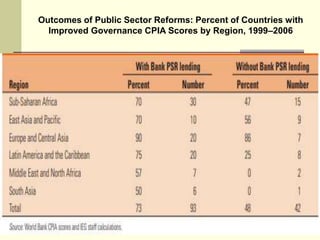
Outcomes of Public Sector Reforms: Percent of Countries with
Improved Governance CPIA Scores by Region, 1999–2006
23
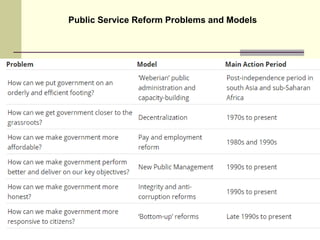
Public Service Reform Problems and Models
24
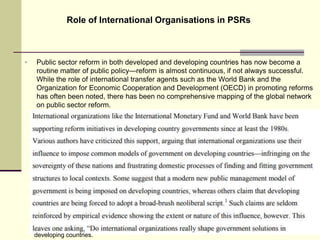
 Public sector reform in both developed and developing countries has now become a
routine matter of public policy—reform is almost continuous, if not always successful.
While the role of international transfer agents such as the World Bank and the
Organization for Economic Cooperation and Development (OECD) in promoting reforms
has often been noted, there has been no comprehensive mapping of the global network
on public sector reform.
Role of International Organisations in PSRs
25
developing countries.
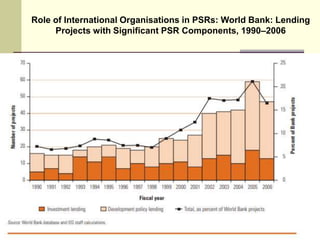
Role of International Organisations in PSRs: World Bank: Lending
Projects with Significant PSR Components, 1990–2006
26
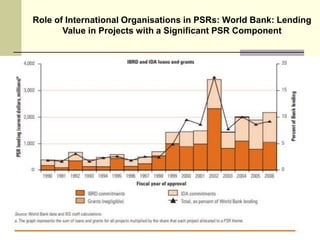
Role of International Organisations in PSRs: World Bank: Lending
Value in Projects with a Significant PSR Component
27
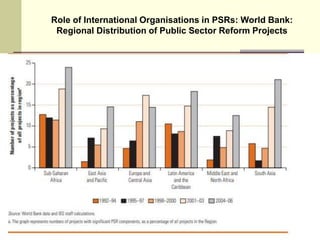
Role of International Organisations in PSRs: World Bank:
Regional Distribution of Public Sector Reform Projects
28
Role of International Organizations in PSRs: IMF
29
 The IMF works with its member countries to promote good governance and combat corruption. In its
surveillance, lending, and technical assistance, the IMF covers economic governance issues that fall
within its mandate and expertise, concentrating on issues likely to have a significant impact on
macroeconomic performance and the country authorities’ ability to pursue sound economic policies.
 In doing so, the IMF stresses evenhandedness across its member countries and collaborates closely
with other multilateral institutions.
 IMF surveillance involves annual reviews of countries’ economic policies, carried out through Article
IV consultations . In the process, staff may discuss economic consequences arising from poor
governance and advise on reforms to strengthen governance and fight corruption.
 Good governance is also promoted via IMF-supported lending. When warranted, specific measures
to strengthen governance may become part of the program’s conditionality.
 Many of the structural conditions in IMF-supported programs focus on improving governance and
reducing vulnerabilities to corruption, including through better public expenditure control,
publication of audited accounts of government agencies and state enterprises, streamlined and
less discretionary revenue administration, greater transparency in the management of natural
resources, the publication of audited central bank accounts, better bank supervision,
regulatory reforms that reduce the scope for bribes, stronger anti-money laundering measures,
and more effective anti-corruption legal frameworks.
Role of International Organizations in PSRs: IMF
30
• In all of these areas, the IMF also provides technical assistance to
help build effective economic institutions and advise countries on how
policies can be strengthened to improve governance and reduce
vulnerabilities to corruption.
• The IMF promotes good governance in two main areas:
• the management of public resources through reforms covering
public sector institutions; and
• the development and maintenance of a transparent and stable
economic and regulatory environment conducive to private sector
activities.
Thank you.
31

Public Service Reforms: An Introduction

  • 1.
    Public Service Reforms: Objectives, Principles, Outcomes & Role of International Organisations Dr. Emmanuel Moore ABOLO Director General, The Economic Thinktank Centre Lagos. Nigeria Group MD/CEO, The Risk Management Academy Limited President, Professional Speakers Society of Nigeria President, Institute for Governance, Risk Management & Compliance Professionals aboloemma@gmail.com; mail@drabolomoore.com; 08021003297
  • 2.
    OUTLINE 2  What isPublic Service  What is a Reform?  What is PSR?  Rationale/Objectives of Public Sector Reforms--Introduction  Rationale/Objectives of Public Sector Reforms  Principles of Public Sector Reforms  Features/Elements of Public Sector Reforms  Outcomes of Public Sector Reforms  Public Service Reform Problems and Models  Role of International Organisations in PSRs
  • 3.
     Public serviceis a service intended to serve all members of a community. It is usually provided by government to people living within its jurisdiction, either directly (through the public sector) or by financing provision of services.  The term is associated with a social consensus (usually expressed through democratic elections) that certain services should be available to all, regardless of income, physical ability or mental acuity. Even where public services are neither publicly provided nor publicly financed, for social and political reasons they are usually subject to regulation going beyond that applying to most economic sectors.  In modern democracies, public service is often performed by employees known as civil servants who are hired by elected officials. Government agencies are not profit-oriented and their employees are motivated very differently. Studies of their work have found contrasting results including both higher levels of effort and fewer hours of work.  A survey in the UK found that private sector hiring managers do not credit government experience as much as private sector experience. Public workers tend to make less in wages when adjusting for education, although that difference is reduced when benefits and hours are included. Public workers have other intangible benefits such as increased job security.  A public service may sometimes have the characteristics of a public good (being non- rivalrous and non- excludable), but most are services which may (according to prevailing social norms) be under-provided by the market. In most cases public services are services, i.e. they do not involve manufacturing of goods. They may be provided by local or national monopolies, especially in sectors which are natural monopolies.  They may involve outputs that are hard to attribute to specific individual effort or hard to measure in terms of key characteristics such as quality. They often require high levels of training and education. They may attract people with a public service ethos who wish to give something to the wider public or community through their work. What is Public Service? 3
  • 4.
     The conceptof reform defies clear-cut definition. Reform involves activities seeking to improve the public administration of the State, its roles and functions as well as the effectiveness and efficiency of its core public service institutions in a systemic and sustainable manner (Caiden 1978; 1978; 1980).  The emphasis on systemic and sustainable is to underline that the desired reforms bring about enduring changes in the behaviour of public sector actors in the interests of better outcomes for citizens.  When planned changes do not institutionalize new or modified behaviours and practices that lead to these better outcomes for citizens, the reforms do not qualify as systemic and sustainable (Sida, Irish Aid and UKAid 2013). According to Caiden and Sundaram (2004) reform may be viewed as a series of three things: (i) a deliberate plan to change public bureaucracies; (ii) synonymous with innovation, which is the injection of new ideas and new people in a new combination of tasks and relationships into the policy and administrative process; and (iii) coping with the uncertainties and rapid changes taking place in the organizational environment. In short, we may define reform as systematic changes in the administrative system, which are designed to lead to more efficient, effective and responsive administration. It has to do with the repositioning or re-profiling of an organization for effectiveness and efficiency (Caiden 1991a&b; 1999).  Some of its core elements include changes to public bureaucracies; innovation; systemic and wide- ranging changes, and urgent coping with changes occurring in the administrative environment. What is a Reform? 4
  • 5.
    What is PSR? Consistsof deliberate changes to the structures and processes of public sector organizations with the objective of getting them to run better. Structural change may include merging or splitting public sector organizations while process change may include redesigning systems, setting quality standards, and focusing on capacity-building. 5
  • 6.
    Public sector reform(PSR) refers to strengthening the management of the public sector. In particular, it involves an effort to fix the problems of the public sector, such as:  Over-extension – attempting to do too much with too few resources;  poor organization;  irrational decision-making processes; (iv) mismanagement of staff;  weak accountability;  poorly designed public programs; and  poorly delivered public services . A related term is public sector governance reform (PSGR), which is about systemic, and sustainable performance improvement in the public sector. It has been pointed out that the importance of PSGR can be appreciated through the following specific improvements that could be anticipated from its successful design and implementation:  improved service delivery;  improved efficiency and value for money;  increasing private sector involvement in public policy and service delivery; devolution of functions and finance to sub-national government;  more effective machinery of government;  enhanced government transparency and accountability;  engagement of citizens in public service development and oversight;  enhanced public sector leadership and professionalism; strengthened strategic management in government; management decentralization with associated accountability for ministries, departments and agencies What is PSR? 6
  • 7.
     The effectivenessand efficiency of a country’s public sector is vital to the success of development activities. Sound financial management, an efficient civil service and administrative policy, efficient and fair collection of taxes, and transparent operations that are relatively free of corruption all contribute to good delivery of public services.  The public sector is the largest spender and employer in virtually every developing country, and it sets the policy environment for the rest of the economy.  The quality of the public sector— accountability, effectiveness, and efficiency in service delivery, transparency, and so forth—is thought by many to contribute to development.  Public sector reforms continue to be an integral part of governments’ efforts to modernise the public service, making it more citizen-centric and responsive.  The effectiveness and efficiency of a country’s public sector is vital to the success of development activities. Sound financial management, an efficient civil service and administrative policy, efficient and fair collection of taxes, and transparent operations that are relatively free of corruption all contribute to good delivery of public services.  The public sector is the largest spender and employer in virtually every developing country, and it sets the policy environment for the rest of the economy. Rationale/Objectives of Public Sector Reforms--Introduction 7
  • 8.
     The publicsector is pivotal both to the day-to-day operation of the state and to its ability to effectively manage development processes and provide universal public goods and services. Public administrators or servants are critical in their roles as gatekeepers, policy-makers, implementers and distributors.  As intermediaries between politicians and the wider population, they are essential to ensuring the penetration of the state at the local level, to the allocation and distribution of resources and to the enforcement of rules.  In short, the public sector plays a vital role in national development and its relevance cannot be underestimated in Africa .  This was re-echoed in the 1997 World Development Report that “an effective state is vital for the provision of goods and services – and the rules and institutions – that allow markets to flourish and the people to lead healthier, happier lives. Without it, sustainable development, both economic and social, is impossible” .  However, the public sector is generally perceived as an obstacle to development because it is plagued by poverty, corruption, inefficiency, poor management, low morale, neo-patrimonialism and political instability Rationale/Objectives of Public Sector Reforms 8
  • 9.
     This hasled to the rationale behind PSRs which entails the “redefinition of the role of the state” whereby the state only performs functions that should be at the level of the state while leaving the other functions to subnational governments and the private sector through the strategies of decentralization, commercialization and privatization and liquidation of state enterprises .  Public sector reforms were largely driven by economic reform, democratization and the search for administrative efficiency to improve the quality of goods and services delivered to the public . Notable examples include the “big bang” comprehensive state reforms in New Zealand from the mid-1980s through the early 1990s, the radical transformation of administrative culture in the United Kingdom (1979-1998), the Government Performance and Results Act (1993) in the United States, the total quality management movements in several Southeastern Asian countries and the decentralized management initiative in several Latin American countries.  These examples emphasized a reduced role of the state, effectiveness of public sector institutions in providing value for money services and seemingly market-oriented organizational mechanisms such as decentralization, privatization, commercialization, contracting out, deregulation, performance management, downsizing and pay reform to ensure and improve effective and efficient public service delivery. Rationale/Objectives of Public Sector Reforms 9
  • 10.
    The Commonwealth WorkingGroup on Public Administration (CWGPA), endorsed the following key guiding principles which met on 27–28 November 2014 in London:  A new pragmatic and results-oriented framework  Clarification of objectives and administrative structures  Intelligent political strategies and engagement  Goal-oriented competencies and skills development  Experimentation and innovation  Professionalisation and improved morale  A code of conduct for public sector ethics  Effective and pragmatic anti-corruption strategies  Effective public financial management Let us now discuss each of them. Principles of Public Sector Reforms 10
  • 11.
    A new pragmaticand results-oriented framework:  As the pressure on public resources continues to rise, increased demand for better, high- quality and more responsive public services has prompted most governments to embrace results-oriented frameworks for programme planning and delivery. The aim is to facilitate better service delivery and ‘value for money’.  The focus on results helps determine national strategic priorities and objectives (outcomes/results) and translation of these into outputs. This focus also ensures a linkage between costs and outputs and outcomes, and measures how efficiently and effectively these outputs and outcomes are being achieved. Clarification of objectives and administrative structures:  In many countries, there are significant skill gaps in the bureaucracy, given the development and administrative challenges involved in an increasingly globalised and competitive world.  Capacity development remains a key priority in many countries, but this needs to be linked to a careful analysis of politically feasible development priorities and needs. Administrative capabilities for service delivery; regulation of local and foreign businesses; and implementation of policies to develop the capabilities of domestic enterprises or regulate particular sectors, for example international trade, natural resources, infrastructure and service delivery to citizens and vulnerable groups—all of these are important. Principles of Public Sector Reforms 11
  • 12.
    Intelligent political strategiesand engagement:  Linkages between politics (formal and informal political arrangements and power structures), policies (objectives and goals) and administrative capabilities (the public bureaucracy) should be the basis for a pragmatic incremental approach to public service reform.  Reform should thus seek to craft strategic engagements between the political and administrative leaderships so as to forge mechanisms that enhance performance and public service delivery. Goal-oriented competencies and skills development:  Capacity-building must be conducted around specific needs, and training must be tailored to address this need and ensure the skills being built directly address the goals to be achieved.  Capacity-building must not only focus on the ‘hard issues’, such as administrative, legal and constitutional matters; also, public service officials must be equipped with ‘soft skills’, such as in negotiation, diplomacy, leadership, public speaking and communication. This will complement their technical knowledge and enhance their performance and productivity. Principles of Public Sector Reforms 12
  • 13.
    Experimentation and innovation: The development of capabilities and the evolution of effective problem-solving approaches requires bureaucracy capacity to carry out experimentation and learning within carefully defined limits.  The experience of successful countries shows that bureaucracies are most effective when they experiment with new and innovative ways of problem- solving.  However, experimentation is difficult because it appears to go against the logic of rule-following behaviour and risk aversion and the need to enforce accountability.  Successful experimentation requires significant changes in the philosophy of administrative reform in many countries, but this depends on local conditions and policy priorities. Principles of Public Sector Reforms 13
  • 14.
    Professionalisation and improvedmorale:  A common experience across many countries is the gradual reduction of morale, a loss of the esprit de corps that has historically been important in ensuring high levels of commitment and probity in public services. Higher levels of remuneration and better social recognition of the work of public servants are important but insufficient on their own.  Non-financial incentives, competitive remuneration and a citizen-based approach to service delivery are some of the ways of both improving perceptions of service delivery and incentivising public servants.  Professionalisation and morale are also a direct reflection of the inclusiveness of society.  On professionalization, a key challenge has been the politicization of the public service and the impact this has on appointments and promotions. This often compromises administrative efficiency and the delivery of developmental goals.  In some cases, the public service is so politicized that the sustainability of democracy and trust in government represents an ongoing challenge.  The administrative bureaucracy has also failed to neutrally serve different political parties professionally, inducing new governments to put ‘loyalty’ above professionalism. Principles of Public Sector Reforms 14
  • 15.
    Professionalisation and improvedmorale:  In some countries, there is the expectation that politicians will create jobs for their constituents and reward their supporters. This is common in countries where the private sector is not well developed and government remains the main provider of goods and services.  Appropriate training and orientation for both politicians and bureaucrats, setting appropriate appointment and promotion procedures, tenures of office and other feasible incremental reforms, are essential.  In this regard, ensuring that the relevant state institutions, such as public service commissions, are modernized and able to function independently, is critical to sustaining morale in the public service. Principles of Public Sector Reforms 15
  • 16.
    A code ofconduct for public sector ethics:  The development of open and enforceable public service standards and ethics is critical to improving both the perception and the professionalism of the public service.  The enforcement of such professional codes should go beyond legal enforcement to include non-judicial channels such as internal or external peer reviews and self- regulation.  The organisation of administrative reforms has to have this as a major objective in the design of training programs, the curricula of administrative training institutes and the appointment of leaders of the administrative system.  Combining these steps with the adoption and enforcement of codes of conduct that highlight the high standards of public service could help raise public respect for the public service. Principles of Public Sector Reforms 16
  • 17.
    Effective and pragmaticanti-corruption strategies:  Anti-corruption strategies in developing countries often do not achieve significant results because they are overly ambitious and do not target specific problems. The critical points at which corruption has the most damaging effects in a country depend on the policy priorities of the country.  Given the limited policy implementation capabilities in many developing countries, focusing on technological improvements to policy implementation can have a direct positive impact on anti-corruption strategies.  The achievement of even partial success in selected areas can create the momentum to expand the remit of technological changes and job design within institutions to limit the effects of corruption.  These incremental and pragmatic approaches to tackling corruption are more likely to achieve results than ambitious approaches that attempt to reduce corruption across the board in countries where ambitious institutional changes cannot be implemented. Principles of Public Sector Reforms 17
  • 18.
    Effective public financialmanagement:  Sound PFM is an essential part of the development process. PFM supports aggregate control, prioritisation, accountability and efficiency in the management of public resources and service delivery, which are critical to the achievement of national policy objectives and goals, including the Sustainable Development Goals (SDGs).  The management and operation of public finances is therefore at the heart of administrative and reform challenges in the public service.  The introduction of reforms such as Financial Management Information Systems (FMIS), procurement and asset/wealth declaration laws has helped minimize loopholes for corrupt practices and misuse of public financial resources.  Nonetheless, corruption requires more proactive attention to regulatory mechanisms, such as making oversight institutions such as the supreme audit and the internal audit and public procurement more effective and making the decision-making process more transparent. In addition, enforcement of rules and reporting mechanisms is imperative. Principles of Public Sector Reforms 18
  • 19.
    PSRs have focusedon the following five features or elements. They are:  the redefinition of the role of the state, which includes the principle of subsidiarity;  efficiency measures such as improved financial and human resources systems to enhance public management performance;  financial management that includes budget reforms, the introduction of the medium and expenditure framework (MTEF) and tax administration such as the creation of semi-autonomous revenue agencies;  improved service delivery through surveys of service delivery, quality charters and programme evaluation;  enforcing accountability through internal and external control mechanisms such as internal audits, code of ethics, developing capacity of supreme audit agencies and improving the independence of the judiciary, legislative and civil society organizations A new element has been introduced which some scholars have referred to as the “new public service, serving rather than steering” Features/Elements of Public Sector Reforms 19
  • 20.
     There isevidence in the literature to show that the outcomes of public sector reform have been consistently disappointing (McCourt 2013). For instance, a World Bank internal paper (2010) carried the title: Why do Bank-supported public service reform efforts have such a poor track record?  However, research also points to the existence of more successful reform experiences that do lead to more functional governments.  In these instances, reforms facilitate the establishment of governments that solve problems and achieve the kind of functionality needed to produce public value; new public financial management systems actually foster better resource use, administrative reforms foster better service delivery, trade reforms generate higher volumes of trade, and so forth.  These experiences could be called positive outliers; given that they produce results that are better than the norm.  ‘Positive deviance’ is another term that describes such experiences. The term has been used in various literatures but entered the development domain because of the work of Pascale, Sternin, and Sternin (2010).  These authors argue that positive deviance is observable in every community or field, where some agents find better solutions to problems than their peers even though they have similar resources as their peers and face similar challenges and obstacles. Outcomes of Public Sector Reforms 20
  • 21.
     Given suchbelief, the positive deviance approach has emerged as a way of identifying workable solutions to development’s toughest problems. It emphasizes the importance of learning from the positive deviants within the contexts where failure is more normal; and focuses especially on learning about the strategies adopted to find and fit effective solutions.  The importance of this kind of learning cannot be overstated in the international development domain. This importance is reflected in a number of studies that have tried to promote such learning in the past decades. Many of these studies try to explain ‘pockets of productivity’ or ‘islands of excellence’ in government organizations in developing countries.  These include studies like Grindle and Thomas (1991), Leonard (1991), Schneider (1991), Grindle (1997), Tendler (1997), Uphoff, Esman and Krishna (1998), Heredia and Schneider (2002), Grindle (2004), Owusu (2006), Bebbington and McCourt (2007).  These studies actually investigate different manifestations of what is being called “positive deviance”. Some focus on oddly successful organizations, others on successful policy interventions, and yet others on successful reforms themselves.  In most cases, the successes one sees emerged from some or other change process, however, so it is appropriate in all cases to ask how such change (or reform) came about and was consolidated to foster more effective government, where Leonard (2010) sees success as the improvement in state capability to sustainably generate public goods. Outcomes of Public Sector Reforms 21
  • 22.
     Public servicereform is staggeringly complex: so many political and institutional ducks to line up, and at so many levels, from the capital city to the remotest outpost of the State.  Most public servants, even very senior ones, have little access to the big levers of government-wide reform.  Similarly, international development agencies find themselves interacting for much of the time with individual public agencies.  If they are reform-minded, public servants and development agencies will want to start from where they are, namely in an individual agency, rather than from where they might like to be, namely at the level of government as a whole. Outcomes of Public Sector Reforms 22
  • 23.
    Outcomes of PublicSector Reforms: Percent of Countries with Improved Governance CPIA Scores by Region, 1999–2006 23
  • 24.
    Public Service ReformProblems and Models 24
  • 25.
     Public sectorreform in both developed and developing countries has now become a routine matter of public policy—reform is almost continuous, if not always successful. While the role of international transfer agents such as the World Bank and the Organization for Economic Cooperation and Development (OECD) in promoting reforms has often been noted, there has been no comprehensive mapping of the global network on public sector reform. Role of International Organisations in PSRs 25 developing countries.
  • 26.
    Role of InternationalOrganisations in PSRs: World Bank: Lending Projects with Significant PSR Components, 1990–2006 26
  • 27.
    Role of InternationalOrganisations in PSRs: World Bank: Lending Value in Projects with a Significant PSR Component 27
  • 28.
    Role of InternationalOrganisations in PSRs: World Bank: Regional Distribution of Public Sector Reform Projects 28
  • 29.
    Role of InternationalOrganizations in PSRs: IMF 29  The IMF works with its member countries to promote good governance and combat corruption. In its surveillance, lending, and technical assistance, the IMF covers economic governance issues that fall within its mandate and expertise, concentrating on issues likely to have a significant impact on macroeconomic performance and the country authorities’ ability to pursue sound economic policies.  In doing so, the IMF stresses evenhandedness across its member countries and collaborates closely with other multilateral institutions.  IMF surveillance involves annual reviews of countries’ economic policies, carried out through Article IV consultations . In the process, staff may discuss economic consequences arising from poor governance and advise on reforms to strengthen governance and fight corruption.  Good governance is also promoted via IMF-supported lending. When warranted, specific measures to strengthen governance may become part of the program’s conditionality.  Many of the structural conditions in IMF-supported programs focus on improving governance and reducing vulnerabilities to corruption, including through better public expenditure control, publication of audited accounts of government agencies and state enterprises, streamlined and less discretionary revenue administration, greater transparency in the management of natural resources, the publication of audited central bank accounts, better bank supervision, regulatory reforms that reduce the scope for bribes, stronger anti-money laundering measures, and more effective anti-corruption legal frameworks.
  • 30.
    Role of InternationalOrganizations in PSRs: IMF 30 • In all of these areas, the IMF also provides technical assistance to help build effective economic institutions and advise countries on how policies can be strengthened to improve governance and reduce vulnerabilities to corruption. • The IMF promotes good governance in two main areas: • the management of public resources through reforms covering public sector institutions; and • the development and maintenance of a transparent and stable economic and regulatory environment conducive to private sector activities.
  • 31.