Special Thanks to DR. Narendra Raj Poudel (Central
Department of Public Administration) and also those
researchers who made my work easier……
BY, NIRANJAN PRAKASH NIROULA
STUDENTS
CENTRAL DEPARTMENT OF PUBLIC
ADMINISTRATION
GARIBILEMAROO@GMAIL.COM
PRESENTATION CLASS
JULY 31, 2014
Social Inclusion: Challenges,
Opportunity and Way Forward
© 2014, Niranjan Prakash Niroula
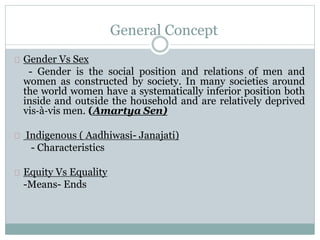
General Concept
Gender Vs Sex
- Gender is the social position and relations of men and
women as constructed by society. In many societies
around the world women have a systematically inferior
position both inside and outside the household and are
relatively deprived vis‐à‐vis men. (Amartya Sen)
Equity Vs Equality
-Means- Ends
General Concept- 2
Social Exclusion
- Social exclusion describes the experience of
groups who are systematically disadvantaged against
on the basis of their caste, gender, ethnicity, race,
religion, sexual orientation, age, disability, HIV
status, migrant status or where they live. DFID
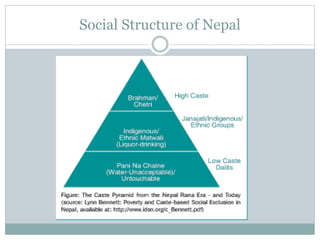
Social Structure of Nepal
Introduction to Social Inclusion
Poverty divides us. Social inclusion can unite us. Whenever too many fall too far
behind the rest, our whole society is diminished. Inclusion demands goals and
policies (multicultural policies) that avoid separating us. Inclusion calls on us to
strive for a nation in which everyone lives with purpose, dignity and satisfaction.
(Bond of Common Fate, www.inclusivedemocracy.org)
Social inclusion is about participation of most disadvantaged people, who are left
out from the mainstream of development and governance process. (Narendra
Raj Paudel, 2014)
Social inclusion generally defined as a process of removing institutionalized social
barriers to solve the persistent problems related to class, caste, regional and gender
development in Nepal. (Gurung, n.d. , quoted from Paudel, 2014)
Antithesis of social exclusion
Rightful sharing of power, resources and opportunity.
Socially Constructed- so we can change this.
Three Phases that create fertile land for
Social Exclusion --(Harka Gurung)
1 . Feudalism Phase (1846-1951)
- Hinduism (dominated other religion)
- Muluki Ain, 1853 (punishment according to caste)
- I want to call this phase as a “Darwinian State Phase”
- Parochial political culture ( didn’t have political awareness- Almond & Verba, 1963)
2. Homogeneity Phase (1951-1990)
-Slogan (ek desh, ek bhasa-Nepali, ek bhes-daura suruwaal)
-Subject political culture ( having political culture but not desire for participation- ibid)
3. Ethnic Diversity Phase (1990-2006)
-gave spaces for multiethnic, multilingual but not multi religious (i.e. still domination by one
religion-Hindu)
- Participant political culture (political awareness- ibid)
Also due to globalization and 10 years long internal conflict gave stresses for social inclusion
(multiculturalism) in governance system. (Opening up a “Pandora's Box”)
Factors that influence Social Exclusion
Development Process- Economic Dimension (physical + psychological + emotional)
- Centralized development (Kathmandu- Jumla = Unequal investment )
- Supply centered (One who is born with a golden spoon hardly knows what
poverty is - Modhi)
Exclusion from social services delivery- Social Dimension
- Education. Health, Social security (lacks accessibility and availability)
- Targeted Group?
- Social inequality
Exclusion from Practices of Power- Political Dimension (lacks authority- participation in
governance system)
- Some caste holds excessive power
-Vertical relationship
Factors that influence Social Exclusion- 2
Culture of no confidence syndrome
- Undervalue their own potentiality, capability
Geographical Dimensions
Religious beliefs and practices
Why Social Inclusion?
Every people feel valued (David Cappo, 2002),
Their differences are respected (ibid),
Opportunity release their full potentiality,
Its also one of the strategy for fight against exclusion which
creates
- National unity and integrity
- Institutionalize of democracy (nearer to the people)
- Management of social conflict
- Social justice
- Popular participation in governance system
Tools for Social Inclusion
Participation with Control
Empowerment and Capacity development
Proportional Representation
Reservation, Special Protection, Subsidies can be
used for short term
Tools for Social Inclusion- 2
Positive Discrimination (Equality through equity)
- Mainstreaming to marginalized
- Support to Disadvantaged
- Opportunity to excluded
- Empower to weaker
Legal Protection
Investment in Human Development and Poverty
Alleviation
Awareness Programs
Practices in Nepal
Commitment towards inclusive democracy
-Political+ Economic+ Social+ Ecological= Combination
Constitutional Provision
Legal Arrangements
Institutional Arrangements
Agreement on International Instruments
Policies and Activities
- Three Year Plan
- Specific Initiatives
- Gender sensitive budget
Threats/ Challenges and Opportunity
Structure of Society – Vertical
- Religion biased 10- Hindu (81.3%)- 90% holds in civil service
- Caste Biased 126- Brahmin, Cheetri, Newar (33.8%)- 73.8%
holds
- Lingual Biased 123- Nepali (44.4%)
-Gender Biased – Male (48.50%)- 85% holds-- ( CBS Report,
2013 & www.psc.gov.np )
Nation Building
- unequal distribution/ sharing of resources- vicious circle of
poverty- hungry stomach- conflict
Substantive Equality (not for Window Dressing))
Threats/ Challenges and Opportunity- 2
Diversity Management (mobilization to accomplish
national goals which creates diversity dividend)
- Managing the differences within the country
(www.diversityworking.com)
- Multicultural societies contribute synergetic effects on
nation building.
-We have to capitalize the diversity to enhance socio-
economic development through organizational practices.
Conflict Management
Institutionalization of Democracy
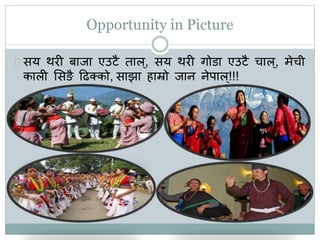
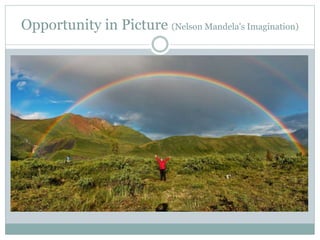
Opportunity in Picture
सय थरी बाजा एउटै ताल्, सय थरी गोडा एउटै चाल्, मेची
काली ससङै ढिक्को, साझा हाम्रो जान नेपाल्!!!
Opportunity in Picture (Nelson Mandela's Imagination)
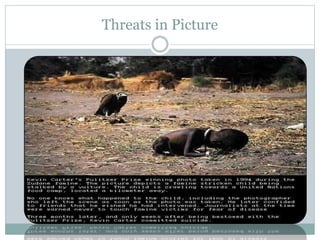
Threats in Picture
Conclusion
Reservation is the floor not the ceiling.
It is largely very low participation (45% does not work
for targeted people. Women - Just 28% in Legislative
body and 15% in Bureaucracy). (www.psc.gov.np)
Current reservation policy can not fulfill the objective
of representation with equity.
The reservation policy is captured by creamy layers.
Conclusion- 2
Psychological cost- They are there because they have quota.
Absence of governmental apparatus in backward region-
loose ownership, public trust and threat to nation building.
( officer exam- Kathmandu)
Inclusion, Gender sensitiveness- but not manage
meaningfully and scientifically
So, it would be better for someone to enable how to fishing
but not to feed them with fried fish, it makes him/her more
dependence and divides the society into two parts “We” and
“ They”.
Way Forward for Future Action
Create an environment that would help benefit the target group
to avail inclusive policies for the diversification of civil service.
The reservation should not privilege creamy layers of
beneficiaries at the true expanse of true egalitarianism. The
provision of reservation within the reservation is needed.
(Paudel, 2014)
Sharpen the weapons before they are used. Education, training,
seminars, workshops and other skill developing programs
certainly empower people and then the level of opportunity
automatically increases.
Focus on empowerment (creates equal playing field) rather
than reservation (side effect- but just for certain period).
Focus on quality rather than just quantity.
Way Forward for Future Action- 2
Guarantee to participate in governance system- Identity,
Access and Representation.
Inclusion is not just to reach power structure but to control
these. (for meaningful and constructive participation)
Change our age old patterns of behavior. {patrimonial
system- women as means of love (does not give anything) to
women as a means of respect which creates opportunity}
Last but not least, it needs to focus on such policies and
programs that enable and empower them to compete each
and every field with more confidence.
Final Conclusion
Human development, if not
engendered, is endangered.
-UNDP, 1995
Wait!!!
Stay Hungry! Stay Foolish!
Thank You for Your Kind Attention!
Question Please!!!

Social inclusion in Nepal

  • 1.
    Special Thanks toDR. Narendra Raj Poudel (Central Department of Public Administration) and also those researchers who made my work easier……
  • 2.
    BY, NIRANJAN PRAKASHNIROULA STUDENTS CENTRAL DEPARTMENT OF PUBLIC ADMINISTRATION GARIBILEMAROO@GMAIL.COM PRESENTATION CLASS JULY 31, 2014 Social Inclusion: Challenges, Opportunity and Way Forward © 2014, Niranjan Prakash Niroula
  • 3.
    General Concept Gender VsSex - Gender is the social position and relations of men and women as constructed by society. In many societies around the world women have a systematically inferior position both inside and outside the household and are relatively deprived vis‐à‐vis men. (Amartya Sen) Equity Vs Equality -Means- Ends
  • 4.
    General Concept- 2 SocialExclusion - Social exclusion describes the experience of groups who are systematically disadvantaged against on the basis of their caste, gender, ethnicity, race, religion, sexual orientation, age, disability, HIV status, migrant status or where they live. DFID
  • 5.
  • 6.
    Introduction to SocialInclusion Poverty divides us. Social inclusion can unite us. Whenever too many fall too far behind the rest, our whole society is diminished. Inclusion demands goals and policies (multicultural policies) that avoid separating us. Inclusion calls on us to strive for a nation in which everyone lives with purpose, dignity and satisfaction. (Bond of Common Fate, www.inclusivedemocracy.org) Social inclusion is about participation of most disadvantaged people, who are left out from the mainstream of development and governance process. (Narendra Raj Paudel, 2014) Social inclusion generally defined as a process of removing institutionalized social barriers to solve the persistent problems related to class, caste, regional and gender development in Nepal. (Gurung, n.d. , quoted from Paudel, 2014) Antithesis of social exclusion Rightful sharing of power, resources and opportunity. Socially Constructed- so we can change this.
  • 7.
    Three Phases thatcreate fertile land for Social Exclusion --(Harka Gurung) 1 . Feudalism Phase (1846-1951) - Hinduism (dominated other religion) - Muluki Ain, 1853 (punishment according to caste) - I want to call this phase as a “Darwinian State Phase” - Parochial political culture ( didn’t have political awareness- Almond & Verba, 1963) 2. Homogeneity Phase (1951-1990) -Slogan (ek desh, ek bhasa-Nepali, ek bhes-daura suruwaal) -Subject political culture ( having political culture but not desire for participation- ibid) 3. Ethnic Diversity Phase (1990-2006) -gave spaces for multiethnic, multilingual but not multi religious (i.e. still domination by one religion-Hindu) - Participant political culture (political awareness- ibid) Also due to globalization and 10 years long internal conflict gave stresses for social inclusion (multiculturalism) in governance system. (Opening up a “Pandora's Box”)
  • 8.
    Factors that influenceSocial Exclusion Development Process- Economic Dimension (physical + psychological + emotional) - Centralized development (Kathmandu- Jumla = Unequal investment ) - Supply centered (One who is born with a golden spoon hardly knows what poverty is - Modhi) Exclusion from social services delivery- Social Dimension - Education. Health, Social security (lacks accessibility and availability) - Targeted Group? - Social inequality Exclusion from Practices of Power- Political Dimension (lacks authority- participation in governance system) - Some caste holds excessive power -Vertical relationship
  • 9.
    Factors that influenceSocial Exclusion- 2 Culture of no confidence syndrome - Undervalue their own potentiality, capability Geographical Dimensions Religious beliefs and practices
  • 10.
    Why Social Inclusion? Everypeople feel valued (David Cappo, 2002), Their differences are respected (ibid), Opportunity release their full potentiality, Its also one of the strategy for fight against exclusion which creates - National unity and integrity - Institutionalize of democracy (nearer to the people) - Management of social conflict - Social justice - Popular participation in governance system
  • 11.
    Tools for SocialInclusion Participation with Control Empowerment and Capacity development Proportional Representation Reservation, Special Protection, Subsidies can be used for short term
  • 12.
    Tools for SocialInclusion- 2 Positive Discrimination (Equality through equity) - Mainstreaming to marginalized - Support to Disadvantaged - Opportunity to excluded - Empower to weaker Legal Protection Investment in Human Development and Poverty Alleviation Awareness Programs
  • 13.
    Practices in Nepal Commitmenttowards inclusive democracy -Political+ Economic+ Social+ Ecological= Combination Constitutional Provision Legal Arrangements Institutional Arrangements Agreement on International Instruments Policies and Activities - Three Year Plan - Specific Initiatives - Gender sensitive budget
  • 14.
    Threats/ Challenges andOpportunity Structure of Society – Vertical - Religion biased 10- Hindu (81.3%)- 90% holds in civil service - Caste Biased 126- Brahmin, Cheetri, Newar (33.8%)- 73.8% holds - Lingual Biased 123- Nepali (44.4%) -Gender Biased – Male (48.50%)- 85% holds-- ( CBS Report, 2013 & www.psc.gov.np ) Nation Building - unequal distribution/ sharing of resources- vicious circle of poverty- hungry stomach- conflict Substantive Equality (not for Window Dressing))
  • 15.
    Threats/ Challenges andOpportunity- 2 Diversity Management (mobilization to accomplish national goals which creates diversity dividend) - Managing the differences within the country (www.diversityworking.com) - Multicultural societies contribute synergetic effects on nation building. -We have to capitalize the diversity to enhance socio- economic development through organizational practices. Conflict Management Institutionalization of Democracy
  • 16.
    Opportunity in Picture सयथरी बाजा एउटै ताल्, सय थरी गोडा एउटै चाल्, मेची काली ससङै ढिक्को, साझा हाम्रो जान नेपाल्!!!
  • 17.
    Opportunity in Picture(Nelson Mandela's Imagination)
  • 18.
  • 19.
    Conclusion Reservation is thefloor not the ceiling. It is largely very low participation (45% does not work for targeted people. Women - Just 28% in Legislative body and 15% in Bureaucracy). (www.psc.gov.np) Current reservation policy can not fulfill the objective of representation with equity. The reservation policy is captured by creamy layers.
  • 20.
    Conclusion- 2 Psychological cost-They are there because they have quota. Absence of governmental apparatus in backward region- loose ownership, public trust and threat to nation building. ( officer exam- Kathmandu) Inclusion, Gender sensitiveness- but not manage meaningfully and scientifically So, it would be better for someone to enable how to fishing but not to feed them with fried fish, it makes him/her more dependence and divides the society into two parts “We” and “ They”.
  • 21.
    Way Forward forFuture Action Create an environment that would help benefit the target group to avail inclusive policies for the diversification of civil service. The reservation should not privilege creamy layers of beneficiaries at the true expanse of true egalitarianism. The provision of reservation within the reservation is needed. (Paudel, 2014) Sharpen the weapons before they are used. Education, training, seminars, workshops and other skill developing programs certainly empower people and then the level of opportunity automatically increases. Focus on empowerment (creates equal playing field) rather than reservation (side effect- but just for certain period). Focus on quality rather than just quantity.
  • 22.
    Way Forward forFuture Action- 2 Guarantee to participate in governance system- Identity, Access and Representation. Inclusion is not just to reach power structure but to control these. (for meaningful and constructive participation) Change our age old patterns of behavior. {patrimonial system- women as means of love (does not give anything) to women as a means of respect which creates opportunity} Last but not least, it needs to focus on such policies and programs that enable and empower them to compete each and every field with more confidence.
  • 23.
    Final Conclusion Human development,if not engendered, is endangered. -UNDP, 1995
  • 24.
  • 25.
    Thank You forYour Kind Attention! Question Please!!!

Editor's Notes

  • #26 Presented by Niranjan Prakash Niroula ( Class Purpose)