Module 11
Citizen Engagement and the Political-
Bureaucratic Divide
PRESENTER
Citizen Engagement
Client and User Satisfaction
 Ensuring that clients are satisfied with a
product is nothing new.
 In the private sector client satisfaction is
often what makes or breaks a product or a
company.
 However, in the public sector the
relationship between services and users is
rather different.
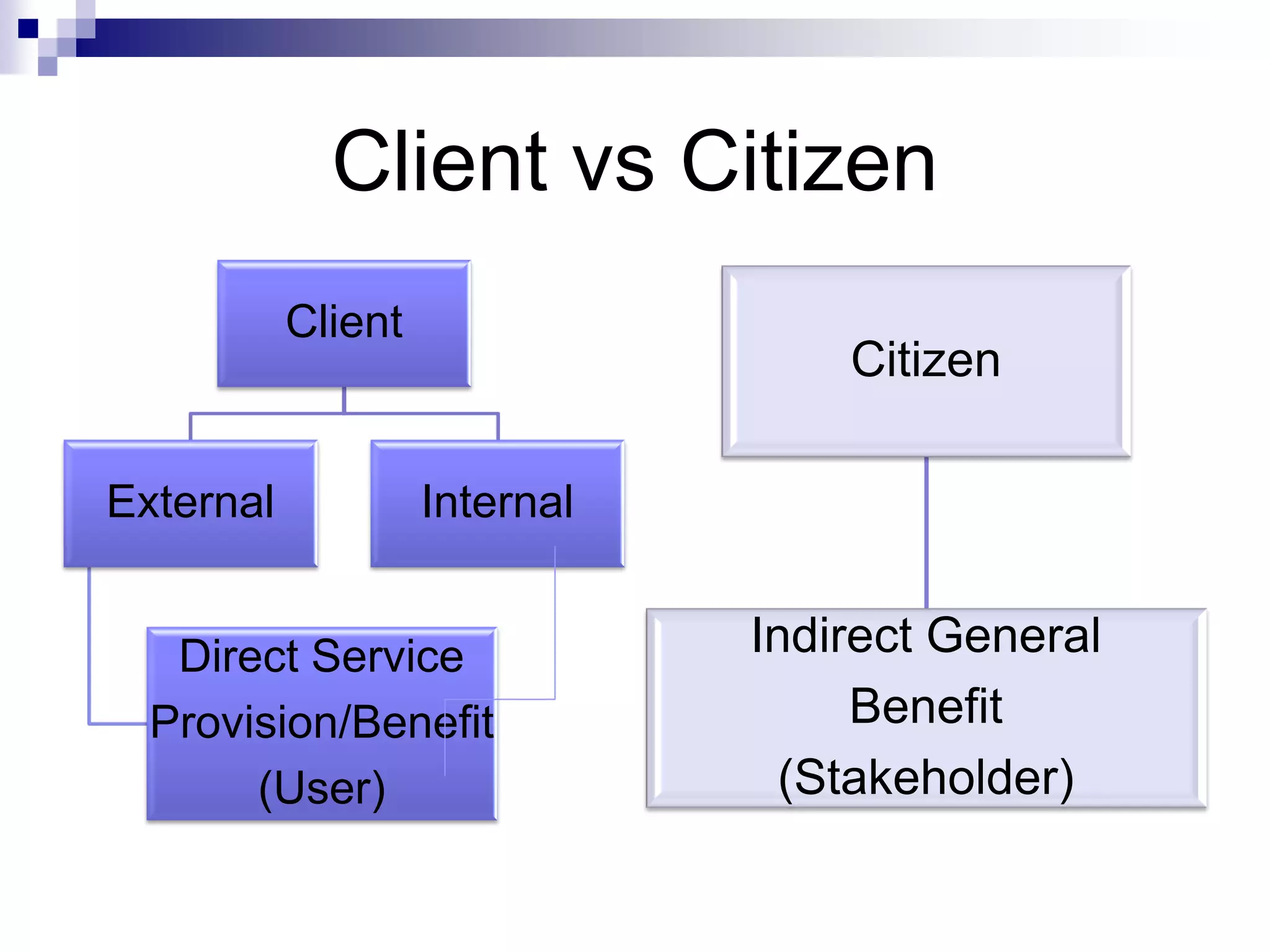
Client vs Citizen
Client
External
Direct Service
Provision/Benefit
(User)
Internal
Citizen
Indirect General
Benefit
(Stakeholder)
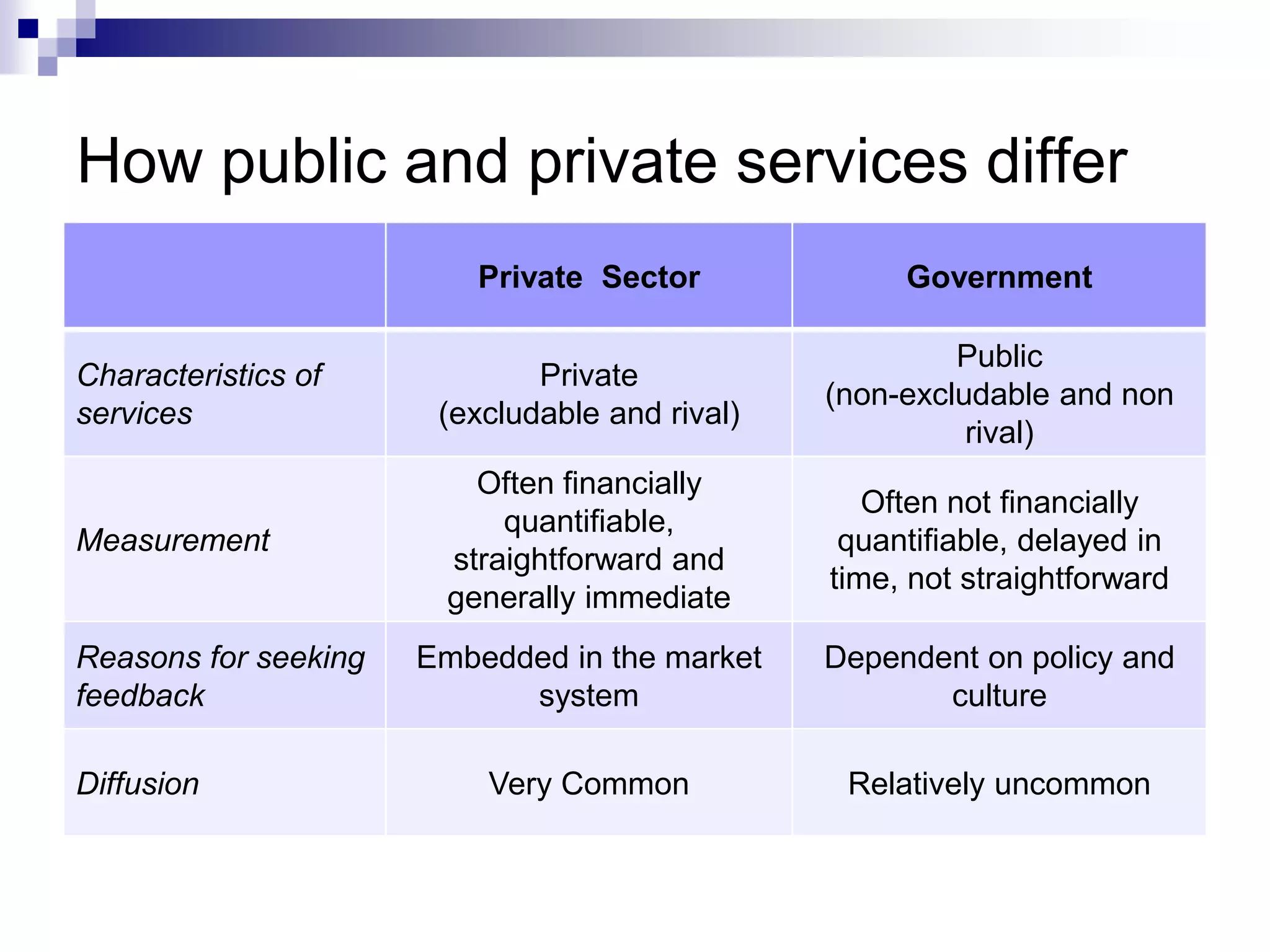
How public and private services differ
Private Sector Government
Characteristics of
services
Private
(excludable and rival)
Public
(non-excludable and non
rival)
Measurement
Often financially
quantifiable,
straightforward and
generally immediate
Often not financially
quantifiable, delayed in
time, not straightforward
Reasons for seeking
feedback
Embedded in the market
system
Dependent on policy and
culture
Diffusion Very Common Relatively uncommon
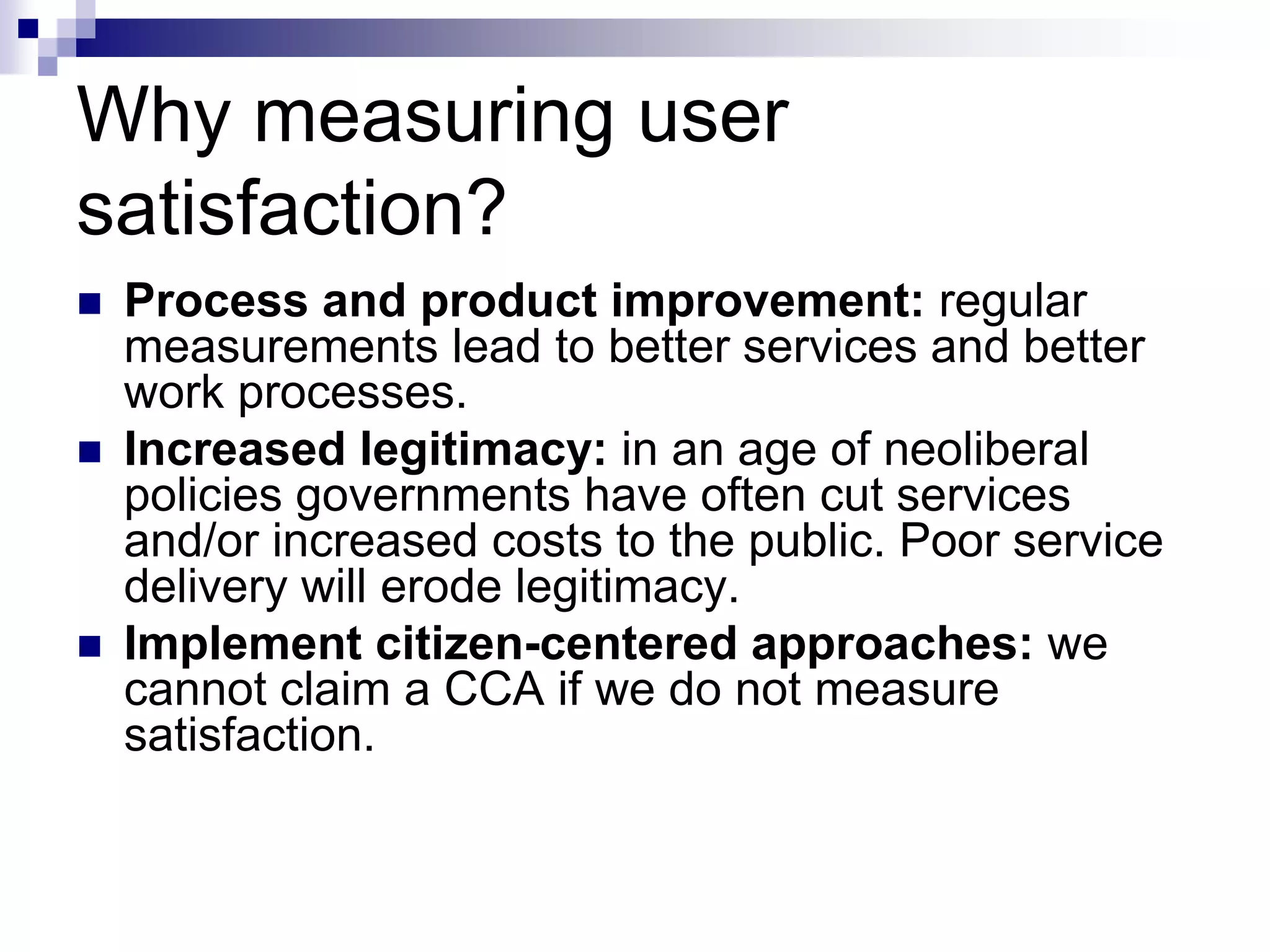
Why measuring user
satisfaction?
 Process and product improvement: regular
measurements lead to better services and better
work processes.
 Increased legitimacy: in an age of neoliberal
policies governments have often cut services
and/or increased costs to the public. Poor service
delivery will erode legitimacy.
 Implement citizen-centered approaches: we
cannot claim a CCA if we do not measure
satisfaction.
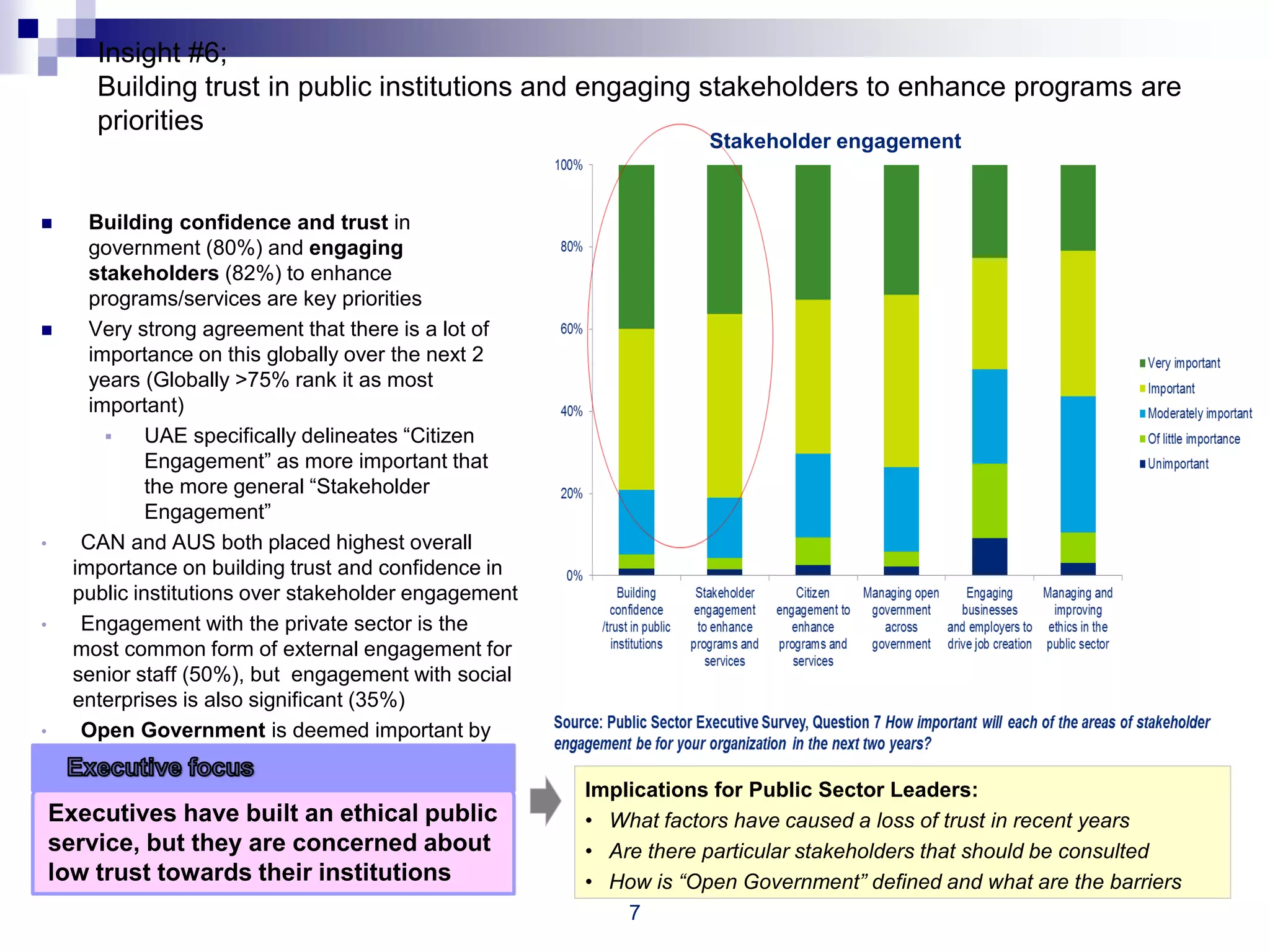
Insight #6;
Building trust in public institutions and engaging stakeholders to enhance programs are
priorities
 Building confidence and trust in
government (80%) and engaging
stakeholders (82%) to enhance
programs/services are key priorities
 Very strong agreement that there is a lot of
importance on this globally over the next 2
years (Globally >75% rank it as most
important)
 UAE specifically delineates “Citizen
Engagement” as more important that
the more general “Stakeholder
Engagement”
• CAN and AUS both placed highest overall
importance on building trust and confidence in
public institutions over stakeholder engagement
• Engagement with the private sector is the
most common form of external engagement for
senior staff (50%), but engagement with social
enterprises is also significant (35%)
• Open Government is deemed important by
75% of participants
7
Implications for Public Sector Leaders:
• What factors have caused a loss of trust in recent years
• Are there particular stakeholders that should be consulted
• How is “Open Government” defined and what are the barriers
Stakeholder engagement
Executives have built an ethical public
service, but they are concerned about
low trust towards their institutions
Insight #8;
Performance Management Frameworks are generally in place but not effective
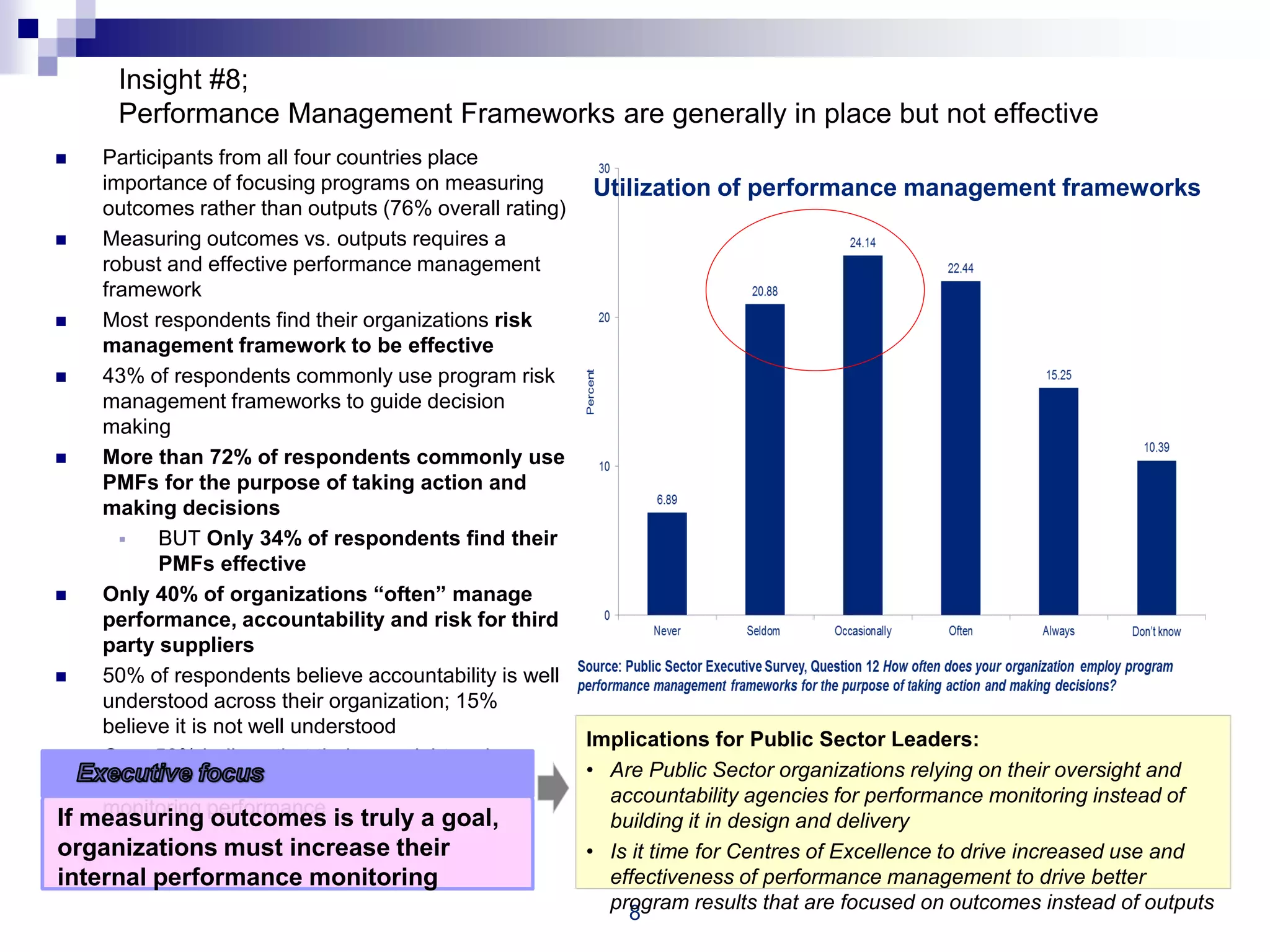
 Participants from all four countries place
importance of focusing programs on measuring
outcomes rather than outputs (76% overall rating)
 Measuring outcomes vs. outputs requires a
robust and effective performance management
framework
 Most respondents find their organizations risk
management framework to be effective
 43% of respondents commonly use program risk
management frameworks to guide decision
making
 More than 72% of respondents commonly use
PMFs for the purpose of taking action and
making decisions
 BUT Only 34% of respondents find their
PMFs effective
 Only 40% of organizations “often” manage
performance, accountability and risk for third
party suppliers
 50% of respondents believe accountability is well
understood across their organization; 15%
believe it is not well understood
 Over 50% believe that their oversight and
accountability agencies are effective at
monitoring performance
8
Implications for Public Sector Leaders:
• Are Public Sector organizations relying on their oversight and
accountability agencies for performance monitoring instead of
building it in design and delivery
• Is it time for Centres of Excellence to drive increased use and
effectiveness of performance management to drive better
program results that are focused on outcomes instead of outputs
Utilization of performance management frameworks
If measuring outcomes is truly a goal,
organizations must increase their
internal performance monitoring
Citizen-Centered Approaches
 In government the strongest drive towards user
satisfaction measurement comes from CCAs.
 CCAs imply:
 Empowering citizens to give input in the type and
modality of services they receive
 Embracing a government approach based on
accountability and continued improvement
 Needs a continuous flow of information about these
outputs and outcomes
 Needs a whole-of-government culture of engagement
 Is based on a set of policies that frame and enable it
 Measuring user satisfaction:
 Meets the need for external public
accountability
 Sets defined targets for service
improvement by management
 Enshrines internal accountability for staff
 Strengthens the legitimacy of public sector
agencies
Measuring Innovation
 Part of the connection between innovation
and public engagement needs to happen
through Citizen-Centered approaches.
 Innovative policies and approaches
 Can take inspiration from the gaps presented
in these analyses
 Will be measured in these analyses
The Citizens First surveys
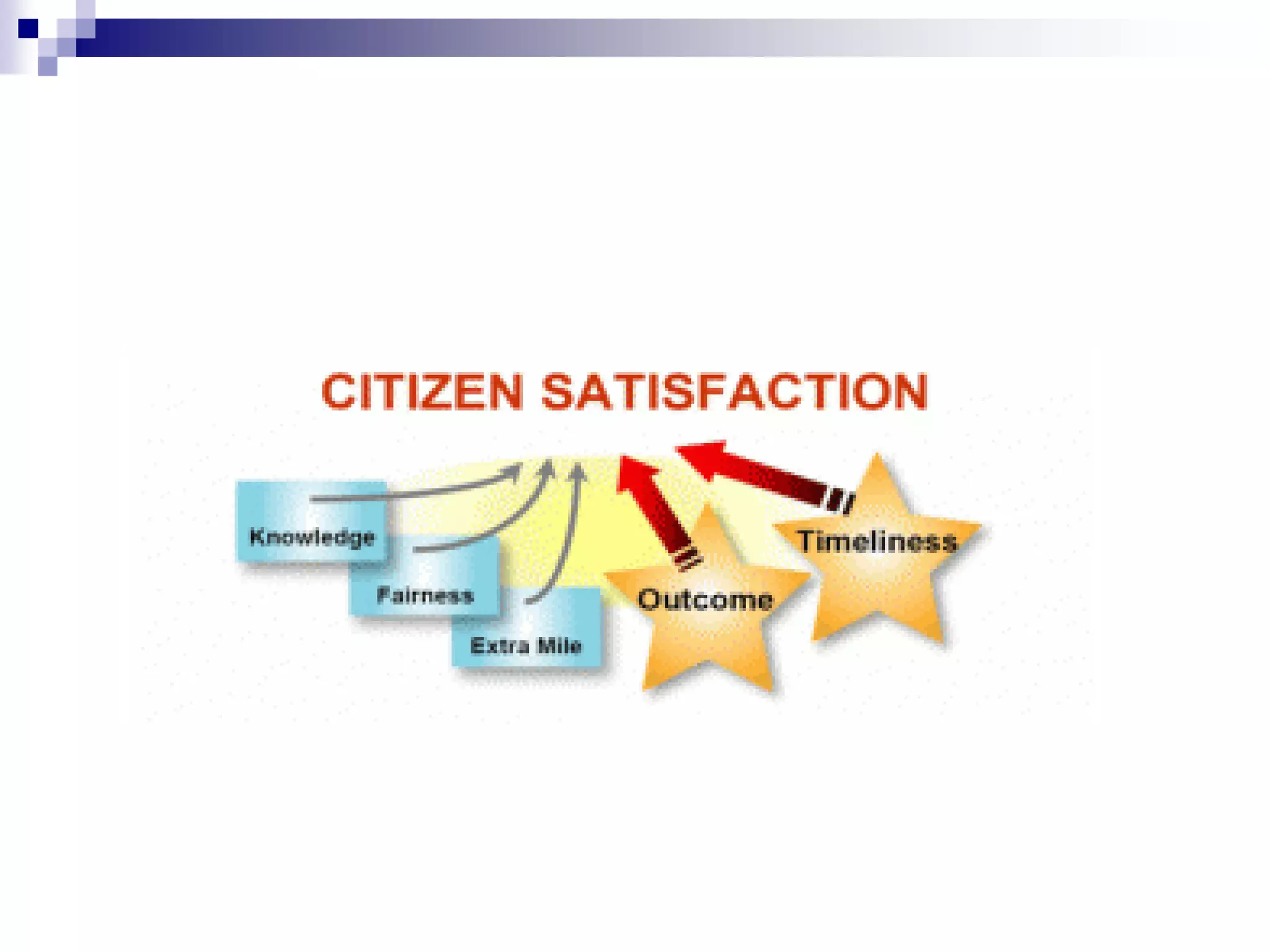
 In 1998, the Canadian government launched the
first of its Citizens First surveys.
 Over 3,000 service experiences were polled
 Five drivers were found to explain over 70% of
satisfaction:
 Timeliness
 Knowledge and competence
 Courtesy (extra smile, extra mile)
 Fairness, and
 Outcome
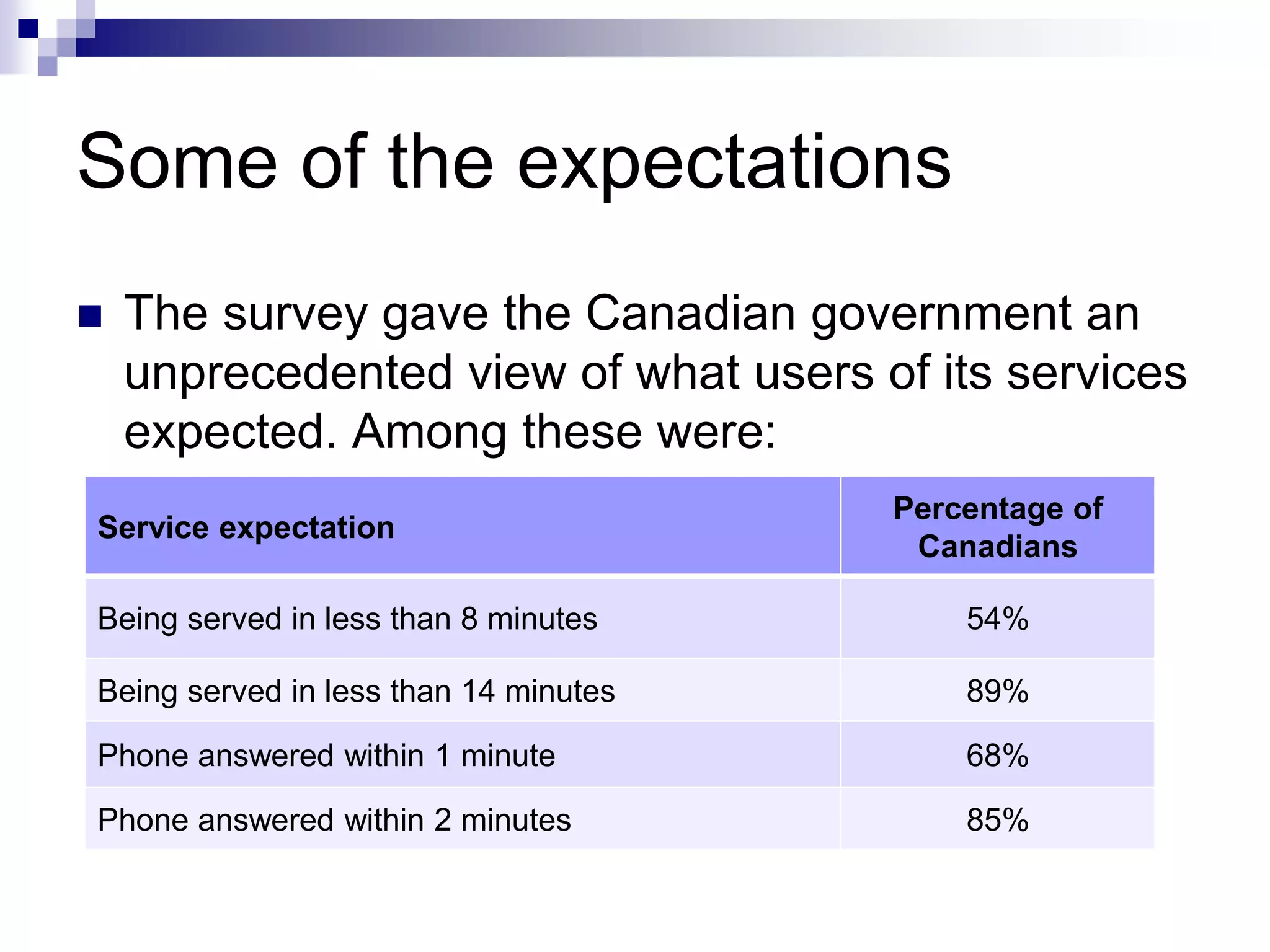
Some of the expectations
 The survey gave the Canadian government an
unprecedented view of what users of its services
expected. Among these were:
Service expectation
Percentage of
Canadians
Being served in less than 8 minutes 54%
Being served in less than 14 minutes 89%
Phone answered within 1 minute 68%
Phone answered within 2 minutes 85%
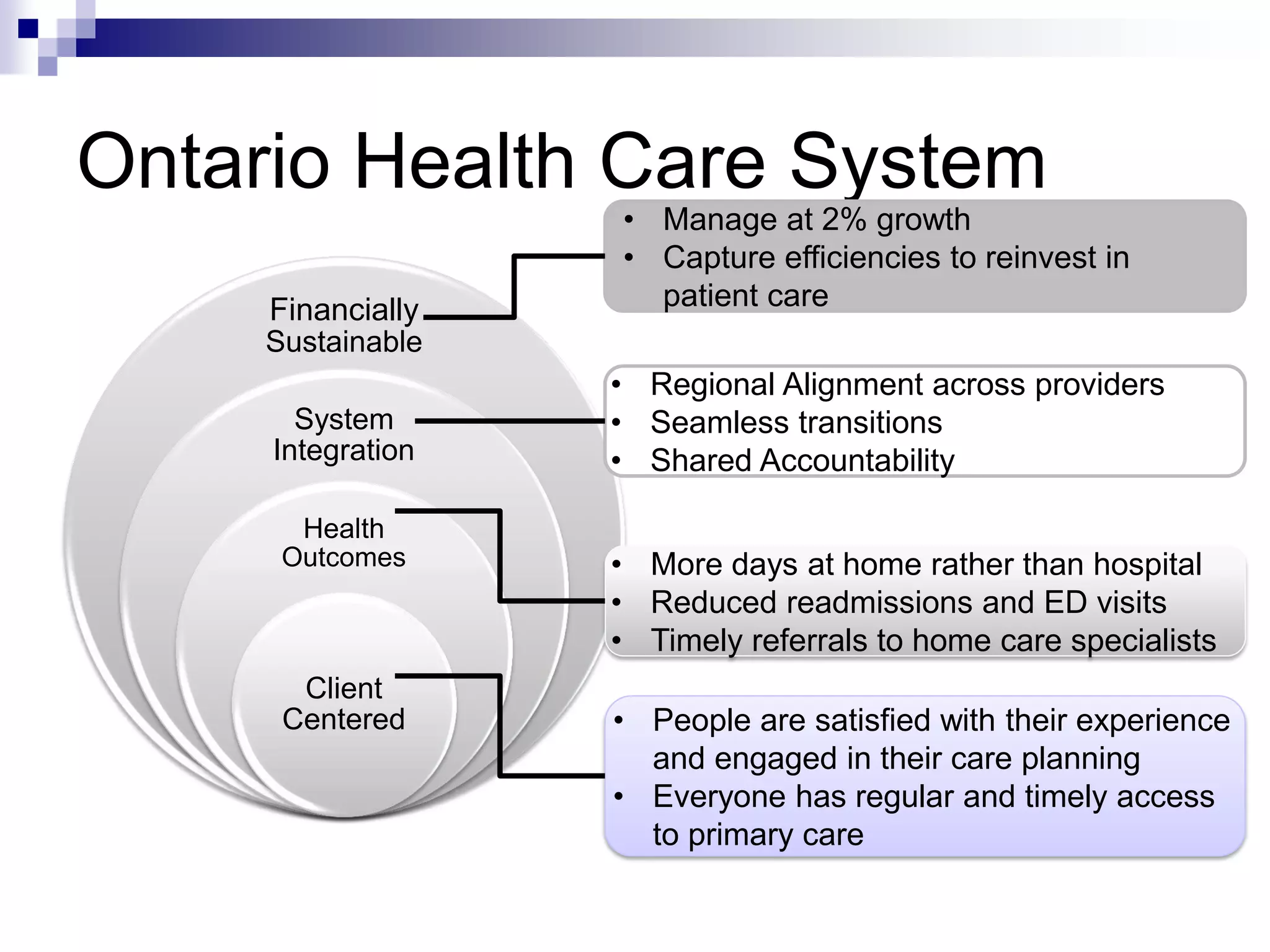
Ontario Health Care System
Financially
Sustainable
System
Integration
Health
Outcomes
Client
Centered
• Manage at 2% growth
• Capture efficiencies to reinvest in
patient care
• Regional Alignment across providers
• Seamless transitions
• Shared Accountability
• More days at home rather than hospital
• Reduced readmissions and ED visits
• Timely referrals to home care specialists
• People are satisfied with their experience
and engaged in their care planning
• Everyone has regular and timely access
to primary care
Measure to improve
 The basic purpose of service satisfaction levels
among users of government services is to
ultimately improve those services.
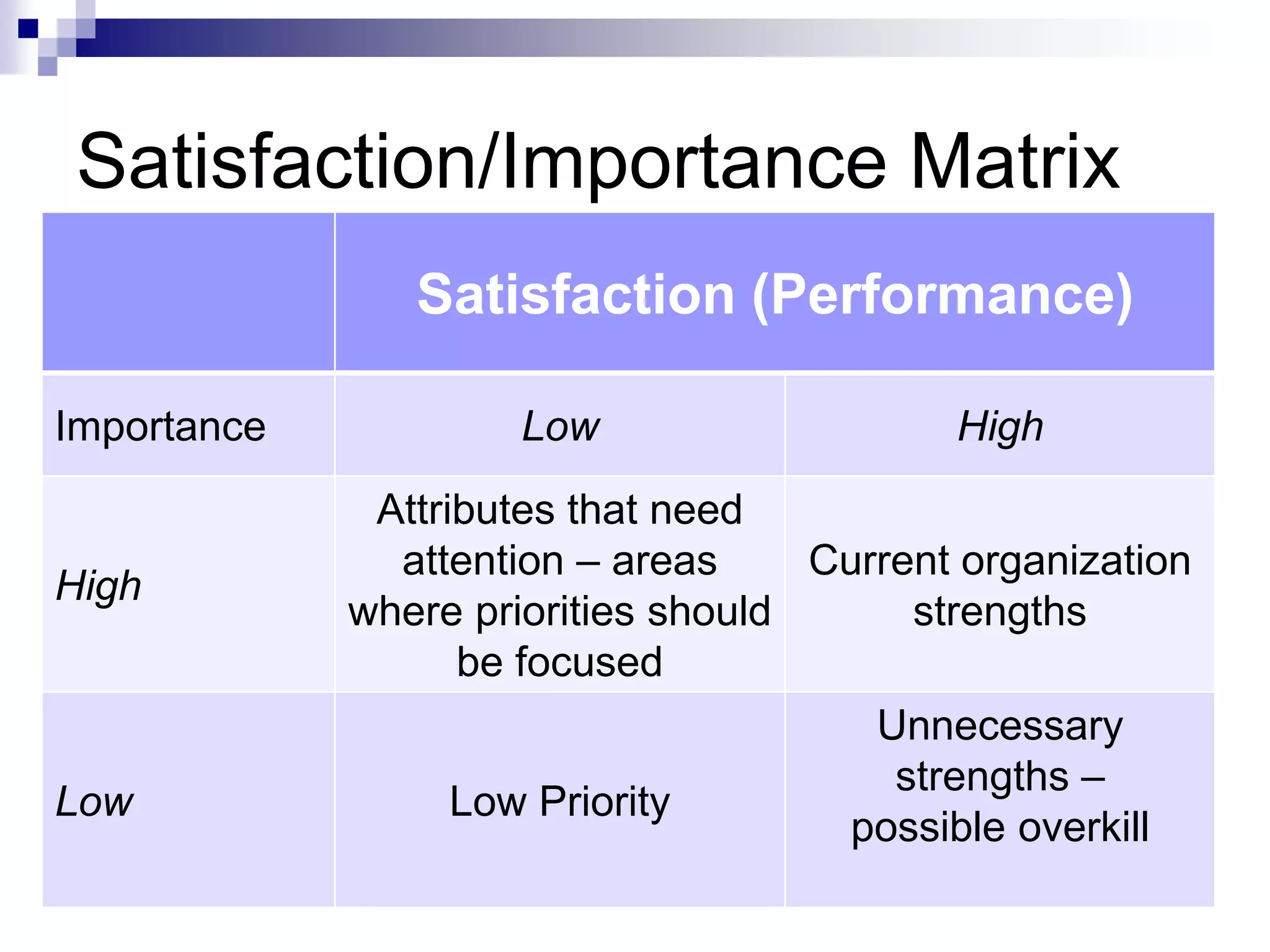
 The CMT relies on an importance/satisfaction
matrix.
 Often when clients are asked what is important
they will answer all.
 To make things manageable, the TMC asks
respondents to rank the top 3 service priorities.
Satisfaction/Importance Matrix
Satisfaction (Performance)
Importance Low High
High
Attributes that need
attention – areas
where priorities should
be focused
Current organization
strengths
Low Low Priority
Unnecessary
strengths –
possible overkill
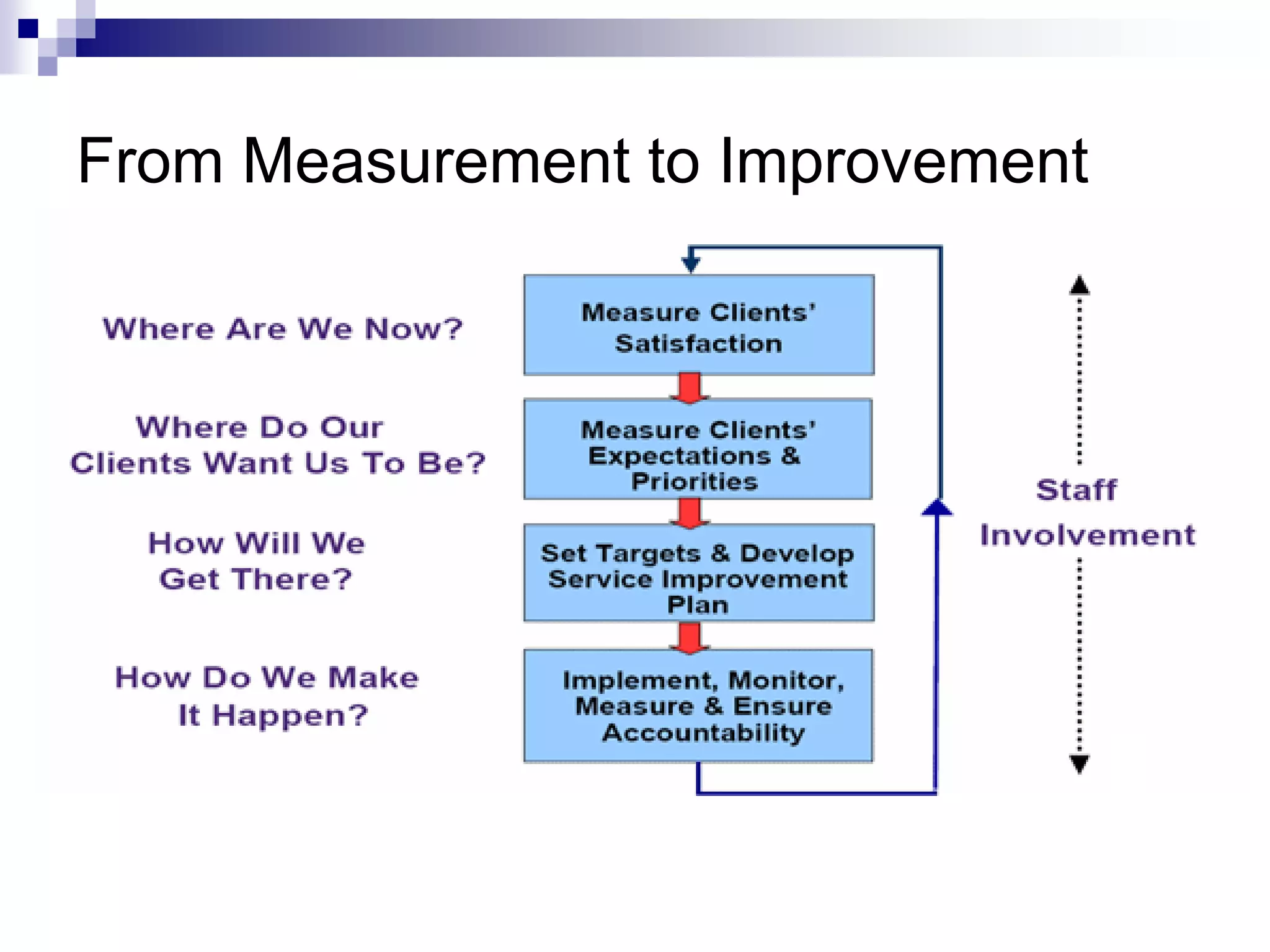
From Measurement to Improvement
The Political-
Bureaucratic Divide
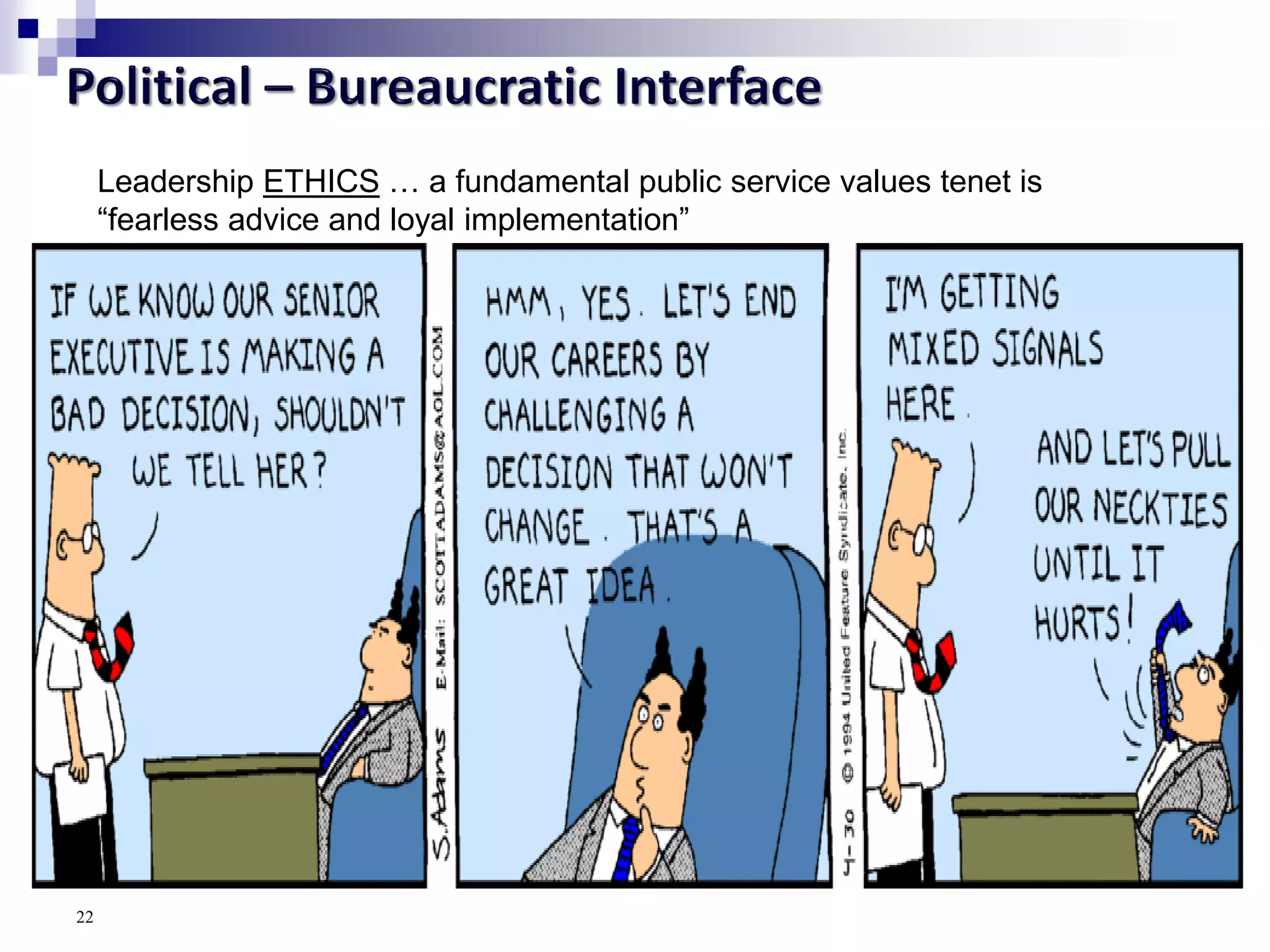
Leadership ETHICS … a fundamental public service values tenet is
“fearless advice and loyal implementation”
22
23
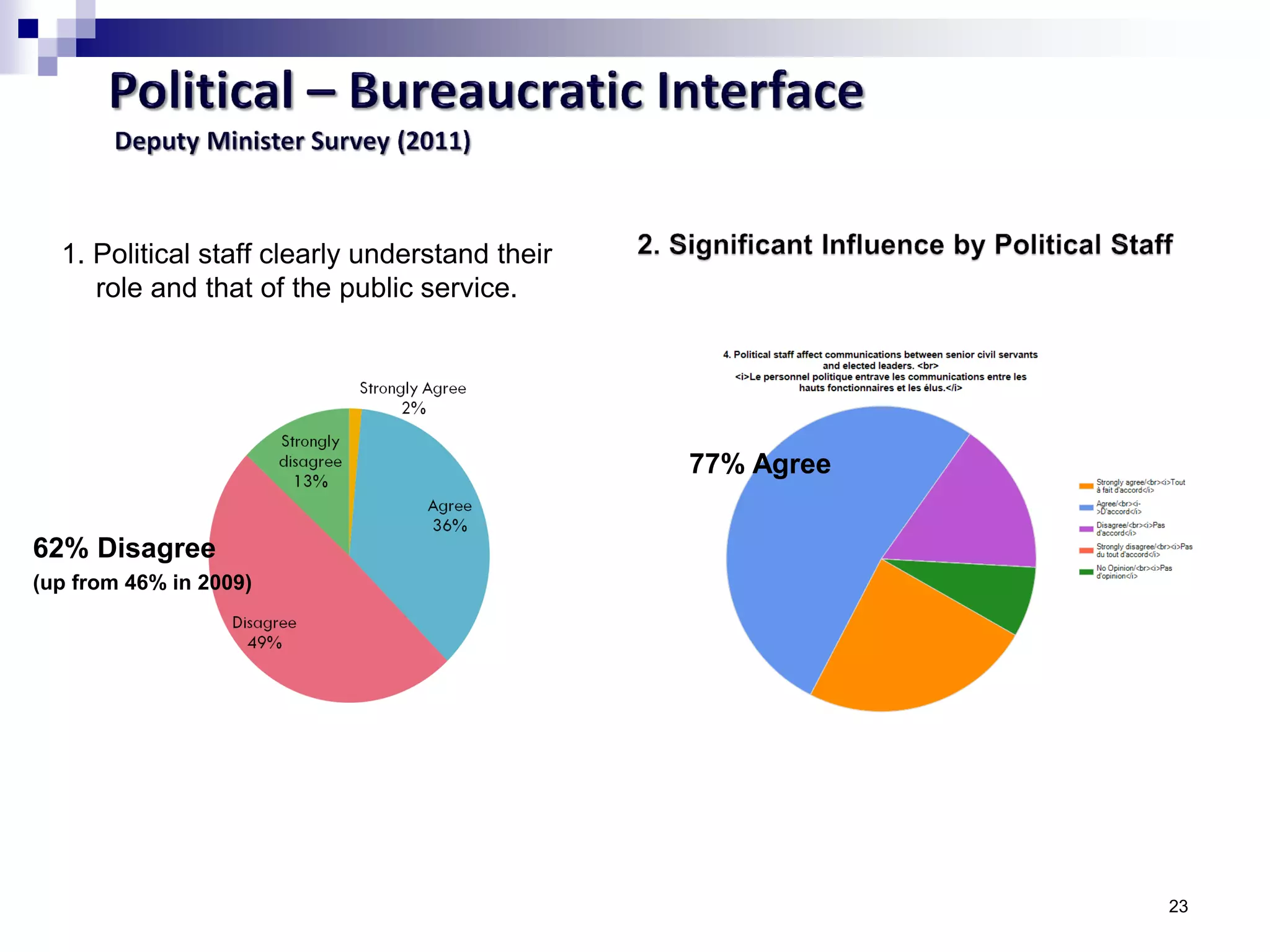
1. Political staff clearly understand their
role and that of the public service.
62% Disagree
(up from 46% in 2009)
77% Agree
Why is Political Acuity Important?
 Underpins ALL of our work
 Supports the essence of the democratic process
 Can improve the quality and success of our work
 Will help to open our minds to the possible and
allows for greater creativity
“Probably one of the biggest challenges in a
public service career”
24
Work of the Political Executive
 Constituency work
 Cabinet and caucus meetings
 Media relations
 Interest groups
 Meetings with Deputy and senior staff
 Getting re-elected is job 1
Work of the Bureaucratic Executive
 Administration of government policies
 Implementation of legislation and regulations
 Management of public funds
 …While being professional, non-partisan, career-oriented
 Control through hierarchical organizational
 “permanent custodians of the permanent problems” (i.e., long term)
25
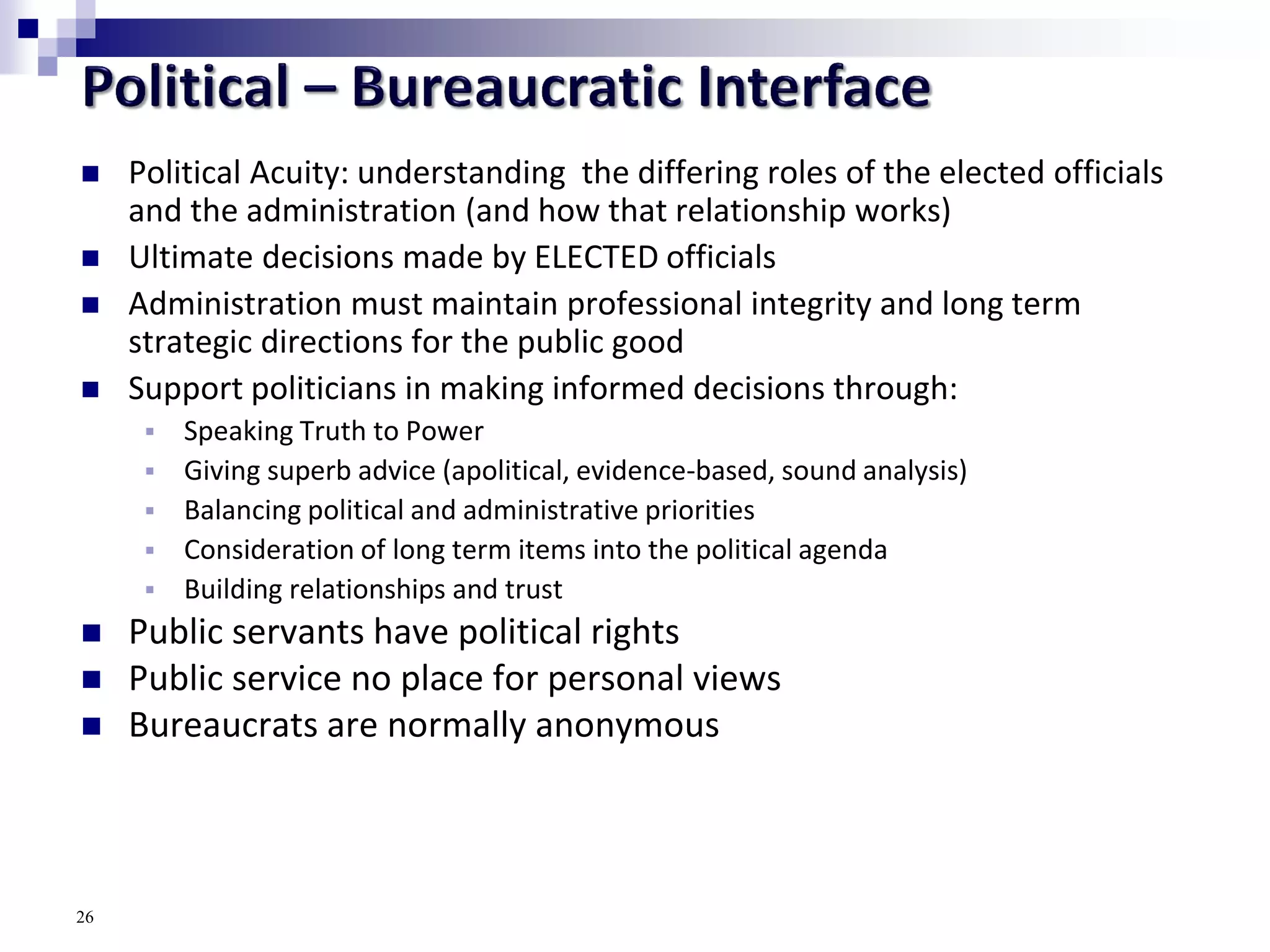
 Political Acuity: understanding the differing roles of the elected officials
and the administration (and how that relationship works)
 Ultimate decisions made by ELECTED officials
 Administration must maintain professional integrity and long term
strategic directions for the public good
 Support politicians in making informed decisions through:
 Speaking Truth to Power
 Giving superb advice (apolitical, evidence-based, sound analysis)
 Balancing political and administrative priorities
 Consideration of long term items into the political agenda
 Building relationships and trust
 Public servants have political rights
 Public service no place for personal views
 Bureaucrats are normally anonymous
26
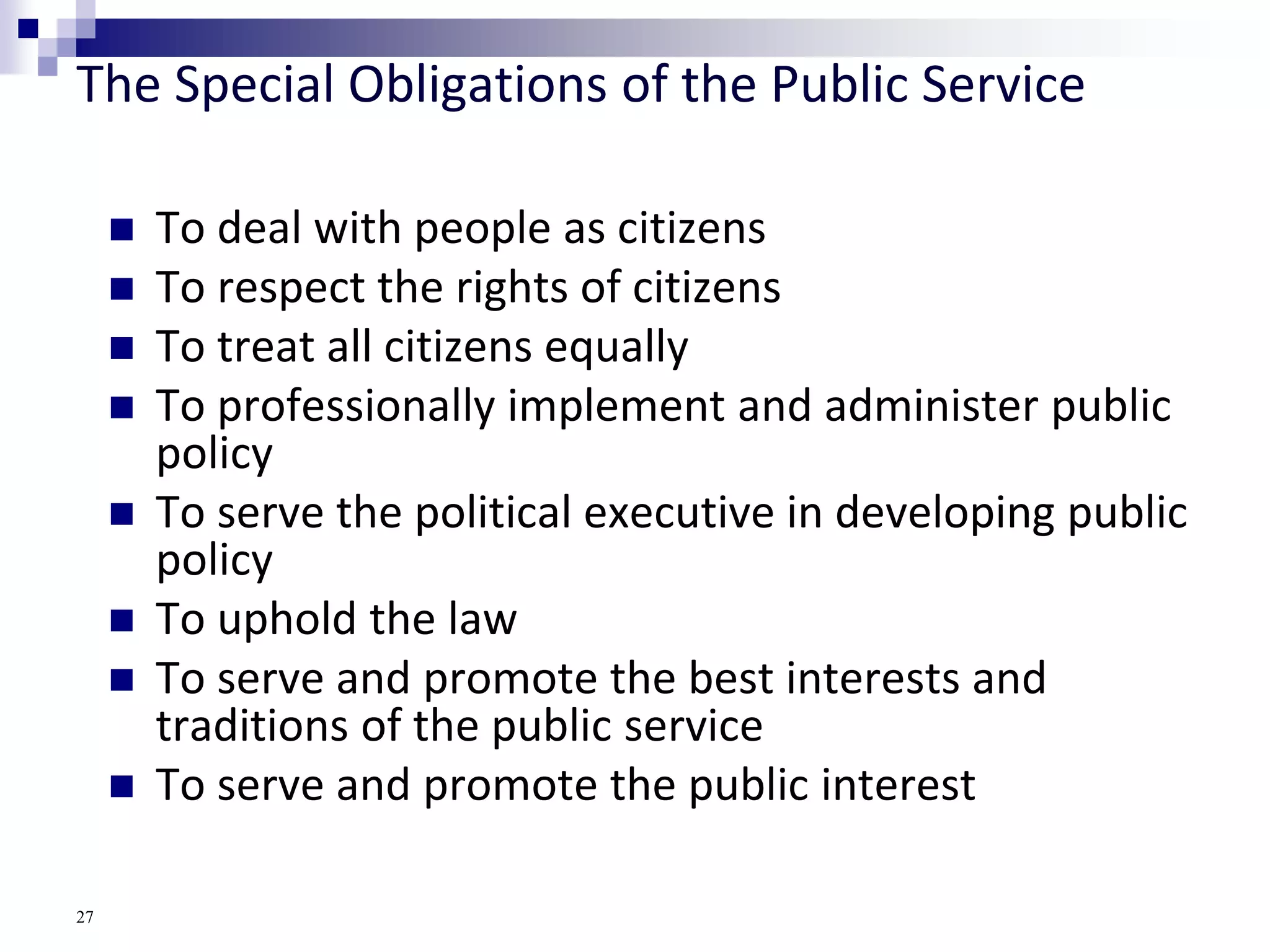
The Special Obligations of the Public Service
 To deal with people as citizens
 To respect the rights of citizens
 To treat all citizens equally
 To professionally implement and administer public
policy
 To serve the political executive in developing public
policy
 To uphold the law
 To serve and promote the best interests and
traditions of the public service
 To serve and promote the public interest
27

Module 11 Engagement and Divide

  • 1.
    Module 11 Citizen Engagementand the Political- Bureaucratic Divide PRESENTER
  • 2.
  • 3.
    Client and UserSatisfaction  Ensuring that clients are satisfied with a product is nothing new.  In the private sector client satisfaction is often what makes or breaks a product or a company.  However, in the public sector the relationship between services and users is rather different.
  • 4.
    Client vs Citizen Client External DirectService Provision/Benefit (User) Internal Citizen Indirect General Benefit (Stakeholder)
  • 5.
    How public andprivate services differ Private Sector Government Characteristics of services Private (excludable and rival) Public (non-excludable and non rival) Measurement Often financially quantifiable, straightforward and generally immediate Often not financially quantifiable, delayed in time, not straightforward Reasons for seeking feedback Embedded in the market system Dependent on policy and culture Diffusion Very Common Relatively uncommon
  • 6.
    Why measuring user satisfaction? Process and product improvement: regular measurements lead to better services and better work processes.  Increased legitimacy: in an age of neoliberal policies governments have often cut services and/or increased costs to the public. Poor service delivery will erode legitimacy.  Implement citizen-centered approaches: we cannot claim a CCA if we do not measure satisfaction.
  • 7.
    Insight #6; Building trustin public institutions and engaging stakeholders to enhance programs are priorities  Building confidence and trust in government (80%) and engaging stakeholders (82%) to enhance programs/services are key priorities  Very strong agreement that there is a lot of importance on this globally over the next 2 years (Globally >75% rank it as most important)  UAE specifically delineates “Citizen Engagement” as more important that the more general “Stakeholder Engagement” • CAN and AUS both placed highest overall importance on building trust and confidence in public institutions over stakeholder engagement • Engagement with the private sector is the most common form of external engagement for senior staff (50%), but engagement with social enterprises is also significant (35%) • Open Government is deemed important by 75% of participants 7 Implications for Public Sector Leaders: • What factors have caused a loss of trust in recent years • Are there particular stakeholders that should be consulted • How is “Open Government” defined and what are the barriers Stakeholder engagement Executives have built an ethical public service, but they are concerned about low trust towards their institutions
  • 8.
    Insight #8; Performance ManagementFrameworks are generally in place but not effective  Participants from all four countries place importance of focusing programs on measuring outcomes rather than outputs (76% overall rating)  Measuring outcomes vs. outputs requires a robust and effective performance management framework  Most respondents find their organizations risk management framework to be effective  43% of respondents commonly use program risk management frameworks to guide decision making  More than 72% of respondents commonly use PMFs for the purpose of taking action and making decisions  BUT Only 34% of respondents find their PMFs effective  Only 40% of organizations “often” manage performance, accountability and risk for third party suppliers  50% of respondents believe accountability is well understood across their organization; 15% believe it is not well understood  Over 50% believe that their oversight and accountability agencies are effective at monitoring performance 8 Implications for Public Sector Leaders: • Are Public Sector organizations relying on their oversight and accountability agencies for performance monitoring instead of building it in design and delivery • Is it time for Centres of Excellence to drive increased use and effectiveness of performance management to drive better program results that are focused on outcomes instead of outputs Utilization of performance management frameworks If measuring outcomes is truly a goal, organizations must increase their internal performance monitoring
  • 9.
    Citizen-Centered Approaches  Ingovernment the strongest drive towards user satisfaction measurement comes from CCAs.  CCAs imply:  Empowering citizens to give input in the type and modality of services they receive  Embracing a government approach based on accountability and continued improvement  Needs a continuous flow of information about these outputs and outcomes  Needs a whole-of-government culture of engagement  Is based on a set of policies that frame and enable it
  • 10.
     Measuring usersatisfaction:  Meets the need for external public accountability  Sets defined targets for service improvement by management  Enshrines internal accountability for staff  Strengthens the legitimacy of public sector agencies
  • 11.
    Measuring Innovation  Partof the connection between innovation and public engagement needs to happen through Citizen-Centered approaches.  Innovative policies and approaches  Can take inspiration from the gaps presented in these analyses  Will be measured in these analyses
  • 12.
    The Citizens Firstsurveys  In 1998, the Canadian government launched the first of its Citizens First surveys.  Over 3,000 service experiences were polled  Five drivers were found to explain over 70% of satisfaction:  Timeliness  Knowledge and competence  Courtesy (extra smile, extra mile)  Fairness, and  Outcome
  • 14.
    Some of theexpectations  The survey gave the Canadian government an unprecedented view of what users of its services expected. Among these were: Service expectation Percentage of Canadians Being served in less than 8 minutes 54% Being served in less than 14 minutes 89% Phone answered within 1 minute 68% Phone answered within 2 minutes 85%
  • 16.
    Ontario Health CareSystem Financially Sustainable System Integration Health Outcomes Client Centered • Manage at 2% growth • Capture efficiencies to reinvest in patient care • Regional Alignment across providers • Seamless transitions • Shared Accountability • More days at home rather than hospital • Reduced readmissions and ED visits • Timely referrals to home care specialists • People are satisfied with their experience and engaged in their care planning • Everyone has regular and timely access to primary care
  • 17.
    Measure to improve The basic purpose of service satisfaction levels among users of government services is to ultimately improve those services.  The CMT relies on an importance/satisfaction matrix.  Often when clients are asked what is important they will answer all.  To make things manageable, the TMC asks respondents to rank the top 3 service priorities.
  • 18.
    Satisfaction/Importance Matrix Satisfaction (Performance) ImportanceLow High High Attributes that need attention – areas where priorities should be focused Current organization strengths Low Low Priority Unnecessary strengths – possible overkill
  • 19.
  • 21.
  • 22.
    Leadership ETHICS …a fundamental public service values tenet is “fearless advice and loyal implementation” 22
  • 23.
    23 1. Political staffclearly understand their role and that of the public service. 62% Disagree (up from 46% in 2009) 77% Agree
  • 24.
    Why is PoliticalAcuity Important?  Underpins ALL of our work  Supports the essence of the democratic process  Can improve the quality and success of our work  Will help to open our minds to the possible and allows for greater creativity “Probably one of the biggest challenges in a public service career” 24
  • 25.
    Work of thePolitical Executive  Constituency work  Cabinet and caucus meetings  Media relations  Interest groups  Meetings with Deputy and senior staff  Getting re-elected is job 1 Work of the Bureaucratic Executive  Administration of government policies  Implementation of legislation and regulations  Management of public funds  …While being professional, non-partisan, career-oriented  Control through hierarchical organizational  “permanent custodians of the permanent problems” (i.e., long term) 25
  • 26.
     Political Acuity:understanding the differing roles of the elected officials and the administration (and how that relationship works)  Ultimate decisions made by ELECTED officials  Administration must maintain professional integrity and long term strategic directions for the public good  Support politicians in making informed decisions through:  Speaking Truth to Power  Giving superb advice (apolitical, evidence-based, sound analysis)  Balancing political and administrative priorities  Consideration of long term items into the political agenda  Building relationships and trust  Public servants have political rights  Public service no place for personal views  Bureaucrats are normally anonymous 26
  • 27.
    The Special Obligationsof the Public Service  To deal with people as citizens  To respect the rights of citizens  To treat all citizens equally  To professionally implement and administer public policy  To serve the political executive in developing public policy  To uphold the law  To serve and promote the best interests and traditions of the public service  To serve and promote the public interest 27