Clean Campus Project
Bruno Citoni
PhD – University of Glasgow
2
LoRaWAN Research
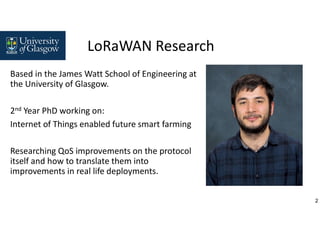
Based in the James Watt School of Engineering at
the University of Glasgow.
2nd Year PhD working on:
Internet of Things enabled future smart farming
Researching QoS improvements on the protocol
itself and how to translate them into
improvements in real life deployments.
3
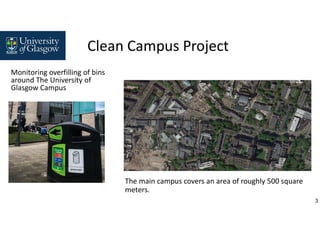
Monitoring overfilling of bins
around The University of
Glasgow Campus
The main campus covers an area of roughly 500 square
meters.
Clean Campus Project
4
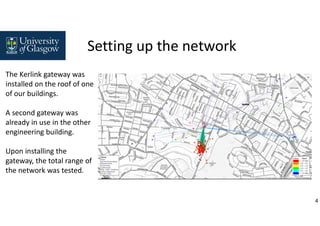
The Kerlink gateway was
installed on the roof of one
of our buildings.
A second gateway was
already in use in the other
engineering building.
Upon installing the
gateway, the total range of
the network was tested.
Setting up the network
5
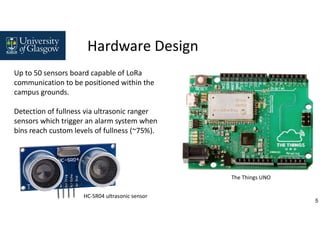
Up to 50 sensors board capable of LoRa
communication to be positioned within the
campus grounds.
Detection of fullness via ultrasonic ranger
sensors which trigger an alarm system when
bins reach custom levels of fullness (~75%).
The Things UNO
HC-SR04 ultrasonic sensor
Hardware Design
6
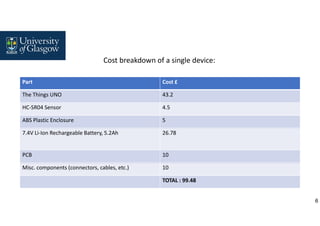
Cost breakdown of a single device:
Part Cost £
The Things UNO 43.2
HC-SR04 Sensor 4.5
ABS Plastic Enclosure 5
7.4V Li-Ion Rechargeable Battery, 5.2Ah 26.78
PCB 10
Misc. components (connectors, cables, etc.) 10
TOTAL : 99.48
7
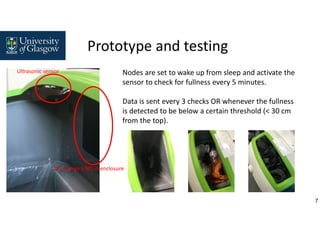
Nodes are set to wake up from sleep and activate the
sensor to check for fullness every 5 minutes.
Data is sent every 3 checks OR whenever the fullness
is detected to be below a certain threshold (< 30 cm
from the top).
Ultrasonic sensor
The Things UNO in enclosure
Prototype and testing
8
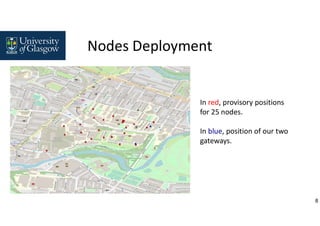
In red, provisory positions
for 25 nodes.
In blue, position of our two
gateways.
Nodes Deployment
9
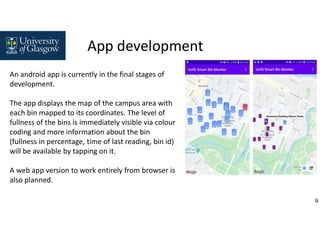
An android app is currently in the final stages of
development.
The app displays the map of the campus area with
each bin mapped to its coordinates. The level of
fullness of the bins is immediately visible via colour
coding and more information about the bin
(fullness in percentage, time of last reading, bin id)
will be available by tapping on it.
A web app version to work entirely from browser is
also planned.
App development
10
Nodes are behaving as expected in our controlled testing.
Physical deployment will begin as soon as restrictions are lifted. Meanwhile work on
the software side continues.
The data obtained will be analysed with machine learning techniques so that useful
information can be extracted.
Predictions can be made to ultimately better inform the janitorial system and save
time and money.
To sum up
G5G
Glasgow
5G Testbed
Thank you
b.citoni.1@research.gla.ac.uk

Smart bin internet of thing (IoT) project using LoRaWAN

  • 1.
    Clean Campus Project BrunoCitoni PhD – University of Glasgow
  • 2.
    2 LoRaWAN Research Based inthe James Watt School of Engineering at the University of Glasgow. 2nd Year PhD working on: Internet of Things enabled future smart farming Researching QoS improvements on the protocol itself and how to translate them into improvements in real life deployments.
  • 3.
    3 Monitoring overfilling ofbins around The University of Glasgow Campus The main campus covers an area of roughly 500 square meters. Clean Campus Project
  • 4.
    4 The Kerlink gatewaywas installed on the roof of one of our buildings. A second gateway was already in use in the other engineering building. Upon installing the gateway, the total range of the network was tested. Setting up the network
  • 5.
    5 Up to 50sensors board capable of LoRa communication to be positioned within the campus grounds. Detection of fullness via ultrasonic ranger sensors which trigger an alarm system when bins reach custom levels of fullness (~75%). The Things UNO HC-SR04 ultrasonic sensor Hardware Design
  • 6.
    6 Cost breakdown ofa single device: Part Cost £ The Things UNO 43.2 HC-SR04 Sensor 4.5 ABS Plastic Enclosure 5 7.4V Li-Ion Rechargeable Battery, 5.2Ah 26.78 PCB 10 Misc. components (connectors, cables, etc.) 10 TOTAL : 99.48
  • 7.
    7 Nodes are setto wake up from sleep and activate the sensor to check for fullness every 5 minutes. Data is sent every 3 checks OR whenever the fullness is detected to be below a certain threshold (< 30 cm from the top). Ultrasonic sensor The Things UNO in enclosure Prototype and testing
  • 8.
    8 In red, provisorypositions for 25 nodes. In blue, position of our two gateways. Nodes Deployment
  • 9.
    9 An android appis currently in the final stages of development. The app displays the map of the campus area with each bin mapped to its coordinates. The level of fullness of the bins is immediately visible via colour coding and more information about the bin (fullness in percentage, time of last reading, bin id) will be available by tapping on it. A web app version to work entirely from browser is also planned. App development
  • 10.
    10 Nodes are behavingas expected in our controlled testing. Physical deployment will begin as soon as restrictions are lifted. Meanwhile work on the software side continues. The data obtained will be analysed with machine learning techniques so that useful information can be extracted. Predictions can be made to ultimately better inform the janitorial system and save time and money. To sum up
  • 11.