




Janet access
solutions
Chair: Jeremy Sharp,
Janet infrastructure director,
Jisc
History and approach
Jeremy Sharp, Janet infrastructure director
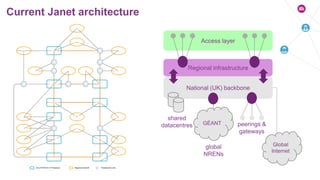
Current Janet architecture
London
East 2
London
Bristol
South
South West
PSBA
Wales
Thames
Valley
KPSN
Kent
London
East 1
NottinghamBirmingham
West
Midlands
Yorkshire &
Humberside
Manchester
North WestCumbria
Northern
Ireland
Glasgow
South East
Scotland
North East
Scotland
South West
Scotland
North East
East
Midlands
EastERN
London
West
Core PoP (Point of Presence) Regional network Transmission site
Leeds
JANET6 BACKBONE OVERVIEW – Oct 2015
14-May-2015 v06 / jas
London
Docklands
Regional infrastructure
National (UK) backbone
shared
datacentres
Global
Internet
GÉANT peerings &
gateways
Access layer
global
NRENs
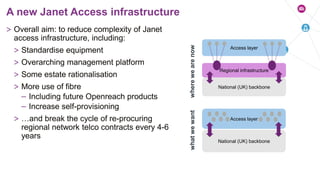
> Overall aim: to reduce complexity of Janet
access infrastructure, including:
> Standardise equipment
> Overarching management platform
> Some estate rationalisation
> More use of fibre
– Including future Openreach products
– Increase self-provisioning
> …and break the cycle of re-procuring
regional network telco contracts every 4-6
years
A new Janet Access infrastructure
Regional infrastructure
National (UK) backbone
Access layer
National (UK) backbone
Access layer
whatwewantwherewearenow
Steps towards a new Janet Access infrastructure
>2017-Q2/3: Procurement for access provisioning strategy
>Competitive dialogue
>Range of approaches invited
>Proposals mainly based around suppliers’ existing network
infrastructures
>Expensive - lacking flexibility & agility around provisioning &
upgrade
>Compared against Jisc build and operate approach (as with
Janet6 backbone)
–Self-build better meets overall aims
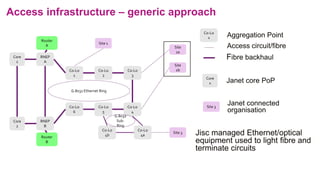
Access infrastructure – generic approach
Aggregation Point
Access circuit/fibre
Fibre backhaul
Janet core PoP
Janet connected
organisation
Jisc managed Ethernet/optical
equipment used to light fibre and
terminate circuits
Core
2
RNEP
A
RNEP
B
Co-Lo
1
Co-Lo
2
Co-Lo
6
Co-Lo
5
Co-Lo
3
Co-Lo
4
Site 1
Site
2a
Site
2b
G.8032 Ethernet Ring
Co-Lo
4a
Co-Lo
4b
G.8032
Sub-
Ring
Site 3
Router
A
Router
B
Core
1
Co-Lo
x
Core
x
Site 3
Building the new Janet Access infrastructure
>Components:
> Regulated Openreach products (EAD, OSA, OSA Filter Connect, DFA,
Exchange space)
> Other telco fibre & col-lo: DPS framework
> Optical/Ethernet switching equipment, support services: New Ciena framework
> Other transmission requirements: Renew Janet telco framework (summer 2018)
>New access infrastructure introduced as regional network
contractual arrangements expire over next 3-4 years.
UK Telecoms Regulation
(a beginners guide as to why we can't have nice things)
James Blessing, Deputy director, Network Architect
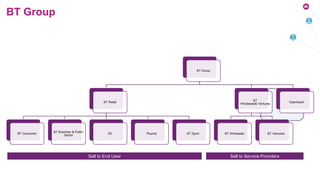
BT Group
BT Group
BT Retail
BT Consumer
BT Business & Public
Sector
EE Plusnet BT Sport
BT
Wholesale& Ventures
BT Wholesale BT Ventures
Openreach
Sell to End User Sell to Service Providers
TLAs*
>EAD – Ethernet Access Direct
>OSA – Optical Spectrum Access
>OSEA – Optical Spectrum Enhanced Access
>DFA – Dark Fibre Access
*Not all the three letter acronyms used in this presentation, just some that are important right now
>Regulator for Telecom
>And other communication things like
TV and Radio
>Market Reviews
>Narrowband, Business Communications, Wholesale
Local Markets, Spectrum, Broadcasting, etc
>Protect "people" from providers with significant
market power (i.e. mostly BT Group, but also
Kingston Communications in Hull)
>BCMR 2016
>DFA
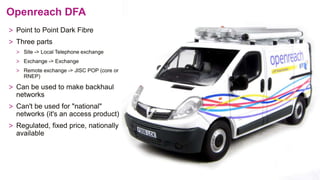
Openreach DFA
> Point to Point Dark Fibre
> Three parts
> Site -> Local Telephone exchange
> Exchange -> Exchange
> Remote exchange -> JISC POP (core or
RNEP)
> Can be used to make backhaul
networks
> Can't be used for "national"
networks (it's an access product)
> Regulated, fixed price, nationally
available
Legal
> BT Group don't agree with
BCMR
> Wrong market geographical
definition
> 1G not same as 10G
> Pricing is wrong (too cheap)
> Take Ofcom to Competition
Appeals Tribunal
> CAT Agrees with BT :(
> Ofcom propose a 1G DFA option
> Openreach respond with
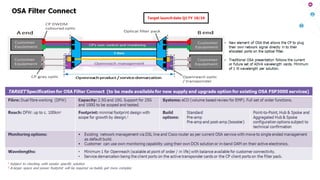
OSA FC
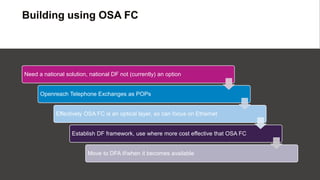
Building using OSA FC
Need a national solution, national DF not (currently) an option
Openreach Telephone Exchanges as POPs
Effectively OSA FC is an optical layer, so can focus on Ethernet
Establish DF framework, use where more cost effective that OSA FC
Move to DFA if/when it becomes available
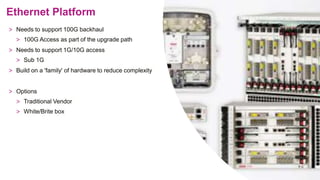
Ethernet Platform
> Needs to support 100G backhaul
> 100G Access as part of the upgrade path
> Needs to support 1G/10G access
> Sub 1G
> Build on a 'family' of hardware to reduce complexity
> Options
> Traditional Vendor
> White/Brite box
DF Framework
> Use as comparator against OSA
FC
>I.e. each new link
request a DF alternative
> Request "partial" solution for a
region
> Sit in room and build based on
OSA FC, per link and full solution
What we’re deploying
Rob Evans, Chief network architect
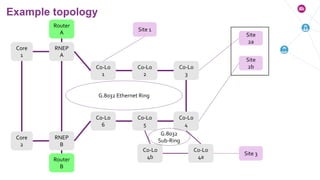
Example topology
Core
1
Core
2
RNEP
A
RNEP
B
Co-Lo
1
Co-Lo
2
Co-Lo
6
Co-Lo
5
Co-Lo
3
Co-Lo
4
Site 1
Site
2a
Site
2b
G.8032 Ethernet Ring
Co-Lo
4a
Co-Lo
4b
G.8032
Sub-Ring
Site 3
Router
A
Router
B
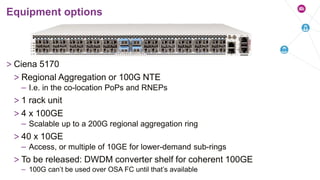
> Ciena 5170
> Regional Aggregation or 100G NTE
– I.e. in the co-location PoPs and RNEPs
> 1 rack unit
> 4 x 100GE
– Scalable up to a 200G regional aggregation ring
> 40 x 10GE
– Access, or multiple of 10GE for lower-demand sub-rings
> To be released: DWDM converter shelf for coherent 100GE
– 100G can’t be used over OSA FC until that’s available
Equipment options
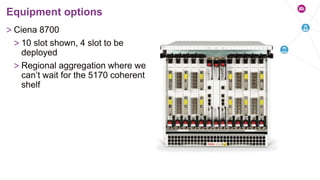
> Ciena 8700
> 10 slot shown, 4 slot to be
deployed
> Regional aggregation where we
can’t wait for the 5170 coherent
shelf
Equipment options
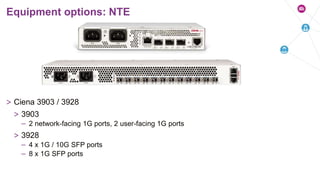
> Ciena 3903 / 3928
> 3903
– 2 network-facing 1G ports, 2 user-facing 1G ports
> 3928
– 4 x 1G / 10G SFP ports
– 8 x 1G SFP ports
Equipment options: NTE
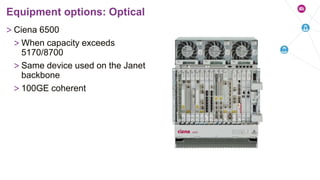
> Ciena 6500
> When capacity exceeds
5170/8700
> Same device used on the Janet
backbone
> 100GE coherent
Equipment options: Optical
What will this look like?
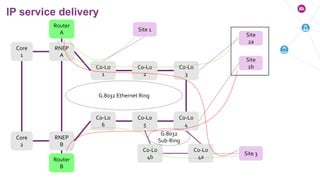
IP service delivery
Core
1
Core
2
RNEP
A
RNEP
B
Co-Lo
1
Co-Lo
2
Co-Lo
6
Co-Lo
5
Co-Lo
3
Co-Lo
4
Site 1
Site
2a
Site
2b
G.8032 Ethernet Ring
Co-Lo
4a
Co-Lo
4b
G.8032
Sub-Ring
Site 3
Router
A
Router
B
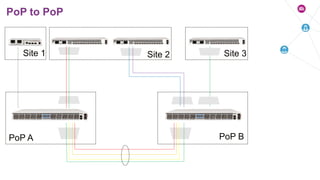
PoP to PoP
PoP A PoP B
Site 2Site 1 Site 3
>G.8032/Y.1344
>Less than 50ms protection switch
– (Assuming fibre ring < 1,200km!)
>Protection at layer 2, so do not need to wait for IP to
reconverge on link failure
Ethernet ring protection
>Check circuit before being brought into service
>RFC2544 / Y.1564
– Loss
– Delay
– Throughput
>Performance monitoring
>CFM / Y.1731
– Delay
– Jitter
– Loss
>Improved visibility of Netpaths through the aggregation
infrastructure
Ethernet Diagnostics
>Services delimited by VLANs
>Or additional ports on the NTE
>Services might be
>IP
>ExpressRoute
>Netpath
Presentation
What can we do in the future?
>Ciena MCP
>“Manage, Control, Plan”
>Formerly “Blue Planet MCP” by Cyan
>Point-and-click provisioning around a single region
>Netpath provisioning through the core needs to be
“stitched” manually
>APIs into MCP and the backbone routers could
enable automation of this
>”Zero touch provisioning” for NTEs
Automation
>If using OSA FC, upgrades will be down to engineer
time.
>New port on the 5170, re-use the NTE if it’s a 3928.
>No involvement from Openreach
>Upgrades to regional aggregation rings
>Insert SFPs, connect to the OSA FC filters.
Scalability
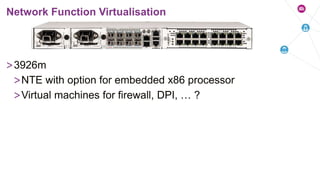
>3926m
>NTE with option for embedded x86 processor
>Virtual machines for firewall, DPI, … ?
Network Function Virtualisation
Any questions? /
Thank you

Janet access solutions

  • 1.
    Janet access solutions Chair: JeremySharp, Janet infrastructure director, Jisc
  • 2.
    History and approach JeremySharp, Janet infrastructure director
  • 3.
    Current Janet architecture London East2 London Bristol South South West PSBA Wales Thames Valley KPSN Kent London East 1 NottinghamBirmingham West Midlands Yorkshire & Humberside Manchester North WestCumbria Northern Ireland Glasgow South East Scotland North East Scotland South West Scotland North East East Midlands EastERN London West Core PoP (Point of Presence) Regional network Transmission site Leeds JANET6 BACKBONE OVERVIEW – Oct 2015 14-May-2015 v06 / jas London Docklands Regional infrastructure National (UK) backbone shared datacentres Global Internet GÉANT peerings & gateways Access layer global NRENs
  • 4.
    > Overall aim:to reduce complexity of Janet access infrastructure, including: > Standardise equipment > Overarching management platform > Some estate rationalisation > More use of fibre – Including future Openreach products – Increase self-provisioning > …and break the cycle of re-procuring regional network telco contracts every 4-6 years A new Janet Access infrastructure Regional infrastructure National (UK) backbone Access layer National (UK) backbone Access layer whatwewantwherewearenow
  • 5.
    Steps towards anew Janet Access infrastructure >2017-Q2/3: Procurement for access provisioning strategy >Competitive dialogue >Range of approaches invited >Proposals mainly based around suppliers’ existing network infrastructures >Expensive - lacking flexibility & agility around provisioning & upgrade >Compared against Jisc build and operate approach (as with Janet6 backbone) –Self-build better meets overall aims
  • 6.
    Access infrastructure –generic approach Aggregation Point Access circuit/fibre Fibre backhaul Janet core PoP Janet connected organisation Jisc managed Ethernet/optical equipment used to light fibre and terminate circuits Core 2 RNEP A RNEP B Co-Lo 1 Co-Lo 2 Co-Lo 6 Co-Lo 5 Co-Lo 3 Co-Lo 4 Site 1 Site 2a Site 2b G.8032 Ethernet Ring Co-Lo 4a Co-Lo 4b G.8032 Sub- Ring Site 3 Router A Router B Core 1 Co-Lo x Core x Site 3
  • 7.
    Building the newJanet Access infrastructure >Components: > Regulated Openreach products (EAD, OSA, OSA Filter Connect, DFA, Exchange space) > Other telco fibre & col-lo: DPS framework > Optical/Ethernet switching equipment, support services: New Ciena framework > Other transmission requirements: Renew Janet telco framework (summer 2018) >New access infrastructure introduced as regional network contractual arrangements expire over next 3-4 years.
  • 8.
    UK Telecoms Regulation (abeginners guide as to why we can't have nice things) James Blessing, Deputy director, Network Architect
  • 9.
    BT Group BT Group BTRetail BT Consumer BT Business & Public Sector EE Plusnet BT Sport BT Wholesale& Ventures BT Wholesale BT Ventures Openreach Sell to End User Sell to Service Providers
  • 10.
    TLAs* >EAD – EthernetAccess Direct >OSA – Optical Spectrum Access >OSEA – Optical Spectrum Enhanced Access >DFA – Dark Fibre Access *Not all the three letter acronyms used in this presentation, just some that are important right now
  • 11.
    >Regulator for Telecom >Andother communication things like TV and Radio >Market Reviews >Narrowband, Business Communications, Wholesale Local Markets, Spectrum, Broadcasting, etc >Protect "people" from providers with significant market power (i.e. mostly BT Group, but also Kingston Communications in Hull) >BCMR 2016 >DFA
  • 12.
    Openreach DFA > Pointto Point Dark Fibre > Three parts > Site -> Local Telephone exchange > Exchange -> Exchange > Remote exchange -> JISC POP (core or RNEP) > Can be used to make backhaul networks > Can't be used for "national" networks (it's an access product) > Regulated, fixed price, nationally available
  • 13.
    Legal > BT Groupdon't agree with BCMR > Wrong market geographical definition > 1G not same as 10G > Pricing is wrong (too cheap) > Take Ofcom to Competition Appeals Tribunal > CAT Agrees with BT :( > Ofcom propose a 1G DFA option > Openreach respond with OSA FC
  • 15.
    Building using OSAFC Need a national solution, national DF not (currently) an option Openreach Telephone Exchanges as POPs Effectively OSA FC is an optical layer, so can focus on Ethernet Establish DF framework, use where more cost effective that OSA FC Move to DFA if/when it becomes available
  • 16.
    Ethernet Platform > Needsto support 100G backhaul > 100G Access as part of the upgrade path > Needs to support 1G/10G access > Sub 1G > Build on a 'family' of hardware to reduce complexity > Options > Traditional Vendor > White/Brite box
  • 17.
    DF Framework > Useas comparator against OSA FC >I.e. each new link request a DF alternative > Request "partial" solution for a region > Sit in room and build based on OSA FC, per link and full solution
  • 18.
    What we’re deploying RobEvans, Chief network architect
  • 19.
  • 20.
    > Ciena 5170 >Regional Aggregation or 100G NTE – I.e. in the co-location PoPs and RNEPs > 1 rack unit > 4 x 100GE – Scalable up to a 200G regional aggregation ring > 40 x 10GE – Access, or multiple of 10GE for lower-demand sub-rings > To be released: DWDM converter shelf for coherent 100GE – 100G can’t be used over OSA FC until that’s available Equipment options
  • 21.
    > Ciena 8700 >10 slot shown, 4 slot to be deployed > Regional aggregation where we can’t wait for the 5170 coherent shelf Equipment options
  • 22.
    > Ciena 3903/ 3928 > 3903 – 2 network-facing 1G ports, 2 user-facing 1G ports > 3928 – 4 x 1G / 10G SFP ports – 8 x 1G SFP ports Equipment options: NTE
  • 23.
    > Ciena 6500 >When capacity exceeds 5170/8700 > Same device used on the Janet backbone > 100GE coherent Equipment options: Optical
  • 24.
    What will thislook like?
  • 25.
    IP service delivery Core 1 Core 2 RNEP A RNEP B Co-Lo 1 Co-Lo 2 Co-Lo 6 Co-Lo 5 Co-Lo 3 Co-Lo 4 Site1 Site 2a Site 2b G.8032 Ethernet Ring Co-Lo 4a Co-Lo 4b G.8032 Sub-Ring Site 3 Router A Router B
  • 26.
    PoP to PoP PoPA PoP B Site 2Site 1 Site 3
  • 27.
    >G.8032/Y.1344 >Less than 50msprotection switch – (Assuming fibre ring < 1,200km!) >Protection at layer 2, so do not need to wait for IP to reconverge on link failure Ethernet ring protection
  • 28.
    >Check circuit beforebeing brought into service >RFC2544 / Y.1564 – Loss – Delay – Throughput >Performance monitoring >CFM / Y.1731 – Delay – Jitter – Loss >Improved visibility of Netpaths through the aggregation infrastructure Ethernet Diagnostics
  • 29.
    >Services delimited byVLANs >Or additional ports on the NTE >Services might be >IP >ExpressRoute >Netpath Presentation
  • 30.
    What can wedo in the future?
  • 31.
    >Ciena MCP >“Manage, Control,Plan” >Formerly “Blue Planet MCP” by Cyan >Point-and-click provisioning around a single region >Netpath provisioning through the core needs to be “stitched” manually >APIs into MCP and the backbone routers could enable automation of this >”Zero touch provisioning” for NTEs Automation
  • 32.
    >If using OSAFC, upgrades will be down to engineer time. >New port on the 5170, re-use the NTE if it’s a 3928. >No involvement from Openreach >Upgrades to regional aggregation rings >Insert SFPs, connect to the OSA FC filters. Scalability
  • 33.
    >3926m >NTE with optionfor embedded x86 processor >Virtual machines for firewall, DPI, … ? Network Function Virtualisation
  • 34.

Editor's Notes

  • #4 18 Regional Networks Delivering ~1500 Janet connections RNs developed autonomously; now managed by Jisc following in-sourcing programme, 2010-2015 Reflect political boundaries Individual designs & wide variety of: Optical, routing and switching equipment Transmission technologies and suppliers Contract arrangements