LORAWAN GARBAGE NETWORK
RIEMANN GARBAGE BINS (RGB)
USING
PROJECT
IDEA
Self-sustained sensor system for
trash bins provided in a local area
ПРОБЛЕМ
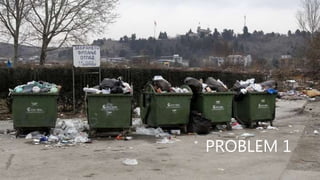
PROBLEM 1
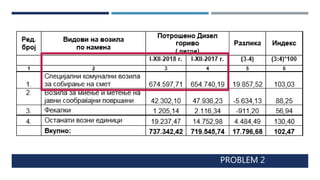
PROBLEM 2
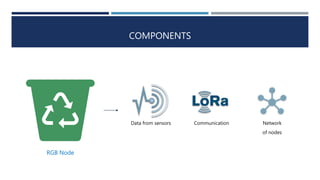
COMPONENTS
Data from sensors Communication Network
of nodes
RGB Node
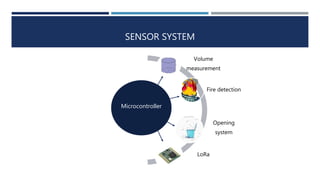
SENSOR SYSTEM
Microcontroller
Volume
measurement
Fire detection
Opening
system
LoRa
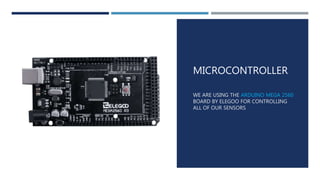
MICROCONTROLLER
WE ARE USING THE ARDUINO MEGA 2560
BOARD BY ELEGOO FOR CONTROLLING
ALL OF OUR SENSORS
OPENING SYSTEM
 Three actions activate the opening lid:
1. RFID [only on prototype]
2. Opening caused by fire detection
3. Pressure plate
Picture 1: Prototype
OPENING MOTORS
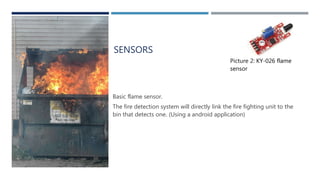
FIRE DETECTION
SENSORS
Basic flame sensor.
The fire detection system will directly link the fire fighting unit to the
bin that detects one. (Using a android application)
Picture 2: KY-026 flame
sensor
VOLUME
MEASUREMENT
SENSORS
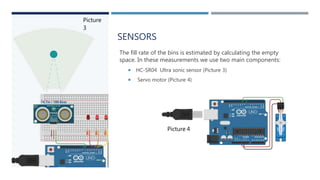
The fill rate of the bins is estimated by calculating the empty
space. In these measurements we use two main components:
 HC-SR04 Ultra sonic sensor (Picture 3)
 Servo motor (Picture 4)
Picture
3
Picture 4
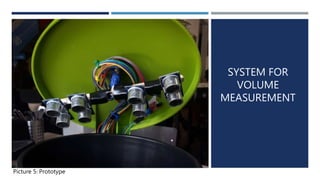
SYSTEM FOR
VOLUME
MEASUREMENT
Picture 5: Prototype
ALGORITHM
Riemann Garbage Bin (RGB)
 Georg Bernhard Riemann [1826-1866]
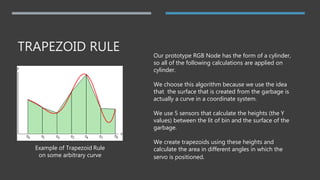
TRAPEZOID RULE Our prototype RGB Node has the form of a cylinder,
so all of the following calculations are applied on
cylinder.
We choose this algorithm because we use the idea
that the surface that is created from the garbage is
actually a curve in a coordinate system.
We use 5 sensors that calculate the heights (the Y
values) between the lit of bin and the surface of the
garbage.
We create trapezoids using these heights and
calculate the area in different angles in which the
servo is positioned.
Example of Trapezoid Rule
on some arbitrary curve
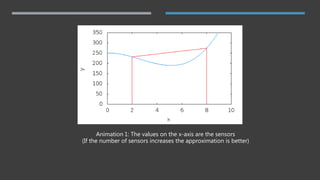
Animation 1: The values on the x-axis are the sensors
(If the number of sensors increases the approximation is better)
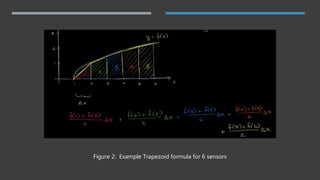
Figure 2: Example Trapezoid formula for 6 sensors
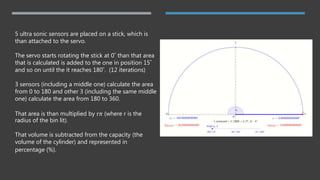
5 ultra sonic sensors are placed on a stick, which is
than attached to the servo.
The servo starts rotating the stick at 0˚ than that area
that is calculated is added to the one in position 15˚
and so on until the it reaches 180˚. (12 iterations)
3 sensors (including a middle one) calculate the area
from 0 to 180 and other 3 (including the same middle
one) calculate the area from 180 to 360.
That area is than multiplied by r𝜋 (where r is the
radius of the bin lit).
That volume is subtracted from the capacity (the
volume of the cylinder) and represented in
percentage (%).
COMMUNICATION → LORA
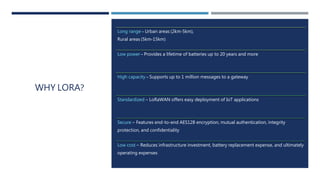
WHY LORA?
Long range – Urban areas (2km-5km),
Rural areas (5km-15km)
Low power – Provides a lifetime of batteries up to 20 years and more
High capacity – Supports up to 1 million messages to a gateway
Standardized – LoRaWAN offers easy deployment of IoT applications
Secure – Features end-to-end AES128 encryption, mutual authentication, integrity
protection, and confidentiality
Low cost – Reduces infrastructure investment, battery replacement expense, and ultimately
operating expenses
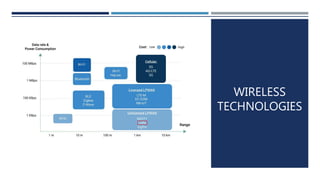
WIRELESS
TECHNOLOGIES
THE THINGS NETWORK
TTN ACRONYM FOR LPWAN
 Low-Power Wide Area Network (LPWAN) is one of the 6 leading types of wireless IoT communication
technologies (beside Cellular, Zigbee, BLE/Bluetooth, Wi-Fi and RFID)
 LPWANs are a new phenomenon in Industrial IoT (IIoT). Providing long-range communication on small,
inexpensive batteries that last for years, this technology family is purpose-built to support large-scale
IIoT networks sprawling over vast industrial and commercial campuses
 Not all LPWANs are created equal. Today, existing LPWANs operate in both the licensed (NB-IoT, LTE-M)
and unlicensed (e.g. MIOTY, LoRa, Sigfox etc.)
WHAT IS THE
THINGS NETWORK
AND WHY TO WE
USE IT?
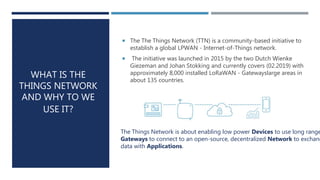
 The The Things Network (TTN) is a community-based initiative to
establish a global LPWAN - Internet-of-Things network.
 The initiative was launched in 2015 by the two Dutch Wienke
Giezeman and Johan Stokking and currently covers (02.2019) with
approximately 8,000 installed LoRaWAN - Gatewayslarge areas in
about 135 countries.
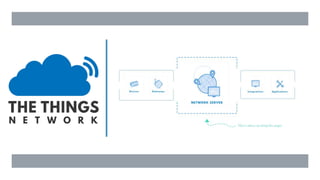
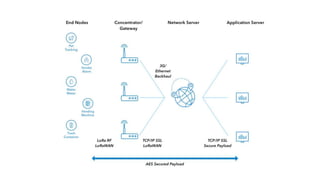
The Things Network is about enabling low power Devices to use long range
Gateways to connect to an open-source, decentralized Network to exchang
data with Applications.
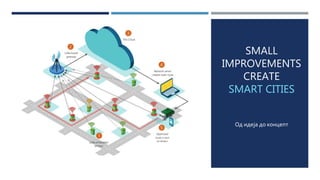
SMALL
IMPROVEMENTS
CREATE
SMART CITIES
Од идеја до концепт
PROTOTYPE
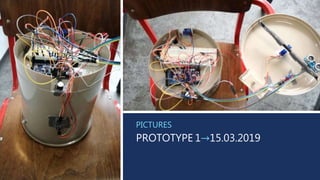
PICTURES
PROTOTYPE 1→15.03.2019
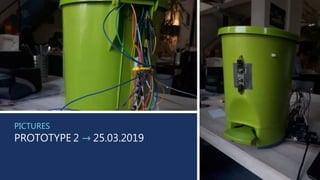
PICTURES
PROTOTYPE 2 → 25.03.2019
Prototype 2[Video]: 25.03.2019
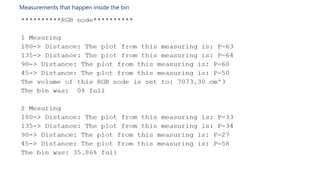
Measurements that happen inside the bin
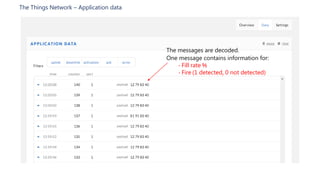
The messages are decoded.
One message contains information for:
- Fill rate %
- Fire (1 detected, 0 not detected)
The Things Network – Application data
LONG TERM BENEFITS
 Reduces infrastructure investment, battery replacement expense, and ultimately operating expenses
(creating a optimal route)
 Reliable RF communication link between sensor infrastructure
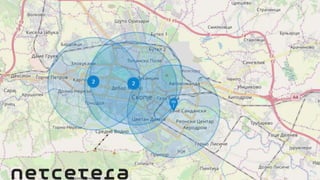
 LoRaWAN – based network provides excellent coverage
 Determine the number of waste bins needed
(Relocating resources where they are actually needed)
 Keep cities cleaner by preventing waste bin overflow
(Situation that is controlled by people ...)
REUSABILITY
PROJECT DEPLOYED IN DENMARK [2018]
Picture: How sensor boxes are placed on existing bins on a student campus
MENTOR:
PHD IGOR MISHKOVSKI
FILIP KARAFILOSKI
KIRIL ZELENKOVSKI (PRESENTER)
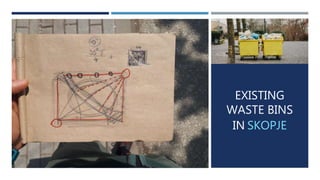
EXISTING
WASTE BINS
IN SKOPJE

IoT Garbage management network using LoRaWAN

  • 1.
    LORAWAN GARBAGE NETWORK RIEMANNGARBAGE BINS (RGB) USING
  • 2.
    PROJECT IDEA Self-sustained sensor systemfor trash bins provided in a local area
  • 3.
  • 4.
  • 5.
    COMPONENTS Data from sensorsCommunication Network of nodes RGB Node
  • 6.
  • 7.
    MICROCONTROLLER WE ARE USINGTHE ARDUINO MEGA 2560 BOARD BY ELEGOO FOR CONTROLLING ALL OF OUR SENSORS
  • 8.
  • 9.
     Three actionsactivate the opening lid: 1. RFID [only on prototype] 2. Opening caused by fire detection 3. Pressure plate Picture 1: Prototype OPENING MOTORS
  • 10.
  • 11.
    SENSORS Basic flame sensor. Thefire detection system will directly link the fire fighting unit to the bin that detects one. (Using a android application) Picture 2: KY-026 flame sensor
  • 12.
  • 13.
    SENSORS The fill rateof the bins is estimated by calculating the empty space. In these measurements we use two main components:  HC-SR04 Ultra sonic sensor (Picture 3)  Servo motor (Picture 4) Picture 3 Picture 4
  • 14.
  • 15.
  • 16.
    Riemann Garbage Bin(RGB)  Georg Bernhard Riemann [1826-1866]
  • 17.
    TRAPEZOID RULE Ourprototype RGB Node has the form of a cylinder, so all of the following calculations are applied on cylinder. We choose this algorithm because we use the idea that the surface that is created from the garbage is actually a curve in a coordinate system. We use 5 sensors that calculate the heights (the Y values) between the lit of bin and the surface of the garbage. We create trapezoids using these heights and calculate the area in different angles in which the servo is positioned. Example of Trapezoid Rule on some arbitrary curve
  • 18.
    Animation 1: Thevalues on the x-axis are the sensors (If the number of sensors increases the approximation is better)
  • 19.
    Figure 2: ExampleTrapezoid formula for 6 sensors
  • 20.
    5 ultra sonicsensors are placed on a stick, which is than attached to the servo. The servo starts rotating the stick at 0˚ than that area that is calculated is added to the one in position 15˚ and so on until the it reaches 180˚. (12 iterations) 3 sensors (including a middle one) calculate the area from 0 to 180 and other 3 (including the same middle one) calculate the area from 180 to 360. That area is than multiplied by r𝜋 (where r is the radius of the bin lit). That volume is subtracted from the capacity (the volume of the cylinder) and represented in percentage (%).
  • 21.
  • 22.
    WHY LORA? Long range– Urban areas (2km-5km), Rural areas (5km-15km) Low power – Provides a lifetime of batteries up to 20 years and more High capacity – Supports up to 1 million messages to a gateway Standardized – LoRaWAN offers easy deployment of IoT applications Secure – Features end-to-end AES128 encryption, mutual authentication, integrity protection, and confidentiality Low cost – Reduces infrastructure investment, battery replacement expense, and ultimately operating expenses
  • 23.
  • 24.
  • 25.
    TTN ACRONYM FORLPWAN  Low-Power Wide Area Network (LPWAN) is one of the 6 leading types of wireless IoT communication technologies (beside Cellular, Zigbee, BLE/Bluetooth, Wi-Fi and RFID)  LPWANs are a new phenomenon in Industrial IoT (IIoT). Providing long-range communication on small, inexpensive batteries that last for years, this technology family is purpose-built to support large-scale IIoT networks sprawling over vast industrial and commercial campuses  Not all LPWANs are created equal. Today, existing LPWANs operate in both the licensed (NB-IoT, LTE-M) and unlicensed (e.g. MIOTY, LoRa, Sigfox etc.)
  • 26.
    WHAT IS THE THINGSNETWORK AND WHY TO WE USE IT?  The The Things Network (TTN) is a community-based initiative to establish a global LPWAN - Internet-of-Things network.  The initiative was launched in 2015 by the two Dutch Wienke Giezeman and Johan Stokking and currently covers (02.2019) with approximately 8,000 installed LoRaWAN - Gatewayslarge areas in about 135 countries. The Things Network is about enabling low power Devices to use long range Gateways to connect to an open-source, decentralized Network to exchang data with Applications.
  • 29.
  • 30.
  • 31.
  • 32.
  • 33.
  • 34.
  • 35.
    The messages aredecoded. One message contains information for: - Fill rate % - Fire (1 detected, 0 not detected) The Things Network – Application data
  • 36.
    LONG TERM BENEFITS Reduces infrastructure investment, battery replacement expense, and ultimately operating expenses (creating a optimal route)  Reliable RF communication link between sensor infrastructure  LoRaWAN – based network provides excellent coverage  Determine the number of waste bins needed (Relocating resources where they are actually needed)  Keep cities cleaner by preventing waste bin overflow (Situation that is controlled by people ...)
  • 37.
    REUSABILITY PROJECT DEPLOYED INDENMARK [2018] Picture: How sensor boxes are placed on existing bins on a student campus
  • 38.
    MENTOR: PHD IGOR MISHKOVSKI FILIPKARAFILOSKI KIRIL ZELENKOVSKI (PRESENTER)
  • 39.