
Disinfection of water
(Chlorination)
Introduction
• Health care to a community cannot be provided without
ample and safe drinking water.
• Health which affects humanity especially in developing
countries is due to lack of safe and wholesome water.
• Water that is easily accessible, adequate in quantity, should be
free from contamination, safe and readily available throughout
the year.
“Safe and
wholesome
water"
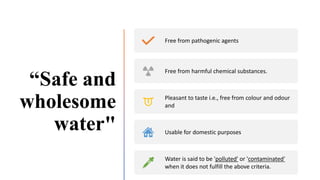
Free from pathogenic agents
Free from harmful chemical substances.
Pleasant to taste i.e., free from colour and odour
and
Usable for domestic purposes
Water is said to be 'polluted' or 'contaminated'
when it does not fulfill the above criteria.
Water
requirement
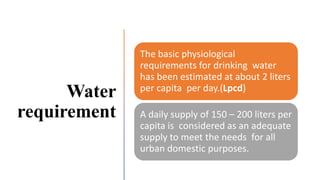
The basic physiological
requirements for drinking water
has been estimated at about 2 liters
per capita per day.(Lpcd)
A daily supply of 150 – 200 liters per
capita is considered as an adequate
supply to meet the needs for all
urban domestic purposes.
Uses of
water
The
uses of
water
include:
Domestic use: Drinking, cooking, washing,
bathing, flushing of toilets, gardening etc.
Public Purposes: Cleaning streets, purposes like
swimming pools, public fountains, ornamental ponds,
fire protect and public parks.
Industrial Purpose: Processing and Cooling.
Agriculture Purpose: Irrigation
Power Production: from hydropower and
steam power
Carrying of waste: through drainage.
Sources of water
supply
• There are three main sources of water
• Rainwater
• Surface water
• Impounding reservoir
• Rivers and streams
• Tanks, ponds and takes
• Ground water
• Shallow wells
• Deep wells
• Springs
Purification on a
large scale
•Storage
•Filtration
•Disinfection
Storage
• Natural/artificial reservoirs gets auto cleaned by this step only
• Purification in terms of-
• Physical: 90% suspended impurities settle down by gravity in 24 hrs
• Chemical: aerobic bacteria oxidize organic matter. From free ammonia to
nitrates.
• Biological : drop in bacterial count 90% bacteria die out in 5-6
days.
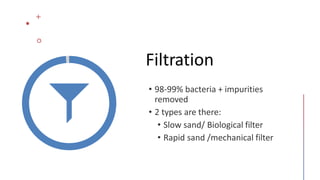
Filtration
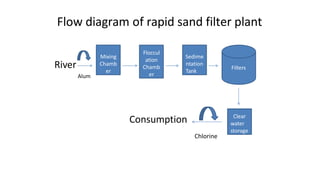
Flow diagram of rapid sand filter plant
River
Alum
Consumption
Chlorine
Mixing
Chamb
er
Floccul
ation
Chamb
er
Sedime
ntation
Tank
Filters
Clear
water
storage
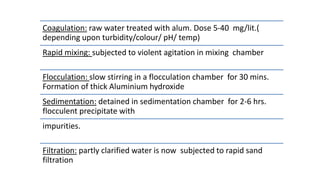
Coagulation: raw water treated with alum. Dose 5-40 mg/lit.(
depending upon turbidity/colour/ pH/ temp)
Rapid mixing: subjected to violent agitation in mixing chamber
Flocculation: slow stirring in a flocculation chamber for 30 mins.
Formation of thick Aluminium hydroxide
Sedimentation: detained in sedimentation chamber for 2-6 hrs.
flocculent precipitate with
impurities.
Filtration: partly clarified water is now subjected to rapid sand
filtration
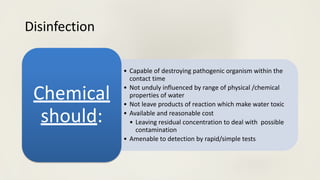
Disinfection
• Capable of destroying pathogenic organism within the
contact time
• Not unduly influenced by range of physical /chemical
properties of water
• Not leave products of reaction which make water toxic
• Available and reasonable cost
• Leaving residual concentration to deal with possible
contamination
• Amenable to detection by rapid/simple tests
Chemical
should:
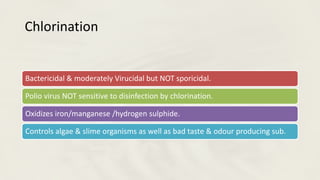
Chlorination
Bactericidal & moderately Virucidal but NOT sporicidal.
Polio virus NOT sensitive to disinfection by chlorination.
Oxidizes iron/manganese /hydrogen sulphide.
Controls algae & slime organisms as well as bad taste & odour producing sub.
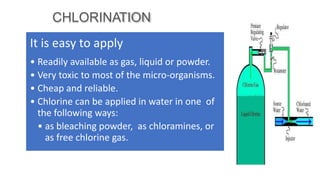
CHLORINATION
It is easy to apply
• Readily available as gas, liquid or powder.
• Very toxic to most of the micro-organisms.
• Cheap and reliable.
• Chlorine can be applied in water in one of
the following ways:
• as bleaching powder, as chloramines, or
as free chlorine gas.
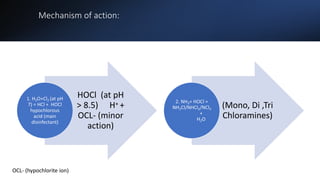
Mechanism of action:
HOCl (at pH
> 8.5) H+ +
OCL- (minor
action)
1. H2O+Cl2 (at pH
7) = HCl + HOCl
hypochlorous
acid (main
disinfectant)
(Mono, Di ,Tri
Chloramines)
2. NH3+ HOCl =
NH2Cl/NHCl2/NCl3
+
H2O
OCL- (hypochlorite ion)
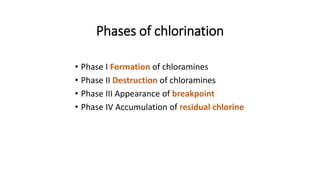
Phases of chlorination
• Phase I Formation of chloramines
• Phase II Destruction of chloramines
• Phase III Appearance of breakpoint
• Phase IV Accumulation of residual chlorine
Chlorination
1. water should be clear/ free of turbidity
2.Chlorine demand: should be estimated. (It is an amount of
Cl needed to destroy bacteria & oxidize organic matter,
ammoniacal substances in water.)
3. Break Point: At which point the Cl demand of water is met called
Break point. If further Cl added after this, it would appear as free
residual Cl (HOCL & OCL)
4. Contact period: presence of free CL for at least 1 hour in water.
*Recommended conc. Of residual CL = 0.5 mg/L after 1hour
3. Min. recommended free Cl gives margin of safety for
subsequent contamination during distribution.
4. Note: Cl is not effective in killing spores, cysts of
protozoa, helminthic ova except higher doses.
5. Swimming pool & wells: more than 1mg/L=
1ppm (parts per million)
6. Post disaster: 0.7 mg/L
Residual germicidal effect of chlorine-
• Provides margin of safety against microbial
contamination, which may occur during storage or
distribution.
• Only chlorine has got this advantage over other types of
disinfectants like- UV rays, Ozone
Calculation of Chlorine demand
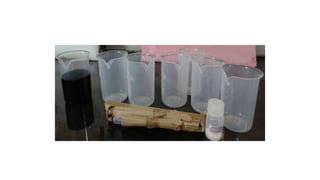
• By Horrock’s apparatus
• To find out dose of Bleaching powder required for
disinfection
• Contents: 1. 6 white cups (200 ml each)
2. one black cup with a circular mark inside
3. 2 metal spoons (2 g when level filled)
4. 7 glass stirring rods
5. One special pipette
6. Two droppers
7. starch-iodide indicator solution
8. Instruction folder
Procedure
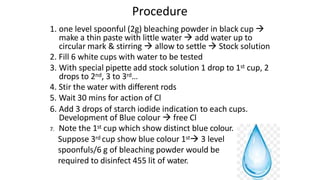
1. one level spoonful (2g) bleaching powder in black cup 
make a thin paste with little water  add water up to
circular mark & stirring  allow to settle  Stock solution
2. Fill 6 white cups with water to be tested
3. With special pipette add stock solution 1 drop to 1st cup, 2
drops to 2nd, 3 to 3rd…
4. Stir the water with different rods
5. Wait 30 mins for action of Cl
6. Add 3 drops of starch iodide indication to each cups.
Development of Blue colour  free Cl
7. Note the 1st cup which show distinct blue colour.
Suppose 3rd cup show blue colour 1st 3 level
spoonfuls/6 g of bleaching powder would be
required to disinfect 455 lit of water.
Method of Chlorination
• Cl added as :
1. Chlorine gas (Cheap/easy/Chlorinating
equipment: Paterson’s chloronome)
2. Chloramine (less chlorinous taste/slower action)
3. Perchloron ( Ca compound with 70 %
available Cl.)
A. Bleaching powder: Ca(OCl)Cl, if freshly
made=33% available Cl, unstable(on
exposure to air/light/moister losses Cl
content. Stored in dark, cool, dry place in
closed container)
B.Chlorine solution : prepared from bleaching
powder. 4 kg of bleaching powder with 25 %
available chlorine mixed with 20 lit of water
gives 5% solution of chlorine.
C.Chlorine Tablets: (Halazone Tablet).
Good but costly. Single tablet of 0.5 g
is suficient to disinfect 20 lit of water.
Superchlorination
Super-chlorination followed by de-chlorination
comprises the addition of large dose of chlorine to
the water, & removal of excess of it after
disinfection, this is applicable for heavily polluted
water
Orthotolidine (OT) Test
• Both free n combined Cl can be determined
• reagent= Orthotolidine (desolved in 10% sol. Of
HCl)
• Water containing Cl+ reagent= yellow
colour(intensity varies with conc. )
• Reaction with free Cl is fast
• 0.1 ml reagent+ 1 ml water=yellow color matched
with color disc.
• Reading: within 10 sec=free Cl
after 15-20 min=both free and
combined Cl
Orthotolodine-arsenite (OTA) Test
• Modification of OT test to identify free and
combined Cl separately
• Error caused by iron/nitrites/ manganese by
producing yellow color can be overcome
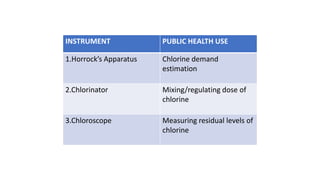
INSTRUMENT PUBLIC HEALTH USE
1.Horrock’s Apparatus Chlorine demand
estimation
2.Chlorinator Mixing/regulating dose of
chlorine
3.Chloroscope Measuring residual levels of
chlorine
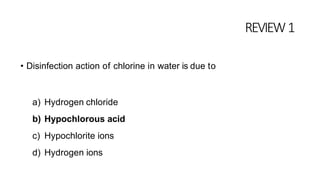
REVIEW1
• Disinfection action of chlorine in water is due to
a) Hydrogen chloride
b) Hypochlorous acid
c) Hypochlorite ions
d) Hydrogen ions
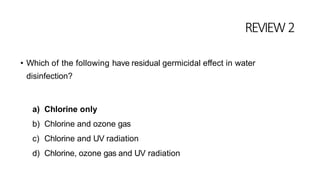
REVIEW2
• Which of the following have residual germicidal effect in water
disinfection?
a) Chlorine only
b) Chlorine and ozone gas
c) Chlorine and UV radiation
d) Chlorine, ozone gas and UV radiation
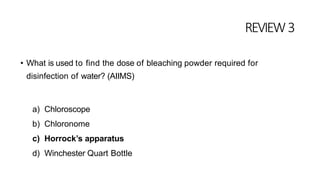
REVIEW3
• What is used to find the dose of bleaching powder required for
disinfection of water? (AIIMS)
a) Chloroscope
b) Chloronome
c) Horrock’s apparatus
d) Winchester Quart Bottle
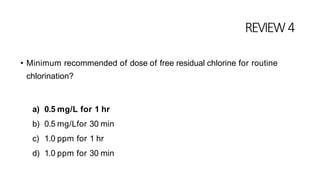
REVIEW4
• Minimum recommended of dose of free residual chlorine for routine
chlorination?
a) 0.5 mg/L for 1 hr
b) 0.5 mg/Lfor 30 min
c) 1.0 ppm for 1 hr
d) 1.0 ppm for 30 min
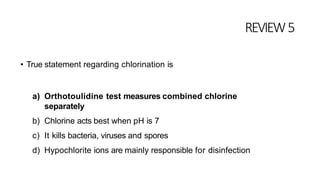
REVIEW5
• True statement regarding chlorination is
a) Orthotoulidine test measures combined chlorine
separately
b) Chlorine acts best when pH is 7
c) It kills bacteria, viruses and spores
d) Hypochlorite ions are mainly responsible for disinfection

chlorination.pptx

  • 1.
  • 2.
    Introduction • Health careto a community cannot be provided without ample and safe drinking water. • Health which affects humanity especially in developing countries is due to lack of safe and wholesome water. • Water that is easily accessible, adequate in quantity, should be free from contamination, safe and readily available throughout the year.
  • 3.
    “Safe and wholesome water" Free frompathogenic agents Free from harmful chemical substances. Pleasant to taste i.e., free from colour and odour and Usable for domestic purposes Water is said to be 'polluted' or 'contaminated' when it does not fulfill the above criteria.
  • 4.
    Water requirement The basic physiological requirementsfor drinking water has been estimated at about 2 liters per capita per day.(Lpcd) A daily supply of 150 – 200 liters per capita is considered as an adequate supply to meet the needs for all urban domestic purposes.
  • 5.
    Uses of water The uses of water include: Domesticuse: Drinking, cooking, washing, bathing, flushing of toilets, gardening etc. Public Purposes: Cleaning streets, purposes like swimming pools, public fountains, ornamental ponds, fire protect and public parks. Industrial Purpose: Processing and Cooling. Agriculture Purpose: Irrigation Power Production: from hydropower and steam power Carrying of waste: through drainage.
  • 6.
    Sources of water supply •There are three main sources of water • Rainwater • Surface water • Impounding reservoir • Rivers and streams • Tanks, ponds and takes • Ground water • Shallow wells • Deep wells • Springs
  • 7.
    Purification on a largescale •Storage •Filtration •Disinfection
  • 8.
    Storage • Natural/artificial reservoirsgets auto cleaned by this step only • Purification in terms of- • Physical: 90% suspended impurities settle down by gravity in 24 hrs • Chemical: aerobic bacteria oxidize organic matter. From free ammonia to nitrates. • Biological : drop in bacterial count 90% bacteria die out in 5-6 days.
  • 9.
  • 10.
    Flow diagram ofrapid sand filter plant River Alum Consumption Chlorine Mixing Chamb er Floccul ation Chamb er Sedime ntation Tank Filters Clear water storage
  • 11.
    Coagulation: raw watertreated with alum. Dose 5-40 mg/lit.( depending upon turbidity/colour/ pH/ temp) Rapid mixing: subjected to violent agitation in mixing chamber Flocculation: slow stirring in a flocculation chamber for 30 mins. Formation of thick Aluminium hydroxide Sedimentation: detained in sedimentation chamber for 2-6 hrs. flocculent precipitate with impurities. Filtration: partly clarified water is now subjected to rapid sand filtration
  • 12.
    Disinfection • Capable ofdestroying pathogenic organism within the contact time • Not unduly influenced by range of physical /chemical properties of water • Not leave products of reaction which make water toxic • Available and reasonable cost • Leaving residual concentration to deal with possible contamination • Amenable to detection by rapid/simple tests Chemical should:
  • 13.
    Chlorination Bactericidal & moderatelyVirucidal but NOT sporicidal. Polio virus NOT sensitive to disinfection by chlorination. Oxidizes iron/manganese /hydrogen sulphide. Controls algae & slime organisms as well as bad taste & odour producing sub.
  • 14.
    CHLORINATION It is easyto apply • Readily available as gas, liquid or powder. • Very toxic to most of the micro-organisms. • Cheap and reliable. • Chlorine can be applied in water in one of the following ways: • as bleaching powder, as chloramines, or as free chlorine gas.
  • 15.
    Mechanism of action: HOCl(at pH > 8.5) H+ + OCL- (minor action) 1. H2O+Cl2 (at pH 7) = HCl + HOCl hypochlorous acid (main disinfectant) (Mono, Di ,Tri Chloramines) 2. NH3+ HOCl = NH2Cl/NHCl2/NCl3 + H2O OCL- (hypochlorite ion)
  • 16.
    Phases of chlorination •Phase I Formation of chloramines • Phase II Destruction of chloramines • Phase III Appearance of breakpoint • Phase IV Accumulation of residual chlorine
  • 17.
    Chlorination 1. water shouldbe clear/ free of turbidity 2.Chlorine demand: should be estimated. (It is an amount of Cl needed to destroy bacteria & oxidize organic matter, ammoniacal substances in water.) 3. Break Point: At which point the Cl demand of water is met called Break point. If further Cl added after this, it would appear as free residual Cl (HOCL & OCL) 4. Contact period: presence of free CL for at least 1 hour in water. *Recommended conc. Of residual CL = 0.5 mg/L after 1hour
  • 18.
    3. Min. recommendedfree Cl gives margin of safety for subsequent contamination during distribution. 4. Note: Cl is not effective in killing spores, cysts of protozoa, helminthic ova except higher doses. 5. Swimming pool & wells: more than 1mg/L= 1ppm (parts per million) 6. Post disaster: 0.7 mg/L
  • 19.
    Residual germicidal effectof chlorine- • Provides margin of safety against microbial contamination, which may occur during storage or distribution. • Only chlorine has got this advantage over other types of disinfectants like- UV rays, Ozone
  • 20.
    Calculation of Chlorinedemand • By Horrock’s apparatus • To find out dose of Bleaching powder required for disinfection • Contents: 1. 6 white cups (200 ml each) 2. one black cup with a circular mark inside 3. 2 metal spoons (2 g when level filled) 4. 7 glass stirring rods 5. One special pipette 6. Two droppers 7. starch-iodide indicator solution 8. Instruction folder
  • 22.
    Procedure 1. one levelspoonful (2g) bleaching powder in black cup  make a thin paste with little water  add water up to circular mark & stirring  allow to settle  Stock solution 2. Fill 6 white cups with water to be tested 3. With special pipette add stock solution 1 drop to 1st cup, 2 drops to 2nd, 3 to 3rd… 4. Stir the water with different rods 5. Wait 30 mins for action of Cl 6. Add 3 drops of starch iodide indication to each cups. Development of Blue colour  free Cl 7. Note the 1st cup which show distinct blue colour. Suppose 3rd cup show blue colour 1st 3 level spoonfuls/6 g of bleaching powder would be required to disinfect 455 lit of water.
  • 23.
    Method of Chlorination •Cl added as : 1. Chlorine gas (Cheap/easy/Chlorinating equipment: Paterson’s chloronome) 2. Chloramine (less chlorinous taste/slower action) 3. Perchloron ( Ca compound with 70 % available Cl.)
  • 24.
    A. Bleaching powder:Ca(OCl)Cl, if freshly made=33% available Cl, unstable(on exposure to air/light/moister losses Cl content. Stored in dark, cool, dry place in closed container)
  • 25.
    B.Chlorine solution :prepared from bleaching powder. 4 kg of bleaching powder with 25 % available chlorine mixed with 20 lit of water gives 5% solution of chlorine. C.Chlorine Tablets: (Halazone Tablet). Good but costly. Single tablet of 0.5 g is suficient to disinfect 20 lit of water.
  • 26.
    Superchlorination Super-chlorination followed byde-chlorination comprises the addition of large dose of chlorine to the water, & removal of excess of it after disinfection, this is applicable for heavily polluted water
  • 27.
    Orthotolidine (OT) Test •Both free n combined Cl can be determined • reagent= Orthotolidine (desolved in 10% sol. Of HCl) • Water containing Cl+ reagent= yellow colour(intensity varies with conc. ) • Reaction with free Cl is fast • 0.1 ml reagent+ 1 ml water=yellow color matched with color disc. • Reading: within 10 sec=free Cl after 15-20 min=both free and combined Cl
  • 28.
    Orthotolodine-arsenite (OTA) Test •Modification of OT test to identify free and combined Cl separately • Error caused by iron/nitrites/ manganese by producing yellow color can be overcome
  • 29.
    INSTRUMENT PUBLIC HEALTHUSE 1.Horrock’s Apparatus Chlorine demand estimation 2.Chlorinator Mixing/regulating dose of chlorine 3.Chloroscope Measuring residual levels of chlorine
  • 31.
    REVIEW1 • Disinfection actionof chlorine in water is due to a) Hydrogen chloride b) Hypochlorous acid c) Hypochlorite ions d) Hydrogen ions
  • 32.
    REVIEW2 • Which ofthe following have residual germicidal effect in water disinfection? a) Chlorine only b) Chlorine and ozone gas c) Chlorine and UV radiation d) Chlorine, ozone gas and UV radiation
  • 33.
    REVIEW3 • What isused to find the dose of bleaching powder required for disinfection of water? (AIIMS) a) Chloroscope b) Chloronome c) Horrock’s apparatus d) Winchester Quart Bottle
  • 34.
    REVIEW4 • Minimum recommendedof dose of free residual chlorine for routine chlorination? a) 0.5 mg/L for 1 hr b) 0.5 mg/Lfor 30 min c) 1.0 ppm for 1 hr d) 1.0 ppm for 30 min
  • 35.
    REVIEW5 • True statementregarding chlorination is a) Orthotoulidine test measures combined chlorine separately b) Chlorine acts best when pH is 7 c) It kills bacteria, viruses and spores d) Hypochlorite ions are mainly responsible for disinfection