Small Intestine
Dr. Priyanka Solanki
FUNCTIONAL ANATOMY
• Small intestine is the part of gastrointestinal (GI) tract, extending
between the pyloric sphincter of stomach and ileocecal valve, which
opens into large intestine.
• It is called small intestine because of its small diameter, compared to
that of the large intestine. But it is longer than large intestine.
• Its length is about 6 meter.
• Important function of small intestine is absorption. Maximum
absorption of digested food products takes place in small intestine.
• Small intestine consists of three portions:
• 1. Proximal part known as duodenum
• 2. Middle part known as jejunum
• 3. Distal part known as ileum.
• Wall of the small intestine has all the four layers as in stomach
INTESTINAL VILLI
• Mucous membrane of small intestine is covered by minute
projections called villi.
• The height of villi is about 1 mm and the diameter is less than 1 mm.
• Villi are lined by columnar cells, which are called enterocytes. Each
enterocyte gives rise to hair-like projections called microvilli.
• Villi and microvilli increase the surface area of mucous membrane by
many folds.
• Within each villus, there is a central channel called lacteal, which
opens into lymphatic vessels. It contains blood vessels also.
CRYPTS OF LIEBERKÜHN OR INTESTINAL GLANDS
• Crypts of Lieberkühn or intestinal glands are simple tubular glands of
intestine.
• Epithelial cells lining the intestinal glands undergo division by mitosis
at a faster rate.
• Newly formed cells push the older cells upward over the lining of villi.
• These cells which move to villi are called enterocytes.
• Enterocytes secrete the enzymes.
• Old enterocytes are continuously shed into lumen along with
enzymes.
• Types of cells
• 1. Argentaffin cells or enterochromaffin cells, which secrete intrinsic
factor of Castle
• 2. Goblet cells, which secrete mucus
• 3. Paneth cells, which secrete the cytokines called defensins.
BRUNNER GLANDS -In addition to intestinal glands, the first part of
duodenum contains some mucus glands, which are called Brunner
glands. Brunner gland secretes mucus and traces of enzymes.
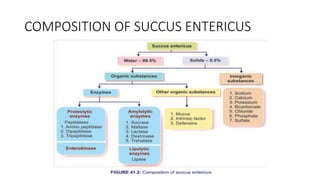
PROPERTIES AND COMPOSITION OF SUCCUS
ENTERICUS
• Secretion from small intestine is called succus entericus.
• PROPERTIES OF SUCCUS ENTERICUS
• Volume : 1800 mL/day
• Reaction : Alkaline
• pH : 8.3
COMPOSITION OF SUCCUS ENTERICUS
FUNCTIONS OF SMALL INTESTINE
• 1. MECHANICAL FUNCTION -Mixing movements of small
intestine help in the thorough mixing of chyme with the
digestive juices like succus entericus, pancreatic juice and
bile.
• 2. SECRETORY FUNCTION- Small intestine secretes succus
entericus, enterokinase and the GI hormones.
• 3. HORMONAL FUNCTION- Small intestine secretes many GI
hormones such as secretin, cholecystokinin, etc. These
hormones regulate the movement of GI tract and secretory
activities of small intestine and pancreas.
• ABSORPTIVE FUNCTIONS- Presence of villi and microvilli in small
intestinal mucosa increases the surface area of mucosa.
• This facilitates the absorptive function of intestine. Digested products
of foodstuffs, proteins, carbohydrates, fats and other nutritive
substances such as vitamins, minerals and water are absorbed mostly
in small intestine.
• From the lumen of intestine, these substances pass through lacteal of
villi, cross the mucosa and enter the blood directly or through
lymphatics.
• FUNCTIONS OF SUCCUS ENTERICUS
• 1. DIGESTIVE FUNCTION- Enzymes of succus entericus act on the
partially digested food and convert them into final digestive products.
• Proteolytic Enzymes
peptidases convert peptides into amino acids.
• Amylolytic Enzymes
• Lactase,
• sucrase
• maltase
• convert the disaccharides (lactose, sucrose and maltose) into two molecules of
monosaccharides.
• Lipolytic Enzyme Intestinal lipase acts on triglycerides converts them
into fatty acids
• 2. PROTECTIVE FUNCTION
• i. Mucus present in the succus entericus protects the intestinal wall from the
acid chyme, which enters the intestine from stomach; thereby it prevents the
intestinal ulcer.
• ii. Defensins secreted by paneth cells of intestinal glands are the
antimicrobial peptides. These peptides are called natural peptide antibiotics
because of their role in killing the phagocytosed bacteria.
3. ACTIVATOR FUNCTION Enterokinase present in intestinal juice activates
trypsinogen into trypsin.
Trypsin, in turn activates other enzymes
• 4. HEMOPOIETIC FUNCTION Intrinsic factor of Castle present in the intestine
plays an important role in erythropoiesis (Chapter 10). It is necessary for the
absorption of vitamin B12.
• 5. HYDROLYTIC PROCESS Intestinal juice helps in all the enzymatic
reactions of digestion.
LARGE INTESTINE
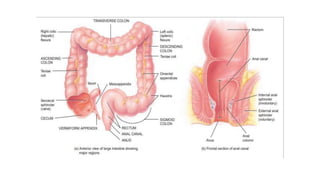
• Large intestine or colon extends from ileocecal valve up to anus.
• PARTS OF LARGE INTESTINE Large intestine is made up of the
following parts:
• 1. Cecum with appendix
• 2. Ascending colon
• 3. Transverse colon
• 4. Descending colon
• 5. Sigmoid colon or pelvic colon
• 6. Rectum
• 7. Anal canal.
COMPOSITION OF LARGE INTESTINAL JUICE
FUNCTIONS OF LARGE INTESTINAL JUICE
• Neutralization of Acids Strong acids formed by bacterial action in
large intestine are neutralized by the alkaline nature of large
intestinal juice. The alkalinity of this juice is mainly due to the
presence of large quantity of bicarbonate.
• Lubrication Activity Mucin present in the secretion of large intestine
lubricates the mucosa of large intestine and the bowel contents, so
that, the movement of bowel is facilitated.
FUNCTIONS OF LARGE INTESTINE
• 1. ABSORPTIVE FUNCTION Large intestine plays an important role in
the absorption of various substances such as:
• i. Water
• ii. Electrolytes
• iii. Organic substances like glucose
• iv. Alcohol
• v. Drugs like anesthetic agents, sedatives and steroids.
• 2. FORMATION OF FECES- After the absorption of nutrients, water
and other substances, the unwanted substances in the large intestine
form feces. This is excreted out.
• 3. EXCRETORY FUNCTION
• Large intestine excretes heavy metals like mercury, lead, bismuth and
arsenic through feces.
• 4. SECRETORY FUNCTION- Large intestine secretes mucin and inorganic
substances like chlorides and bicarbonates.
• 5. SYNTHETIC FUNCTION-
• Bacterial flora of large intestine synthesizes folic acid, vitamin B12 and
vitamin K. By this function, large intestine contributes in erythropoietic
activity and blood clotting mechanism.
Small Intestine.pptx

Small Intestine.pptx

  • 1.
  • 2.
    FUNCTIONAL ANATOMY • Smallintestine is the part of gastrointestinal (GI) tract, extending between the pyloric sphincter of stomach and ileocecal valve, which opens into large intestine. • It is called small intestine because of its small diameter, compared to that of the large intestine. But it is longer than large intestine. • Its length is about 6 meter. • Important function of small intestine is absorption. Maximum absorption of digested food products takes place in small intestine. • Small intestine consists of three portions: • 1. Proximal part known as duodenum • 2. Middle part known as jejunum • 3. Distal part known as ileum. • Wall of the small intestine has all the four layers as in stomach
  • 3.
    INTESTINAL VILLI • Mucousmembrane of small intestine is covered by minute projections called villi. • The height of villi is about 1 mm and the diameter is less than 1 mm. • Villi are lined by columnar cells, which are called enterocytes. Each enterocyte gives rise to hair-like projections called microvilli. • Villi and microvilli increase the surface area of mucous membrane by many folds. • Within each villus, there is a central channel called lacteal, which opens into lymphatic vessels. It contains blood vessels also.
  • 5.
    CRYPTS OF LIEBERKÜHNOR INTESTINAL GLANDS • Crypts of Lieberkühn or intestinal glands are simple tubular glands of intestine. • Epithelial cells lining the intestinal glands undergo division by mitosis at a faster rate. • Newly formed cells push the older cells upward over the lining of villi. • These cells which move to villi are called enterocytes. • Enterocytes secrete the enzymes. • Old enterocytes are continuously shed into lumen along with enzymes.
  • 6.
    • Types ofcells • 1. Argentaffin cells or enterochromaffin cells, which secrete intrinsic factor of Castle • 2. Goblet cells, which secrete mucus • 3. Paneth cells, which secrete the cytokines called defensins. BRUNNER GLANDS -In addition to intestinal glands, the first part of duodenum contains some mucus glands, which are called Brunner glands. Brunner gland secretes mucus and traces of enzymes.
  • 8.
    PROPERTIES AND COMPOSITIONOF SUCCUS ENTERICUS • Secretion from small intestine is called succus entericus. • PROPERTIES OF SUCCUS ENTERICUS • Volume : 1800 mL/day • Reaction : Alkaline • pH : 8.3
  • 9.
  • 10.
    FUNCTIONS OF SMALLINTESTINE • 1. MECHANICAL FUNCTION -Mixing movements of small intestine help in the thorough mixing of chyme with the digestive juices like succus entericus, pancreatic juice and bile. • 2. SECRETORY FUNCTION- Small intestine secretes succus entericus, enterokinase and the GI hormones. • 3. HORMONAL FUNCTION- Small intestine secretes many GI hormones such as secretin, cholecystokinin, etc. These hormones regulate the movement of GI tract and secretory activities of small intestine and pancreas.
  • 11.
    • ABSORPTIVE FUNCTIONS-Presence of villi and microvilli in small intestinal mucosa increases the surface area of mucosa. • This facilitates the absorptive function of intestine. Digested products of foodstuffs, proteins, carbohydrates, fats and other nutritive substances such as vitamins, minerals and water are absorbed mostly in small intestine. • From the lumen of intestine, these substances pass through lacteal of villi, cross the mucosa and enter the blood directly or through lymphatics.
  • 12.
    • FUNCTIONS OFSUCCUS ENTERICUS • 1. DIGESTIVE FUNCTION- Enzymes of succus entericus act on the partially digested food and convert them into final digestive products. • Proteolytic Enzymes peptidases convert peptides into amino acids. • Amylolytic Enzymes • Lactase, • sucrase • maltase • convert the disaccharides (lactose, sucrose and maltose) into two molecules of monosaccharides. • Lipolytic Enzyme Intestinal lipase acts on triglycerides converts them into fatty acids
  • 13.
    • 2. PROTECTIVEFUNCTION • i. Mucus present in the succus entericus protects the intestinal wall from the acid chyme, which enters the intestine from stomach; thereby it prevents the intestinal ulcer. • ii. Defensins secreted by paneth cells of intestinal glands are the antimicrobial peptides. These peptides are called natural peptide antibiotics because of their role in killing the phagocytosed bacteria. 3. ACTIVATOR FUNCTION Enterokinase present in intestinal juice activates trypsinogen into trypsin. Trypsin, in turn activates other enzymes • 4. HEMOPOIETIC FUNCTION Intrinsic factor of Castle present in the intestine plays an important role in erythropoiesis (Chapter 10). It is necessary for the absorption of vitamin B12.
  • 14.
    • 5. HYDROLYTICPROCESS Intestinal juice helps in all the enzymatic reactions of digestion.
  • 15.
    LARGE INTESTINE • Largeintestine or colon extends from ileocecal valve up to anus. • PARTS OF LARGE INTESTINE Large intestine is made up of the following parts: • 1. Cecum with appendix • 2. Ascending colon • 3. Transverse colon • 4. Descending colon • 5. Sigmoid colon or pelvic colon • 6. Rectum • 7. Anal canal.
  • 16.
    COMPOSITION OF LARGEINTESTINAL JUICE
  • 18.
    FUNCTIONS OF LARGEINTESTINAL JUICE • Neutralization of Acids Strong acids formed by bacterial action in large intestine are neutralized by the alkaline nature of large intestinal juice. The alkalinity of this juice is mainly due to the presence of large quantity of bicarbonate. • Lubrication Activity Mucin present in the secretion of large intestine lubricates the mucosa of large intestine and the bowel contents, so that, the movement of bowel is facilitated.
  • 19.
    FUNCTIONS OF LARGEINTESTINE • 1. ABSORPTIVE FUNCTION Large intestine plays an important role in the absorption of various substances such as: • i. Water • ii. Electrolytes • iii. Organic substances like glucose • iv. Alcohol • v. Drugs like anesthetic agents, sedatives and steroids. • 2. FORMATION OF FECES- After the absorption of nutrients, water and other substances, the unwanted substances in the large intestine form feces. This is excreted out.
  • 20.
    • 3. EXCRETORYFUNCTION • Large intestine excretes heavy metals like mercury, lead, bismuth and arsenic through feces. • 4. SECRETORY FUNCTION- Large intestine secretes mucin and inorganic substances like chlorides and bicarbonates. • 5. SYNTHETIC FUNCTION- • Bacterial flora of large intestine synthesizes folic acid, vitamin B12 and vitamin K. By this function, large intestine contributes in erythropoietic activity and blood clotting mechanism.