

EDUCAUSE
2013 Southeast Regional Conference
Connecting Virtual Teaching and Evaluation:
The Progression from Training Online
Faculty to Supervisors
Mrs. Shawndra T. Bowers,
eLearning Coordinator
Dr. Kenley Obas,
Associate Vice President for Academic Computing
http://www.polleverywhere.com/m
ultiple_choice_polls/Kb3RExWblM
dciLc
This presentation leaves copyright of the content to the
presenter. Unless otherwise noted in the materials,
uploaded content carries the Creative Commons Attribution-
Non-Commercial-Share Alike license, which grants usage to
the general public with the stipulated criteria.
Alabama State University
• Comprehensive regional institution with over 50
graduate and undergraduate programs
• Founded in 1867
• Historically Black Institution
• Located in Montgomery, Alabama
• Approximately 5,500 students
• 150 full-time faculty
• Nation's top producer of African-American Educators
• Considering online degree programs for the over a
decade
• Established a distance education committee – almost ten
years ago to…
• “come up with some guidelines and some
recommendations on what we needed to do for distance
education”
• review and approve the syllabi of faculty who want to
implement an online course.
The History of Distance Education
at Alabama State University
• Establish Academic Computing Director
• Adopt Learning Management System (Blackboard)
• Adopted Spring 2005
• Fully integrated with SIS
• Adopted Elluminate in Fall 2005
• Develop Online Course Approval Process
• Quality Matters Standards
• Seven Principles of Quality Instruction
• Provide Faculty Training
DE Committee
Recommendations
December 2002
• Over 100 courses offered each semester –
undergraduate and graduate
• Institutional goal is to have 2 fully online programs in
each academic unit by 2014
• Current online degree programs:
• Marketing (Bachelor)
• Computer Science (Bachelor)
• Library Education Media (Master)
• Applied Technology (Master)
• Physical Therapy (Doctorate)
The History of Distance Education
at Alabama State University
Getting Started
The Evolution:
Understanding the decision to create an in-house certification program for faculty
teaching online and hybrid courses and how it has evolved and changed over time
• Mandated Usage of BlackBoard from Office of the
Provost
• Faculty Senate Initiative to Provide Online Teaching
Incentive
• Reached Maturity for BlackBoard Adoption
• Student Complaints
• NEW FOCUS =
o Quality Assurance of Courses
o Way to Identify Faculty for Incentives
Rationale for the Certification
Course
• Options for initial certification:
• Successful completion of four-week course offered by Academic
Computing
• Transfer of online teaching certification in Blackboard 9 from
other universities completed within the past two years
• Proposed content of the online teaching course:
• Building a course in Blackboard
• Assessing Learners: Assignment, Tests, and Gradebook
• Communicating and Collaborating in Blackboard
• Wimba and Lecture Capture
Online Teaching Certification Proposal
• November 5, 2010
• All face-to-face sessions (including Wimba)
• 15 participants (mostly highly technology-savvy faculty)
• First come, first served (early adopters)
• Used in-house created material to facilitate
• Focused on mechanics of BlackBoard tools and features
• 100% completion
The First Cohort
The Next Steps
The Evolution:
Identifying the challenges faced during initial implementation, lessons learned from
experience and faculty feedback, and solutions to keeping faculty engaged and
refreshed
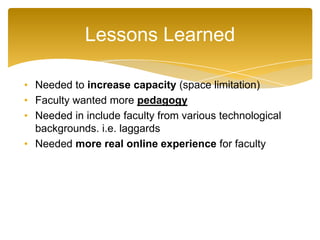
• Needed to increase capacity (space limitation)
• Faculty wanted more pedagogy
• Needed in include faculty from various technological
backgrounds. i.e. laggards
• Needed more real online experience for faculty
Lessons Learned
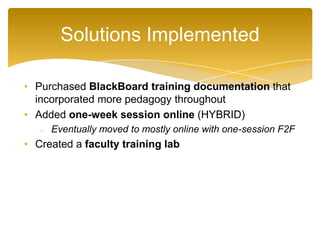
• Purchased BlackBoard training documentation that
incorporated more pedagogy throughout
• Added one-week session online (HYBRID)
o Eventually moved to mostly online with one-session F2F
• Created a faculty training lab
Solutions Implemented
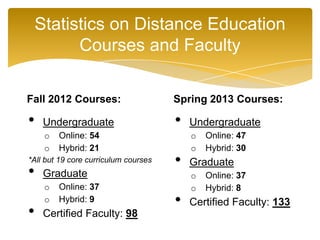
Statistics on Distance Education
Courses and Faculty
Fall 2012 Courses:
• Undergraduate
o Online: 54
o Hybrid: 21
*All but 19 core curriculum courses
• Graduate
o Online: 37
o Hybrid: 9
• Certified Faculty: 98
Spring 2013 Courses:
• Undergraduate
o Online: 47
o Hybrid: 30
• Graduate
o Online: 37
o Hybrid: 8
• Certified Faculty: 133
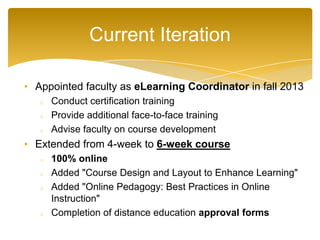
• Appointed faculty as eLearning Coordinator in fall 2013
o Conduct certification training
o Provide additional face-to-face training
o Advise faculty on course development
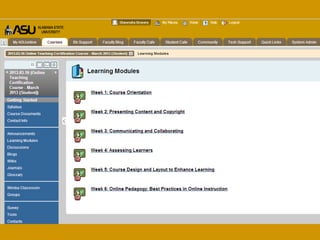
• Extended from 4-week to 6-week course
o 100% online
o Added "Course Design and Layout to Enhance Learning"
o Added "Online Pedagogy: Best Practices in Online
Instruction"
o Completion of distance education approval forms
Current Iteration
Beyond Teaching
The Evolution:
Discussing the rationale for and the development of a certificate program for
academic deans and department chairs responsible for evaluating online instruction
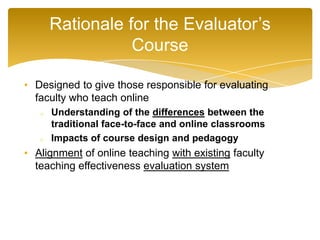
• Designed to give those responsible for evaluating
faculty who teach online
o Understanding of the differences between the
traditional face-to-face and online classrooms
o Impacts of course design and pedagogy
• Alignment of online teaching with existing faculty
teaching effectiveness evaluation system
Rationale for the Evaluator’s
Course
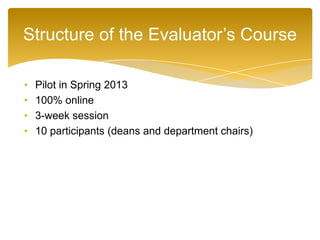
• Pilot in Spring 2013
• 100% online
• 3-week session
• 10 participants (deans and department chairs)
Structure of the Evaluator’s Course
• Trying to reach more adjunct faculty
• Offering multiple sessions simultaneously
• Having a dedicated instructor for online certification
• Need instructional designer to follow-up/assist with
course design and development
• Emphasize need for incentives to administration
Where We Are Now...

Connecting Virtual Teaching and Evaluation

  • 1.
    EDUCAUSE 2013 Southeast RegionalConference Connecting Virtual Teaching and Evaluation: The Progression from Training Online Faculty to Supervisors Mrs. Shawndra T. Bowers, eLearning Coordinator Dr. Kenley Obas, Associate Vice President for Academic Computing
  • 2.
    http://www.polleverywhere.com/m ultiple_choice_polls/Kb3RExWblM dciLc This presentation leavescopyright of the content to the presenter. Unless otherwise noted in the materials, uploaded content carries the Creative Commons Attribution- Non-Commercial-Share Alike license, which grants usage to the general public with the stipulated criteria.
  • 3.
    Alabama State University •Comprehensive regional institution with over 50 graduate and undergraduate programs • Founded in 1867 • Historically Black Institution • Located in Montgomery, Alabama • Approximately 5,500 students • 150 full-time faculty • Nation's top producer of African-American Educators
  • 4.
    • Considering onlinedegree programs for the over a decade • Established a distance education committee – almost ten years ago to… • “come up with some guidelines and some recommendations on what we needed to do for distance education” • review and approve the syllabi of faculty who want to implement an online course. The History of Distance Education at Alabama State University
  • 5.
    • Establish AcademicComputing Director • Adopt Learning Management System (Blackboard) • Adopted Spring 2005 • Fully integrated with SIS • Adopted Elluminate in Fall 2005 • Develop Online Course Approval Process • Quality Matters Standards • Seven Principles of Quality Instruction • Provide Faculty Training DE Committee Recommendations December 2002
  • 6.
    • Over 100courses offered each semester – undergraduate and graduate • Institutional goal is to have 2 fully online programs in each academic unit by 2014 • Current online degree programs: • Marketing (Bachelor) • Computer Science (Bachelor) • Library Education Media (Master) • Applied Technology (Master) • Physical Therapy (Doctorate) The History of Distance Education at Alabama State University
  • 7.
    Getting Started The Evolution: Understandingthe decision to create an in-house certification program for faculty teaching online and hybrid courses and how it has evolved and changed over time
  • 8.
    • Mandated Usageof BlackBoard from Office of the Provost • Faculty Senate Initiative to Provide Online Teaching Incentive • Reached Maturity for BlackBoard Adoption • Student Complaints • NEW FOCUS = o Quality Assurance of Courses o Way to Identify Faculty for Incentives Rationale for the Certification Course
  • 9.
    • Options forinitial certification: • Successful completion of four-week course offered by Academic Computing • Transfer of online teaching certification in Blackboard 9 from other universities completed within the past two years • Proposed content of the online teaching course: • Building a course in Blackboard • Assessing Learners: Assignment, Tests, and Gradebook • Communicating and Collaborating in Blackboard • Wimba and Lecture Capture Online Teaching Certification Proposal
  • 10.
    • November 5,2010 • All face-to-face sessions (including Wimba) • 15 participants (mostly highly technology-savvy faculty) • First come, first served (early adopters) • Used in-house created material to facilitate • Focused on mechanics of BlackBoard tools and features • 100% completion The First Cohort
  • 11.
    The Next Steps TheEvolution: Identifying the challenges faced during initial implementation, lessons learned from experience and faculty feedback, and solutions to keeping faculty engaged and refreshed
  • 12.
    • Needed toincrease capacity (space limitation) • Faculty wanted more pedagogy • Needed in include faculty from various technological backgrounds. i.e. laggards • Needed more real online experience for faculty Lessons Learned
  • 13.
    • Purchased BlackBoardtraining documentation that incorporated more pedagogy throughout • Added one-week session online (HYBRID) o Eventually moved to mostly online with one-session F2F • Created a faculty training lab Solutions Implemented
  • 14.
    Statistics on DistanceEducation Courses and Faculty Fall 2012 Courses: • Undergraduate o Online: 54 o Hybrid: 21 *All but 19 core curriculum courses • Graduate o Online: 37 o Hybrid: 9 • Certified Faculty: 98 Spring 2013 Courses: • Undergraduate o Online: 47 o Hybrid: 30 • Graduate o Online: 37 o Hybrid: 8 • Certified Faculty: 133
  • 15.
    • Appointed facultyas eLearning Coordinator in fall 2013 o Conduct certification training o Provide additional face-to-face training o Advise faculty on course development • Extended from 4-week to 6-week course o 100% online o Added "Course Design and Layout to Enhance Learning" o Added "Online Pedagogy: Best Practices in Online Instruction" o Completion of distance education approval forms Current Iteration
  • 17.
    Beyond Teaching The Evolution: Discussingthe rationale for and the development of a certificate program for academic deans and department chairs responsible for evaluating online instruction
  • 18.
    • Designed togive those responsible for evaluating faculty who teach online o Understanding of the differences between the traditional face-to-face and online classrooms o Impacts of course design and pedagogy • Alignment of online teaching with existing faculty teaching effectiveness evaluation system Rationale for the Evaluator’s Course
  • 19.
    • Pilot inSpring 2013 • 100% online • 3-week session • 10 participants (deans and department chairs) Structure of the Evaluator’s Course
  • 20.
    • Trying toreach more adjunct faculty • Offering multiple sessions simultaneously • Having a dedicated instructor for online certification • Need instructional designer to follow-up/assist with course design and development • Emphasize need for incentives to administration Where We Are Now...

Editor's Notes

  • #2 Session Title:Connecting Virtual Teaching and Evaluation: The Progression from TrainingOnline Faculty to University SupervisorsTrack Choice 1:Developing IT Leadership SkillsTrack Choice 2:Format Choice 1:Track session: Interactive PresentationFormat Choice 2:Poster session: Effective PracticesContent Level:Are new to this topic/content areaAudience:Teaching and learning professionals/faculty/instructional designersFocus of Proposal Topic:The number of online courses and fully online degree programs continues toincrease at a disproportionate rate as compared to traditional on-campusofferings, largely due to the growing needs of a diverse, non-traditionalstudent population's demand for greater flexibility. With dramaticincreases in online enrollment, it is essential that higher educationadministrators recognize that distance education is primarily an academicissue and not a technological one, and therefore develop support programsto ensure quality instruction for all students. Online programs cannotmeet the strategic goals of the institution without an engaged andsupportive faculty, especially since the quality of the educationalexperience is often determined by student access to qualified facultymembers.This session will explain the evolution of a university-created onlineteaching certification program for faculty initially transitioning toonline to one that provides for continuous improvement in online designand pedagogy as it moved to meet the changing demands of the market.Additionally, participants in this session will discuss the disparitiesbetween faculty who have been trained to effectively create and facilitateonline courses and campus supervisors who are responsible for evaluatingtheir instruction, especially those who may not have ever even taughtonline themselves. Session leaders will provide recommendations forimplementing a development program for novice as well as more experiencedonline faculty, and discuss how to structure a program to meet the needsof academic deans and department chairs learning how to effectively assessthe design, development, and delivery of online courses.Important Points for Attendees to Grasp:1. Getting Started: Understanding the decision to create an in-housecertification program for faculty teaching online and hybrid courses andhow it has evolved and changed over time2. The Next Steps: Identifying the challenges faced during initialimplementation, lessons learned from experience and faculty feedback, andsolutions to keeping faculty engaged and refreshed3. Beyond Teaching: Discussing the rationale for and the development of acertificate program for academic deans and department chairs responsiblefor evaluating online instructionParticipant Engagement Strategies:Participant Polling, Participant Collaboration