BAREILLY INTERNATIONAL UNIVERSITY, BAREILLY
A
LECTURE
ON
“ Slit Lamp Examination”
DELIVERED BY
MS. GULAFSHAN SAIFI
ASSISTANT PROFESSOR
DEPARTMENT OF OPTOMETRY
FACULTY OF PARAMEDICAL SCIENCES BAREILLY
Rohilkhand Medical College And Hospital ,Campus , Pilibhit Bypass Road Bareilly ,U.P -
243006
TODAY’S GOALS
• By the end of today’s lecture, you should be able to…
• List the uses of the slit lamp biomicroscope
• Identify the main components of the slit lamp; be able to
operate these components
• Discuss and perform a series of basic illumination and
magnification techniques
• A second lecture will follow where we talk about
combining these techniques into a routine and look at
some examples
WHY SLIT LAMPS ARE SO GREAT
 Slit lamp assessment is considered to be the gold
standard device for the assessment of the anterior
segment of the eye in clinical practice
 This is because they provide…
 Excellent image quality
 Stereoscopic image
 Flexible illumination
 Flexible magnification
 Therefore there are many different uses
 Even more when attachments are added
TYPES
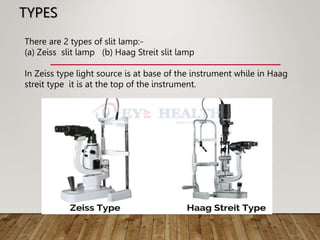
There are 2 types of slit lamp:-
(a) Zeiss slit lamp (b) Haag Streit slit lamp
In Zeiss type light source is at base of the instrument while in Haag
streit type it is at the top of the instrument.
WHAT CAN WE USE THEM FOR?
ON THEIR OWN
 Routine examination of anterior
segment
 Adnexa through to anterior vitreous
 Problem-based examination of
anterior segment
 Contact lens examination
 Assessment of anterior chamber
depth and angle
WITH ACCESSORIES
 Gonioscopy
 Fundoscopy
 Ocular photography
 Contact tonometry (Goldmann)
 Pachymetry
 Corneal sensitivity measurements
(aesthiometry)
 Laser photocoagulation
BASIC DESIGN
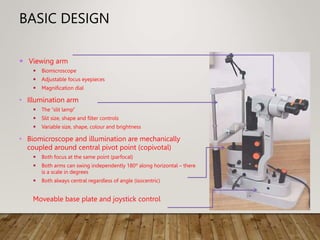
 Viewing arm
 Biomicroscope
 Adjustable focus eyepieces
 Magnification dial
• Illumination arm
 The “slit lamp”
 Slit size, shape and filter controls
 Variable size, shape, colour and brightness
• Biomicroscope and illumination are mechanically
coupled around central pivot point (copivotal)
 Both focus at the same point (parfocal)
 Both arms can swing independently 180º along horizontal – there
is a scale in degrees
 Both always central regardless of angle (isocentric)
Moveable base plate and joystick control
PRINCIPLE
• A narrow beam is produced by the slit lamp which is observed by
the examiner.
OBSERVATION SYSTEM
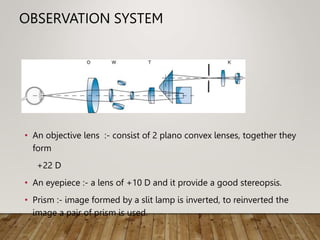
• An objective lens :- consist of 2 plano convex lenses, together they
form
+22 D
• An eyepiece :- a lens of +10 D and it provide a good stereopsis.
• Prism :- image formed by a slit lamp is inverted, to reinverted the
image a pair of prism is used.
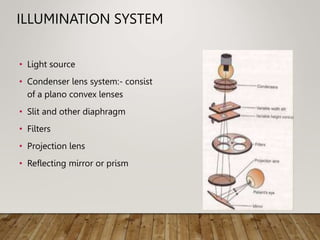
ILLUMINATION SYSTEM
• Light source
• Condenser lens system:- consist
of a plano convex lenses
• Slit and other diaphragm
• Filters
• Projection lens
• Reflecting mirror or prism
MECHANICAL SYSTEM
• Joystick
• Up and down movement
arrangement
• Patient support arranegemnt
• Fixation target
MAGNIFICATION
MAGNIFICATION
• Slit lamps provide variable magnification
• Lower magnifications are used for general assessment
and orientation
• Higher magnifications are used for detailed
inspections of areas of interest
• There are several ways to do this
• Common methods: Littmann-Galilean telescope and zoom
systems
• Less common methods: Change the eyepieces and/or change
the objective lens
LITTMANN-GALILEAN
TELESCOPE METHOD
 A separate optical system is placed in between the
eyepiece and the objective
 It consists of a rotating drum that house 2 Galilean
telescopes plus a pair of empty slots
 Optics refresher: Galilean telescopes consist of a positive and
negative lens that provide magnification based on the lens powers
and their separation
 It is easy to identify whether the slit lamp you are using
has this inside
 The magnification dial will click into place as you turn it, and there
will be numbers on the dial that correspond to the magnification in
each position
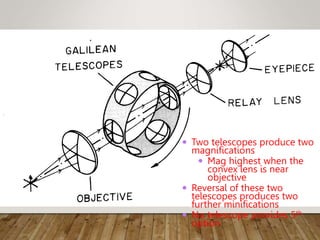
A GALILEAN TELESCOPE
Parallel light enters and exits.
Magnification is typically the
intended outcome.
However, if you look from the other
side, the image will be minified.
 Two telescopes produce two
magnifications
 Mag highest when the
convex lens is near
objective
 Reversal of these two
telescopes produces two
further minifications
 No telescope provides 5th
option
ZOOM SYSTEMS
• This tends to be found on high-end Nikon, Topcon
and Zeiss instruments
• Magnification can vary between 7x to ~ 40X
• I find that the image quality is not as good with zoom
magnification
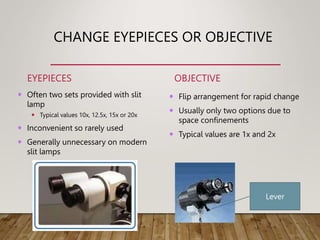
CHANGE EYEPIECES OR OBJECTIVE
EYEPIECES
 Often two sets provided with slit
lamp
 Typical values 10x, 12.5x, 15x or 20x
 Inconvenient so rarely used
 Generally unnecessary on modern
slit lamps
OBJECTIVE
 Flip arrangement for rapid change
 Usually only two options due to
space confinements
 Typical values are 1x and 2x
Lever
ILLUMINATION
THE SLIT LAMP
WHAT MAKES A GOOD SLIT?
• A good slit needs to be
• Bright
• Evenly illuminated
• Finely focused
• Have well defined, straight edges
• Flexible in terms of size, shape, colour and intensity
• The illumination also needs to
• Provide good colour rendering to detect subtle colour changes
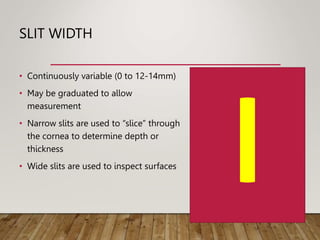
SLIT WIDTH
• Continuously variable (0 to 12-14mm)
• May be graduated to allow
measurement
• Narrow slits are used to “slice” through
the cornea to determine depth or
thickness
• Wide slits are used to inspect surfaces
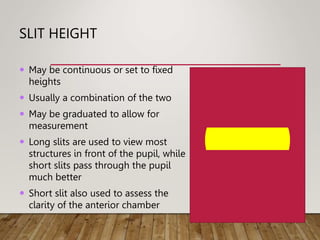
SLIT HEIGHT
 May be continuous or set to fixed
heights
 Usually a combination of the two
 May be graduated to allow for
measurement
 Long slits are used to view most
structures in front of the pupil, while
short slits pass through the pupil
much better
 Short slit also used to assess the
clarity of the anterior chamber
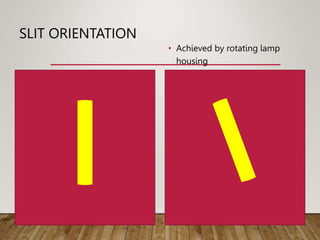
SLIT ORIENTATION
• Achieved by rotating lamp
housing
slit Lamp ppt-1.ppt

slit Lamp ppt-1.ppt

  • 1.
    BAREILLY INTERNATIONAL UNIVERSITY,BAREILLY A LECTURE ON “ Slit Lamp Examination” DELIVERED BY MS. GULAFSHAN SAIFI ASSISTANT PROFESSOR DEPARTMENT OF OPTOMETRY FACULTY OF PARAMEDICAL SCIENCES BAREILLY Rohilkhand Medical College And Hospital ,Campus , Pilibhit Bypass Road Bareilly ,U.P - 243006
  • 2.
    TODAY’S GOALS • Bythe end of today’s lecture, you should be able to… • List the uses of the slit lamp biomicroscope • Identify the main components of the slit lamp; be able to operate these components • Discuss and perform a series of basic illumination and magnification techniques • A second lecture will follow where we talk about combining these techniques into a routine and look at some examples
  • 3.
    WHY SLIT LAMPSARE SO GREAT  Slit lamp assessment is considered to be the gold standard device for the assessment of the anterior segment of the eye in clinical practice  This is because they provide…  Excellent image quality  Stereoscopic image  Flexible illumination  Flexible magnification  Therefore there are many different uses  Even more when attachments are added
  • 4.
    TYPES There are 2types of slit lamp:- (a) Zeiss slit lamp (b) Haag Streit slit lamp In Zeiss type light source is at base of the instrument while in Haag streit type it is at the top of the instrument.
  • 5.
    WHAT CAN WEUSE THEM FOR? ON THEIR OWN  Routine examination of anterior segment  Adnexa through to anterior vitreous  Problem-based examination of anterior segment  Contact lens examination  Assessment of anterior chamber depth and angle WITH ACCESSORIES  Gonioscopy  Fundoscopy  Ocular photography  Contact tonometry (Goldmann)  Pachymetry  Corneal sensitivity measurements (aesthiometry)  Laser photocoagulation
  • 6.
    BASIC DESIGN  Viewingarm  Biomicroscope  Adjustable focus eyepieces  Magnification dial • Illumination arm  The “slit lamp”  Slit size, shape and filter controls  Variable size, shape, colour and brightness • Biomicroscope and illumination are mechanically coupled around central pivot point (copivotal)  Both focus at the same point (parfocal)  Both arms can swing independently 180º along horizontal – there is a scale in degrees  Both always central regardless of angle (isocentric) Moveable base plate and joystick control
  • 7.
    PRINCIPLE • A narrowbeam is produced by the slit lamp which is observed by the examiner.
  • 8.
    OBSERVATION SYSTEM • Anobjective lens :- consist of 2 plano convex lenses, together they form +22 D • An eyepiece :- a lens of +10 D and it provide a good stereopsis. • Prism :- image formed by a slit lamp is inverted, to reinverted the image a pair of prism is used.
  • 9.
    ILLUMINATION SYSTEM • Lightsource • Condenser lens system:- consist of a plano convex lenses • Slit and other diaphragm • Filters • Projection lens • Reflecting mirror or prism
  • 10.
    MECHANICAL SYSTEM • Joystick •Up and down movement arrangement • Patient support arranegemnt • Fixation target
  • 11.
  • 12.
    MAGNIFICATION • Slit lampsprovide variable magnification • Lower magnifications are used for general assessment and orientation • Higher magnifications are used for detailed inspections of areas of interest • There are several ways to do this • Common methods: Littmann-Galilean telescope and zoom systems • Less common methods: Change the eyepieces and/or change the objective lens
  • 13.
    LITTMANN-GALILEAN TELESCOPE METHOD  Aseparate optical system is placed in between the eyepiece and the objective  It consists of a rotating drum that house 2 Galilean telescopes plus a pair of empty slots  Optics refresher: Galilean telescopes consist of a positive and negative lens that provide magnification based on the lens powers and their separation  It is easy to identify whether the slit lamp you are using has this inside  The magnification dial will click into place as you turn it, and there will be numbers on the dial that correspond to the magnification in each position
  • 14.
    A GALILEAN TELESCOPE Parallellight enters and exits. Magnification is typically the intended outcome. However, if you look from the other side, the image will be minified.
  • 15.
     Two telescopesproduce two magnifications  Mag highest when the convex lens is near objective  Reversal of these two telescopes produces two further minifications  No telescope provides 5th option
  • 16.
    ZOOM SYSTEMS • Thistends to be found on high-end Nikon, Topcon and Zeiss instruments • Magnification can vary between 7x to ~ 40X • I find that the image quality is not as good with zoom magnification
  • 17.
    CHANGE EYEPIECES OROBJECTIVE EYEPIECES  Often two sets provided with slit lamp  Typical values 10x, 12.5x, 15x or 20x  Inconvenient so rarely used  Generally unnecessary on modern slit lamps OBJECTIVE  Flip arrangement for rapid change  Usually only two options due to space confinements  Typical values are 1x and 2x Lever
  • 18.
  • 19.
    WHAT MAKES AGOOD SLIT? • A good slit needs to be • Bright • Evenly illuminated • Finely focused • Have well defined, straight edges • Flexible in terms of size, shape, colour and intensity • The illumination also needs to • Provide good colour rendering to detect subtle colour changes
  • 20.
    SLIT WIDTH • Continuouslyvariable (0 to 12-14mm) • May be graduated to allow measurement • Narrow slits are used to “slice” through the cornea to determine depth or thickness • Wide slits are used to inspect surfaces
  • 21.
    SLIT HEIGHT  Maybe continuous or set to fixed heights  Usually a combination of the two  May be graduated to allow for measurement  Long slits are used to view most structures in front of the pupil, while short slits pass through the pupil much better  Short slit also used to assess the clarity of the anterior chamber
  • 22.
    SLIT ORIENTATION • Achievedby rotating lamp housing