Arthur CHARPENTIER - Modeling and covering catastrophes


      Modeling and covering catastrophes
                                     Arthur Charpentier
                                      Sao Paulo, April 2009

                                 arthur.charpentier@univ-rennes1.fr

             http ://blogperso.univ-rennes1.fr/arthur.charpentier/index.php/


                                                                               1
Arthur CHARPENTIER - Modeling and covering catastrophes


                                                     Agenda
Catastrophic risks products and models
•    General introduction
•    Modeling very large claims
•    Natural catastrophes and accumulation risk
•    Insurance covers against catastrophes, traditional versus alternative techniques
Risk measures and pricing covers
•    Pricing insurance linked securities
•    Risk measures, an economic introduction
•    Calculating risk measures for catastrophic risks
•    Pricing cat bonds : the Winterthur example
•    Pricing cat bonds : the Mexican Earthquake


                                                                                  2
Arthur CHARPENTIER - Modeling and covering catastrophes


                                                     Agenda
Catastrophic risks products and models
•    General introduction
•    Modeling very large claims
•    Natural catastrophes and accumulation risk
•    Insurance covers against catastrophes, traditional versus alternative techniques
Risk measures and pricing covers
•    Pricing insurance linked securities
•    Risk measures, an economic introduction
•    Calculating risk measures for catastrophic risks
•    Pricing cat bonds : the Winterthur example
•    Pricing cat bonds : the Mexican Earthquake


                                                                                  3
Arthur CHARPENTIER - Modeling and covering catastrophes


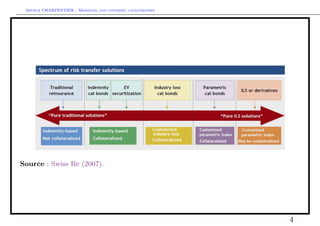
Source : Swiss Re (2007).


                                                           4
Arthur CHARPENTIER - Modeling and covering catastrophes


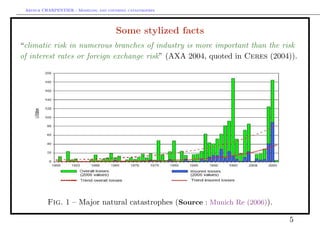
                                       Some stylized facts
“climatic risk in numerous branches of industry is more important than the risk
of interest rates or foreign exchange risk” (AXA 2004, quoted in Ceres (2004)).


          Fig. 1 – Major natural catastrophes (Source : Munich Re (2006)).

                                                                             5
Arthur CHARPENTIER - Modeling and covering catastrophes


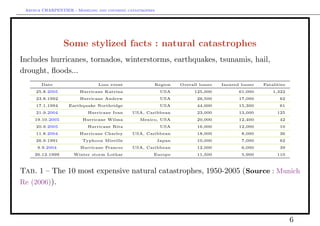
                  Some stylized facts : natural catastrophes
Includes hurricanes, tornados, winterstorms, earthquakes, tsunamis, hail,
drought, floods...
       Date                     Loss event             Region      Overall losses   Insured losses   Fatalities
     25.8.2005          Hurricane Katrina                   USA          125,000           61,000        1,322
     23.8.1992          Hurricane Andrew                    USA           26,500           17,000           62
     17.1.1994     Earthquake Northridge                    USA           44,000           15,300           61
     21.9.2004             Hurricane Ivan     USA, Caribbean              23,000           13,000          125
     19.10.2005          Hurricane Wilma         Mexico, USA              20,000           12,400           42
     20.9.2005             Hurricane Rita                   USA           16,000           12,000           10
     11.8.2004          Hurricane Charley     USA, Caribbean              18,000            8,000           36
     26.9.1991           Typhoon Mireille                  Japan          10,000            7,000           62
      9.9.2004          Hurricane Frances     USA, Caribbean              12,000            6,000           39
     26.12.1999      Winter storm Lothar               Europe             11,500            5,900          110


Tab. 1 – The 10 most expensive natural catastrophes, 1950-2005 (Source : Munich
Re (2006)).


                                                                                                                  6
Arthur CHARPENTIER - Modeling and covering catastrophes


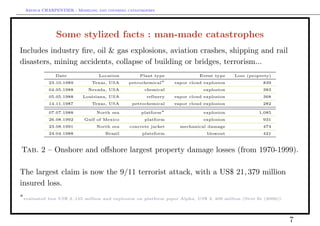
                 Some stylized facts : man-made catastrophes
Includes industry fire, oil & gas explosions, aviation crashes, shipping and rail
disasters, mining accidents, collapse of building or bridges, terrorism...
                 Date              Location         Plant type                Event type     Loss (property)
              23.10.1989         Texas, USA     petrochemical∗     vapor cloud explosion                 839
              04.05.1988       Nevada, USA             chemical                 explosion                383
              05.05.1988     Louisiana, USA             refinery   vapor cloud explosion                 368
              14.11.1987         Texas, USA       petrochemical    vapor cloud explosion                 282

              07.07.1988          North sea           platform∗                 explosion              1,085
              26.08.1992     Gulf of Mexico            platform                 explosion                931
              23.08.1991          North sea      concrete jacket      mechanical damage                  474
              24.04.1988              Brazil          plateform                  blowout                 421


Tab. 2 – Onshore and offshore largest property damage losses (from 1970-1999).

The largest claim is now the 9/11 terrorist attack, with a US$ 21, 379 million
insured loss.
∗
    evaluated loss US$ 2, 155 million and explosion on platform piper Alpha, US$ 3, 409 million (Swiss Re (2006)).


                                                                                                                     7
Arthur CHARPENTIER - Modeling and covering catastrophes


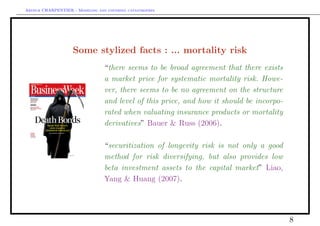
                    Some stylized facts : ... mortality risk
                                 “there seems to be broad agreement that there exists
                                 a market price for systematic mortality risk. Howe-
                                 ver, there seems to be no agreement on the structure
                                 and level of this price, and how it should be incorpo-
                                 rated when valuating insurance products or mortality
                                 derivatives” Bauer & Russ (2006).

                                 “securitization of longevity risk is not only a good
                                 method for risk diversifying, but also provides low
                                 beta investment assets to the capital market” Liao,
                                 Yang & Huang (2007).


                                                                                          8
Arthur CHARPENTIER - Modeling and covering catastrophes


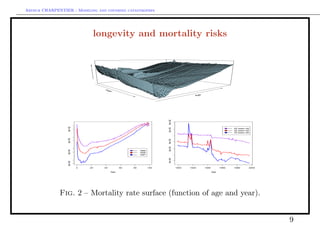
                               longevity and mortality risks


                                   Yea
                                        r
                                                                                        Age


                                                                      5e−02
                  5e−02


                                                                      2e−02
                                                                                                                  60 years old
                                                                                                                  40 years old
                                                                                                                  20 years old
                  5e−03


                                                                      5e−03
                                                                      2e−03
                  5e−04


                                                         1899
                                                         1948
                                                         1997


                                                                      5e−04
                  5e−05


                          0   20   40          60   80          100           1900   1920     1940         1960   1980       2000

                                         Age                                                         Age


              Fig. 2 – Mortality rate surface (function of age and year).


                                                                                                                                    9
Arthur CHARPENTIER - Modeling and covering catastrophes


                                   What is a large claim ?
An academic answer ? Teugels (1982) defined “large claims”,
  Answer 1 “large claims are the upper 10% largest claims”,
  Answer 2 “large claims are every claim that consumes at least 5% of the sum
  of claims, or at least 5% of the net premiums”,
  Answer 3 “large claims are every claim for which the actuary has to go and
  see one of the chief members of the company”.
Examples Traditional types of catastrophes, natural (hurricanes, typhoons,
earthquakes, floods, tornados...), man-made (fires, explosions, business
interruption...) or new risks (terrorist acts, asteroids, power outages...).
From large claims to catastrophe, the difference is that there is a before the
catastrophe, and an after : something has changed !


                                                                                10
Arthur CHARPENTIER - Modeling and covering catastrophes


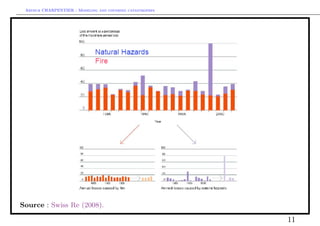
Source : Swiss Re (2008).

                                                           11
Arthur CHARPENTIER - Modeling and covering catastrophes


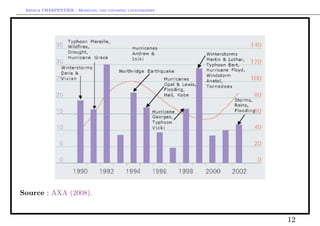
Source : AXA (2008).


                                                           12
Arthur CHARPENTIER - Modeling and covering catastrophes


                              The impact of a catastrophe
• Property damage : houses, cars and commercial structures,
• Human casualties (may not be correlated with economic loss),
• Business interruption
Example
• Natural Catastrophes - USA : succession of natural events that have hit
  insurers, reinsurers and the retrocession market
• lack of capacity, strong increase in rate
• Natural Catastrophes - nonUSA : in Asia (earthquakes, typhoons) and Europe
  (flood, drought, subsidence)
• sui generis protection programs in some countries


                                                                         13
Arthur CHARPENTIER - Modeling and covering catastrophes


                                   The impact of a catastrophe
•    Storms - Europe : high speed wind in Europe and US, considered as insurable
•    main risk for P&C insurers
•    Terrorism, including nuclear, biologic or bacteriologic weapons
•    lack of capacity, strong social pressure : private/public partnerships
•    Liabilities, third party damage
•    growth in indemnities (jurisdictions) yield unsustainable losses
•    Transportation (maritime and aircrafts), volatile business, and concentrated
     market


                                                                              14
Arthur CHARPENTIER - Modeling and covering catastrophes


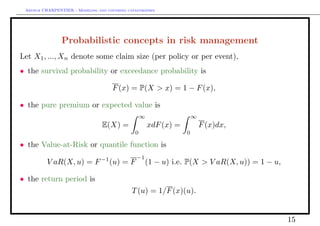
                Probabilistic concepts in risk management
Let X1 , ..., Xn denote some claim size (per policy or per event),
• the survival probability or exceedance probability is

                                      F (x) = P(X > x) = 1 − F (x),

• the pure premium or expected value is
                                                   ∞                   ∞
                                 E(X) =                xdF (x) =           F (x)dx,
                                               0                   0

• the Value-at-Risk or quantile function is
                                 −1             −1
          V aR(X, u) = F              (u) = F        (1 − u) i.e. P(X > V aR(X, u)) = 1 − u,

• the return period is
                                              T (u) = 1/F (x)(u).


                                                                                               15
Arthur CHARPENTIER - Modeling and covering catastrophes


                                   Modeling catastrophes
• Man-made catastrophes : modeling very large claims,
• extreme value theory (ex : business interruption)
• Natural Catastrophes : modeling very large claims taking into accont
  accumulation and global warming
• extreme value theory for losses
• time series theory for occurrence
• credit risk models for contagion or accumulation


                                                                         16
Arthur CHARPENTIER - Modeling and covering catastrophes


                                Updating actuarial models
In classical actuarial models (from Cramer and Lundberg), one usually
                                          ´
consider
• a model for the claims occurrence, e.g. a Poisson process,
• a model for the claim size, e.g. a exponential, Weibull, lognormal...
For light tailed risk, Cram´r-Lundberg’s theory gives a bound for the ruin
                           e
probability, assuming that claim size is not to large. Furthermore, additional
capital to ensure solvency (non-ruin) can be obtained using the central limit
theorem (see e.g. RBC approach). But the variance has to be finite.
In the case of large risks or catastrophes, claim size has heavy tails (e.g. the
variance is usually infinite), but the Poisson assumption for occurrence is still
relevant.


                                                                                   17
Arthur CHARPENTIER - Modeling and covering catastrophes


                                Updating actuarial models
                                                                      N
Example For business interruption, the total loss is S =                    Xi where N is
                                                                      i=1
Poisson, and the Xi ’s are i.i.d. Pareto.
Example In the case of natural catastrophes, claim size is not necessarily huge,
but the is an accumulation of claims, and the Poisson distribution is not relevant.
But if considering events instead of claims, the Poisson model can be relevant.
But the Poisson process is nonhomogeneous.
                                                                              N
Example For hurricanes or winterstorms, the total loss is S =                      Xi where N is
                                                                             i=1
                           Ni
Poisson, and Xi =               Xi,j , where the Xi,j ’s are i.i.d.
                          j=1


                                                                                            18
Arthur CHARPENTIER - Modeling and covering catastrophes


                                                     Agenda
Catastrophic risks products and models
•    General introduction
•    Modeling very large claims
•    Natural catastrophes and accumulation risk
•    Insurance covers against catastrophes, traditional versus alternative techniques
Risk measures and pricing covers
•    Pricing insurance linked securities
•    Risk measures, an economic introduction
•    Calculating risk measures for catastrophic risks
•    Pricing cat bonds : the Winterthur example
•    Pricing cat bonds : the Mexican Earthquake


                                                                                 19
Arthur CHARPENTIER - Modeling and covering catastrophes


                          Example : business interruption
Business interruption claims can be very expensive. Zajdenweber (2001)
claimed that it is a noninsurable risk since the pure premium is (theoretically)
infinite.
Remark For the 9/11 terrorist attacks, business interruption represented US$ 11
billion.


                                                                               20
Arthur CHARPENTIER - Modeling and covering catastrophes


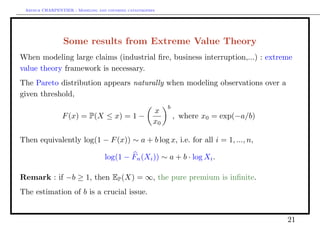
                 Some results from Extreme Value Theory
When modeling large claims (industrial fire, business interruption,...) : extreme
value theory framework is necessary.
The Pareto distribution appears naturally when modeling observations over a
given threshold,
                                                            b
                                                       x
                F (x) = P(X ≤ x) = 1 −                          , where x0 = exp(−a/b)
                                                       x0

Then equivalently log(1 − F (x)) ∼ a + b log x, i.e. for all i = 1, ..., n,

                                  log(1 − Fn (Xi )) ∼ a + b · log Xi .

Remark : if −b ≥ 1, then EP (X) = ∞, the pure premium is infinite.
The estimation of b is a crucial issue.


                                                                                         21
Arthur CHARPENTIER - Modeling and covering catastrophes


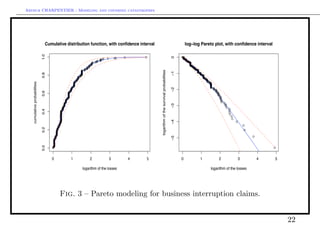
                                Cumulative distribution function, with confidence interval
                              1.0                                                                                                               lo#!lo# %areto *lot, ,it. /onfiden/e inter3al


                                                                                                                                       0
                                                                                             lo)arit.m of t.e sur5i5al 6ro7a7ilities

                                                                                                                                       !1
                              0.8
   cumulative probabilities


                                                                                                                                       !#
                              0.6


                                                                                                                                       !$
                              0.4


                                                                                                                                       !%
                              0.2


                                                                                                                                       !5
                              0.0


                                    0        1          2           3        4       5                                                      0          1          #           $        %        5

                                                   logarithm of the losses                                                                                   lo)arit.m of t.e losses


                                        Fig. 3 – Pareto modeling for business interruption claims.


                                                                                                                                                                                                    22
Arthur CHARPENTIER - Modeling and covering catastrophes


      Why the Pareto distribution ? historical perspective
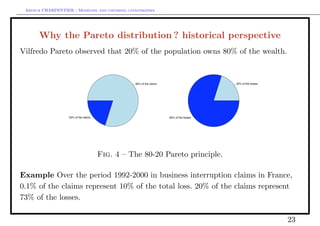
Vilfredo Pareto observed that 20% of the population owns 80% of the wealth.


                                                 80% of the claims                       20% of the losses


                   20% of the claims                                 80% of the losses


                                       Fig. 4 – The 80-20 Pareto principle.

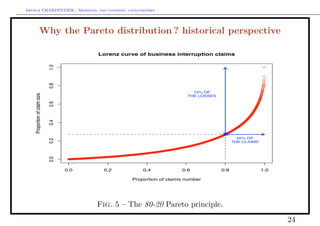
Example Over the period 1992-2000 in business interruption claims in France,
0.1% of the claims represent 10% of the total loss. 20% of the claims represent
73% of the losses.

                                                                                                             23
Arthur CHARPENTIER - Modeling and covering catastrophes


                   Why the Pareto distribution ? historical perspective

                                           Lorenz curve of business interruption claims
                               1.0
                               0.8


                                                                            73% OF
    Proportion of claim size


                                                                          THE LOSSES
                               0.6
                               0.4


                                                                                               20% OF
                               0.2


                                                                                             THE CLAIMS
                               0.0


                                     0.0    0.2          0.4            0.6            0.8                1.0

                                                     Proportion of claims number


                                           Fig. 5 – The 80-20 Pareto principle.
                                                                                                                24
Arthur CHARPENTIER - Modeling and covering catastrophes


 Why the Pareto distribution ? mathematical explanation
We consider here the exceedance distribution, i.e. the distribution of X − u given
that X > u, with survival distribution G(·) defined as

                                                           F (x + u)
                            G(x) = P(X − u > x|X > u) =
                                                             F (u)

This is closely related to some regular variation property, and only power
function my appear as limit when u → ∞ : G(·) is necessarily a power function.

                  The Pareto model in actuarial literature
Swiss Re highlighted the importance of the Pareto distribution in two technical
brochures the Pareto model in property reinsurance and estimating property
excess of loss risk premium : The Pareto model.
Actually, we will see that the Pareto model gives much more than only a
premium.

                                                                              25
Arthur CHARPENTIER - Modeling and covering catastrophes


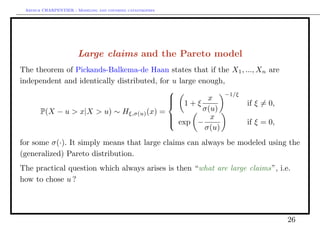
                       Large claims and the Pareto model
The theorem of Pickands-Balkema-de Haan states that if the X1 , ..., Xn are
independent and identically distributed, for u large enough,
                                                            −1/ξ
                                           
                                           
                                            1+ξ        x
                                                                if ξ = 0,
     P(X − u > x|X > u) ∼ Hξ,σ(u) (x) =               σ(u)
                                            exp − x
                                           
                                                                if ξ = 0,
                                                       σ(u)
for some σ(·). It simply means that large claims can always be modeled using the
(generalized) Pareto distribution.
The practical question which always arises is then “what are large claims”, i.e.
how to chose u ?


                                                                               26
Arthur CHARPENTIER - Modeling and covering catastrophes


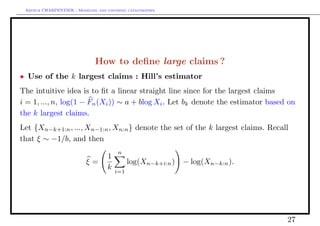
                              How to define large claims ?
• Use of the k largest claims : Hill’s estimator
The intuitive idea is to fit a linear straight line since for the largest claims
i = 1, ..., n, log(1 − Fn (Xi )) ∼ a + blog Xi . Let bk denote the estimator based on
the k largest claims.
Let {Xn−k+1:n , ..., Xn−1:n , Xn:n } denote the set of the k largest claims. Recall
that ξ ∼ −1/b, and then
                                        n
                                   1
                          ξ=                 log(Xn−k+i:n )   − log(Xn−k:n ).
                                   k   i=1


                                                                                  27
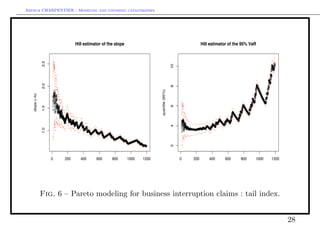
Arthur CHARPENTIER - Modeling and covering catastrophes


                2.5             Hill estimator of the slope                                                 Hill estimator of the 95% VaR


                                                                                             10
                2.0


                                                                                             8
                                                                            quantile (95%)
   slope (!b)


                                                                                             6
                1.5


                                                                                             4
                1.0


                                                                                             2
                      0   200      400     600      800       1000   1200                         0   200       400     600      800    1000   1200


                Fig. 6 – Pareto modeling for business interruption claims : tail index.


                                                                                                                                                      28
Arthur CHARPENTIER - Modeling and covering catastrophes


                            Extreme value distributions...
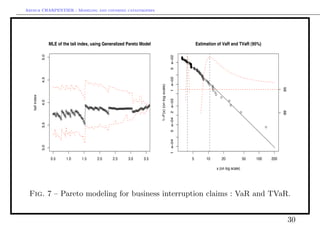
A natural idea is to fit a generalized Pareto distribution for claims exceeding u,
for some u large enough.
threshold [1] 3, we chose u = 3
p.less.thresh [1] 0.9271357, i.e. we keep to 8.5% largest claims
n.exceed [1] 87
method [1] ‘‘ml’’, we use the maximum likelihood technique,
par.ests, we get estimators ξ and σ,
            xi            sigma
 0.6179447         2.0453168
par.ses, with the following standard errors
            xi            sigma
 0.1769205         0.4008392

                                                                               29
Arthur CHARPENTIER - Modeling and covering catastrophes


                5.0   MLE of the tail index, using Generalized Pareto Model                                        Estimation of VaR and TVaR (95%)


                                                                                                      5 e!02
                                                                                                      1 e!02
                4.5


                                                                              1!F(x) (on log scale)


                                                                                                                                                                 95
   tail index


                                                                                                      2 e!03
                4.0


                                                                                                                                                                 99
                                                                                                      5 e!04
                3.5


                                                                                                      1 e!04
                3.0


                       0.5     1.0     1.5     2.0     2.5     3.0     3.5                                     5        10      20              50   100   200

                                                                                                                             x (on log scale)


 Fig. 7 – Pareto modeling for business interruption claims : VaR and TVaR.


                                                                                                                                                                      30
Arthur CHARPENTIER - Modeling and covering catastrophes


 From the statistical model of claims to the pure premium
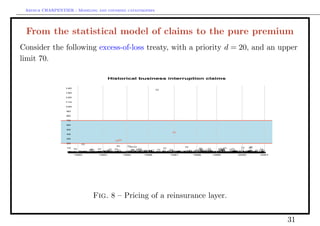
Consider the following excess-of-loss treaty, with a priority d = 20, and an upper
limit 70.

                                       Historical business interruption claims

                  140

                  130

                  120

                  110

                  100

                  90

                  80

                  70

                  60

                  50

                  40

                  30

                  20

                  10


                        1993    1994        1995   1996    1997    1998   1999   2000   2001


                               Fig. 8 – Pricing of a reinsurance layer.


                                                                                               31
Arthur CHARPENTIER - Modeling and covering catastrophes


 From the statistical model of claims to the pure premium
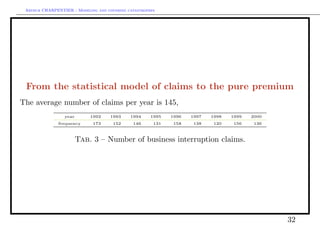
The average number of claims per year is 145,
                 year       1992     1993    1994     1995   1996   1997   1998   1999   2000
               frequency     173      152     146      131    158    138   120    156    136


                        Tab. 3 – Number of business interruption claims.


                                                                                                32
Arthur CHARPENTIER - Modeling and covering catastrophes


 From the statistical model of claims to the pure premium
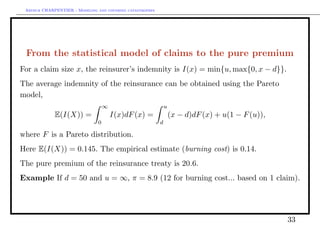
For a claim size x, the reinsurer’s indemnity is I(x) = min{u, max{0, x − d}}.
The average indemnity of the reinsurance can be obtained using the Pareto
model,
                                   ∞                           u
             E(I(X)) =                 I(x)dF (x) =                (x − d)dF (x) + u(1 − F (u)),
                               0                           d

where F is a Pareto distribution.
Here E(I(X)) = 0.145. The empirical estimate (burning cost) is 0.14.
The pure premium of the reinsurance treaty is 20.6.
Example If d = 50 and u = ∞, π = 8.9 (12 for burning cost... based on 1 claim).


                                                                                                   33
Arthur CHARPENTIER - Modeling and covering catastrophes


                                                     Agenda
Catastrophic risks modelling
•    General introduction
•    Business interruption and very large claims
•    Natural catastrophes and accumulation risk
•    Insurance covers against catastrophes, traditional versus alternative techniques
Risk measures and capital requirements
• Risk measures, an economic introduction
• Calculating risk measures for catastrophic risks
• Diversification and capital allocation


                                                                                 34
Arthur CHARPENTIER - Modeling and covering catastrophes


                                    Increased value at risk
In 1950, 30% of the world’s population (2.5 billion people) lived in cities. In 2000,
50% of the world’s population (6 billon).
In 1950 the only city with more than 10 million inhabitants was New York. There
were 12 in 1990, and 26 are expected by 2015, including
• Tokyo (29 million),
• New York (18 million),
• Los Angeles (14 million).
• Increasing value at risk (for all risks)
The total value of insured costal exposure in 2004 was
• $1, 937 billion in Florida (18 million),
• $1, 902 billion in New York.


                                                                                 35
Arthur CHARPENTIER - Modeling and covering catastrophes


                      Two techniques to model large risks
• The actuarial-statistical technique : modeling historical series,
The actuary models the occurrence process of events, and model the claim size
(of the total event).
This is simple but relies on stability assumptions. If not, one should model
changes in the occurrence process, and should take into account inflation or
increase in value-at-risk.
• The meteorological-engineering technique : modeling natural hazard and
  exposure.
This approach needs a lot of data and information so generate scenarios taking
all the policies specificities. Not very flexible to estimate return periods, and
works as a black box. Very hard to assess any confidence levels.


                                                                               36
Arthur CHARPENTIER - Modeling and covering catastrophes


                         The actuarial-statistical approach
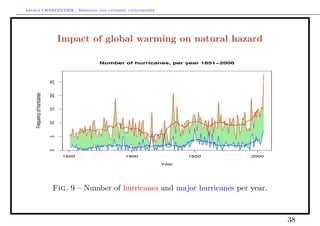
• Modeling event occurrence, the problem of global warming.
Global warming has an impact on climate related hazard (droughts, subsidence,
hurricanes, winterstorms, tornados, floods, coastal floods) but not geophysical
(earthquakes).
• Modeling claim size, the problem of increase of value at risk and inflation.
Pielke & Landsea (1998) normalized losses due to hurricanes, using both
population and wealth increases, “with this normalization, the trend of increasing
damage amounts in recent decades disappears”.


                                                                                37
Arthur CHARPENTIER - Modeling and covering catastrophes


                                   Impact of global warming on natural hazard

                                            !u#$er o) *urricanes, per 2ear 3853!6008
                              25
    Frequency of hurricanes

                              20
                              15
                              10
                              5
                              0


                                    1850           1900               1950             2000

                                                              Year


                               Fig. 9 – Number of hurricanes and major hurricanes per year.


                                                                                              38
Arthur CHARPENTIER - Modeling and covering catastrophes


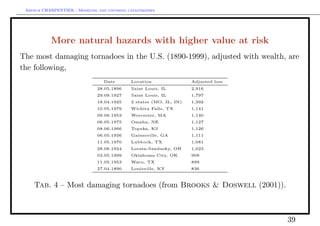
           More natural hazards with higher value at risk
The most damaging tornadoes in the U.S. (1890-1999), adjusted with wealth, are
the following,
                                  Date       Location                Adjusted loss
                               28.05.1896    Saint Louis, IL         2,916
                               29.09.1927    Saint Louis, IL         1,797
                               18.04.1925    3 states (MO, IL, IN)   1,392
                               10.05.1979    Wichita Falls, TX       1,141
                               09.06.1953    Worcester, MA           1,140
                               06.05.1975    Omaha, NE               1,127
                               08.06.1966    Topeka, KS              1,126
                               06.05.1936    Gainesville, GA         1,111
                               11.05.1970    Lubbock, TX             1,081
                               28.06.1924    Lorain-Sandusky, OH     1,023
                               03.05.1999    Oklahoma City, OK       909
                               11.05.1953    Waco, TX                899
                               27.04.1890    Louisville, KY          836


    Tab. 4 – Most damaging tornadoes (from Brooks & Doswell (2001)).


                                                                                     39
Arthur CHARPENTIER - Modeling and covering catastrophes


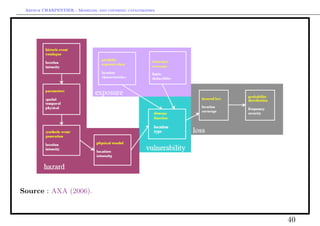
Source : AXA (2006).


                                                           40
Arthur CHARPENTIER - Modeling and covering catastrophes


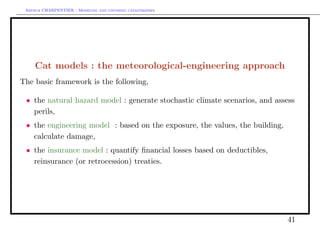
     Cat models : the meteorological-engineering approach
The basic framework is the following,

 • the natural hazard model : generate stochastic climate scenarios, and assess
   perils,
 • the engineering model : based on the exposure, the values, the building,
   calculate damage,
 • the insurance model : quantify financial losses based on deductibles,
   reinsurance (or retrocession) treaties.


                                                                              41
Arthur CHARPENTIER - Modeling and covering catastrophes


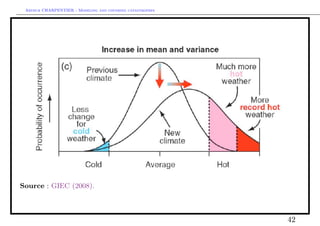
Source : GIEC (2008).


                                                           42
Arthur CHARPENTIER - Modeling and covering catastrophes


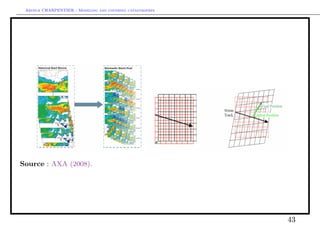
Source : AXA (2008).


                                                           43
Arthur CHARPENTIER - Modeling and covering catastrophes


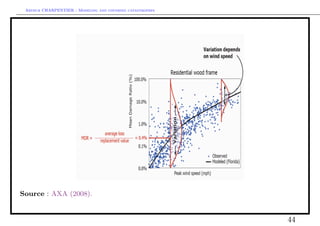
Source : AXA (2008).


                                                           44
Arthur CHARPENTIER - Modeling and covering catastrophes


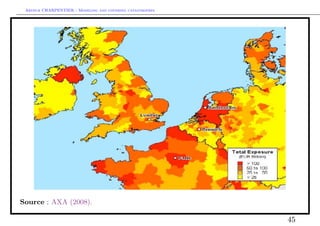
Source : AXA (2008).

                                                           45
Arthur CHARPENTIER - Modeling and covering catastrophes


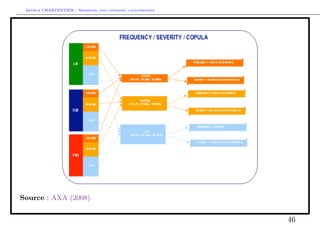
Source : AXA (2008).


                                                           46
Arthur CHARPENTIER - Modeling and covering catastrophes


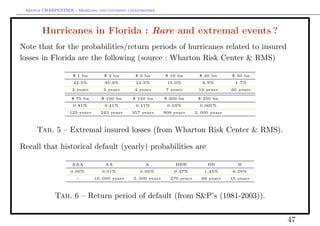
        Hurricanes in Florida : Rare and extremal events ?
Note that for the probabilities/return periods of hurricanes related to insured
losses in Florida are the following (source : Wharton Risk Center & RMS)

                     $ 1 bn        $ 2 bn       $ 5 bn        $ 10 bn         $ 20 bn      $ 50 bn
                     42.5%         35.9%        24.5%          15.0%           6.9%          1.7%
                    2 years        3 years      4 years        7 years       14 years      60 years

                    $ 75 bn       $ 100 bn     $ 150 bn       $ 200 bn       $ 250 bn
                     0.81%         0.41%        0.11%          0.03%          0.005%
                   123 years     243 years     357 years      909 years     2, 000 years


     Tab. 5 – Extremal insured losses (from Wharton Risk Center & RMS).

Recall that historical default (yearly) probabilities are

                    AAA            AA               A              BBB           BB           B
                    0.00%         0.01%           0.05%           0.37%         1.45%       6.59%
                      -        10, 000 years   2, 000 years     270 years      69 years    15 years


             Tab. 6 – Return period of default (from S&P’s (1981-2003)).


                                                                                                      47
Arthur CHARPENTIER - Modeling and covering catastrophes


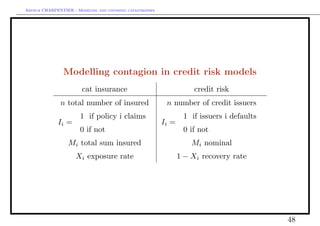
                Modelling contagion in credit risk models
                        cat insurance                                 credit risk
              n total number of insured                    n number of credit issuers
                       1 if policy i claims                       1 if issuers i defaults
             Ii =                                         Ii =
                       0 if not                                   0 if not
                  Mi total sum insured                               Mi nominal
                     Xi exposure rate                            1 − Xi recovery rate


                                                                                            48
Arthur CHARPENTIER - Modeling and covering catastrophes


                 Modelling contagion in credit risk models
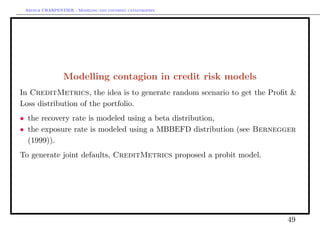
In CreditMetrics, the idea is to generate random scenario to get the Profit &
Loss distribution of the portfolio.
• the recovery rate is modeled using a beta distribution,
• the exposure rate is modeled using a MBBEFD distribution (see Bernegger
  (1999)).
To generate joint defaults, CreditMetrics proposed a probit model.


                                                                         49
Arthur CHARPENTIER - Modeling and covering catastrophes


                                                     Agenda
Catastrophic risks modelling
•    General introduction
•    Modeling very large claims
•    Natural catastrophes and accumulation risk
•    Insurance covers against catastrophes, traditional versus alternative
     techniques
Risk measures and capital requirements
• Risk measures, an economic introduction
• Calculating risk measures for catastrophic risks
• Diversification and capital allocation


                                                                       50
Arthur CHARPENTIER - Modeling and covering catastrophes


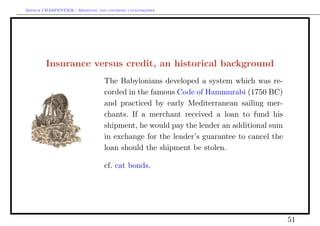
        Insurance versus credit, an historical background
                                 The Babylonians developed a system which was re-
                                 corded in the famous Code of Hammurabi (1750 BC)
                                 and practiced by early Mediterranean sailing mer-
                                 chants. If a merchant received a loan to fund his
                                 shipment, he would pay the lender an additional sum
                                 in exchange for the lender’s guarantee to cancel the
                                 loan should the shipment be stolen.

                                 cf. cat bonds.


                                                                                        51
Arthur CHARPENTIER - Modeling and covering catastrophes


                              Why a reinsurance market ?
“reinsurance is the transfer of part of the hazards of risks that a direct insurer
assumes by way of reinsurance contracts or legal provision on behalf of an
insured, to a second insurancce carrier, the reinsurer, who has no direct
contractual relationship with the insured” (Swiss Re, introduction to reinsurance)
Reinsurance allwo (primary) insurers to increase the maximum amount they can
insure for a given loss : they can optimize their underwriting capacity without
burdening their need to cover their solvency margin.
The law of large number can be used by insurance companies to assess their
probable annual loss... but under strong assumptions of identical distribution
(hence past event can be used to estimate future one) and independence.


                                                                                 52
Arthur CHARPENTIER - Modeling and covering catastrophes


                     Which reinsurance treaty is optimal ?
In a proportional agreement, the cedent and the reinsurer will agree on a
contractually defined ratio to share (identically) the premiums and the losses
In a non-proportional reinsurance treaty, the amount up to which the insurer will
keep (entierely) the loss is defined. The reinsurance company will pay the loss
above the deductible (up to a certain limit).
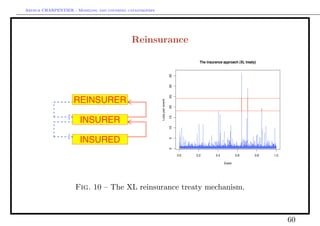
The Excess-of-Loss (XL) trearty, as the basis for non-proportional reinsurance,
with
• a risk XL : any individual claim can trigger the cover
• an event (or cat) XL : only a loss event involving several individual claims are
  covered by the treaty
• a stop-loss, or excess-of-loss ratio : the deductible and the limit og liability are
  expressed as annnual aggregate amounts (usually as percentage of annual
  premium).


                                                                                  53
Arthur CHARPENTIER - Modeling and covering catastrophes


                             Risk management solutions ?
• Equity holding : holding in solvency margin
+ easy and basic buffer
− very expensive
• Reinsurance and retrocession : transfer of the large risks to better diversified
  companies
+ easy to structure, indemnity based
− business cycle influences capacities, default risk
• Side cars : dedicated reinsurance vehicules, with quota share covers
+ add new capacity, allows for regulatory capital relief
− short maturity, possible adverse selection


                                                                               54
Arthur CHARPENTIER - Modeling and covering catastrophes


                             Risk management solutions ?
• Industry loss warranties (ILW) : index based reinsurance triggers
+ simple to structure, no credit risk
− limited number of capacity providers, noncorrelation risk, shortage of capacity
• Cat bonds : bonds with capital and/or interest at risk when a specified trigger
  is reached
+ large capacities, no credit risk, multi year contracts
− more and more industry/parametric based, structuration costs


                                                                             55
Arthur CHARPENTIER - Modeling and covering catastrophes


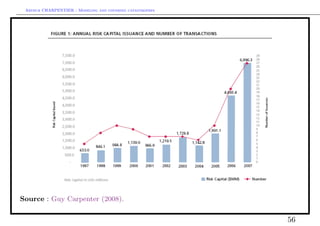
Source : Guy Carpenter (2008).

                                                           56
Arthur CHARPENTIER - Modeling and covering catastrophes


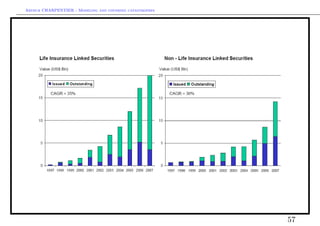
                                                          57
Arthur CHARPENTIER - Modeling and covering catastrophes


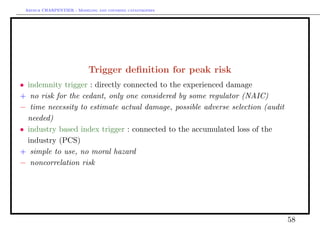
                           Trigger definition for peak risk
• indemnity trigger : directly connected to the experienced damage
+ no risk for the cedant, only one considered by some regulator (NAIC)
− time necessity to estimate actual damage, possible adverse selection (audit
  needed)
• industry based index trigger : connected to the accumulated loss of the
  industry (PCS)
+ simple to use, no moral hazard
− noncorrelation risk


                                                                                58
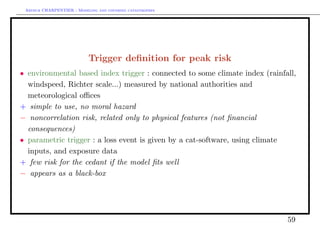
Arthur CHARPENTIER - Modeling and covering catastrophes


                           Trigger definition for peak risk
• environmental based index trigger : connected to some climate index (rainfall,
  windspeed, Richter scale...) measured by national authorities and
  meteorological offices
+ simple to use, no moral hazard
− noncorrelation risk, related only to physical features (not financial
  consequences)
• parametric trigger : a loss event is given by a cat-software, using climate
  inputs, and exposure data
+ few risk for the cedant if the model fits well
− appears as a black-box


                                                                             59
Arthur CHARPENTIER - Modeling and covering catastrophes


                                             Reinsurance

                                                                                        The insurance approach (XL treaty)


                                                                           35
                                                                           30
                                                                           25
                    REINSURER


                                                          Loss per event

                                                                           20
                                                                           15
                       INSURER


                                                                           10
                       INSURED


                                                                           5
                                                                           0
                                                                                0.0   0.2        0.4           0.6       0.8   1.0

                                                                                                       Event


                     Fig. 10 – The XL reinsurance treaty mechanism.


                                                                                                                                     60
Arthur CHARPENTIER - Modeling and covering catastrophes


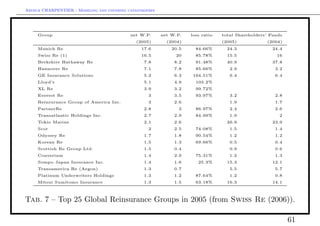
     Group                                  net W.P.      net W.P.   loss ratio   total Shareholders’ Funds
                                               (2005)       (2004)                (2005)            (2004)
     Munich Re                                   17.6         20.5     84.66%       24.3              24.4
     Swiss Re (1)                                16.5          20      85.78%       15.5                16
     Berkshire Hathaway Re                        7.8          8.2     91.48%       40.9              37.8
     Hannover Re                                  7.1          7.8     85.66%        2.9                3.2
     GE Insurance Solutions                       5.2          6.3   164.51%         6.4                6.4
     Lloyd’s                                      5.1          4.9     103.2%
     XL Re                                        3.9          3.2     99.72%
     Everest Re                                     3          3.5     93.97%        3.2                2.8
     Reinsurance Group of America Inc.              3          2.6                   1.9                1.7
     PartnerRe                                    2.8           3      86.97%        2.4                2.6
     Transatlantic Holdings Inc.                  2.7          2.9     84.99%        1.9                 2
     Tokio Marine                                 2.1          2.6                  26.9              23.9
     Scor                                           2          2.5     74.08%        1.5                1.4
     Odyssey Re                                   1.7          1.8     90.54%        1.2                1.2
     Korean Re                                    1.5          1.3     69.66%        0.5                0.4
     Scottish Re Group Ltd.                       1.5          0.4                   0.9                0.6
     Converium                                    1.4          2.9     75.31%        1.2                1.3
     Sompo Japan Insurance Inc.                   1.4          1.6      25.3%       15.3              12.1
     Transamerica Re (Aegon)                      1.3          0.7                   5.5                5.7
     Platinum Underwriters Holdings               1.3          1.2     87.64%        1.2                0.8
     Mitsui Sumitomo Insurance                    1.3          1.5     63.18%       16.3              14.1


Tab. 7 – Top 25 Global Reinsurance Groups in 2005 (from Swiss Re (2006)).

                                                                                                              61
Arthur CHARPENTIER - Modeling and covering catastrophes


                                                 Side cars
A hedge fund that wishes to get into the reinsurance business will start a special
purpose vehicle with a reinsurer.
The hedge fund is able to get into reinsurance without hiring underwriters,
buying models, nor getting rated by the rating agencies


                                                                              62
Arthur CHARPENTIER - Modeling and covering catastrophes


                           ILW - Insurance Loss Warranty
Industry loss warranties pay a fixed amount based of the amount of industry loss
(PCS or SIGMA).
Example For example, a $30 million ILW with a $5 billion trigger.


                             Cat bonds and securitization
Bonds issued to cover catastrophe risk were developed subsequent to Hurricane
Andrew
These bonds are structured so that the investor has a good return if there are no
qualifying events and a poor return if a loss occurs. Losses can be triggered on an
industry index or on an indemnity basis.


                                                                               63
Arthur CHARPENTIER - Modeling and covering catastrophes


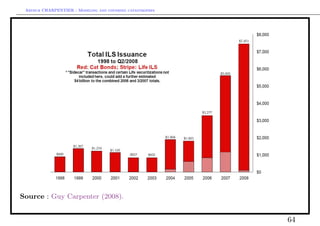
Source : Guy Carpenter (2008).


                                                           64
Arthur CHARPENTIER - Modeling and covering catastrophes


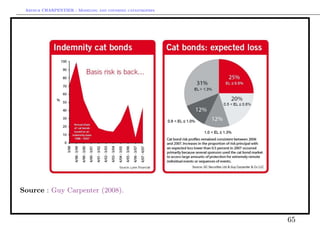
Source : Guy Carpenter (2008).


                                                           65
Arthur CHARPENTIER - Modeling and covering catastrophes


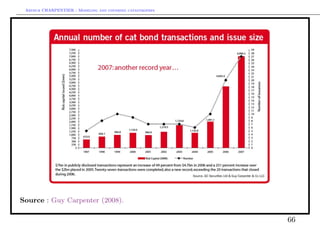
Source : Guy Carpenter (2008).

                                                           66
Arthur CHARPENTIER - Modeling and covering catastrophes


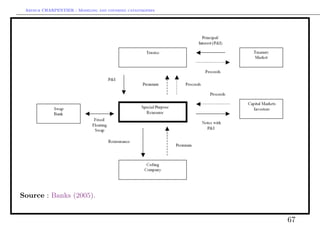
Source : Banks (2005).


                                                           67
Arthur CHARPENTIER - Modeling and covering catastrophes


                             Cat Bonds and securitization
Secutizations in capital markets were intiated with
   mortgage-backed securities (MBS)
   collaterized mortgage obligations (CMO)
   asset-backed securities (ABS)
   collaterized loan obligations (CLO)
   collaterized bond obligations (CBO)
   collaterized debt obligations (CDO)


                                                            68
Arthur CHARPENTIER - Modeling and covering catastrophes


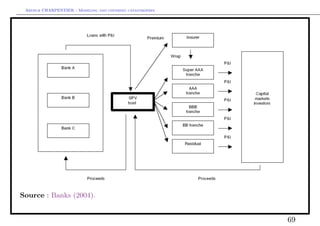
Source : Banks (2004).


                                                           69
Arthur CHARPENTIER - Modeling and covering catastrophes


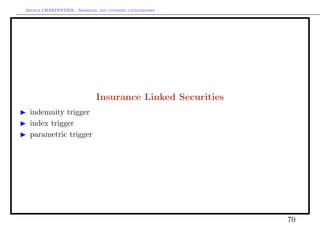
                              Insurance Linked Securities
  indemnity trigger
  index trigger
  parametric trigger


                                                            70
Arthur CHARPENTIER - Modeling and covering catastrophes


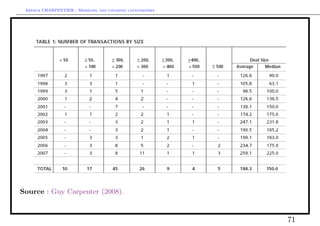
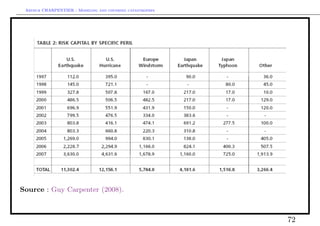
Source : Guy Carpenter (2008).


                                                           71
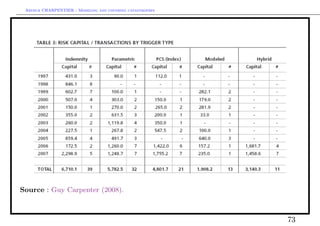
Arthur CHARPENTIER - Modeling and covering catastrophes


Source : Guy Carpenter (2008).


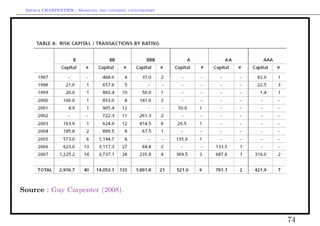
                                                           72
Arthur CHARPENTIER - Modeling and covering catastrophes


Source : Guy Carpenter (2008).


                                                           73
Arthur CHARPENTIER - Modeling and covering catastrophes


Source : Guy Carpenter (2008).


                                                           74
Arthur CHARPENTIER - Modeling and covering catastrophes


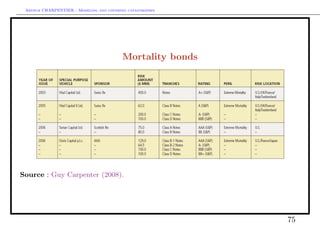
                                          Mortality bonds


Source : Guy Carpenter (2008).


                                                            75
Arthur CHARPENTIER - Modeling and covering catastrophes


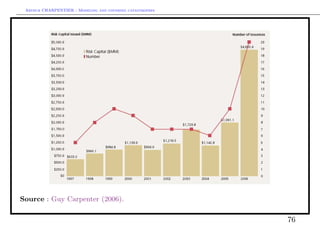
Source : Guy Carpenter (2006).

                                                           76
Arthur CHARPENTIER - Modeling and covering catastrophes


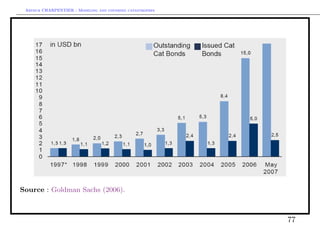
Source : Goldman Sachs (2006).


                                                           77
Arthur CHARPENTIER - Modeling and covering catastrophes


               USAA’s hurricane bond(s) : Residential Re
USAA, mutually owned insurance company (auto, householders, dwelling,
personal libability for US military personal, and family).
Hurricane Andrew (1992) : USD 620 million
Early 1996, work with AIR and Merrill Lynch (and later Goldman Sachs and
Lehman Brothers) to transfer a part of their portfolio
Bond structured to give the insurer cover of the Excess-of-Loss layer above USD
1 billon, to a maximum of USD 500 million, at an 80% rate (i.e. 20% coinsured),
provided by an insurance vehicule Residential Re, established as a Cayman SPR.
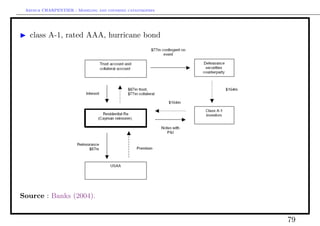
The SPR issued notes to investors, in 2 classes of 3 tranches,
  class A-1, rated AAA, featuring a USD 77 million tranche of principal
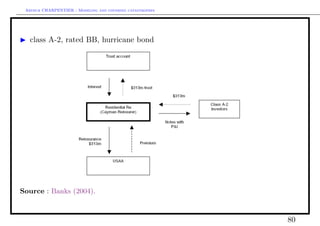
  protected notes, and USD 87 million of principal variable notes,
  class A-2, rated BB, featuring a USD 313 million of principal variable notes,
Trigger is the single occurrence of a class 3-5 hurricane, with ultimate net loss as
defined under USAA’s portfolio parameters (indemnity trigger)

                                                                                78
Arthur CHARPENTIER - Modeling and covering catastrophes


   class A-1, rated AAA, hurricane bond


Source : Banks (2004).


                                                           79
Arthur CHARPENTIER - Modeling and covering catastrophes


   class A-2, rated BB, hurricane bond


Source : Banks (2004).


                                                           80
Arthur CHARPENTIER - Modeling and covering catastrophes


                                                          81
Arthur CHARPENTIER - Modeling and covering catastrophes


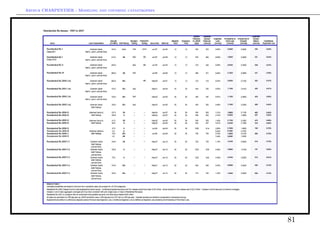
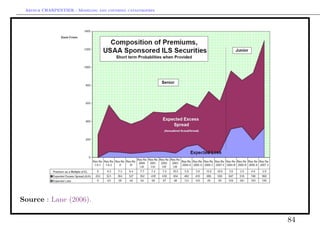
Source : Lane (2006).


                                                           82
Arthur CHARPENTIER - Modeling and covering catastrophes


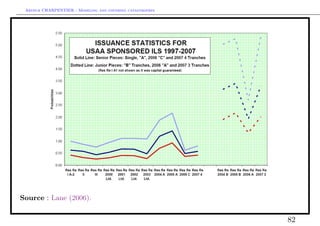
Source : Lane (2006).


                                                           83
Arthur CHARPENTIER - Modeling and covering catastrophes


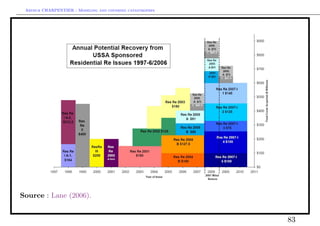
Source : Lane (2006).

                                                           84
Arthur CHARPENTIER - Modeling and covering catastrophes


                                                     Agenda
Catastrophic risks modelling
•    General introduction
•    Business interruption and very large claims
•    Natural catastrophes and accumulation risk
•    Insurance covers against catastrophes, traditional versus alternative techniques
Risk measures and pricing covers
•    Pricing insurance linked securities
•    Risk measures, an economic introduction
•    Calculating risk measures for catastrophic risks
•    Pricing cat bonds : the Winterthur example
•    Pricing cat bonds : the Mexican Earthquake


                                                                                 85
Arthur CHARPENTIER - Modeling and covering catastrophes


                            survey of literature on pricing
• Fundamental asset pricing theorem, in finance, Cox & Ross (JFE, 1976),
  Harrison & Kreps (JET, 1979), Harrison & Pliska (SPA, 1981, 1983).
  Recent general survey
– Dana & Jeanblanc-Picque (1998). March´s financiers en temps continu :
                                ´           e
                             ´
  valorisation et ´quilibre. Economica.
                  e
– Duffie (2001). Dynamic Asset Pricing Theory. Princeton University Press.
– Bingham & Kiesel (2004). Risk neutral valuation. Springer Verlag
• Premium calculation, in insurance.
– Buhlmann (1970) Mathematical Methods in Risk Theory. Springer Verlag.
    ¨
– Goovaerts, de Vylder & Haezendonck (1984). Premium Calculation in
  Insurance. Springer Verlag.
– Denuit & Charpentier (2004). Math´matiques de l’assurance non-vie, tome
                                     e
     ´
  1. Economica.


                                                                        86
Arthur CHARPENTIER - Modeling and covering catastrophes


                            survey of literature on pricing
• Price of uncertain quantities, in economics of uncertainty, von Neumann
  & Morgenstern (1944), Yaari (E, 1987). Recent general survey
– Quiggin (1993). Generalized expected utility theory : the rank-dependent
  model. Kluwer Academic Publishers.
– Gollier (2001). The Economics of Risk and Time. MIT Press.


                                                                       87
Arthur CHARPENTIER - Modeling and covering catastrophes


                              from mass risk to large risks
insurance is “the contribution of the many to the misfortune of the few”.
 1. judicially, an insurance contract can be valid only if claim occurrence satisfy
    some randomness property,
 2. the “game rule” (using the expression from Berliner (Prentice-Hall, 1982),
    i.e. legal framework) should remain stable in time,
 3. the possible maximum loss should not be huge, with respect to the insurer’s
    solvency,
 4. the average cost should be identifiable and quantifiable,
 5. risks could be pooled so that the law of large numbers can be used
    (independent and identically distributed, i.e. the portfolio should be
    homogeneous),
 6. there should be no moral hazard, and no adverse selection,
 7. there must exist an insurance market, in the sense that demand and supply
    should meet, and a price (equilibrium price) should arise.

                                                                                88
Arthur CHARPENTIER - Modeling and covering catastrophes


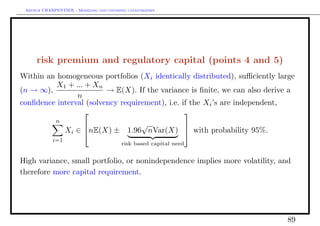
     risk premium and regulatory capital (points 4 and 5)
Within an homogeneous portfolios (Xi identically distributed), sufficiently large
          X1 + ... + Xn
(n → ∞),                 → E(X). If the variance is finite, we can also derive a
                n
confidence interval (solvency requirement), i.e. if the Xi ’s are independent,
                                                
             n
                                    √
                  Xi ∈ nE(X) ± 1.96 nVar(X)  with probability 95%.
                                            
            i=1
                                         risk based capital need


High variance, small portfolio, or nonindependence implies more volatility, and
therefore more capital requirement.


                                                                             89
Arthur CHARPENTIER - Modeling and covering catastrophes


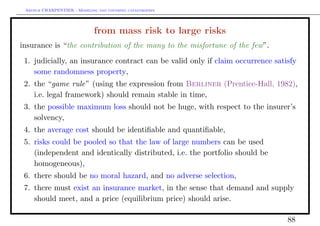
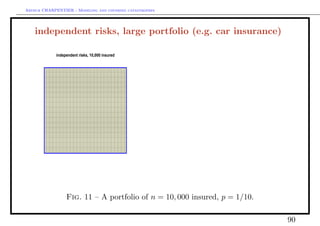
    independent risks, large portfolio (e.g. car insurance)

             independent risks, 10,000 insured

                                                 q                          q


       q                                                  q


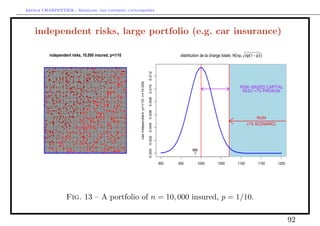
                  Fig. 11 – A portfolio of n = 10, 000 insured, p = 1/10.

                                                                                90
Arthur CHARPENTIER - Modeling and covering catastrophes


    independent risks, large portfolio (e.g. car insurance)

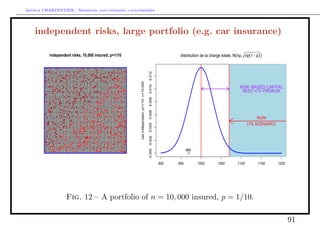
           independent risks, 10,000 insured, p=1/10                                                          distribution de la charge totale, N(np, np(1 − p) )
                                                                                                                                                    ,

                                                       q


                                                                                               0.012
                                                           cas indépendant, p=1/10, n=10,000

                                                                                               0.010
                                                                                                                                                   RISK−BASED CAPITAL
                                                                                                                                                    NEED +7% PREMIUM


                                                                                               0.008
                                                                                               0.006
                                                                                                                                                             RUIN
                                                                                                                                                        (1% SCENARIO)


                                                                                               0.004
                                                                                               0.002
                                                                                               0.000               969
       q


                                                                                                       900   950         1000        1050        1100         1150      1200


                    Fig. 12 – A portfolio of n = 10, 000 insured, p = 1/10.

                                                                                                                                                                               91
Arthur CHARPENTIER - Modeling and covering catastrophes


    independent risks, large portfolio (e.g. car insurance)

           independent risks, 10,000 insured, p=1/10                                                          distribution de la charge totale, N(np, np(1 − p) )
                                                                                                                                                    ,

                                                       q


                                                                                               0.012
                                                           cas indépendant, p=1/10, n=10,000

                                                                                               0.010
                                                                                                                                                   RISK−BASED CAPITAL
                                                                                                                                                    NEED +7% PREMIUM


                                                                                               0.008
                                                                                               0.006
                                                                                                                                                             RUIN
                                                                                                                                                        (1% SCENARIO)


                                                                                               0.004
                                                                                               0.002
                                                                                               0.000                 986
       q


                                                                                                       900   950        1000         1050        1100         1150      1200


                    Fig. 13 – A portfolio of n = 10, 000 insured, p = 1/10.

                                                                                                                                                                               92
Arthur CHARPENTIER - Modeling and covering catastrophes


   independent risks, small portfolio (e.g. fire insurance)

              independent risks, 400 insured

                                               q                           q


       q                                                  q


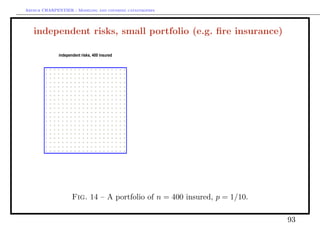
                     Fig. 14 – A portfolio of n = 400 insured, p = 1/10.

                                                                               93
Arthur CHARPENTIER - Modeling and covering catastrophes


   independent risks, small portfolio (e.g. fire insurance)

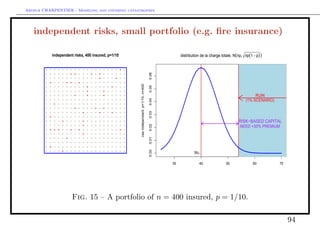
           independent risks, 400 insured, p=1/10                                                    distribution de la charge totale, N(np, np(1 − p) )
                                                                                                                                           ,

                                                    q


                                                                                         0.06
                                                        cas indépendant, p=1/10, n=400

                                                                                         0.05
                                                                                                                                                  RUIN


                                                                                         0.04
                                                                                                                                             (1% SCENARIO)


                                                                                         0.03
                                                                                                                                         RISK−BASED CAPITAL


                                                                                         0.02
                                                                                                                                          NEED +35% PREMIUM


                                                                                         0.01
                                                                                         0.00
       q                                                                                                     39

                                                                                                30                40             50               60         70


                      Fig. 15 – A portfolio of n = 400 insured, p = 1/10.

                                                                                                                                                                  94
Arthur CHARPENTIER - Modeling and covering catastrophes


   independent risks, small portfolio (e.g. fire insurance)

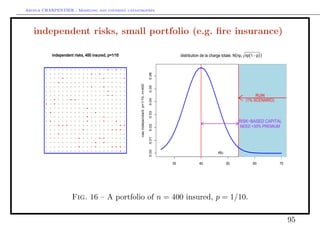
           independent risks, 400 insured, p=1/10                                                    distribution de la charge totale, N(np, np(1 − p) )
                                                                                                                                           ,

                                                    q


                                                                                         0.06
                                                        cas indépendant, p=1/10, n=400

                                                                                         0.05
                                                                                                                                                  RUIN


                                                                                         0.04
                                                                                                                                             (1% SCENARIO)


                                                                                         0.03
                                                                                                                                         RISK−BASED CAPITAL


                                                                                         0.02
                                                                                                                                          NEED +35% PREMIUM


                                                                                         0.01
                                                                                         0.00
       q                                                                                                                    48

                                                                                                30              40               50               60         70


                      Fig. 16 – A portfolio of n = 400 insured, p = 1/10.

                                                                                                                                                                  95
Arthur CHARPENTIER - Modeling and covering catastrophes


  nonindependent risks, large portfolio (e.g. earthquake)

             independent risks, 10,000 insured

                                                 q                        q


       q                                                  q


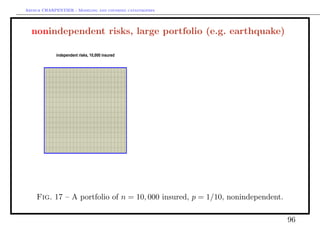
    Fig. 17 – A portfolio of n = 10, 000 insured, p = 1/10, nonindependent.

                                                                              96
Arthur CHARPENTIER - Modeling and covering catastrophes


  nonindependent risks, large portfolio (e.g. earthquake)

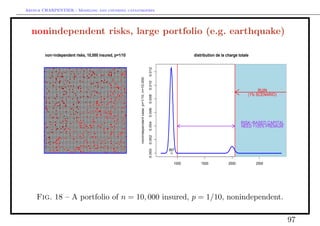
           non−independent risks, 10,000 insured, p=1/10                                                                distribution de la charge totale

                                                           q


                                                                                                       0.012
                                                               nonindependant case, p=1/10, n=10,000

                                                                                                       0.010
                                                                                                                                                            RUIN
                                                                                                                                                       (1% SCENARIO)


                                                                                                       0.008
                                                                                                       0.006
                                                                                                                                                   RISK−BASED CAPITAL


                                                                                                       0.004
                                                                                                                                                   NEED +105% PREMIUM


                                                                                                       0.002
                                                                                                       0.000   897
       q


                                                                                                                 1000       1500            2000           2500


    Fig. 18 – A portfolio of n = 10, 000 insured, p = 1/10, nonindependent.

                                                                                                                                                                        97
Arthur CHARPENTIER - Modeling and covering catastrophes


  nonindependent risks, large portfolio (e.g. earthquake)

           non−independent risks, 10,000 insured, p=1/10                                                              distribution de la charge totale

                                                           q


                                                                                                       0.012
                                                               nonindependant case, p=1/10, n=10,000

                                                                                                       0.010
                                                                                                                                                          RUIN
                                                                                                                                                     (1% SCENARIO)


                                                                                                       0.008
                                                                                                       0.006
                                                                                                                                                 RISK−BASED CAPITAL


                                                                                                       0.004
                                                                                                                                                 NEED +105% PREMIUM


                                                                                                       0.002
                                                                                                       0.000                              2013
       q


                                                                                                               1000       1500            2000           2500


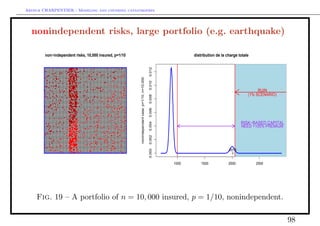
    Fig. 19 – A portfolio of n = 10, 000 insured, p = 1/10, nonindependent.

                                                                                                                                                                      98
Arthur CHARPENTIER - Modeling and covering catastrophes


              the pure premium as a technical benchmark
Pascal, Fermat, Condorcet, Huygens, d’Alembert in the XVIIIth century
proposed to evaluate the “produit scalaire des probabilit´s et des gains”,
                                                         e
                                       n               n
                     < p, x >=              pi xi =         P(X = xi ) · xi = EP (X),
                                      i=1             i=1

based on the “r`gle des parties”.
               e
For Qu´telet, the expected value was, in the context of insurance, the price that
      e
guarantees a financial equilibrium.
From this idea, we consider in insurance the pure premium as EP (X). As in
Cournot (1843), “l’esp´rance math´matique est donc le juste prix des chances”
                        e            e
(or the “fair price” mentioned in Feller (AS, 1953)).
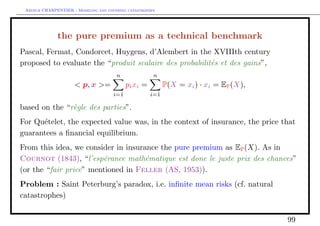
Problem : Saint Peterburg’s paradox, i.e. infinite mean risks (cf. natural
catastrophes)


                                                                                        99
Arthur CHARPENTIER - Modeling and covering catastrophes


              the pure premium as a technical benchmark
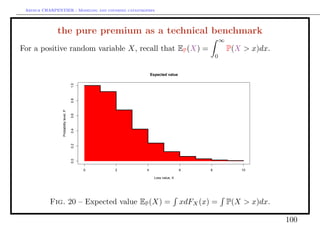
                                                                                                    ∞
For a positive random variable X, recall that EP (X) =                                                  P(X > x)dx.
                                                                                                0


                                                                  Expected value
                                        1.0


                                                                                                            q


                                                                                                        q
                                        0.8


                                                                                            q


                                                                                        q
                 Probability level, P

                                        0.6


                                                                                    q


                                                                         q
                                        0.4


                                                              q


                                                          q
                                        0.2


                                                      q


                                                  q
                                        0.0


                                              q


                                              0       2       4                     6       8               10

                                                                    Loss value, X


           Fig. 20 – Expected value EP (X) =                                        xdFX (x) =          P(X > x)dx.

                                                                                                                      100
Arthur CHARPENTIER - Modeling and covering catastrophes


          from pure premium to expected utility principle

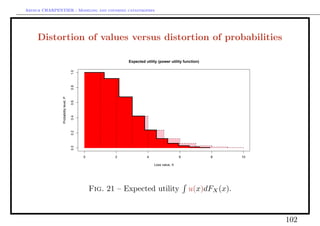
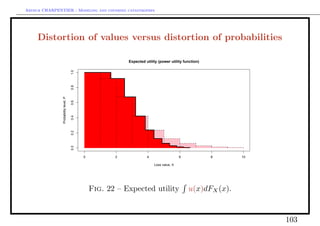
                           Ru (X) =           u(x)dP =       P(u(X) > x))dx

where u : [0, ∞) → [0, ∞) is a utility function.
Example with an exponential utility, u(x) = [1 − e−αx ]/α,
                                                     1
                                      Ru (X) =         log EP (eαX ) ,
                                                     α
i.e. the entropic risk measure.
See Cramer (1728), Bernoulli (1738), von Neumann & Morgenstern
(PUP, 1944), ... etc.


                                                                              101
Arthur CHARPENTIER - Modeling and covering catastrophes


     Distortion of values versus distortion of probabilities

                                                            Expected utility (power utility function)

                                       1.0                                                                      q


                                                                                                            q
                                       0.8


                                                                                                        q


                                                                                                  q
                Probability level, P

                                       0.6


                                                                                          q


                                                                                q
                                       0.4


                                                                      q


                                                             q
                                       0.2


                                                        q


                                                    q
                                       0.0


                                             q


                                             0          2             4                   6             8       10

                                                                          Loss value, X


                                                 Fig. 21 – Expected utility                   u(x)dFX (x).


                                                                                                                     102
Arthur CHARPENTIER - Modeling and covering catastrophes


     Distortion of values versus distortion of probabilities

                                                            Expected utility (power utility function)

                                       1.0                                                                      q


                                                                                                            q
                                       0.8


                                                                                                        q


                                                                                                  q
                Probability level, P

                                       0.6


                                                                                          q


                                                                                q
                                       0.4


                                                                      q


                                                             q
                                       0.2


                                                        q


                                                    q
                                       0.0


                                             q


                                             0          2             4                   6             8       10

                                                                          Loss value, X


                                                 Fig. 22 – Expected utility                   u(x)dFX (x).


                                                                                                                     103
Arthur CHARPENTIER - Modeling and covering catastrophes


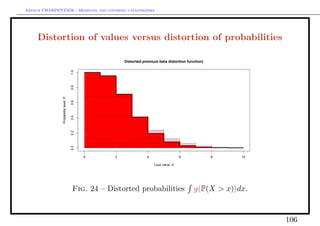
       from pure premium to distorted premiums (Wang)
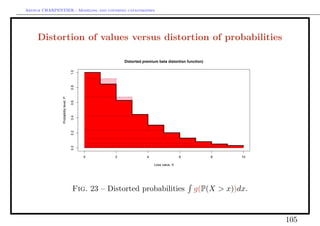
                            Rg (X) =          xdg ◦ P =    g(P(X > x))dx
where g : [0, 1] → [0, 1] is a distorted function.
Example
• if g(x) = I(X ≥ 1 − α) Rg (X) = V aR(X, α),
• if g(x) = min{x/(1 − α), 1} Rg (X) = T V aR(X, α) (also called expected
  shortfall), Rg (X) = EP (X|X > V aR(X, α)).
See D’Alembert (1754), Schmeidler (PAMS, 1986, E, 1989), Yaari (E, 1987),
Denneberg (KAP, 1994)... etc.
Remark : Rg (X) will be denoted Eg◦P . But it is not an expected value since
Q = g ◦ P is not a probability measure.


                                                                           104
Arthur CHARPENTIER - Modeling and covering catastrophes


     Distortion of values versus distortion of probabilities

                                                         Distorted premium beta distortion function)

                                       1.0                                                                     q


                                                                                                           q
                                       0.8


                                                                                                       q


                                                                                               q
                Probability level, P

                                       0.6


                                                                                         q


                                                                              q
                                       0.4


                                                                     q


                                                            q
                                       0.2


                                                     q


                                                 q
                                       0.0


                                             q


                                             0       2               4                   6             8       10

                                                                         Loss value, X


                                        Fig. 23 – Distorted probabilities                     g(P(X > x))dx.


                                                                                                                    105
Arthur CHARPENTIER - Modeling and covering catastrophes


     Distortion of values versus distortion of probabilities

                                                         Distorted premium beta distortion function)

                                       1.0                                                                     q


                                                                                                           q
                                       0.8


                                                                                                       q


                                                                                               q
                Probability level, P

                                       0.6


                                                                                         q


                                                                              q
                                       0.4


                                                                     q


                                                            q
                                       0.2


                                                     q


                                                 q
                                       0.0


                                             q


                                             0       2               4                   6             8       10

                                                                         Loss value, X


                                        Fig. 24 – Distorted probabilities                     g(P(X > x))dx.


                                                                                                                    106
Arthur CHARPENTIER - Modeling and covering catastrophes


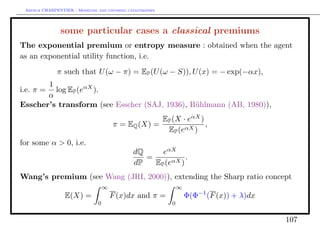
               some particular cases a classical premiums
The exponential premium or entropy measure : obtained when the agent
as an exponential utility function, i.e.
              π such that U (ω − π) = EP (U (ω − S)), U (x) = − exp(−αx),
       1
i.e. π = log EP (eαX ).
       α
Esscher’s transform (see Esscher (SAJ, 1936), B¨hlmann (AB, 1980)),
                                               u
                                                    EP (X · eαX )
                                       π = EQ (X) =               ,
                                                     EP (eαX )
for some α > 0, i.e.
                                              dQ     eαX
                                                 =       αX )
                                                              .
                                              dP   EP (e
Wang’s premium (see Wang (JRI, 2000)), extending the Sharp ratio concept
                                   ∞                           ∞
                 E(X) =                F (x)dx and π =             Φ(Φ−1 (F (x)) + λ)dx
                               0                           0


                                                                                          107
Arthur CHARPENTIER - Modeling and covering catastrophes


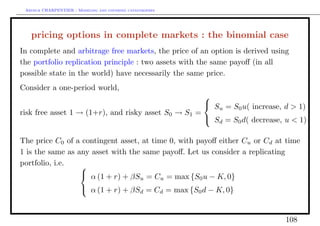
   pricing options in complete markets : the binomial case
In complete and arbitrage free markets, the price of an option is derived using
the portfolio replication principle : two assets with the same payoff (in all
possible state in the world) have necessarily the same price.
Consider a one-period world,
                                                     
                                                      S = S u( increase, d > 1)
                                                        u    0
risk free asset 1 → (1+r), and risky asset S0 → S1 =
                                                      Sd = S0 d( decrease, u < 1)

The price C0 of a contingent asset, at time 0, with payoff either Cu or Cd at time
1 is the same as any asset with the same payoff. Let us consider a replicating
portfolio, i.e.   
                   α (1 + r) + βS = C = max {S u − K, 0}
                                                 u         u   0
                         α (1 + r) + βSd = Cd = max {S0 d − K, 0}


                                                                             108
Arthur CHARPENTIER - Modeling and covering catastrophes


   pricing options in complete markets : the binomial case
The only solution of the system is
                          Cu − Cd             1                         Cu − Cd
                  β=                 and α =               Cu − S0 u               .
                         S0 u − S0 d         1+r                       S0 u − S0 d

C0 is the price at time 0 of that portfolio.
                               1                                1+r−d
     C0 = α + βS0 =               (πCu + (1 − π) Cd ) where π =       (∈ [0, 1]).
                              1+r                                u−d

                   C1
Hence C0 = EQ           where Q is the probability measure (π, 1 − π), called risk
                  1+r
neutral probability measure.


                                                                                       109
Arthur CHARPENTIER - Modeling and covering catastrophes


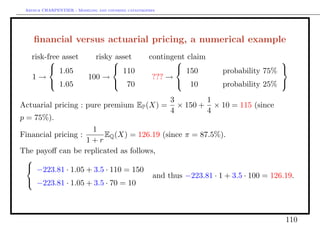
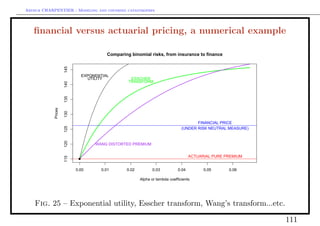
    financial versus actuarial pricing, a numerical example
   risk-free asset           risky asset             contingent claim
                                                                                     
          1.05                    110                      150       probability 75% 
   1→                      100 →                      ??? →
          1.05                    70                       10        probability 25% 
                                                           3        1
Actuarial pricing : pure premium EP (X) =                    × 150 + × 10 = 115 (since
                                                           4        4
p = 75%).
                     1
Financial pricing :     EQ (X) = 126.19 (since π = 87.5%).
                    1+r
The payoff can be replicated as follows,
 
  −223.81 · 1.05 + 3.5 · 110 = 150
                                      and thus −223.81 · 1 + 3.5 · 100 = 126.19.
  −223.81 · 1.05 + 3.5 · 70 = 10


                                                                                         110
Arthur CHARPENTIER - Modeling and covering catastrophes


   financial versus actuarial pricing, a numerical example

                                          Comparing binomial risks, from insurance to finance

                     145

                                EXPONENTIAL
                                  UTILITY           ESSCHER
                                                   TRANSFORM
                     140
                     135
            Prices

                     130


                                                                                       FINANCIAL PRICE
                     125


                                                                                (UNDER RISK NEUTRAL MEASURE)
                     120


                                     WANG DISTORTED PREMIUM


                                                                                     ACTUARIAL PURE PREMIUM
                     115


                            q


                           0.00         0.01      0.02          0.03          0.04         0.05      0.06

                                                         Alpha or lambda coefficients


    Fig. 25 – Exponential utility, Esscher transform, Wang’s transform...etc.

                                                                                                               111
Arthur CHARPENTIER - Modeling and covering catastrophes


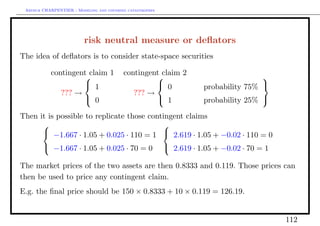
                          risk neutral measure or deflators
The idea of deflators is to consider state-space securities

           contingent claim 1             contingent claim 2
                                                                             
                     1                             0         probability 75% 
              ??? →                          ??? →
                     0                             1         probability 25% 

Then it is possible to replicate those contingent claims
                                          
       −1.667 · 1.05 + 0.025 · 110 = 1  2.619 · 1.05 + −0.02 · 110 = 0
       −1.667 · 1.05 + 0.025 · 70 = 0  2.619 · 1.05 + −0.02 · 70 = 1

The market prices of the two assets are then 0.8333 and 0.119. Those prices can
then be used to price any contingent claim.
E.g. the final price should be 150 × 0.8333 + 10 × 0.119 = 126.19.


                                                                                   112
Arthur CHARPENTIER - Modeling and covering catastrophes


     Cat bonds versus (traditional) reinsurance : the price
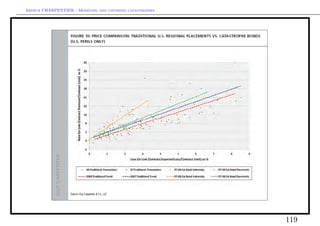
• A regression model (Lane (2000))
• A regression model (Major & Kreps (2002))


                                                              113
Arthur CHARPENTIER - Modeling and covering catastrophes


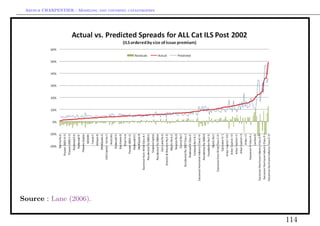
Source : Lane (2006).

                                                           114
Arthur CHARPENTIER - Modeling and covering catastrophes


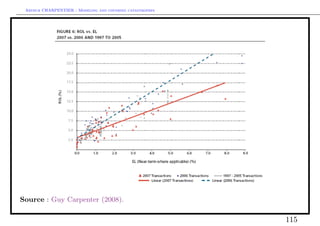
Source : Guy Carpenter (2008).

                                                           115
Arthur CHARPENTIER - Modeling and covering catastrophes


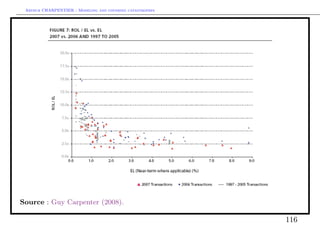
Source : Guy Carpenter (2008).

                                                           116
Arthur CHARPENTIER - Modeling and covering catastrophes


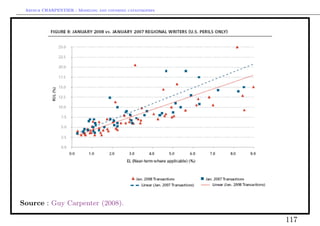
Source : Guy Carpenter (2008).

                                                           117
Arthur CHARPENTIER - Modeling and covering catastrophes


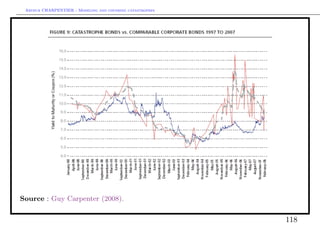
Source : Guy Carpenter (2008).

                                                           118
Arthur CHARPENTIER - Modeling and covering catastrophes


                                                          119
Arthur CHARPENTIER - Modeling and covering catastrophes


     Cat bonds versus (traditional) reinsurance : the price
• Using distorted premiums (Wang (2000,2002))
If F (x) = P(X > x) denotes the losses survival distribution, the pure premium is
                 ∞
π(X) = E(X) = 0 F (x)dx. The distorted premium is
                                                           ∞
                                        πg (X) =               g(F (x))dx,
                                                       0

where g : [0, 1] → [0, 1] is increasing, with g(0) = 0 and g(1) = 1.
Example The proportional hazards (PH) transform is obtained when g is a
power function.
Wang (2000) proposed the following transformation, g(·) = Φ(Φ−1 (F (·)) + λ),
where Φ is the N (0, 1) cdf, and λ is the “market price of risk”, i.e. the Sharpe
ratio. More generally, consider g(·) = tκ (t−1 (F (·)) + λ), where tκ is the Student t
                                            κ
cdf with κ degrees of freedom.


                                                                                 120
0
                         2
                             4
                                 6
                                     8
                                         10
                                              12
                                                   14
                                                                             16


           Mosaic 2A

           Mosaic 2B

           Halyard Re
                                                                             Yield spread (%)


         Domestic Re

        Concentric Re

             Juno Re

       Residential Re
                                                                                                                                                    Arthur CHARPENTIER - Modeling and covering catastrophes


      Kelvin 1st event

      Kelvin 2nd event

         Gold Eagle A

         Gold Eagle B

          Namazu Re
                                                    Empirical
                                                                             Lane model


           Atlas Re A
                                                                Wang model


           Atlas Re B

           Atlas Re C

          Seismic Ltd
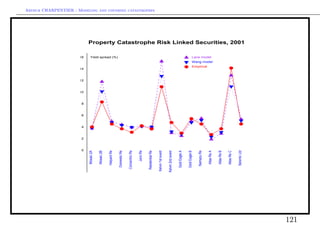
                                                                                                Property Catastrophe Risk Linked Securities, 2001


121
Arthur CHARPENTIER - Modeling and covering catastrophes


                              Who might buy cat bonds ?
In 2004,
• 40% of the total amount has been bought by mutual funds,
• 33% of the total amount has been bought by cat funds,
• 15% of the total amount has been bought by hedge funds.
Opportunity to diversify asset management (theoretical low correlation with
other asset classes), opportunity to gain Sharpe ratios through cat bonds excess
spread.


                                                                             122
Arthur CHARPENTIER - Modeling and covering catastrophes


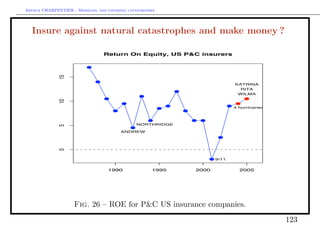
  Insure against natural catastrophes and make money ?

                                 Return On Equity, US P&C insurers
              15


                                                                          KATRINA
                                                                            RITA
                                                                           WILMA
              10


                                                                          4 hurricanes


                                               NORTHRIDGE
              5


                                        ANDREW
              0


                                                                   9/11


                                   1990              1995   2000            2005


                    Fig. 26 – ROE for P&C US insurance companies.
                                                                                         123
Arthur CHARPENTIER - Modeling and covering catastrophes


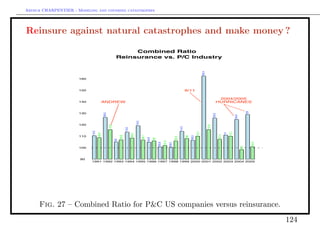
Reinsure against natural catastrophes and make money ?

                                                                  Combined Ratio
                                                             Reinsurance vs. P/C Industry


                                                                                                                                                                                      162.4
                      160


                      150                                                                                                                                       9/11

                                                                                                                                                                                                           2004/2005
                      140               ANDREW                                                                                                                                                            HURRICANES


                                                                                                                                                                                                                                                   129
                      130
                                            126.5


                                                                                                                                                                                                      125.8


                                                                                                                                                                                                                                    124.6
                                                                                          119.2
                      120
                                                    115.8


                                                                                                                                                                                              115.8
                                                                                                                                                        114.3
                                                                          113.6
                            110.5


                                                                                                                                                                              110.1


                                                                                                                                                                                                                            110.1
                                                                                                                                                                                                                      111
                                    108.8


                                                                                  108.5


                                                                                                                                                                                                              107.4
                                                                  106.9


                      110

                                                                                                  106.7


                                                                                                                                                                108
                                                                                                                                                                      106.5
                                                                                                                                                105.9
                                                                                                          104.8
                                                                                                                  106
                                                            105


                                                                                                                                101.9


                                                                                                                                                                                                                                                         100.9
                                                                                                                        100.8


                                                                                                                                        100.5


                                                                                                                                                                                                                                            98.3
                      100


                       90
                            1991 1992 1993 1994 1995 1996 1997 1998 1999 2000 2001 2002 2003 2004 2005


     Fig. 27 – Combined Ratio for P&C US companies versus reinsurance.
                                                                                                                                                                                                                                                                 124
Arthur CHARPENTIER - Modeling and covering catastrophes


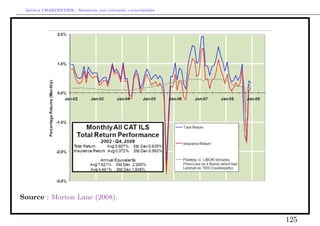
Source : Morton Lane (2008).


                                                           125
Arthur CHARPENTIER - Modeling and covering catastrophes


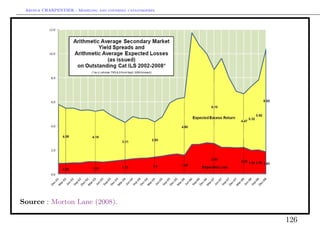
Source : Morton Lane (2008).

                                                           126
Arthur CHARPENTIER - Modeling and covering catastrophes


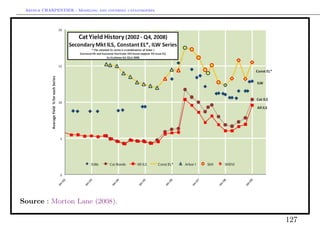
Source : Morton Lane (2008).

                                                           127
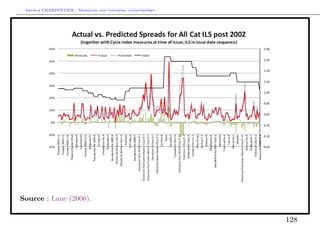
Arthur CHARPENTIER - Modeling and covering catastrophes


Source : Lane (2006).


                                                           128
Arthur CHARPENTIER - Modeling and covering catastrophes


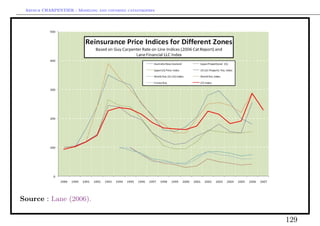
Source : Lane (2006).

                                                           129
Arthur CHARPENTIER - Modeling and covering catastrophes


                                                     Agenda
Catastrophic risks modelling
•    General introduction
•    Business interruption and very large claims
•    Natural catastrophes and accumulation risk
•    Insurance covers against catastrophes, traditional versus alternative techniques
Risk measures and pricing covers
•    Pricing insurance linked securities
•    Risk measures, an economic introduction
•    Calculating risk measures for catastrophic risks
•    Pricing cat bonds : the Winterthur example
•    Pricing cat bonds : the Mexican Earthquake


                                                                                130
Arthur CHARPENTIER - Modeling and covering catastrophes


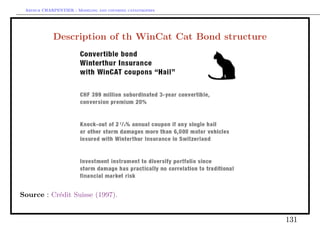
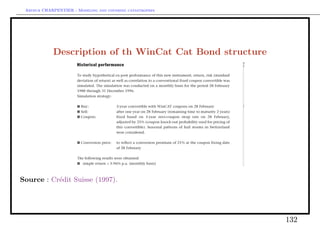
            Description of th WinCat Cat Bond structure


Source : Cr´dit Suisse (1997).
           e


                                                           131
Arthur CHARPENTIER - Modeling and covering catastrophes


            Description of th WinCat Cat Bond structure


Source : Cr´dit Suisse (1997).
           e


                                                           132
Arthur CHARPENTIER - Modeling and covering catastrophes


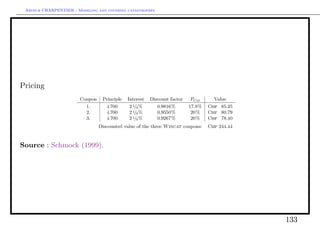
Pricing


Source : Schmock (1999).


                                                           133
Arthur CHARPENTIER - Modeling and covering catastrophes


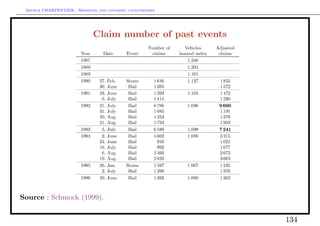
                             Claim number of past events


Source : Schmock (1999).


                                                           134
Arthur CHARPENTIER - Modeling and covering catastrophes


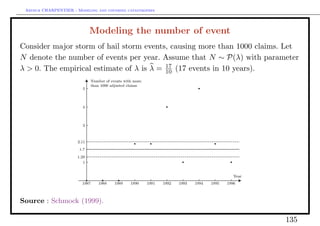
                            Modeling the number of event
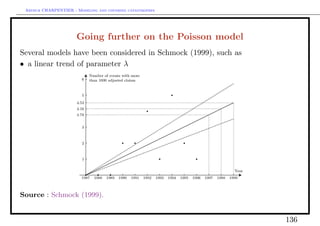
Consider major storm of hail storm events, causing more than 1000 claims. Let
N denote the number of events per year. Assume that N ∼ P(λ) with parameter
λ > 0. The empirical estimate of λ is λ = 17 (17 events in 10 years).
                                          10


Source : Schmock (1999).

                                                                         135
Arthur CHARPENTIER - Modeling and covering catastrophes


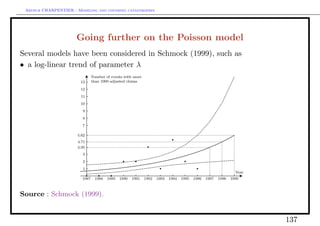
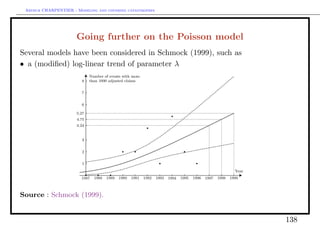
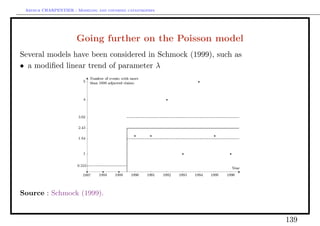
                      Going further on the Poisson model
Several models have been considered in Schmock (1999), such as
• a linear trend of parameter λ


Source : Schmock (1999).


                                                                 136
Arthur CHARPENTIER - Modeling and covering catastrophes


                      Going further on the Poisson model
Several models have been considered in Schmock (1999), such as
• a log-linear trend of parameter λ


Source : Schmock (1999).


                                                                 137
Arthur CHARPENTIER - Modeling and covering catastrophes


                      Going further on the Poisson model
Several models have been considered in Schmock (1999), such as
• a (modified) log-linear trend of parameter λ


Source : Schmock (1999).


                                                                 138
Arthur CHARPENTIER - Modeling and covering catastrophes


                      Going further on the Poisson model
Several models have been considered in Schmock (1999), such as
• a modified linear trend of parameter λ


Source : Schmock (1999).


                                                                 139
Arthur CHARPENTIER - Modeling and covering catastrophes


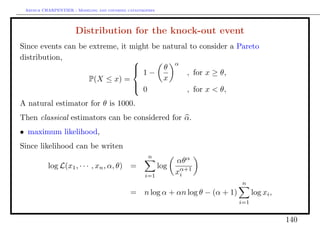
                      Distribution for the knock-out event
Since events can be extreme, it might be natural to consider a Pareto
distribution,                              α
                                 1−     θ
                                                , for x ≥ θ,
                                
                    P(X ≤ x) =           x
                                
                                 0             , for x < θ,
A natural estimator for θ is 1000.
Then classical estimators can be considered for α.
• maximum likelihood,
Since likelihood can be writen
                                                     n
                                                                 αθα
          log L(x1 , · · · , xn , α, θ)      =             log
                                                   i=1
                                                                 xα+1
                                                                  i
                                                                              n
                                             = n log α + αn log θ − (α + 1)         log xi ,
                                                                              i=1


                                                                                               140
Arthur CHARPENTIER - Modeling and covering catastrophes


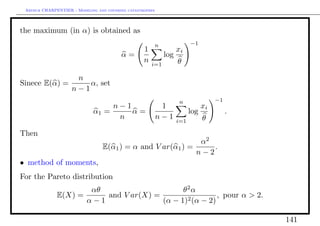
the maximum (in α) is obtained as
                                                       n                 −1
                                                   1               xi
                                         α=                  log
                                                   n   i=1         θ

               n
Sinece E(α) =     α, set
              n−1
                                                                   n                −1
                                      n−1                   1                  xi
                             α1 =         α=                             log             .
                                       n                   n−1     i=1         θ
Then
                                                             α2
                                 E(α1 ) = α and V ar(α1 ) =     .
                                                            n−2
• method of moments,
For the Pareto distribution
                      αθ                     θ2 α
              E(X) =     and V ar(X) =         2 (α − 2)
                                                         , pour α > 2.
                     α−1               (α − 1)

                                                                                             141
Arthur CHARPENTIER - Modeling and covering catastrophes


Thus
                                                      X
                                                α2 =      .
                                                     X −θ
Asymptotical properties are then
                                                         α(α − 1)2
                               E(α2 ) → α et V ar(α2 ) →           .
                                                         n(α − 2)
• OLS regression,
If the logarithm of survival probabilities log[1 − F (x)] are linear in log x, i.e.
                            log[1 − F (x)] = log F (x) = β0 + β1 log x,
we obtain a Pareto distribution. In that case
                  Yi = log[1 − F (Xi )] = log F (Xi ) = β0 + β1 log Xi + εi .

The OLS estimator for β = (β0 , β1 ) is then
                                 n                                     n               n
                        −n       i=1   log Xi · log F (Xi ) +          i=1 log Xi · i=1    log F (Xi )
      β1 = −α3 =                                 n                       n           2
                                           n                  2   −
                                                 i=1 [log Xi ]        [ i=1 log Xi ]
                                                                                                         142
Arthur CHARPENTIER - Modeling and covering catastrophes


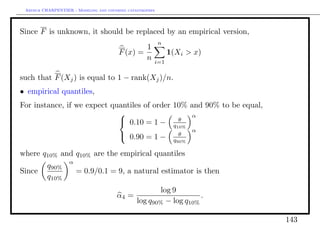
Since F is unknown, it should be replaced by an empirical version,
                                                           n
                                                1
                                        F (x) =                1(Xi > x)
                                                n      i=1

such that F (Xj ) is equal to 1 − rank(Xj )/n.
• empirical quantiles,
For instance, if we expect quantiles of order 10% and 90% to be equal,
                                                  α
                              0.10 = 1 −       θ
                                              q10%
                                                                       α
                                         0.90 = 1 −              θ
                                                                q90%

where q10% and q10% are the empirical quantiles
                   α
          q90%
Since                  = 0.9/0.1 = 9, a natural estimator is then
          q10%
                                                    log 9
                                       α4 =                     .
                                            log q90% − log q10%

                                                                           143
Arthur CHARPENTIER - Modeling and covering catastrophes


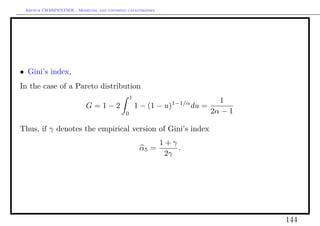
• Gini’s index,
In the case of a Pareto distribution
                                               1
                                                             1−1/α          1
                          G=1−2                    1 − (1 − u)       du =
                                           0                              2α − 1

Thus, if γ denotes the empirical version of Gini’s index
                                                           1+γ
                                                    α5 =       .
                                                            2γ


                                                                                   144
Arthur CHARPENTIER - Modeling and covering catastrophes


In that case, p6000 = P(X > 6000) ∼ 6−1.37 ∼ 8.57%. It is also possible to derive
bounds for this probability,

                             p6000 ∈ [4.5%; 16.2%] with 68% chance.


Source : Schmock (1999).


                                                                              145
Arthur CHARPENTIER - Modeling and covering catastrophes


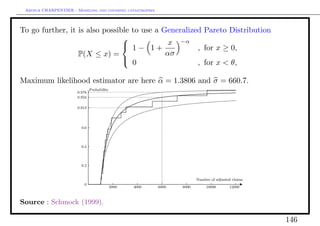
To go further, it is also possible to use a Generalized Pareto Distribution
                                                 −α
                                 1− 1+ x
                                
                                                      , for x ≥ 0,
                  P(X ≤ x) =                 ασ
                                 0                   , for x < θ,

Maximum likelihood estimator are here α = 1.3806 and σ = 660.7.


Source : Schmock (1999).

                                                                              146
Arthur CHARPENTIER - Modeling and covering catastrophes


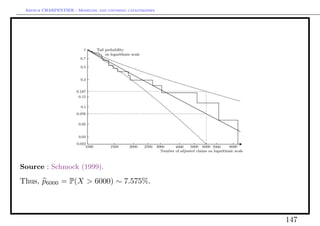
Source : Schmock (1999).

Thus, p6000 = P(X > 6000) ∼ 7.575%.


                                                           147
Arthur CHARPENTIER - Modeling and covering catastrophes


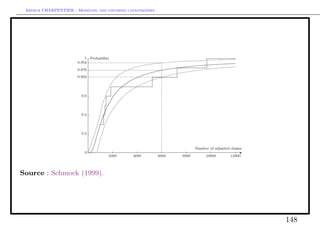
Source : Schmock (1999).


                                                           148
Arthur CHARPENTIER - Modeling and covering catastrophes


                                                     Agenda
Catastrophic risks modelling
•    General introduction
•    Business interruption and very large claims
•    Natural catastrophes and accumulation risk
•    Insurance covers against catastrophes, traditional versus alternative techniques
Risk measures and pricing covers
•    Pricing insurance linked securities
•    Risk measures, an economic introduction
•    Calculating risk measures for catastrophic risks
•    Pricing cat bonds : the Winterthur example
•    Pricing cat bonds : the Mexican Earthquake


                                                                                149
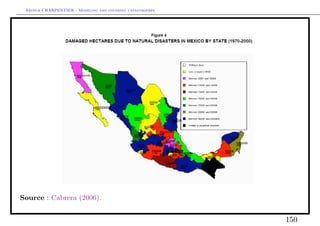
Arthur CHARPENTIER - Modeling and covering catastrophes


Source : Cabrera (2006).


                                                           150
Arthur CHARPENTIER - Modeling and covering catastrophes


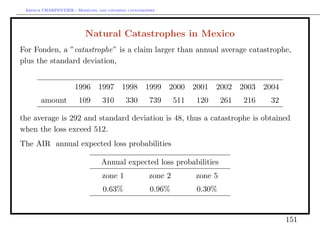
                          Natural Catastrophes in Mexico
For Fonden, a ”catastrophe” is a claim larger than annual average catastrophe,
plus the standard deviation,


                      1996      1997 1998 1999 2000 2001 2002                      2003   2004
       amount          109       310       330       739     511     120     261   216     32

the average is 292 and standard deviation is 48, thus a catastrophe is obtained
when the loss exceed 512.
The AIR annual expected loss probabilities

                                 Annual expected loss probabilities
                              00zone 100          00zone 200       00zone 500
                                 0.63%               0.96%           0.30%


                                                                                                 151
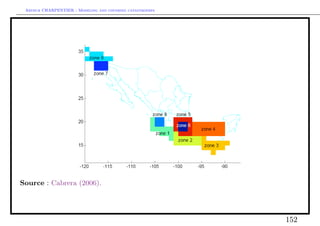
Arthur CHARPENTIER - Modeling and covering catastrophes


Source : Cabrera (2006).


                                                           152
Arthur CHARPENTIER - Modeling and covering catastrophes


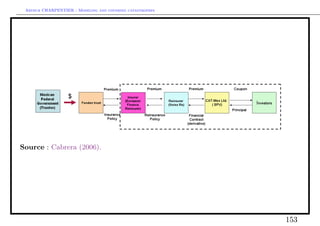
Source : Cabrera (2006).


                                                           153
Arthur CHARPENTIER - Modeling and covering catastrophes


Source : Cabrera (2006).


                                                           154
Arthur CHARPENTIER - Modeling and covering catastrophes


Source : Cabrera (2006).


                                                           155
Arthur CHARPENTIER - Modeling and covering catastrophes


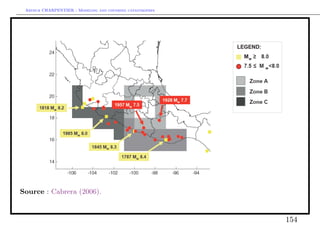
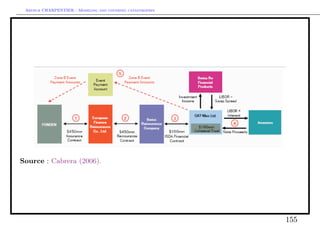
                                  The Mexican Cat Bond
The cat bond was issued by a SPV Cayman Islands Cat-Mex Ltd, structured by
Swiss Reinsurance Company (SRC) and Deutsche Bank.
The 160 million cat bond pays a tranche equal to the LIBOR + 235 basis points.
The cat bond is a part of a total coverage of 450 million provided by the reinsurer
for three years against earthquakes risk, with a total premium of 26 millions.
Payment of losses is conditional upon confirmation by AIR, which modeled the
seismic risk. Only 3 zones (out of 9) are insured in the transaction : zones 1, 2
and 5, with coverage of 150 million (in each case).
The cat bond payment would be triggered if there is an event, i.e. an earthquake
higher (or equal) than 8M w hitting zone 1 or zone 2, or an eathquake higher or
equal than 7.5M w hitting zone 5.


                                                                               156
Arthur CHARPENTIER - Modeling and covering catastrophes


                              Insurance market intensity λ1
Consider an homogeneous Poisson process with intensity λ1 . Under the
non-artbitrage framework, the compounded discount actuarial fair insurance
price at time t = 0, in the reinsurance market is
                                                               3                               3
  H = E 450 · 1 (τ < 3) e−rτ τ = 450                               e−rt t fτ (t)dt = 450           e−rt t λ1 e−λ1 t dt
                                                           0                               0

i.e. the insurance premium is equal to the value of the expected discounted loss
from earthquake.
With constant interest rate, rt = log(1.0541). Thus
                 3
26 = 450             e− log(1.0541)t λ1 e−λ1 t dt, where 1 − e−λ1 t is the probability of
             0
occurence of an event over period [0, t]. Hence, we get an intensity rate from the
reinsurance market λ1 ≈ 0.0214.
The probability of having (at least) one event in three years is 0.0624, i.e. 2.15
events in one hundred years.

                                                                                                                   157
Arthur CHARPENTIER - Modeling and covering catastrophes


                               Capital market intensity λ2
The cat bond pays to the investors the principal P equal to 160 million at
maturity T = 3 years, and gives coupon C every 3 months during the bond’s life
in case of no event. The coupon bonds pays a fixed spread rate z = 235 basis
points over LIBOR.
Hence the annual interest rate is r = 5.1439%, and thus
                            r+z                  5.1439% + 2.35%
                  C=                   P =                         · 160 = 3.1055
                             4                          4


                                                                                    158
Arthur CHARPENTIER - Modeling and covering catastrophes


Let G be the random variable representing the investor’s gain,
                                 1
           P     = E                 τ
                                       G
                              (1 + r)
                              12
                                           t     1                        1
                 = E              C · 1(τ > )           + P · 1(τ > 3)
                              t=1
                                           4 (1 + r)t/4                (1 + r)3
                        12
                                              1                   1
                 =            Ce−λ2 t/4              + P e−3λ2
                        t=1
                                          (1 + r)t/4           (1 + r)3

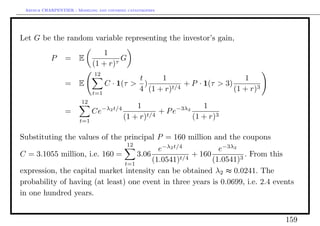
Substituting the values of the principal P = 160 million and the coupons
                                 12
                                           e−λ2 t/4           e−3λ2
C = 3.1055 million, i.e. 160 =      3.06          t/4
                                                      + 160         3
                                                                      . From this
                                t=1
                                         (1.0541)           (1.0541)
expression, the capital market intensity can be obtained λ2 ≈ 0.0241. The
probability of having (at least) one event in three years is 0.0699, i.e. 2.4 events
in one hundred years.


                                                                                  159
Arthur CHARPENTIER - Modeling and covering catastrophes


                                    Historical intensity λ3
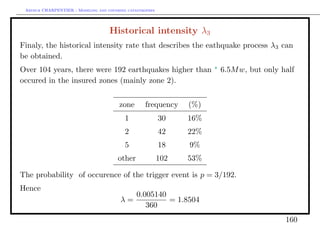
Finaly, the historical intensity rate that describes the eathquake process λ3 can
be obtained.
Over 104 years, there were 192 earthquakes higher than                 6.5M w, but only half
occured in the insured zones (mainly zone 2).


                                        zone       frequency     (%)
                                           1               30    16%
                                           2               42    22%
                                           5               18    9%
                                        other              102   53%

The probability of occurence of the trigger event is p = 3/192.
Hence
                                                0.005140
                                         λ=              = 1.8504
                                                   360
                                                                                         160
Arthur CHARPENTIER - Modeling and covering catastrophes


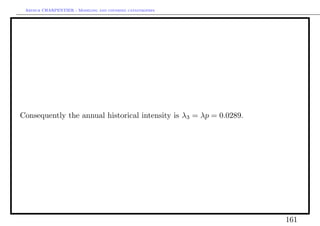
Consequently the annual historical intensity is λ3 = λp = 0.0289.


                                                                    161
Arthur CHARPENTIER - Modeling and covering catastrophes


                                     References (internet)
Artemis (Alternative Risk Transfer Internet Portal) http ://www.artemis.bm/
Guy Carpenter http ://www.guycarp.com/
Lane Financial LLC http ://www.lanefinancialllc.com/
Munich Re http ://www.munichre.com/
AON Bnefield http ://www.benfieldgroup.com/
Swiss Re http ://www.swissre.com/


                                                                          162
Arthur CHARPENTIER - Modeling and covering catastrophes


                                               References
Banks, E. (2004). Alternative Risk Transfer : Integrated Risk Management
through Insurance, Reinsurance, and the Capital Markets. Wiley.
Banks, E. (2005). Catastrophic Risk. Wiley.
Cabrera, B., B. (2006). Pricing catastrophic bonds for earthquakes in Mexico.
Master thesis, Humboldt-Universit¨t zu Berlin.
                                   a
Cardenas, V. & Mechler, R. (2005). The Mexico cat bonds - a solution for
country at risk ? Munich Re Foundation Symposium.
Cox, S.H. & Pedersen, H.W. (2000). Catastrophe risk bonds. North American
Actuarial Journal, 4, 4, 56-..
Kreps, R. (2005). Riskiness leverage models. CAS Forum.
Lane, M. & Mahul, O. (2008). Catastrophe Risk Pricing : an empirical analysis.
World Bank, WPS 4765.
Mata, A.J. (2004) Catastrophe Excess of Loss. in Encyclopedia of Actuarial
Sciences.
                                                                                163
Arthur CHARPENTIER - Modeling and covering catastrophes


Meyers, G. (2004) Catastrophe Models and Catastrophe Loads. in Encyclopedia of
Actuarial Sciences.
Muerlann, A. (2004) Catastrophe Derivatives. in Encyclopedia of Actuarial
Sciences.
Neuhaus, W. (2004) Alternative Risk Transfer. in Encyclopedia of Actuarial
Sciences.
Schmock, U. (1999). Estimating the value of the WinCat coupons of the
Winterthur insurance convertible bond. A study of the model risk. ASTIN
Bulleton, 29, 101-163.


                                                                             164
Arthur CHARPENTIER - Modeling and covering catastrophes


                                                          165
Arthur CHARPENTIER - Modeling and covering catastrophes


                                                          166
Arthur CHARPENTIER - Modeling and covering catastrophes


Source : Lane (2006).


                                                           167
Arthur CHARPENTIER - Modeling and covering catastrophes


Source : Lane (2006).

                                                           168

Slides saopaulo-catastrophe (1)

  • 1.
    Arthur CHARPENTIER -Modeling and covering catastrophes Modeling and covering catastrophes Arthur Charpentier Sao Paulo, April 2009 arthur.charpentier@univ-rennes1.fr http ://blogperso.univ-rennes1.fr/arthur.charpentier/index.php/ 1
  • 2.
    Arthur CHARPENTIER -Modeling and covering catastrophes Agenda Catastrophic risks products and models • General introduction • Modeling very large claims • Natural catastrophes and accumulation risk • Insurance covers against catastrophes, traditional versus alternative techniques Risk measures and pricing covers • Pricing insurance linked securities • Risk measures, an economic introduction • Calculating risk measures for catastrophic risks • Pricing cat bonds : the Winterthur example • Pricing cat bonds : the Mexican Earthquake 2
  • 3.
    Arthur CHARPENTIER -Modeling and covering catastrophes Agenda Catastrophic risks products and models • General introduction • Modeling very large claims • Natural catastrophes and accumulation risk • Insurance covers against catastrophes, traditional versus alternative techniques Risk measures and pricing covers • Pricing insurance linked securities • Risk measures, an economic introduction • Calculating risk measures for catastrophic risks • Pricing cat bonds : the Winterthur example • Pricing cat bonds : the Mexican Earthquake 3
  • 4.
    Arthur CHARPENTIER -Modeling and covering catastrophes Source : Swiss Re (2007). 4
  • 5.
    Arthur CHARPENTIER -Modeling and covering catastrophes Some stylized facts “climatic risk in numerous branches of industry is more important than the risk of interest rates or foreign exchange risk” (AXA 2004, quoted in Ceres (2004)). Fig. 1 – Major natural catastrophes (Source : Munich Re (2006)). 5
  • 6.
    Arthur CHARPENTIER -Modeling and covering catastrophes Some stylized facts : natural catastrophes Includes hurricanes, tornados, winterstorms, earthquakes, tsunamis, hail, drought, floods... Date Loss event Region Overall losses Insured losses Fatalities 25.8.2005 Hurricane Katrina USA 125,000 61,000 1,322 23.8.1992 Hurricane Andrew USA 26,500 17,000 62 17.1.1994 Earthquake Northridge USA 44,000 15,300 61 21.9.2004 Hurricane Ivan USA, Caribbean 23,000 13,000 125 19.10.2005 Hurricane Wilma Mexico, USA 20,000 12,400 42 20.9.2005 Hurricane Rita USA 16,000 12,000 10 11.8.2004 Hurricane Charley USA, Caribbean 18,000 8,000 36 26.9.1991 Typhoon Mireille Japan 10,000 7,000 62 9.9.2004 Hurricane Frances USA, Caribbean 12,000 6,000 39 26.12.1999 Winter storm Lothar Europe 11,500 5,900 110 Tab. 1 – The 10 most expensive natural catastrophes, 1950-2005 (Source : Munich Re (2006)). 6
  • 7.
    Arthur CHARPENTIER -Modeling and covering catastrophes Some stylized facts : man-made catastrophes Includes industry fire, oil & gas explosions, aviation crashes, shipping and rail disasters, mining accidents, collapse of building or bridges, terrorism... Date Location Plant type Event type Loss (property) 23.10.1989 Texas, USA petrochemical∗ vapor cloud explosion 839 04.05.1988 Nevada, USA chemical explosion 383 05.05.1988 Louisiana, USA refinery vapor cloud explosion 368 14.11.1987 Texas, USA petrochemical vapor cloud explosion 282 07.07.1988 North sea platform∗ explosion 1,085 26.08.1992 Gulf of Mexico platform explosion 931 23.08.1991 North sea concrete jacket mechanical damage 474 24.04.1988 Brazil plateform blowout 421 Tab. 2 – Onshore and offshore largest property damage losses (from 1970-1999). The largest claim is now the 9/11 terrorist attack, with a US$ 21, 379 million insured loss. ∗ evaluated loss US$ 2, 155 million and explosion on platform piper Alpha, US$ 3, 409 million (Swiss Re (2006)). 7
  • 8.
    Arthur CHARPENTIER -Modeling and covering catastrophes Some stylized facts : ... mortality risk “there seems to be broad agreement that there exists a market price for systematic mortality risk. Howe- ver, there seems to be no agreement on the structure and level of this price, and how it should be incorpo- rated when valuating insurance products or mortality derivatives” Bauer & Russ (2006). “securitization of longevity risk is not only a good method for risk diversifying, but also provides low beta investment assets to the capital market” Liao, Yang & Huang (2007). 8
  • 9.
    Arthur CHARPENTIER -Modeling and covering catastrophes longevity and mortality risks Yea r Age 5e−02 5e−02 2e−02 60 years old 40 years old 20 years old 5e−03 5e−03 2e−03 5e−04 1899 1948 1997 5e−04 5e−05 0 20 40 60 80 100 1900 1920 1940 1960 1980 2000 Age Age Fig. 2 – Mortality rate surface (function of age and year). 9
  • 10.
    Arthur CHARPENTIER -Modeling and covering catastrophes What is a large claim ? An academic answer ? Teugels (1982) defined “large claims”, Answer 1 “large claims are the upper 10% largest claims”, Answer 2 “large claims are every claim that consumes at least 5% of the sum of claims, or at least 5% of the net premiums”, Answer 3 “large claims are every claim for which the actuary has to go and see one of the chief members of the company”. Examples Traditional types of catastrophes, natural (hurricanes, typhoons, earthquakes, floods, tornados...), man-made (fires, explosions, business interruption...) or new risks (terrorist acts, asteroids, power outages...). From large claims to catastrophe, the difference is that there is a before the catastrophe, and an after : something has changed ! 10
  • 11.
    Arthur CHARPENTIER -Modeling and covering catastrophes Source : Swiss Re (2008). 11
  • 12.
    Arthur CHARPENTIER -Modeling and covering catastrophes Source : AXA (2008). 12
  • 13.
    Arthur CHARPENTIER -Modeling and covering catastrophes The impact of a catastrophe • Property damage : houses, cars and commercial structures, • Human casualties (may not be correlated with economic loss), • Business interruption Example • Natural Catastrophes - USA : succession of natural events that have hit insurers, reinsurers and the retrocession market • lack of capacity, strong increase in rate • Natural Catastrophes - nonUSA : in Asia (earthquakes, typhoons) and Europe (flood, drought, subsidence) • sui generis protection programs in some countries 13
  • 14.
    Arthur CHARPENTIER -Modeling and covering catastrophes The impact of a catastrophe • Storms - Europe : high speed wind in Europe and US, considered as insurable • main risk for P&C insurers • Terrorism, including nuclear, biologic or bacteriologic weapons • lack of capacity, strong social pressure : private/public partnerships • Liabilities, third party damage • growth in indemnities (jurisdictions) yield unsustainable losses • Transportation (maritime and aircrafts), volatile business, and concentrated market 14
  • 15.
    Arthur CHARPENTIER -Modeling and covering catastrophes Probabilistic concepts in risk management Let X1 , ..., Xn denote some claim size (per policy or per event), • the survival probability or exceedance probability is F (x) = P(X > x) = 1 − F (x), • the pure premium or expected value is ∞ ∞ E(X) = xdF (x) = F (x)dx, 0 0 • the Value-at-Risk or quantile function is −1 −1 V aR(X, u) = F (u) = F (1 − u) i.e. P(X > V aR(X, u)) = 1 − u, • the return period is T (u) = 1/F (x)(u). 15
  • 16.
    Arthur CHARPENTIER -Modeling and covering catastrophes Modeling catastrophes • Man-made catastrophes : modeling very large claims, • extreme value theory (ex : business interruption) • Natural Catastrophes : modeling very large claims taking into accont accumulation and global warming • extreme value theory for losses • time series theory for occurrence • credit risk models for contagion or accumulation 16
  • 17.
    Arthur CHARPENTIER -Modeling and covering catastrophes Updating actuarial models In classical actuarial models (from Cramer and Lundberg), one usually ´ consider • a model for the claims occurrence, e.g. a Poisson process, • a model for the claim size, e.g. a exponential, Weibull, lognormal... For light tailed risk, Cram´r-Lundberg’s theory gives a bound for the ruin e probability, assuming that claim size is not to large. Furthermore, additional capital to ensure solvency (non-ruin) can be obtained using the central limit theorem (see e.g. RBC approach). But the variance has to be finite. In the case of large risks or catastrophes, claim size has heavy tails (e.g. the variance is usually infinite), but the Poisson assumption for occurrence is still relevant. 17
  • 18.
    Arthur CHARPENTIER -Modeling and covering catastrophes Updating actuarial models N Example For business interruption, the total loss is S = Xi where N is i=1 Poisson, and the Xi ’s are i.i.d. Pareto. Example In the case of natural catastrophes, claim size is not necessarily huge, but the is an accumulation of claims, and the Poisson distribution is not relevant. But if considering events instead of claims, the Poisson model can be relevant. But the Poisson process is nonhomogeneous. N Example For hurricanes or winterstorms, the total loss is S = Xi where N is i=1 Ni Poisson, and Xi = Xi,j , where the Xi,j ’s are i.i.d. j=1 18
  • 19.
    Arthur CHARPENTIER -Modeling and covering catastrophes Agenda Catastrophic risks products and models • General introduction • Modeling very large claims • Natural catastrophes and accumulation risk • Insurance covers against catastrophes, traditional versus alternative techniques Risk measures and pricing covers • Pricing insurance linked securities • Risk measures, an economic introduction • Calculating risk measures for catastrophic risks • Pricing cat bonds : the Winterthur example • Pricing cat bonds : the Mexican Earthquake 19
  • 20.
    Arthur CHARPENTIER -Modeling and covering catastrophes Example : business interruption Business interruption claims can be very expensive. Zajdenweber (2001) claimed that it is a noninsurable risk since the pure premium is (theoretically) infinite. Remark For the 9/11 terrorist attacks, business interruption represented US$ 11 billion. 20
  • 21.
    Arthur CHARPENTIER -Modeling and covering catastrophes Some results from Extreme Value Theory When modeling large claims (industrial fire, business interruption,...) : extreme value theory framework is necessary. The Pareto distribution appears naturally when modeling observations over a given threshold, b x F (x) = P(X ≤ x) = 1 − , where x0 = exp(−a/b) x0 Then equivalently log(1 − F (x)) ∼ a + b log x, i.e. for all i = 1, ..., n, log(1 − Fn (Xi )) ∼ a + b · log Xi . Remark : if −b ≥ 1, then EP (X) = ∞, the pure premium is infinite. The estimation of b is a crucial issue. 21
  • 22.
    Arthur CHARPENTIER -Modeling and covering catastrophes Cumulative distribution function, with confidence interval 1.0 lo#!lo# %areto *lot, ,it. /onfiden/e inter3al 0 lo)arit.m of t.e sur5i5al 6ro7a7ilities !1 0.8 cumulative probabilities !# 0.6 !$ 0.4 !% 0.2 !5 0.0 0 1 2 3 4 5 0 1 # $ % 5 logarithm of the losses lo)arit.m of t.e losses Fig. 3 – Pareto modeling for business interruption claims. 22
  • 23.
    Arthur CHARPENTIER -Modeling and covering catastrophes Why the Pareto distribution ? historical perspective Vilfredo Pareto observed that 20% of the population owns 80% of the wealth. 80% of the claims 20% of the losses 20% of the claims 80% of the losses Fig. 4 – The 80-20 Pareto principle. Example Over the period 1992-2000 in business interruption claims in France, 0.1% of the claims represent 10% of the total loss. 20% of the claims represent 73% of the losses. 23
  • 24.
    Arthur CHARPENTIER -Modeling and covering catastrophes Why the Pareto distribution ? historical perspective Lorenz curve of business interruption claims 1.0 0.8 73% OF Proportion of claim size THE LOSSES 0.6 0.4 20% OF 0.2 THE CLAIMS 0.0 0.0 0.2 0.4 0.6 0.8 1.0 Proportion of claims number Fig. 5 – The 80-20 Pareto principle. 24
  • 25.
    Arthur CHARPENTIER -Modeling and covering catastrophes Why the Pareto distribution ? mathematical explanation We consider here the exceedance distribution, i.e. the distribution of X − u given that X > u, with survival distribution G(·) defined as F (x + u) G(x) = P(X − u > x|X > u) = F (u) This is closely related to some regular variation property, and only power function my appear as limit when u → ∞ : G(·) is necessarily a power function. The Pareto model in actuarial literature Swiss Re highlighted the importance of the Pareto distribution in two technical brochures the Pareto model in property reinsurance and estimating property excess of loss risk premium : The Pareto model. Actually, we will see that the Pareto model gives much more than only a premium. 25
  • 26.
    Arthur CHARPENTIER -Modeling and covering catastrophes Large claims and the Pareto model The theorem of Pickands-Balkema-de Haan states that if the X1 , ..., Xn are independent and identically distributed, for u large enough, −1/ξ    1+ξ x  if ξ = 0, P(X − u > x|X > u) ∼ Hξ,σ(u) (x) = σ(u)  exp − x   if ξ = 0, σ(u) for some σ(·). It simply means that large claims can always be modeled using the (generalized) Pareto distribution. The practical question which always arises is then “what are large claims”, i.e. how to chose u ? 26
  • 27.
    Arthur CHARPENTIER -Modeling and covering catastrophes How to define large claims ? • Use of the k largest claims : Hill’s estimator The intuitive idea is to fit a linear straight line since for the largest claims i = 1, ..., n, log(1 − Fn (Xi )) ∼ a + blog Xi . Let bk denote the estimator based on the k largest claims. Let {Xn−k+1:n , ..., Xn−1:n , Xn:n } denote the set of the k largest claims. Recall that ξ ∼ −1/b, and then n 1 ξ= log(Xn−k+i:n ) − log(Xn−k:n ). k i=1 27
  • 28.
    Arthur CHARPENTIER -Modeling and covering catastrophes 2.5 Hill estimator of the slope Hill estimator of the 95% VaR 10 2.0 8 quantile (95%) slope (!b) 6 1.5 4 1.0 2 0 200 400 600 800 1000 1200 0 200 400 600 800 1000 1200 Fig. 6 – Pareto modeling for business interruption claims : tail index. 28
  • 29.
    Arthur CHARPENTIER -Modeling and covering catastrophes Extreme value distributions... A natural idea is to fit a generalized Pareto distribution for claims exceeding u, for some u large enough. threshold [1] 3, we chose u = 3 p.less.thresh [1] 0.9271357, i.e. we keep to 8.5% largest claims n.exceed [1] 87 method [1] ‘‘ml’’, we use the maximum likelihood technique, par.ests, we get estimators ξ and σ, xi sigma 0.6179447 2.0453168 par.ses, with the following standard errors xi sigma 0.1769205 0.4008392 29
  • 30.
    Arthur CHARPENTIER -Modeling and covering catastrophes 5.0 MLE of the tail index, using Generalized Pareto Model Estimation of VaR and TVaR (95%) 5 e!02 1 e!02 4.5 1!F(x) (on log scale) 95 tail index 2 e!03 4.0 99 5 e!04 3.5 1 e!04 3.0 0.5 1.0 1.5 2.0 2.5 3.0 3.5 5 10 20 50 100 200 x (on log scale) Fig. 7 – Pareto modeling for business interruption claims : VaR and TVaR. 30
  • 31.
    Arthur CHARPENTIER -Modeling and covering catastrophes From the statistical model of claims to the pure premium Consider the following excess-of-loss treaty, with a priority d = 20, and an upper limit 70. Historical business interruption claims 140 130 120 110 100 90 80 70 60 50 40 30 20 10 1993 1994 1995 1996 1997 1998 1999 2000 2001 Fig. 8 – Pricing of a reinsurance layer. 31
  • 32.
    Arthur CHARPENTIER -Modeling and covering catastrophes From the statistical model of claims to the pure premium The average number of claims per year is 145, year 1992 1993 1994 1995 1996 1997 1998 1999 2000 frequency 173 152 146 131 158 138 120 156 136 Tab. 3 – Number of business interruption claims. 32
  • 33.
    Arthur CHARPENTIER -Modeling and covering catastrophes From the statistical model of claims to the pure premium For a claim size x, the reinsurer’s indemnity is I(x) = min{u, max{0, x − d}}. The average indemnity of the reinsurance can be obtained using the Pareto model, ∞ u E(I(X)) = I(x)dF (x) = (x − d)dF (x) + u(1 − F (u)), 0 d where F is a Pareto distribution. Here E(I(X)) = 0.145. The empirical estimate (burning cost) is 0.14. The pure premium of the reinsurance treaty is 20.6. Example If d = 50 and u = ∞, π = 8.9 (12 for burning cost... based on 1 claim). 33
  • 34.
    Arthur CHARPENTIER -Modeling and covering catastrophes Agenda Catastrophic risks modelling • General introduction • Business interruption and very large claims • Natural catastrophes and accumulation risk • Insurance covers against catastrophes, traditional versus alternative techniques Risk measures and capital requirements • Risk measures, an economic introduction • Calculating risk measures for catastrophic risks • Diversification and capital allocation 34
  • 35.
    Arthur CHARPENTIER -Modeling and covering catastrophes Increased value at risk In 1950, 30% of the world’s population (2.5 billion people) lived in cities. In 2000, 50% of the world’s population (6 billon). In 1950 the only city with more than 10 million inhabitants was New York. There were 12 in 1990, and 26 are expected by 2015, including • Tokyo (29 million), • New York (18 million), • Los Angeles (14 million). • Increasing value at risk (for all risks) The total value of insured costal exposure in 2004 was • $1, 937 billion in Florida (18 million), • $1, 902 billion in New York. 35
  • 36.
    Arthur CHARPENTIER -Modeling and covering catastrophes Two techniques to model large risks • The actuarial-statistical technique : modeling historical series, The actuary models the occurrence process of events, and model the claim size (of the total event). This is simple but relies on stability assumptions. If not, one should model changes in the occurrence process, and should take into account inflation or increase in value-at-risk. • The meteorological-engineering technique : modeling natural hazard and exposure. This approach needs a lot of data and information so generate scenarios taking all the policies specificities. Not very flexible to estimate return periods, and works as a black box. Very hard to assess any confidence levels. 36
  • 37.
    Arthur CHARPENTIER -Modeling and covering catastrophes The actuarial-statistical approach • Modeling event occurrence, the problem of global warming. Global warming has an impact on climate related hazard (droughts, subsidence, hurricanes, winterstorms, tornados, floods, coastal floods) but not geophysical (earthquakes). • Modeling claim size, the problem of increase of value at risk and inflation. Pielke & Landsea (1998) normalized losses due to hurricanes, using both population and wealth increases, “with this normalization, the trend of increasing damage amounts in recent decades disappears”. 37
  • 38.
    Arthur CHARPENTIER -Modeling and covering catastrophes Impact of global warming on natural hazard !u#$er o) *urricanes, per 2ear 3853!6008 25 Frequency of hurricanes 20 15 10 5 0 1850 1900 1950 2000 Year Fig. 9 – Number of hurricanes and major hurricanes per year. 38
  • 39.
    Arthur CHARPENTIER -Modeling and covering catastrophes More natural hazards with higher value at risk The most damaging tornadoes in the U.S. (1890-1999), adjusted with wealth, are the following, Date Location Adjusted loss 28.05.1896 Saint Louis, IL 2,916 29.09.1927 Saint Louis, IL 1,797 18.04.1925 3 states (MO, IL, IN) 1,392 10.05.1979 Wichita Falls, TX 1,141 09.06.1953 Worcester, MA 1,140 06.05.1975 Omaha, NE 1,127 08.06.1966 Topeka, KS 1,126 06.05.1936 Gainesville, GA 1,111 11.05.1970 Lubbock, TX 1,081 28.06.1924 Lorain-Sandusky, OH 1,023 03.05.1999 Oklahoma City, OK 909 11.05.1953 Waco, TX 899 27.04.1890 Louisville, KY 836 Tab. 4 – Most damaging tornadoes (from Brooks & Doswell (2001)). 39
  • 40.
    Arthur CHARPENTIER -Modeling and covering catastrophes Source : AXA (2006). 40
  • 41.
    Arthur CHARPENTIER -Modeling and covering catastrophes Cat models : the meteorological-engineering approach The basic framework is the following, • the natural hazard model : generate stochastic climate scenarios, and assess perils, • the engineering model : based on the exposure, the values, the building, calculate damage, • the insurance model : quantify financial losses based on deductibles, reinsurance (or retrocession) treaties. 41
  • 42.
    Arthur CHARPENTIER -Modeling and covering catastrophes Source : GIEC (2008). 42
  • 43.
    Arthur CHARPENTIER -Modeling and covering catastrophes Source : AXA (2008). 43
  • 44.
    Arthur CHARPENTIER -Modeling and covering catastrophes Source : AXA (2008). 44
  • 45.
    Arthur CHARPENTIER -Modeling and covering catastrophes Source : AXA (2008). 45
  • 46.
    Arthur CHARPENTIER -Modeling and covering catastrophes Source : AXA (2008). 46
  • 47.
    Arthur CHARPENTIER -Modeling and covering catastrophes Hurricanes in Florida : Rare and extremal events ? Note that for the probabilities/return periods of hurricanes related to insured losses in Florida are the following (source : Wharton Risk Center & RMS) $ 1 bn $ 2 bn $ 5 bn $ 10 bn $ 20 bn $ 50 bn 42.5% 35.9% 24.5% 15.0% 6.9% 1.7% 2 years 3 years 4 years 7 years 14 years 60 years $ 75 bn $ 100 bn $ 150 bn $ 200 bn $ 250 bn 0.81% 0.41% 0.11% 0.03% 0.005% 123 years 243 years 357 years 909 years 2, 000 years Tab. 5 – Extremal insured losses (from Wharton Risk Center & RMS). Recall that historical default (yearly) probabilities are AAA AA A BBB BB B 0.00% 0.01% 0.05% 0.37% 1.45% 6.59% - 10, 000 years 2, 000 years 270 years 69 years 15 years Tab. 6 – Return period of default (from S&P’s (1981-2003)). 47
  • 48.
    Arthur CHARPENTIER -Modeling and covering catastrophes Modelling contagion in credit risk models cat insurance credit risk n total number of insured n number of credit issuers 1 if policy i claims 1 if issuers i defaults Ii = Ii = 0 if not 0 if not Mi total sum insured Mi nominal Xi exposure rate 1 − Xi recovery rate 48
  • 49.
    Arthur CHARPENTIER -Modeling and covering catastrophes Modelling contagion in credit risk models In CreditMetrics, the idea is to generate random scenario to get the Profit & Loss distribution of the portfolio. • the recovery rate is modeled using a beta distribution, • the exposure rate is modeled using a MBBEFD distribution (see Bernegger (1999)). To generate joint defaults, CreditMetrics proposed a probit model. 49
  • 50.
    Arthur CHARPENTIER -Modeling and covering catastrophes Agenda Catastrophic risks modelling • General introduction • Modeling very large claims • Natural catastrophes and accumulation risk • Insurance covers against catastrophes, traditional versus alternative techniques Risk measures and capital requirements • Risk measures, an economic introduction • Calculating risk measures for catastrophic risks • Diversification and capital allocation 50
  • 51.
    Arthur CHARPENTIER -Modeling and covering catastrophes Insurance versus credit, an historical background The Babylonians developed a system which was re- corded in the famous Code of Hammurabi (1750 BC) and practiced by early Mediterranean sailing mer- chants. If a merchant received a loan to fund his shipment, he would pay the lender an additional sum in exchange for the lender’s guarantee to cancel the loan should the shipment be stolen. cf. cat bonds. 51
  • 52.
    Arthur CHARPENTIER -Modeling and covering catastrophes Why a reinsurance market ? “reinsurance is the transfer of part of the hazards of risks that a direct insurer assumes by way of reinsurance contracts or legal provision on behalf of an insured, to a second insurancce carrier, the reinsurer, who has no direct contractual relationship with the insured” (Swiss Re, introduction to reinsurance) Reinsurance allwo (primary) insurers to increase the maximum amount they can insure for a given loss : they can optimize their underwriting capacity without burdening their need to cover their solvency margin. The law of large number can be used by insurance companies to assess their probable annual loss... but under strong assumptions of identical distribution (hence past event can be used to estimate future one) and independence. 52
  • 53.
    Arthur CHARPENTIER -Modeling and covering catastrophes Which reinsurance treaty is optimal ? In a proportional agreement, the cedent and the reinsurer will agree on a contractually defined ratio to share (identically) the premiums and the losses In a non-proportional reinsurance treaty, the amount up to which the insurer will keep (entierely) the loss is defined. The reinsurance company will pay the loss above the deductible (up to a certain limit). The Excess-of-Loss (XL) trearty, as the basis for non-proportional reinsurance, with • a risk XL : any individual claim can trigger the cover • an event (or cat) XL : only a loss event involving several individual claims are covered by the treaty • a stop-loss, or excess-of-loss ratio : the deductible and the limit og liability are expressed as annnual aggregate amounts (usually as percentage of annual premium). 53
  • 54.
    Arthur CHARPENTIER -Modeling and covering catastrophes Risk management solutions ? • Equity holding : holding in solvency margin + easy and basic buffer − very expensive • Reinsurance and retrocession : transfer of the large risks to better diversified companies + easy to structure, indemnity based − business cycle influences capacities, default risk • Side cars : dedicated reinsurance vehicules, with quota share covers + add new capacity, allows for regulatory capital relief − short maturity, possible adverse selection 54
  • 55.
    Arthur CHARPENTIER -Modeling and covering catastrophes Risk management solutions ? • Industry loss warranties (ILW) : index based reinsurance triggers + simple to structure, no credit risk − limited number of capacity providers, noncorrelation risk, shortage of capacity • Cat bonds : bonds with capital and/or interest at risk when a specified trigger is reached + large capacities, no credit risk, multi year contracts − more and more industry/parametric based, structuration costs 55
  • 56.
    Arthur CHARPENTIER -Modeling and covering catastrophes Source : Guy Carpenter (2008). 56
  • 57.
    Arthur CHARPENTIER -Modeling and covering catastrophes 57
  • 58.
    Arthur CHARPENTIER -Modeling and covering catastrophes Trigger definition for peak risk • indemnity trigger : directly connected to the experienced damage + no risk for the cedant, only one considered by some regulator (NAIC) − time necessity to estimate actual damage, possible adverse selection (audit needed) • industry based index trigger : connected to the accumulated loss of the industry (PCS) + simple to use, no moral hazard − noncorrelation risk 58
  • 59.
    Arthur CHARPENTIER -Modeling and covering catastrophes Trigger definition for peak risk • environmental based index trigger : connected to some climate index (rainfall, windspeed, Richter scale...) measured by national authorities and meteorological offices + simple to use, no moral hazard − noncorrelation risk, related only to physical features (not financial consequences) • parametric trigger : a loss event is given by a cat-software, using climate inputs, and exposure data + few risk for the cedant if the model fits well − appears as a black-box 59
  • 60.
    Arthur CHARPENTIER -Modeling and covering catastrophes Reinsurance The insurance approach (XL treaty) 35 30 25 REINSURER Loss per event 20 15 INSURER 10 INSURED 5 0 0.0 0.2 0.4 0.6 0.8 1.0 Event Fig. 10 – The XL reinsurance treaty mechanism. 60
  • 61.
    Arthur CHARPENTIER -Modeling and covering catastrophes Group net W.P. net W.P. loss ratio total Shareholders’ Funds (2005) (2004) (2005) (2004) Munich Re 17.6 20.5 84.66% 24.3 24.4 Swiss Re (1) 16.5 20 85.78% 15.5 16 Berkshire Hathaway Re 7.8 8.2 91.48% 40.9 37.8 Hannover Re 7.1 7.8 85.66% 2.9 3.2 GE Insurance Solutions 5.2 6.3 164.51% 6.4 6.4 Lloyd’s 5.1 4.9 103.2% XL Re 3.9 3.2 99.72% Everest Re 3 3.5 93.97% 3.2 2.8 Reinsurance Group of America Inc. 3 2.6 1.9 1.7 PartnerRe 2.8 3 86.97% 2.4 2.6 Transatlantic Holdings Inc. 2.7 2.9 84.99% 1.9 2 Tokio Marine 2.1 2.6 26.9 23.9 Scor 2 2.5 74.08% 1.5 1.4 Odyssey Re 1.7 1.8 90.54% 1.2 1.2 Korean Re 1.5 1.3 69.66% 0.5 0.4 Scottish Re Group Ltd. 1.5 0.4 0.9 0.6 Converium 1.4 2.9 75.31% 1.2 1.3 Sompo Japan Insurance Inc. 1.4 1.6 25.3% 15.3 12.1 Transamerica Re (Aegon) 1.3 0.7 5.5 5.7 Platinum Underwriters Holdings 1.3 1.2 87.64% 1.2 0.8 Mitsui Sumitomo Insurance 1.3 1.5 63.18% 16.3 14.1 Tab. 7 – Top 25 Global Reinsurance Groups in 2005 (from Swiss Re (2006)). 61
  • 62.
    Arthur CHARPENTIER -Modeling and covering catastrophes Side cars A hedge fund that wishes to get into the reinsurance business will start a special purpose vehicle with a reinsurer. The hedge fund is able to get into reinsurance without hiring underwriters, buying models, nor getting rated by the rating agencies 62
  • 63.
    Arthur CHARPENTIER -Modeling and covering catastrophes ILW - Insurance Loss Warranty Industry loss warranties pay a fixed amount based of the amount of industry loss (PCS or SIGMA). Example For example, a $30 million ILW with a $5 billion trigger. Cat bonds and securitization Bonds issued to cover catastrophe risk were developed subsequent to Hurricane Andrew These bonds are structured so that the investor has a good return if there are no qualifying events and a poor return if a loss occurs. Losses can be triggered on an industry index or on an indemnity basis. 63
  • 64.
    Arthur CHARPENTIER -Modeling and covering catastrophes Source : Guy Carpenter (2008). 64
  • 65.
    Arthur CHARPENTIER -Modeling and covering catastrophes Source : Guy Carpenter (2008). 65
  • 66.
    Arthur CHARPENTIER -Modeling and covering catastrophes Source : Guy Carpenter (2008). 66
  • 67.
    Arthur CHARPENTIER -Modeling and covering catastrophes Source : Banks (2005). 67
  • 68.
    Arthur CHARPENTIER -Modeling and covering catastrophes Cat Bonds and securitization Secutizations in capital markets were intiated with mortgage-backed securities (MBS) collaterized mortgage obligations (CMO) asset-backed securities (ABS) collaterized loan obligations (CLO) collaterized bond obligations (CBO) collaterized debt obligations (CDO) 68
  • 69.
    Arthur CHARPENTIER -Modeling and covering catastrophes Source : Banks (2004). 69
  • 70.
    Arthur CHARPENTIER -Modeling and covering catastrophes Insurance Linked Securities indemnity trigger index trigger parametric trigger 70
  • 71.
    Arthur CHARPENTIER -Modeling and covering catastrophes Source : Guy Carpenter (2008). 71
  • 72.
    Arthur CHARPENTIER -Modeling and covering catastrophes Source : Guy Carpenter (2008). 72
  • 73.
    Arthur CHARPENTIER -Modeling and covering catastrophes Source : Guy Carpenter (2008). 73
  • 74.
    Arthur CHARPENTIER -Modeling and covering catastrophes Source : Guy Carpenter (2008). 74
  • 75.
    Arthur CHARPENTIER -Modeling and covering catastrophes Mortality bonds Source : Guy Carpenter (2008). 75
  • 76.
    Arthur CHARPENTIER -Modeling and covering catastrophes Source : Guy Carpenter (2006). 76
  • 77.
    Arthur CHARPENTIER -Modeling and covering catastrophes Source : Goldman Sachs (2006). 77
  • 78.
    Arthur CHARPENTIER -Modeling and covering catastrophes USAA’s hurricane bond(s) : Residential Re USAA, mutually owned insurance company (auto, householders, dwelling, personal libability for US military personal, and family). Hurricane Andrew (1992) : USD 620 million Early 1996, work with AIR and Merrill Lynch (and later Goldman Sachs and Lehman Brothers) to transfer a part of their portfolio Bond structured to give the insurer cover of the Excess-of-Loss layer above USD 1 billon, to a maximum of USD 500 million, at an 80% rate (i.e. 20% coinsured), provided by an insurance vehicule Residential Re, established as a Cayman SPR. The SPR issued notes to investors, in 2 classes of 3 tranches, class A-1, rated AAA, featuring a USD 77 million tranche of principal protected notes, and USD 87 million of principal variable notes, class A-2, rated BB, featuring a USD 313 million of principal variable notes, Trigger is the single occurrence of a class 3-5 hurricane, with ultimate net loss as defined under USAA’s portfolio parameters (indemnity trigger) 78
  • 79.
    Arthur CHARPENTIER -Modeling and covering catastrophes class A-1, rated AAA, hurricane bond Source : Banks (2004). 79
  • 80.
    Arthur CHARPENTIER -Modeling and covering catastrophes class A-2, rated BB, hurricane bond Source : Banks (2004). 80
  • 81.
    Arthur CHARPENTIER -Modeling and covering catastrophes 81
  • 82.
    Arthur CHARPENTIER -Modeling and covering catastrophes Source : Lane (2006). 82
  • 83.
    Arthur CHARPENTIER -Modeling and covering catastrophes Source : Lane (2006). 83
  • 84.
    Arthur CHARPENTIER -Modeling and covering catastrophes Source : Lane (2006). 84
  • 85.
    Arthur CHARPENTIER -Modeling and covering catastrophes Agenda Catastrophic risks modelling • General introduction • Business interruption and very large claims • Natural catastrophes and accumulation risk • Insurance covers against catastrophes, traditional versus alternative techniques Risk measures and pricing covers • Pricing insurance linked securities • Risk measures, an economic introduction • Calculating risk measures for catastrophic risks • Pricing cat bonds : the Winterthur example • Pricing cat bonds : the Mexican Earthquake 85
  • 86.
    Arthur CHARPENTIER -Modeling and covering catastrophes survey of literature on pricing • Fundamental asset pricing theorem, in finance, Cox & Ross (JFE, 1976), Harrison & Kreps (JET, 1979), Harrison & Pliska (SPA, 1981, 1983). Recent general survey – Dana & Jeanblanc-Picque (1998). March´s financiers en temps continu : ´ e ´ valorisation et ´quilibre. Economica. e – Duffie (2001). Dynamic Asset Pricing Theory. Princeton University Press. – Bingham & Kiesel (2004). Risk neutral valuation. Springer Verlag • Premium calculation, in insurance. – Buhlmann (1970) Mathematical Methods in Risk Theory. Springer Verlag. ¨ – Goovaerts, de Vylder & Haezendonck (1984). Premium Calculation in Insurance. Springer Verlag. – Denuit & Charpentier (2004). Math´matiques de l’assurance non-vie, tome e ´ 1. Economica. 86
  • 87.
    Arthur CHARPENTIER -Modeling and covering catastrophes survey of literature on pricing • Price of uncertain quantities, in economics of uncertainty, von Neumann & Morgenstern (1944), Yaari (E, 1987). Recent general survey – Quiggin (1993). Generalized expected utility theory : the rank-dependent model. Kluwer Academic Publishers. – Gollier (2001). The Economics of Risk and Time. MIT Press. 87
  • 88.
    Arthur CHARPENTIER -Modeling and covering catastrophes from mass risk to large risks insurance is “the contribution of the many to the misfortune of the few”. 1. judicially, an insurance contract can be valid only if claim occurrence satisfy some randomness property, 2. the “game rule” (using the expression from Berliner (Prentice-Hall, 1982), i.e. legal framework) should remain stable in time, 3. the possible maximum loss should not be huge, with respect to the insurer’s solvency, 4. the average cost should be identifiable and quantifiable, 5. risks could be pooled so that the law of large numbers can be used (independent and identically distributed, i.e. the portfolio should be homogeneous), 6. there should be no moral hazard, and no adverse selection, 7. there must exist an insurance market, in the sense that demand and supply should meet, and a price (equilibrium price) should arise. 88
  • 89.
    Arthur CHARPENTIER -Modeling and covering catastrophes risk premium and regulatory capital (points 4 and 5) Within an homogeneous portfolios (Xi identically distributed), sufficiently large X1 + ... + Xn (n → ∞), → E(X). If the variance is finite, we can also derive a n confidence interval (solvency requirement), i.e. if the Xi ’s are independent,   n √ Xi ∈ nE(X) ± 1.96 nVar(X)  with probability 95%.   i=1 risk based capital need High variance, small portfolio, or nonindependence implies more volatility, and therefore more capital requirement. 89
  • 90.
    Arthur CHARPENTIER -Modeling and covering catastrophes independent risks, large portfolio (e.g. car insurance) independent risks, 10,000 insured q q q q Fig. 11 – A portfolio of n = 10, 000 insured, p = 1/10. 90
  • 91.
    Arthur CHARPENTIER -Modeling and covering catastrophes independent risks, large portfolio (e.g. car insurance) independent risks, 10,000 insured, p=1/10 distribution de la charge totale, N(np, np(1 − p) ) , q 0.012 cas indépendant, p=1/10, n=10,000 0.010 RISK−BASED CAPITAL NEED +7% PREMIUM 0.008 0.006 RUIN (1% SCENARIO) 0.004 0.002 0.000 969 q 900 950 1000 1050 1100 1150 1200 Fig. 12 – A portfolio of n = 10, 000 insured, p = 1/10. 91
  • 92.
    Arthur CHARPENTIER -Modeling and covering catastrophes independent risks, large portfolio (e.g. car insurance) independent risks, 10,000 insured, p=1/10 distribution de la charge totale, N(np, np(1 − p) ) , q 0.012 cas indépendant, p=1/10, n=10,000 0.010 RISK−BASED CAPITAL NEED +7% PREMIUM 0.008 0.006 RUIN (1% SCENARIO) 0.004 0.002 0.000 986 q 900 950 1000 1050 1100 1150 1200 Fig. 13 – A portfolio of n = 10, 000 insured, p = 1/10. 92
  • 93.
    Arthur CHARPENTIER -Modeling and covering catastrophes independent risks, small portfolio (e.g. fire insurance) independent risks, 400 insured q q q q Fig. 14 – A portfolio of n = 400 insured, p = 1/10. 93
  • 94.
    Arthur CHARPENTIER -Modeling and covering catastrophes independent risks, small portfolio (e.g. fire insurance) independent risks, 400 insured, p=1/10 distribution de la charge totale, N(np, np(1 − p) ) , q 0.06 cas indépendant, p=1/10, n=400 0.05 RUIN 0.04 (1% SCENARIO) 0.03 RISK−BASED CAPITAL 0.02 NEED +35% PREMIUM 0.01 0.00 q 39 30 40 50 60 70 Fig. 15 – A portfolio of n = 400 insured, p = 1/10. 94
  • 95.
    Arthur CHARPENTIER -Modeling and covering catastrophes independent risks, small portfolio (e.g. fire insurance) independent risks, 400 insured, p=1/10 distribution de la charge totale, N(np, np(1 − p) ) , q 0.06 cas indépendant, p=1/10, n=400 0.05 RUIN 0.04 (1% SCENARIO) 0.03 RISK−BASED CAPITAL 0.02 NEED +35% PREMIUM 0.01 0.00 q 48 30 40 50 60 70 Fig. 16 – A portfolio of n = 400 insured, p = 1/10. 95
  • 96.
    Arthur CHARPENTIER -Modeling and covering catastrophes nonindependent risks, large portfolio (e.g. earthquake) independent risks, 10,000 insured q q q q Fig. 17 – A portfolio of n = 10, 000 insured, p = 1/10, nonindependent. 96
  • 97.
    Arthur CHARPENTIER -Modeling and covering catastrophes nonindependent risks, large portfolio (e.g. earthquake) non−independent risks, 10,000 insured, p=1/10 distribution de la charge totale q 0.012 nonindependant case, p=1/10, n=10,000 0.010 RUIN (1% SCENARIO) 0.008 0.006 RISK−BASED CAPITAL 0.004 NEED +105% PREMIUM 0.002 0.000 897 q 1000 1500 2000 2500 Fig. 18 – A portfolio of n = 10, 000 insured, p = 1/10, nonindependent. 97
  • 98.
    Arthur CHARPENTIER -Modeling and covering catastrophes nonindependent risks, large portfolio (e.g. earthquake) non−independent risks, 10,000 insured, p=1/10 distribution de la charge totale q 0.012 nonindependant case, p=1/10, n=10,000 0.010 RUIN (1% SCENARIO) 0.008 0.006 RISK−BASED CAPITAL 0.004 NEED +105% PREMIUM 0.002 0.000 2013 q 1000 1500 2000 2500 Fig. 19 – A portfolio of n = 10, 000 insured, p = 1/10, nonindependent. 98
  • 99.
    Arthur CHARPENTIER -Modeling and covering catastrophes the pure premium as a technical benchmark Pascal, Fermat, Condorcet, Huygens, d’Alembert in the XVIIIth century proposed to evaluate the “produit scalaire des probabilit´s et des gains”, e n n < p, x >= pi xi = P(X = xi ) · xi = EP (X), i=1 i=1 based on the “r`gle des parties”. e For Qu´telet, the expected value was, in the context of insurance, the price that e guarantees a financial equilibrium. From this idea, we consider in insurance the pure premium as EP (X). As in Cournot (1843), “l’esp´rance math´matique est donc le juste prix des chances” e e (or the “fair price” mentioned in Feller (AS, 1953)). Problem : Saint Peterburg’s paradox, i.e. infinite mean risks (cf. natural catastrophes) 99
  • 100.
    Arthur CHARPENTIER -Modeling and covering catastrophes the pure premium as a technical benchmark ∞ For a positive random variable X, recall that EP (X) = P(X > x)dx. 0 Expected value 1.0 q q 0.8 q q Probability level, P 0.6 q q 0.4 q q 0.2 q q 0.0 q 0 2 4 6 8 10 Loss value, X Fig. 20 – Expected value EP (X) = xdFX (x) = P(X > x)dx. 100
  • 101.
    Arthur CHARPENTIER -Modeling and covering catastrophes from pure premium to expected utility principle Ru (X) = u(x)dP = P(u(X) > x))dx where u : [0, ∞) → [0, ∞) is a utility function. Example with an exponential utility, u(x) = [1 − e−αx ]/α, 1 Ru (X) = log EP (eαX ) , α i.e. the entropic risk measure. See Cramer (1728), Bernoulli (1738), von Neumann & Morgenstern (PUP, 1944), ... etc. 101
  • 102.
    Arthur CHARPENTIER -Modeling and covering catastrophes Distortion of values versus distortion of probabilities Expected utility (power utility function) 1.0 q q 0.8 q q Probability level, P 0.6 q q 0.4 q q 0.2 q q 0.0 q 0 2 4 6 8 10 Loss value, X Fig. 21 – Expected utility u(x)dFX (x). 102
  • 103.
    Arthur CHARPENTIER -Modeling and covering catastrophes Distortion of values versus distortion of probabilities Expected utility (power utility function) 1.0 q q 0.8 q q Probability level, P 0.6 q q 0.4 q q 0.2 q q 0.0 q 0 2 4 6 8 10 Loss value, X Fig. 22 – Expected utility u(x)dFX (x). 103
  • 104.
    Arthur CHARPENTIER -Modeling and covering catastrophes from pure premium to distorted premiums (Wang) Rg (X) = xdg ◦ P = g(P(X > x))dx where g : [0, 1] → [0, 1] is a distorted function. Example • if g(x) = I(X ≥ 1 − α) Rg (X) = V aR(X, α), • if g(x) = min{x/(1 − α), 1} Rg (X) = T V aR(X, α) (also called expected shortfall), Rg (X) = EP (X|X > V aR(X, α)). See D’Alembert (1754), Schmeidler (PAMS, 1986, E, 1989), Yaari (E, 1987), Denneberg (KAP, 1994)... etc. Remark : Rg (X) will be denoted Eg◦P . But it is not an expected value since Q = g ◦ P is not a probability measure. 104
  • 105.
    Arthur CHARPENTIER -Modeling and covering catastrophes Distortion of values versus distortion of probabilities Distorted premium beta distortion function) 1.0 q q 0.8 q q Probability level, P 0.6 q q 0.4 q q 0.2 q q 0.0 q 0 2 4 6 8 10 Loss value, X Fig. 23 – Distorted probabilities g(P(X > x))dx. 105
  • 106.
    Arthur CHARPENTIER -Modeling and covering catastrophes Distortion of values versus distortion of probabilities Distorted premium beta distortion function) 1.0 q q 0.8 q q Probability level, P 0.6 q q 0.4 q q 0.2 q q 0.0 q 0 2 4 6 8 10 Loss value, X Fig. 24 – Distorted probabilities g(P(X > x))dx. 106
  • 107.
    Arthur CHARPENTIER -Modeling and covering catastrophes some particular cases a classical premiums The exponential premium or entropy measure : obtained when the agent as an exponential utility function, i.e. π such that U (ω − π) = EP (U (ω − S)), U (x) = − exp(−αx), 1 i.e. π = log EP (eαX ). α Esscher’s transform (see Esscher (SAJ, 1936), B¨hlmann (AB, 1980)), u EP (X · eαX ) π = EQ (X) = , EP (eαX ) for some α > 0, i.e. dQ eαX = αX ) . dP EP (e Wang’s premium (see Wang (JRI, 2000)), extending the Sharp ratio concept ∞ ∞ E(X) = F (x)dx and π = Φ(Φ−1 (F (x)) + λ)dx 0 0 107
  • 108.
    Arthur CHARPENTIER -Modeling and covering catastrophes pricing options in complete markets : the binomial case In complete and arbitrage free markets, the price of an option is derived using the portfolio replication principle : two assets with the same payoff (in all possible state in the world) have necessarily the same price. Consider a one-period world,   S = S u( increase, d > 1) u 0 risk free asset 1 → (1+r), and risky asset S0 → S1 =  Sd = S0 d( decrease, u < 1) The price C0 of a contingent asset, at time 0, with payoff either Cu or Cd at time 1 is the same as any asset with the same payoff. Let us consider a replicating portfolio, i.e.   α (1 + r) + βS = C = max {S u − K, 0} u u 0  α (1 + r) + βSd = Cd = max {S0 d − K, 0} 108
  • 109.
    Arthur CHARPENTIER -Modeling and covering catastrophes pricing options in complete markets : the binomial case The only solution of the system is Cu − Cd 1 Cu − Cd β= and α = Cu − S0 u . S0 u − S0 d 1+r S0 u − S0 d C0 is the price at time 0 of that portfolio. 1 1+r−d C0 = α + βS0 = (πCu + (1 − π) Cd ) where π = (∈ [0, 1]). 1+r u−d C1 Hence C0 = EQ where Q is the probability measure (π, 1 − π), called risk 1+r neutral probability measure. 109
  • 110.
    Arthur CHARPENTIER -Modeling and covering catastrophes financial versus actuarial pricing, a numerical example risk-free asset risky asset contingent claim      1.05  110  150 probability 75%  1→ 100 → ??? →  1.05  70  10 probability 25%  3 1 Actuarial pricing : pure premium EP (X) = × 150 + × 10 = 115 (since 4 4 p = 75%). 1 Financial pricing : EQ (X) = 126.19 (since π = 87.5%). 1+r The payoff can be replicated as follows,   −223.81 · 1.05 + 3.5 · 110 = 150 and thus −223.81 · 1 + 3.5 · 100 = 126.19.  −223.81 · 1.05 + 3.5 · 70 = 10 110
  • 111.
    Arthur CHARPENTIER -Modeling and covering catastrophes financial versus actuarial pricing, a numerical example Comparing binomial risks, from insurance to finance 145 EXPONENTIAL UTILITY ESSCHER TRANSFORM 140 135 Prices 130 FINANCIAL PRICE 125 (UNDER RISK NEUTRAL MEASURE) 120 WANG DISTORTED PREMIUM ACTUARIAL PURE PREMIUM 115 q 0.00 0.01 0.02 0.03 0.04 0.05 0.06 Alpha or lambda coefficients Fig. 25 – Exponential utility, Esscher transform, Wang’s transform...etc. 111
  • 112.
    Arthur CHARPENTIER -Modeling and covering catastrophes risk neutral measure or deflators The idea of deflators is to consider state-space securities contingent claim 1 contingent claim 2     1  0 probability 75%  ??? → ??? →  0  1 probability 25%  Then it is possible to replicate those contingent claims    −1.667 · 1.05 + 0.025 · 110 = 1  2.619 · 1.05 + −0.02 · 110 = 0  −1.667 · 1.05 + 0.025 · 70 = 0  2.619 · 1.05 + −0.02 · 70 = 1 The market prices of the two assets are then 0.8333 and 0.119. Those prices can then be used to price any contingent claim. E.g. the final price should be 150 × 0.8333 + 10 × 0.119 = 126.19. 112
  • 113.
    Arthur CHARPENTIER -Modeling and covering catastrophes Cat bonds versus (traditional) reinsurance : the price • A regression model (Lane (2000)) • A regression model (Major & Kreps (2002)) 113
  • 114.
    Arthur CHARPENTIER -Modeling and covering catastrophes Source : Lane (2006). 114
  • 115.
    Arthur CHARPENTIER -Modeling and covering catastrophes Source : Guy Carpenter (2008). 115
  • 116.
    Arthur CHARPENTIER -Modeling and covering catastrophes Source : Guy Carpenter (2008). 116
  • 117.
    Arthur CHARPENTIER -Modeling and covering catastrophes Source : Guy Carpenter (2008). 117
  • 118.
    Arthur CHARPENTIER -Modeling and covering catastrophes Source : Guy Carpenter (2008). 118
  • 119.
    Arthur CHARPENTIER -Modeling and covering catastrophes 119
  • 120.
    Arthur CHARPENTIER -Modeling and covering catastrophes Cat bonds versus (traditional) reinsurance : the price • Using distorted premiums (Wang (2000,2002)) If F (x) = P(X > x) denotes the losses survival distribution, the pure premium is ∞ π(X) = E(X) = 0 F (x)dx. The distorted premium is ∞ πg (X) = g(F (x))dx, 0 where g : [0, 1] → [0, 1] is increasing, with g(0) = 0 and g(1) = 1. Example The proportional hazards (PH) transform is obtained when g is a power function. Wang (2000) proposed the following transformation, g(·) = Φ(Φ−1 (F (·)) + λ), where Φ is the N (0, 1) cdf, and λ is the “market price of risk”, i.e. the Sharpe ratio. More generally, consider g(·) = tκ (t−1 (F (·)) + λ), where tκ is the Student t κ cdf with κ degrees of freedom. 120
  • 121.
    0 2 4 6 8 10 12 14 16 Mosaic 2A Mosaic 2B Halyard Re Yield spread (%) Domestic Re Concentric Re Juno Re Residential Re Arthur CHARPENTIER - Modeling and covering catastrophes Kelvin 1st event Kelvin 2nd event Gold Eagle A Gold Eagle B Namazu Re Empirical Lane model Atlas Re A Wang model Atlas Re B Atlas Re C Seismic Ltd Property Catastrophe Risk Linked Securities, 2001 121
  • 122.
    Arthur CHARPENTIER -Modeling and covering catastrophes Who might buy cat bonds ? In 2004, • 40% of the total amount has been bought by mutual funds, • 33% of the total amount has been bought by cat funds, • 15% of the total amount has been bought by hedge funds. Opportunity to diversify asset management (theoretical low correlation with other asset classes), opportunity to gain Sharpe ratios through cat bonds excess spread. 122
  • 123.
    Arthur CHARPENTIER -Modeling and covering catastrophes Insure against natural catastrophes and make money ? Return On Equity, US P&C insurers 15 KATRINA RITA WILMA 10 4 hurricanes NORTHRIDGE 5 ANDREW 0 9/11 1990 1995 2000 2005 Fig. 26 – ROE for P&C US insurance companies. 123
  • 124.
    Arthur CHARPENTIER -Modeling and covering catastrophes Reinsure against natural catastrophes and make money ? Combined Ratio Reinsurance vs. P/C Industry 162.4 160 150 9/11 2004/2005 140 ANDREW HURRICANES 129 130 126.5 125.8 124.6 119.2 120 115.8 115.8 114.3 113.6 110.5 110.1 110.1 111 108.8 108.5 107.4 106.9 110 106.7 108 106.5 105.9 104.8 106 105 101.9 100.9 100.8 100.5 98.3 100 90 1991 1992 1993 1994 1995 1996 1997 1998 1999 2000 2001 2002 2003 2004 2005 Fig. 27 – Combined Ratio for P&C US companies versus reinsurance. 124
  • 125.
    Arthur CHARPENTIER -Modeling and covering catastrophes Source : Morton Lane (2008). 125
  • 126.
    Arthur CHARPENTIER -Modeling and covering catastrophes Source : Morton Lane (2008). 126
  • 127.
    Arthur CHARPENTIER -Modeling and covering catastrophes Source : Morton Lane (2008). 127
  • 128.
    Arthur CHARPENTIER -Modeling and covering catastrophes Source : Lane (2006). 128
  • 129.
    Arthur CHARPENTIER -Modeling and covering catastrophes Source : Lane (2006). 129
  • 130.
    Arthur CHARPENTIER -Modeling and covering catastrophes Agenda Catastrophic risks modelling • General introduction • Business interruption and very large claims • Natural catastrophes and accumulation risk • Insurance covers against catastrophes, traditional versus alternative techniques Risk measures and pricing covers • Pricing insurance linked securities • Risk measures, an economic introduction • Calculating risk measures for catastrophic risks • Pricing cat bonds : the Winterthur example • Pricing cat bonds : the Mexican Earthquake 130
  • 131.
    Arthur CHARPENTIER -Modeling and covering catastrophes Description of th WinCat Cat Bond structure Source : Cr´dit Suisse (1997). e 131
  • 132.
    Arthur CHARPENTIER -Modeling and covering catastrophes Description of th WinCat Cat Bond structure Source : Cr´dit Suisse (1997). e 132
  • 133.
    Arthur CHARPENTIER -Modeling and covering catastrophes Pricing Source : Schmock (1999). 133
  • 134.
    Arthur CHARPENTIER -Modeling and covering catastrophes Claim number of past events Source : Schmock (1999). 134
  • 135.
    Arthur CHARPENTIER -Modeling and covering catastrophes Modeling the number of event Consider major storm of hail storm events, causing more than 1000 claims. Let N denote the number of events per year. Assume that N ∼ P(λ) with parameter λ > 0. The empirical estimate of λ is λ = 17 (17 events in 10 years). 10 Source : Schmock (1999). 135
  • 136.
    Arthur CHARPENTIER -Modeling and covering catastrophes Going further on the Poisson model Several models have been considered in Schmock (1999), such as • a linear trend of parameter λ Source : Schmock (1999). 136
  • 137.
    Arthur CHARPENTIER -Modeling and covering catastrophes Going further on the Poisson model Several models have been considered in Schmock (1999), such as • a log-linear trend of parameter λ Source : Schmock (1999). 137
  • 138.
    Arthur CHARPENTIER -Modeling and covering catastrophes Going further on the Poisson model Several models have been considered in Schmock (1999), such as • a (modified) log-linear trend of parameter λ Source : Schmock (1999). 138
  • 139.
    Arthur CHARPENTIER -Modeling and covering catastrophes Going further on the Poisson model Several models have been considered in Schmock (1999), such as • a modified linear trend of parameter λ Source : Schmock (1999). 139
  • 140.
    Arthur CHARPENTIER -Modeling and covering catastrophes Distribution for the knock-out event Since events can be extreme, it might be natural to consider a Pareto distribution,  α  1− θ , for x ≥ θ,  P(X ≤ x) = x   0 , for x < θ, A natural estimator for θ is 1000. Then classical estimators can be considered for α. • maximum likelihood, Since likelihood can be writen n αθα log L(x1 , · · · , xn , α, θ) = log i=1 xα+1 i n = n log α + αn log θ − (α + 1) log xi , i=1 140
  • 141.
    Arthur CHARPENTIER -Modeling and covering catastrophes the maximum (in α) is obtained as n −1 1 xi α= log n i=1 θ n Sinece E(α) = α, set n−1 n −1 n−1 1 xi α1 = α= log . n n−1 i=1 θ Then α2 E(α1 ) = α and V ar(α1 ) = . n−2 • method of moments, For the Pareto distribution αθ θ2 α E(X) = and V ar(X) = 2 (α − 2) , pour α > 2. α−1 (α − 1) 141
  • 142.
    Arthur CHARPENTIER -Modeling and covering catastrophes Thus X α2 = . X −θ Asymptotical properties are then α(α − 1)2 E(α2 ) → α et V ar(α2 ) → . n(α − 2) • OLS regression, If the logarithm of survival probabilities log[1 − F (x)] are linear in log x, i.e. log[1 − F (x)] = log F (x) = β0 + β1 log x, we obtain a Pareto distribution. In that case Yi = log[1 − F (Xi )] = log F (Xi ) = β0 + β1 log Xi + εi . The OLS estimator for β = (β0 , β1 ) is then n n n −n i=1 log Xi · log F (Xi ) + i=1 log Xi · i=1 log F (Xi ) β1 = −α3 = n n 2 n 2 − i=1 [log Xi ] [ i=1 log Xi ] 142
  • 143.
    Arthur CHARPENTIER -Modeling and covering catastrophes Since F is unknown, it should be replaced by an empirical version, n 1 F (x) = 1(Xi > x) n i=1 such that F (Xj ) is equal to 1 − rank(Xj )/n. • empirical quantiles, For instance, if we expect quantiles of order 10% and 90% to be equal,  α  0.10 = 1 − θ q10% α  0.90 = 1 − θ q90% where q10% and q10% are the empirical quantiles α q90% Since = 0.9/0.1 = 9, a natural estimator is then q10% log 9 α4 = . log q90% − log q10% 143
  • 144.
    Arthur CHARPENTIER -Modeling and covering catastrophes • Gini’s index, In the case of a Pareto distribution 1 1−1/α 1 G=1−2 1 − (1 − u) du = 0 2α − 1 Thus, if γ denotes the empirical version of Gini’s index 1+γ α5 = . 2γ 144
  • 145.
    Arthur CHARPENTIER -Modeling and covering catastrophes In that case, p6000 = P(X > 6000) ∼ 6−1.37 ∼ 8.57%. It is also possible to derive bounds for this probability, p6000 ∈ [4.5%; 16.2%] with 68% chance. Source : Schmock (1999). 145
  • 146.
    Arthur CHARPENTIER -Modeling and covering catastrophes To go further, it is also possible to use a Generalized Pareto Distribution −α  1− 1+ x  , for x ≥ 0, P(X ≤ x) = ασ  0 , for x < θ, Maximum likelihood estimator are here α = 1.3806 and σ = 660.7. Source : Schmock (1999). 146
  • 147.
    Arthur CHARPENTIER -Modeling and covering catastrophes Source : Schmock (1999). Thus, p6000 = P(X > 6000) ∼ 7.575%. 147
  • 148.
    Arthur CHARPENTIER -Modeling and covering catastrophes Source : Schmock (1999). 148
  • 149.
    Arthur CHARPENTIER -Modeling and covering catastrophes Agenda Catastrophic risks modelling • General introduction • Business interruption and very large claims • Natural catastrophes and accumulation risk • Insurance covers against catastrophes, traditional versus alternative techniques Risk measures and pricing covers • Pricing insurance linked securities • Risk measures, an economic introduction • Calculating risk measures for catastrophic risks • Pricing cat bonds : the Winterthur example • Pricing cat bonds : the Mexican Earthquake 149
  • 150.
    Arthur CHARPENTIER -Modeling and covering catastrophes Source : Cabrera (2006). 150
  • 151.
    Arthur CHARPENTIER -Modeling and covering catastrophes Natural Catastrophes in Mexico For Fonden, a ”catastrophe” is a claim larger than annual average catastrophe, plus the standard deviation, 1996 1997 1998 1999 2000 2001 2002 2003 2004 amount 109 310 330 739 511 120 261 216 32 the average is 292 and standard deviation is 48, thus a catastrophe is obtained when the loss exceed 512. The AIR annual expected loss probabilities Annual expected loss probabilities 00zone 100 00zone 200 00zone 500 0.63% 0.96% 0.30% 151
  • 152.
    Arthur CHARPENTIER -Modeling and covering catastrophes Source : Cabrera (2006). 152
  • 153.
    Arthur CHARPENTIER -Modeling and covering catastrophes Source : Cabrera (2006). 153
  • 154.
    Arthur CHARPENTIER -Modeling and covering catastrophes Source : Cabrera (2006). 154
  • 155.
    Arthur CHARPENTIER -Modeling and covering catastrophes Source : Cabrera (2006). 155
  • 156.
    Arthur CHARPENTIER -Modeling and covering catastrophes The Mexican Cat Bond The cat bond was issued by a SPV Cayman Islands Cat-Mex Ltd, structured by Swiss Reinsurance Company (SRC) and Deutsche Bank. The 160 million cat bond pays a tranche equal to the LIBOR + 235 basis points. The cat bond is a part of a total coverage of 450 million provided by the reinsurer for three years against earthquakes risk, with a total premium of 26 millions. Payment of losses is conditional upon confirmation by AIR, which modeled the seismic risk. Only 3 zones (out of 9) are insured in the transaction : zones 1, 2 and 5, with coverage of 150 million (in each case). The cat bond payment would be triggered if there is an event, i.e. an earthquake higher (or equal) than 8M w hitting zone 1 or zone 2, or an eathquake higher or equal than 7.5M w hitting zone 5. 156
  • 157.
    Arthur CHARPENTIER -Modeling and covering catastrophes Insurance market intensity λ1 Consider an homogeneous Poisson process with intensity λ1 . Under the non-artbitrage framework, the compounded discount actuarial fair insurance price at time t = 0, in the reinsurance market is 3 3 H = E 450 · 1 (τ < 3) e−rτ τ = 450 e−rt t fτ (t)dt = 450 e−rt t λ1 e−λ1 t dt 0 0 i.e. the insurance premium is equal to the value of the expected discounted loss from earthquake. With constant interest rate, rt = log(1.0541). Thus 3 26 = 450 e− log(1.0541)t λ1 e−λ1 t dt, where 1 − e−λ1 t is the probability of 0 occurence of an event over period [0, t]. Hence, we get an intensity rate from the reinsurance market λ1 ≈ 0.0214. The probability of having (at least) one event in three years is 0.0624, i.e. 2.15 events in one hundred years. 157
  • 158.
    Arthur CHARPENTIER -Modeling and covering catastrophes Capital market intensity λ2 The cat bond pays to the investors the principal P equal to 160 million at maturity T = 3 years, and gives coupon C every 3 months during the bond’s life in case of no event. The coupon bonds pays a fixed spread rate z = 235 basis points over LIBOR. Hence the annual interest rate is r = 5.1439%, and thus r+z 5.1439% + 2.35% C= P = · 160 = 3.1055 4 4 158
  • 159.
    Arthur CHARPENTIER -Modeling and covering catastrophes Let G be the random variable representing the investor’s gain, 1 P = E τ G (1 + r) 12 t 1 1 = E C · 1(τ > ) + P · 1(τ > 3) t=1 4 (1 + r)t/4 (1 + r)3 12 1 1 = Ce−λ2 t/4 + P e−3λ2 t=1 (1 + r)t/4 (1 + r)3 Substituting the values of the principal P = 160 million and the coupons 12 e−λ2 t/4 e−3λ2 C = 3.1055 million, i.e. 160 = 3.06 t/4 + 160 3 . From this t=1 (1.0541) (1.0541) expression, the capital market intensity can be obtained λ2 ≈ 0.0241. The probability of having (at least) one event in three years is 0.0699, i.e. 2.4 events in one hundred years. 159
  • 160.
    Arthur CHARPENTIER -Modeling and covering catastrophes Historical intensity λ3 Finaly, the historical intensity rate that describes the eathquake process λ3 can be obtained. Over 104 years, there were 192 earthquakes higher than 6.5M w, but only half occured in the insured zones (mainly zone 2). zone frequency (%) 1 30 16% 2 42 22% 5 18 9% other 102 53% The probability of occurence of the trigger event is p = 3/192. Hence 0.005140 λ= = 1.8504 360 160
  • 161.
    Arthur CHARPENTIER -Modeling and covering catastrophes Consequently the annual historical intensity is λ3 = λp = 0.0289. 161
  • 162.
    Arthur CHARPENTIER -Modeling and covering catastrophes References (internet) Artemis (Alternative Risk Transfer Internet Portal) http ://www.artemis.bm/ Guy Carpenter http ://www.guycarp.com/ Lane Financial LLC http ://www.lanefinancialllc.com/ Munich Re http ://www.munichre.com/ AON Bnefield http ://www.benfieldgroup.com/ Swiss Re http ://www.swissre.com/ 162
  • 163.
    Arthur CHARPENTIER -Modeling and covering catastrophes References Banks, E. (2004). Alternative Risk Transfer : Integrated Risk Management through Insurance, Reinsurance, and the Capital Markets. Wiley. Banks, E. (2005). Catastrophic Risk. Wiley. Cabrera, B., B. (2006). Pricing catastrophic bonds for earthquakes in Mexico. Master thesis, Humboldt-Universit¨t zu Berlin. a Cardenas, V. & Mechler, R. (2005). The Mexico cat bonds - a solution for country at risk ? Munich Re Foundation Symposium. Cox, S.H. & Pedersen, H.W. (2000). Catastrophe risk bonds. North American Actuarial Journal, 4, 4, 56-.. Kreps, R. (2005). Riskiness leverage models. CAS Forum. Lane, M. & Mahul, O. (2008). Catastrophe Risk Pricing : an empirical analysis. World Bank, WPS 4765. Mata, A.J. (2004) Catastrophe Excess of Loss. in Encyclopedia of Actuarial Sciences. 163
  • 164.
    Arthur CHARPENTIER -Modeling and covering catastrophes Meyers, G. (2004) Catastrophe Models and Catastrophe Loads. in Encyclopedia of Actuarial Sciences. Muerlann, A. (2004) Catastrophe Derivatives. in Encyclopedia of Actuarial Sciences. Neuhaus, W. (2004) Alternative Risk Transfer. in Encyclopedia of Actuarial Sciences. Schmock, U. (1999). Estimating the value of the WinCat coupons of the Winterthur insurance convertible bond. A study of the model risk. ASTIN Bulleton, 29, 101-163. 164
  • 165.
    Arthur CHARPENTIER -Modeling and covering catastrophes 165
  • 166.
    Arthur CHARPENTIER -Modeling and covering catastrophes 166
  • 167.
    Arthur CHARPENTIER -Modeling and covering catastrophes Source : Lane (2006). 167
  • 168.
    Arthur CHARPENTIER -Modeling and covering catastrophes Source : Lane (2006). 168