Strategic Management
Coca-Cola Co.
PRESENTED BY:
MAHA SADDIQUE
SAAD ALI
HASINA SADIQ
ASAD SIDDIQUE
ANAM MUSTAFA
Overview
1. Company Overview
 A brief history about Coca Cola
 Existing Mission and Vision Statement
 Existing Objectives and Strategies
 New Mission and Vision Statement
2. External Audit
 Industry Analysis
 Current Opportunities and Threats
 CPM Matrix
 EFE Matrix
3. Internal Assessment
 Strengths and Weaknesses
 IFE Matrix
4. Strategy Formation
 SWOT matrix
 Space Matrix
 BCG Matrix
 Grand Strategy Matrix
 Matrix Analysis
 QSPM Matrix
5. Strategic Plan for the Future
 Strategies
6. Implementation
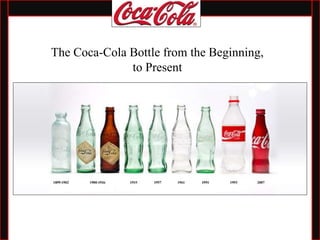
The Coca-Cola Bottle from the Beginning,
to Present
Vision Statement
Existing vision:
Be the outstanding beverage company leading the market,
inspiring people, adding value through excellence.
Proposed vision:
• We are dedicated to upholding standards, while maintaining the leadership
position in the beverages category when delivering superior customer
service in a highly efficient and profitable manner.
Mission Statement
Existing:
Be the outstanding beverage company leading the market, inspiring
people, adding value through excellence.
Proposed:
Our mission is to bring consumers quality refreshments that anticipate and
satisfy their desires and needs Through modern technology and inspiring
employees to be the best they can be we know we can continue to provide the
best products on the market.
Our Goals
People and Organizational Leadership
• Commercial Leadership
• Supply Chain
• Operational Excellence
• Sustainability
Porter's five forces
1.Threat of new entrants
2. Rivalry among existing competitors
3. The bargaining power of buyers
4. The bargaining power of suppliers
5. Threat of substitute product
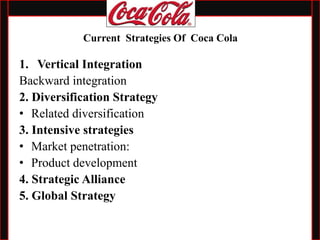
1. Vertical Integration
Backward integration
2. Diversification Strategy
• Related diversification
3. Intensive strategies
• Market penetration:
• Product development
4. Strategic Alliance
5. Global Strategy
Current Strategies Of Coca Cola
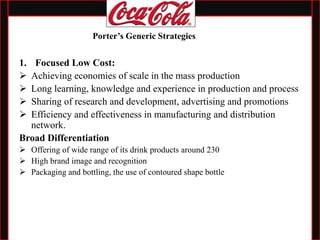
1. Focused Low Cost:
 Achieving economies of scale in the mass production
 Long learning, knowledge and experience in production and process
 Sharing of research and development, advertising and promotions
 Efficiency and effectiveness in manufacturing and distribution
network.
Broad Differentiation
 Offering of wide range of its drink products around 230
 High brand image and recognition
 Packaging and bottling, the use of contoured shape bottle
Porter’s Generic Strategies
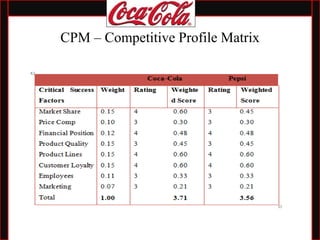
CPM – Competitive Profile Matrix
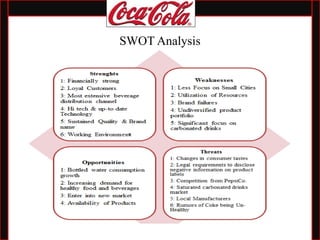
SWOT Analysis
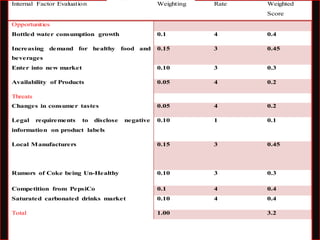
Internal Factor Evaluation Weighting Rate Weighted
Score
Opportunities
Bottled water consumption growth 0.1 4 0.4
Increasing demand for healthy food and
beverages
0.15 3 0.45
Enter into new market 0.10 3 0.3
Availability of Products 0.05 4 0.2
Threats
Changes in consumer tastes 0.05 4 0.2
Legal requirements to disclose negative
information on product labels
0.10 1 0.1
Local Manufacturers 0.15 3 0.45
Rumors of Coke being Un-Healthy 0.10 3 0.3
Competition from PepsiCo 0.1 4 0.4
Saturated carbonated drinks market 0.10 4 0.4
Total 1.00 3.2
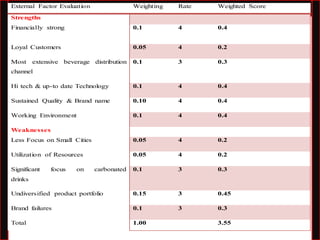
External Factor Evaluation Weighting Rate Weighted Score
Strengths
Financially strong 0.1 4 0.4
Loyal Customers 0.05 4 0.2
Most extensive beverage distribution
channel
0.1 3 0.3
Hi tech & up-to date Technology 0.1 4 0.4
Sustained Quality & Brand name 0.10 4 0.4
Working Environment 0.1 4 0.4
Weaknesses
Less Focus on Small Cities 0.05 4 0.2
Utilization of Resources 0.05 4 0.2
Significant focus on carbonated
drinks
0.1 3 0.3
Undiversified product portfolio 0.15 3 0.45
Brand failures 0.1 3 0.3
Total 1.00 3.55
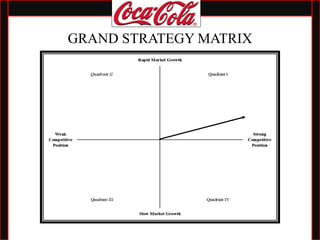
GRAND STRATEGY MATRIX
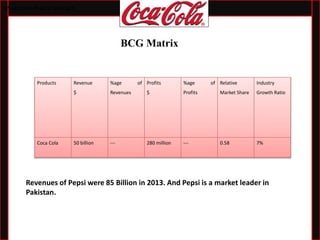
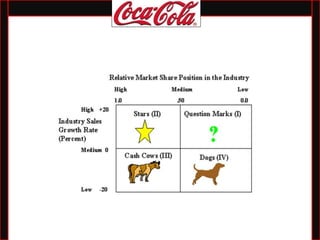
BCG Matrix
Revenues of Pepsi were 85 Billion in 2013. And Pepsi is a market leader in
Pakistan.
Products Revenue
$
%age of
Revenues
Profits
$
%age of
Profits
Relative
Market Share
Industry
Growth Ratio
Coca Cola 50 billion --- 280 million --- 0.58 7%
ANALYSIS ON BCG MATRIX
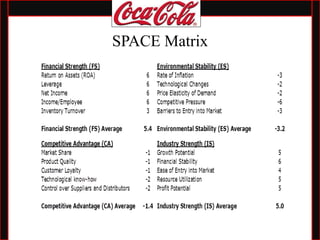
SPACE Matrix
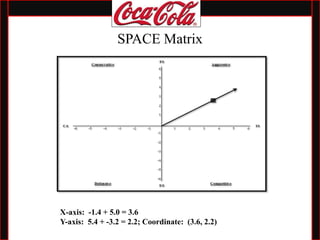
SPACE Matrix
X-axis: -1.4 + 5.0 = 3.6
Y-axis: 5.4 + -3.2 = 2.2; Coordinate: (3.6, 2.2)
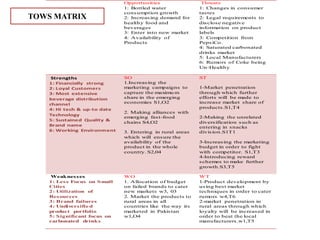
Opportunities
1: Bottled water
consumption growth
2: Increasing demand for
healthy food and
beverages
3: Enter into new market
4: Availability of
Products
Threats
1: Changes in consumer
tastes
2: Legal requirements to
disclose negative
information on product
labels
3: Competition from
PepsiCo.
4: Saturated carbonated
drinks market
5: Local Manufacturers
6: Rumors of Coke being
Un-Healthy
Strengths
1: Financially strong
2: Loyal Customers
3: Most extensive
beverage distribution
channel
4: Hi tech & up-to date
Technology
5: Sustained Quality &
Brand name
6: Working Environment
SO
1.Increasing the
marketing campaigns to
capture the maximu m
share in the emerging
economies S1,O2
2. Making alliances with
emerging fast-food
chains S4,O2
3. Entering in rural areas
which will ensure the
availability of the
product in the whole
country. S2,04
ST
1-Market penetration
through which further
efforts will be made to
increase market share of
products.S1,T4
2-Making the unrelated
diversification such as
entering in snacks
division.S1T1
3-Increasing the marketing
budget in order to fight
with competitor. S1,T3
4-Introducing reward
schemes to make further
growth.S3,T5
Weaknesses
1: Less Focus on Small
Cities
2: Utilization of
Resources
3: Brand failures
4: Undiversified
product portfolio
5: Significant focus on
carbonated drinks
WO
1. Allocation of budget
on failed brands to cater
new markets w3, 03
2. Market the products to
rural areas in all
countries like the way its
marketed in Pakistan
w1,O4
WT
1-Product development by
using best market
techniques in order to cater
rumors w4,T6
2-market penetration in
rural areas through which
loyalty will be increased in
order to beat the local
manufacturers.w1,T5
TOWS MATRIX
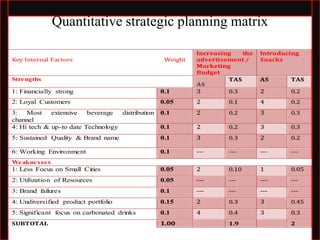
Quantitative strategic planning matrix
Key Internal Factors Weight
Increasing the
advertisement /
Marketing
Budget
Introducing
Snacks
Strengths
AS
TAS AS TAS
1: Financially strong 0.1 3 0.3 2 0.2
2: Loyal Customers 0.05 2 0.1 4 0.2
3: Most extensive beverage distribution
channel
0.1 2 0.2 3 0.3
4: Hi tech & up-to date Technology 0.1 2 0.2 3 0.3
5: Sustained Quality & Brand name 0.1 3 0.3 2 0.2
6: Working Environment 0.1 --- --- --- ---
Weaknesses
1: Less Focus on Small Cities 0.05 2 0.10 1 0.05
2: Utilization of Resources 0.05 --- --- --- ---
3: Brand failures 0.1 --- --- --- ---
4: Undiversified product portfolio 0.15 2 0.3 3 0.45
5: Significant focus on carbonated drinks 0.1 4 0.4 3 0.3
SUBTOTAL 1.00 1.9 2
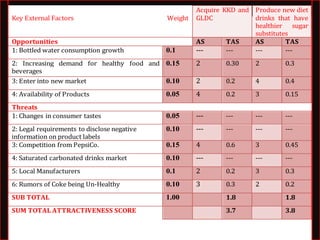
Key External Factors Weight
Acquire KKD and
GLDC
Produce new diet
drinks that have
healthier sugar
substitutes
Opportunities AS TAS AS TAS
1: Bottled water consumption growth 0.1 --- --- --- ---
2: Increasing demand for healthy food and
beverages
0.15 2 0.30 2 0.3
3: Enter into new market 0.10 2 0.2 4 0.4
4: Availability of Products 0.05 4 0.2 3 0.15
Threats
1: Changes in consumer tastes 0.05 --- --- --- ---
2: Legal requirements to disclose negative
information on product labels
0.10 --- --- --- ---
3: Competition from PepsiCo. 0.15 4 0.6 3 0.45
4: Saturated carbonated drinks market 0.10 --- --- --- ---
5: Local Manufacturers 0.1 2 0.2 3 0.3
6: Rumors of Coke being Un-Healthy 0.10 3 0.3 2 0.2
SUB TOTAL 1.00 1.8 1.8
SUM TOTAL ATTRACTIVENESS SCORE 3.7 3.8
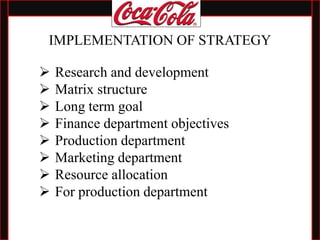
IMPLEMENTATION OF STRATEGY
 Research and development
 Matrix structure
 Long term goal
 Finance department objectives
 Production department
 Marketing department
 Resource allocation
 For production department
Conclusion
Slides final

Slides final

  • 1.
  • 2.
    PRESENTED BY: MAHA SADDIQUE SAADALI HASINA SADIQ ASAD SIDDIQUE ANAM MUSTAFA
  • 3.
    Overview 1. Company Overview A brief history about Coca Cola  Existing Mission and Vision Statement  Existing Objectives and Strategies  New Mission and Vision Statement 2. External Audit  Industry Analysis  Current Opportunities and Threats  CPM Matrix  EFE Matrix 3. Internal Assessment  Strengths and Weaknesses  IFE Matrix 4. Strategy Formation  SWOT matrix  Space Matrix  BCG Matrix  Grand Strategy Matrix  Matrix Analysis  QSPM Matrix 5. Strategic Plan for the Future  Strategies 6. Implementation
  • 4.
    The Coca-Cola Bottlefrom the Beginning, to Present
  • 5.
    Vision Statement Existing vision: Bethe outstanding beverage company leading the market, inspiring people, adding value through excellence. Proposed vision: • We are dedicated to upholding standards, while maintaining the leadership position in the beverages category when delivering superior customer service in a highly efficient and profitable manner.
  • 6.
    Mission Statement Existing: Be theoutstanding beverage company leading the market, inspiring people, adding value through excellence. Proposed: Our mission is to bring consumers quality refreshments that anticipate and satisfy their desires and needs Through modern technology and inspiring employees to be the best they can be we know we can continue to provide the best products on the market.
  • 7.
    Our Goals People andOrganizational Leadership • Commercial Leadership • Supply Chain • Operational Excellence • Sustainability
  • 8.
    Porter's five forces 1.Threatof new entrants 2. Rivalry among existing competitors 3. The bargaining power of buyers 4. The bargaining power of suppliers 5. Threat of substitute product
  • 9.
    1. Vertical Integration Backwardintegration 2. Diversification Strategy • Related diversification 3. Intensive strategies • Market penetration: • Product development 4. Strategic Alliance 5. Global Strategy Current Strategies Of Coca Cola
  • 10.
    1. Focused LowCost:  Achieving economies of scale in the mass production  Long learning, knowledge and experience in production and process  Sharing of research and development, advertising and promotions  Efficiency and effectiveness in manufacturing and distribution network. Broad Differentiation  Offering of wide range of its drink products around 230  High brand image and recognition  Packaging and bottling, the use of contoured shape bottle Porter’s Generic Strategies
  • 11.
    CPM – CompetitiveProfile Matrix
  • 12.
  • 13.
    Internal Factor EvaluationWeighting Rate Weighted Score Opportunities Bottled water consumption growth 0.1 4 0.4 Increasing demand for healthy food and beverages 0.15 3 0.45 Enter into new market 0.10 3 0.3 Availability of Products 0.05 4 0.2 Threats Changes in consumer tastes 0.05 4 0.2 Legal requirements to disclose negative information on product labels 0.10 1 0.1 Local Manufacturers 0.15 3 0.45 Rumors of Coke being Un-Healthy 0.10 3 0.3 Competition from PepsiCo 0.1 4 0.4 Saturated carbonated drinks market 0.10 4 0.4 Total 1.00 3.2
  • 14.
    External Factor EvaluationWeighting Rate Weighted Score Strengths Financially strong 0.1 4 0.4 Loyal Customers 0.05 4 0.2 Most extensive beverage distribution channel 0.1 3 0.3 Hi tech & up-to date Technology 0.1 4 0.4 Sustained Quality & Brand name 0.10 4 0.4 Working Environment 0.1 4 0.4 Weaknesses Less Focus on Small Cities 0.05 4 0.2 Utilization of Resources 0.05 4 0.2 Significant focus on carbonated drinks 0.1 3 0.3 Undiversified product portfolio 0.15 3 0.45 Brand failures 0.1 3 0.3 Total 1.00 3.55
  • 15.
  • 16.
    BCG Matrix Revenues ofPepsi were 85 Billion in 2013. And Pepsi is a market leader in Pakistan. Products Revenue $ %age of Revenues Profits $ %age of Profits Relative Market Share Industry Growth Ratio Coca Cola 50 billion --- 280 million --- 0.58 7% ANALYSIS ON BCG MATRIX
  • 18.
  • 19.
    SPACE Matrix X-axis: -1.4+ 5.0 = 3.6 Y-axis: 5.4 + -3.2 = 2.2; Coordinate: (3.6, 2.2)
  • 20.
    Opportunities 1: Bottled water consumptiongrowth 2: Increasing demand for healthy food and beverages 3: Enter into new market 4: Availability of Products Threats 1: Changes in consumer tastes 2: Legal requirements to disclose negative information on product labels 3: Competition from PepsiCo. 4: Saturated carbonated drinks market 5: Local Manufacturers 6: Rumors of Coke being Un-Healthy Strengths 1: Financially strong 2: Loyal Customers 3: Most extensive beverage distribution channel 4: Hi tech & up-to date Technology 5: Sustained Quality & Brand name 6: Working Environment SO 1.Increasing the marketing campaigns to capture the maximu m share in the emerging economies S1,O2 2. Making alliances with emerging fast-food chains S4,O2 3. Entering in rural areas which will ensure the availability of the product in the whole country. S2,04 ST 1-Market penetration through which further efforts will be made to increase market share of products.S1,T4 2-Making the unrelated diversification such as entering in snacks division.S1T1 3-Increasing the marketing budget in order to fight with competitor. S1,T3 4-Introducing reward schemes to make further growth.S3,T5 Weaknesses 1: Less Focus on Small Cities 2: Utilization of Resources 3: Brand failures 4: Undiversified product portfolio 5: Significant focus on carbonated drinks WO 1. Allocation of budget on failed brands to cater new markets w3, 03 2. Market the products to rural areas in all countries like the way its marketed in Pakistan w1,O4 WT 1-Product development by using best market techniques in order to cater rumors w4,T6 2-market penetration in rural areas through which loyalty will be increased in order to beat the local manufacturers.w1,T5 TOWS MATRIX
  • 21.
    Quantitative strategic planningmatrix Key Internal Factors Weight Increasing the advertisement / Marketing Budget Introducing Snacks Strengths AS TAS AS TAS 1: Financially strong 0.1 3 0.3 2 0.2 2: Loyal Customers 0.05 2 0.1 4 0.2 3: Most extensive beverage distribution channel 0.1 2 0.2 3 0.3 4: Hi tech & up-to date Technology 0.1 2 0.2 3 0.3 5: Sustained Quality & Brand name 0.1 3 0.3 2 0.2 6: Working Environment 0.1 --- --- --- --- Weaknesses 1: Less Focus on Small Cities 0.05 2 0.10 1 0.05 2: Utilization of Resources 0.05 --- --- --- --- 3: Brand failures 0.1 --- --- --- --- 4: Undiversified product portfolio 0.15 2 0.3 3 0.45 5: Significant focus on carbonated drinks 0.1 4 0.4 3 0.3 SUBTOTAL 1.00 1.9 2
  • 22.
    Key External FactorsWeight Acquire KKD and GLDC Produce new diet drinks that have healthier sugar substitutes Opportunities AS TAS AS TAS 1: Bottled water consumption growth 0.1 --- --- --- --- 2: Increasing demand for healthy food and beverages 0.15 2 0.30 2 0.3 3: Enter into new market 0.10 2 0.2 4 0.4 4: Availability of Products 0.05 4 0.2 3 0.15 Threats 1: Changes in consumer tastes 0.05 --- --- --- --- 2: Legal requirements to disclose negative information on product labels 0.10 --- --- --- --- 3: Competition from PepsiCo. 0.15 4 0.6 3 0.45 4: Saturated carbonated drinks market 0.10 --- --- --- --- 5: Local Manufacturers 0.1 2 0.2 3 0.3 6: Rumors of Coke being Un-Healthy 0.10 3 0.3 2 0.2 SUB TOTAL 1.00 1.8 1.8 SUM TOTAL ATTRACTIVENESS SCORE 3.7 3.8
  • 23.
    IMPLEMENTATION OF STRATEGY Research and development  Matrix structure  Long term goal  Finance department objectives  Production department  Marketing department  Resource allocation  For production department
  • 24.

Editor's Notes

  • #4 Change this slide according to finishing of powerpoint