We are grateful to Ma’am Samia Sundus for giving us such
Opportunity to polish our skills towards marketing management.
About company
Objective
Values
Executive Summary
Marketing Policy principles
Situational analysis
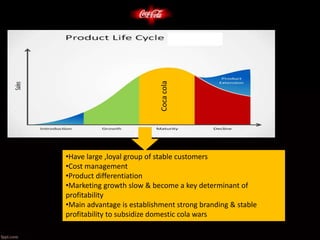
Product life cycle
Marketing Objective
Target market
Marketing Mix
Pricing method
Market Analysis
S.w.o.t Analysis
Pests Analysis
Mission
Vision
Content
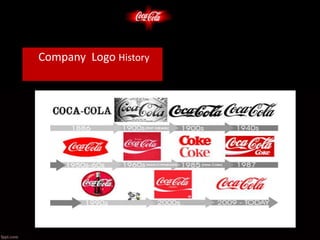
Logo history
Logo color
meaning
Company
history
Company
profile
Company Logo History
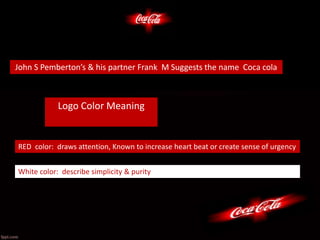
Logo Color Meaning
RED color: draws attention, Known to increase heart beat or create sense of urgency
White color: describe simplicity & purity
John S Pemberton’s & his partner Frank M Suggests the name Coca cola
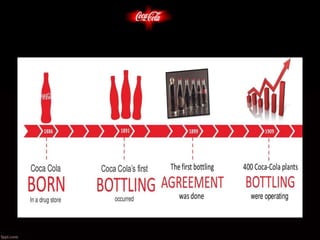
In 1886 ,Coca cola invented by Pharmacist name John pemberton
Jacobs’ pharmacy , caramel colored combined mixture with
carbohydrate water and put it on sale
Lets look company history in a interesting a way……………..next slides
History
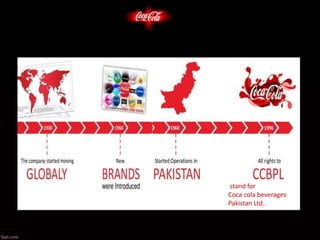
stand for
Coca cola beverages
Pakistan Ltd..
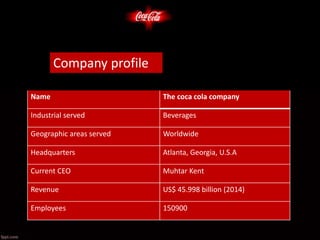
Name The coca cola company
Industrial served Beverages
Geographic areas served Worldwide
Headquarters Atlanta, Georgia, U.S.A
Current CEO Muhtar Kent
Revenue US$ 45.998 billion (2014)
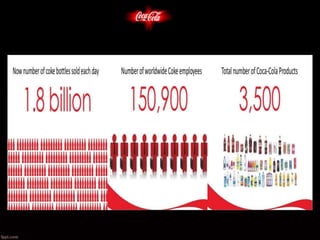
Employees 150900
Company profile
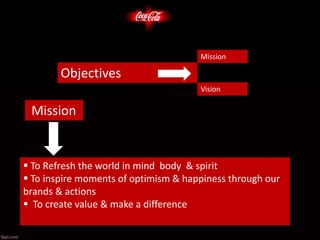
Mission
 To Refresh the world in mind body & spirit
 To inspire moments of optimism & happiness through our
brands & actions
 To create value & make a difference
Objectives
Mission
Vision
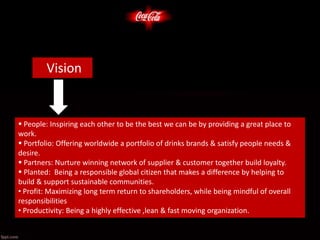
Vision
 People: Inspiring each other to be the best we can be by providing a great place to
work.
 Portfolio: Offering worldwide a portfolio of drinks brands & satisfy people needs &
desire.
 Partners: Nurture winning network of supplier & customer together build loyalty.
 Planted: Being a responsible global citizen that makes a difference by helping to
build & support sustainable communities.
• Profit: Maximizing long term return to shareholders, while being mindful of overall
responsibilities
• Productivity: Being a highly effective ,lean & fast moving organization.
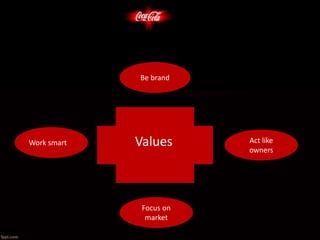
ValuesWork smart
Focus on
market
Be brand
Act like
owners
Executive summary
 Doubling the revenues by 2020w
 Making a positive difference between communities
Company as a responsible citizen
a) Sustainable water use & packing
b) Climate protection
 Lift the corporate brand Image
 Connect with global middle class by creating new products &
packaging formats for all life styles & occasions
 Choice: Provide a range of products for making choices to suitable diets
and active life styles .
 Balance : Encourage sensible consumption & moderation.
 Honesty: Endurance in all marketing & sales activity.
 No marketing to children: under 12 no any product marketed to
children.
Marketing policy principle
• Feature 1
• Feature 2
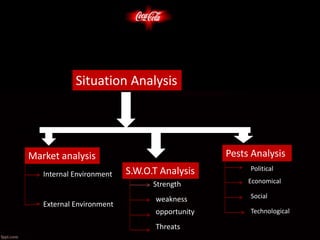
• Feature 3 S.W.O.T Analysis
Pests AnalysisMarket analysis
Internal Environment
External Environment
Strength
weakness
opportunity
Threats
Political
Economical
Social
Technological
Situation Analysis
Internal Environment :
External Environment
Offers efficiency in the production process, by using its
Personnel management skills & proper communication
channels & avoid inefficiencies in any phase of
production line.
Can effects the whole company as it is consist of powerful
forces which can bring changes that create opportunity &
threats in market place. Company must be aware of
fluctuations in the economy, changing customer attitude &
value.
Market Analysis
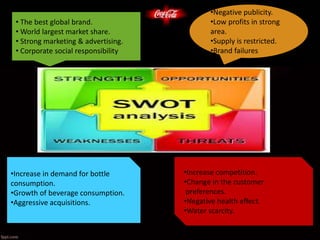
• The best global brand.
• World largest market share.
• Strong marketing & advertising.
• Corporate social responsibility
•Negative publicity.
•Low profits in strong
area.
•Supply is restricted.
•Brand failures
•Increase in demand for bottle
consumption.
•Growth of beverage consumption.
•Aggressive acquisitions.
•Increase competition.
•Change in the customer
preferences.
•Negative health effect.
•Water scarcity.
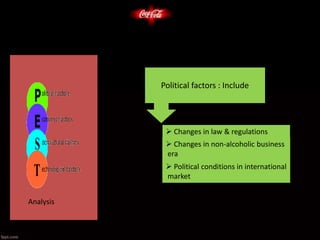
 Changes in non-alcoholic business
era
 Changes in law & regulations
Analysis
Political factors : Include
 Political conditions in international
market
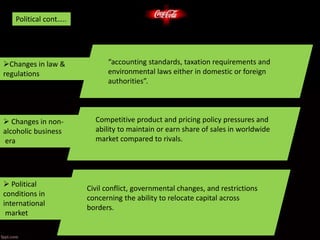
Changes in law &
regulations
“accounting standards, taxation requirements and
environmental laws either in domestic or foreign
authorities”.
Political cont…..
 Changes in non-
alcoholic business
era
Competitive product and pricing policy pressures and
ability to maintain or earn share of sales in worldwide
market compared to rivals.
•Competitive product and pricing policy pressures and ability to maintain or earn share of sales in worldwide market compared to rivals.•Competitive product and pricing policy pressures and ability to maintain or earn share of sales in worldwide market compared to rivals.•: Competitive product and pricing policy pressures and ability to maintain or earn share of sales in worldwide market compared to rivals.•: Competitive product and pricing policy pressures and ability to maintain or earn share of sales in worldwide market compared to rivals.•: Competitive product and pricing policy pressures and ability to maintain or earn share of sales in worldwide market compared to rivals.•Competitive product and pricing policy pressures and ability to maintain or earn share of sales in worldwide market compared to rivals.•Competitive product and pricing policy pressures and ability to maintain or earn share of sales in worldwide market compared to rivals.•Competitive product and pricing policy pressures and ability to maintain or earn share of sales in worldwide market compared to rivals.•Competitive product and pricing policy pressures and ability to maintain or earn share of sales in worldwide market compared to rivals.•Competitive product and pricing policy pressures and ability to maintain or earn share of sales in worldwide market compared to rivals.
 Political
conditions in
international
market
Civil conflict, governmental changes, and restrictions
concerning the ability to relocate capital across
borders.
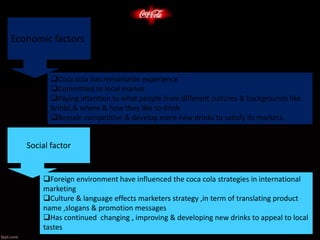
Economic factors
Coca cola has remarkable experience
Committed to local market
Paying attention to what people from different cultures & backgrounds like
brinks,& where & how they like to drink
Remain competitive & develop more new drinks to satisfy its markets.
Social factor
Foreign environment have influenced the coca cola strategies in international
marketing
Culture & language effects marketers strategy ,in term of translating product
name ,slogans & promotion messages
Has continued changing , improving & developing new drinks to appeal to local
tastes
Social contn…
Like after discovering coke did not appeal much in Japanese consumers,
develop over 30 new drinks are Asian tea, coffee & fermented milk.
Similarly in china ,coke launched fruit juice drinks ice tea & soy milk drink.
Technology factors
 It plays vital role for advertising company's products.
Internet & television uses for advertising through media, it help in
selling products & advertising makes products attractive.
Due to advance technology uses in machineries , production has
tremendously increased.
•Have large ,loyal group of stable customers
•Cost management
•Product differentiation
•Marketing growth slow & become a key determinant of
profitability
•Main advantage is establishment strong branding & stable
profitability to subsidize domestic cola wars
Cocacola
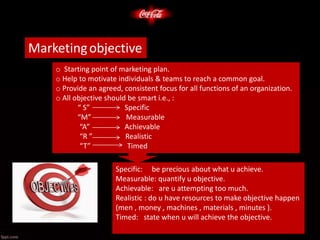
Marketingobjective
o Starting point of marketing plan.
o Help to motivate individuals & teams to reach a common goal.
o Provide an agreed, consistent focus for all functions of an organization.
o All objective should be smart i.e., :
“ S” Specific
“M” Measurable
“A” Achievable
“R ” Realistic
“T” Timed
Specific: be precious about what u achieve.
Measurable: quantify u objective.
Achievable: are u attempting too much.
Realistic : do u have resources to make objective happen
(men , money , machines , materials , minutes ).
Timed: state when u will achieve the objective.
Promotional Objectives: To increase awareness of the product on the market.
Objectives for Survival: To survive the current market war between competitors.
7.
Objectives for Growth: To increase the size of the worldwide Coca Cola
enterprise by 10%.
etermined, attention turns to the target market.determined, attention turns to the target market.
Coca cola objectives
Market Share Objectives: To gain 60% of the market for soft drinks industry by
September 2007.
Profitability Objectives: To achieve a 20% return on capital employed by August
2007
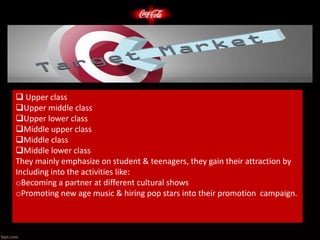
 Upper class
Upper middle class
Upper lower class
Middle upper class
Middle class
Middle lower class
They mainly emphasize on student & teenagers, they gain their attraction by
Including into the activities like:
oBecoming a partner at different cultural shows
oPromoting new age music & hiring pop stars into their promotion campaign.
Positioning
Coca cola adopts various advertising & promotional
strategies to create an increased demand in market by
associating with life style & behavior & mainly targeting
value based advertising.
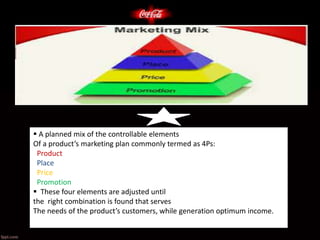
 A planned mix of the controllable elements
Of a product’s marketing plan commonly termed as 4Ps:
Product
Place
Price
Promotion
 These four elements are adjusted until
the right combination is found that serves
The needs of the product’s customers, while generation optimum income.
Product
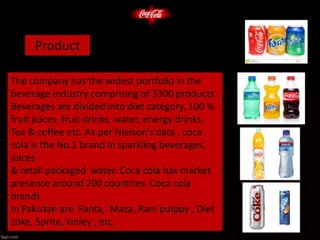
The company has the widest portfolio in the
beverage industry comprising of 3300 products .
Beverages are divided into diet category, 100 %
fruit juices, fruit drinks, water, energy drinks,
Tea & coffee etc. As per Nielson’s data , coca
cola is the No.1 brand in sparkling beverages,
juices
& retail packaged water. Coca cola has market
presence around 200 countries. Coca cola
brands
In Pakistan are Fanta, Maza, Rani pulppy , Diet
coke, Sprite, kinley , etc.
Place
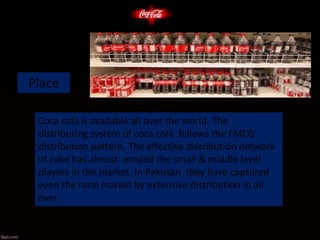
Coca cola is available all over the world. The
distributing system of coca cola follows the FMCG
distribution pattern. The effective distribution network
of coke has almost eroded the small & middle level
players in the market. In Pakistan they have captured
even the rural market by extensive distribution in all
over.
Price
Due to the availability of range products the
pricing is done according to the market &
geographic segment. Each sub-brand of coca cola
has a different pricing strategy. Their pricing
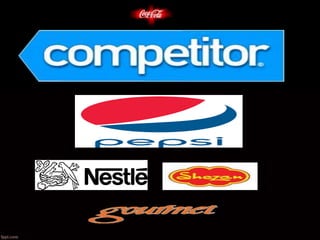
strategy is based on the competitor to coke. Pepsi
is the direct competitor to coke. Beverage market
is said to be a oligopoly market (few sellers & large
buyers), hence they form into cartel contract to
ensure a mutual balance in pricing between the
sellers.
Promotion
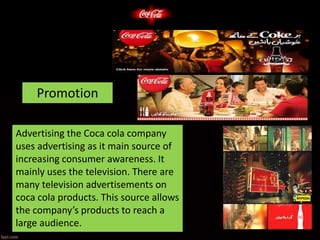
Advertising the Coca cola company
uses advertising as it main source of
increasing consumer awareness. It
mainly uses the television. There are
many television advertisements on
coca cola products. This source allows
the company’s products to reach a
large audience.
coca cola markting project

coca cola markting project

  • 2.
    We are gratefulto Ma’am Samia Sundus for giving us such Opportunity to polish our skills towards marketing management.
  • 5.
    About company Objective Values Executive Summary MarketingPolicy principles Situational analysis Product life cycle Marketing Objective Target market Marketing Mix Pricing method Market Analysis S.w.o.t Analysis Pests Analysis Mission Vision Content
  • 6.
  • 7.
  • 8.
    Logo Color Meaning REDcolor: draws attention, Known to increase heart beat or create sense of urgency White color: describe simplicity & purity John S Pemberton’s & his partner Frank M Suggests the name Coca cola
  • 9.
    In 1886 ,Cocacola invented by Pharmacist name John pemberton Jacobs’ pharmacy , caramel colored combined mixture with carbohydrate water and put it on sale Lets look company history in a interesting a way……………..next slides History
  • 12.
    stand for Coca colabeverages Pakistan Ltd..
  • 16.
    Name The cocacola company Industrial served Beverages Geographic areas served Worldwide Headquarters Atlanta, Georgia, U.S.A Current CEO Muhtar Kent Revenue US$ 45.998 billion (2014) Employees 150900 Company profile
  • 17.
    Mission  To Refreshthe world in mind body & spirit  To inspire moments of optimism & happiness through our brands & actions  To create value & make a difference Objectives Mission Vision
  • 18.
    Vision  People: Inspiringeach other to be the best we can be by providing a great place to work.  Portfolio: Offering worldwide a portfolio of drinks brands & satisfy people needs & desire.  Partners: Nurture winning network of supplier & customer together build loyalty.  Planted: Being a responsible global citizen that makes a difference by helping to build & support sustainable communities. • Profit: Maximizing long term return to shareholders, while being mindful of overall responsibilities • Productivity: Being a highly effective ,lean & fast moving organization.
  • 19.
  • 20.
    Executive summary  Doublingthe revenues by 2020w  Making a positive difference between communities Company as a responsible citizen a) Sustainable water use & packing b) Climate protection  Lift the corporate brand Image  Connect with global middle class by creating new products & packaging formats for all life styles & occasions
  • 21.
     Choice: Providea range of products for making choices to suitable diets and active life styles .  Balance : Encourage sensible consumption & moderation.  Honesty: Endurance in all marketing & sales activity.  No marketing to children: under 12 no any product marketed to children. Marketing policy principle
  • 22.
    • Feature 1 •Feature 2 • Feature 3 S.W.O.T Analysis Pests AnalysisMarket analysis Internal Environment External Environment Strength weakness opportunity Threats Political Economical Social Technological Situation Analysis
  • 23.
    Internal Environment : ExternalEnvironment Offers efficiency in the production process, by using its Personnel management skills & proper communication channels & avoid inefficiencies in any phase of production line. Can effects the whole company as it is consist of powerful forces which can bring changes that create opportunity & threats in market place. Company must be aware of fluctuations in the economy, changing customer attitude & value. Market Analysis
  • 24.
    • The bestglobal brand. • World largest market share. • Strong marketing & advertising. • Corporate social responsibility •Negative publicity. •Low profits in strong area. •Supply is restricted. •Brand failures •Increase in demand for bottle consumption. •Growth of beverage consumption. •Aggressive acquisitions. •Increase competition. •Change in the customer preferences. •Negative health effect. •Water scarcity.
  • 25.
     Changes innon-alcoholic business era  Changes in law & regulations Analysis Political factors : Include  Political conditions in international market
  • 26.
    Changes in law& regulations “accounting standards, taxation requirements and environmental laws either in domestic or foreign authorities”. Political cont…..  Changes in non- alcoholic business era Competitive product and pricing policy pressures and ability to maintain or earn share of sales in worldwide market compared to rivals. •Competitive product and pricing policy pressures and ability to maintain or earn share of sales in worldwide market compared to rivals.•Competitive product and pricing policy pressures and ability to maintain or earn share of sales in worldwide market compared to rivals.•: Competitive product and pricing policy pressures and ability to maintain or earn share of sales in worldwide market compared to rivals.•: Competitive product and pricing policy pressures and ability to maintain or earn share of sales in worldwide market compared to rivals.•: Competitive product and pricing policy pressures and ability to maintain or earn share of sales in worldwide market compared to rivals.•Competitive product and pricing policy pressures and ability to maintain or earn share of sales in worldwide market compared to rivals.•Competitive product and pricing policy pressures and ability to maintain or earn share of sales in worldwide market compared to rivals.•Competitive product and pricing policy pressures and ability to maintain or earn share of sales in worldwide market compared to rivals.•Competitive product and pricing policy pressures and ability to maintain or earn share of sales in worldwide market compared to rivals.•Competitive product and pricing policy pressures and ability to maintain or earn share of sales in worldwide market compared to rivals.  Political conditions in international market Civil conflict, governmental changes, and restrictions concerning the ability to relocate capital across borders.
  • 27.
    Economic factors Coca colahas remarkable experience Committed to local market Paying attention to what people from different cultures & backgrounds like brinks,& where & how they like to drink Remain competitive & develop more new drinks to satisfy its markets. Social factor Foreign environment have influenced the coca cola strategies in international marketing Culture & language effects marketers strategy ,in term of translating product name ,slogans & promotion messages Has continued changing , improving & developing new drinks to appeal to local tastes
  • 28.
    Social contn… Like afterdiscovering coke did not appeal much in Japanese consumers, develop over 30 new drinks are Asian tea, coffee & fermented milk. Similarly in china ,coke launched fruit juice drinks ice tea & soy milk drink. Technology factors  It plays vital role for advertising company's products. Internet & television uses for advertising through media, it help in selling products & advertising makes products attractive. Due to advance technology uses in machineries , production has tremendously increased.
  • 29.
    •Have large ,loyalgroup of stable customers •Cost management •Product differentiation •Marketing growth slow & become a key determinant of profitability •Main advantage is establishment strong branding & stable profitability to subsidize domestic cola wars Cocacola
  • 30.
    Marketingobjective o Starting pointof marketing plan. o Help to motivate individuals & teams to reach a common goal. o Provide an agreed, consistent focus for all functions of an organization. o All objective should be smart i.e., : “ S” Specific “M” Measurable “A” Achievable “R ” Realistic “T” Timed Specific: be precious about what u achieve. Measurable: quantify u objective. Achievable: are u attempting too much. Realistic : do u have resources to make objective happen (men , money , machines , materials , minutes ). Timed: state when u will achieve the objective.
  • 31.
    Promotional Objectives: Toincrease awareness of the product on the market. Objectives for Survival: To survive the current market war between competitors. 7. Objectives for Growth: To increase the size of the worldwide Coca Cola enterprise by 10%. etermined, attention turns to the target market.determined, attention turns to the target market. Coca cola objectives Market Share Objectives: To gain 60% of the market for soft drinks industry by September 2007. Profitability Objectives: To achieve a 20% return on capital employed by August 2007
  • 32.
     Upper class Uppermiddle class Upper lower class Middle upper class Middle class Middle lower class They mainly emphasize on student & teenagers, they gain their attraction by Including into the activities like: oBecoming a partner at different cultural shows oPromoting new age music & hiring pop stars into their promotion campaign.
  • 34.
    Positioning Coca cola adoptsvarious advertising & promotional strategies to create an increased demand in market by associating with life style & behavior & mainly targeting value based advertising.
  • 35.
     A plannedmix of the controllable elements Of a product’s marketing plan commonly termed as 4Ps: Product Place Price Promotion  These four elements are adjusted until the right combination is found that serves The needs of the product’s customers, while generation optimum income.
  • 36.
    Product The company hasthe widest portfolio in the beverage industry comprising of 3300 products . Beverages are divided into diet category, 100 % fruit juices, fruit drinks, water, energy drinks, Tea & coffee etc. As per Nielson’s data , coca cola is the No.1 brand in sparkling beverages, juices & retail packaged water. Coca cola has market presence around 200 countries. Coca cola brands In Pakistan are Fanta, Maza, Rani pulppy , Diet coke, Sprite, kinley , etc.
  • 37.
    Place Coca cola isavailable all over the world. The distributing system of coca cola follows the FMCG distribution pattern. The effective distribution network of coke has almost eroded the small & middle level players in the market. In Pakistan they have captured even the rural market by extensive distribution in all over.
  • 38.
    Price Due to theavailability of range products the pricing is done according to the market & geographic segment. Each sub-brand of coca cola has a different pricing strategy. Their pricing strategy is based on the competitor to coke. Pepsi is the direct competitor to coke. Beverage market is said to be a oligopoly market (few sellers & large buyers), hence they form into cartel contract to ensure a mutual balance in pricing between the sellers.
  • 39.
    Promotion Advertising the Cocacola company uses advertising as it main source of increasing consumer awareness. It mainly uses the television. There are many television advertisements on coca cola products. This source allows the company’s products to reach a large audience.