Sleep and Wakefulness
Chapter 8
Reporters
Janna Andrea S. Generalo
Iris Mae F. Genigani
Mary Faith P. Gersava
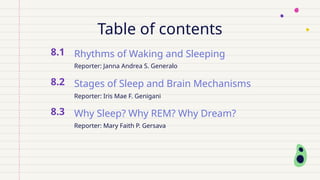
Table of contents
8.1 Rhythms of Waking and Sleeping
8.2 Stages of Sleep and Brain Mechanisms
8.3 Why Sleep? Why REM? Why Dream?
Reporter: Janna Andrea S. Generalo
Reporter: Iris Mae F. Genigani
Reporter: Mary Faith P. Gersava
Rhythms of
Waking and
Sleeping
Module 8.1
Reporter: Janna Andrea S.
Generalo
What help us wake up and fall asleep?
During the mid-1900s, many psychologist
believed that the alternation between
wakefulness and sleep must depend on
something in the outside world, such as changes
in light or temperature.
Meanwhile at the same time, Curt Richter,
implied that the body generates its own cycles of
activity and inactivity.
Endogenous Rhythms
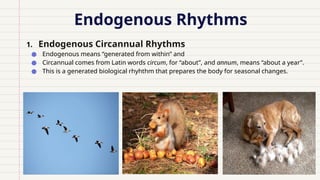
1. Endogenous Circannual Rhythms
● Endogenous means “generated from within” and
● Circannual comes from Latin words circum, for “about”, and annum, means “about a year”.
● This is a generated biological rhyhthm that prepares the body for seasonal changes.
2. Endogenous Circadian Rhythms
● Circadian comes from Latin words circum, for “about”, and dies, For “day.”
● This is a generated biological rhythms that last about a day.
● This is the most common type of rhythms used by people.
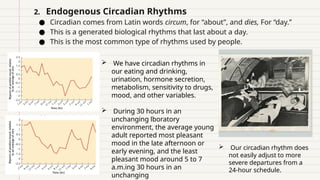
 We have circadian rhythms in
our eating and drinking,
urination, hormone secretion,
metabolism, sensitivity to drugs,
mood, and other variables.
 During 30 hours in an
unchanging lboratory
environment, the average young
adult reported most pleasant
mood in the late afternoon or
early evening, and the least
pleasant mood around 5 to 7
a.m.ing 30 hours in an
unchanging
 Our circadian rhythm does
not easily adjust to more
severe departures from a
24-hour schedule.
Setting and Resetting the Biological
Clock
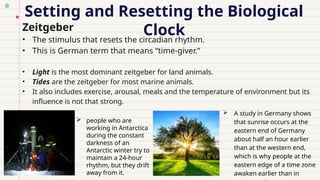
Zeitgeber
• The stimulus that resets the circadian rhythm.
• This is German term that means “time-giver.”
• Light is the most dominant zeitgeber for land animals.
• Tides are the zeitgeber for most marine animals.
• It also includes exercise, arousal, meals and the temperature of environment but its
influence is not that strong.
 A study in Germany shows
that sunrise occurs at the
eastern end of Germany
about half an hour earlier
than at the western end,
which is why people at the
eastern edge of a time zone
awaken earlier than in
 people who are
working in Antarctica
during the constant
darkness of an
Antarctic winter try to
maintain a 24-hour
rhythm, but they drift
away from it.
Disruptions of Circadian Rhythms
1. Jet Lag
• A disruption of circadian rhythms due to crossing time zones.
2. Shift Work
• People who sleep irregularly – find that their duration of sleep depends on
when they go to sleep.
• People adjust best to night work if they sleep in a very dark room during the day and work
under very bright lights at night, comparable to the noonday sun . Short-wavelength
(bluish) light helps to reset the circadian rhythm better than long-wavelength light does.
3. Morning People and Evening People
• Morning people “larks” – awaken early, reach their peak of productivity early
and become less alert later in the day.
• Evening people “owls” – warm up more slowly, reaching their peak in the late
afternoon or evening.
• The tendency for most young people to be evening types causes problems. In many
countries, high school classes start at 8:00 a.m. or earlier. Most teenagers are at least a bit
drowsy at that time, some more than others. Those who are strongly evening types tend
to get lower than average test scores, especially in their morning classes.
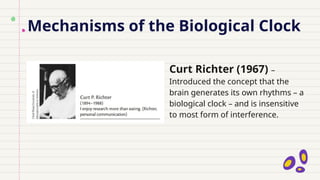
Mechanisms of the Biological Clock
Curt Richter (1967) –
Introduced the concept that the
brain generates its own rhythms – a
biological clock – and is insensitive
to most form of interference.
Mechanisms of the Biological Clock
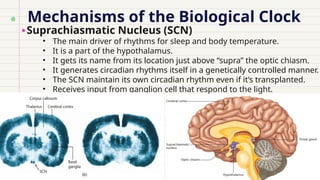
Suprachiasmatic Nucleus (SCN)
• The main driver of rhythms for sleep and body temperature.
• It is a part of the hypothalamus.
• It gets its name from its location just above “supra” the optic chiasm.
• It generates circadian rhythms itself in a genetically controlled manner.
• The SCN maintain its own circadian rhythm even if it’s transplanted.
• Receives input from ganglion cell that respond to the light.
Mechanisms of the Biological Clock
How Light Resets the SCN?
Retinohypothalamic path
• A small branch of the optic nerve, from the retina to the SCN, alters the SCN’s settings.
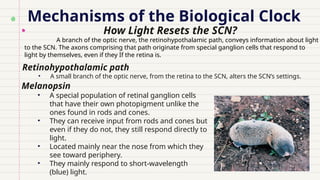
Melanopsin
• A special population of retinal ganglion cells
that have their own photopigment unlike the
ones found in rods and cones.
• They can receive input from rods and cones but
even if they do not, they still respond directly to
light.
• Located mainly near the nose from which they
see toward periphery.
• They mainly respond to short-wavelength
(blue) light.
A branch of the optic nerve, the retinohypothalamic path, conveys information about light
to the SCN. The axons comprising that path originate from special ganglion cells that respond to
light by themselves, even if they If the retina is.
Sleep and Wake Cycle
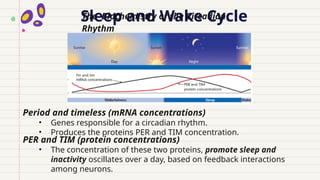
The Biochemistry of the Circadian
Rhythm
Period and timeless (mRNA concentrations)
• Genes responsible for a circadian rhythm.
• Produces the proteins PER and TIM concentration.
PER and TIM (protein concentrations)
• The concentration of these two proteins, promote sleep and
inactivity oscillates over a day, based on feedback interactions
among neurons.
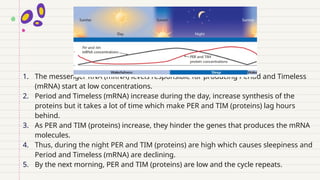
1. The messenger RNA (mRNA) levels responsible for producing Period and Timeless
(mRNA) start at low concentrations.
2. Period and Timeless (mRNA) increase during the day, increase synthesis of the
proteins but it takes a lot of time which make PER and TIM (proteins) lag hours
behind.
3. As PER and TIM (proteins) increase, they hinder the genes that produces the mRNA
molecules.
4. Thus, during the night PER and TIM (proteins) are high which causes sleepiness and
Period and Timeless (mRNA) are declining.
5. By the next morning, PER and TIM (proteins) are low and the cycle repeats.
Sleep and Wake Cycle
Melatonin
• The pineal gland release this hormone melatonin which is a
widespread chemical, found in nearly all animals – except sponges,
plant and bacteria.
• It is released mostly at night.
• Diurnal Animals – it increases sleepiness.
• Nocturnal animals – it is increases wakefulness.
• Also helps control the onset of puberty and bodily adjustments to
changes of season.
• Its secretion starts to increase about 2 or 3 hours before bedtime.
The SCN regulates waking and sleeping by controlling activity
levels in other brain areas , including pineal gland.
Stages of Sleep and
Brain Mechanisms
Module
8.2
Reporter: Iris Mae F. Genigani
Sleep and Other Interruptions of
Concsciousness
1. Sleep
● A state that the brain actively produces, characterized by decreased activity and decreased
response to stimuli.
2. Coma
● An extended period unconsciousness caused by head, trauma, stroke, or disease.
● Low level of brain activity and little or no response to stimuli.
3. Vegetative State
● Alternates between periods of sleep and moderate arousal, although even during the more
aroused state, the person shows no awareness of surroundings and no purposeful behavior.
● Either dies or begins to recover within a few weeks.
● Can last for months or years.
4. Minimally Conscious State
● Brief periods of purposeful actions and a limited amount of speech comprehension.
● Can last for months or years.
5. Brain Death
● No sign of brain activity and no response to any stimulus.
● At which point most people believe it is ethical to remove life support.
The Stages of Sleep
Electroencephalograph (EEG)
• Records an average of the electrical potentials of the cells and fibers in the
brain areas nearest to each electrode on the scalp.
• If half the cells in some area increase their electrical potentials while the other
half decrease, they cancel out. The EEG record rises or falls when most cells do
the same thing at the same time.
Polysomnograph
• A combination of EEG and eye-movement records, for a college
student during various stages of sleep.
Alpha Waves
• characteristic of relaxation and wakefulness.
The Stages of Sleep
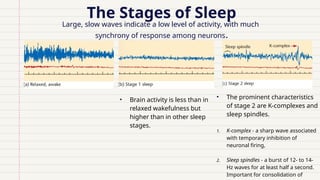
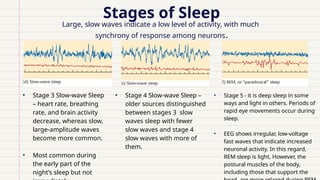
Large, slow waves indicate a low level of activity, with much
synchrony of response among neurons.
• Brain activity is less than in
relaxed wakefulness but
higher than in other sleep
stages.
• The prominent characteristics
of stage 2 are K-complexes and
sleep spindles.
1. K-complex - a sharp wave associated
with temporary inhibition of
neuronal firing,
2. Sleep spindles - a burst of 12- to 14-
Hz waves for at least half a second.
Important for consolidation of
Stages of Sleep
Large, slow waves indicate a low level of activity, with much
synchrony of response among neurons.
• Stage 3 Slow-wave Sleep
– heart rate, breathing
rate, and brain activity
decrease, whereas slow,
large-amplitude waves
become more common.
• Most common during
the early part of the
night’s sleep but not
• Stage 5 - it is deep sleep in some
ways and light in others. Periods of
rapid eye movements occur during
sleep.
• EEG shows irregular, low-voltage
fast waves that indicate increased
neuronal activity. In this regard,
REM sleep is light, However, the
postural muscles of the body,
including those that support the
• Stage 4 Slow-wave Sleep –
older sources distinguished
between stages 3 slow
waves sleep with fewer
slow waves and stage 4
slow waves with more of
them.
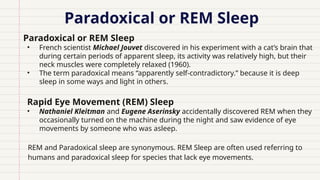
Paradoxical or REM Sleep
• Paradoxical or REM Sleep
• French scientist Michael Jouvet discovered in his experiment with a cat’s brain that
during certain periods of apparent sleep, its activity was relatively high, but their
neck muscles were completely relaxed (1960).
• The term paradoxical means “apparently self-contradictory.” because it is deep
sleep in some ways and light in others.
Rapid Eye Movement (REM) Sleep
• Nathaniel Kleitman and Eugene Aserinsky accidentally discovered REM when they
occasionally turned on the machine during the night and saw evidence of eye
movements by someone who was asleep.
REM and Paradoxical sleep are synonymous. REM Sleep are often used referring to
humans and paradoxical sleep for species that lack eye movements.
REM Sleep
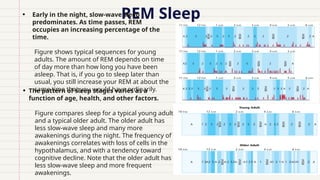
• Early in the night, slow-wave sleep
predominates. As time passes, REM
occupies an increasing percentage of the
time.
• Figure shows typical sequences for young
adults. The amount of REM depends on time
of day more than how long you have been
asleep. That is, if you go to sleep later than
usual, you still increase your REM at about the
same time that you would have ordinarily.
• The pattern of sleep stages varies as a
function of age, health, and other factors.
• Figure compares sleep for a typical young adult
and a typical older adult. The older adult has
less slow-wave sleep and many more
awakenings during the night. The frequency of
awakenings correlates with loss of cells in the
hypothalamus, and with a tendency toward
cognitive decline. Note that the older adult has
less slow-wave sleep and more frequent
awakenings.
Brain Mechanisms
of Wakefulness, Arousal, and Sleep
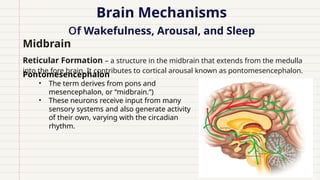
Reticular Formation – a structure in the midbrain that extends from the medulla
into the fore brain. It contributes to cortical arousal known as pontomesencephalon.
Pontomesencephalon
• The term derives from pons and
mesencephalon, or “midbrain.”)
• These neurons receive input from many
sensory systems and also generate activity
of their own, varying with the circadian
rhythm.
Midbrain
Locus Coeruleus “dark blue place”
• A small structure in the pons, is usually inactive, especially during sleep, but it emits bursts of
impulses in response to meaningful events, especially those that produce emotional arousal.
• It increases the activity of the most active neurons and decreases the activity of less active
neurons. The result is enhanced attention to important information and enhanced memory.
Hypothalamus
• releases the excitatory neurotransmitter histamine which enhances arousal and alertness
throughout the brain.
• releases a peptide neurotransmitter called either orexin or hypocretin which enhances
wakefulness and activity. Orexin is not necessary for waking up, but it is for staying awake.
• from the lateral hypothalamus regulate cells in the basal forebrain provide axons that extend
throughout the thalamus and cerebral cortex, some of them increasing wakefulness and others
inhibiting it.
• Acetylcholine stimulates the basal forebrain cells that promote wakefulness, although those cells
release other transmitters to the cortex.
Hindbrain
Forebrain
Sleep and the Inhibition of Brain
Activity
Sleep depends partly on decreased sensory input to the cerebral cortex. During sleep, neurons in
the thalamus become hyperpolarized, decreasing their readiness to respond to stimuli and
decreasing the information they transmit to the cortex.
During sleep, spontaneously active neurons continue firing at only slightly less than
their usual rate. How, then, do we remain unconscious in spite of sustained neuronal
activity?
Inhibition
• During sleep, axons that release the inhibitory neurotransmitter GABA increase
their activity, interfering with the spread of information from one neuron to
another (Massimini et al., 2005). Connections from one brain area to another
become weaker.
During REM sleep
1. Activity increased in the pons and the limbic system.
2. Activity decreased in the primary visual cortex, the motor cortex, and the dorsolateral prefrontal cortex.
3. Increased in parts of the parietal and temporal.
4. PGO Waves - Waves of neural activity are detected first in the pons, shortly afterward in the lateral geniculate
nucleus of the thalamus, and then in the occipital cortex. It is a distinctive pattern of high-amplitude electrical
potentials for pons-geniculate-occipital.
5. A path of axons from the ventral medulla releasing GABA promotes REM sleep .
6. Injections of the drug carbachol, which stimulates acetylcholine synapses, quickly move a sleeper into REM
sleep.
7. Acetylcholine is important for both wakefulness and REM sleep, states of brain arousal. Serotonin and
norepinephrine interrupt REM sleep.
Brain Activity in REM Sleep
• Researchers interested in the mechanisms of REM decided to use a PET scan to
determine which brain areas increased or decreased their activity during REM.
Sleep Disorders
Insomnia—inadequate sleep—is how someone feels the following day. If you feel
tired during the day, you are not sleeping enough at night. Sleep deprivation impairs
memory, attention, and cognition.It also magnifies unpleasant emotional reactions and
increases the risk of depression
Sleep Apnea – impaired ability to breathe while sleeping. People with sleep apnea have
breathless periods of a minute or so from which they awaken gasping for breath. They
may not remember their awakenings, although they certainly notice the consequences,
such as sleepiness during the day and impaired attention. People with sleep apnea are
at increased risk of stroke, heart problems, and other disorders.
Narcolepsy – a condition characterized by frequent periods of sleepiness during the
day, strikes about 1 person in 1,000. It sometimes runs in families, but most cases
emerge in people with no affected relatives.
Why Sleep?
Why REM? Why
Dreams?
Module
8.3
Reporter: Mary Faith P. Gersava
Functions of Sleep
1. Sleep and Energy Conversation
• A likely hypothesis is that sleep’s original function – and still an important one – is to save
energy.
• Sleep conserves energy during the inefficient times, when activity would be wasteful and
possible dangerous.
2. Hibernation
• The function of hibernation is simply to conserve energy while food is scarce.
• Animals decrease their body temperature to only slightly above that of the environment but not
low enough for their blood to freeze.
• this also helps retards or suspend aging process.
• Also a period of relative invulnerability to infection and trauma.
• Bears sleep most of the winter, lowering their body temperature a few degress and decreasing
their metabolism and heart rate.
• Hamsters also hibernate during winter.
• Reptiles and amphibians become dormant, a state similar to hibernation during winter. They
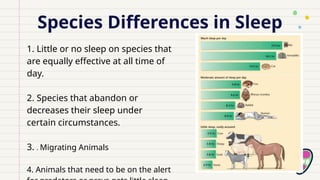
Species Differences in Sleep
1. Little or no sleep on species that
are equally effective at all time of
day.
2. Species that abandon or
decreases their sleep under
certain circumstances.
3. . Migrating Animals
4. Animals that need to be on the alert
Sleep and Memory
Improved Memory
• Another function of sleep is improved memory
• If you learn something and then go to sleep, or even take a nap, your
memory solidifies and may even become better than it was before sleep.
• Sleep also helps people reanalyze their memories.
• A nap that included REM sleep enhanced performance on certain kinds of
creative problem.
• Patterns that occurred during sleep in the hippocampus resembled those
that had occurred during learning, except that they were more rapid
during sleep. The amount of hippocampal activity during sleep correlated
highly with the subsequent improvement in performance.
• One way for sleep to strengthen memory is by weeding out the less
successful connections.
Functions of REM Sleep
• The species with the most total sleep hours also have
the highest percentage of REM sleep.
• Although REM is no doubt important, NREM is more
tightly regulated. The mount of NREM varies less
among individuals and among species.
1. REM is important for strengthening memory.
2. REM just shakes the eyeballs back and forth enough to
get sufficient oxygen to the corneas of the eyes.
Biological Perspectives on
Dreaming
1. Activation-synthesis Hypothesis - a dream
represents the brain’s effort to make sense of sparse
and distorted information.
2. Neurocognitive Hypothesis - regards dreams as
thinking that takes place under unusual conditions. It
emphasizes that dreams begin with spontaneous
brain activity related to recent memories.
References
• Biological Psychology-Cengage Learning (2018) 13th
Edition by James W. Kalat
Images References
• Biological Psychology-Cengage Learning (2018) 13th
Edition by James W. Kalat
• Abdi, A. (2023, January 25). How to stay Awake In Class. University Magazine. https://www.universitymagazine.ca/how-to-stay-awake-in-
class/
• E, K. (2013, February 7). Hoarder. Pinterest. https://www.pinterest.ph/pin/143974519309654570/
• FunnyWorm. (2020, May 5). Funny Stories, Images & Videos Fresh Out of The Oven - FunnyWorm. Pinterest.
https://www.pinterest.ph/pin/317222367506134330/
• Kosheluk, C. (2023, October 20). Why are the birds flying north — again? Ducks Unlimited Canada.
https://www.ducks.ca/stories/waterfowl/why-are-the-birds-flying-north-again/
• McGwin, K. (2020, March 6). Work ongoing on the largest Arctic expedition or Life in the dark and cold or What’s going on at the North Pole? The
Rasmussen . . . why do fur animals shed - Bing. (n.d.). Bing.
CREDITS: This presentation template was created by Slidesgo,
and includes icons by Flaticon, and infographics & images by
Freepik
Thank you
for listening!
Please keep this slide for attribution
Psych4_Chapter8_WakefulnessAndSleep.pptx

  • 1.
    Sleep and Wakefulness Chapter8 Reporters Janna Andrea S. Generalo Iris Mae F. Genigani Mary Faith P. Gersava
  • 2.
    Table of contents 8.1Rhythms of Waking and Sleeping 8.2 Stages of Sleep and Brain Mechanisms 8.3 Why Sleep? Why REM? Why Dream? Reporter: Janna Andrea S. Generalo Reporter: Iris Mae F. Genigani Reporter: Mary Faith P. Gersava
  • 3.
    Rhythms of Waking and Sleeping Module8.1 Reporter: Janna Andrea S. Generalo
  • 4.
    What help uswake up and fall asleep? During the mid-1900s, many psychologist believed that the alternation between wakefulness and sleep must depend on something in the outside world, such as changes in light or temperature. Meanwhile at the same time, Curt Richter, implied that the body generates its own cycles of activity and inactivity.
  • 5.
    Endogenous Rhythms 1. EndogenousCircannual Rhythms ● Endogenous means “generated from within” and ● Circannual comes from Latin words circum, for “about”, and annum, means “about a year”. ● This is a generated biological rhyhthm that prepares the body for seasonal changes.
  • 6.
    2. Endogenous CircadianRhythms ● Circadian comes from Latin words circum, for “about”, and dies, For “day.” ● This is a generated biological rhythms that last about a day. ● This is the most common type of rhythms used by people.  We have circadian rhythms in our eating and drinking, urination, hormone secretion, metabolism, sensitivity to drugs, mood, and other variables.  During 30 hours in an unchanging lboratory environment, the average young adult reported most pleasant mood in the late afternoon or early evening, and the least pleasant mood around 5 to 7 a.m.ing 30 hours in an unchanging  Our circadian rhythm does not easily adjust to more severe departures from a 24-hour schedule.
  • 7.
    Setting and Resettingthe Biological Clock Zeitgeber • The stimulus that resets the circadian rhythm. • This is German term that means “time-giver.” • Light is the most dominant zeitgeber for land animals. • Tides are the zeitgeber for most marine animals. • It also includes exercise, arousal, meals and the temperature of environment but its influence is not that strong.  A study in Germany shows that sunrise occurs at the eastern end of Germany about half an hour earlier than at the western end, which is why people at the eastern edge of a time zone awaken earlier than in  people who are working in Antarctica during the constant darkness of an Antarctic winter try to maintain a 24-hour rhythm, but they drift away from it.
  • 8.
    Disruptions of CircadianRhythms 1. Jet Lag • A disruption of circadian rhythms due to crossing time zones. 2. Shift Work • People who sleep irregularly – find that their duration of sleep depends on when they go to sleep. • People adjust best to night work if they sleep in a very dark room during the day and work under very bright lights at night, comparable to the noonday sun . Short-wavelength (bluish) light helps to reset the circadian rhythm better than long-wavelength light does. 3. Morning People and Evening People • Morning people “larks” – awaken early, reach their peak of productivity early and become less alert later in the day. • Evening people “owls” – warm up more slowly, reaching their peak in the late afternoon or evening. • The tendency for most young people to be evening types causes problems. In many countries, high school classes start at 8:00 a.m. or earlier. Most teenagers are at least a bit drowsy at that time, some more than others. Those who are strongly evening types tend to get lower than average test scores, especially in their morning classes.
  • 9.
    Mechanisms of theBiological Clock Curt Richter (1967) – Introduced the concept that the brain generates its own rhythms – a biological clock – and is insensitive to most form of interference.
  • 10.
    Mechanisms of theBiological Clock Suprachiasmatic Nucleus (SCN) • The main driver of rhythms for sleep and body temperature. • It is a part of the hypothalamus. • It gets its name from its location just above “supra” the optic chiasm. • It generates circadian rhythms itself in a genetically controlled manner. • The SCN maintain its own circadian rhythm even if it’s transplanted. • Receives input from ganglion cell that respond to the light.
  • 11.
    Mechanisms of theBiological Clock How Light Resets the SCN? Retinohypothalamic path • A small branch of the optic nerve, from the retina to the SCN, alters the SCN’s settings. Melanopsin • A special population of retinal ganglion cells that have their own photopigment unlike the ones found in rods and cones. • They can receive input from rods and cones but even if they do not, they still respond directly to light. • Located mainly near the nose from which they see toward periphery. • They mainly respond to short-wavelength (blue) light. A branch of the optic nerve, the retinohypothalamic path, conveys information about light to the SCN. The axons comprising that path originate from special ganglion cells that respond to light by themselves, even if they If the retina is.
  • 12.
    Sleep and WakeCycle The Biochemistry of the Circadian Rhythm Period and timeless (mRNA concentrations) • Genes responsible for a circadian rhythm. • Produces the proteins PER and TIM concentration. PER and TIM (protein concentrations) • The concentration of these two proteins, promote sleep and inactivity oscillates over a day, based on feedback interactions among neurons.
  • 13.
    1. The messengerRNA (mRNA) levels responsible for producing Period and Timeless (mRNA) start at low concentrations. 2. Period and Timeless (mRNA) increase during the day, increase synthesis of the proteins but it takes a lot of time which make PER and TIM (proteins) lag hours behind. 3. As PER and TIM (proteins) increase, they hinder the genes that produces the mRNA molecules. 4. Thus, during the night PER and TIM (proteins) are high which causes sleepiness and Period and Timeless (mRNA) are declining. 5. By the next morning, PER and TIM (proteins) are low and the cycle repeats.
  • 14.
    Sleep and WakeCycle Melatonin • The pineal gland release this hormone melatonin which is a widespread chemical, found in nearly all animals – except sponges, plant and bacteria. • It is released mostly at night. • Diurnal Animals – it increases sleepiness. • Nocturnal animals – it is increases wakefulness. • Also helps control the onset of puberty and bodily adjustments to changes of season. • Its secretion starts to increase about 2 or 3 hours before bedtime. The SCN regulates waking and sleeping by controlling activity levels in other brain areas , including pineal gland.
  • 15.
    Stages of Sleepand Brain Mechanisms Module 8.2 Reporter: Iris Mae F. Genigani
  • 16.
    Sleep and OtherInterruptions of Concsciousness 1. Sleep ● A state that the brain actively produces, characterized by decreased activity and decreased response to stimuli. 2. Coma ● An extended period unconsciousness caused by head, trauma, stroke, or disease. ● Low level of brain activity and little or no response to stimuli. 3. Vegetative State ● Alternates between periods of sleep and moderate arousal, although even during the more aroused state, the person shows no awareness of surroundings and no purposeful behavior. ● Either dies or begins to recover within a few weeks. ● Can last for months or years. 4. Minimally Conscious State ● Brief periods of purposeful actions and a limited amount of speech comprehension. ● Can last for months or years. 5. Brain Death ● No sign of brain activity and no response to any stimulus. ● At which point most people believe it is ethical to remove life support.
  • 17.
    The Stages ofSleep Electroencephalograph (EEG) • Records an average of the electrical potentials of the cells and fibers in the brain areas nearest to each electrode on the scalp. • If half the cells in some area increase their electrical potentials while the other half decrease, they cancel out. The EEG record rises or falls when most cells do the same thing at the same time. Polysomnograph • A combination of EEG and eye-movement records, for a college student during various stages of sleep. Alpha Waves • characteristic of relaxation and wakefulness.
  • 18.
    The Stages ofSleep Large, slow waves indicate a low level of activity, with much synchrony of response among neurons. • Brain activity is less than in relaxed wakefulness but higher than in other sleep stages. • The prominent characteristics of stage 2 are K-complexes and sleep spindles. 1. K-complex - a sharp wave associated with temporary inhibition of neuronal firing, 2. Sleep spindles - a burst of 12- to 14- Hz waves for at least half a second. Important for consolidation of
  • 19.
    Stages of Sleep Large,slow waves indicate a low level of activity, with much synchrony of response among neurons. • Stage 3 Slow-wave Sleep – heart rate, breathing rate, and brain activity decrease, whereas slow, large-amplitude waves become more common. • Most common during the early part of the night’s sleep but not • Stage 5 - it is deep sleep in some ways and light in others. Periods of rapid eye movements occur during sleep. • EEG shows irregular, low-voltage fast waves that indicate increased neuronal activity. In this regard, REM sleep is light, However, the postural muscles of the body, including those that support the • Stage 4 Slow-wave Sleep – older sources distinguished between stages 3 slow waves sleep with fewer slow waves and stage 4 slow waves with more of them.
  • 20.
    Paradoxical or REMSleep • Paradoxical or REM Sleep • French scientist Michael Jouvet discovered in his experiment with a cat’s brain that during certain periods of apparent sleep, its activity was relatively high, but their neck muscles were completely relaxed (1960). • The term paradoxical means “apparently self-contradictory.” because it is deep sleep in some ways and light in others. Rapid Eye Movement (REM) Sleep • Nathaniel Kleitman and Eugene Aserinsky accidentally discovered REM when they occasionally turned on the machine during the night and saw evidence of eye movements by someone who was asleep. REM and Paradoxical sleep are synonymous. REM Sleep are often used referring to humans and paradoxical sleep for species that lack eye movements.
  • 21.
    REM Sleep • Earlyin the night, slow-wave sleep predominates. As time passes, REM occupies an increasing percentage of the time. • Figure shows typical sequences for young adults. The amount of REM depends on time of day more than how long you have been asleep. That is, if you go to sleep later than usual, you still increase your REM at about the same time that you would have ordinarily. • The pattern of sleep stages varies as a function of age, health, and other factors. • Figure compares sleep for a typical young adult and a typical older adult. The older adult has less slow-wave sleep and many more awakenings during the night. The frequency of awakenings correlates with loss of cells in the hypothalamus, and with a tendency toward cognitive decline. Note that the older adult has less slow-wave sleep and more frequent awakenings.
  • 22.
    Brain Mechanisms of Wakefulness,Arousal, and Sleep Reticular Formation – a structure in the midbrain that extends from the medulla into the fore brain. It contributes to cortical arousal known as pontomesencephalon. Pontomesencephalon • The term derives from pons and mesencephalon, or “midbrain.”) • These neurons receive input from many sensory systems and also generate activity of their own, varying with the circadian rhythm. Midbrain
  • 23.
    Locus Coeruleus “darkblue place” • A small structure in the pons, is usually inactive, especially during sleep, but it emits bursts of impulses in response to meaningful events, especially those that produce emotional arousal. • It increases the activity of the most active neurons and decreases the activity of less active neurons. The result is enhanced attention to important information and enhanced memory. Hypothalamus • releases the excitatory neurotransmitter histamine which enhances arousal and alertness throughout the brain. • releases a peptide neurotransmitter called either orexin or hypocretin which enhances wakefulness and activity. Orexin is not necessary for waking up, but it is for staying awake. • from the lateral hypothalamus regulate cells in the basal forebrain provide axons that extend throughout the thalamus and cerebral cortex, some of them increasing wakefulness and others inhibiting it. • Acetylcholine stimulates the basal forebrain cells that promote wakefulness, although those cells release other transmitters to the cortex. Hindbrain Forebrain
  • 24.
    Sleep and theInhibition of Brain Activity Sleep depends partly on decreased sensory input to the cerebral cortex. During sleep, neurons in the thalamus become hyperpolarized, decreasing their readiness to respond to stimuli and decreasing the information they transmit to the cortex. During sleep, spontaneously active neurons continue firing at only slightly less than their usual rate. How, then, do we remain unconscious in spite of sustained neuronal activity? Inhibition • During sleep, axons that release the inhibitory neurotransmitter GABA increase their activity, interfering with the spread of information from one neuron to another (Massimini et al., 2005). Connections from one brain area to another become weaker.
  • 25.
    During REM sleep 1.Activity increased in the pons and the limbic system. 2. Activity decreased in the primary visual cortex, the motor cortex, and the dorsolateral prefrontal cortex. 3. Increased in parts of the parietal and temporal. 4. PGO Waves - Waves of neural activity are detected first in the pons, shortly afterward in the lateral geniculate nucleus of the thalamus, and then in the occipital cortex. It is a distinctive pattern of high-amplitude electrical potentials for pons-geniculate-occipital. 5. A path of axons from the ventral medulla releasing GABA promotes REM sleep . 6. Injections of the drug carbachol, which stimulates acetylcholine synapses, quickly move a sleeper into REM sleep. 7. Acetylcholine is important for both wakefulness and REM sleep, states of brain arousal. Serotonin and norepinephrine interrupt REM sleep. Brain Activity in REM Sleep • Researchers interested in the mechanisms of REM decided to use a PET scan to determine which brain areas increased or decreased their activity during REM.
  • 26.
    Sleep Disorders Insomnia—inadequate sleep—ishow someone feels the following day. If you feel tired during the day, you are not sleeping enough at night. Sleep deprivation impairs memory, attention, and cognition.It also magnifies unpleasant emotional reactions and increases the risk of depression Sleep Apnea – impaired ability to breathe while sleeping. People with sleep apnea have breathless periods of a minute or so from which they awaken gasping for breath. They may not remember their awakenings, although they certainly notice the consequences, such as sleepiness during the day and impaired attention. People with sleep apnea are at increased risk of stroke, heart problems, and other disorders. Narcolepsy – a condition characterized by frequent periods of sleepiness during the day, strikes about 1 person in 1,000. It sometimes runs in families, but most cases emerge in people with no affected relatives.
  • 27.
    Why Sleep? Why REM?Why Dreams? Module 8.3 Reporter: Mary Faith P. Gersava
  • 28.
    Functions of Sleep 1.Sleep and Energy Conversation • A likely hypothesis is that sleep’s original function – and still an important one – is to save energy. • Sleep conserves energy during the inefficient times, when activity would be wasteful and possible dangerous. 2. Hibernation • The function of hibernation is simply to conserve energy while food is scarce. • Animals decrease their body temperature to only slightly above that of the environment but not low enough for their blood to freeze. • this also helps retards or suspend aging process. • Also a period of relative invulnerability to infection and trauma. • Bears sleep most of the winter, lowering their body temperature a few degress and decreasing their metabolism and heart rate. • Hamsters also hibernate during winter. • Reptiles and amphibians become dormant, a state similar to hibernation during winter. They
  • 29.
    Species Differences inSleep 1. Little or no sleep on species that are equally effective at all time of day. 2. Species that abandon or decreases their sleep under certain circumstances. 3. . Migrating Animals 4. Animals that need to be on the alert
  • 30.
    Sleep and Memory ImprovedMemory • Another function of sleep is improved memory • If you learn something and then go to sleep, or even take a nap, your memory solidifies and may even become better than it was before sleep. • Sleep also helps people reanalyze their memories. • A nap that included REM sleep enhanced performance on certain kinds of creative problem. • Patterns that occurred during sleep in the hippocampus resembled those that had occurred during learning, except that they were more rapid during sleep. The amount of hippocampal activity during sleep correlated highly with the subsequent improvement in performance. • One way for sleep to strengthen memory is by weeding out the less successful connections.
  • 31.
    Functions of REMSleep • The species with the most total sleep hours also have the highest percentage of REM sleep. • Although REM is no doubt important, NREM is more tightly regulated. The mount of NREM varies less among individuals and among species. 1. REM is important for strengthening memory. 2. REM just shakes the eyeballs back and forth enough to get sufficient oxygen to the corneas of the eyes.
  • 32.
    Biological Perspectives on Dreaming 1.Activation-synthesis Hypothesis - a dream represents the brain’s effort to make sense of sparse and distorted information. 2. Neurocognitive Hypothesis - regards dreams as thinking that takes place under unusual conditions. It emphasizes that dreams begin with spontaneous brain activity related to recent memories.
  • 33.
    References • Biological Psychology-CengageLearning (2018) 13th Edition by James W. Kalat Images References • Biological Psychology-Cengage Learning (2018) 13th Edition by James W. Kalat • Abdi, A. (2023, January 25). How to stay Awake In Class. University Magazine. https://www.universitymagazine.ca/how-to-stay-awake-in- class/ • E, K. (2013, February 7). Hoarder. Pinterest. https://www.pinterest.ph/pin/143974519309654570/ • FunnyWorm. (2020, May 5). Funny Stories, Images & Videos Fresh Out of The Oven - FunnyWorm. Pinterest. https://www.pinterest.ph/pin/317222367506134330/ • Kosheluk, C. (2023, October 20). Why are the birds flying north — again? Ducks Unlimited Canada. https://www.ducks.ca/stories/waterfowl/why-are-the-birds-flying-north-again/ • McGwin, K. (2020, March 6). Work ongoing on the largest Arctic expedition or Life in the dark and cold or What’s going on at the North Pole? The Rasmussen . . . why do fur animals shed - Bing. (n.d.). Bing.
  • 34.
    CREDITS: This presentationtemplate was created by Slidesgo, and includes icons by Flaticon, and infographics & images by Freepik Thank you for listening! Please keep this slide for attribution