How do wepreventobesityin 2011?Angelo TremblayDivision of Kinesiology
How do wepreventobesityin 2011?By counteracting the impact of obesogenicenvironmentalfactors
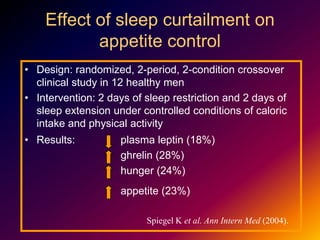
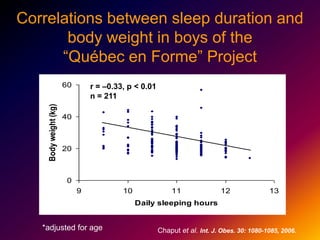
By promotingadequatesleep
By increasing the physicalwork/cognitive effort ratio
By investing in nutrition competence and healthyfoodavailability
By promotinghealthyfood-relatedbehaviours
By investing in preventivepharmacology !!!The QuebecFamilyStudyexperience
Risk factors for overweight and obesity in adulthood: Results from the Quebec Family StudyRisk factors			Adjusted OR		    BW (kg) vs					(cross-sectional)                 reference category							              (6 y follow-up)Short sleep duration		     3.81*			      1.65High disinhibition eating		     3.8*			      1.46behaviorLow dietary calcium intake	     2.88*			       1.3High susceptibility to hunger	     2.2*			       1.28behaviorNon-participation in high-intensity	     2.03*			       1.23physical exerciseHigh dietary restraint behavior	     2.01*			       1.09Non-consumption of multivitamin	     1.86*			       0.87 and dietary supplementsHigh dietary lipid intake		     1.64**		       0.61High alcohol intake		     1.37**		       0.39*p < 0.01, ** p < 0.05Adapted from Chaput et al, Obesity 2009
How do wepreventobesityin 2011?By counteracting the impact of obesogenicenvironmentalfactors
By promotingadequatesleep
By increasing the physicalwork/cognitive effort ratio

Sleep

  • 1.
    How do wepreventobesityin2011?Angelo TremblayDivision of Kinesiology
  • 2.
    How do wepreventobesityin2011?By counteracting the impact of obesogenicenvironmentalfactors
  • 3.
  • 4.
    By increasing thephysicalwork/cognitive effort ratio
  • 5.
    By investing innutrition competence and healthyfoodavailability
  • 6.
  • 7.
    By investing inpreventivepharmacology !!!The QuebecFamilyStudyexperience
  • 8.
    Risk factors foroverweight and obesity in adulthood: Results from the Quebec Family StudyRisk factors Adjusted OR BW (kg) vs (cross-sectional) reference category (6 y follow-up)Short sleep duration 3.81* 1.65High disinhibition eating 3.8* 1.46behaviorLow dietary calcium intake 2.88* 1.3High susceptibility to hunger 2.2* 1.28behaviorNon-participation in high-intensity 2.03* 1.23physical exerciseHigh dietary restraint behavior 2.01* 1.09Non-consumption of multivitamin 1.86* 0.87 and dietary supplementsHigh dietary lipid intake 1.64** 0.61High alcohol intake 1.37** 0.39*p < 0.01, ** p < 0.05Adapted from Chaput et al, Obesity 2009
  • 9.
    How do wepreventobesityin2011?By counteracting the impact of obesogenicenvironmentalfactors
  • 10.
  • 11.
    By increasing thephysicalwork/cognitive effort ratio