
The Obesity Epidemic
-do we only treat or do we demand
change


Hal Robertson
>Manual Tasks Services
>Workforce Health
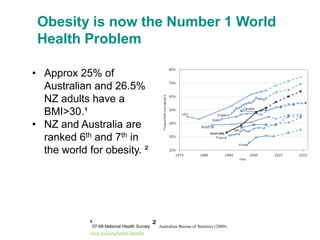
Obesity is now the Number 1 World
 Health Problem

• Approx 25% of
  Australian and 26.5%
  NZ adults have a
  BMI>30.¹
• NZ and Australia are
  ranked 6th and 7th in
  the world for obesity. ²


            '07-08 National Health Survey. ² Australian Bureau of Statistics (2009).
            www.oecd.org/health/fitnotfat
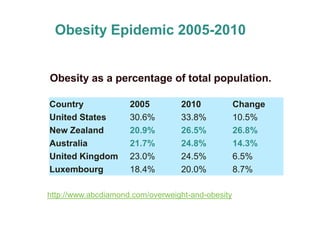
Obesity Epidemic 2005-2010


Obesity as a percentage of total population.

Country              2005         2010             Change
United States        30.6%        33.8%            10.5%
New Zealand          20.9%        26.5%            26.8%
Australia            21.7%        24.8%            14.3%
United Kingdom       23.0%        24.5%            6.5%
Luxembourg           18.4%        20.0%            8.7%

http://www.abcdiamond.com/overweight-and-obesity
Bariatric definition

 Person fits two or more of the
   following criteria:
 > Weighs 120+Kg
 > BMI 40+
 > Seated hip width >20” (51cm)


   Body mass Index (BMI)=weight in KG/height in metres ²


                                                           SA Health
Bariatric statistics
Royal Adelaide Hospital and Flinders Medical Centre

> 2% of inpatient admissions are bariatric.
  Ie approx 80 inpatients per month at RAH

> 5% of maintenance stay patients waiting
  for nursing home placement (RAH) are
  bariatric
> The average acute LOS for a patient over
  120kg is 1.6 times longer than a normal
  weight patient and 1.8 times longer if the
  patient is over 150kg compared for other patients
  with same Diagnostic Related Group matched for age and sex.


                                                   SA Health
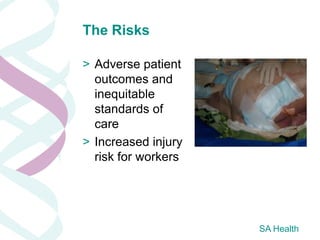
The Risks

> Adverse patient
  outcomes and
  inequitable
  standards of
  care
> Increased injury
  risk for workers


                     SA Health
Increase risk of worker injury

Bariatric patients…
> Are involved in between 14%-21% of body
  stressing incidents assoc with patient care in
  acute hospitals in Adelaide
> Caused 30% body stressing Workcover claims
  FMC 2009-10- the relative risk of workers
  sustaining Musculoskeletal injury is 19:1
SALHN 2010: Nursing and Allied Health Survey on Care of
   Bariatric Patients
> 20% did not feel safe caring for a B patient
> 70% reported appropriate equipment is rarely
  available


                                                  SA Health
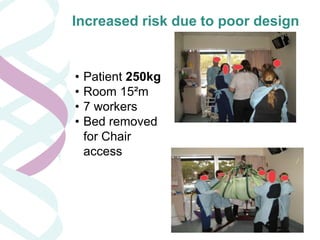
Increased risk due to poor design


•   Patient 250kg
•   Room 15²m
•   7 workers
•   Bed removed
    for Chair
    access


                           SA Health
Impact on Heath Care systems

> Acute hospitals-increased risks to workers
  and the patient with dependent
  patients>200kg
> Aged Care Facilities- struggle to care for
  dependant residents in 120-150kg range
> Community support programs- limited
  equipment options, environment and
  home design restrictions, and often only
  1-2 worker(s) available


                                   SA Health
Managing Obesity


                   SA Health
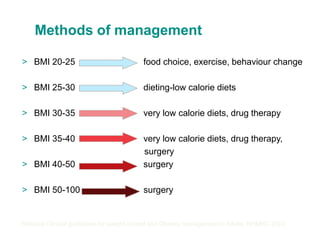
Methods of management

> BMI 20-25                               food choice, exercise, behaviour change

> BMI 25-30                               dieting-low calorie diets

> BMI 30-35                               very low calorie diets, drug therapy

> BMI 35-40                               very low calorie diets, drug therapy,
                                          surgery
> BMI 40-50                               surgery

> BMI 50-100                              surgery


National Clinical guidelines for weight control and Obesity management in Adults, NHMRC 2003
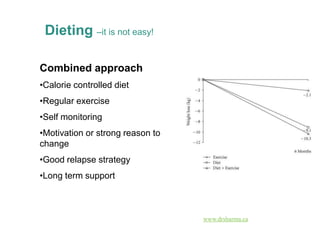
Dieting –it is not easy!

Combined approach
•Calorie controlled diet
•Regular exercise
•Self monitoring
•Motivation or strong reason to
change
•Good relapse strategy
•Long term support


                                  www.drsharma.ca
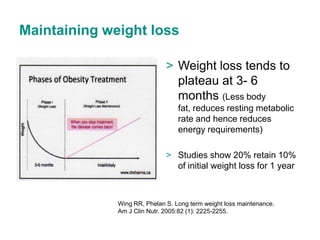
Maintaining weight loss

                              > Weight loss tends to
                                plateau at 3- 6
                                months (Less body
                                  fat, reduces resting metabolic
                                  rate and hence reduces
                                  energy requirements)

                              > Studies show 20% retain 10%
                                of initial weight loss for 1 year


              Wing RR, Phelan S. Long term weight loss maintenance.
              Am J Clin Nutr. 2005:82 (1): 2225-2255.
Yoyo dieters
Achieving long term weight loss

> National Weight Control Registry Australia
  • Little similarity in weight loss methods
> Common behaviours in weight loss
  maintenance
  •   Low calorie diet
  •   Low to moderate fat intake
  •   Limited fast food
  •   Eat breakfast most days
  •   Regular self monitoring
  •   Engaging in high levels of physical activity
      (min 1 hour a day)
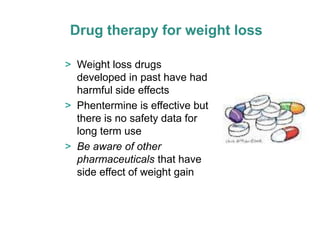
Drug therapy for weight loss

> Weight loss drugs
  developed in past have had
  harmful side effects
> Phentermine is effective but
  there is no safety data for
  long term use
> Be aware of other
  pharmaceuticals that have
  side effect of weight gain
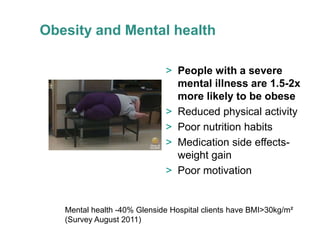
Obesity and Mental health

                             > People with a severe
                               mental illness are 1.5-2x
                               more likely to be obese
                             > Reduced physical activity
                             > Poor nutrition habits
                             > Medication side effects-
                               weight gain
                             > Poor motivation


   Mental health -40% Glenside Hospital clients have BMI>30kg/m²
   (Survey August 2011)
Bariatric Surgery


> Aim-reduce mortality from obesity
  related co-morbidities
> Dietary, psychological and medical
  assessments
> Commitment to change. Pre surgery
  weight loss requirement
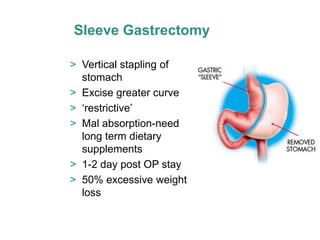
Sleeve Gastrectomy

> Vertical stapling of
  stomach
> Excise greater curve
> ‘restrictive’
> Mal absorption-need
  long term dietary
  supplements
> 1-2 day post OP stay
> 50% excessive weight
  loss
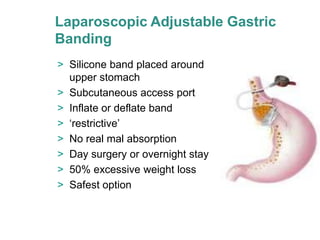
Laparoscopic Adjustable Gastric
Banding
> Silicone band placed around
  upper stomach
> Subcutaneous access port
> Inflate or deflate band
> ‘restrictive’
> No real mal absorption
> Day surgery or overnight stay
> 50% excessive weight loss
> Safest option
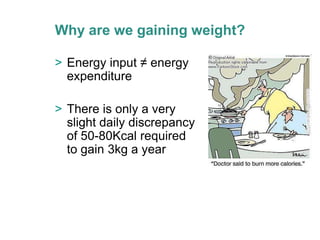
Why are we gaining weight?

> Energy input ≠ energy
  expenditure

> There is only a very
  slight daily discrepancy
  of 50-80Kcal required
  to gain 3kg a year
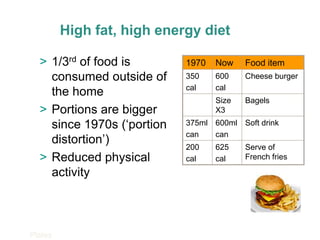
High fat, high energy diet

  > 1/3rd of food is        1970   Now    Food item
    consumed outside of     350    600    Cheese burger
                            cal    cal
    the home
                                   Size   Bagels
  > Portions are bigger            X3
    since 1970s (‘portion   375ml 600ml Soft drink
                            can   can
    distortion’)
                            200    625    Serve of
  > Reduced physical        cal    cal    French fries

    activity


Plates
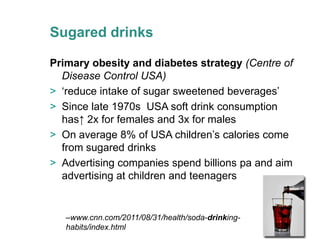
Sugared drinks

Primary obesity and diabetes strategy (Centre of
  Disease Control USA)
> ‘reduce intake of sugar sweetened beverages’
> Since late 1970s USA soft drink consumption
  has↑ 2x for females and 3x for males
> On average 8% of USA children’s calories come
  from sugared drinks
> Advertising companies spend billions pa and aim
  advertising at children and teenagers


   –www.cnn.com/2011/08/31/health/soda-drinking-
   habits/index.html
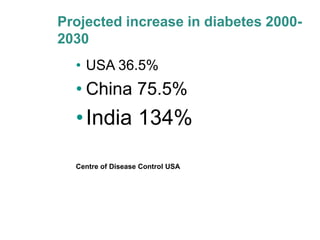
Projected increase in diabetes 2000-
2030
  • USA 36.5%
  • China 75.5%
  • India 134%

  Centre of Disease Control USA
Link with advertising and obesity

  Food promotion is having an effect
  particularly on children's’ preferences,
  purchases behaviours and consumption.
  Hastings et al 2003


 77% of obese children will become
 obese adults.
 Pre schoolers in the USA will see on
 average 5000 fast food ads by the
 time they reach 5.
  www.yaleruddcenter.org
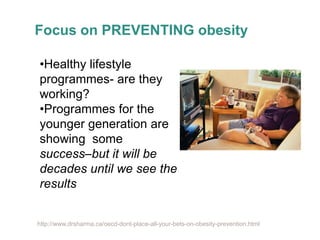
Focus on PREVENTING obesity

•Healthy lifestyle
programmes- are they
working?
•Programmes for the
younger generation are
showing some
success–but it will be
decades until we see the
results


http://www.drsharma.ca/oecd-dont-place-all-your-bets-on-obesity-prevention.html
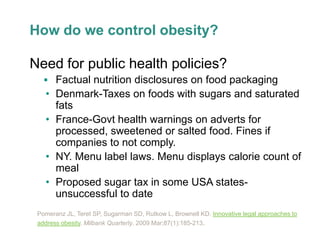
How do we control obesity?

Need for public health policies?
    Factual nutrition disclosures on food packaging
   • Denmark-Taxes on foods with sugars and saturated
     fats
   • France-Govt health warnings on adverts for
     processed, sweetened or salted food. Fines if
     companies to not comply.
   • NY. Menu label laws. Menu displays calorie count of
     meal
   • Proposed sugar tax in some USA states-
     unsuccessful to date
 Pomeranz JL, Teret SP, Sugarman SD, Rutkow L, Brownell KD. Innovative legal approaches to
 address obesity. Milbank Quarterly. 2009 Mar;87(1):185-213.
> 62 yo patient weighing 276kg UTI and chest infection
> Ambulance retrieval-2 teams
> HIGH STAFF DEMAND:
   • 6 staff to roll her when she was acutely ill, and 3 staff to
     assist with placing her on a bed pan when she was
     ‘well’.
   • 5 physiotherapy staff to stand her from lying in bed, + 2
     nurses to move equipment during this procedure.
> STAFF INJURY
   • 2 physiotherapists were injured attempting to lift her
     legs back onto the bed. (legs weighed 80kg each)
> Specialist equipment needed
> POOR PATIENT OUTCOME
   • Patient quickly became deconditioned due to limited
     resources to mobilise her
   • She died in hospital 4 months after admission


                                                    SA Health
The Obesity Epidemic - Do we only treat or do we demand change

The Obesity Epidemic - Do we only treat or do we demand change

  • 1.
    The Obesity Epidemic -dowe only treat or do we demand change Hal Robertson >Manual Tasks Services >Workforce Health
  • 2.
    Obesity is nowthe Number 1 World Health Problem • Approx 25% of Australian and 26.5% NZ adults have a BMI>30.¹ • NZ and Australia are ranked 6th and 7th in the world for obesity. ² '07-08 National Health Survey. ² Australian Bureau of Statistics (2009). www.oecd.org/health/fitnotfat
  • 3.
    Obesity Epidemic 2005-2010 Obesityas a percentage of total population. Country 2005 2010 Change United States 30.6% 33.8% 10.5% New Zealand 20.9% 26.5% 26.8% Australia 21.7% 24.8% 14.3% United Kingdom 23.0% 24.5% 6.5% Luxembourg 18.4% 20.0% 8.7% http://www.abcdiamond.com/overweight-and-obesity
  • 4.
    Bariatric definition Personfits two or more of the following criteria: > Weighs 120+Kg > BMI 40+ > Seated hip width >20” (51cm) Body mass Index (BMI)=weight in KG/height in metres ² SA Health
  • 5.
    Bariatric statistics Royal AdelaideHospital and Flinders Medical Centre > 2% of inpatient admissions are bariatric. Ie approx 80 inpatients per month at RAH > 5% of maintenance stay patients waiting for nursing home placement (RAH) are bariatric > The average acute LOS for a patient over 120kg is 1.6 times longer than a normal weight patient and 1.8 times longer if the patient is over 150kg compared for other patients with same Diagnostic Related Group matched for age and sex. SA Health
  • 6.
    The Risks > Adversepatient outcomes and inequitable standards of care > Increased injury risk for workers SA Health
  • 7.
    Increase risk ofworker injury Bariatric patients… > Are involved in between 14%-21% of body stressing incidents assoc with patient care in acute hospitals in Adelaide > Caused 30% body stressing Workcover claims FMC 2009-10- the relative risk of workers sustaining Musculoskeletal injury is 19:1 SALHN 2010: Nursing and Allied Health Survey on Care of Bariatric Patients > 20% did not feel safe caring for a B patient > 70% reported appropriate equipment is rarely available SA Health
  • 8.
    Increased risk dueto poor design • Patient 250kg • Room 15²m • 7 workers • Bed removed for Chair access SA Health
  • 9.
    Impact on HeathCare systems > Acute hospitals-increased risks to workers and the patient with dependent patients>200kg > Aged Care Facilities- struggle to care for dependant residents in 120-150kg range > Community support programs- limited equipment options, environment and home design restrictions, and often only 1-2 worker(s) available SA Health
  • 10.
  • 11.
    Methods of management >BMI 20-25 food choice, exercise, behaviour change > BMI 25-30 dieting-low calorie diets > BMI 30-35 very low calorie diets, drug therapy > BMI 35-40 very low calorie diets, drug therapy, surgery > BMI 40-50 surgery > BMI 50-100 surgery National Clinical guidelines for weight control and Obesity management in Adults, NHMRC 2003
  • 12.
    Dieting –it isnot easy! Combined approach •Calorie controlled diet •Regular exercise •Self monitoring •Motivation or strong reason to change •Good relapse strategy •Long term support www.drsharma.ca
  • 13.
    Maintaining weight loss > Weight loss tends to plateau at 3- 6 months (Less body fat, reduces resting metabolic rate and hence reduces energy requirements) > Studies show 20% retain 10% of initial weight loss for 1 year Wing RR, Phelan S. Long term weight loss maintenance. Am J Clin Nutr. 2005:82 (1): 2225-2255.
  • 14.
  • 15.
    Achieving long termweight loss > National Weight Control Registry Australia • Little similarity in weight loss methods > Common behaviours in weight loss maintenance • Low calorie diet • Low to moderate fat intake • Limited fast food • Eat breakfast most days • Regular self monitoring • Engaging in high levels of physical activity (min 1 hour a day)
  • 16.
    Drug therapy forweight loss > Weight loss drugs developed in past have had harmful side effects > Phentermine is effective but there is no safety data for long term use > Be aware of other pharmaceuticals that have side effect of weight gain
  • 17.
    Obesity and Mentalhealth > People with a severe mental illness are 1.5-2x more likely to be obese > Reduced physical activity > Poor nutrition habits > Medication side effects- weight gain > Poor motivation Mental health -40% Glenside Hospital clients have BMI>30kg/m² (Survey August 2011)
  • 18.
    Bariatric Surgery > Aim-reducemortality from obesity related co-morbidities > Dietary, psychological and medical assessments > Commitment to change. Pre surgery weight loss requirement
  • 19.
    Sleeve Gastrectomy > Verticalstapling of stomach > Excise greater curve > ‘restrictive’ > Mal absorption-need long term dietary supplements > 1-2 day post OP stay > 50% excessive weight loss
  • 20.
    Laparoscopic Adjustable Gastric Banding >Silicone band placed around upper stomach > Subcutaneous access port > Inflate or deflate band > ‘restrictive’ > No real mal absorption > Day surgery or overnight stay > 50% excessive weight loss > Safest option
  • 21.
    Why are wegaining weight? > Energy input ≠ energy expenditure > There is only a very slight daily discrepancy of 50-80Kcal required to gain 3kg a year
  • 22.
    High fat, highenergy diet > 1/3rd of food is 1970 Now Food item consumed outside of 350 600 Cheese burger cal cal the home Size Bagels > Portions are bigger X3 since 1970s (‘portion 375ml 600ml Soft drink can can distortion’) 200 625 Serve of > Reduced physical cal cal French fries activity Plates
  • 23.
    Sugared drinks Primary obesityand diabetes strategy (Centre of Disease Control USA) > ‘reduce intake of sugar sweetened beverages’ > Since late 1970s USA soft drink consumption has↑ 2x for females and 3x for males > On average 8% of USA children’s calories come from sugared drinks > Advertising companies spend billions pa and aim advertising at children and teenagers –www.cnn.com/2011/08/31/health/soda-drinking- habits/index.html
  • 24.
    Projected increase indiabetes 2000- 2030 • USA 36.5% • China 75.5% • India 134% Centre of Disease Control USA
  • 25.
    Link with advertisingand obesity Food promotion is having an effect particularly on children's’ preferences, purchases behaviours and consumption. Hastings et al 2003 77% of obese children will become obese adults. Pre schoolers in the USA will see on average 5000 fast food ads by the time they reach 5. www.yaleruddcenter.org
  • 26.
    Focus on PREVENTINGobesity •Healthy lifestyle programmes- are they working? •Programmes for the younger generation are showing some success–but it will be decades until we see the results http://www.drsharma.ca/oecd-dont-place-all-your-bets-on-obesity-prevention.html
  • 27.
    How do wecontrol obesity? Need for public health policies?  Factual nutrition disclosures on food packaging • Denmark-Taxes on foods with sugars and saturated fats • France-Govt health warnings on adverts for processed, sweetened or salted food. Fines if companies to not comply. • NY. Menu label laws. Menu displays calorie count of meal • Proposed sugar tax in some USA states- unsuccessful to date Pomeranz JL, Teret SP, Sugarman SD, Rutkow L, Brownell KD. Innovative legal approaches to address obesity. Milbank Quarterly. 2009 Mar;87(1):185-213.
  • 28.
    > 62 yopatient weighing 276kg UTI and chest infection > Ambulance retrieval-2 teams > HIGH STAFF DEMAND: • 6 staff to roll her when she was acutely ill, and 3 staff to assist with placing her on a bed pan when she was ‘well’. • 5 physiotherapy staff to stand her from lying in bed, + 2 nurses to move equipment during this procedure. > STAFF INJURY • 2 physiotherapists were injured attempting to lift her legs back onto the bed. (legs weighed 80kg each) > Specialist equipment needed > POOR PATIENT OUTCOME • Patient quickly became deconditioned due to limited resources to mobilise her • She died in hospital 4 months after admission SA Health

Editor's Notes

  • #2 This is the first slide of presentation. Use as the title page, intro page of presentation.
  • #3 Use this slide for inside information page. Do not place text or images/graphic over the faded helix.
  • #9 Recommendations: auditCentralised equipment poolsSharing between LHNs and services to follow patioent
  • #11 Use this slide as the beginning of a different chapters or sections in presentation. This slide is used for larger PPT presentations.If the presentation does not have different chapters or sections- you do not need to use this.
  • #16 National Weight Control Registry (Success or maintenance defined as keeping off all initial weight lost or at least 9-11kg of initial weight loss)
  • #30 This slide is the last page of the presentation.