SLE – An Overview and Update
SAMIR EL ANSARY
ICU PROFESSOR
AIN SHAMS
CAIRO
elansarysamir@yahoo.com
https://www.facebook.com/groups/1451610115129555/#!/groups/145
1610115129555/
Wellcome in our new group ..... Dr.SAMIR EL ANSARY
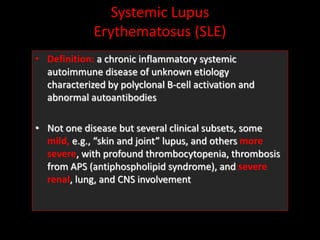
Systemic Lupus
Erythematosus (SLE)
• Definition: a chronic inflammatory systemic
autoimmune disease of unknown etiology
characterized by polyclonal B-cell activation and
abnormal autoantibodies
• Not one disease but several clinical subsets, some

mild, e.g., “skin and joint” lupus, and others more
severe, with profound thrombocytopenia, thrombosis
from APS (antiphospholipid syndrome), and severe
renal, lung, and CNS involvement
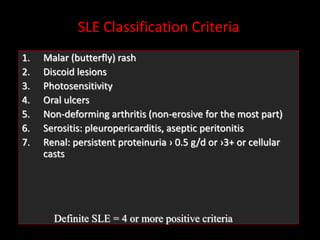
SLE Classification Criteria
1. Malar (butterfly) rash
2. Discoid lesions
3. Photosensitivity
4. Oral ulcers
5. Non-deforming arthritis (non-erosive for the most part)
6. Serositis: pleuropericarditis, aseptic peritonitis
7. Renal: persistent proteinuria › 0.5 g/d or ›3+ or cellular
casts
Definite SLE = 4 or more positive criteria
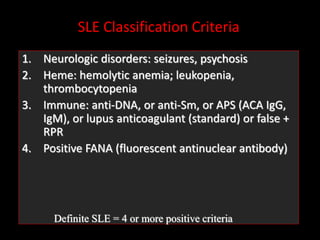
SLE Classification Criteria
1. Neurologic disorders: seizures, psychosis
2. Heme: hemolytic anemia; leukopenia,
thrombocytopenia
3. Immune: anti-DNA, or anti-Sm, or APS (ACA IgG,
IgM), or lupus anticoagulant (standard) or false +
RPR
4. Positive FANA (fluorescent antinuclear antibody)
Definite SLE = 4 or more positive criteria
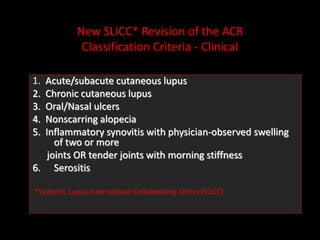
New SLICC* Revision of the ACR
Classification Criteria - Clinical
1. Acute/subacute cutaneous lupus
2. Chronic cutaneous lupus
3. Oral/Nasal ulcers
4. Nonscarring alopecia
5. Inflammatory synovitis with physician-observed swelling
of two or more
joints OR tender joints with morning stiffness
6. Serositis
*Systemic Lupus International Collaborating Clinics (SLICC)
New SLICC* Revision of the ACR
Classification Criteria - Clinical
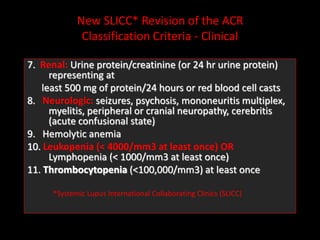
7. Renal: Urine protein/creatinine (or 24 hr urine protein)
representing at
least 500 mg of protein/24 hours or red blood cell casts
8. Neurologic: seizures, psychosis, mononeuritis multiplex,
myelitis, peripheral or cranial neuropathy, cerebritis
(acute confusional state)
9. Hemolytic anemia
10. Leukopenia (< 4000/mm3 at least once) OR
Lymphopenia (< 1000/mm3 at least once)
11. Thrombocytopenia (<100,000/mm3) at least once
*Systemic Lupus International Collaborating Clinics (SLICC)
SLICC Revision of the ACR
Classification Criteria – Immunologic
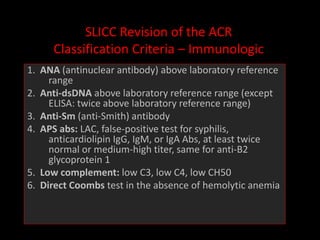
1. ANA (antinuclear antibody) above laboratory reference
range
2. Anti-dsDNA above laboratory reference range (except
ELISA: twice above laboratory reference range)
3. Anti-Sm (anti-Smith) antibody
4. APS abs: LAC, false-positive test for syphilis,
anticardiolipin IgG, IgM, or IgA Abs, at least twice
normal or medium-high titer, same for anti-B2
glycoprotein 1
5. Low complement: low C3, low C4, low CH50
6. Direct Coombs test in the absence of hemolytic anemia
Lupus - SLICC* 17 New Classification Criteria: 4
needed
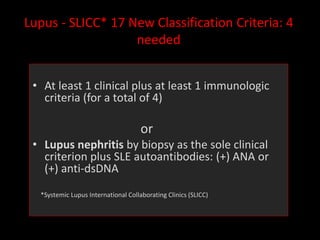
• At least 1 clinical plus at least 1 immunologic
criteria (for a total of 4)
or
• Lupus nephritis by biopsy as the sole clinical
criterion plus SLE autoantibodies: (+) ANA or
(+) anti-dsDNA
*Systemic Lupus International Collaborating Clinics (SLICC)
The Use of ANA for Screening
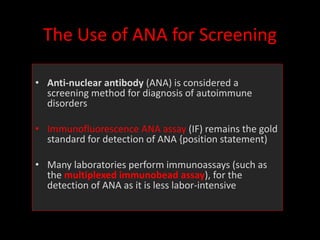
• Anti-nuclear antibody (ANA) is considered a
screening method for diagnosis of autoimmune
disorders
• Immunofluorescence ANA assay (IF) remains the gold
standard for detection of ANA {position statement)
• Many laboratories perform immunoassays (such as
the multiplexed immunobead assay), for the
detection of ANA as it is less labor-intensive
• To compare ANA detection by multiplex
immunobead assay with the gold standard
immunofluorescence (IF)
• Patient samples tested for both assays:
• Multiplex immunobead assay (MIA) were
considered positive based on the
manufacturer’s instructions
• Immunofluorescence (IF) was considered
positive at a titer ≥ 1:160
Methods
• Data collected prospectively on rheumatology patients
tested for ANA by multiplex immunobead assay MIA
• Performance characteristics of the immuno-assay were
determined using the IF results as the “gold standard”
Conclusions
• Patients tested negative by the MIA (bioplex) included
patients with definite ANA-associated autoimmune diseases
• These data suggest that screening with an immunoassay
would result in misclassification and potential delay or
missed diagnoses of certain systemic autoimmune diseases -
Multiplex immunobead assay unreliable
• Immunofluorescence (IF) should remain the preferred assay
for ANA testing in patients with suspicion of autoimmune
disorders until platforms with sensitivities comparable to IF
or better are developed. IF the preferred method – Endorsed
by the American College of Rheumatology (ACR)
The Genetics of SLE
SLE – Genetic Susceptibility
MHC Related
• HLA-DR1, 2, 3, 4
• Alleles of HLA-DRB1, IRF5,
and STAT4
• C2 - C4 deficiency
• TNF- polymorphisms
Not MHC Related
• C1q deficiency (rare but highest risk)
• Chromosome 1 region 1q41-43 (PARP),
region 1q23 (FcγRIIA, FcγRIIIA)
• IL-10, IL-6 and MBL polymorphisms
• Chromosome 8.p23.1: reduced
expression of BLK and increased
expression of C8orf13 (B cell tyrosine
kinase), chromosome 16p11.22: integrin
 genes IGAM-ITGAX
• B cell gene BANK1
• X chromosome-linked gene IRAK1
MHC = Major Histocompatibility Complex
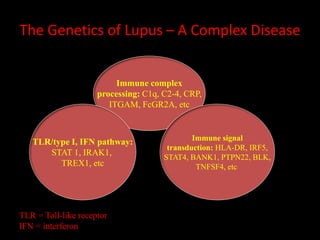
The Genetics of Lupus – A Complex Disease
Immune complex
processing: C1q, C2-4, CRP,
ITGAM, FcGR2A, etc
TLR/type I, IFN pathway:
STAT 1, IRAK1,
TREX1, etc
Immune signal
transduction: HLA-DR, IRF5,
STAT4, BANK1, PTPN22, BLK,
TNFSF4, etc
TLR = Toll-like receptor
IFN = interferon
Increased Interferon Alpha
(IFNα) in Lupus
The signature cytokine for the disease?
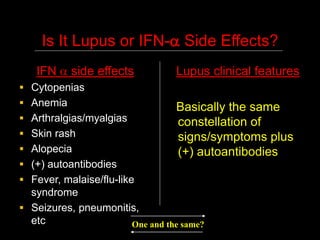
Is It Lupus or IFN- Side Effects?
IFN  side effects
 Cytopenias
 Anemia
 Arthralgias/myalgias
 Skin rash
 Alopecia
 (+) autoantibodies
 Fever, malaise/flu-like
syndrome
 Seizures, pneumonitis,
etc
Lupus clinical features
Basically the same
constellation of
signs/symptoms plus
(+) autoantibodies
One and the same?
SLE
How Does Tissue Injury
Occur?
SLE
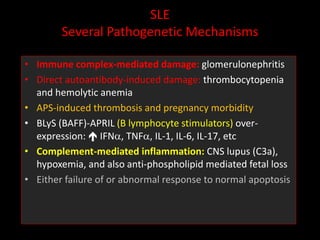
Several Pathogenetic Mechanisms
• Immune complex-mediated damage: glomerulonephritis
• Direct autoantibody-induced damage: thrombocytopenia
and hemolytic anemia
• APS-induced thrombosis and pregnancy morbidity
• BLyS (BAFF)-APRIL (B lymphocyte stimulators) over-
expression:  IFN, TNF, IL-1, IL-6, IL-17, etc
• Complement-mediated inflammation: CNS lupus (C3a),
hypoxemia, and also anti-phospholipid mediated fetal loss
• Either failure of or abnormal response to normal apoptosis
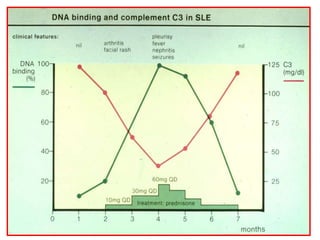
Lupus – Complement Levels
Patients who are always
hypocomplementemic regardless of
clinical disease activity may have an
underlying complement deficiency!
Mortality in Lupus - Bimodal Peaks
Early:
• Increased disease activity
• Infections due to immunosuppression
Late:
• Deaths the result of permanent damage: treatment side
effects, atherosclerosis with CAD and heart attacks,
strokes, pulmonary, end-stage renal disease (ESRD), etc
Coronary Heart Disease in Lupus
Premature or Accelerated Atherosclerosis
 The prevalence ranges from 6 to 15%
 The incidence of a MI is 5 times higher in lupus than
in the general population
 The risk of adverse cardiovascular outcomes is  by
a factor of 7 to 17 in patients with lupus
 Young women (between ages 35 and 44) are
significantly more likely (52-fold increased risk) to
experience an MI if they have lupus
 Reasons: multifactorial and not explained just by the
traditional CAD risk factors
Leading Causes of Death in SLE
 Active lupus
 Infection
 Cardiovascular
disease
SLE
Therapeutic
Approaches
Treatment of Lupus
• Vitamin D (an immunomodulator!)
• Hydroxychloroquine (HCQ) (Plaquenil®)
• Corticosteroids – Minimize to the extent possible
• Immunosuppressive agents (MTX, azathioprine,
mycophenolate mofetil, etc)
• Targeted biologic therapies: belimumab (Benlysta®),
rituximab (Rituxan®)
• Statins? especially for APS (antiphospholipid
syndrome)?*
Every patient with lupus should be on vitamin D
and hydroxychloroquine (HCQ)!
• A 20-ng/ml increase in the 25 (OH) D level was
associated with a 21% decrease in the odds of
having a high disease activity score
• There was no evidence of additional benefit of
25 (OH) D beyond a level of 40 ng/ml
Hydroxychloroquine (HCQ)
• It prevents thrombotic events in lupus patients.
• HCQ is an anti-platelet agent, inhibiting aPL-
induced GPIIb/IIIa expression; it does not prolong
bleeding time
• It prevents lupus flare-ups and progression of
disease, including lupus nephritis . It prevents
diabetes in patients with RA receiving it
Hydroxychloroquine (HCQ)
• It lowers glycemia and lipids (although
modestly)
• It downregulates inflammation at different
levels: prostaglandins, DNA Abs, T cell
activation, inhibits intracellular TLR
activation , inhibits IFN-a, IL-1 and IL-6
production .
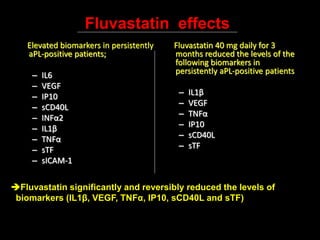
Elevated biomarkers in persistently
aPL-positive patients;
– IL6
– VEGF
– IP10
– sCD40L
– INFα2
– IL1β
– TNFα
– sTF
– sICAM-1
Fluvastatin 40 mg daily for 3
months reduced the levels of the
following biomarkers in
persistently aPL-positive patients
– IL1β
– VEGF
– TNFα
– IP10
– sCD40L
– sTF
Fluvastatin effects
Fluvastatin significantly and reversibly reduced the levels of
biomarkers (IL1β, VEGF, TNFα, IP10, sCD40L and sTF)
NSAIDS and Steroids
INCREASES CARDIOVASCULAR
DAMAGE AND SHOULD BE AVOIDED
New FDA-Approved Agent – Belimumab
(Benlysta®)
• Anti-BLYS humanized monoclonal antibody.
• Problematic indications: not for thrombocytopenia,
CNS, or renal lupus
• Helpful but modest efficacy
• It helps reduce steroids, prevent flares, and
maintain disease remission
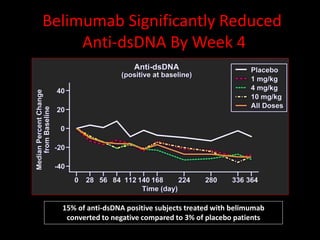
Belimumab Significantly Reduced
Anti-dsDNA By Week 4
15% of anti-dsDNA positive subjects treated with belimumab
converted to negative compared to 3% of placebo patients
The Future
Biomarkers and Targeted Therapies
• Develop better biomarkers for flares and
predictors of response
• Corticosteroid-free regimens
• Other B cell blockers, e.g., ocrelizumab,
epratuzumab, TACI-Ig (atacicept, an anti-
BLyS/April agent).
The Future
Biomarkers and Targeted Therapies
Ongoing trials :
• Interferon alpha (IFN) blockers, e.g.,
sifalimumab. Good promising data. Ongoing trials
• Anti-C5: humanized monoclonal Ab, especially
for APS, ongoing trials.
• Interferon gamma (IFNγ) blockers: for renal
lupus. Ongoing trials
https://www.facebook.com/groups/1451610115129555/#!/groups/145
1610115129555/
Wellcome in our new group ..... Dr.SAMIR EL ANSARY
GOOD LUCK
SAMIR EL ANSARY
ICU PROFESSOR
AIN SHAMS
CAIRO
elansarysamir@yahoo.com

Sle pathophysiology and management

  • 1.
    SLE – AnOverview and Update SAMIR EL ANSARY ICU PROFESSOR AIN SHAMS CAIRO elansarysamir@yahoo.com
  • 2.
  • 3.
    Systemic Lupus Erythematosus (SLE) •Definition: a chronic inflammatory systemic autoimmune disease of unknown etiology characterized by polyclonal B-cell activation and abnormal autoantibodies • Not one disease but several clinical subsets, some mild, e.g., “skin and joint” lupus, and others more severe, with profound thrombocytopenia, thrombosis from APS (antiphospholipid syndrome), and severe renal, lung, and CNS involvement
  • 4.
    SLE Classification Criteria 1.Malar (butterfly) rash 2. Discoid lesions 3. Photosensitivity 4. Oral ulcers 5. Non-deforming arthritis (non-erosive for the most part) 6. Serositis: pleuropericarditis, aseptic peritonitis 7. Renal: persistent proteinuria › 0.5 g/d or ›3+ or cellular casts Definite SLE = 4 or more positive criteria
  • 5.
    SLE Classification Criteria 1.Neurologic disorders: seizures, psychosis 2. Heme: hemolytic anemia; leukopenia, thrombocytopenia 3. Immune: anti-DNA, or anti-Sm, or APS (ACA IgG, IgM), or lupus anticoagulant (standard) or false + RPR 4. Positive FANA (fluorescent antinuclear antibody) Definite SLE = 4 or more positive criteria
  • 6.
    New SLICC* Revisionof the ACR Classification Criteria - Clinical 1. Acute/subacute cutaneous lupus 2. Chronic cutaneous lupus 3. Oral/Nasal ulcers 4. Nonscarring alopecia 5. Inflammatory synovitis with physician-observed swelling of two or more joints OR tender joints with morning stiffness 6. Serositis *Systemic Lupus International Collaborating Clinics (SLICC)
  • 7.
    New SLICC* Revisionof the ACR Classification Criteria - Clinical 7. Renal: Urine protein/creatinine (or 24 hr urine protein) representing at least 500 mg of protein/24 hours or red blood cell casts 8. Neurologic: seizures, psychosis, mononeuritis multiplex, myelitis, peripheral or cranial neuropathy, cerebritis (acute confusional state) 9. Hemolytic anemia 10. Leukopenia (< 4000/mm3 at least once) OR Lymphopenia (< 1000/mm3 at least once) 11. Thrombocytopenia (<100,000/mm3) at least once *Systemic Lupus International Collaborating Clinics (SLICC)
  • 8.
    SLICC Revision ofthe ACR Classification Criteria – Immunologic 1. ANA (antinuclear antibody) above laboratory reference range 2. Anti-dsDNA above laboratory reference range (except ELISA: twice above laboratory reference range) 3. Anti-Sm (anti-Smith) antibody 4. APS abs: LAC, false-positive test for syphilis, anticardiolipin IgG, IgM, or IgA Abs, at least twice normal or medium-high titer, same for anti-B2 glycoprotein 1 5. Low complement: low C3, low C4, low CH50 6. Direct Coombs test in the absence of hemolytic anemia
  • 9.
    Lupus - SLICC*17 New Classification Criteria: 4 needed • At least 1 clinical plus at least 1 immunologic criteria (for a total of 4) or • Lupus nephritis by biopsy as the sole clinical criterion plus SLE autoantibodies: (+) ANA or (+) anti-dsDNA *Systemic Lupus International Collaborating Clinics (SLICC)
  • 10.
    The Use ofANA for Screening • Anti-nuclear antibody (ANA) is considered a screening method for diagnosis of autoimmune disorders • Immunofluorescence ANA assay (IF) remains the gold standard for detection of ANA {position statement) • Many laboratories perform immunoassays (such as the multiplexed immunobead assay), for the detection of ANA as it is less labor-intensive
  • 11.
    • To compareANA detection by multiplex immunobead assay with the gold standard immunofluorescence (IF) • Patient samples tested for both assays: • Multiplex immunobead assay (MIA) were considered positive based on the manufacturer’s instructions • Immunofluorescence (IF) was considered positive at a titer ≥ 1:160
  • 12.
    Methods • Data collectedprospectively on rheumatology patients tested for ANA by multiplex immunobead assay MIA • Performance characteristics of the immuno-assay were determined using the IF results as the “gold standard”
  • 13.
    Conclusions • Patients testednegative by the MIA (bioplex) included patients with definite ANA-associated autoimmune diseases • These data suggest that screening with an immunoassay would result in misclassification and potential delay or missed diagnoses of certain systemic autoimmune diseases - Multiplex immunobead assay unreliable • Immunofluorescence (IF) should remain the preferred assay for ANA testing in patients with suspicion of autoimmune disorders until platforms with sensitivities comparable to IF or better are developed. IF the preferred method – Endorsed by the American College of Rheumatology (ACR)
  • 14.
  • 15.
    SLE – GeneticSusceptibility MHC Related • HLA-DR1, 2, 3, 4 • Alleles of HLA-DRB1, IRF5, and STAT4 • C2 - C4 deficiency • TNF- polymorphisms Not MHC Related • C1q deficiency (rare but highest risk) • Chromosome 1 region 1q41-43 (PARP), region 1q23 (FcγRIIA, FcγRIIIA) • IL-10, IL-6 and MBL polymorphisms • Chromosome 8.p23.1: reduced expression of BLK and increased expression of C8orf13 (B cell tyrosine kinase), chromosome 16p11.22: integrin  genes IGAM-ITGAX • B cell gene BANK1 • X chromosome-linked gene IRAK1 MHC = Major Histocompatibility Complex
  • 16.
    The Genetics ofLupus – A Complex Disease Immune complex processing: C1q, C2-4, CRP, ITGAM, FcGR2A, etc TLR/type I, IFN pathway: STAT 1, IRAK1, TREX1, etc Immune signal transduction: HLA-DR, IRF5, STAT4, BANK1, PTPN22, BLK, TNFSF4, etc TLR = Toll-like receptor IFN = interferon
  • 17.
    Increased Interferon Alpha (IFNα)in Lupus The signature cytokine for the disease?
  • 18.
    Is It Lupusor IFN- Side Effects? IFN  side effects  Cytopenias  Anemia  Arthralgias/myalgias  Skin rash  Alopecia  (+) autoantibodies  Fever, malaise/flu-like syndrome  Seizures, pneumonitis, etc Lupus clinical features Basically the same constellation of signs/symptoms plus (+) autoantibodies One and the same?
  • 19.
    SLE How Does TissueInjury Occur?
  • 20.
    SLE Several Pathogenetic Mechanisms •Immune complex-mediated damage: glomerulonephritis • Direct autoantibody-induced damage: thrombocytopenia and hemolytic anemia • APS-induced thrombosis and pregnancy morbidity • BLyS (BAFF)-APRIL (B lymphocyte stimulators) over- expression:  IFN, TNF, IL-1, IL-6, IL-17, etc • Complement-mediated inflammation: CNS lupus (C3a), hypoxemia, and also anti-phospholipid mediated fetal loss • Either failure of or abnormal response to normal apoptosis
  • 22.
    Lupus – ComplementLevels Patients who are always hypocomplementemic regardless of clinical disease activity may have an underlying complement deficiency!
  • 23.
    Mortality in Lupus- Bimodal Peaks Early: • Increased disease activity • Infections due to immunosuppression Late: • Deaths the result of permanent damage: treatment side effects, atherosclerosis with CAD and heart attacks, strokes, pulmonary, end-stage renal disease (ESRD), etc
  • 24.
    Coronary Heart Diseasein Lupus Premature or Accelerated Atherosclerosis  The prevalence ranges from 6 to 15%  The incidence of a MI is 5 times higher in lupus than in the general population  The risk of adverse cardiovascular outcomes is  by a factor of 7 to 17 in patients with lupus  Young women (between ages 35 and 44) are significantly more likely (52-fold increased risk) to experience an MI if they have lupus  Reasons: multifactorial and not explained just by the traditional CAD risk factors
  • 25.
    Leading Causes ofDeath in SLE  Active lupus  Infection  Cardiovascular disease
  • 26.
  • 27.
    Treatment of Lupus •Vitamin D (an immunomodulator!) • Hydroxychloroquine (HCQ) (Plaquenil®) • Corticosteroids – Minimize to the extent possible • Immunosuppressive agents (MTX, azathioprine, mycophenolate mofetil, etc) • Targeted biologic therapies: belimumab (Benlysta®), rituximab (Rituxan®) • Statins? especially for APS (antiphospholipid syndrome)?*
  • 28.
    Every patient withlupus should be on vitamin D and hydroxychloroquine (HCQ)! • A 20-ng/ml increase in the 25 (OH) D level was associated with a 21% decrease in the odds of having a high disease activity score • There was no evidence of additional benefit of 25 (OH) D beyond a level of 40 ng/ml
  • 29.
    Hydroxychloroquine (HCQ) • Itprevents thrombotic events in lupus patients. • HCQ is an anti-platelet agent, inhibiting aPL- induced GPIIb/IIIa expression; it does not prolong bleeding time • It prevents lupus flare-ups and progression of disease, including lupus nephritis . It prevents diabetes in patients with RA receiving it
  • 30.
    Hydroxychloroquine (HCQ) • Itlowers glycemia and lipids (although modestly) • It downregulates inflammation at different levels: prostaglandins, DNA Abs, T cell activation, inhibits intracellular TLR activation , inhibits IFN-a, IL-1 and IL-6 production .
  • 31.
    Elevated biomarkers inpersistently aPL-positive patients; – IL6 – VEGF – IP10 – sCD40L – INFα2 – IL1β – TNFα – sTF – sICAM-1 Fluvastatin 40 mg daily for 3 months reduced the levels of the following biomarkers in persistently aPL-positive patients – IL1β – VEGF – TNFα – IP10 – sCD40L – sTF Fluvastatin effects Fluvastatin significantly and reversibly reduced the levels of biomarkers (IL1β, VEGF, TNFα, IP10, sCD40L and sTF)
  • 32.
    NSAIDS and Steroids INCREASESCARDIOVASCULAR DAMAGE AND SHOULD BE AVOIDED
  • 33.
    New FDA-Approved Agent– Belimumab (Benlysta®) • Anti-BLYS humanized monoclonal antibody. • Problematic indications: not for thrombocytopenia, CNS, or renal lupus • Helpful but modest efficacy • It helps reduce steroids, prevent flares, and maintain disease remission
  • 34.
    Belimumab Significantly Reduced Anti-dsDNABy Week 4 15% of anti-dsDNA positive subjects treated with belimumab converted to negative compared to 3% of placebo patients
  • 35.
    The Future Biomarkers andTargeted Therapies • Develop better biomarkers for flares and predictors of response • Corticosteroid-free regimens • Other B cell blockers, e.g., ocrelizumab, epratuzumab, TACI-Ig (atacicept, an anti- BLyS/April agent).
  • 36.
    The Future Biomarkers andTargeted Therapies Ongoing trials : • Interferon alpha (IFN) blockers, e.g., sifalimumab. Good promising data. Ongoing trials • Anti-C5: humanized monoclonal Ab, especially for APS, ongoing trials. • Interferon gamma (IFNγ) blockers: for renal lupus. Ongoing trials
  • 37.
  • 38.
    GOOD LUCK SAMIR ELANSARY ICU PROFESSOR AIN SHAMS CAIRO elansarysamir@yahoo.com