Meat
Done by: Mr. Devon Nicholas
Mr. Kellon Marecheau
INTRODUCTION
• The transformation of slaughter animals into meat is a chain of events including
handling and loading on the farm, transport to the market, pens or
slaughterhouse, off-loading and holding and finally slaughter.
• During these procedures poor operational techniques and facilities will lead to
unnecessary suffering, injury and loss of production
INTRODUCTION
• Livestock referred to in this teaching are animals from which meat is
produced. Types of food animals vary in different parts of the world.
• This will refer mainly to cattle, goats, sheep, pigs, poultry
• Other slaughter animals of relevance in particular in developing
countries are buffaloes, camels and rabbits.
Criteria to Selecting Animals to be Slaughtered
1. Age
2. Weight and visual appraisal
3. Animal Health
Basic Selection of Animal to be Slaughtered
1. Age
Recommended for swine is 6 to 12 months, 3 years or younger for cattle and
about 1 year for goats
Meat from older animals tend to become darker, tougher, fattier and poorer in
meat quality than meat from younger animal. However, it is flavorful
In general, meat from old animals is juicier than meat from young ones.
Pork follows the same trend as beef. Very little changes in tenderness occurs
after 11 months of age
Basic Selection of Animal to be Slaughtered
2. Weight and visual appraisal are a general guide to an animal’s
readiness for market, but, to ensure accurate selection, handling the live
animal is essential.
By knowing and understanding the key handling points, you will be able to
assess the potential carcass classification, to help you consistently meet your
customers’ specification.
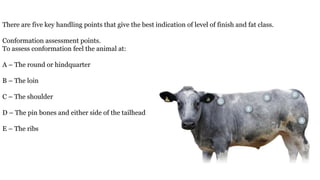
There are five key handling points that give the best indication of level of finish and fat class.
Conformation assessment points.
To assess conformation feel the animal at:
A – The round or hindquarter
B – The loin
C – The shoulder
D – The pin bones and either side of the tailhead
E – The ribs
Basic Selection of Animal to be Slaughtered
• 3. Animal Health:
Only healthy animals shall be considered for slaughtering
Unhealthy animals must first be treated to become normal prior to
slaughter.
Meat from unhealthy animals is poor quality and it is not
recommended
HANDLING OF LIVESTOCK
• The first principle of animal handling is to avoid getting the animal excited.
• It takes up to 30 minutes for an animal to calm down and its heart rate to
return to be normal after rough handling.
• Calm animals move more easily and are less likely to bunch and be difficult
to remove from a pen.
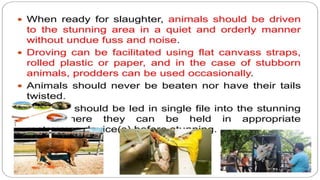
• Handlers should move with slow, deliberate movements and refrain from
yelling.
HANDLING OF LIVESTOCK
• Animals may become agitated when they are isolated from others. If an isolated
animal becomes agitated, other animals should be put in with it.
• Electric prodders (prods) should be used as little as possible or only on stubborn
animals. However it is more humane and causes less damage to give an animal a
mild electric shock than to hit it with a stick or twist its tail.
• Battery-operated prods are preferred to mains-current operated ones . The
voltage used should not exceed 32 V and never be used on sensitive parts such as
eyes, muzzle, anus and vulva.
Pre-Slaughtering Handling
Pre-slaughter handling is a major concern to the livestock industry,
especially the pork industry.
Stress applied to livestock before slaughter can lead to undesirable effects
on the meat produced from these animals,
Preslaughter stress can be reduced by preventing the mixing of different
groups of animals, by keeping livestock cool with adequate ventilation,
and by avoiding overcrowding.
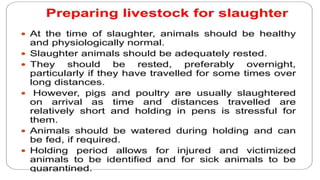
Before slaughter, animals should be allowed access to water but held off
feed for 12 to 24 hours to assure complete bleeding and ease of
evisceration (the removal of internal organs).
Transportation of Meat Animals
• Transport of livestock is undoubtedly the most stressful and injurious
stage in the chain of operations between farm and slaughterhouse
and contributes significantly to poor animal welfare and loss of
production.
Transportation of Meat Animals
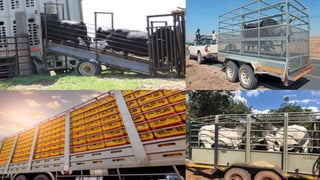
•Animals are taken to the slaughter house either on hoof or through
road. Whatever the means, what is of paramount importance is that the
animals must not be subjected to cruelty.
•If the animals are carried by road, care needs to be taken to avoid
overcrowding which may lead to suffocation and physical injuries in the
form of bruises, fractures etc.
•Tying or chaining of the animals is to be avoided.
•There are specially designed trucks and wagons available to take care
of such issues and should be used as far as possible.
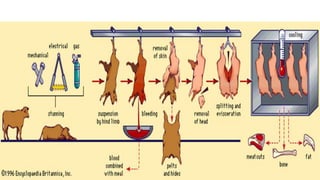
What is SLAUGHTERING?
Slaughtering is the term used to describe
the killing and butchering of animals, usually
for food.
Commonly it refers to killing and
butchering of domestic livestock (tame
animals).
The animals most commonly slaughtered for
food are:
 Cattle(for beef and veal),
 Buffalo,
 Sheep (for lamb and mutton),
 Goats,
Pigs (for pork),
Horses (for horsemeat),
Fowl, largely chickens, turkeys, and ducks.
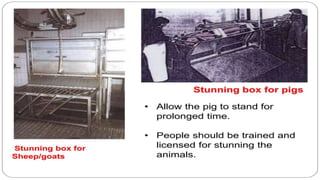
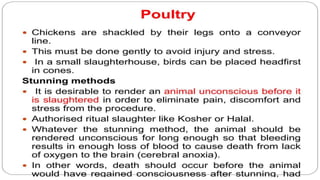
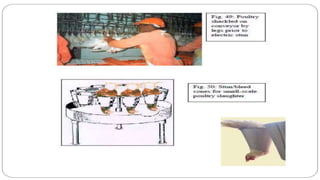
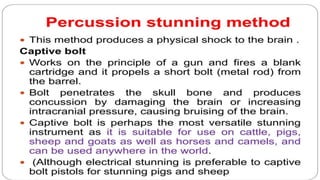
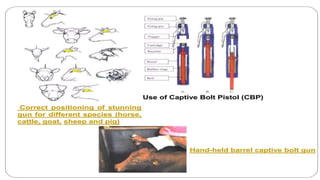
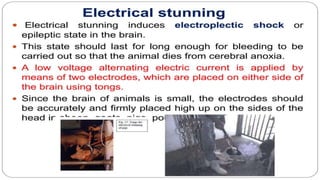
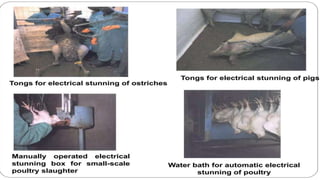
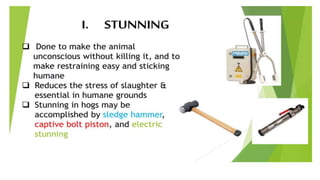
STUNNING METHODS
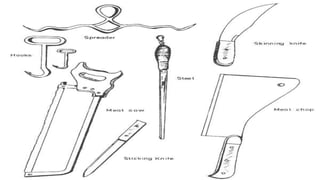
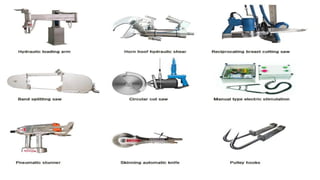
TOOLS USED FOR
SLAUGHTERING
PROCESS OF SLAUGHTERING A PIG
EDUCATIONAL VIDEOS
• https://www.youtube.com/watch?v=JtnsZ2JaKso - PIG
• https://www.youtube.com/watch?v=WrOzwoMKzH4 - CATTLE
• https://www.youtube.com/watch?v=Uq_GB3ldQW8 - LAMB
..SLAUGHTERING AND MEAT FABRICATION.pptx

..SLAUGHTERING AND MEAT FABRICATION.pptx

  • 1.
    Meat Done by: Mr.Devon Nicholas Mr. Kellon Marecheau
  • 2.
    INTRODUCTION • The transformationof slaughter animals into meat is a chain of events including handling and loading on the farm, transport to the market, pens or slaughterhouse, off-loading and holding and finally slaughter. • During these procedures poor operational techniques and facilities will lead to unnecessary suffering, injury and loss of production
  • 3.
    INTRODUCTION • Livestock referredto in this teaching are animals from which meat is produced. Types of food animals vary in different parts of the world. • This will refer mainly to cattle, goats, sheep, pigs, poultry • Other slaughter animals of relevance in particular in developing countries are buffaloes, camels and rabbits.
  • 5.
    Criteria to SelectingAnimals to be Slaughtered 1. Age 2. Weight and visual appraisal 3. Animal Health
  • 6.
    Basic Selection ofAnimal to be Slaughtered 1. Age Recommended for swine is 6 to 12 months, 3 years or younger for cattle and about 1 year for goats Meat from older animals tend to become darker, tougher, fattier and poorer in meat quality than meat from younger animal. However, it is flavorful In general, meat from old animals is juicier than meat from young ones. Pork follows the same trend as beef. Very little changes in tenderness occurs after 11 months of age
  • 7.
    Basic Selection ofAnimal to be Slaughtered 2. Weight and visual appraisal are a general guide to an animal’s readiness for market, but, to ensure accurate selection, handling the live animal is essential. By knowing and understanding the key handling points, you will be able to assess the potential carcass classification, to help you consistently meet your customers’ specification.
  • 8.
    There are fivekey handling points that give the best indication of level of finish and fat class. Conformation assessment points. To assess conformation feel the animal at: A – The round or hindquarter B – The loin C – The shoulder D – The pin bones and either side of the tailhead E – The ribs
  • 9.
    Basic Selection ofAnimal to be Slaughtered • 3. Animal Health: Only healthy animals shall be considered for slaughtering Unhealthy animals must first be treated to become normal prior to slaughter. Meat from unhealthy animals is poor quality and it is not recommended
  • 10.
    HANDLING OF LIVESTOCK •The first principle of animal handling is to avoid getting the animal excited. • It takes up to 30 minutes for an animal to calm down and its heart rate to return to be normal after rough handling. • Calm animals move more easily and are less likely to bunch and be difficult to remove from a pen. • Handlers should move with slow, deliberate movements and refrain from yelling.
  • 11.
    HANDLING OF LIVESTOCK •Animals may become agitated when they are isolated from others. If an isolated animal becomes agitated, other animals should be put in with it. • Electric prodders (prods) should be used as little as possible or only on stubborn animals. However it is more humane and causes less damage to give an animal a mild electric shock than to hit it with a stick or twist its tail. • Battery-operated prods are preferred to mains-current operated ones . The voltage used should not exceed 32 V and never be used on sensitive parts such as eyes, muzzle, anus and vulva.
  • 12.
    Pre-Slaughtering Handling Pre-slaughter handlingis a major concern to the livestock industry, especially the pork industry. Stress applied to livestock before slaughter can lead to undesirable effects on the meat produced from these animals, Preslaughter stress can be reduced by preventing the mixing of different groups of animals, by keeping livestock cool with adequate ventilation, and by avoiding overcrowding. Before slaughter, animals should be allowed access to water but held off feed for 12 to 24 hours to assure complete bleeding and ease of evisceration (the removal of internal organs).
  • 13.
    Transportation of MeatAnimals • Transport of livestock is undoubtedly the most stressful and injurious stage in the chain of operations between farm and slaughterhouse and contributes significantly to poor animal welfare and loss of production.
  • 14.
    Transportation of MeatAnimals •Animals are taken to the slaughter house either on hoof or through road. Whatever the means, what is of paramount importance is that the animals must not be subjected to cruelty. •If the animals are carried by road, care needs to be taken to avoid overcrowding which may lead to suffocation and physical injuries in the form of bruises, fractures etc. •Tying or chaining of the animals is to be avoided. •There are specially designed trucks and wagons available to take care of such issues and should be used as far as possible.
  • 16.
    What is SLAUGHTERING? Slaughteringis the term used to describe the killing and butchering of animals, usually for food. Commonly it refers to killing and butchering of domestic livestock (tame animals).
  • 17.
    The animals mostcommonly slaughtered for food are:  Cattle(for beef and veal),  Buffalo,  Sheep (for lamb and mutton),  Goats, Pigs (for pork), Horses (for horsemeat), Fowl, largely chickens, turkeys, and ducks.
  • 25.
  • 30.
  • 34.
  • 56.
    EDUCATIONAL VIDEOS • https://www.youtube.com/watch?v=JtnsZ2JaKso- PIG • https://www.youtube.com/watch?v=WrOzwoMKzH4 - CATTLE • https://www.youtube.com/watch?v=Uq_GB3ldQW8 - LAMB