premises that are approved and registered by the
controlling authority in which food animals are slaughtered
and dressed for human consumption (NMIS)
Also known as abattoir
A --with minimum facilities and operational procedures that are
adequate to slaughter food animals for distribution and sale only
within the city or municipality where the slaughterhouse is located.
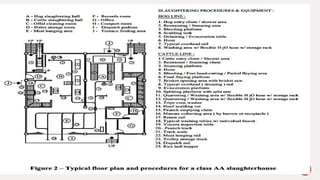
AA- has semi-automated/ semi-mechanized facilities and operational
procedures that are adequate to slaughter food animals or cutting
and packing of carcasses or primal parts for inter-provincial
distribution and sale in any meat market nationwide. The application
of Good Manufacturing Practices (GMP) program shall be required for
this classification
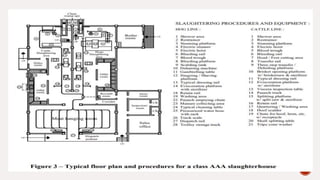
AAA-with fully automated/ mechanized facilities and
operational procedures that are adequate to slaughter
food animals or cut and pack carcasses or primal parts
for distribution and sale for domestic and international
trade.
The competent authority shall certify that the meat is fit
for human consumption. The application of Hazard
Analysis and Critical Control Point (HACCP) program
shall be required for this classification.
The site shall be on a higher level than its surroundings
The slope, terrain, foundation and soil conditions on the site shall be suitable for
the construction of substantial, and permanent buildings.
The site shall be located far from any building used for human habitation, and
from any factory, public road or public place (at least 200 meters) and should be
free from dust, odor, smoke, and other contaminants.
The site shall not be located adjacent to the public market areas.
If possible, it shall be located near livestock production areas.
If located near a river, stream, or lake, the slaughterhouse shall be at least 10
meters away from the bank.
The site shall have a continuous water supply to meet the required amount of
water.
The site shall be dry and well drained.
The site shall be suitable for the adequate disposal of solid and liquid waste.
Adequate sources of energy shall be available at the site. Electric wiring and installations
shall be enclosed in suitable trunking or casing that conform with the national electric
code.
Transport to and from the slaughterhouse shall be accessible.
The site shall be fenced.
The area immediately surrounding the slaughterhouse shall be concreted or covered
with asphalt or a similar material. The access road shall be similarly treated.
There shall be sufficient space for possible future expansion.
Manual system- utilizes gravity or manual
pushing/pulling and lifting
Semi-mechanized system- utilizes a mechanized system
on selected slaughtering processes.
Fully-mechanized system- utilizes fully automated
equipment for elevating and lowering of animal and
carcass. The overhead railing system for this classification
is continuous at a constant speed.
Holding Pen
Stunning pen
Sticking and Bleeding Area
Scalding and dehairing area
Evisceration area
Offal room
Retained carcass area/rails
 Cold storage
Chilling temperature: 0°C to 4 °C
Refrigeration temperature: 5°C to 18°C
Freezing temperature: below 0°C to -40 °C
 Storage Room
 Dispatch Area
Boiler room
Condemnation pit
 It should have complete facilities for prior care of animals prior to
slaughter
 Should have good ventilation
 It should have separate dressing floors for hogs and large animals
 Separate room for handling meat and offals
 There should have an equipment and implement for proper handling of
meat and byproducts
 There must be provisions for hanging carcasses and if possible
refrigeration facilities
Adequate water supply and if possible pressurized,
water supply should be potable. Water heater should
be provided to facilitate cleaning of facilities and to
minimize use of detergents
Requirements for water: Cattle - 60 gallons/heads Hogs
- 30 gals/head Goat/sheep - 15 gals/head Poultry – 7
gals/head
With waste disposal facility
Holding area for live birds and shackling area
Conditioning and slitting
Scalding Tank and defeathering machines
Evisceration area
Refrigeration (Optional)
Dry storage
Holding area for dressed birds
Recommended Extraction Rate
 Refers to the proportion of animals in a given population that can be slaughtered for
one year. The following are recommended percentage per species.
Carabao 11.15%
Cattle 22%
Hogs 135%
Goat 85%
Chicken 397%
Ducks 65%
1
Reasons for the differences in the Recommended Extraction Rate
1. Species differ in production/growing period
- carabao/cattle – 2-3 yrs slaughter wt
- hogs - 2 batches/yr
- chicken - 38-40 days/batch
2. Species differ in reproduction rate
- carabao/cattle - 1 calf/birth
- hogs - 10 piglets/litter
Reasons for the differences in Extraction Rate
3. Species differ in reproduction cycle/ gestation period
- carabao - 324 days
- cattle - 283 days
- hogs - 114 days
1
depends mainly on the purpose the meat is to be used
and on the cost of the end-product
the meat produced should possess the characteristics
necessary for the products or recipes to be made
ex. for comminuted products manufacture then it should
have high water holding capacity, high emulsion capacity
1. Sex Type
◦Fresh meat retailing – gilt, barrow, heifer & steers are
recommended
◦For processing – stag, sow, bull, cow
- Boars are not used for processing and fresh meat retailing
due to the boar taint odor – the 5-α-androst-16ene-3one,
◦For processed meat:
a. Intact meat (ham, bacon) – gilt & barrow
b. Comminuted – sausage, hamburger – stag, sow, cow (Has
high WHC, flavorful)
2. Age
 the older the animals the darker the meat and is less
tender (tougher) but is more flavorful compared to young
ones
• hogs – 6-12 months before, now 4-5 months weighing
about 90 kg
• cattle/carabao – 2.5 to 3 years
• native cattle - 3 to 5 years; crossbreds- 3 years
3. Condition and Health of the Animal
-should have an optimum condition, not too thin, not too fat
-Only healthy animals are recommended for slaughter
-Slaughtered animals are intended for human consumption
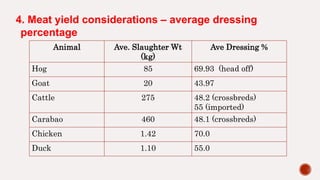
4. Meat yield considerations – average dressing
percentage
Animal Ave. Slaughter Wt
(kg)
Ave Dressing %
Hog 85 69.93 (head off)
Goat 20 43.97
Cattle 275 48.2 (crossbreds)
55 (imported)
Carabao 460 48.1 (crossbreds)
Chicken 1.42 70.0
Duck 1.10 55.0
5. Loin Eye area and other measurements considerations
◦wide loin eye area in swine is indicative of high lean cut and
low fat cut yields
- hogs with wide loin eye area are ideal for slaughtering
A B
C D
LOIN EYE AREA OF PORK
6. Degree of fatness consideration
◦in meat, palatability factors like flavor, tenderness and
juiciness are influenced by fat
◦30 to 40% fat is the most acceptable for comminuted beef
and pork products
◦at this fat level meat tends to lose much weight during
cooking but remains juicy, tender and flavorful
--thicker backfat= higher dressing percentage but yield lower
percent ham, loin and lean cuts
1. Fasting – the withdrawal of feeds and giving an ad
libitum amount of water
-Ruminants – 48 hrs (24-48 hrs)
-Hogs – 12 to 24 hours
-Poultry – 6 to 12 hours
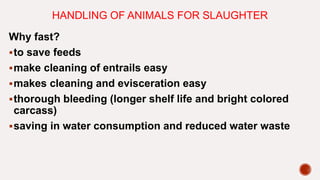
HANDLING OF ANIMALS FOR SLAUGHTER
Why fast?
to save feeds
make cleaning of entrails easy
makes cleaning and evisceration easy
thorough bleeding (longer shelf life and bright colored
carcass)
saving in water consumption and reduced water waste
HANDLING OF ANIMALS FOR SLAUGHTER
2. Let animals relax and avoid any form of stress prior to
slaughter
◦For mild stress (usually stress condition) – let the animals
relax for 12 – 24 hours
◦Severe stressful condition – rest for 24 hours with sufficient
feed and water, fasting will follow for another days
Disadvantages of stress:
a. loss of muscle glycogen (the reserve energy) and meat pH
b. Affects the water holding capacity
c. Loss of flavor, color, juiciness, tenderness
in a carcass, glycogen is converted into lactic acid that controls the pH
of the meat (ideal pH-5.7 to 6.0)
 more glycogen present in the muscle, the greater the potential for
lower ultimate pH.
 High pH =DFD (Dark, Firm and Dry) meat---Long term stress
 Low pH= PSE (Pale, Soft, Exudative) meat--- short term stress
3. Handle the animal gently or with care
prior to slaughter
- avoid mishandling the animal, like: kicking or boxing – causes
blood clots,
- provided in the RA 8485 “ Animal Welfare Act”
4. Cleaning the exterior of the animal
- before slaughtering to avoid contamination
- the hide is a potent source of contaminants
1. Cleanliness of the carcass
- proper hygiene to produce clean
carcass
2. Hygiene of production
- Good Manufacturing Practice (GMP)
-Hazard Analysis Critical Control
Points (HACCP))
FACTORS TO CONSIDER IN SLAUGHTERING
ANIMALS
3. Efficiency of meat inspection
- to avoid spread of disease to humans
4. Adequacy of meat preservation
- availability of chiller/ refrigeration
facilities
- allow to drip for 30 minutes before
transfer to chiller
FACTORS TO CONSIDER IN SLAUGHTERING
ANIMALS

Slaughterhouse PPT.pptx

  • 1.
    premises that areapproved and registered by the controlling authority in which food animals are slaughtered and dressed for human consumption (NMIS) Also known as abattoir
  • 2.
    A --with minimumfacilities and operational procedures that are adequate to slaughter food animals for distribution and sale only within the city or municipality where the slaughterhouse is located. AA- has semi-automated/ semi-mechanized facilities and operational procedures that are adequate to slaughter food animals or cutting and packing of carcasses or primal parts for inter-provincial distribution and sale in any meat market nationwide. The application of Good Manufacturing Practices (GMP) program shall be required for this classification
  • 3.
    AAA-with fully automated/mechanized facilities and operational procedures that are adequate to slaughter food animals or cut and pack carcasses or primal parts for distribution and sale for domestic and international trade. The competent authority shall certify that the meat is fit for human consumption. The application of Hazard Analysis and Critical Control Point (HACCP) program shall be required for this classification.
  • 7.
    The site shallbe on a higher level than its surroundings The slope, terrain, foundation and soil conditions on the site shall be suitable for the construction of substantial, and permanent buildings. The site shall be located far from any building used for human habitation, and from any factory, public road or public place (at least 200 meters) and should be free from dust, odor, smoke, and other contaminants. The site shall not be located adjacent to the public market areas. If possible, it shall be located near livestock production areas. If located near a river, stream, or lake, the slaughterhouse shall be at least 10 meters away from the bank. The site shall have a continuous water supply to meet the required amount of water.
  • 8.
    The site shallbe dry and well drained. The site shall be suitable for the adequate disposal of solid and liquid waste. Adequate sources of energy shall be available at the site. Electric wiring and installations shall be enclosed in suitable trunking or casing that conform with the national electric code. Transport to and from the slaughterhouse shall be accessible. The site shall be fenced. The area immediately surrounding the slaughterhouse shall be concreted or covered with asphalt or a similar material. The access road shall be similarly treated. There shall be sufficient space for possible future expansion.
  • 10.
    Manual system- utilizesgravity or manual pushing/pulling and lifting Semi-mechanized system- utilizes a mechanized system on selected slaughtering processes. Fully-mechanized system- utilizes fully automated equipment for elevating and lowering of animal and carcass. The overhead railing system for this classification is continuous at a constant speed.
  • 11.
    Holding Pen Stunning pen Stickingand Bleeding Area Scalding and dehairing area Evisceration area Offal room Retained carcass area/rails  Cold storage Chilling temperature: 0°C to 4 °C Refrigeration temperature: 5°C to 18°C Freezing temperature: below 0°C to -40 °C  Storage Room  Dispatch Area
  • 12.
  • 13.
     It shouldhave complete facilities for prior care of animals prior to slaughter  Should have good ventilation  It should have separate dressing floors for hogs and large animals  Separate room for handling meat and offals  There should have an equipment and implement for proper handling of meat and byproducts  There must be provisions for hanging carcasses and if possible refrigeration facilities
  • 14.
    Adequate water supplyand if possible pressurized, water supply should be potable. Water heater should be provided to facilitate cleaning of facilities and to minimize use of detergents Requirements for water: Cattle - 60 gallons/heads Hogs - 30 gals/head Goat/sheep - 15 gals/head Poultry – 7 gals/head With waste disposal facility
  • 17.
    Holding area forlive birds and shackling area Conditioning and slitting Scalding Tank and defeathering machines Evisceration area Refrigeration (Optional) Dry storage Holding area for dressed birds
  • 18.
    Recommended Extraction Rate Refers to the proportion of animals in a given population that can be slaughtered for one year. The following are recommended percentage per species. Carabao 11.15% Cattle 22% Hogs 135% Goat 85% Chicken 397% Ducks 65%
  • 19.
    1 Reasons for thedifferences in the Recommended Extraction Rate 1. Species differ in production/growing period - carabao/cattle – 2-3 yrs slaughter wt - hogs - 2 batches/yr - chicken - 38-40 days/batch 2. Species differ in reproduction rate - carabao/cattle - 1 calf/birth - hogs - 10 piglets/litter
  • 20.
    Reasons for thedifferences in Extraction Rate 3. Species differ in reproduction cycle/ gestation period - carabao - 324 days - cattle - 283 days - hogs - 114 days 1
  • 21.
    depends mainly onthe purpose the meat is to be used and on the cost of the end-product the meat produced should possess the characteristics necessary for the products or recipes to be made ex. for comminuted products manufacture then it should have high water holding capacity, high emulsion capacity
  • 22.
    1. Sex Type ◦Freshmeat retailing – gilt, barrow, heifer & steers are recommended ◦For processing – stag, sow, bull, cow - Boars are not used for processing and fresh meat retailing due to the boar taint odor – the 5-α-androst-16ene-3one, ◦For processed meat: a. Intact meat (ham, bacon) – gilt & barrow b. Comminuted – sausage, hamburger – stag, sow, cow (Has high WHC, flavorful)
  • 23.
    2. Age  theolder the animals the darker the meat and is less tender (tougher) but is more flavorful compared to young ones • hogs – 6-12 months before, now 4-5 months weighing about 90 kg • cattle/carabao – 2.5 to 3 years • native cattle - 3 to 5 years; crossbreds- 3 years
  • 24.
    3. Condition andHealth of the Animal -should have an optimum condition, not too thin, not too fat -Only healthy animals are recommended for slaughter -Slaughtered animals are intended for human consumption
  • 25.
    4. Meat yieldconsiderations – average dressing percentage Animal Ave. Slaughter Wt (kg) Ave Dressing % Hog 85 69.93 (head off) Goat 20 43.97 Cattle 275 48.2 (crossbreds) 55 (imported) Carabao 460 48.1 (crossbreds) Chicken 1.42 70.0 Duck 1.10 55.0
  • 26.
    5. Loin Eyearea and other measurements considerations ◦wide loin eye area in swine is indicative of high lean cut and low fat cut yields - hogs with wide loin eye area are ideal for slaughtering
  • 28.
    A B C D LOINEYE AREA OF PORK
  • 29.
    6. Degree offatness consideration ◦in meat, palatability factors like flavor, tenderness and juiciness are influenced by fat ◦30 to 40% fat is the most acceptable for comminuted beef and pork products ◦at this fat level meat tends to lose much weight during cooking but remains juicy, tender and flavorful --thicker backfat= higher dressing percentage but yield lower percent ham, loin and lean cuts
  • 30.
    1. Fasting –the withdrawal of feeds and giving an ad libitum amount of water -Ruminants – 48 hrs (24-48 hrs) -Hogs – 12 to 24 hours -Poultry – 6 to 12 hours HANDLING OF ANIMALS FOR SLAUGHTER
  • 31.
    Why fast? to savefeeds make cleaning of entrails easy makes cleaning and evisceration easy thorough bleeding (longer shelf life and bright colored carcass) saving in water consumption and reduced water waste HANDLING OF ANIMALS FOR SLAUGHTER
  • 32.
    2. Let animalsrelax and avoid any form of stress prior to slaughter ◦For mild stress (usually stress condition) – let the animals relax for 12 – 24 hours ◦Severe stressful condition – rest for 24 hours with sufficient feed and water, fasting will follow for another days
  • 33.
    Disadvantages of stress: a.loss of muscle glycogen (the reserve energy) and meat pH b. Affects the water holding capacity c. Loss of flavor, color, juiciness, tenderness in a carcass, glycogen is converted into lactic acid that controls the pH of the meat (ideal pH-5.7 to 6.0)  more glycogen present in the muscle, the greater the potential for lower ultimate pH.  High pH =DFD (Dark, Firm and Dry) meat---Long term stress  Low pH= PSE (Pale, Soft, Exudative) meat--- short term stress
  • 34.
    3. Handle theanimal gently or with care prior to slaughter - avoid mishandling the animal, like: kicking or boxing – causes blood clots, - provided in the RA 8485 “ Animal Welfare Act” 4. Cleaning the exterior of the animal - before slaughtering to avoid contamination - the hide is a potent source of contaminants
  • 35.
    1. Cleanliness ofthe carcass - proper hygiene to produce clean carcass 2. Hygiene of production - Good Manufacturing Practice (GMP) -Hazard Analysis Critical Control Points (HACCP)) FACTORS TO CONSIDER IN SLAUGHTERING ANIMALS
  • 36.
    3. Efficiency ofmeat inspection - to avoid spread of disease to humans 4. Adequacy of meat preservation - availability of chiller/ refrigeration facilities - allow to drip for 30 minutes before transfer to chiller FACTORS TO CONSIDER IN SLAUGHTERING ANIMALS