Download free for 30 days
Sign in
Upload
Language (EN)
Support
Business
Mobile
Social Media
Marketing
Technology
Art & Photos
Career
Design
Education
Presentations & Public Speaking
Government & Nonprofit
Healthcare
Internet
Law
Leadership & Management
Automotive
Engineering
Software
Recruiting & HR
Retail
Sales
Services
Science
Small Business & Entrepreneurship
Food
Environment
Economy & Finance
Data & Analytics
Investor Relations
Sports
Spiritual
News & Politics
Travel
Self Improvement
Real Estate
Entertainment & Humor
Health & Medicine
Devices & Hardware
Lifestyle
Change Language
Language
English
Español
Português
Français
Deutsche
Cancel
Save
Submit search
EN
Uploaded by
asuerose1234
PPTX, PDF
4 views
Slaughter operation and handling process.pptx
Slaughter house management
Education
◦
Read more
0
Save
Share
Embed
Embed presentation
Download
Download to read offline
1
/ 18
2
/ 18
3
/ 18
4
/ 18
5
/ 18
6
/ 18
7
/ 18
8
/ 18
9
/ 18
10
/ 18
11
/ 18
12
/ 18
13
/ 18
14
/ 18
15
/ 18
16
/ 18
17
/ 18
18
/ 18
More Related Content
PPTX
Pre slaughtering .pptx
by
preethap18
PPTX
..SLAUGHTERING AND MEAT FABRICATION.pptx
by
kellon2
PPTX
Meat hygiene.pptx from Werabe university by Dr.Redwan Anwar
by
Redwan60
PPTX
Abbatoir meat science and Properties of carcass
by
sangeetalpt28
PPT
Slaughter Technology and Meat Inspection.ppt
by
sadiqludinvet
PPTX
Farm Animals and Factory Farming
by
HVCClibrary
DOCX
Term paper in asci 30 copy
by
Central Mindanao University
PPTX
FarmAnimals_Oct_2022.pptx
by
Valerie Lang Waldin
Pre slaughtering .pptx
by
preethap18
..SLAUGHTERING AND MEAT FABRICATION.pptx
by
kellon2
Meat hygiene.pptx from Werabe university by Dr.Redwan Anwar
by
Redwan60
Abbatoir meat science and Properties of carcass
by
sangeetalpt28
Slaughter Technology and Meat Inspection.ppt
by
sadiqludinvet
Farm Animals and Factory Farming
by
HVCClibrary
Term paper in asci 30 copy
by
Central Mindanao University
FarmAnimals_Oct_2022.pptx
by
Valerie Lang Waldin
Similar to Slaughter operation and handling process.pptx
PPSX
Slaughtering of Animal and Processing of their Products
by
Karl Obispo
PDF
Slaughtering
by
Margie Lumanggaya
PPTX
Slaughterhouse PPT.pptx
by
genlymorante
PDF
BUTCHERY
by
SASIKUMAR NATARAJAN
PPTX
MEAT PROCESSING TECHNOLOGY
by
ANKIT_BIHOLA
PPTX
007. The concept of Livestock Shelter.pptx
by
shabirhassan4585
PPTX
1. Terminologies-1.pptxpakistan veterinary
by
HafizMubashirGulzar
PDF
Method of Slaughter. (Humane Slaughter,Jewish,hindu,halal)
by
FEBYNINANGELULOREA
PPTX
Preslaughter handling, stunning and slaughtering method.pptx
by
nawahassan45
PPTX
VPH 1 PATHOLOGICAL CONDITIONS ASSOCIATED WITH TRANSPORT OF ANIMALS.pptx
by
Rajkumar Ramasamy
PPTX
Slaughtering and Pork processing_agtech314
by
MaZocitGuevarra
PPTX
Pre - Slaughter care Presentation.p nmptx
by
kmchaudhary9584
PPTX
Abattoir practices and animal byproducts Technology Introduction
by
Rajkumar Ramasamy
PPTX
Swine-Production.pptx
by
MarkAlvinVillanueva
PPTX
Swine-Production.pptx
by
NOELIEIBACARRA
PPT
2.0 REVIEW OF SLAUGHTER AND HANDLING OF MEAT. ppt (1) (1).ppt
by
jessaescarcha
PPTX
3 swine-production-221112063013-4856ac23.pptx
by
DanielJadol
PPTX
Animal Product Technology and inspection.pptx
by
NarayanNeupane3
PDF
Beef cattle finishing in the feedlot
by
Eddington Gororo
PDF
Go Vegan
by
School Vegetable Gardening - Victory Gardens
Slaughtering of Animal and Processing of their Products
by
Karl Obispo
Slaughtering
by
Margie Lumanggaya
Slaughterhouse PPT.pptx
by
genlymorante
BUTCHERY
by
SASIKUMAR NATARAJAN
MEAT PROCESSING TECHNOLOGY
by
ANKIT_BIHOLA
007. The concept of Livestock Shelter.pptx
by
shabirhassan4585
1. Terminologies-1.pptxpakistan veterinary
by
HafizMubashirGulzar
Method of Slaughter. (Humane Slaughter,Jewish,hindu,halal)
by
FEBYNINANGELULOREA
Preslaughter handling, stunning and slaughtering method.pptx
by
nawahassan45
VPH 1 PATHOLOGICAL CONDITIONS ASSOCIATED WITH TRANSPORT OF ANIMALS.pptx
by
Rajkumar Ramasamy
Slaughtering and Pork processing_agtech314
by
MaZocitGuevarra
Pre - Slaughter care Presentation.p nmptx
by
kmchaudhary9584
Abattoir practices and animal byproducts Technology Introduction
by
Rajkumar Ramasamy
Swine-Production.pptx
by
MarkAlvinVillanueva
Swine-Production.pptx
by
NOELIEIBACARRA
2.0 REVIEW OF SLAUGHTER AND HANDLING OF MEAT. ppt (1) (1).ppt
by
jessaescarcha
3 swine-production-221112063013-4856ac23.pptx
by
DanielJadol
Animal Product Technology and inspection.pptx
by
NarayanNeupane3
Beef cattle finishing in the feedlot
by
Eddington Gororo
Go Vegan
by
School Vegetable Gardening - Victory Gardens
Recently uploaded
PDF
The Industrialisation of Deception: An Analysis of the 2024 Cybercrime Landscape
by
krutivyas2005
PPTX
Cardiovascular System or The Details of Heart.pptx
by
Ashish Umale
PPTX
Aligning Ireland’s Open Repository Network by Strengthening Shared Standards ...
by
CONUL Conference
PPTX
Conduction System of the Heart, The Cardiac Cycle, The Cardiac Output, ECG.pptx
by
Ashish Umale
PPTX
Pharmaceutical organic chemistry II :unit V - Cycloalkanes
by
POOJA KARVANDE
PPTX
LEARNING PART 2.SHILPA HOTAKAR PSYCHOLOGY NOTES pptx
by
SHILPA HOTAKAR
PDF
How to Report Cyber Fraud in India: Your Digital First Aid Kit (2025 Guide)
by
Sanjay Rathod
PPTX
Thriving in Uncertain Times: Building on the past, positioning for the future...
by
CONUL Conference
PPTX
CHAPTER 4. Size Reduction, Size Separation, Mixing, Filtration, Drying, Extra...
by
SharibJamal
PPTX
Archival literacy and engagement through Brightspace: the new Special Collect...
by
CONUL Conference
PPTX
Foundations for the Future: Auditing Digital Collections for Long-Term Preser...
by
CONUL Conference
PPTX
From Vision to Action: UCC Library’s Digital & Information Literacy Framework...
by
CONUL Conference
PPTX
Growing the Imirce Collection through Public Participation. Caitríona Cannon...
by
CONUL Conference
PPTX
Well on our way – Rolling out a wellbeing programme at the Radcliffe Science ...
by
CONUL Conference
PPTX
Non aqueous titration First Year B. Pharm.pptx
by
Ms. Ashatai Patil
PPTX
Collecting and preserving: new imperatives and new challenges. Speaker: Richa...
by
CONUL Conference
PPTX
Spectrofluorometery one of the analytical technique
by
Savitribai Phule Pune University
PDF
BÀI TẬP TEST BỔ TRỢ THEO TỪNG CHỦ ĐỀ CỦA TỪNG UNIT KÈM BÀI TẬP NGHE - TIẾNG A...
by
Nguyen Thanh Tu Collection
PDF
Road Safety Calendar-2026 Courtesy - IYSO Team India - Safer Indian Roads
by
Indian Youth Secured Organisation
PDF
The Scientific Research Lifecycle From Concept to Publication.pdf
by
Muhammad Fahad Bashir
The Industrialisation of Deception: An Analysis of the 2024 Cybercrime Landscape
by
krutivyas2005
Cardiovascular System or The Details of Heart.pptx
by
Ashish Umale
Aligning Ireland’s Open Repository Network by Strengthening Shared Standards ...
by
CONUL Conference
Conduction System of the Heart, The Cardiac Cycle, The Cardiac Output, ECG.pptx
by
Ashish Umale
Pharmaceutical organic chemistry II :unit V - Cycloalkanes
by
POOJA KARVANDE
LEARNING PART 2.SHILPA HOTAKAR PSYCHOLOGY NOTES pptx
by
SHILPA HOTAKAR
How to Report Cyber Fraud in India: Your Digital First Aid Kit (2025 Guide)
by
Sanjay Rathod
Thriving in Uncertain Times: Building on the past, positioning for the future...
by
CONUL Conference
CHAPTER 4. Size Reduction, Size Separation, Mixing, Filtration, Drying, Extra...
by
SharibJamal
Archival literacy and engagement through Brightspace: the new Special Collect...
by
CONUL Conference
Foundations for the Future: Auditing Digital Collections for Long-Term Preser...
by
CONUL Conference
From Vision to Action: UCC Library’s Digital & Information Literacy Framework...
by
CONUL Conference
Growing the Imirce Collection through Public Participation. Caitríona Cannon...
by
CONUL Conference
Well on our way – Rolling out a wellbeing programme at the Radcliffe Science ...
by
CONUL Conference
Non aqueous titration First Year B. Pharm.pptx
by
Ms. Ashatai Patil
Collecting and preserving: new imperatives and new challenges. Speaker: Richa...
by
CONUL Conference
Spectrofluorometery one of the analytical technique
by
Savitribai Phule Pune University
BÀI TẬP TEST BỔ TRỢ THEO TỪNG CHỦ ĐỀ CỦA TỪNG UNIT KÈM BÀI TẬP NGHE - TIẾNG A...
by
Nguyen Thanh Tu Collection
Road Safety Calendar-2026 Courtesy - IYSO Team India - Safer Indian Roads
by
Indian Youth Secured Organisation
The Scientific Research Lifecycle From Concept to Publication.pdf
by
Muhammad Fahad Bashir
Slaughter operation and handling process.pptx
1.
© Food –
a fact of life 2009 SLAUGHTER PROCESS 12/16/2025
2.
© Food –
a fact of life 2009 Outline • Introduction • Cattle handling • ante-mortem examination • Slaughter house operations • Conclusion 12/16/2025
3.
© Food –
a fact of life 2009 INTRODUCTION • Livestock are animals from which meat is produced. • Types of food animals vary in different parts of the world. • The transformation of slaughter animals into meat is a chain of events including handling and loading on the farm, transport to the market, pens or slaughterhouse, off-loading and holding and finally slaughter. • During these procedures poor operational techniques and facilities will lead to unnecessary suffering, injury and loss of production. 12/16/2025
4.
© Food –
a fact of life 2009 ANIMAL HANDLING • Principle Of animal Handling The first principle of animal handling is to avoid getting the animal excited. It takes up to 30 minutes for an animal to calm down and its heart rate to return to be normal after rough handling. Calm animals move more easily and are less likely to bunch and be difficult to remove from a pen. Handlers should move with slow, deliberate movements and refrain from yelling. 12/16/2025
5.
© Food –
a fact of life 2009 • Handling in crowd pens and races Overloading the crowd pen is one of the most common animal handling mistakes. The crowd pen and the alley that leads to it from the yard should be only half filled. Handlers must also be careful not to force animals to move by using crowd gates. Animals should walk up the race without being forcibly pushed. If they are pushed up too tightly with a crowding gate, handling becomes more difficult. 12/16/2025
6.
© Food –
a fact of life 2009 Tightly packed animals are unable to turn around to enter the race. If animals refuse to enter the single file race, they may be hesitating because of a distraction ahead, such as a moving person. 12/16/2025
7.
© Food –
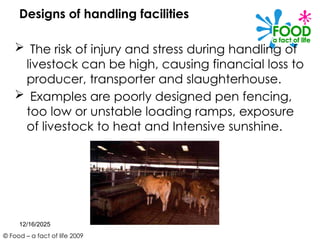
a fact of life 2009 Designs of handling facilities The risk of injury and stress during handling of livestock can be high, causing financial loss to producer, transporter and slaughterhouse. Examples are poorly designed pen fencing, too low or unstable loading ramps, exposure of livestock to heat and Intensive sunshine. 12/16/2025
8.
© Food –
a fact of life 2009 Properly designed and constructed facilities on farms, at auction yards and slaughter houses etc. will contribute significantly towards the safe handling of livestock, thereby reducing the risk of injuries and stress to animals and workers alike. 12/16/2025
9.
© Food –
a fact of life 2009 • Methods of transport The most appropriate methods of moving cattle are on hoof, by road motor vehicle or by rail wagon. Moving cattle on the hoof (trekking) is suitable only where road and rail infrastructure does not exist, or when distances from farm to destination are short. This method is slow and fraught with risks to the welfare and value of the animals. Rail transport is useful for short-haul journeys where loading ramps are available at railheads and communication is direct to destination 12/16/2025
10.
© Food –
a fact of life 2009 • Road motor transport is by far the most versatile, the method of first choice and the most user friendly. • The most satisfactory method of transporting cattle is by road motor vehicle. • Moving by rail truck requires more careful management and strekking is satisfactory for well-planned distances. 12/16/2025
11.
© Food –
a fact of life 2009 SLAUGHTER OF LIVESTOCK • The obligation in the conversion of food animals into edible products and useful by- products is to slaughter the animal in a humane manner and to process the carcass in a hygienic and efficient way. 12/16/2025
12.
© Food –
a fact of life 2009 Preparing livestock for slaughter • At the time of slaughter, animals should be healthy and physiologically normal. • Slaughter animals should be adequately rested. They should be rested, preferably overnight, particularly if they have travelled for some times over long distances. • Animals should be watered during holding and can be fed, if required. The holding period allows for injured and victimized animals to be identified and for sick animals to be quarantined. 12/16/2025
13.
© Food –
a fact of life 2009 • When ready for slaughter, animals should be driven to the stunning area in a quiet and orderly manner without undue fuss and noise. Driving can be facilitated using flat canvass straps, rolled plastic or paper, and in the case of stubborn animals, prodders can be used occasionally. • Animals should never be beaten nor have their tails twisted. • Animals should be led in single file into the stunning 12/16/2025
14.
© Food –
a fact of life 2009 Restraint devices • For cattle, A stunning box is the most common method of restraining cattle • While for chicken • chickens must be caught and handled with care to ensure their safety and that of the handler. • Aggressive techniques cause panic, leading to injuries (bone breaks, dislocations and bruises) and stress. • This makes them release adrenaline that can affect the quality of carcass. It is important to approach birds quietly and calmly under dim light to avoid panic. 12/16/2025
15.
© Food –
a fact of life 2009 METHODS OF SLAUGTHER • Stunning methods It is desirable to render an animal unconscious before it is slaughtered in order to eliminate pain, discomfort and stress from the procedure. • There are three main technologies used to effect stunning—Percussion, Electrical and Gas. Only the first two are commonly used in developing countries. • In some circumstances, traditional slaughter may be exempted from preslaughter stunning. 12/16/2025
16.
© Food –
a fact of life 2009 Bleeding Method • Bleeding is the part of the slaughter process where the main blood vessels of the neck are severed in order to allow blood to drain from the carcass, resulting in the death of the animal from cerebral anoxia. • The bleeding knife should continuously be sharpened. A blunt knife will prolong the incision and the cut ends of the blood vessels will be damaged. 12/16/2025
17.
© Food –
a fact of life 2009 Determining insensibility at slaughter It is important to be able to determine if an animal has become insensible after stunning, as the bleeding and dressing operations must not begin until complete stunning has been achieved. When cattle, sheep, goats and pigs are stunned using a captive bolt, the animal should collapse immediately. There should be no corneal or blink reflex, if the eye is touched. These signs of insensibility should be looked for before bleeding commences, usually when the carcass is hanging on the bleeding rail. 12/16/2025
18.
© Food –
a fact of life 2009 CONCLUSION • The international livestock industry must be encouraged to practice increasingly better handling and welfare of slaughter animals. • This is particularly important for developing countries, as this will improve production. • Here, the introduction of better stunning practices and improved pre-stunning methods for ritual slaughter are urgently required. 12/16/2025
Download