COLLOQUIALISM
Learning Objective:
1. Understand the conventions of English usage in different forms of writing
2. Select and employ colloquialisms in gap fill exercise.
© Seemeen Khan Yousufzai
COLLOQUIALISM
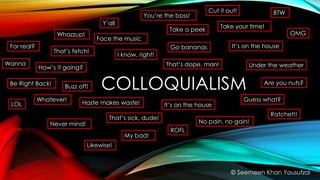
You’re the boss!
Take a peek
Whazzup!
That’s sick, dude!
Whatever!
I know, right!
How’s it going? Under the weather
It’s on the house
Cut it out!
For real?
My bad!
Never mind!
Likewise!
Face the music
Guess what?
No pain, no gain!
It’s on the houseHaste makes waste!
Take your time!
That’s dope, man!
Ratchet!!
Are you nuts?Be Right Back!
That’s fetch!
BTW
LOL
ROFL
OMG
Y’all
Buzz off!
Wanna
Go bananas
© Seemeen Khan Yousufzai
COLLOQUIALISM
Language appropriate to ordinary or familiar conversation rather than
formal speech or writing.
© Seemeen Khan Yousufzai
COLLOQUIALIASM
• Language used in everyday informal conversation
• Can reflect regional characteristics
• Not used in formal speech or writing
© Seemeen Khan Yousufzai
COLLOQUIALISM IN LITERATURE
• Read the following passage :
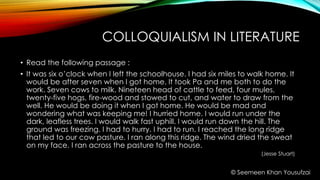
• It was six o’clock when I left the schoolhouse. I had six miles to walk home. It
would be after seven when I got home. It took Pa and me both to do the
work. Seven cows to milk. Nineteen head of cattle to feed, four mules,
twenty-five hogs, fire-wood and stowed to cut, and water to draw from the
well. He would be doing it when I got home. He would be mad and
wondering what was keeping me! I hurried home. I would run under the
dark, leafless trees. I would walk fast uphill. I would run down the hill. The
ground was freezing. I had to hurry. I had to run. I reached the long ridge
that led to our cow pasture. I ran along this ridge. The wind dried the sweat
on my face. I ran across the pasture to the house.
(Jesse Stuart)
© Seemeen Khan Yousufzai
COLLOQUIALISM IN LITERATURE
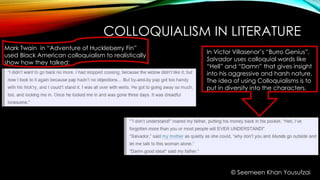
Mark Twain in “Adventure of Huckleberry Fin”
used Black American colloquialism to realistically
show how they talked:
In Victor Villasenor’s “Burro Genius”,
Salvador uses colloquial words like
“Hell” and “Damn” that gives insight
into his aggressive and harsh nature.
The idea of using Colloquialisms is to
put in diversity into the characters.
© Seemeen Khan Yousufzai
WHY ARE COLLOQUIALISMS USED?
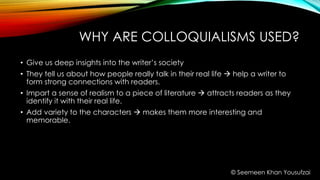
• Give us deep insights into the writer’s society
• They tell us about how people really talk in their real life  help a writer to
form strong connections with readers.
• Impart a sense of realism to a piece of literature  attracts readers as they
identify it with their real life.
• Add variety to the characters  makes them more interesting and
memorable.
© Seemeen Khan Yousufzai
PRACTISE TIME
• Test your formal and colloquial language skills by choosing the correct formal
meaning from the options given, for the colloquial expressions listed in the
exercise sheet.
ALL THE BEST
© Seemeen Khan Yousufzai

Colloquialism

  • 1.
    COLLOQUIALISM Learning Objective: 1. Understandthe conventions of English usage in different forms of writing 2. Select and employ colloquialisms in gap fill exercise. © Seemeen Khan Yousufzai
  • 2.
    COLLOQUIALISM You’re the boss! Takea peek Whazzup! That’s sick, dude! Whatever! I know, right! How’s it going? Under the weather It’s on the house Cut it out! For real? My bad! Never mind! Likewise! Face the music Guess what? No pain, no gain! It’s on the houseHaste makes waste! Take your time! That’s dope, man! Ratchet!! Are you nuts?Be Right Back! That’s fetch! BTW LOL ROFL OMG Y’all Buzz off! Wanna Go bananas © Seemeen Khan Yousufzai
  • 3.
    COLLOQUIALISM Language appropriate toordinary or familiar conversation rather than formal speech or writing. © Seemeen Khan Yousufzai
  • 4.
    COLLOQUIALIASM • Language usedin everyday informal conversation • Can reflect regional characteristics • Not used in formal speech or writing © Seemeen Khan Yousufzai
  • 5.
    COLLOQUIALISM IN LITERATURE •Read the following passage : • It was six o’clock when I left the schoolhouse. I had six miles to walk home. It would be after seven when I got home. It took Pa and me both to do the work. Seven cows to milk. Nineteen head of cattle to feed, four mules, twenty-five hogs, fire-wood and stowed to cut, and water to draw from the well. He would be doing it when I got home. He would be mad and wondering what was keeping me! I hurried home. I would run under the dark, leafless trees. I would walk fast uphill. I would run down the hill. The ground was freezing. I had to hurry. I had to run. I reached the long ridge that led to our cow pasture. I ran along this ridge. The wind dried the sweat on my face. I ran across the pasture to the house. (Jesse Stuart) © Seemeen Khan Yousufzai
  • 6.
    COLLOQUIALISM IN LITERATURE MarkTwain in “Adventure of Huckleberry Fin” used Black American colloquialism to realistically show how they talked: In Victor Villasenor’s “Burro Genius”, Salvador uses colloquial words like “Hell” and “Damn” that gives insight into his aggressive and harsh nature. The idea of using Colloquialisms is to put in diversity into the characters. © Seemeen Khan Yousufzai
  • 7.
    WHY ARE COLLOQUIALISMSUSED? • Give us deep insights into the writer’s society • They tell us about how people really talk in their real life  help a writer to form strong connections with readers. • Impart a sense of realism to a piece of literature  attracts readers as they identify it with their real life. • Add variety to the characters  makes them more interesting and memorable. © Seemeen Khan Yousufzai
  • 8.
    PRACTISE TIME • Testyour formal and colloquial language skills by choosing the correct formal meaning from the options given, for the colloquial expressions listed in the exercise sheet. ALL THE BEST © Seemeen Khan Yousufzai