
English II
JournalYou have been hired to write a dictionary of common terms, phrases, and slang used by you and your friends.  Brainstorm at least 5 ideas and explain what each word means.
Video ClipWatch the following video clip from ER:http://www.youtube.com/watch?v=LZ98ke7ma3sWhat do you notice about the language used in the clip?Why is the use of language in this clip so important?Why might understanding the language used in this clip help your overall understanding of what you watched?
JargonJargon: The specialized language of a professional, occupational, or other group, often meaningless to outsidersJargon can be found in sports, religion, medicine, information technology, and internet.Do you think the jargon of certain groups of people gives us an idea of where they are from geographically?
Video ClipWatch the following video clip from Brave heart: What do you notice about the language used in the clip?Why is the use of language in this clip so important?Why might understanding the language used in this clip help your overall understanding of what you watched?
DialectDialect:A provincial, rural, or socially distinct variety of a language that differs from the standard language
Provides resources for learning about the connections between language and culture
Language varies over time and space, including regional, social, ethnic, gender and other types of social and physical space
Latin exampleWhat’s the difference?Jargon refers to the language of a group of people who share a profession or occupation (like doctors or lawyers).Dialect refers to the language of people who share a social or geographic background (like all the people from Eastern Kentucky or from Scotland).
Changing dialect will affect the reader’s perception of a characterOriginal“No, ‘course I ain’t,” George said.
Changing dialect will affect the reader’s perception of a characterInformal“Nothing like that ever happened!” George replied.Formal“With great fortune, that happenstance did not become a reality,” George stated.

Jargon And Dialect P Pt

  • 1.
  • 2.
    JournalYou have beenhired to write a dictionary of common terms, phrases, and slang used by you and your friends. Brainstorm at least 5 ideas and explain what each word means.
  • 3.
    Video ClipWatch thefollowing video clip from ER:http://www.youtube.com/watch?v=LZ98ke7ma3sWhat do you notice about the language used in the clip?Why is the use of language in this clip so important?Why might understanding the language used in this clip help your overall understanding of what you watched?
  • 4.
    JargonJargon: The specializedlanguage of a professional, occupational, or other group, often meaningless to outsidersJargon can be found in sports, religion, medicine, information technology, and internet.Do you think the jargon of certain groups of people gives us an idea of where they are from geographically?
  • 5.
    Video ClipWatch thefollowing video clip from Brave heart: What do you notice about the language used in the clip?Why is the use of language in this clip so important?Why might understanding the language used in this clip help your overall understanding of what you watched?
  • 6.
    DialectDialect:A provincial, rural,or socially distinct variety of a language that differs from the standard language
  • 7.
    Provides resources forlearning about the connections between language and culture
  • 8.
    Language varies overtime and space, including regional, social, ethnic, gender and other types of social and physical space
  • 9.
    Latin exampleWhat’s thedifference?Jargon refers to the language of a group of people who share a profession or occupation (like doctors or lawyers).Dialect refers to the language of people who share a social or geographic background (like all the people from Eastern Kentucky or from Scotland).
  • 10.
    Changing dialect willaffect the reader’s perception of a characterOriginal“No, ‘course I ain’t,” George said.
  • 11.
    Changing dialect willaffect the reader’s perception of a characterInformal“Nothing like that ever happened!” George replied.Formal“With great fortune, that happenstance did not become a reality,” George stated.
  • 12.
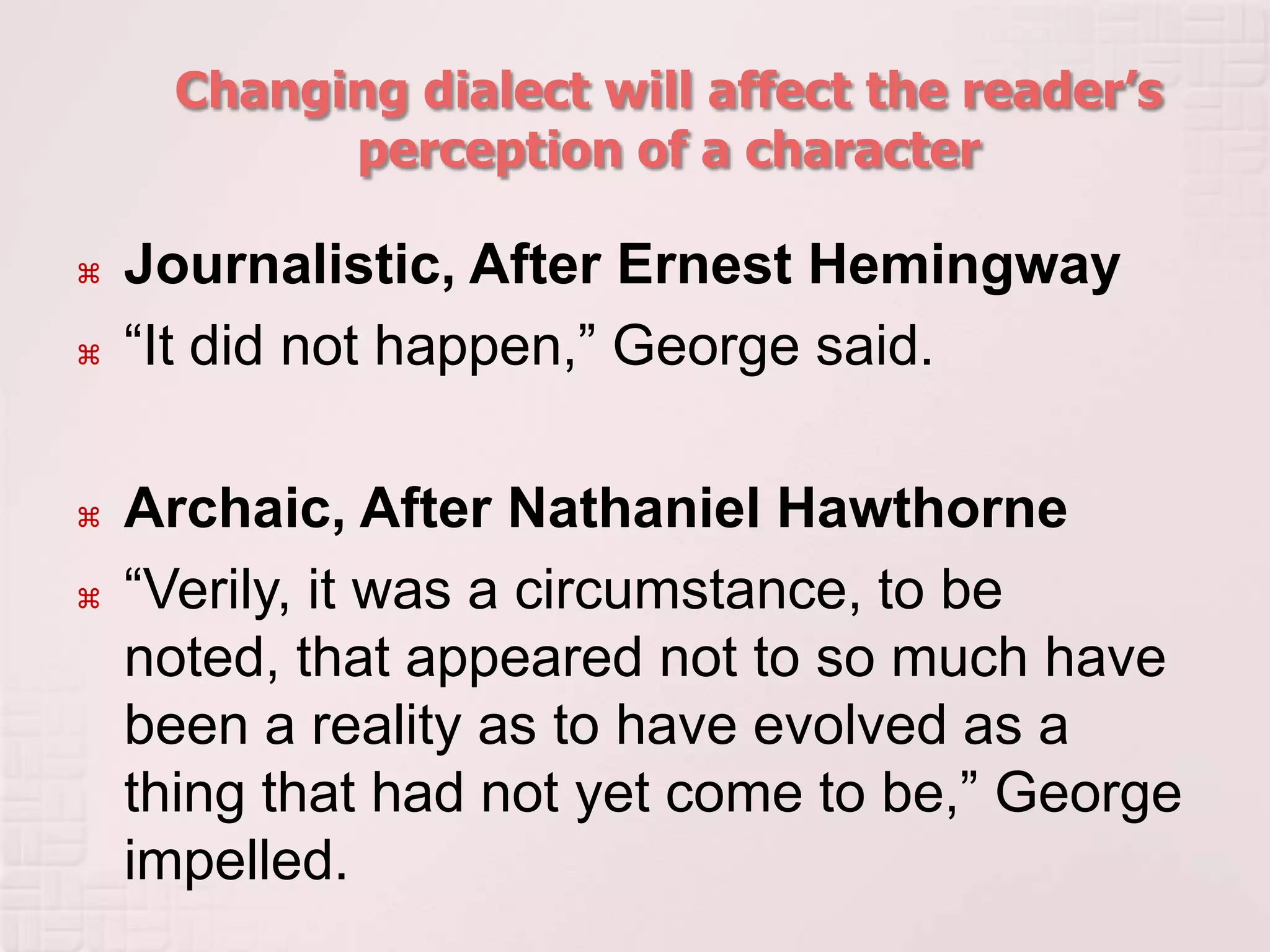
    Changing dialect willaffect the reader’s perception of a characterJournalistic, After Ernest Hemingway“It did not happen,” George said.Archaic, After Nathaniel Hawthorne“Verily, it was a circumstance, to be noted, that appeared not to so much have been a reality as to have evolved as a thing that had not yet come to be,” George impelled.
  • 13.
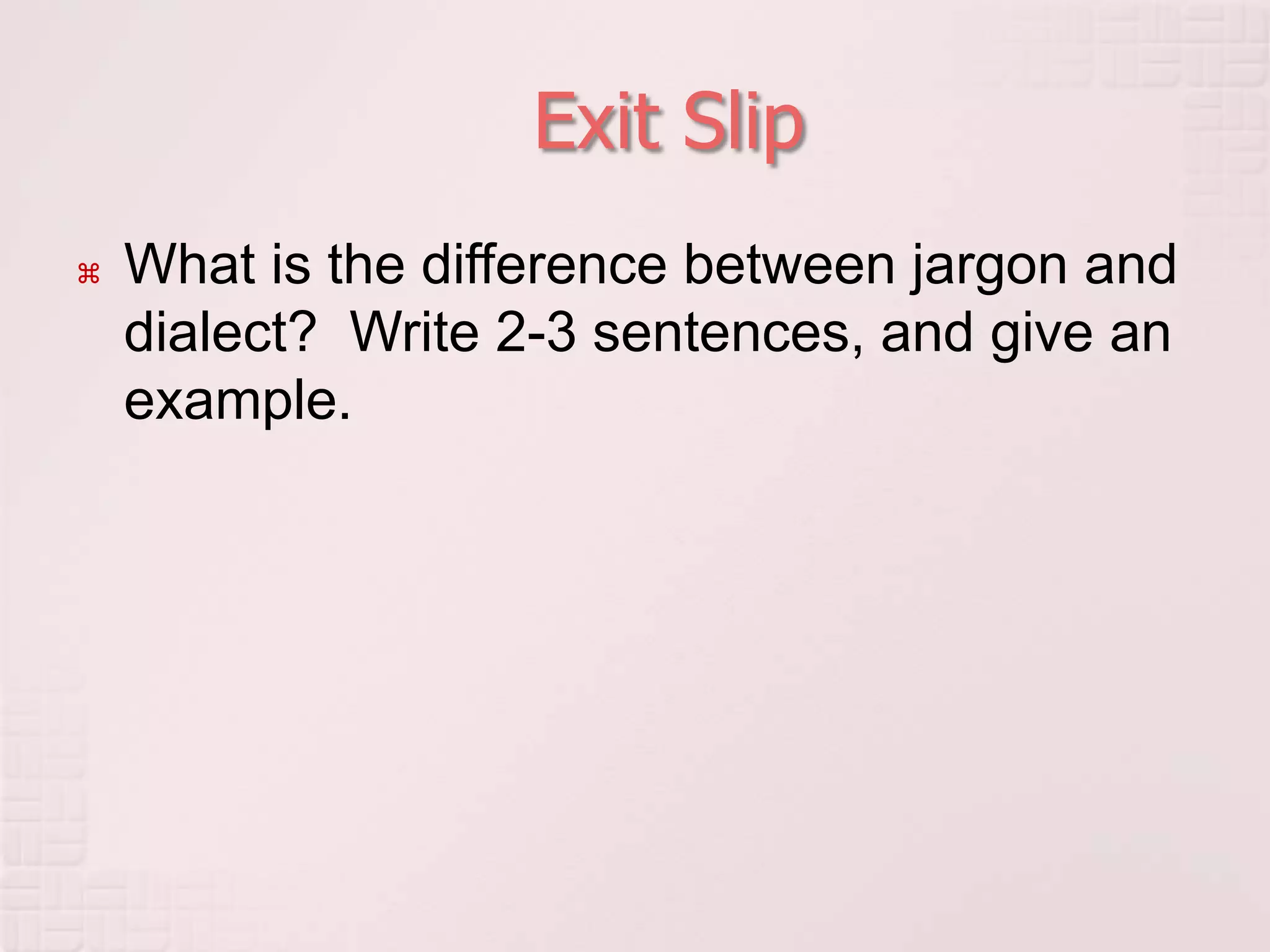
    Exit SlipWhat isthe difference between jargon and dialect? Write 2-3 sentences, and give an example.