Teaching requirements analysis:
A student project framework to
bridge the gap between business
analysis and software engineering*
Luisa Mich
Dept. of Industrial Engineering, Trento, Italy
Workshop on Requirements Engineering Education & Training, REET at RE’14
analysis and software engineering*
* L. Mich, Teaching Requirements Analysis: A Student Project
Framework to Bridge the Gap between Business Analysis and Software
Engineering, Proc. 8th International Workshop on Requirements
Engineering Education and Training (REET) at RE 2014, Karlskrona,
Sweden, 25/08/2014, CEUR-WS.org
Schema
Challenges in teaching requirements analysis
(RA)
The proposal: a framework for student
projects to address the gap between skills
needed to deal with business problems andneeded to deal with business problems and
those for SW requirements
Conclusion
Luisa Mich, REET 2014 2
Antefact
The analysis of the challenges in teaching RA
and the framework for the students project
are based on more than 20 years of teaching
RA in different (not of experiments ☺):
Courses: information systems design, SWCourses: information systems design, SW
engineering and Web engineering, and
Degrees: at the bachelor’s and master’s
level in the areas of Computer Science
(CS) and Economics
Luisa Mich, REET 2014 3
Challenges in teaching RA
Teaching RA (for a university course) is
challenging in many ways
The main positive and negative aspects can
be illustrated with a SWOT matrix:
Strengths, Weaknesses, Opportunities, andStrengths, Weaknesses, Opportunities, and
Threats
Luisa Mich, REET 2014 4
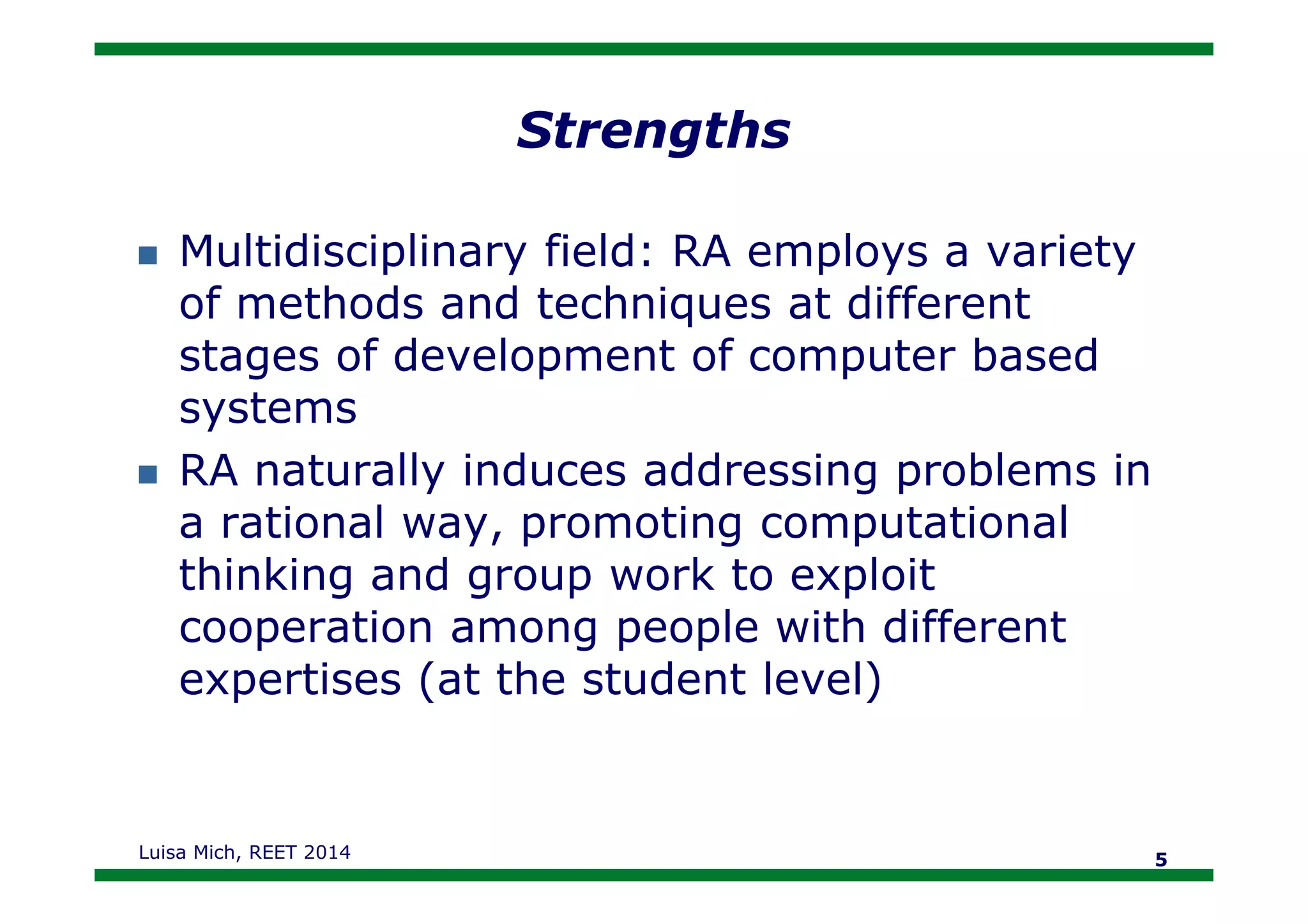
Strengths
Multidisciplinary field: RA employs a variety
of methods and techniques at different
stages of development of computer based
systems
RA naturally induces addressing problems inRA naturally induces addressing problems in
a rational way, promoting computational
thinking and group work to exploit
cooperation among people with different
expertises (at the student level)
Luisa Mich, REET 2014 5
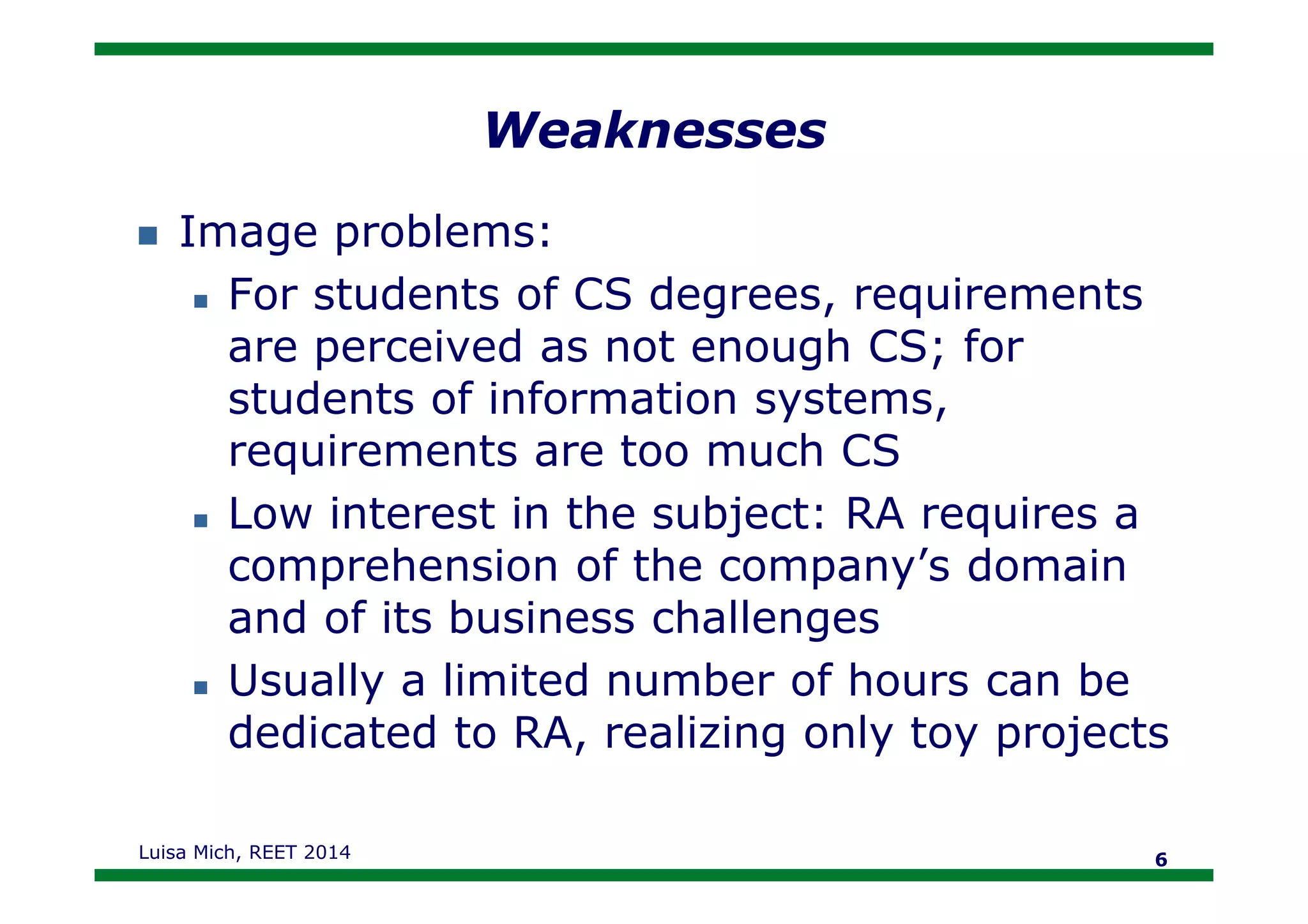
Weaknesses
Image problems:
For students of CS degrees, requirements
are perceived as not enough CS; for
students of information systems,
requirements are too much CSrequirements are too much CS
Low interest in the subject: RA requires a
comprehension of the company’s domain
and of its business challenges
Usually a limited number of hours can be
dedicated to RA, realizing only toy projects
Luisa Mich, REET 2014 6
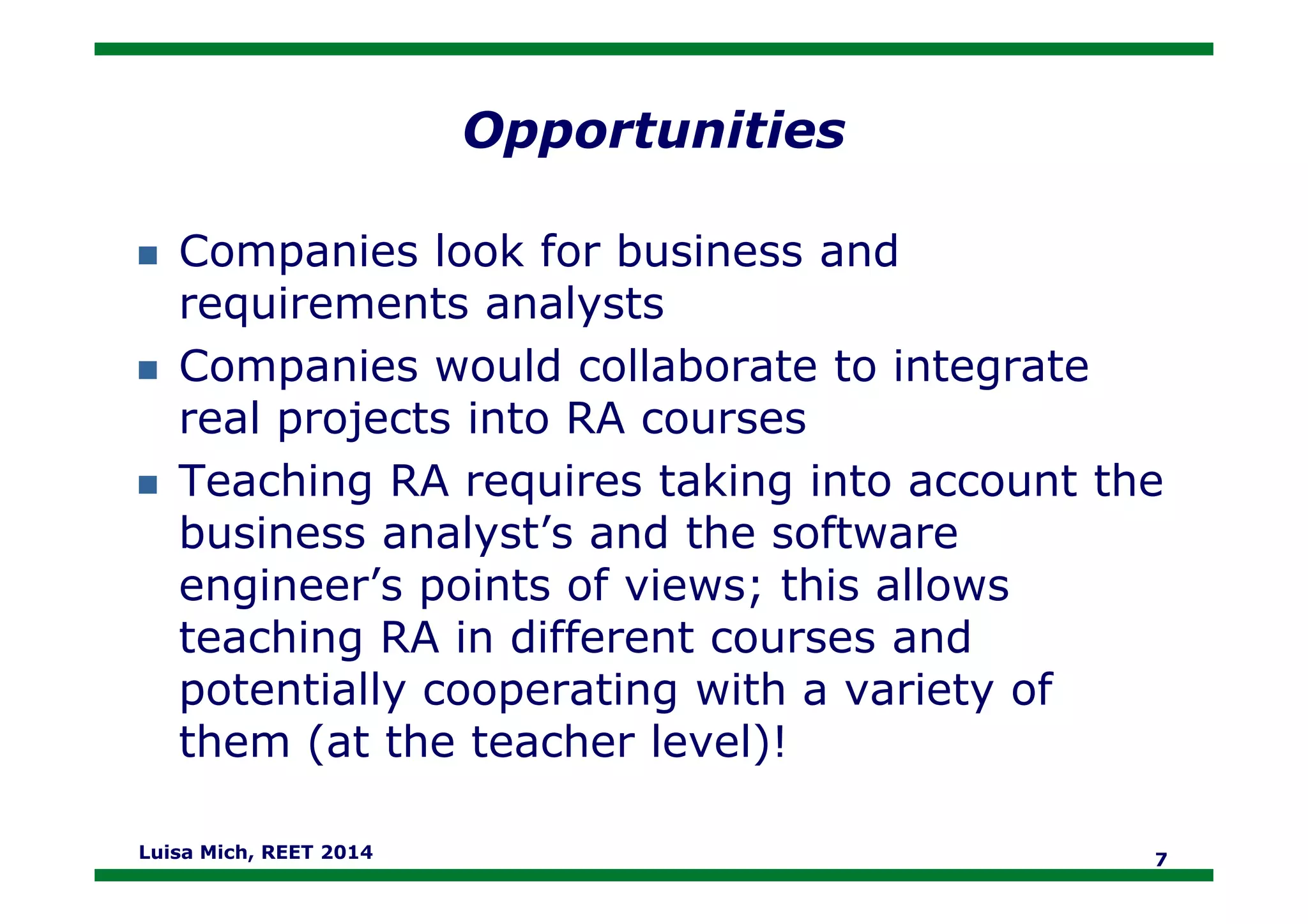
Opportunities
Companies look for business and
requirements analysts
Companies would collaborate to integrate
real projects into RA courses
Teaching RA requires taking into account theTeaching RA requires taking into account the
business analyst’s and the software
engineer’s points of views; this allows
teaching RA in different courses and
potentially cooperating with a variety of
them (at the teacher level)!
Luisa Mich, REET 2014 7
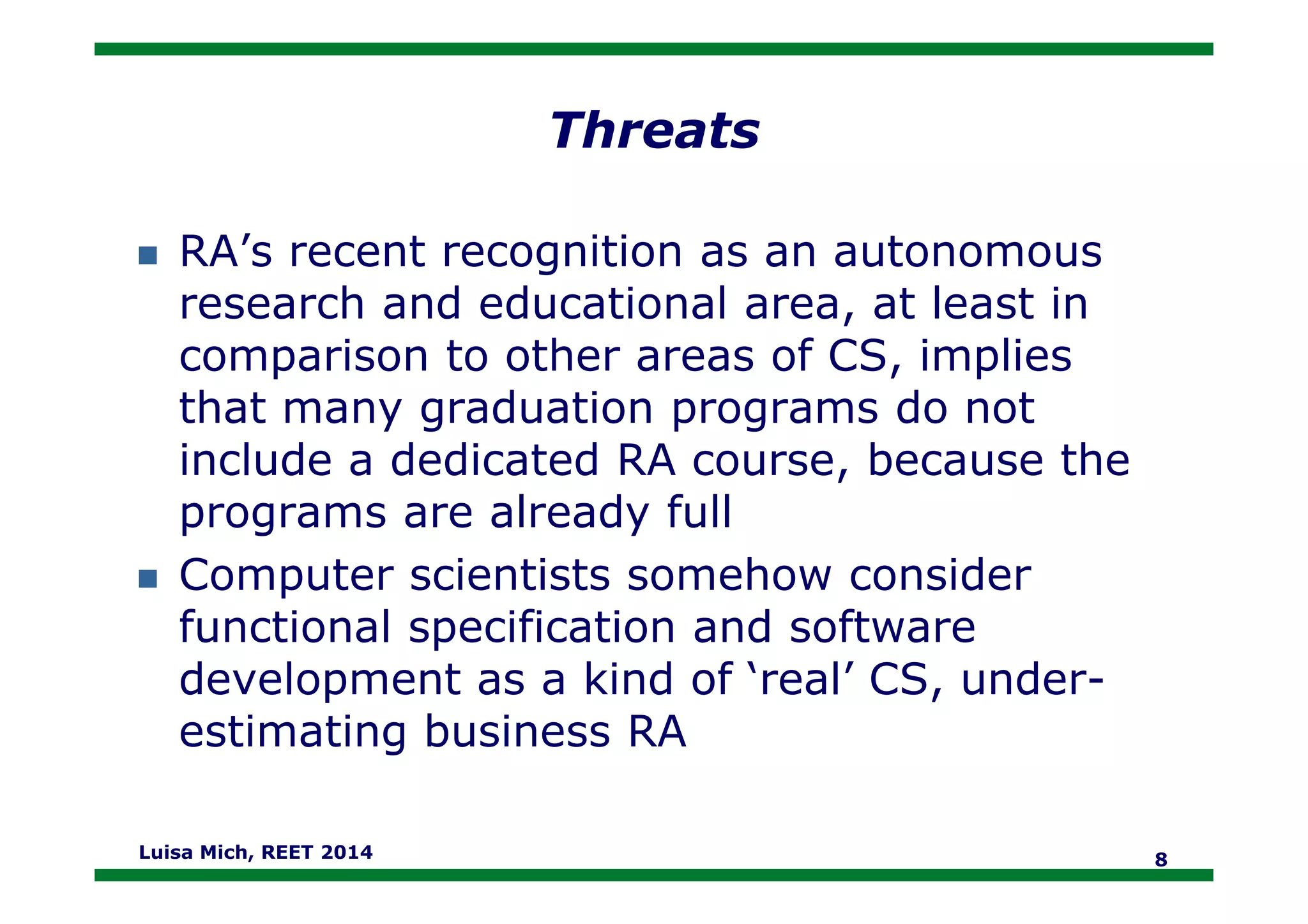
Threats
RA’s recent recognition as an autonomous
research and educational area, at least in
comparison to other areas of CS, implies
that many graduation programs do not
include a dedicated RA course, because theinclude a dedicated RA course, because the
programs are already full
Computer scientists somehow consider
functional specification and software
development as a kind of ‘real’ CS, under-
estimating business RA
Luisa Mich, REET 2014 8
Threats, Cont’d
Not many textbooks dedicated to didactics of
requirements engineering (not many
dedicated to the didactics of CS either)
Luisa Mich, REET 2014 9
The proposed approach
Addressing challenges in teaching RA in a
university course requires that the course’s
design take into account many factors:
the syllabus of the degree
available human resources
time available for the coursetime available for the course
the kind of classrooms available
HW and SW available
technical support
topics to be covered
students’ previous knowledge on related topics
etc.
Luisa Mich, REET 2014 10
A framework for the student project
We concentrate on the problem of the
student project: which projects can be
realized by students to motivate them and to
teach a structured, efficient, and systematic
way to identify and model business and highway to identify and model business and high
level requirements
We propose a framework for a student
project that has been defined, adapting it
year after year according to the results of its
implementation in a number of university
courses
Luisa Mich, REET 2014 11
Characteristics of the courses
Some common characteristics positively
contributed to the adoption of an activity
based approach in which students have to
work in group on a small scale real project:
small classes: from 9 to 20 studentssmall classes: from 9 to 20 students
a computer laboratory, 1 to 2 students per PC
support of a tutor
support of an e-learning platform
<comunitaonline.unitn.it>
presence of international students (English)
one term course of 30 to 40 hours
Luisa Mich, REET 2014 12
Main goal for all these courses
To focus on the problem-solving nature of
requirements, and in particular on the need
to first analyze a problem from the point of
view of all the stakeholders
A focus on RA in about half of the course,A focus on RA in about half of the course,
assuming that it is easier to learn, apply,
and validate UML models (requirements
specification and validation) than to learn a
structured way to effectively define the
scope of a project and the requirements to
be fulfilled
Luisa Mich, REET 2014 13
Main didactic objectives of the
student projects
Introducing the role of the computer based
systems to solve business problems or
suggest business strategies
Integrating organizational issues in the
analysis of the problem (eg “who has toanalysis of the problem (eg “who has to
cooperate to gather the data for the system
to be developed?”)
Understanding the role of RA in the process
of the system development, including
contractual impacts
Luisa Mich, REET 2014 14
The structure of the framework
The template adapts and integrates a model
of the computer based system as a solution
of ‘business challenges’ into a template for a
business requirements document, that is:
An information system model by LaudonAn information system model by Laudon
and Laudon (L&L)
A Business Requirements Document (BRD)
template by Podeswa
Luisa Mich, REET 2014 15
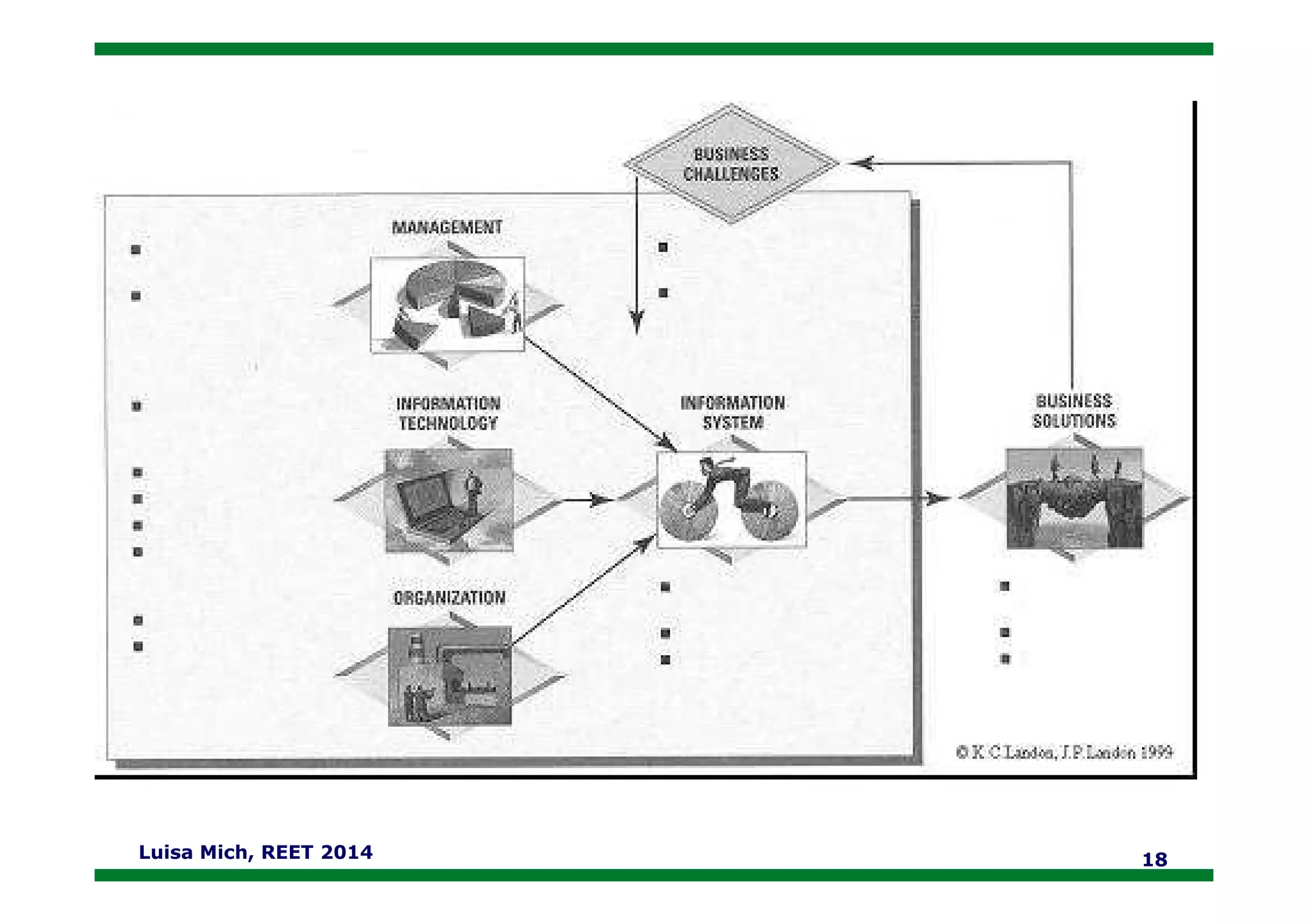
The L&L model
It defines and, more importantly, graphically
represents the information system as “an
organizational and managerial solution
based on information technology, to a
challenge posed by the environment”challenge posed by the environment”
It can be used for any kind of project: size,
domain, sector and force the adoption of a
problem solving approach, starting from the
business challenges, iterating whenever
necessary
Luisa Mich, REET 2014 16
To students with knowledge in economics
and management, the L&L model is a natural
bridge towards RA; for those in CS it
suggests a wider context for their projects
It makes it possible to work on the projectIt makes it possible to work on the project
since the first meeting of the course
Luisa Mich, REET 2014 17
Luisa Mich, REET 2014 18
Applying the L&L model
Start from the business challenges (first
box), take into account the management
decisions and goals (actual or needed to
address the identified challenges), identify
the information technologies for the modules
of the information systems and theof the information systems and the
organizational issues relevant for the project
(stakeholders to be involved). Business
solutions evaluate the impact of the
proposed system (any kind of output useful
to check if the expected goals or returns
have been reached)
Luisa Mich, REET 2014 19
The BRD
The template is part of BOOM, business
object-oriented modeling
BOOM applies UML to business analysis
underlining the role of business use-cases to
define the scope of a project and itsdefine the scope of a project and its
stakeholders, both internal and external to
the company
For the student projects, an adapted version
of the BRD was defined extracting issues
relevant for the requirements engineering
steps
Luisa Mich, REET 2014 20
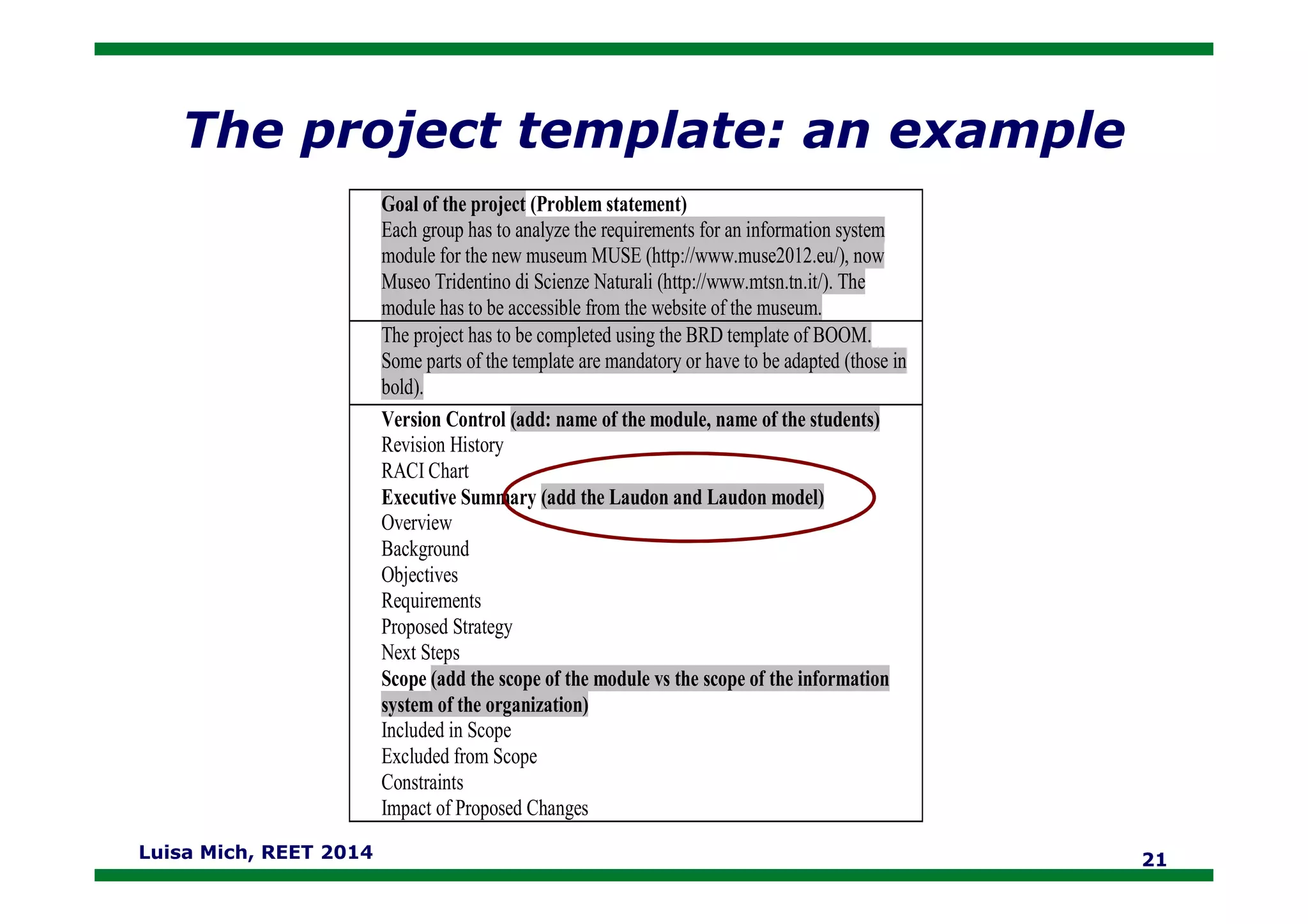
The project template: an example
Goal of the project (Problem statement)
Each group has to analyze the requirements for an information system
module for the new museum MUSE (http://www.muse2012.eu/), now
Museo Tridentino di Scienze Naturali (http://www.mtsn.tn.it/). The
module has to be accessible from the website of the museum.
The project has to be completed using the BRD template of BOOM.
Some parts of the template are mandatory or have to be adapted (those in
bold).
Version Control (add: name of the module, name of the students)
Revision History
RACI Chart
Luisa Mich, REET 2014 21
RACI Chart
Executive Summary (add the Laudon and Laudon model)
Overview
Background
Objectives
Requirements
Proposed Strategy
Next Steps
Scope (add the scope of the module vs the scope of the information
system of the organization)
Included in Scope
Excluded from Scope
Constraints
Impact of Proposed Changes
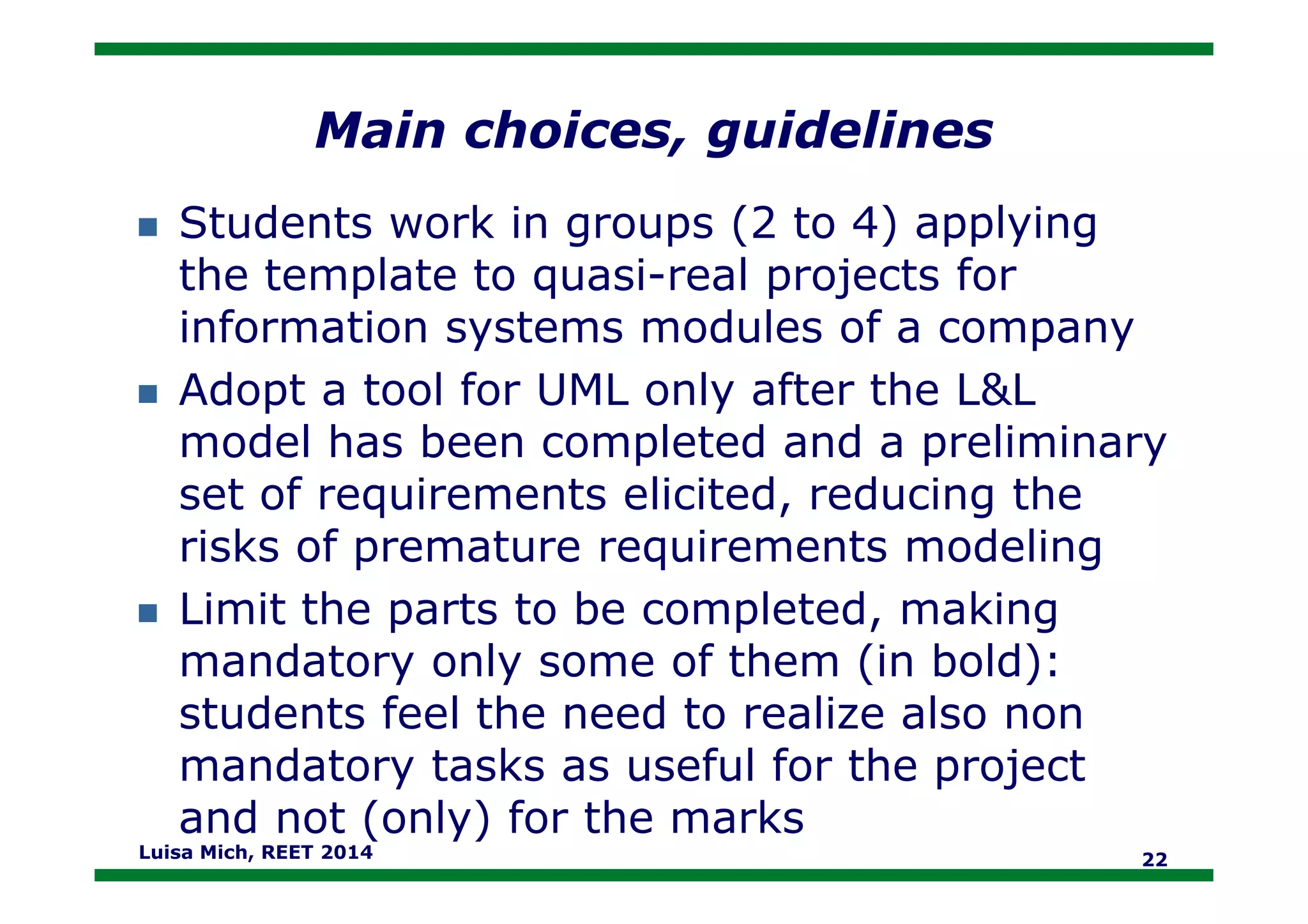
Main choices, guidelines
Students work in groups (2 to 4) applying
the template to quasi-real projects for
information systems modules of a company
Adopt a tool for UML only after the L&L
model has been completed and a preliminarymodel has been completed and a preliminary
set of requirements elicited, reducing the
risks of premature requirements modeling
Limit the parts to be completed, making
mandatory only some of them (in bold):
students feel the need to realize also non
mandatory tasks as useful for the project
and not (only) for the marks
Luisa Mich, REET 2014 22
Involving the companies
Involve them with an initial presentation by
a company representative and a final
presentation of results by students; adding if
possible, interviews with real stakeholders
from the organization
Luisa Mich, REET 2014 23
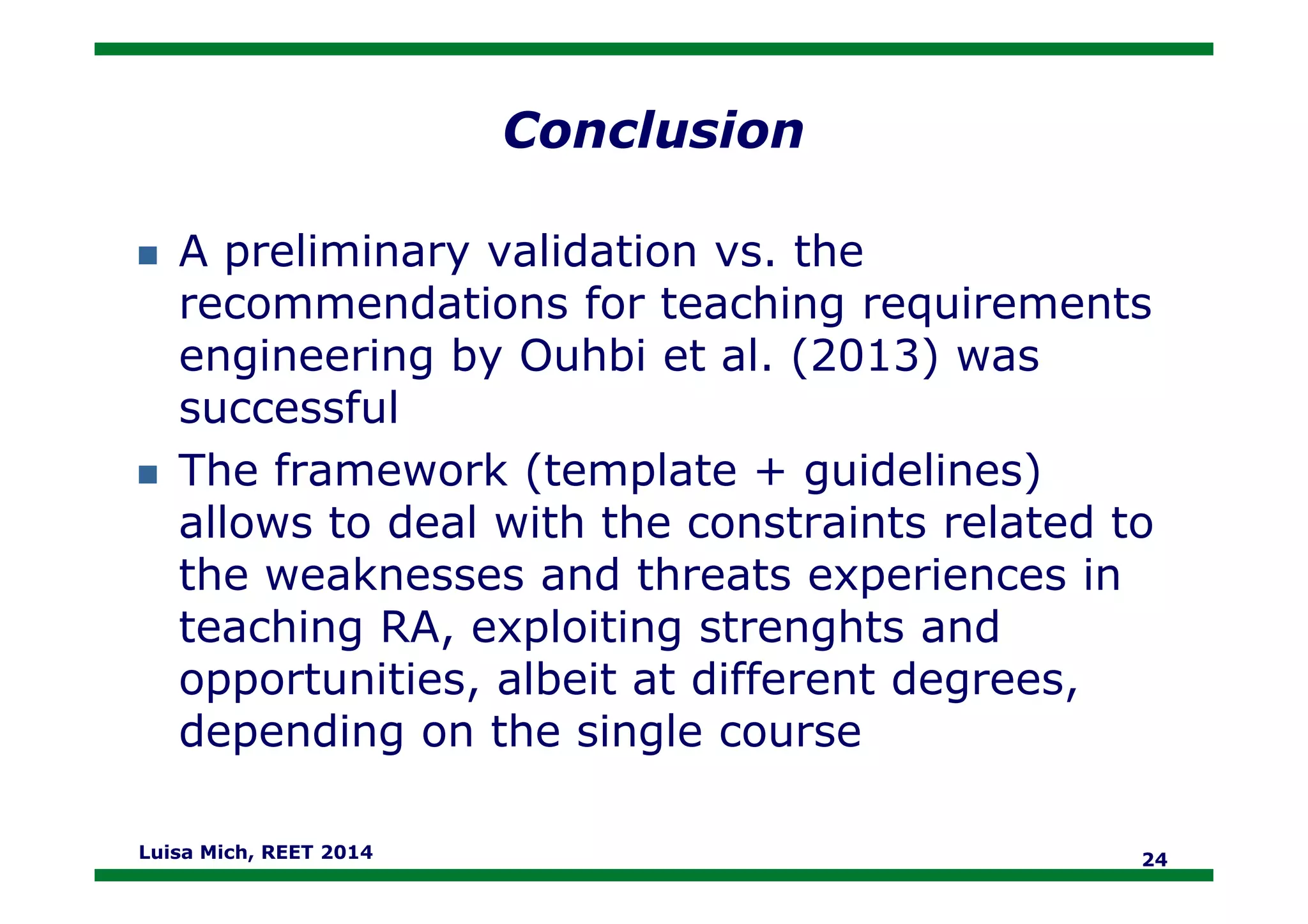
Conclusion
A preliminary validation vs. the
recommendations for teaching requirements
engineering by Ouhbi et al. (2013) was
successful
The framework (template + guidelines)The framework (template + guidelines)
allows to deal with the constraints related to
the weaknesses and threats experiences in
teaching RA, exploiting strenghts and
opportunities, albeit at different degrees,
depending on the single course
Luisa Mich, REET 2014 24
The future
Reporting the author experience, mainly in
an Italian university, there are a lot of issues
that could be further investigated
Among them: could the framework help to
have more non CS students choosing tohave more non CS students choosing to
learn more CS?
Luisa Mich, REET 2014 25
Contacts and other info
e-mail: luisa.mich@unitn.it
skype: luisa.mich
university Website:
http://webapps.unitn.it/People/en/Web/Pers
ona/PER0001016#INFOona/PER0001016#INFO
other Websites: it.linkedin.com/pub/luisa-
mich/2/a79/9/,
https://www.researchgate.net/profile/Luisa_
Mich
Luisa Mich, REET 2014 26

Teaching requirements analysis REET 2014 at RE2014

  • 1.
    Teaching requirements analysis: Astudent project framework to bridge the gap between business analysis and software engineering* Luisa Mich Dept. of Industrial Engineering, Trento, Italy Workshop on Requirements Engineering Education & Training, REET at RE’14 analysis and software engineering* * L. Mich, Teaching Requirements Analysis: A Student Project Framework to Bridge the Gap between Business Analysis and Software Engineering, Proc. 8th International Workshop on Requirements Engineering Education and Training (REET) at RE 2014, Karlskrona, Sweden, 25/08/2014, CEUR-WS.org
  • 2.
    Schema Challenges in teachingrequirements analysis (RA) The proposal: a framework for student projects to address the gap between skills needed to deal with business problems andneeded to deal with business problems and those for SW requirements Conclusion Luisa Mich, REET 2014 2
  • 3.
    Antefact The analysis ofthe challenges in teaching RA and the framework for the students project are based on more than 20 years of teaching RA in different (not of experiments ☺): Courses: information systems design, SWCourses: information systems design, SW engineering and Web engineering, and Degrees: at the bachelor’s and master’s level in the areas of Computer Science (CS) and Economics Luisa Mich, REET 2014 3
  • 4.
    Challenges in teachingRA Teaching RA (for a university course) is challenging in many ways The main positive and negative aspects can be illustrated with a SWOT matrix: Strengths, Weaknesses, Opportunities, andStrengths, Weaknesses, Opportunities, and Threats Luisa Mich, REET 2014 4
  • 5.
    Strengths Multidisciplinary field: RAemploys a variety of methods and techniques at different stages of development of computer based systems RA naturally induces addressing problems inRA naturally induces addressing problems in a rational way, promoting computational thinking and group work to exploit cooperation among people with different expertises (at the student level) Luisa Mich, REET 2014 5
  • 6.
    Weaknesses Image problems: For studentsof CS degrees, requirements are perceived as not enough CS; for students of information systems, requirements are too much CSrequirements are too much CS Low interest in the subject: RA requires a comprehension of the company’s domain and of its business challenges Usually a limited number of hours can be dedicated to RA, realizing only toy projects Luisa Mich, REET 2014 6
  • 7.
    Opportunities Companies look forbusiness and requirements analysts Companies would collaborate to integrate real projects into RA courses Teaching RA requires taking into account theTeaching RA requires taking into account the business analyst’s and the software engineer’s points of views; this allows teaching RA in different courses and potentially cooperating with a variety of them (at the teacher level)! Luisa Mich, REET 2014 7
  • 8.
    Threats RA’s recent recognitionas an autonomous research and educational area, at least in comparison to other areas of CS, implies that many graduation programs do not include a dedicated RA course, because theinclude a dedicated RA course, because the programs are already full Computer scientists somehow consider functional specification and software development as a kind of ‘real’ CS, under- estimating business RA Luisa Mich, REET 2014 8
  • 9.
    Threats, Cont’d Not manytextbooks dedicated to didactics of requirements engineering (not many dedicated to the didactics of CS either) Luisa Mich, REET 2014 9
  • 10.
    The proposed approach Addressingchallenges in teaching RA in a university course requires that the course’s design take into account many factors: the syllabus of the degree available human resources time available for the coursetime available for the course the kind of classrooms available HW and SW available technical support topics to be covered students’ previous knowledge on related topics etc. Luisa Mich, REET 2014 10
  • 11.
    A framework forthe student project We concentrate on the problem of the student project: which projects can be realized by students to motivate them and to teach a structured, efficient, and systematic way to identify and model business and highway to identify and model business and high level requirements We propose a framework for a student project that has been defined, adapting it year after year according to the results of its implementation in a number of university courses Luisa Mich, REET 2014 11
  • 12.
    Characteristics of thecourses Some common characteristics positively contributed to the adoption of an activity based approach in which students have to work in group on a small scale real project: small classes: from 9 to 20 studentssmall classes: from 9 to 20 students a computer laboratory, 1 to 2 students per PC support of a tutor support of an e-learning platform <comunitaonline.unitn.it> presence of international students (English) one term course of 30 to 40 hours Luisa Mich, REET 2014 12
  • 13.
    Main goal forall these courses To focus on the problem-solving nature of requirements, and in particular on the need to first analyze a problem from the point of view of all the stakeholders A focus on RA in about half of the course,A focus on RA in about half of the course, assuming that it is easier to learn, apply, and validate UML models (requirements specification and validation) than to learn a structured way to effectively define the scope of a project and the requirements to be fulfilled Luisa Mich, REET 2014 13
  • 14.
    Main didactic objectivesof the student projects Introducing the role of the computer based systems to solve business problems or suggest business strategies Integrating organizational issues in the analysis of the problem (eg “who has toanalysis of the problem (eg “who has to cooperate to gather the data for the system to be developed?”) Understanding the role of RA in the process of the system development, including contractual impacts Luisa Mich, REET 2014 14
  • 15.
    The structure ofthe framework The template adapts and integrates a model of the computer based system as a solution of ‘business challenges’ into a template for a business requirements document, that is: An information system model by LaudonAn information system model by Laudon and Laudon (L&L) A Business Requirements Document (BRD) template by Podeswa Luisa Mich, REET 2014 15
  • 16.
    The L&L model Itdefines and, more importantly, graphically represents the information system as “an organizational and managerial solution based on information technology, to a challenge posed by the environment”challenge posed by the environment” It can be used for any kind of project: size, domain, sector and force the adoption of a problem solving approach, starting from the business challenges, iterating whenever necessary Luisa Mich, REET 2014 16
  • 17.
    To students withknowledge in economics and management, the L&L model is a natural bridge towards RA; for those in CS it suggests a wider context for their projects It makes it possible to work on the projectIt makes it possible to work on the project since the first meeting of the course Luisa Mich, REET 2014 17
  • 18.
  • 19.
    Applying the L&Lmodel Start from the business challenges (first box), take into account the management decisions and goals (actual or needed to address the identified challenges), identify the information technologies for the modules of the information systems and theof the information systems and the organizational issues relevant for the project (stakeholders to be involved). Business solutions evaluate the impact of the proposed system (any kind of output useful to check if the expected goals or returns have been reached) Luisa Mich, REET 2014 19
  • 20.
    The BRD The templateis part of BOOM, business object-oriented modeling BOOM applies UML to business analysis underlining the role of business use-cases to define the scope of a project and itsdefine the scope of a project and its stakeholders, both internal and external to the company For the student projects, an adapted version of the BRD was defined extracting issues relevant for the requirements engineering steps Luisa Mich, REET 2014 20
  • 21.
    The project template:an example Goal of the project (Problem statement) Each group has to analyze the requirements for an information system module for the new museum MUSE (http://www.muse2012.eu/), now Museo Tridentino di Scienze Naturali (http://www.mtsn.tn.it/). The module has to be accessible from the website of the museum. The project has to be completed using the BRD template of BOOM. Some parts of the template are mandatory or have to be adapted (those in bold). Version Control (add: name of the module, name of the students) Revision History RACI Chart Luisa Mich, REET 2014 21 RACI Chart Executive Summary (add the Laudon and Laudon model) Overview Background Objectives Requirements Proposed Strategy Next Steps Scope (add the scope of the module vs the scope of the information system of the organization) Included in Scope Excluded from Scope Constraints Impact of Proposed Changes
  • 22.
    Main choices, guidelines Studentswork in groups (2 to 4) applying the template to quasi-real projects for information systems modules of a company Adopt a tool for UML only after the L&L model has been completed and a preliminarymodel has been completed and a preliminary set of requirements elicited, reducing the risks of premature requirements modeling Limit the parts to be completed, making mandatory only some of them (in bold): students feel the need to realize also non mandatory tasks as useful for the project and not (only) for the marks Luisa Mich, REET 2014 22
  • 23.
    Involving the companies Involvethem with an initial presentation by a company representative and a final presentation of results by students; adding if possible, interviews with real stakeholders from the organization Luisa Mich, REET 2014 23
  • 24.
    Conclusion A preliminary validationvs. the recommendations for teaching requirements engineering by Ouhbi et al. (2013) was successful The framework (template + guidelines)The framework (template + guidelines) allows to deal with the constraints related to the weaknesses and threats experiences in teaching RA, exploiting strenghts and opportunities, albeit at different degrees, depending on the single course Luisa Mich, REET 2014 24
  • 25.
    The future Reporting theauthor experience, mainly in an Italian university, there are a lot of issues that could be further investigated Among them: could the framework help to have more non CS students choosing tohave more non CS students choosing to learn more CS? Luisa Mich, REET 2014 25
  • 26.
    Contacts and otherinfo e-mail: luisa.mich@unitn.it skype: luisa.mich university Website: http://webapps.unitn.it/People/en/Web/Pers ona/PER0001016#INFOona/PER0001016#INFO other Websites: it.linkedin.com/pub/luisa- mich/2/a79/9/, https://www.researchgate.net/profile/Luisa_ Mich Luisa Mich, REET 2014 26