Skin Infections
Lecture9
The skin protects you from germs, but sometimes it can get affected by
them. In this section you will look at the following skin infections:
Parasitic infections, such as scabies.
Bacterial infections, for example impetigo.
Fungal infections, for example dermatophytosis.
Introduction
These skin infections are caused by insects or worms that burrow in
the skin to produce their eggs. An example of a parasitic skin infection
is scabies.
1-Parasitic Skin Infection
• The causative agent of scabies is Sarcoptes scabiei which is a parasitic
arthropod that burrows into skin and causes scabies. Scabies affects
not only humans but also wild and domesticated animals.
• Scabies is highly contagious and can be spread by scratching, picking
up the mites under the fingernails and simply touching another
person's skin.
Scabies
• They can also be spread through objects as keyboards, toilets,
clothing, towels, bedding, furniture, especially if a person is heavily
infested. The parasites can survive up to 14 days away from a host,
but often do not survive longer than two or three days away from
human skin.
Conti…
The characteristic symptoms of scabies infection include the following:
Superficial burrows.
Intense pruritus (itching).
A generalised rash.
Secondary infection.
Acropustulosis or blisters and pustules on the palms and soles of the feet, are
characteristic symptoms of scabies in infants.
Signs and Symptoms of Scabies
Secondary infection is often due to impetigo, a type of bacterial skin
infection, after scratching. Cellulitis may also occur, resulting in
localised swelling, redness and fever.
In immuno-compromised, malnourished, elderly or institutionalised
individuals, infestation can cause a more severe form of scabies
known as crusted scabies or Norwegian scabies.
Conti…
This syndrome is characterised by a scaly rash, slight itching and thickened
crusts of skin containing thousands of mites. Norwegian scabies is the most
difficult form of scabies to treat .
In individuals who have never been exposed to scabies; the onset of
clinical signs and symptoms is four to six weeks after infestation. Some
people may not realise that they have it for years. In previously exposed
individuals, the onset can be as soon as one to four days after infestation.
Conti…
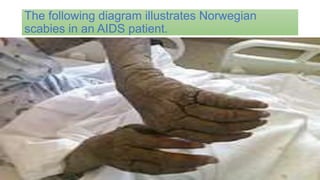
The following diagram illustrates Norwegian
scabies in an AIDS patient.
Signs and symptoms of early scabies infestation mirror other skin diseases,
including dermatitis, syphilis, allergic reactions, and other ectoparasites
such as lice and fleas.
Generally diagnosis is made by finding burrows which often may be
difficult because they are scarce, and because they are obscured by scratch
marks. If burrows are not found in the primary areas known to be affected,
the entire skin surface of the body should be examined.
Diagnosis of Scabies
• When a suspected burrow is found, diagnosis may be confirmed by
microscopy of surface scrapings, which are placed on a slide in
glycerol, mineral oil or immersed in oil and covered with a cover slip.
• Sometimes, the best diagnosis is made through history taking,
physical examination and monitoring response to topical treatment.
Conti…
• The preferred medication for scabies is the following:
100% benzyl benzoate emulsion (BBE). It is applied after the patient
has taken a warm bath. After 24 hours the patient should bath again.
This should be repeated for about four to seven days because BBE has
little effect on the eggs.
Topical Medications for Scabies
• The management includes topical medication, oral medication and
alleviating the itchiness (Fauci and Longo, 2008).
• Calamine lotion helps to treat the itchiness.
• Secondary infection should be treated with PPF (Nordberg, 2004).
Management of Scabies
There is no vaccine available for scabies, nor are there any proven causative risk
factors. Therefore, most strategies focus on preventing re-infection.
Some of these strategies include the following:
All family and close contacts should be treated at the same time, even if
asymptomatic.
Health education should be given.
Use of clean water is recommended.
Public Health and Prevention Strategies
Cleaning of the environment should occur simultaneously, as there is
a risk of re-infection.
It is recommended to wash and hot iron all material (such as clothes,
bedding, and towels) that have been in contact with scabies
infestation (Nordberg, 2004).
Conti…
• Bacterial skin infections can range in size from a tiny spot to the
whole body. In this section you will look at impetigo and cellulitis.
2-Bacterial Skin Infections
Impetigo is a highly infectious skin disease found mostly in children.
Etiology of Impetigo
• It is spread by direct contact. The term 'scrum pox' is impetigo spread
between rugby players. The main causative agents of impetigo are group A
β haemolytic streptococci and staphylococci. Bullous impetigo is caused by
bacterial toxins (exfoliation A and B) from Staphylococcus aureus (Fauci
and Longo, 2008).
A-Impetigo
• It presents as weeping in exudative areas with a typical honey-coloured crust on
the surface.
Investigation of Impetigo
• The diagnosis of the disease is usually clinical. Skin swabs should be taken for
culture and sensitivity (Fauci and Longo, 2008).
Signs and Symptoms of Impetigo
Localised disease is treated with topical fucidic acid and mupirocin which is used
for MRSA (three times daily).
The antiseptic povidone iodine is used to soften crusts and exudates for one
week.
 Extensive disease is treated with oral antibiotics for seven to 10 days
(flucloxacillin 500mg four times daily for staphylococcus; penicillin V 500mg four
times daily for streptococcus) (Fauci and Longo, 2008).
Treatment of Impetigo
Other close contacts should be examined and children should avoid
school for one week after starting therapy.
If impetigo appears resistant to treatment or is recurrent, take nasal
swabs and check other family members. Give nasal mupirocin three
times daily for one week, to eradicate nasal carriage in hospitals
(Fauci and Longo, 2008).
Prevention and Control of Impetigo
• Cellulitis is usually caused by a streptococcus or a staphylococcus. In
the immunosuppressed or diabetic patient, gram-negative organisms
or anaerobes should be suspected. There may be an obvious port of
entry for infection such as a recent abrasion or a venous leg ulcer
(Fauci and Longo, 2008).
B- Cellulitis
Cellulitis presents as a hot, sometimes tender area of confluent
erythema of the skin owing to infection of the deep subcutaneous
layer. It often affects the lower leg, causing an upwards-spreading,
hot erythema and occasionally a blister, especially if oedema is
prominent. It may also be seen affecting one side of the face. Patients
are often unwell with a high temperature (Fauci and Longo, 2008).
Signs and Symptoms of Cellulitis
• Skin swabs are usually unhelpful. Confirmation of infection is best
done serologically through streptococcal titres (Fauci and Longo,
2008).
Investigation of Cellulitis
• The treatment includes penicillin V (or erythromycin) and
flucloxacillin) all 500mg four times daily. If disease is advanced,
treatment may need to be given intravenously for three to five days
followed by one to two weeks of oral therapy (Fauci and Longo,
2008).
Treatment of Cellulitis
 Treat any identifiable underlying cause. If cellulitis is recurrent, give
low-dose antibiotic prophylaxis (for example penicillin V 500mg twice
daily), as each episode will cause further lymphatic damage (Fauci
and Longo, 2008).
Prevention and Control of Cellulitis

Skin Infections.pptx

  • 1.
  • 2.
    The skin protectsyou from germs, but sometimes it can get affected by them. In this section you will look at the following skin infections: Parasitic infections, such as scabies. Bacterial infections, for example impetigo. Fungal infections, for example dermatophytosis. Introduction
  • 3.
    These skin infectionsare caused by insects or worms that burrow in the skin to produce their eggs. An example of a parasitic skin infection is scabies. 1-Parasitic Skin Infection
  • 4.
    • The causativeagent of scabies is Sarcoptes scabiei which is a parasitic arthropod that burrows into skin and causes scabies. Scabies affects not only humans but also wild and domesticated animals. • Scabies is highly contagious and can be spread by scratching, picking up the mites under the fingernails and simply touching another person's skin. Scabies
  • 5.
    • They canalso be spread through objects as keyboards, toilets, clothing, towels, bedding, furniture, especially if a person is heavily infested. The parasites can survive up to 14 days away from a host, but often do not survive longer than two or three days away from human skin. Conti…
  • 6.
    The characteristic symptomsof scabies infection include the following: Superficial burrows. Intense pruritus (itching). A generalised rash. Secondary infection. Acropustulosis or blisters and pustules on the palms and soles of the feet, are characteristic symptoms of scabies in infants. Signs and Symptoms of Scabies
  • 7.
    Secondary infection isoften due to impetigo, a type of bacterial skin infection, after scratching. Cellulitis may also occur, resulting in localised swelling, redness and fever. In immuno-compromised, malnourished, elderly or institutionalised individuals, infestation can cause a more severe form of scabies known as crusted scabies or Norwegian scabies. Conti…
  • 8.
    This syndrome ischaracterised by a scaly rash, slight itching and thickened crusts of skin containing thousands of mites. Norwegian scabies is the most difficult form of scabies to treat . In individuals who have never been exposed to scabies; the onset of clinical signs and symptoms is four to six weeks after infestation. Some people may not realise that they have it for years. In previously exposed individuals, the onset can be as soon as one to four days after infestation. Conti…
  • 9.
    The following diagramillustrates Norwegian scabies in an AIDS patient.
  • 10.
    Signs and symptomsof early scabies infestation mirror other skin diseases, including dermatitis, syphilis, allergic reactions, and other ectoparasites such as lice and fleas. Generally diagnosis is made by finding burrows which often may be difficult because they are scarce, and because they are obscured by scratch marks. If burrows are not found in the primary areas known to be affected, the entire skin surface of the body should be examined. Diagnosis of Scabies
  • 11.
    • When asuspected burrow is found, diagnosis may be confirmed by microscopy of surface scrapings, which are placed on a slide in glycerol, mineral oil or immersed in oil and covered with a cover slip. • Sometimes, the best diagnosis is made through history taking, physical examination and monitoring response to topical treatment. Conti…
  • 12.
    • The preferredmedication for scabies is the following: 100% benzyl benzoate emulsion (BBE). It is applied after the patient has taken a warm bath. After 24 hours the patient should bath again. This should be repeated for about four to seven days because BBE has little effect on the eggs. Topical Medications for Scabies
  • 13.
    • The managementincludes topical medication, oral medication and alleviating the itchiness (Fauci and Longo, 2008). • Calamine lotion helps to treat the itchiness. • Secondary infection should be treated with PPF (Nordberg, 2004). Management of Scabies
  • 14.
    There is novaccine available for scabies, nor are there any proven causative risk factors. Therefore, most strategies focus on preventing re-infection. Some of these strategies include the following: All family and close contacts should be treated at the same time, even if asymptomatic. Health education should be given. Use of clean water is recommended. Public Health and Prevention Strategies
  • 15.
    Cleaning of theenvironment should occur simultaneously, as there is a risk of re-infection. It is recommended to wash and hot iron all material (such as clothes, bedding, and towels) that have been in contact with scabies infestation (Nordberg, 2004). Conti…
  • 16.
    • Bacterial skininfections can range in size from a tiny spot to the whole body. In this section you will look at impetigo and cellulitis. 2-Bacterial Skin Infections
  • 17.
    Impetigo is ahighly infectious skin disease found mostly in children. Etiology of Impetigo • It is spread by direct contact. The term 'scrum pox' is impetigo spread between rugby players. The main causative agents of impetigo are group A β haemolytic streptococci and staphylococci. Bullous impetigo is caused by bacterial toxins (exfoliation A and B) from Staphylococcus aureus (Fauci and Longo, 2008). A-Impetigo
  • 18.
    • It presentsas weeping in exudative areas with a typical honey-coloured crust on the surface. Investigation of Impetigo • The diagnosis of the disease is usually clinical. Skin swabs should be taken for culture and sensitivity (Fauci and Longo, 2008). Signs and Symptoms of Impetigo
  • 19.
    Localised disease istreated with topical fucidic acid and mupirocin which is used for MRSA (three times daily). The antiseptic povidone iodine is used to soften crusts and exudates for one week.  Extensive disease is treated with oral antibiotics for seven to 10 days (flucloxacillin 500mg four times daily for staphylococcus; penicillin V 500mg four times daily for streptococcus) (Fauci and Longo, 2008). Treatment of Impetigo
  • 20.
    Other close contactsshould be examined and children should avoid school for one week after starting therapy. If impetigo appears resistant to treatment or is recurrent, take nasal swabs and check other family members. Give nasal mupirocin three times daily for one week, to eradicate nasal carriage in hospitals (Fauci and Longo, 2008). Prevention and Control of Impetigo
  • 21.
    • Cellulitis isusually caused by a streptococcus or a staphylococcus. In the immunosuppressed or diabetic patient, gram-negative organisms or anaerobes should be suspected. There may be an obvious port of entry for infection such as a recent abrasion or a venous leg ulcer (Fauci and Longo, 2008). B- Cellulitis
  • 22.
    Cellulitis presents asa hot, sometimes tender area of confluent erythema of the skin owing to infection of the deep subcutaneous layer. It often affects the lower leg, causing an upwards-spreading, hot erythema and occasionally a blister, especially if oedema is prominent. It may also be seen affecting one side of the face. Patients are often unwell with a high temperature (Fauci and Longo, 2008). Signs and Symptoms of Cellulitis
  • 23.
    • Skin swabsare usually unhelpful. Confirmation of infection is best done serologically through streptococcal titres (Fauci and Longo, 2008). Investigation of Cellulitis
  • 24.
    • The treatmentincludes penicillin V (or erythromycin) and flucloxacillin) all 500mg four times daily. If disease is advanced, treatment may need to be given intravenously for three to five days followed by one to two weeks of oral therapy (Fauci and Longo, 2008). Treatment of Cellulitis
  • 25.
     Treat anyidentifiable underlying cause. If cellulitis is recurrent, give low-dose antibiotic prophylaxis (for example penicillin V 500mg twice daily), as each episode will cause further lymphatic damage (Fauci and Longo, 2008). Prevention and Control of Cellulitis