Skeletons in the Closet
           Securing Inherited Applications
                         Dan Cornell


© Copyright 2011 Denim Group - All Rights Reserved
Overview for Today’s Session

   •    The Problem
   •    Information Gathering
   •    Application Scoring
   •    Risk Rank & Tradeoff Analysis
   •    Discussion
   •    Conclusion, Next Steps, and Q&A


© Copyright 2011 Denim Group - All Rights Reserved   1
Some Key Questions for Today’s Session

   • Where do you start?
   • What applications represent the biggest risk?
   • What attributes make applications more or less risky?
   • What are the most cost-effective way to manage the risk of inherited
     applications?
   • What approaches might work for your organization?


© Copyright 2011 Denim Group - All Rights Reserved                          2
Key Goals for Today’s Session

   • Understand risk-based options for managing the security of inherited
     applications
   • Develop a framework for ranking risks with specific applications
   • Understand some of the decision-making factors that come into play
     when risk-ranking applications
   • Apply one tactic from what you learn today next week at your
     organization


© Copyright 2011 Denim Group - All Rights Reserved                          3
Personal Background


          • 13-years information software development and security
          • Works with CIOs and CSOs to build successful software security
            initiatives
          • Educates both developers and non-developer security
            professionals how to build secure applications and manage
            application risk


© Copyright 2011 Denim Group - All Rights Reserved                           4
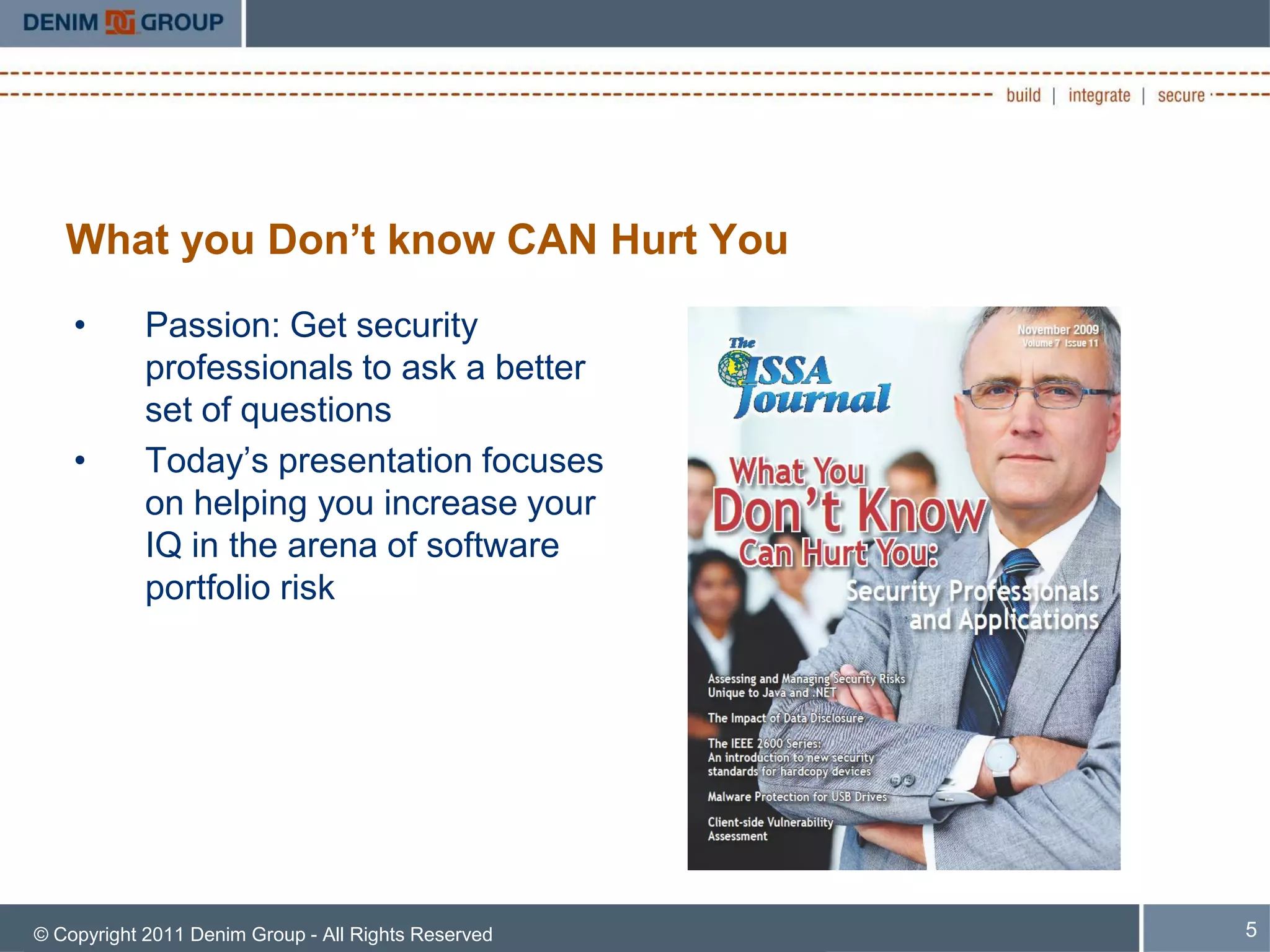
What you Don’t know CAN Hurt You
    •       Passion: Get security
            professionals to ask a better
            set of questions
    •       Today’s presentation focuses
            on helping you increase your
            IQ in the arena of software
            portfolio risk


© Copyright 2011 Denim Group - All Rights Reserved   5
Denim Group Background
          – Professional services firm that builds & secures enterprise
            applications
          – Secure development services:
                 • Secure .NET and Java application development
                 • Post-assessment remediation
                 • Secure web services
          – Application security services include:
                 •   External application assessments
                 •   Code reviews
                 •   Software development lifecycle development (SDLC) consulting
                 •   Classroom and e-Learning instruction for developers


© Copyright 2011 Denim Group - All Rights Reserved                                  6
Denim Group Background


          “CSRF Explained”


   http://threadstrong.com/courses-csrf-explained.html


© Copyright 2011 Denim Group - All Rights Reserved       7
Background – the Current State of Affairs

   • Creating meaningful enterprise-wide software security initiatives is
     hard
   • The vast majority of info regarding software security focuses on writing
     more secure code or SDLC process improvement
   • Most organizations have hundreds or thousands of legacy applications
     that work!
          – They represent money already spent – ROI?
          – They are viewed “part of the plumbing” by management
          – The code base can be millions of lines of code
   • Focus on web applications
          – Other software risks must be taken into consideration
                 • Web services, Saas, certain desktop applications


© Copyright 2011 Denim Group - All Rights Reserved                              8
Key Facts
   • 66% have adopted a risk-based approach to remediation of
     application vulnerabilities
   • 71% have an executive or team with primary ownership and
     accountability for application security
   • 66% have defined communications channels between security,
     operations, and development teams

          – Source: “Securing Your Applications: Three Ways to Play,” Aberdeen Group,
            August 2010


© Copyright 2011 Denim Group - All Rights Reserved                                      9
Step 1 – Information Gathering
   • Build a Portfolio of Applications
   • Collect Background Information
          –   Development Details
          –   Vendor (if any)
          –   Audience
          –   Hosting Details
   • Assess the Data
          – Type (CCs, PII, ePHI, etc)
          – Compliance Requirements


© Copyright 2011 Denim Group - All Rights Reserved   10
Step 1 – Information Gathering
   • Build a Portfolio of Applications
   • Collect Background Information
          –   Development Details
          –   Vendor (if any)
          –   Audience
          –   Hosting Details
   • Assess the Data
          – Type (CCs, PII, ePHI, etc)
          – Compliance Requirements


© Copyright 2011 Denim Group - All Rights Reserved   11
Step 1 – Information Gathering (Continued)
   • Determine the Scale
          –   Lines of Code
          –   Dynamic Pages
          –   Concurrent Users
          –   User Roles
   • Assess the Underlying Technology
          – Infrastructure (OS, hardware, etc)
          – Platform (.NET, Java, PHP, etc)
          – Versions
   • Assess the Security State
          – Assessment Activity (type, date, etc)
          – Vulnerabilities (high, medium, low)
          – Protection (IDS/IPS, WAF)


© Copyright 2011 Denim Group - All Rights Reserved   12
Step 2 – Application Scoring
   • Business Importance Risk
          – Business Function (customer interface, internal but public-facing, departmental use
            only)
          – Access Scope (external, internal)
          – Data Sensitivity (customer data, company confidential, public)
          – Availability Impact (serious, minor, minimal, or no reputation damage)


© Copyright 2011 Denim Group - All Rights Reserved                                                13
Step 2 – Application Scoring (Continued)
   • Technology Risk
          – Authentication (methods, enforcement)
          – Data Classification (formal approach or not)
          – Input / Output Validation (structured or not)
          – Authorization Controls (resource checks in place or not)
          – Security Requirements (explicitly documented or not)
          – Sensitive Data Handling (controls in place like encryption or not)
          – User Identity Management (procedures in place for account creation, access
            provisioning, and change control or not)
          – Infrastructure Architecture (network segmentation, patching)


© Copyright 2011 Denim Group - All Rights Reserved                                       14
Step 2 – Application Scoring (Continued)

   • Assessment Risk
          – Technical Assessment (assessment activity, vulnerabilities still present)
          – Regulatory Exposure (unknown, subject to regulation)
          – Third-Party Risks (outsourced development, SaaS hosting, etc)


© Copyright 2011 Denim Group - All Rights Reserved                                      15
Example Application Analysis
   •    Patient portal for hospital system
   •    Connects to back-end Electronic Medical Record system
   •    Microsoft.NET 3.5 framework
   •    Currently functionality being enhanced by internal development team
   •    Contains Electronic Patient (EPI) Data
   •    Audited once for PCI compliance in 2007
   •    Scanned by outside 3rd party for application security vulnerabilities in
        2009


© Copyright 2011 Denim Group - All Rights Reserved                                 16
Application Comparisons
   Application #1

   • Publicly accessible staff scheduling application
   • 1 million lines of code
   • Written in classic ASP by an outsourced company that is no longer
     under contract
   • <$1M year sales goes through the application in a $5B company
   • No mitigating security technologies in place
   • Still processes orders efficiently; supported by application
     maintenance group


© Copyright 2011 Denim Group - All Rights Reserved                       17
Application Comparisons
   Application #2

   •    External company website with limited functionality
   •    Site build it in Microsoft SharePoint 2007 technologies
   •    Custom web parts provide some interactivity
   •    Site actively managed by corporate marketing team
   •    Not in scope for past outside security audit given marketing
        responsibility


© Copyright 2011 Denim Group - All Rights Reserved                     18
Application Comparisons
   Application #3

   •    J2EE-based corporate E-commerce site
   •    500K lines of code
   •    Lots of revenue ($$$) for the company
   •    Regular security audits and scans by 3rd parties
   •    Web services to various internal applications


© Copyright 2011 Denim Group - All Rights Reserved         19
Application Comparisons
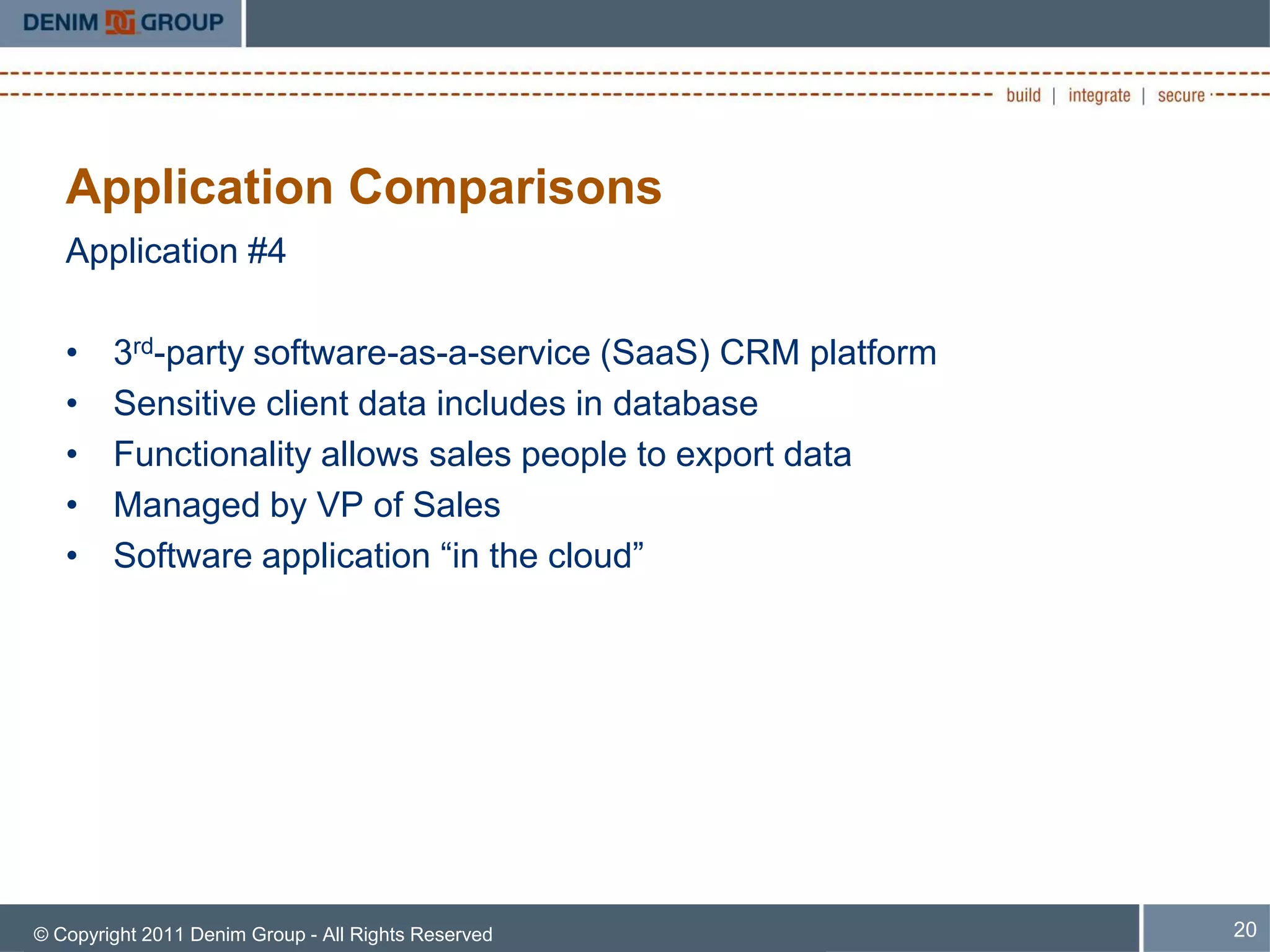
   Application #4

   •    3rd-party software-as-a-service (SaaS) CRM platform
   •    Sensitive client data includes in database
   •    Functionality allows sales people to export data
   •    Managed by VP of Sales
   •    Software application “in the cloud”


© Copyright 2011 Denim Group - All Rights Reserved            20
Results Comparison
   • Let’s analyze our results
   • Apply quantitative decision-making analysis concepts
          – Want to understand what level of effort addresses the highest amount of risk
   • Tradeoff analysis


© Copyright 2011 Denim Group - All Rights Reserved                                         21
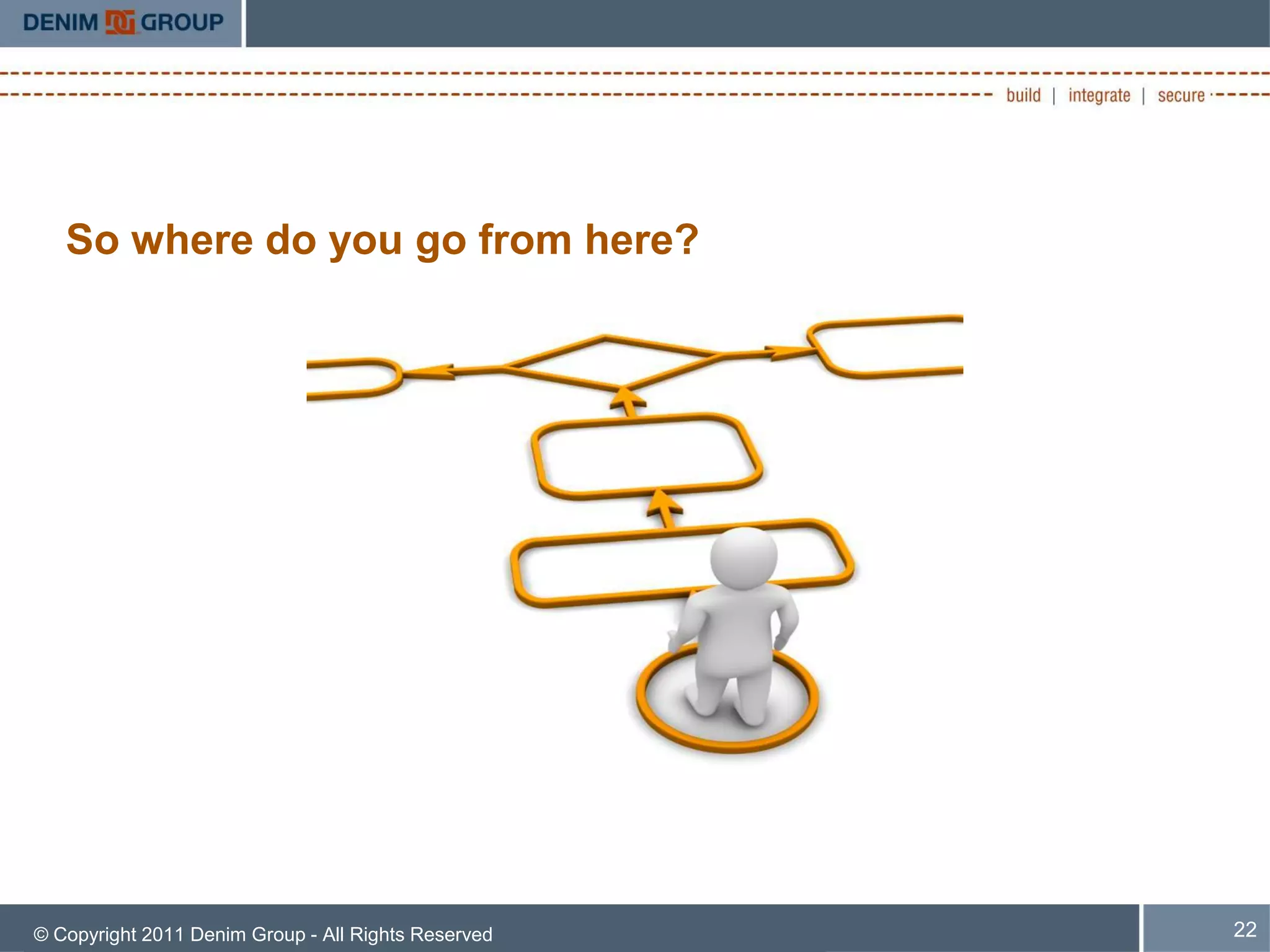
So where do you go from here?


© Copyright 2011 Denim Group - All Rights Reserved   22
Potential Follow-up Options
   • End of Life
   • Remediate
   • Potential Testing Approaches
          – Tailoring to Documented Risk
          – Work identified list from top to bottom
   • Application Security Verification Standard
          – Levels of application-level security verification that increase in breadth and depth as
            one moves up the levels
          – Verification requirements that prescribe a unique white-list approach for security
            controls
          – Reporting requirements that ensure reports are sufficiently detailed to make
            verification repeatable, and to determine if the verification was accurate and
            complete.


© Copyright 2011 Denim Group - All Rights Reserved                                                    23
What you can do now!
   • Collect or scrub your initial application inventory
   • Develop relationships w/ 3rd parties who can help you through the
     identification process
   • Find a peer that is conducting the same risk ranking
   • Exhaust Open Web Application Security Project (OWASP) resources!
   • Familiarize yourself with OWASP OpenSAMM


© Copyright 2011 Denim Group - All Rights Reserved                       24
Conclusion
   • Managing the security of inherited applications can present the most
     severe headaches for someone building a software security program
   • A risk-based approach is really the only economically feasible
     approach given the size/complexity of the problem
   • Understanding certain attributes of inherited applications is critical to
     applying a risk-based management approach


© Copyright 2011 Denim Group - All Rights Reserved                               25
Resources
   •    “Web Application Security Portfolios, ISSA Journal, May 2009, Coblentz, Nick.
   •    Open Web Application Security Project Open Software Assurance Maturity Model,
        www.owasp.org
   •    Open Web Application Security Project Application Security Verification Standard,
        www.owasp.org
   •    “How-to-Guide for Software Security Vulnerability Remediation,” Dan Cornell, Denim
        Group, October 2010
   •    Cloud Security Alliance
   •    “Securing your Applications,” Aberdeen Group, Brink, Derek, August 2010


© Copyright 2011 Denim Group - All Rights Reserved                                           26
Contact
     Dan Cornell
     dan@denimgroup.com
     (210) 572-4400

     www.denimgroup.com
     blog.denimgroup.com
     Twitter: @danielcornell


© Copyright 2011 Denim Group - All Rights Reserved   27

Skeletons in the Closet: Securing Inherited Applications

  • 1.
    Skeletons in theCloset Securing Inherited Applications Dan Cornell © Copyright 2011 Denim Group - All Rights Reserved
  • 2.
    Overview for Today’sSession • The Problem • Information Gathering • Application Scoring • Risk Rank & Tradeoff Analysis • Discussion • Conclusion, Next Steps, and Q&A © Copyright 2011 Denim Group - All Rights Reserved 1
  • 3.
    Some Key Questionsfor Today’s Session • Where do you start? • What applications represent the biggest risk? • What attributes make applications more or less risky? • What are the most cost-effective way to manage the risk of inherited applications? • What approaches might work for your organization? © Copyright 2011 Denim Group - All Rights Reserved 2
  • 4.
    Key Goals forToday’s Session • Understand risk-based options for managing the security of inherited applications • Develop a framework for ranking risks with specific applications • Understand some of the decision-making factors that come into play when risk-ranking applications • Apply one tactic from what you learn today next week at your organization © Copyright 2011 Denim Group - All Rights Reserved 3
  • 5.
    Personal Background • 13-years information software development and security • Works with CIOs and CSOs to build successful software security initiatives • Educates both developers and non-developer security professionals how to build secure applications and manage application risk © Copyright 2011 Denim Group - All Rights Reserved 4
  • 6.
    What you Don’tknow CAN Hurt You • Passion: Get security professionals to ask a better set of questions • Today’s presentation focuses on helping you increase your IQ in the arena of software portfolio risk © Copyright 2011 Denim Group - All Rights Reserved 5
  • 7.
    Denim Group Background – Professional services firm that builds & secures enterprise applications – Secure development services: • Secure .NET and Java application development • Post-assessment remediation • Secure web services – Application security services include: • External application assessments • Code reviews • Software development lifecycle development (SDLC) consulting • Classroom and e-Learning instruction for developers © Copyright 2011 Denim Group - All Rights Reserved 6
  • 8.
    Denim Group Background “CSRF Explained” http://threadstrong.com/courses-csrf-explained.html © Copyright 2011 Denim Group - All Rights Reserved 7
  • 9.
    Background – theCurrent State of Affairs • Creating meaningful enterprise-wide software security initiatives is hard • The vast majority of info regarding software security focuses on writing more secure code or SDLC process improvement • Most organizations have hundreds or thousands of legacy applications that work! – They represent money already spent – ROI? – They are viewed “part of the plumbing” by management – The code base can be millions of lines of code • Focus on web applications – Other software risks must be taken into consideration • Web services, Saas, certain desktop applications © Copyright 2011 Denim Group - All Rights Reserved 8
  • 10.
    Key Facts • 66% have adopted a risk-based approach to remediation of application vulnerabilities • 71% have an executive or team with primary ownership and accountability for application security • 66% have defined communications channels between security, operations, and development teams – Source: “Securing Your Applications: Three Ways to Play,” Aberdeen Group, August 2010 © Copyright 2011 Denim Group - All Rights Reserved 9
  • 11.
    Step 1 –Information Gathering • Build a Portfolio of Applications • Collect Background Information – Development Details – Vendor (if any) – Audience – Hosting Details • Assess the Data – Type (CCs, PII, ePHI, etc) – Compliance Requirements © Copyright 2011 Denim Group - All Rights Reserved 10
  • 12.
    Step 1 –Information Gathering • Build a Portfolio of Applications • Collect Background Information – Development Details – Vendor (if any) – Audience – Hosting Details • Assess the Data – Type (CCs, PII, ePHI, etc) – Compliance Requirements © Copyright 2011 Denim Group - All Rights Reserved 11
  • 13.
    Step 1 –Information Gathering (Continued) • Determine the Scale – Lines of Code – Dynamic Pages – Concurrent Users – User Roles • Assess the Underlying Technology – Infrastructure (OS, hardware, etc) – Platform (.NET, Java, PHP, etc) – Versions • Assess the Security State – Assessment Activity (type, date, etc) – Vulnerabilities (high, medium, low) – Protection (IDS/IPS, WAF) © Copyright 2011 Denim Group - All Rights Reserved 12
  • 14.
    Step 2 –Application Scoring • Business Importance Risk – Business Function (customer interface, internal but public-facing, departmental use only) – Access Scope (external, internal) – Data Sensitivity (customer data, company confidential, public) – Availability Impact (serious, minor, minimal, or no reputation damage) © Copyright 2011 Denim Group - All Rights Reserved 13
  • 15.
    Step 2 –Application Scoring (Continued) • Technology Risk – Authentication (methods, enforcement) – Data Classification (formal approach or not) – Input / Output Validation (structured or not) – Authorization Controls (resource checks in place or not) – Security Requirements (explicitly documented or not) – Sensitive Data Handling (controls in place like encryption or not) – User Identity Management (procedures in place for account creation, access provisioning, and change control or not) – Infrastructure Architecture (network segmentation, patching) © Copyright 2011 Denim Group - All Rights Reserved 14
  • 16.
    Step 2 –Application Scoring (Continued) • Assessment Risk – Technical Assessment (assessment activity, vulnerabilities still present) – Regulatory Exposure (unknown, subject to regulation) – Third-Party Risks (outsourced development, SaaS hosting, etc) © Copyright 2011 Denim Group - All Rights Reserved 15
  • 17.
    Example Application Analysis • Patient portal for hospital system • Connects to back-end Electronic Medical Record system • Microsoft.NET 3.5 framework • Currently functionality being enhanced by internal development team • Contains Electronic Patient (EPI) Data • Audited once for PCI compliance in 2007 • Scanned by outside 3rd party for application security vulnerabilities in 2009 © Copyright 2011 Denim Group - All Rights Reserved 16
  • 18.
    Application Comparisons Application #1 • Publicly accessible staff scheduling application • 1 million lines of code • Written in classic ASP by an outsourced company that is no longer under contract • <$1M year sales goes through the application in a $5B company • No mitigating security technologies in place • Still processes orders efficiently; supported by application maintenance group © Copyright 2011 Denim Group - All Rights Reserved 17
  • 19.
    Application Comparisons Application #2 • External company website with limited functionality • Site build it in Microsoft SharePoint 2007 technologies • Custom web parts provide some interactivity • Site actively managed by corporate marketing team • Not in scope for past outside security audit given marketing responsibility © Copyright 2011 Denim Group - All Rights Reserved 18
  • 20.
    Application Comparisons Application #3 • J2EE-based corporate E-commerce site • 500K lines of code • Lots of revenue ($$$) for the company • Regular security audits and scans by 3rd parties • Web services to various internal applications © Copyright 2011 Denim Group - All Rights Reserved 19
  • 21.
    Application Comparisons Application #4 • 3rd-party software-as-a-service (SaaS) CRM platform • Sensitive client data includes in database • Functionality allows sales people to export data • Managed by VP of Sales • Software application “in the cloud” © Copyright 2011 Denim Group - All Rights Reserved 20
  • 22.
    Results Comparison • Let’s analyze our results • Apply quantitative decision-making analysis concepts – Want to understand what level of effort addresses the highest amount of risk • Tradeoff analysis © Copyright 2011 Denim Group - All Rights Reserved 21
  • 23.
    So where doyou go from here? © Copyright 2011 Denim Group - All Rights Reserved 22
  • 24.
    Potential Follow-up Options • End of Life • Remediate • Potential Testing Approaches – Tailoring to Documented Risk – Work identified list from top to bottom • Application Security Verification Standard – Levels of application-level security verification that increase in breadth and depth as one moves up the levels – Verification requirements that prescribe a unique white-list approach for security controls – Reporting requirements that ensure reports are sufficiently detailed to make verification repeatable, and to determine if the verification was accurate and complete. © Copyright 2011 Denim Group - All Rights Reserved 23
  • 25.
    What you cando now! • Collect or scrub your initial application inventory • Develop relationships w/ 3rd parties who can help you through the identification process • Find a peer that is conducting the same risk ranking • Exhaust Open Web Application Security Project (OWASP) resources! • Familiarize yourself with OWASP OpenSAMM © Copyright 2011 Denim Group - All Rights Reserved 24
  • 26.
    Conclusion • Managing the security of inherited applications can present the most severe headaches for someone building a software security program • A risk-based approach is really the only economically feasible approach given the size/complexity of the problem • Understanding certain attributes of inherited applications is critical to applying a risk-based management approach © Copyright 2011 Denim Group - All Rights Reserved 25
  • 27.
    Resources • “Web Application Security Portfolios, ISSA Journal, May 2009, Coblentz, Nick. • Open Web Application Security Project Open Software Assurance Maturity Model, www.owasp.org • Open Web Application Security Project Application Security Verification Standard, www.owasp.org • “How-to-Guide for Software Security Vulnerability Remediation,” Dan Cornell, Denim Group, October 2010 • Cloud Security Alliance • “Securing your Applications,” Aberdeen Group, Brink, Derek, August 2010 © Copyright 2011 Denim Group - All Rights Reserved 26
  • 28.
    Contact Dan Cornell dan@denimgroup.com (210) 572-4400 www.denimgroup.com blog.denimgroup.com Twitter: @danielcornell © Copyright 2011 Denim Group - All Rights Reserved 27