Skeletal muscle relaxants
Peripherally acting skeletal muscle relaxants
• These drugs act peripherally and block neuromuscular transmission at
neuromuscular junction, causing paralysis and or reduce tone of skeletal
muscle.
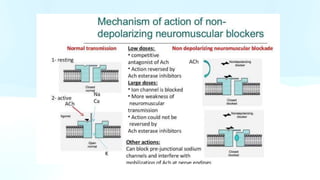
• They mainly block Nm receptors. This produces skeletal muscle relaxation.
• Mechanism of action: the site of
action of skeletal muscle relaxants
is the motor end plate of the
skeletal muscle fibres
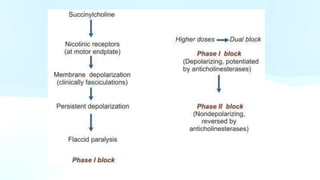
Succinylcholine apnoea
• SCh is rapidly hydrolysed by pseudocholinesterase, hence has a very short
duration of action (3–8 minutes).
• Transient apnoea is usually seen at the peak of its action.
• In people with liver disease or atypical pseudocholinesterase due to genetic
defect, the metabolism of SCh becomes slow which results in severe
neuromuscular blockade leading to respiratory paralysis with prolonged
apnoea. This is referred to as ‘prolonged succinylcholine apnoea’.
• Fresh frozen plasma should be infused.
• Patient should be ventilated artificially until full recovery.
Uses of peripherally acting skeletal muscle relaxants
• Adjuvants to general anesthesia
• For adequate muscle relaxation
• Abdominal and thoracic surgeries, intubation and endoscopies, orthopaedic
manipulation etc
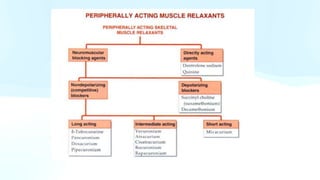
• Vecuronium,cisatracurium and rocuronium are frequently used.
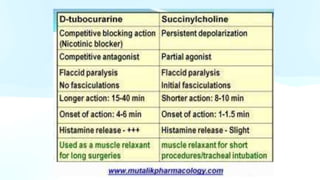
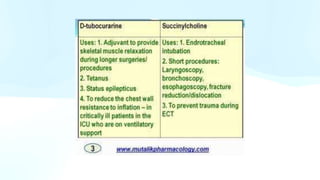
• Succinylcholine is employed for brief procedures like endotracheal intubation,
oesophagoscopy, reduction of fractures, dislocation to treat laryngospasm
• Ocular surgery( competitive blockade)
Drug interactions
• Non depolarising blockers x antibiotics
• General anesthetics x smr
• Thiopentone x sch
• Thiazides x smr
• Assisted mechanical ventilation
• To avoid convulsions and coma in
electro convulsive therapy
• Spastic disorders- tetanus and
status epilepticus.
Reversal of neuromuscular blockers
• Edrophonium or neostigmine by increasing the concentration of ACh reverses
the effect of d-TC and other competitive blockers at NMJ.
• Use of prior atropine administration is necessary to block the muscarinic
effects of anti- cholinesterases .
• Mivacurium (short acting), atracurium (intermediate acting), etc. do not require
reversal.
Centrally acting skeletal muscle relaxants
• Most of the centrally acting skeletal muscle relaxants are available in
combination with one or other nonsteroidal anti-inflammatory drugs (NSAIDs).
• All of them cause certain degree of sedation.
• They act by depressing polysynaptic pathways in spinal and supra- spinal
sites.
• They are used to reduce spasm associated with cerebral palsy, trauma,
sprain, tetanus, multiple sclerosis, etc.
Directly acting skeletal muscle relaxant
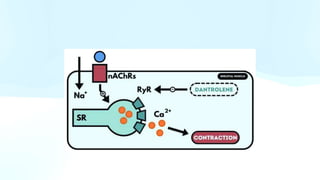
• Dantrolene. Dantrolene is a directly acting skeletal muscle relaxant.
• It inhibits depolarization-induced Ca2 release from sarcoplasmic reticulum and
produces skeletal muscle relaxation.
• Intravenous dantrolene is the life-saving drug in malignant hyperthermia.
• It is used orally to reduce spasm in multiple sclerosis, cerebral palsy, spinal
injuries, etc. The side effects are drowsiness, diarrhoea, dizziness, headache,
fatigue and rarely hepatotoxicity.
Botulinum toxin A
• Botulinum Toxin A. It is obtained from Clostridium botulinum, a gram-positive
anaerobic bacterium.
• The toxin prevents release of ACh into the synaptic cleft by inhibiting proteins
necessary for the release of ACh.
• Thus, it normalizes the tone in hyperreactive or spastic muscles when given
locally.
• It is given intradermally for antiwrinkle effect in cosmetic procedures and into
the muscle in multiple doses for spasticity or dystonia.
Skeletal muscle relaxants .presentations

Skeletal muscle relaxants .presentations

  • 1.
  • 2.
    Peripherally acting skeletalmuscle relaxants • These drugs act peripherally and block neuromuscular transmission at neuromuscular junction, causing paralysis and or reduce tone of skeletal muscle. • They mainly block Nm receptors. This produces skeletal muscle relaxation.
  • 5.
    • Mechanism ofaction: the site of action of skeletal muscle relaxants is the motor end plate of the skeletal muscle fibres
  • 11.
    Succinylcholine apnoea • SChis rapidly hydrolysed by pseudocholinesterase, hence has a very short duration of action (3–8 minutes). • Transient apnoea is usually seen at the peak of its action. • In people with liver disease or atypical pseudocholinesterase due to genetic defect, the metabolism of SCh becomes slow which results in severe neuromuscular blockade leading to respiratory paralysis with prolonged apnoea. This is referred to as ‘prolonged succinylcholine apnoea’. • Fresh frozen plasma should be infused. • Patient should be ventilated artificially until full recovery.
  • 12.
    Uses of peripherallyacting skeletal muscle relaxants • Adjuvants to general anesthesia • For adequate muscle relaxation • Abdominal and thoracic surgeries, intubation and endoscopies, orthopaedic manipulation etc • Vecuronium,cisatracurium and rocuronium are frequently used. • Succinylcholine is employed for brief procedures like endotracheal intubation, oesophagoscopy, reduction of fractures, dislocation to treat laryngospasm • Ocular surgery( competitive blockade)
  • 13.
    Drug interactions • Nondepolarising blockers x antibiotics • General anesthetics x smr • Thiopentone x sch • Thiazides x smr
  • 14.
    • Assisted mechanicalventilation • To avoid convulsions and coma in electro convulsive therapy • Spastic disorders- tetanus and status epilepticus.
  • 15.
    Reversal of neuromuscularblockers • Edrophonium or neostigmine by increasing the concentration of ACh reverses the effect of d-TC and other competitive blockers at NMJ. • Use of prior atropine administration is necessary to block the muscarinic effects of anti- cholinesterases . • Mivacurium (short acting), atracurium (intermediate acting), etc. do not require reversal.
  • 16.
    Centrally acting skeletalmuscle relaxants • Most of the centrally acting skeletal muscle relaxants are available in combination with one or other nonsteroidal anti-inflammatory drugs (NSAIDs). • All of them cause certain degree of sedation. • They act by depressing polysynaptic pathways in spinal and supra- spinal sites. • They are used to reduce spasm associated with cerebral palsy, trauma, sprain, tetanus, multiple sclerosis, etc.
  • 17.
    Directly acting skeletalmuscle relaxant • Dantrolene. Dantrolene is a directly acting skeletal muscle relaxant. • It inhibits depolarization-induced Ca2 release from sarcoplasmic reticulum and produces skeletal muscle relaxation. • Intravenous dantrolene is the life-saving drug in malignant hyperthermia. • It is used orally to reduce spasm in multiple sclerosis, cerebral palsy, spinal injuries, etc. The side effects are drowsiness, diarrhoea, dizziness, headache, fatigue and rarely hepatotoxicity.
  • 19.
    Botulinum toxin A •Botulinum Toxin A. It is obtained from Clostridium botulinum, a gram-positive anaerobic bacterium. • The toxin prevents release of ACh into the synaptic cleft by inhibiting proteins necessary for the release of ACh. • Thus, it normalizes the tone in hyperreactive or spastic muscles when given locally. • It is given intradermally for antiwrinkle effect in cosmetic procedures and into the muscle in multiple doses for spasticity or dystonia.