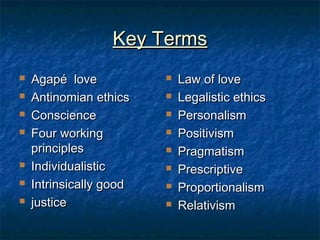
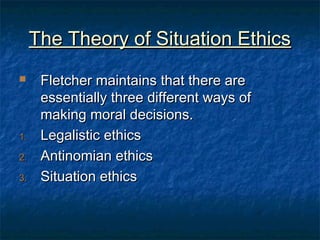
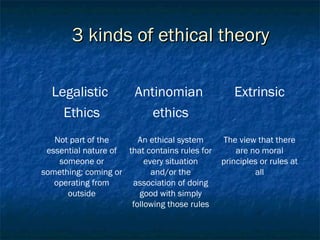
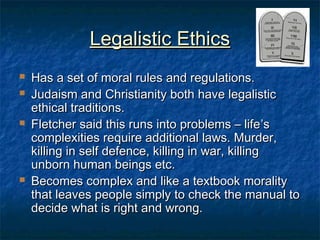
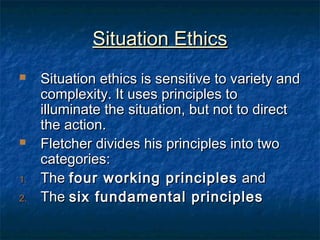
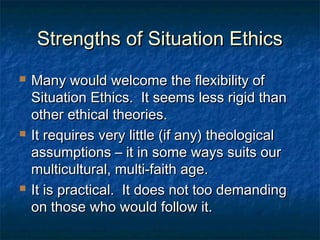
Situation ethics is a normative ethical theory developed by Joseph Fletcher in the 1960s. It holds that the only intrinsically good thing is love, and that moral decisions should be made based on the situation by considering what decision best displays love. Situation ethics rejects both legalistic ethics, which bases morality on fixed rules, and antinomian ethics, which rejects all rules. Instead, situation ethics allows that established moral rules may be set aside if following love requires a different action. Strengths include flexibility, but weaknesses include the difficulty determining consequences and potential for justifying harmful actions.










![Exam QuestionExam Question
(a)(a) How might a Situation EthicistHow might a Situation Ethicist
respond to the claim that people shouldrespond to the claim that people should
always tellalways tell
the truth?the truth? [33][33]
(b)(b) Assess the strengths and weaknessesAssess the strengths and weaknesses
of Situation ethics.of Situation ethics. [17][17]
You will haveYou will have 30 minutes30 minutes to answer thisto answer this
question in the January exam. Deadlinequestion in the January exam. Deadline
16/10/06 (Next Monday)16/10/06 (Next Monday)](https://image.slidesharecdn.com/situationethicspowerpoint-140320144626-phpapp02/85/Situation-ethics-powerpoint-24-320.jpg)


