SITE DIRECTED
MUTAGENESIS
By
Sushmitha
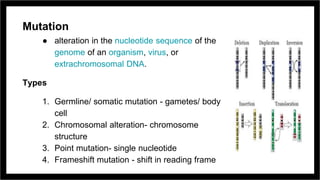
Mutation
● alteration in the nucleotide sequence of the
genome of an organism, virus, or
extrachromosomal DNA.
Types
1. Germline/ somatic mutation - gametes/ body
cell
2. Chromosomal alteration- chromosome
structure
3. Point mutation- single nucleotide
4. Frameshift mutation - shift in reading frame
Site directed mutagenesis
● Molecular biology method- make
specific&intentional changes DNA seq.
● Investigating stuct& bio activity of
DNA,RNA,protein.
● Imp lab techniq for creating DNA libs by
introducing mutations into DNA seq.
● Numerous methods r there- but low cost of
oligonucleotide ,artificial gene syn is used as
alternative method.
Other names
● Site specific
mutagenesis
● Oligonucleotid
e directed
mutagenesis
History
● Early attempts at mutation- radiation or chemical mutagens-non
specific , generating random mutation.
● Nucleotides &other chemicals were used to generate localized point
mutation -aminopurine,nitroguanidine,bisulfate.
● 1974-Charles Weissmann- N4-hydroxycytidine - GC to AT.
● 1971-Clyde Hutchison& Marshall Edgell -produce mutants with phage
ϕX174 and restriction nucleases.
● 1978-Hutchison& Michael smith - primer extension method.
● 1993 Michael Smith & Kary B Mullis invent PCR - Nobel prize in
chemistry.
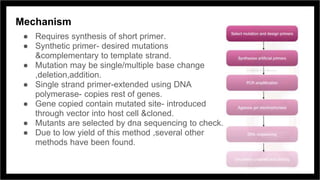
Mechanism
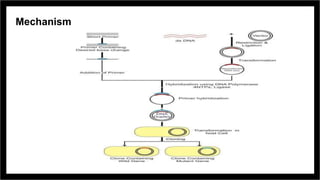
● Requires synthesis of short primer.
● Synthetic primer- desired mutations
&complementary to template strand.
● Mutation may be single/multiple base change
,deletion,addition.
● Single strand primer-extended using DNA
polymerase- copies rest of genes.
● Gene copied contain mutated site- introduced
through vector into host cell &cloned.
● Mutants are selected by dna sequencing to check.
● Due to low yield of this method ,several other
methods have been found.
Mechanism
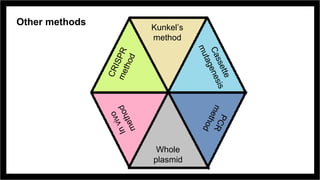
Other methods
Kunkel’s
method
Whole
plasmid
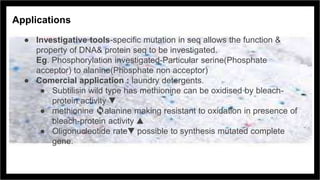
Applications
● Investigative tools-specific mutation in seq allows the function &
property of DNA& protein seq to be investigated.
Eg. Phosphorylation investigated-Particular serine(Phosphate
acceptor) to alanine(Phosphate non acceptor)
● Comercial application : laundry detergents.
● Subtilisin wild type has methionine can be oxidised by bleach-
protein activity 🔻
● methionine 🔄alanine making resistant to oxidation in presence of
bleach-protein activity 🔺
● Oligonucleotide rate🔻 possible to synthesis mutated complete
gene.
Disadvantages
● Long amplification protocol - 25cycles(b/w 4 to 8hrs) .
● Low yield of amplified DNA
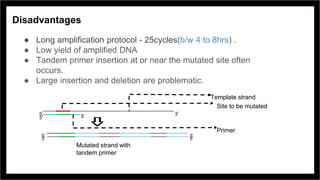
● Tandem primer insertion at or near the mutated site often
occurs.
● Large insertion and deletion are problematic.
5’ 5’
3’
5’
5’
3’
3’
3’
Template strand
Site to be mutated
Primer
Mutated strand with
tandem primer
site directed mutagenesis .pptx

site directed mutagenesis .pptx

  • 1.
  • 2.
    Mutation ● alteration inthe nucleotide sequence of the genome of an organism, virus, or extrachromosomal DNA. Types 1. Germline/ somatic mutation - gametes/ body cell 2. Chromosomal alteration- chromosome structure 3. Point mutation- single nucleotide 4. Frameshift mutation - shift in reading frame
  • 3.
    Site directed mutagenesis ●Molecular biology method- make specific&intentional changes DNA seq. ● Investigating stuct& bio activity of DNA,RNA,protein. ● Imp lab techniq for creating DNA libs by introducing mutations into DNA seq. ● Numerous methods r there- but low cost of oligonucleotide ,artificial gene syn is used as alternative method. Other names ● Site specific mutagenesis ● Oligonucleotid e directed mutagenesis
  • 4.
    History ● Early attemptsat mutation- radiation or chemical mutagens-non specific , generating random mutation. ● Nucleotides &other chemicals were used to generate localized point mutation -aminopurine,nitroguanidine,bisulfate. ● 1974-Charles Weissmann- N4-hydroxycytidine - GC to AT. ● 1971-Clyde Hutchison& Marshall Edgell -produce mutants with phage ϕX174 and restriction nucleases. ● 1978-Hutchison& Michael smith - primer extension method. ● 1993 Michael Smith & Kary B Mullis invent PCR - Nobel prize in chemistry.
  • 5.
    Mechanism ● Requires synthesisof short primer. ● Synthetic primer- desired mutations &complementary to template strand. ● Mutation may be single/multiple base change ,deletion,addition. ● Single strand primer-extended using DNA polymerase- copies rest of genes. ● Gene copied contain mutated site- introduced through vector into host cell &cloned. ● Mutants are selected by dna sequencing to check. ● Due to low yield of this method ,several other methods have been found.
  • 6.
  • 7.
  • 8.
    Applications ● Investigative tools-specificmutation in seq allows the function & property of DNA& protein seq to be investigated. Eg. Phosphorylation investigated-Particular serine(Phosphate acceptor) to alanine(Phosphate non acceptor) ● Comercial application : laundry detergents. ● Subtilisin wild type has methionine can be oxidised by bleach- protein activity 🔻 ● methionine 🔄alanine making resistant to oxidation in presence of bleach-protein activity 🔺 ● Oligonucleotide rate🔻 possible to synthesis mutated complete gene.
  • 9.
    Disadvantages ● Long amplificationprotocol - 25cycles(b/w 4 to 8hrs) . ● Low yield of amplified DNA ● Tandem primer insertion at or near the mutated site often occurs. ● Large insertion and deletion are problematic. 5’ 5’ 3’ 5’ 5’ 3’ 3’ 3’ Template strand Site to be mutated Primer Mutated strand with tandem primer