M. NAVEED
CONTENTS
 Introduction
 History
 Vision, Mission and Ethics
 Objective
 Ratio’s
Liquidity
Activity
Profitability
Solvency
 SWOT Analysis
 Suggestion and Conclusion
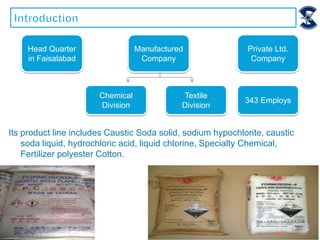
Its product line includes Caustic Soda solid, sodium hypochlorite, caustic
soda liquid, hydrochloric acid, liquid chlorine, Specialty Chemical,
Fertilizer polyester Cotton.
Head Quarter
in Faisalabad
343 Employs
Private Ltd.
Company
Chemical
Division
Textile
Division
Manufactured
Company
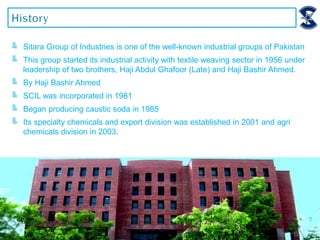
╚ Sitara Group of Industries is one of the well-known industrial groups of Pakistan
╚ This group started its industrial activity with textile weaving sector in 1956 under
leadership of two brothers, Haji Abdul Ghafoor (Late) and Haji Bashir Ahmed.
╚ By Haji Bashir Ahmed
╚ SCIL was incorporated in 1981
╚ Began producing caustic soda in 1985
╚ Its specialty chemicals and export division was established in 2001 and agri
chemicals division in 2003.
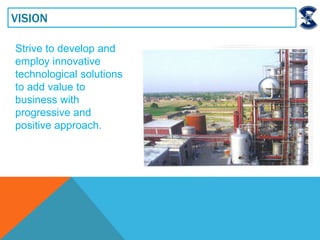
VISION
Strive to develop and
employ innovative
technological solutions
to add value to
business with
progressive and
positive approach.
MISSION
Continuing growth
and diversification
for bottom line
results with risks
well contained.
BUSINESSES
 Sitara Chemical Industries Ltd.
 Sitara Chemical Industries Ltd. (Textile Division)
 Sitara Textile Industries Ltd.
 Sitara Spinning Mills Ltd.
 Sitara Energy Ltd.
 Aziz Fatima Trust Hospital
 Ghafoor Bashir Children Hospital
 Sitara Developers Ptv. Ltd.
 Sitara Hamza Pvt. Ltd.
OBJECTIVES
Safety
Quality
Integrity
Respect
Excellence
Innovation
M. SHAHID MUNIR
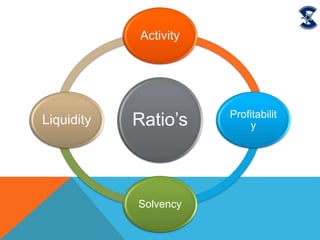
Ratio’s
Activity
Profitabilit
y
Solvency
Liquidity
LIQUIDITY
RATIO
LIQUIDITY RATIO
“ Liquidity ratios measure the company's ability to meet its
short-term obligations.”
Liquidity Ratios:
Current Ratio
 Quick Ratio
 Absolute Ratio
CURRENT RATIO
Definition:
Total current assets to total current
liabilities.
Known as:
Working Capital Ratio
Bench-Mark Rate:
2:1
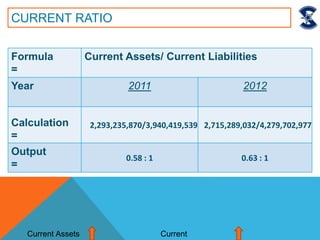
Formula
=
Current Assets/ Current Liabilities
Year 2011 2012
Calculation
=
2,293,235,870/3,940,419,539 2,715,289,032/4,279,702,977
Output
=
0.58 : 1 0.63 : 1
CURRENT RATIO
Current Assets Current
LIQUID RATIO
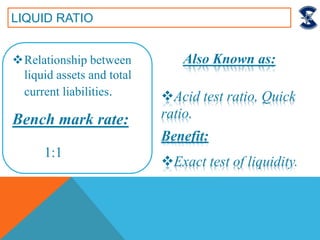
Relationship between
liquid assets and total
current liabilities.
Bench mark rate:
1:1
Acid test ratio, Quick
ratio.
Benefit:
Exact test of liquidity.
Also Known as:
LIQUID RATIO
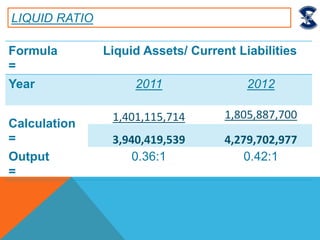
Formula
=
Liquid Assets/ Current Liabilities
Year 2011 2012
Calculation
=
1,401,115,714 1,805,887,700
3,940,419,539 4,279,702,977
Output
=
0.36:1 0.42:1
ABSOLUTE LIQUID RATIO
Relates cash , bank and
marketable securities to
current liabilities.
Very strict and
exacting standard of
liquidity.
Bench Mark rate:
0.5:1
ABSOLUTE LIQUID RATIO
Formula
=
[Cash + Bank+ Marketable Securities]
Current Liabilities
Years 2011 2012
Calculation
=
140,776,990 79,861,668
4,27,97,02,977 3,94,04,19,539
Output
=
0.04:1 0.02:1
FARHAT ABBAS
ACTIVITY RATIO
ACTIVITY RATIO
“Activity or efficiency ratio
reflects the intensity of a
company’s resource utilization
or how efficient management
team uses its assets or capital to
generate sales.’’ in other words
‘measure the efficiency of
Business’
ACTIVITY RATIO
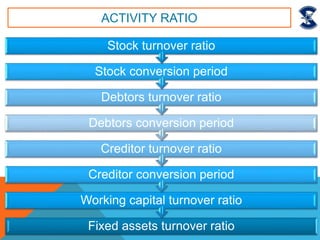
Fixed assets turnover ratio
Working capital turnover ratio
Creditor conversion period
Creditor turnover ratio
Debtors conversion period
Debtors turnover ratio
Stock conversion period
Stock turnover ratio
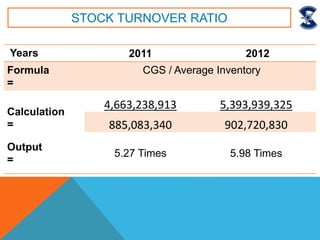
Years 2011 2012
Formula
=
CGS / Average Inventory
Calculation
=
4,663,238,913 5,393,939,325
885,083,340 902,720,830
Output
=
5.27 Times 5.98 Times
STOCK TURNOVER RATIO
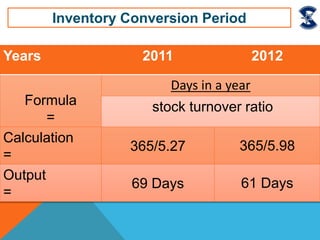
Years 2011 2012
Formula
=
Days in a year
stock turnover ratio
Calculation
=
365/5.27 365/5.98
Output
=
69 Days 61 Days
Inventory Conversion Period
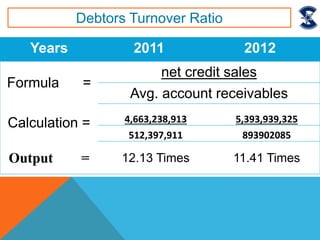
Years 2011 2012
Formula =
net credit sales
Avg. account receivables
Calculation = 4,663,238,913 5,393,939,325
512,397,911 893902085
Output = 12.13 Times 11.41 Times
Debtors Turnover Ratio
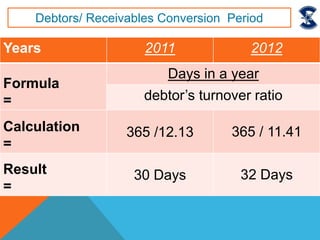
Years 2011 2012
Formula
=
Days in a year
debtor’s turnover ratio
Calculation
=
365 /12.13 365 / 11.41
Result
=
30 Days 32 Days
Debtors/ Receivables Conversion Period
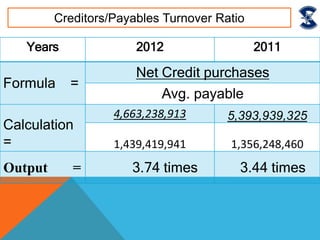
Creditors/Payables Turnover Ratio
Years 2012 2011
Formula =
Net Credit purchases
Avg. payable
Calculation
=
4,663,238,913 5,393,939,325
1,439,419,941 1,356,248,460
Output = 3.74 times 3.44 times
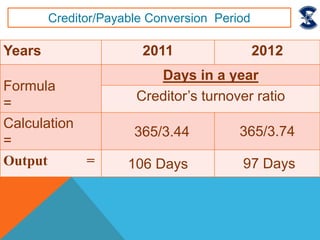
Years 2011 2012
Formula
=
Days in a year
Creditor’s turnover ratio
Calculation
=
365/3.44 365/3.74
Output = 106 Days 97 Days
Creditor/Payable Conversion Period
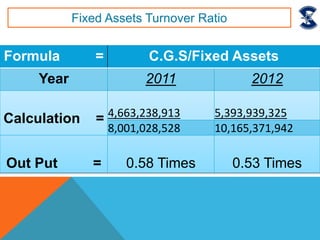
Formula = C.G.S/Fixed Assets
Year 2011 2012
Calculation = 4,663,238,913 5,393,939,325
8,001,028,528 10,165,371,942
Out Put = 0.58 Times 0.53 Times
Fixed Assets Turnover Ratio
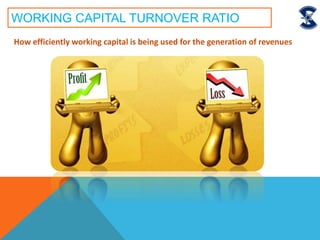
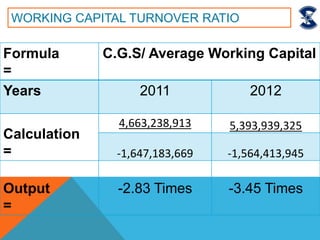
WORKING CAPITAL TURNOVER RATIO
How efficiently working capital is being used for the generation of revenues
WORKING CAPITAL TURNOVER RATIO
Formula
=
C.G.S/ Average Working Capital
Years 2011 2012
Calculation
=
4,663,238,913 5,393,939,325
-1,647,183,669 -1,564,413,945
Output
=
-2.83 Times -3.45 Times
GOHAR IQBAL
Profitability Ratio’s
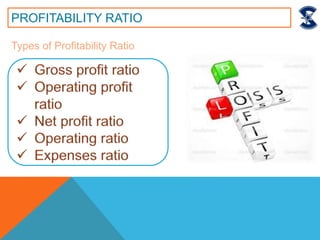
PROFITABILITY RATIO
Types of Profitability Ratio
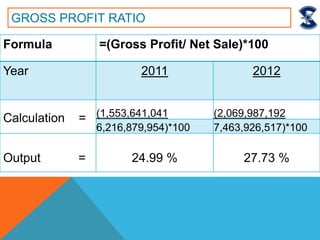
Formula =(Gross Profit/ Net Sale)*100
Year 2011 2012
Calculation = (1,553,641,041 (2,069,987,192
6,216,879,954)*100 7,463,926,517)*100
Output = 24.99 % 27.73 %
GROSS PROFIT RATIO
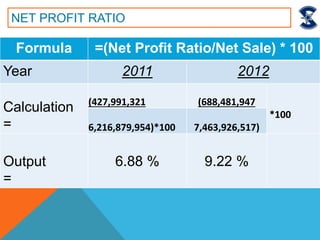
Formula =(Net Profit Ratio/Net Sale) * 100
Year 2011 2012
Calculation
=
(427,991,321 (688,481,947
*100
6,216,879,954)*100 7,463,926,517)
Output
=
6.88 % 9.22 %
NET PROFIT RATIO
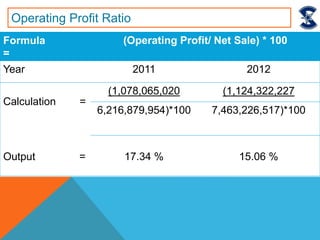
Formula
=
(Operating Profit/ Net Sale) * 100
Year 2011 2012
Calculation =
(1,078,065,020 (1,124,322,227
6,216,879,954)*100 7,463,226,517)*100
Output = 17.34 % 15.06 %
Operating Profit Ratio
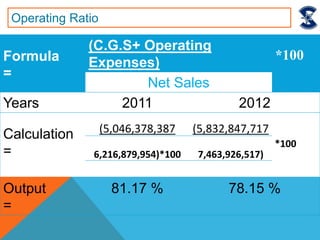
Formula
=
(C.G.S+ Operating
Expenses)
*100
Net Sales
Years 2011 2012
Calculation
=
(5,046,378,387 (5,832,847,717
*100
6,216,879,954)*100 7,463,926,517)
Output
=
81.17 % 78.15 %
Operating Ratio
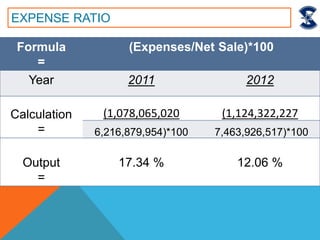
Formula
=
(Expenses/Net Sale)*100
Year 2011 2012
Calculation
=
(1,078,065,020 (1,124,322,227
6,216,879,954)*100 7,463,926,517)*100
Output
=
17.34 % 12.06 %
EXPENSE RATIO
ZEESHAN
ATTIQUE
The ratio’s are used to
determine the long term
debt paying capacity of
any organization &
measure the efficiency
of firm regarding
interest payment.
SOLVENCY RATIO
In which including…..
SOLVENCY RATIO
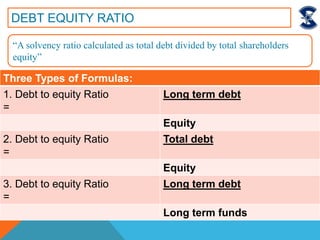
DEBT EQUITY RATIO
“A solvency ratio calculated as total debt divided by total shareholders
equity”
Three Types of Formulas:
1. Debt to equity Ratio
=
Long term debt
Equity
2. Debt to equity Ratio
=
Total debt
Equity
3. Debt to equity Ratio
=
Long term debt
Long term funds
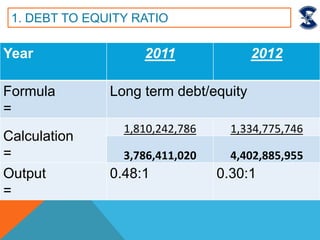
1. DEBT TO EQUITY RATIO
Year 2011 2012
Formula
=
Long term debt/equity
Calculation
=
1,810,242,786 1,334,775,746
3,786,411,020 4,402,885,955
Output
=
0.48:1 0.30:1
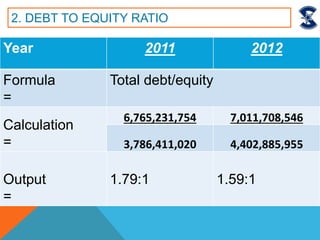
2. DEBT TO EQUITY RATIO
Year 2011 2012
Formula
=
Total debt/equity
Calculation
=
6,765,231,754 7,011,708,546
3,786,411,020 4,402,885,955
Output
=
1.79:1 1.59:1
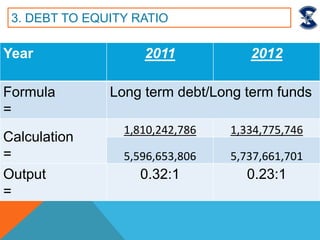
3. DEBT TO EQUITY RATIO
Year 2011 2012
Formula
=
Long term debt/Long term funds
Calculation
=
1,810,242,786 1,334,775,746
5,596,653,806 5,737,661,701
Output
=
0.32:1 0.23:1
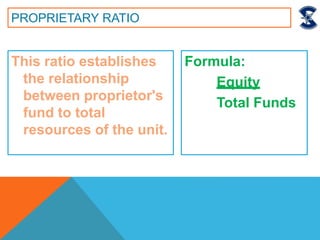
This ratio establishes
the relationship
between proprietor's
fund to total
resources of the unit.
PROPRIETARY RATIO
Formula:
Equity
Total Funds
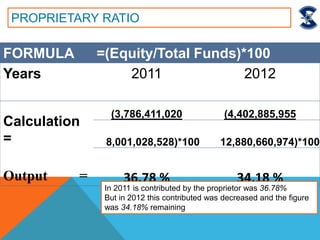
FORMULA =(Equity/Total Funds)*100
Years 2011 2012
Calculation
=
(3,786,411,020 (4,402,885,955
8,001,028,528)*100 12,880,660,974)*100
Output = 36.78 % 34.18 %
PROPRIETARY RATIO
In 2011 is contributed by the proprietor was 36.78%
But in 2012 this contributed was decreased and the figure
was 34.18% remaining
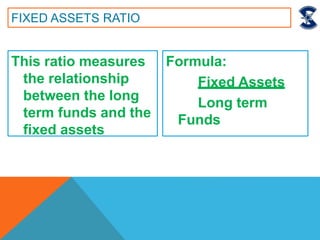
This ratio measures
the relationship
between the long
term funds and the
fixed assets
FIXED ASSETS RATIO
Formula:
Fixed Assets
Long term
Funds
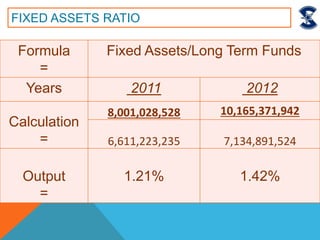
Formula
=
Fixed Assets/Long Term Funds
Years 2011 2012
Calculation
=
8,001,028,528 10,165,371,942
6,611,223,235 7,134,891,524
Output
=
1.21% 1.42%
FIXED ASSETS RATIO
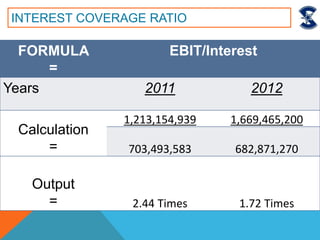
FORMULA
=
EBIT/Interest
Years 2011 2012
Calculation
=
1,213,154,939 1,669,465,200
703,493,583 682,871,270
Output
= 2.44 Times 1.72 Times
INTEREST COVERAGE RATIO
Akbar Butt
Earning Per Share
EPS:
EPS is the most important
term for the investors of
stock exchange
Definition:
“This ratio tells us
about how much
earning on “1” share”.
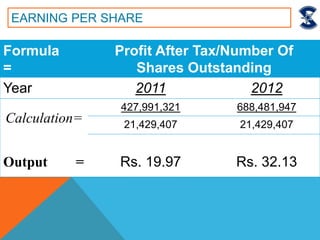
Formula
=
Profit After Tax/Number Of
Shares Outstanding
Year 2011 2012
Calculation=
427,991,321 688,481,947
21,429,407 21,429,407
Output = Rs. 19.97 Rs. 32.13
EARNING PER SHARE
RETURN ON INVESTMENT RATIO
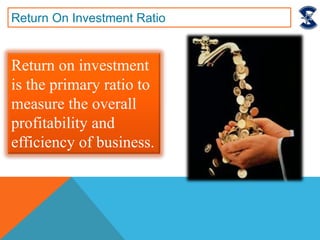
Return On Investment Ratio
Return on investment
is the primary ratio to
measure the overall
profitability and
efficiency of business.
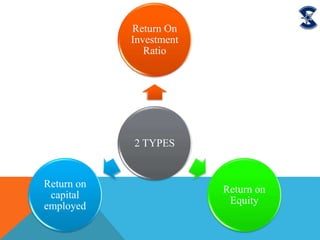
2 TYPES
Return On
Investment
Ratio
Return on
Equity
Return on
capital
employed
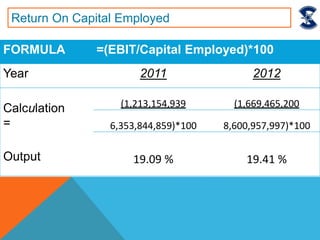
FORMULA =(EBIT/Capital Employed)*100
Year 2011 2012
Calculation
=
(1,213,154,939 (1,669,465,200
6,353,844,859)*100 8,600,957,997)*100
Output 19.09 % 19.41 %
Return On Capital Employed
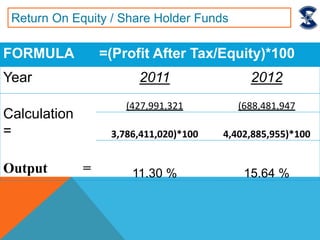
FORMULA =(Profit After Tax/Equity)*100
Year 2011 2012
Calculation
=
(427,991,321 (688,481,947
3,786,411,020)*100 4,402,885,955)*100
Output = 11.30 % 15.64 %
Return On Equity / Share Holder Funds
ARFAN M. AFZAL
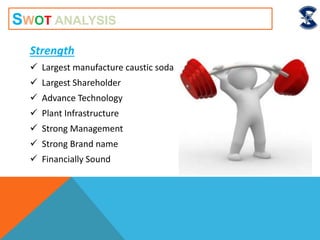
SWOT ANALYSIS
Strength
 Largest manufacture caustic soda
 Largest Shareholder
 Advance Technology
 Plant Infrastructure
 Strong Management
 Strong Brand name
 Financially Sound
SWOT ANALYSIS
Weaknesses
 Need Considerable Market to Sustain
 Lack of Operations in Abroad
 Relying on Permanent Customers
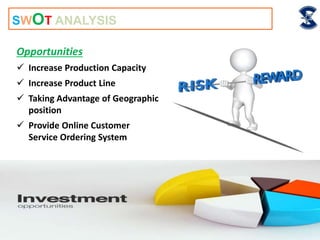
Opportunities
 Increase Production Capacity
 Increase Product Line
 Taking Advantage of Geographic
position
 Provide Online Customer
Service Ordering System
SWOT ANALYSIS
Threats
Competitors
Economic Environment
Energy Crises
Threat of Stakeholders
Unstable Law & Order Situation
SWOT ANALYSIS
POSITIVE POINTS
 We did not found much difference in the
SWOT Analysis of SCIL. They are
performing pretty well and have
strong strategic direction.
 When we Comparison with other
Chemical industries like NIMIR the
SCIL worked in well Condition.
SUGGESTIONS
 For the Market Development, it is opportunity for them to export their
product in new markets.
 Sitara Chemical Industry must involve employees in decision making.
 Increase the Basic salary of its employees to increases their motivations.
 Avoid more credit Purchases.
 Control the Cost of product with the use of Advance Technology.
Another they have to make segment in
their website through which they can
provide online customer services in which
customer can place
order and provide Feedback as well, this
will help them to capture more customers
throughout the world
CONCLUSION
 After the completion of ratio analysis ,we have concluded
that the Industry has good will in market but this year some
profitability ratios decreased & some increased as
compare to previous year plus E P S. It’s means that the
company has to take measures to maintain its position
 But still there is some room for improvement in compensation
system, and employment Planning.
T
H
A
N
K
S
Sitara chemical industry........hj

Sitara chemical industry........hj

  • 4.
  • 6.
    CONTENTS  Introduction  History Vision, Mission and Ethics  Objective  Ratio’s Liquidity Activity Profitability Solvency  SWOT Analysis  Suggestion and Conclusion
  • 7.
    Its product lineincludes Caustic Soda solid, sodium hypochlorite, caustic soda liquid, hydrochloric acid, liquid chlorine, Specialty Chemical, Fertilizer polyester Cotton. Head Quarter in Faisalabad 343 Employs Private Ltd. Company Chemical Division Textile Division Manufactured Company
  • 8.
    ╚ Sitara Groupof Industries is one of the well-known industrial groups of Pakistan ╚ This group started its industrial activity with textile weaving sector in 1956 under leadership of two brothers, Haji Abdul Ghafoor (Late) and Haji Bashir Ahmed. ╚ By Haji Bashir Ahmed ╚ SCIL was incorporated in 1981 ╚ Began producing caustic soda in 1985 ╚ Its specialty chemicals and export division was established in 2001 and agri chemicals division in 2003.
  • 9.
    VISION Strive to developand employ innovative technological solutions to add value to business with progressive and positive approach.
  • 10.
    MISSION Continuing growth and diversification forbottom line results with risks well contained.
  • 11.
    BUSINESSES  Sitara ChemicalIndustries Ltd.  Sitara Chemical Industries Ltd. (Textile Division)  Sitara Textile Industries Ltd.  Sitara Spinning Mills Ltd.  Sitara Energy Ltd.  Aziz Fatima Trust Hospital  Ghafoor Bashir Children Hospital  Sitara Developers Ptv. Ltd.  Sitara Hamza Pvt. Ltd.
  • 12.
  • 13.
  • 14.
  • 15.
  • 16.
    LIQUIDITY RATIO “ Liquidityratios measure the company's ability to meet its short-term obligations.” Liquidity Ratios: Current Ratio  Quick Ratio  Absolute Ratio
  • 17.
    CURRENT RATIO Definition: Total currentassets to total current liabilities. Known as: Working Capital Ratio Bench-Mark Rate: 2:1
  • 18.
    Formula = Current Assets/ CurrentLiabilities Year 2011 2012 Calculation = 2,293,235,870/3,940,419,539 2,715,289,032/4,279,702,977 Output = 0.58 : 1 0.63 : 1 CURRENT RATIO Current Assets Current
  • 19.
    LIQUID RATIO Relationship between liquidassets and total current liabilities. Bench mark rate: 1:1 Acid test ratio, Quick ratio. Benefit: Exact test of liquidity. Also Known as:
  • 20.
    LIQUID RATIO Formula = Liquid Assets/Current Liabilities Year 2011 2012 Calculation = 1,401,115,714 1,805,887,700 3,940,419,539 4,279,702,977 Output = 0.36:1 0.42:1
  • 21.
    ABSOLUTE LIQUID RATIO Relatescash , bank and marketable securities to current liabilities. Very strict and exacting standard of liquidity. Bench Mark rate: 0.5:1
  • 22.
    ABSOLUTE LIQUID RATIO Formula = [Cash+ Bank+ Marketable Securities] Current Liabilities Years 2011 2012 Calculation = 140,776,990 79,861,668 4,27,97,02,977 3,94,04,19,539 Output = 0.04:1 0.02:1
  • 23.
  • 24.
  • 25.
    ACTIVITY RATIO “Activity orefficiency ratio reflects the intensity of a company’s resource utilization or how efficient management team uses its assets or capital to generate sales.’’ in other words ‘measure the efficiency of Business’
  • 26.
    ACTIVITY RATIO Fixed assetsturnover ratio Working capital turnover ratio Creditor conversion period Creditor turnover ratio Debtors conversion period Debtors turnover ratio Stock conversion period Stock turnover ratio
  • 27.
    Years 2011 2012 Formula = CGS/ Average Inventory Calculation = 4,663,238,913 5,393,939,325 885,083,340 902,720,830 Output = 5.27 Times 5.98 Times STOCK TURNOVER RATIO
  • 28.
    Years 2011 2012 Formula = Daysin a year stock turnover ratio Calculation = 365/5.27 365/5.98 Output = 69 Days 61 Days Inventory Conversion Period
  • 29.
    Years 2011 2012 Formula= net credit sales Avg. account receivables Calculation = 4,663,238,913 5,393,939,325 512,397,911 893902085 Output = 12.13 Times 11.41 Times Debtors Turnover Ratio
  • 30.
    Years 2011 2012 Formula = Daysin a year debtor’s turnover ratio Calculation = 365 /12.13 365 / 11.41 Result = 30 Days 32 Days Debtors/ Receivables Conversion Period
  • 31.
    Creditors/Payables Turnover Ratio Years2012 2011 Formula = Net Credit purchases Avg. payable Calculation = 4,663,238,913 5,393,939,325 1,439,419,941 1,356,248,460 Output = 3.74 times 3.44 times
  • 32.
    Years 2011 2012 Formula = Daysin a year Creditor’s turnover ratio Calculation = 365/3.44 365/3.74 Output = 106 Days 97 Days Creditor/Payable Conversion Period
  • 33.
    Formula = C.G.S/FixedAssets Year 2011 2012 Calculation = 4,663,238,913 5,393,939,325 8,001,028,528 10,165,371,942 Out Put = 0.58 Times 0.53 Times Fixed Assets Turnover Ratio
  • 34.
    WORKING CAPITAL TURNOVERRATIO How efficiently working capital is being used for the generation of revenues
  • 35.
    WORKING CAPITAL TURNOVERRATIO Formula = C.G.S/ Average Working Capital Years 2011 2012 Calculation = 4,663,238,913 5,393,939,325 -1,647,183,669 -1,564,413,945 Output = -2.83 Times -3.45 Times
  • 36.
  • 37.
  • 38.
    PROFITABILITY RATIO Types ofProfitability Ratio
  • 39.
    Formula =(Gross Profit/Net Sale)*100 Year 2011 2012 Calculation = (1,553,641,041 (2,069,987,192 6,216,879,954)*100 7,463,926,517)*100 Output = 24.99 % 27.73 % GROSS PROFIT RATIO
  • 40.
    Formula =(Net ProfitRatio/Net Sale) * 100 Year 2011 2012 Calculation = (427,991,321 (688,481,947 *100 6,216,879,954)*100 7,463,926,517) Output = 6.88 % 9.22 % NET PROFIT RATIO
  • 41.
    Formula = (Operating Profit/ NetSale) * 100 Year 2011 2012 Calculation = (1,078,065,020 (1,124,322,227 6,216,879,954)*100 7,463,226,517)*100 Output = 17.34 % 15.06 % Operating Profit Ratio
  • 42.
    Formula = (C.G.S+ Operating Expenses) *100 Net Sales Years2011 2012 Calculation = (5,046,378,387 (5,832,847,717 *100 6,216,879,954)*100 7,463,926,517) Output = 81.17 % 78.15 % Operating Ratio
  • 43.
    Formula = (Expenses/Net Sale)*100 Year 20112012 Calculation = (1,078,065,020 (1,124,322,227 6,216,879,954)*100 7,463,926,517)*100 Output = 17.34 % 12.06 % EXPENSE RATIO
  • 44.
  • 46.
    The ratio’s areused to determine the long term debt paying capacity of any organization & measure the efficiency of firm regarding interest payment. SOLVENCY RATIO
  • 47.
  • 48.
    DEBT EQUITY RATIO “Asolvency ratio calculated as total debt divided by total shareholders equity” Three Types of Formulas: 1. Debt to equity Ratio = Long term debt Equity 2. Debt to equity Ratio = Total debt Equity 3. Debt to equity Ratio = Long term debt Long term funds
  • 49.
    1. DEBT TOEQUITY RATIO Year 2011 2012 Formula = Long term debt/equity Calculation = 1,810,242,786 1,334,775,746 3,786,411,020 4,402,885,955 Output = 0.48:1 0.30:1
  • 50.
    2. DEBT TOEQUITY RATIO Year 2011 2012 Formula = Total debt/equity Calculation = 6,765,231,754 7,011,708,546 3,786,411,020 4,402,885,955 Output = 1.79:1 1.59:1
  • 51.
    3. DEBT TOEQUITY RATIO Year 2011 2012 Formula = Long term debt/Long term funds Calculation = 1,810,242,786 1,334,775,746 5,596,653,806 5,737,661,701 Output = 0.32:1 0.23:1
  • 52.
    This ratio establishes therelationship between proprietor's fund to total resources of the unit. PROPRIETARY RATIO Formula: Equity Total Funds
  • 53.
    FORMULA =(Equity/Total Funds)*100 Years2011 2012 Calculation = (3,786,411,020 (4,402,885,955 8,001,028,528)*100 12,880,660,974)*100 Output = 36.78 % 34.18 % PROPRIETARY RATIO In 2011 is contributed by the proprietor was 36.78% But in 2012 this contributed was decreased and the figure was 34.18% remaining
  • 54.
    This ratio measures therelationship between the long term funds and the fixed assets FIXED ASSETS RATIO Formula: Fixed Assets Long term Funds
  • 55.
    Formula = Fixed Assets/Long TermFunds Years 2011 2012 Calculation = 8,001,028,528 10,165,371,942 6,611,223,235 7,134,891,524 Output = 1.21% 1.42% FIXED ASSETS RATIO
  • 56.
    FORMULA = EBIT/Interest Years 2011 2012 Calculation = 1,213,154,9391,669,465,200 703,493,583 682,871,270 Output = 2.44 Times 1.72 Times INTEREST COVERAGE RATIO
  • 57.
  • 58.
    Earning Per Share EPS: EPSis the most important term for the investors of stock exchange Definition: “This ratio tells us about how much earning on “1” share”.
  • 59.
    Formula = Profit After Tax/NumberOf Shares Outstanding Year 2011 2012 Calculation= 427,991,321 688,481,947 21,429,407 21,429,407 Output = Rs. 19.97 Rs. 32.13 EARNING PER SHARE
  • 60.
  • 61.
    Return On InvestmentRatio Return on investment is the primary ratio to measure the overall profitability and efficiency of business.
  • 62.
    2 TYPES Return On Investment Ratio Returnon Equity Return on capital employed
  • 63.
    FORMULA =(EBIT/Capital Employed)*100 Year2011 2012 Calculation = (1,213,154,939 (1,669,465,200 6,353,844,859)*100 8,600,957,997)*100 Output 19.09 % 19.41 % Return On Capital Employed
  • 64.
    FORMULA =(Profit AfterTax/Equity)*100 Year 2011 2012 Calculation = (427,991,321 (688,481,947 3,786,411,020)*100 4,402,885,955)*100 Output = 11.30 % 15.64 % Return On Equity / Share Holder Funds
  • 65.
  • 67.
    SWOT ANALYSIS Strength  Largestmanufacture caustic soda  Largest Shareholder  Advance Technology  Plant Infrastructure  Strong Management  Strong Brand name  Financially Sound
  • 68.
    SWOT ANALYSIS Weaknesses  NeedConsiderable Market to Sustain  Lack of Operations in Abroad  Relying on Permanent Customers
  • 69.
    Opportunities  Increase ProductionCapacity  Increase Product Line  Taking Advantage of Geographic position  Provide Online Customer Service Ordering System SWOT ANALYSIS
  • 70.
    Threats Competitors Economic Environment Energy Crises Threatof Stakeholders Unstable Law & Order Situation SWOT ANALYSIS
  • 71.
    POSITIVE POINTS  Wedid not found much difference in the SWOT Analysis of SCIL. They are performing pretty well and have strong strategic direction.  When we Comparison with other Chemical industries like NIMIR the SCIL worked in well Condition.
  • 72.
    SUGGESTIONS  For theMarket Development, it is opportunity for them to export their product in new markets.  Sitara Chemical Industry must involve employees in decision making.  Increase the Basic salary of its employees to increases their motivations.  Avoid more credit Purchases.  Control the Cost of product with the use of Advance Technology. Another they have to make segment in their website through which they can provide online customer services in which customer can place order and provide Feedback as well, this will help them to capture more customers throughout the world
  • 73.
    CONCLUSION  After thecompletion of ratio analysis ,we have concluded that the Industry has good will in market but this year some profitability ratios decreased & some increased as compare to previous year plus E P S. It’s means that the company has to take measures to maintain its position  But still there is some room for improvement in compensation system, and employment Planning.
  • 74.

Editor's Notes

  • #32 This ratio show the velocity with which Avg. A/c payable are being paid during a period of 1 year
  • #33 In 2012 (97 Days) are more better for the payment of Liability as compare to 2011 (106 Days)
  • #34 How efficiently F.A use for the generation of revenues. More is more better
  • #57 Interest pay to the IMF. How strong the company long term debt. More and more time is better (But > 1) 441450957
  • #64 More is more Favourable
  • #65 More is more Favourable
  • #69 Larg market (Consideration)