HIGH PERFORMANCE JSON SEARCH AND
RELATIONAL FACETED BROWSING WITH LUCENE

Renaud Delbru
renaud@sindicetech.com
renaud.delbru@deri.org

Co-Founder, SindiceTech
Post-Doctoral Researcher, NUIG
My Background
•

•

•

Lucene / Solr
– User since 7 years
– Built a web search engine – sindice.com (700M documents)
Academia & Research
– Ph.D. in Information Retrieval and Semantic Web
– Post-doctoral researcher at National Univerity of Ireland, Galway
Industry
– Technical co-founder of SindiceTech
– Management Platform for Enterprise Knowledge Graph
Agenda
•
•
•
•
•

Nested Data Model
SIREn Overview & Theory
SIREn Plugin Architecture
Relational Faceted Browsing
Comparison with BlockJoin
Nested Data Model: Why is it important ?
•
•

SQL
– Query-time join
performance penalty
NoSQL
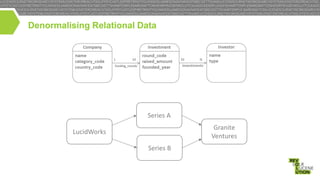
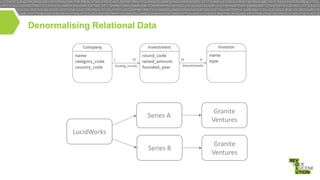
– Denormalisation of relational data into nested data
– Convert many-to-one/many into one-to-many relationships
Denormalising Relational Data

Series A
Granite
Ventures

LucidWorks
Series B
Denormalising Relational Data

Series A

Granite
Ventures

Series B

Granite
Ventures

LucidWorks
Nested Data Model: Why is it important ?
•
•

SQL
– Query-time join
performance penalty
NoSQL
– Denormalisation of relational data into nested data
– Convert many-to-one/many into one-to-many relationships
– Duplicate data …
– … but avoid joins
Schema-Less Nested Data Model
•

•

•

Model becoming prevalent: JSON, XML, Avro, …
– Can be arbitrarily nested and large
– No strict schema / structure enforced
Schema-less brings
– Flexibility
– Ease of development
Developers do not have to invest significant modelling effort upfront
Introducing SIREn
•
•
•

Lucene/Solr plugin for indexing and searching JSON
Rich data model (JSON)
– Nested objects, nested arrays, datatypes
Schema-agnostic
– No need to define structure (nested model)
– No need to define schema (fields)
Overview of the SIREn API
Document

Query

{
"name" : "LucidWorks",
"category_code" : "analytics",
"funding_rounds" : [
{
"round_code" : "a",
"raised_amount" : 6000000,
"funded_year" : 2009,
"investments" : [
{
"name" : "Granite Ventures",
"type" : "financial-org"
},
…
]
},
…
]
}

(category_code :

analytics)

AND
(funding_rounds : {
round_code : seed OR a OR angel,
raised_amount : [0 TO 12000000],
* : {
type : financial-org
}
})
Theory behind SIREn
•
•
•

Inspired from tree-labelling scheme techniques (XML IR)
– Label each node with a hierarchical ids (here Dewey’s identifiers)
Full-text search operators over the content of a node
Structural search operators over the nodes of the tree
– Ancestor-Descendant, Parent-Child, Sibling, …
Theory behind SIREn: Tree-Labelling

{
"name" : "LucidWorks",
"category_code" : "analytics",
"funding_rounds" : [
{
"round_code" : "a",
"raised_amount" : 6000000,
"funded_year" : 2009,
…
},
…
]
}

name

LucidWorks

funding_
rounds
round_
code

a

raised_
amount

6000000

…
Theory behind SIREn: Tree-Labelling

1

{
"name" : "LucidWorks",
"category_code" : "analytics",
"funding_rounds" : [
{
"round_code" : "a",
"raised_amount" : 6000000,
"funded_year" : 2009,
…
},
…
]
}

name

LucidWorks

1.1

1.1.1

funding_
rounds

1.2

1.2.1
round_
code

a

1.2.2.1

1.2.2.1.1

raised_
amount

6000000

1.2.2.2
…
1.2.2

1.2.2.2.1
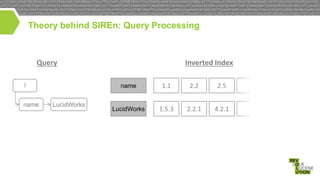
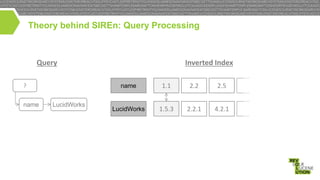
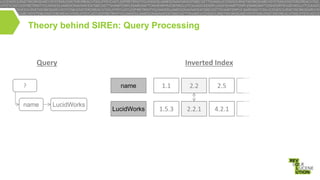
Theory behind SIREn: Query Processing

Query
name

?

name

Inverted Index

LucidWorks

1.1

2.2

2.5

LucidWorks

1.5.3

2.2.1

4.2.1
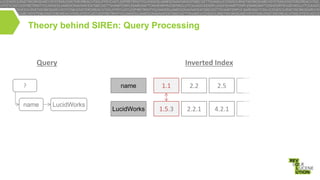
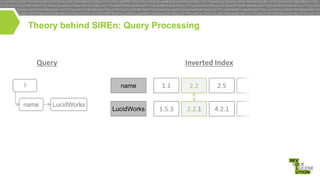
Theory behind SIREn: Query Processing

Query
name

?

name

Inverted Index

LucidWorks

1.1

2.2

2.5

LucidWorks

1.5.3

2.2.1

4.2.1
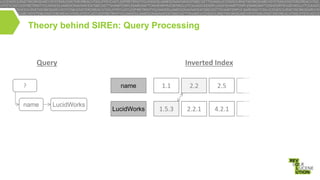
Theory behind SIREn: Query Processing

Query
name

?

name

Inverted Index

LucidWorks

1.1

2.2

2.5

LucidWorks

1.5.3

2.2.1

4.2.1
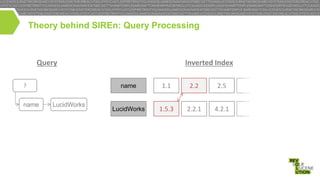
Theory behind SIREn: Query Processing

Query
name

?

name

Inverted Index

LucidWorks

1.1

2.2

2.5

LucidWorks

1.5.3

2.2.1

4.2.1
Theory behind SIREn: Query Processing

Query
name

?

name

Inverted Index

LucidWorks

1.1

2.2

2.5

LucidWorks

1.5.3

2.2.1

4.2.1
Theory behind SIREn: Query Processing

Query
name

?

name

Inverted Index

LucidWorks

1.1

2.2

2.5

LucidWorks

1.5.3

2.2.1

4.2.1
Theory behind SIREn: Query Processing

Query
name

?

name

Inverted Index

LucidWorks

1.1

2.2

2.5

LucidWorks

1.5.3

2.2.1

4.2.1
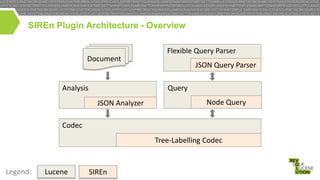
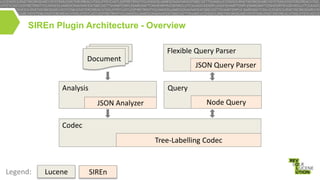
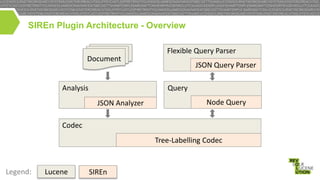
SIREn Plugin Architecture - Overview

Document

Analysis

Flexible Query Parser

JSON Query Parser
Query

JSON Analyzer

Node Query

Codec
Tree-Labelling Codec

Legend:

Lucene

SIREn
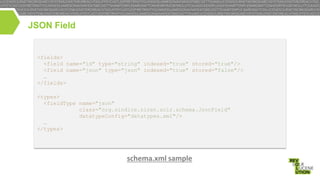
JSON Field

<fields>
<field name="id" type="string" indexed="true" stored="true"/>
<field name="json" type="json" indexed="true" stored="false"/>
…
</fields>
<types>
<fieldType name="json"
class="org.sindice.siren.solr.schema.JsonField"
datatypeConfig="datatypes.xml"/>
…
</types>

schema.xml sample
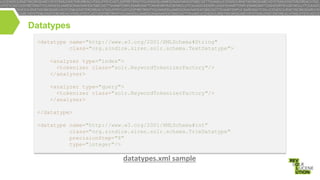
Datatypes
<datatype name="http://www.w3.org/2001/XMLSchema#String"
class="org.sindice.siren.solr.schema.TextDatatype">
<analyzer type="index">
<tokenizer class="solr.KeywordTokenizerFactory"/>
</analyzer>
<analyzer type="query">
<tokenizer class="solr.KeywordTokenizerFactory"/>
</analyzer>
</datatype>
<datatype name="http://www.w3.org/2001/XMLSchema#int"
class="org.sindice.siren.solr.schema.TrieDatatype"
precisionStep="8"
type="integer"/>

datatypes.xml sample
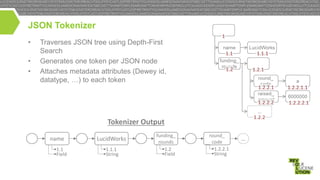
JSON Tokenizer
•
•
•

Traverses JSON tree using Depth-First
Search
Generates one token per JSON node
Attaches metadata attributes (Dewey id,
datatype, …) to each token

Tokenizer Output
name
1.1
Field

LucidWorks
1.1.1
String

funding_
rounds
1.2
Field

round_
code
1.2.2.1
String

…
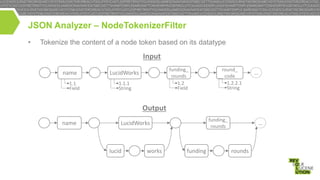
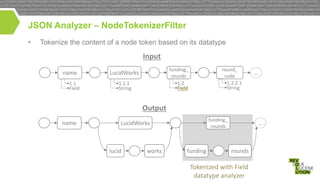
JSON Analyzer – NodeTokenizerFilter
•

Tokenize the content of a node token based on its datatype

Input
name
1.1
Field

funding_
rounds
1.2
Field

LucidWorks
1.1.1
String

round_
code
1.2.2.1
String

…

Output
name

funding_
rounds

LucidWorks

lucid

works

funding

…

rounds
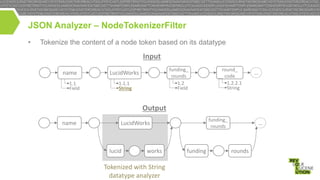
JSON Analyzer – NodeTokenizerFilter
•

Tokenize the content of a node token based on its datatype

Input
name
1.1
Field

funding_
rounds
1.2
Field

LucidWorks
1.1.1
String

round_
code
1.2.2.1
String

…

Output
name

funding_
rounds

LucidWorks

lucid

works

Tokenized with String
datatype analyzer

funding

…

rounds
JSON Analyzer – NodeTokenizerFilter
•

Tokenize the content of a node token based on its datatype

Input
name
1.1
Field

funding_
rounds
1.2
Field

LucidWorks
1.1.1
String

round_
code
1.2.2.1
String

…

Output
name

funding_
rounds

LucidWorks

lucid

works

funding

…

rounds

Tokenized with Field
datatype analyzer
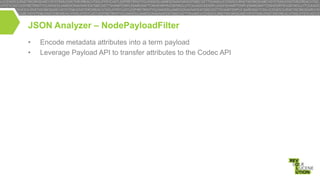
JSON Analyzer – NodePayloadFilter
•
•

Encode metadata attributes into a term payload
Leverage Payload API to transfer attributes to the Codec API
SIREn Plugin Architecture - Overview

Document

Analysis

Flexible Query Parser

JSON Query Parser
Query

JSON Analyzer

Node Query

Codec
Tree-Labelling Codec

Legend:

Lucene

SIREn
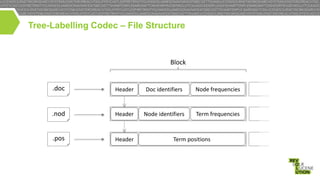
Tree-Labelling Codec – File Structure

Block

.doc

Header

Doc identifiers

Node frequencies

.nod

Header

Node identifiers

Term frequencies

.pos

Header

Term positions
Tree-Labelling Codec – Compression
•

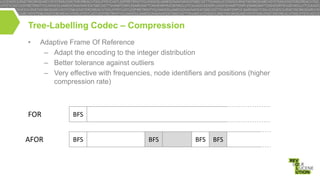
Adaptive Frame Of Reference
– Adapt the encoding to the integer distribution
– Better tolerance against outliers
– Very effective with frequencies, node identifiers and positions (higher
compression rate)

FOR

BFS

AFOR

BFS

BFS

BFS

BFS
SIREn Plugin Architecture - Overview

Document

Analysis

Flexible Query Parser

JSON Query Parser
Query

JSON Analyzer

Node Query

Codec
Tree-Labelling Codec

Legend:

Lucene

SIREn
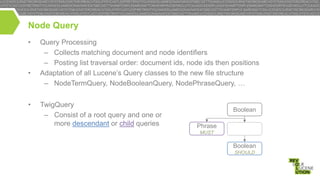
Node Query
•

•

Query Processing
– Collects matching document and node identifiers
– Posting list traversal order: document ids, node ids then positions
Adaptation of all Lucene’s Query classes to the new file structure
– NodeTermQuery, NodeBooleanQuery, NodePhraseQuery, …
Node Query
•

•

•

Query Processing
– Collects matching document and node identifiers
– Posting list traversal order: document ids, node ids then positions
Adaptation of all Lucene’s Query classes to the new file structure
– NodeTermQuery, NodeBooleanQuery, NodePhraseQuery, …
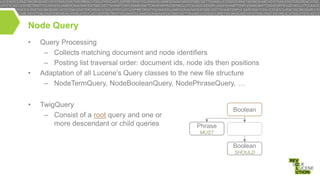
TwigQuery
– Consist of a root query and one or
more descendant or child queries

Boolean

Phrase
MUST

Boolean
SHOULD
Node Query
•

•

•

Query Processing
– Collects matching document and node identifiers
– Posting list traversal order: document ids, node ids then positions
Adaptation of all Lucene’s Query classes to the new file structure
– NodeTermQuery, NodeBooleanQuery, NodePhraseQuery, …
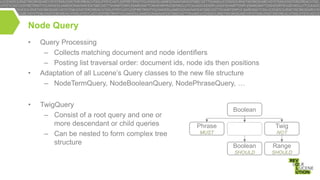
TwigQuery
– Consist of a root query and one or
more descendant or child queries

Boolean

Phrase
MUST

Boolean
SHOULD
Node Query
•

•

•

Query Processing
– Collects matching document and node identifiers
– Posting list traversal order: document ids, node ids then positions
Adaptation of all Lucene’s Query classes to the new file structure
– NodeTermQuery, NodeBooleanQuery, NodePhraseQuery, …
TwigQuery
– Consist of a root query and one or
more descendant or child queries
– Can be nested to form complex tree
structure

Boolean

Phrase

Twig

MUST

NOT

Boolean

Range

SHOULD

SHOULD
Node Query
•

•

•

Query Processing
– Collects matching document and node identifiers
– Posting list traversal order: document ids, node ids then positions
Adaptation of all Lucene’s Query classes to the new file structure
– NodeTermQuery, NodeBooleanQuery, NodePhraseQuery, …
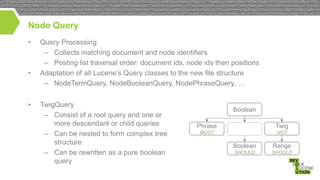
TwigQuery
– Consist of a root query and one or
more descendant or child queries
– Can be nested to form complex tree
structure
– Can be rewritten as a pure boolean
query

Boolean

Phrase

Twig

MUST

NOT

Boolean

Range

SHOULD

SHOULD
Application: Relational Faceted Navigation
•

•

Faceted Navigation
– Data-driven exploratory interface
– User incrementally adds constraints
– Restricted to one record collection
Relational Faceted Navigation
– Enables navigation of interrelated record collections
– Constraints affect all record collections
– New navigation operation: Pivot
• Switch user view to a record collection
Relational Faceted Navigation – Demo

HCLS Demo: http://hcls.sindice.com/pivot-browser/
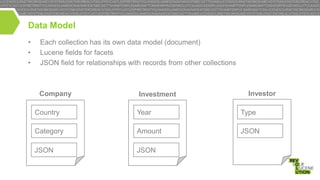
Data Model
•
•
•

Each collection has its own data model (document)
Lucene fields for facets
JSON field for relationships with records from other collections

Company

Investment

Investor

Country

Year

Type

Category

Amount

JSON

JSON

JSON
JSON Model
•
•

JSON field: Tree covering all the relationships with records from other collections
Resulting tree can be very large
Company

Investment

Investor

category_
code

round_
code

type

country_
code
funding_
rounds

raised_
amount

investments -1

funding_
rounds -1

[…]

category_
code

round_
code
raised_
amount
investments

[…]

country_
code

[…]
type

investments

[…]
type

[…]
round_
code
raised_
amount
funding_
rounds -1

[…]
category_
code
country_
code
JSON Model
•
•

JSON field: Tree covering all the relationships with records from other collections
Resulting tree can be very large
Company

Investment

category_
code
country_
code
funding_
rounds

[…]
round_
code
raised_
amount
investments

[…]
type

Investor
JSON Model
•
•

JSON field: Tree covering all the relationships with records from other collections
Resulting tree can be very large
Company

Investment

category_
code
country_
code
funding_
rounds

[…]
round_
code
raised_
amount
investments

[…]
type

Investor
JSON Model
•
•

JSON field: Tree covering all the relationships with records from other collections
Resulting tree can be very large
Company

Investment
round_
code
raised_
amount
funding_
rounds -1

[…]
category_
code

country_
code
investments

[…]
type

Investor
JSON Model
•
•

JSON field: Tree covering all the relationships with records from other collections
Resulting tree can be very large
Company

Investment
round_
code
raised_
amount
funding_
rounds -1

[…]
category_
code

country_
code
investments

[…]
type

Investor
JSON Model
•
•

JSON field: Tree covering all the relationships with records from other collections
Resulting tree can be very large
Company

Investment

Investor

type
investments -1

[…]
round_
code
raised_
amount
funding_
rounds -1

[…]
category_
code
country_
code
JSON Model
•
•

JSON field: Tree covering all the relationships with records from other collections
Resulting tree can be very large
Company

Investment

Investor

type
investments -1

[…]
round_
code
raised_
amount
funding_
rounds -1

[…]
category_
code
country_
code
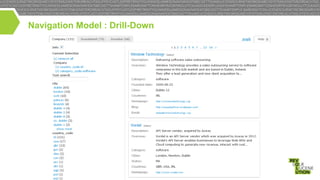
Navigation Model : Drill-Down
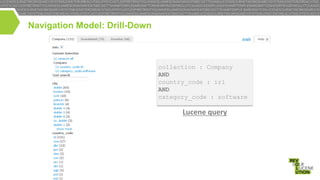
Navigation Model: Drill-Down

collection : Company
AND
country_code : irl
AND
category_code : software

Lucene query
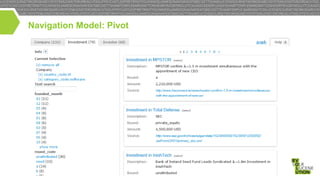
Navigation Model: Pivot

collection : Investment

Lucene query
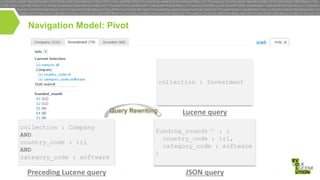
Navigation Model: Pivot

collection : Investment

Query Rewriting
collection : Company
AND
country_code : irl
AND
category_code : software

Preceding Lucene query

Lucene query

funding_rounds -1 : {
country_code : irl,
category_code : software
}

JSON query
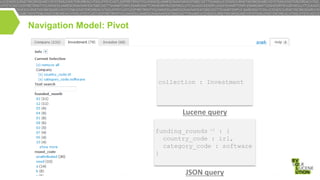
Navigation Model: Pivot

collection : Investment

Lucene query
funding_rounds -1 : {
country_code : irl,
category_code : software
}

JSON query
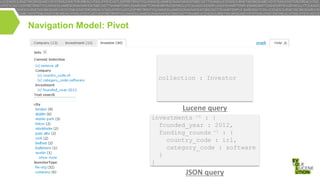
Navigation Model: Pivot

collection : Investor

Lucene query
investments -1 : {
founded_year : 2012,
funding_rounds -1 : {
country_code : irl,
category_code : software
}
}

JSON query
Comparison with BlockJoin
•

Lucene BlockJoin
– Introduced support for indexing and searching nested data …
– … for small and well-defined schema
Lucene BlockJoin - Scalability
•
•

Increase artificially the number of documents in the index
– One document per nested data record
Cache size linear with the number of nested data records
– Increased memory usage
Lucene BlockJoin - Flexibility
•

•

•

Developers must be aware of the relations between nested data records
– At indexing time to tag parent records
– At querying time to filter parent records
Upfront effort required to design and configure the system
– Define Parent-Child relationships between record collections
– Define attributes for each record collection
If not properly designed, risk of incorrect matches
Comparison with BlockJoin
•

•

BlockJoin
+ Works out of the box with all Lucene’s features
‒ Requires upfront design effort
‒ Memory usage dependent on nested data structure
Tree-Labelling
+ Can handle arbitrary and large nested model
+ Memory friendly
‒ Have to re-think and re-implement Lucene’s features
Conclusion
•
•
•
•
•

Nested data model becomes more and more prevalent
Searching nested data brings new challenges: performance, scalability, flexibility
Different approaches exist, each one with pros and cons
SIREn plugin based on tree-labelling techniques
Enables new kind of search applications, e.g., relational faceted browser, with subsecond response time

•

SIREn Availability
– Trial license currently available
– In negotiation with the University to open-source
Acknowledgement
This material is based upon works supported by the European FP7 project LOD2
(257943) and the Irish Research Council for Science, Engineering and Technology.

High Performance JSON Search and Relational Faceted Browsing with Lucene

  • 2.
    HIGH PERFORMANCE JSONSEARCH AND RELATIONAL FACETED BROWSING WITH LUCENE Renaud Delbru renaud@sindicetech.com renaud.delbru@deri.org Co-Founder, SindiceTech Post-Doctoral Researcher, NUIG
  • 3.
    My Background • • • Lucene /Solr – User since 7 years – Built a web search engine – sindice.com (700M documents) Academia & Research – Ph.D. in Information Retrieval and Semantic Web – Post-doctoral researcher at National Univerity of Ireland, Galway Industry – Technical co-founder of SindiceTech – Management Platform for Enterprise Knowledge Graph
  • 4.
    Agenda • • • • • Nested Data Model SIREnOverview & Theory SIREn Plugin Architecture Relational Faceted Browsing Comparison with BlockJoin
  • 5.
    Nested Data Model:Why is it important ? • • SQL – Query-time join performance penalty NoSQL – Denormalisation of relational data into nested data – Convert many-to-one/many into one-to-many relationships
  • 6.
    Denormalising Relational Data SeriesA Granite Ventures LucidWorks Series B
  • 7.
    Denormalising Relational Data SeriesA Granite Ventures Series B Granite Ventures LucidWorks
  • 8.
    Nested Data Model:Why is it important ? • • SQL – Query-time join performance penalty NoSQL – Denormalisation of relational data into nested data – Convert many-to-one/many into one-to-many relationships – Duplicate data … – … but avoid joins
  • 9.
    Schema-Less Nested DataModel • • • Model becoming prevalent: JSON, XML, Avro, … – Can be arbitrarily nested and large – No strict schema / structure enforced Schema-less brings – Flexibility – Ease of development Developers do not have to invest significant modelling effort upfront
  • 10.
    Introducing SIREn • • • Lucene/Solr pluginfor indexing and searching JSON Rich data model (JSON) – Nested objects, nested arrays, datatypes Schema-agnostic – No need to define structure (nested model) – No need to define schema (fields)
  • 11.
    Overview of theSIREn API Document Query { "name" : "LucidWorks", "category_code" : "analytics", "funding_rounds" : [ { "round_code" : "a", "raised_amount" : 6000000, "funded_year" : 2009, "investments" : [ { "name" : "Granite Ventures", "type" : "financial-org" }, … ] }, … ] } (category_code : analytics) AND (funding_rounds : { round_code : seed OR a OR angel, raised_amount : [0 TO 12000000], * : { type : financial-org } })
  • 12.
    Theory behind SIREn • • • Inspiredfrom tree-labelling scheme techniques (XML IR) – Label each node with a hierarchical ids (here Dewey’s identifiers) Full-text search operators over the content of a node Structural search operators over the nodes of the tree – Ancestor-Descendant, Parent-Child, Sibling, …
  • 13.
    Theory behind SIREn:Tree-Labelling { "name" : "LucidWorks", "category_code" : "analytics", "funding_rounds" : [ { "round_code" : "a", "raised_amount" : 6000000, "funded_year" : 2009, … }, … ] } name LucidWorks funding_ rounds round_ code a raised_ amount 6000000 …
  • 14.
    Theory behind SIREn:Tree-Labelling 1 { "name" : "LucidWorks", "category_code" : "analytics", "funding_rounds" : [ { "round_code" : "a", "raised_amount" : 6000000, "funded_year" : 2009, … }, … ] } name LucidWorks 1.1 1.1.1 funding_ rounds 1.2 1.2.1 round_ code a 1.2.2.1 1.2.2.1.1 raised_ amount 6000000 1.2.2.2 … 1.2.2 1.2.2.2.1
  • 15.
    Theory behind SIREn:Query Processing Query name ? name Inverted Index LucidWorks 1.1 2.2 2.5 LucidWorks 1.5.3 2.2.1 4.2.1
  • 16.
    Theory behind SIREn:Query Processing Query name ? name Inverted Index LucidWorks 1.1 2.2 2.5 LucidWorks 1.5.3 2.2.1 4.2.1
  • 17.
    Theory behind SIREn:Query Processing Query name ? name Inverted Index LucidWorks 1.1 2.2 2.5 LucidWorks 1.5.3 2.2.1 4.2.1
  • 18.
    Theory behind SIREn:Query Processing Query name ? name Inverted Index LucidWorks 1.1 2.2 2.5 LucidWorks 1.5.3 2.2.1 4.2.1
  • 19.
    Theory behind SIREn:Query Processing Query name ? name Inverted Index LucidWorks 1.1 2.2 2.5 LucidWorks 1.5.3 2.2.1 4.2.1
  • 20.
    Theory behind SIREn:Query Processing Query name ? name Inverted Index LucidWorks 1.1 2.2 2.5 LucidWorks 1.5.3 2.2.1 4.2.1
  • 21.
    Theory behind SIREn:Query Processing Query name ? name Inverted Index LucidWorks 1.1 2.2 2.5 LucidWorks 1.5.3 2.2.1 4.2.1
  • 22.
    SIREn Plugin Architecture- Overview Document Analysis Flexible Query Parser JSON Query Parser Query JSON Analyzer Node Query Codec Tree-Labelling Codec Legend: Lucene SIREn
  • 23.
    JSON Field <fields> <field name="id"type="string" indexed="true" stored="true"/> <field name="json" type="json" indexed="true" stored="false"/> … </fields> <types> <fieldType name="json" class="org.sindice.siren.solr.schema.JsonField" datatypeConfig="datatypes.xml"/> … </types> schema.xml sample
  • 24.
    Datatypes <datatype name="http://www.w3.org/2001/XMLSchema#String" class="org.sindice.siren.solr.schema.TextDatatype"> <analyzer type="index"> <tokenizerclass="solr.KeywordTokenizerFactory"/> </analyzer> <analyzer type="query"> <tokenizer class="solr.KeywordTokenizerFactory"/> </analyzer> </datatype> <datatype name="http://www.w3.org/2001/XMLSchema#int" class="org.sindice.siren.solr.schema.TrieDatatype" precisionStep="8" type="integer"/> datatypes.xml sample
  • 25.
    JSON Tokenizer • • • Traverses JSONtree using Depth-First Search Generates one token per JSON node Attaches metadata attributes (Dewey id, datatype, …) to each token Tokenizer Output name 1.1 Field LucidWorks 1.1.1 String funding_ rounds 1.2 Field round_ code 1.2.2.1 String …
  • 26.
    JSON Analyzer –NodeTokenizerFilter • Tokenize the content of a node token based on its datatype Input name 1.1 Field funding_ rounds 1.2 Field LucidWorks 1.1.1 String round_ code 1.2.2.1 String … Output name funding_ rounds LucidWorks lucid works funding … rounds
  • 27.
    JSON Analyzer –NodeTokenizerFilter • Tokenize the content of a node token based on its datatype Input name 1.1 Field funding_ rounds 1.2 Field LucidWorks 1.1.1 String round_ code 1.2.2.1 String … Output name funding_ rounds LucidWorks lucid works Tokenized with String datatype analyzer funding … rounds
  • 28.
    JSON Analyzer –NodeTokenizerFilter • Tokenize the content of a node token based on its datatype Input name 1.1 Field funding_ rounds 1.2 Field LucidWorks 1.1.1 String round_ code 1.2.2.1 String … Output name funding_ rounds LucidWorks lucid works funding … rounds Tokenized with Field datatype analyzer
  • 29.
    JSON Analyzer –NodePayloadFilter • • Encode metadata attributes into a term payload Leverage Payload API to transfer attributes to the Codec API
  • 30.
    SIREn Plugin Architecture- Overview Document Analysis Flexible Query Parser JSON Query Parser Query JSON Analyzer Node Query Codec Tree-Labelling Codec Legend: Lucene SIREn
  • 31.
    Tree-Labelling Codec –File Structure Block .doc Header Doc identifiers Node frequencies .nod Header Node identifiers Term frequencies .pos Header Term positions
  • 32.
    Tree-Labelling Codec –Compression • Adaptive Frame Of Reference – Adapt the encoding to the integer distribution – Better tolerance against outliers – Very effective with frequencies, node identifiers and positions (higher compression rate) FOR BFS AFOR BFS BFS BFS BFS
  • 33.
    SIREn Plugin Architecture- Overview Document Analysis Flexible Query Parser JSON Query Parser Query JSON Analyzer Node Query Codec Tree-Labelling Codec Legend: Lucene SIREn
  • 34.
    Node Query • • Query Processing –Collects matching document and node identifiers – Posting list traversal order: document ids, node ids then positions Adaptation of all Lucene’s Query classes to the new file structure – NodeTermQuery, NodeBooleanQuery, NodePhraseQuery, …
  • 35.
    Node Query • • • Query Processing –Collects matching document and node identifiers – Posting list traversal order: document ids, node ids then positions Adaptation of all Lucene’s Query classes to the new file structure – NodeTermQuery, NodeBooleanQuery, NodePhraseQuery, … TwigQuery – Consist of a root query and one or more descendant or child queries Boolean Phrase MUST Boolean SHOULD
  • 36.
    Node Query • • • Query Processing –Collects matching document and node identifiers – Posting list traversal order: document ids, node ids then positions Adaptation of all Lucene’s Query classes to the new file structure – NodeTermQuery, NodeBooleanQuery, NodePhraseQuery, … TwigQuery – Consist of a root query and one or more descendant or child queries Boolean Phrase MUST Boolean SHOULD
  • 37.
    Node Query • • • Query Processing –Collects matching document and node identifiers – Posting list traversal order: document ids, node ids then positions Adaptation of all Lucene’s Query classes to the new file structure – NodeTermQuery, NodeBooleanQuery, NodePhraseQuery, … TwigQuery – Consist of a root query and one or more descendant or child queries – Can be nested to form complex tree structure Boolean Phrase Twig MUST NOT Boolean Range SHOULD SHOULD
  • 38.
    Node Query • • • Query Processing –Collects matching document and node identifiers – Posting list traversal order: document ids, node ids then positions Adaptation of all Lucene’s Query classes to the new file structure – NodeTermQuery, NodeBooleanQuery, NodePhraseQuery, … TwigQuery – Consist of a root query and one or more descendant or child queries – Can be nested to form complex tree structure – Can be rewritten as a pure boolean query Boolean Phrase Twig MUST NOT Boolean Range SHOULD SHOULD
  • 39.
    Application: Relational FacetedNavigation • • Faceted Navigation – Data-driven exploratory interface – User incrementally adds constraints – Restricted to one record collection Relational Faceted Navigation – Enables navigation of interrelated record collections – Constraints affect all record collections – New navigation operation: Pivot • Switch user view to a record collection
  • 40.
    Relational Faceted Navigation– Demo HCLS Demo: http://hcls.sindice.com/pivot-browser/
  • 41.
    Data Model • • • Each collectionhas its own data model (document) Lucene fields for facets JSON field for relationships with records from other collections Company Investment Investor Country Year Type Category Amount JSON JSON JSON
  • 42.
    JSON Model • • JSON field:Tree covering all the relationships with records from other collections Resulting tree can be very large Company Investment Investor category_ code round_ code type country_ code funding_ rounds raised_ amount investments -1 funding_ rounds -1 […] category_ code round_ code raised_ amount investments […] country_ code […] type investments […] type […] round_ code raised_ amount funding_ rounds -1 […] category_ code country_ code
  • 43.
    JSON Model • • JSON field:Tree covering all the relationships with records from other collections Resulting tree can be very large Company Investment category_ code country_ code funding_ rounds […] round_ code raised_ amount investments […] type Investor
  • 44.
    JSON Model • • JSON field:Tree covering all the relationships with records from other collections Resulting tree can be very large Company Investment category_ code country_ code funding_ rounds […] round_ code raised_ amount investments […] type Investor
  • 45.
    JSON Model • • JSON field:Tree covering all the relationships with records from other collections Resulting tree can be very large Company Investment round_ code raised_ amount funding_ rounds -1 […] category_ code country_ code investments […] type Investor
  • 46.
    JSON Model • • JSON field:Tree covering all the relationships with records from other collections Resulting tree can be very large Company Investment round_ code raised_ amount funding_ rounds -1 […] category_ code country_ code investments […] type Investor
  • 47.
    JSON Model • • JSON field:Tree covering all the relationships with records from other collections Resulting tree can be very large Company Investment Investor type investments -1 […] round_ code raised_ amount funding_ rounds -1 […] category_ code country_ code
  • 48.
    JSON Model • • JSON field:Tree covering all the relationships with records from other collections Resulting tree can be very large Company Investment Investor type investments -1 […] round_ code raised_ amount funding_ rounds -1 […] category_ code country_ code
  • 49.
  • 50.
    Navigation Model: Drill-Down collection: Company AND country_code : irl AND category_code : software Lucene query
  • 51.
  • 52.
    Navigation Model: Pivot collection: Investment Lucene query
  • 53.
    Navigation Model: Pivot collection: Investment Query Rewriting collection : Company AND country_code : irl AND category_code : software Preceding Lucene query Lucene query funding_rounds -1 : { country_code : irl, category_code : software } JSON query
  • 54.
    Navigation Model: Pivot collection: Investment Lucene query funding_rounds -1 : { country_code : irl, category_code : software } JSON query
  • 55.
  • 56.
    Navigation Model: Pivot collection: Investor Lucene query investments -1 : { founded_year : 2012, funding_rounds -1 : { country_code : irl, category_code : software } } JSON query
  • 57.
    Comparison with BlockJoin • LuceneBlockJoin – Introduced support for indexing and searching nested data … – … for small and well-defined schema
  • 58.
    Lucene BlockJoin -Scalability • • Increase artificially the number of documents in the index – One document per nested data record Cache size linear with the number of nested data records – Increased memory usage
  • 59.
    Lucene BlockJoin -Flexibility • • • Developers must be aware of the relations between nested data records – At indexing time to tag parent records – At querying time to filter parent records Upfront effort required to design and configure the system – Define Parent-Child relationships between record collections – Define attributes for each record collection If not properly designed, risk of incorrect matches
  • 60.
    Comparison with BlockJoin • • BlockJoin +Works out of the box with all Lucene’s features ‒ Requires upfront design effort ‒ Memory usage dependent on nested data structure Tree-Labelling + Can handle arbitrary and large nested model + Memory friendly ‒ Have to re-think and re-implement Lucene’s features
  • 61.
    Conclusion • • • • • Nested data modelbecomes more and more prevalent Searching nested data brings new challenges: performance, scalability, flexibility Different approaches exist, each one with pros and cons SIREn plugin based on tree-labelling techniques Enables new kind of search applications, e.g., relational faceted browser, with subsecond response time • SIREn Availability – Trial license currently available – In negotiation with the University to open-source
  • 62.
    Acknowledgement This material isbased upon works supported by the European FP7 project LOD2 (257943) and the Irish Research Council for Science, Engineering and Technology.