Mobile Apps and
Artificial Intelligence
Ray Tri | CTO & Co-Founder
Pai Charasika | CMO & Co-Founder
Who are these guys?
Pai Charasika
 Wake Forest
 Business and Communications
 Financial Advisor
 Local Entrepreneur
 Salesman Extraordinaire
Ray Tri
 University of Louisville
 Organizational Leadership and Development
 Business Consultant
 Serial Entrepreneur
 Full Stack Developer
What in the world is Sippin?
Let’s talk AI
Intro to Artificial Intelligence
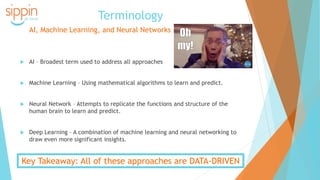
Terminology
 AI – Broadest term used to address all approaches
 Machine Learning – Using mathematical algorithms to learn and predict.
 Neural Network – Attempts to replicate the functions and structure of the
human brain to learn and predict.
 Deep Learning – A combination of machine learning and neural networking to
draw even more significant insights.
AI, Machine Learning, and Neural Networks
Key Takeaway: All of these approaches are DATA-DRIVEN
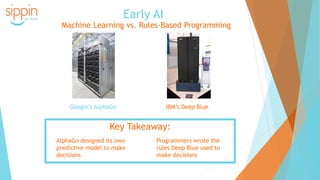
Early AI
Machine Learning vs. Rules-Based Programming
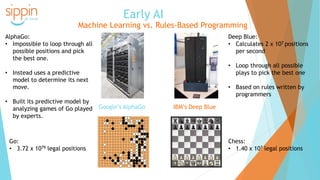
Google’s AlphaGo IBM’s Deep Blue
Chess:
• 1.40 x 10⁷ legal positions
Go:
• 3.72 x 1079 legal positions
Deep Blue:
• Calculates 2 x 10⁷ positions
per second
• Loop through all possible
plays to pick the best one
• Based on rules written by
programmers
AlphaGo:
• Impossible to loop through all
possible positions and pick
the best one.
• Instead uses a predictive
model to determine its next
move.
• Built its predictive model by
analyzing games of Go played
by experts.
Early AI
Machine Learning vs. Rules-Based Programming
Key Takeaway:
Google’s AlphaGo IBM’s Deep Blue
AlphaGo designed its own
predictive model to make
decisions
Programmers wrote the
rules Deep Blue used to
make decisions
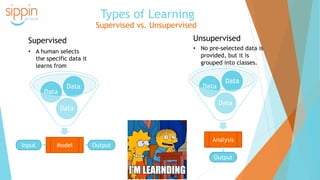
Types of Learning
Supervised vs. Unsupervised
Data
Data
Data
Supervised Unsupervised
• A human selects
the specific data it
learns from
• No pre-selected data is
provided, but it is
grouped into classes.
ModelInput Output
Data
Data
Data
Analysis
Output
Applications of Supervised Learning
What problems can it solve?
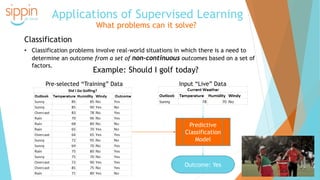
Classification
• Classification problems involve real-world situations in which there is a need to
determine an outcome from a set of non-continuous outcomes based on a set of
factors.
Example: Should I golf today?
Predictive
Classification
Model
Pre-selected “Training” Data Input “Live” Data
Outcome: Yes
Applications of Supervised Learning
What problems can it solve?
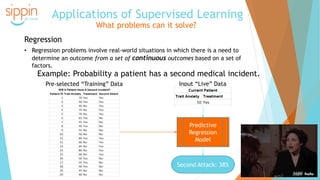
Regression
• Regression problems involve real-world situations in which there is a need to
determine an outcome from a set of continuous outcomes based on a set of
factors.
Example: Probability a patient has a second medical incident.
Predictive
Regression
Model
Pre-selected “Training” Data Input “Live” Data
Second Attack: 38%
Applications of Unsupervised Learning
What problems can it solve?
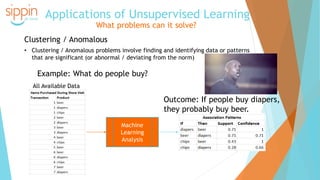
Clustering / Anomalous
• Clustering / Anomalous problems involve finding and identifying data or patterns
that are significant (or abnormal / deviating from the norm)
Example: What do people buy?
Machine
Learning
Analysis
All Available Data
Outcome: If people buy diapers,
they probably buy beer.
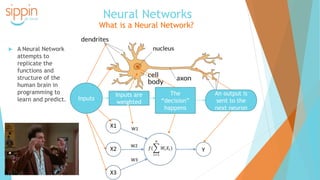
Neural Networks
What is a Neural Network?
 A Neural Network
attempts to
replicate the
functions and
structure of the
human brain in
programming to
learn and predict. Inputs
Inputs are
weighted
The
“decision”
happens
An output is
sent to the
next neuron
Neural Networks
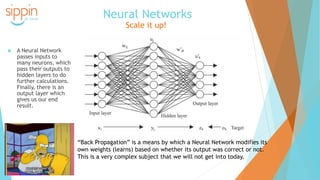
Scale it up!
 A Neural Network
passes inputs to
many neurons, which
pass their outputs to
hidden layers to do
further calculations.
Finally, there is an
output layer which
gives us our end
result.
“Back Propagation” is a means by which a Neural Network modifies its
own weights (learns) based on whether its output was correct or not.
This is a very complex subject that we will not get into today.
Neural Networks
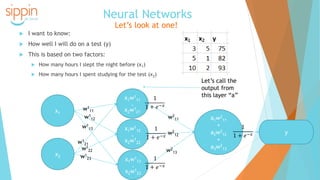
Let’s look at one!
 I want to know:
 How well I will do on a test (y)
 This is based on two factors:
 How many hours I slept the night before (x1)
 How many hours I spent studying for the test (x2)
x1
x2
x1w1
11
+
x2w1
21
x1w1
12
+
x2w1
22
x1w1
13
+
x2w1
23
w1
11
w1
12
w1
13
w1
21
w1
22
w1
23
a1w2
11
+
a2w2
12
+
a3w2
13
w2
11
w2
13
w2
12
Let’s call the
output from
this layer “a”
y
1
1 + 𝑒−𝑥
1
1 + 𝑒−𝑥
1
1 + 𝑒−𝑥
1
1 + 𝑒−𝑥
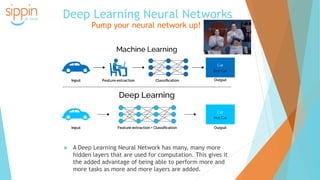
Deep Learning Neural Networks
Pump your neural network up!
 A Deep Learning Neural Network has many, many more
hidden layers that are used for computation. This gives it
the added advantage of being able to perform more and
more tasks as more and more layers are added.
Conclusion
Let the questions begin

Sippin: A Mobile Application Case Study presented at Techfest Louisville

  • 1.
    Mobile Apps and ArtificialIntelligence Ray Tri | CTO & Co-Founder Pai Charasika | CMO & Co-Founder
  • 2.
    Who are theseguys? Pai Charasika  Wake Forest  Business and Communications  Financial Advisor  Local Entrepreneur  Salesman Extraordinaire Ray Tri  University of Louisville  Organizational Leadership and Development  Business Consultant  Serial Entrepreneur  Full Stack Developer
  • 3.
    What in theworld is Sippin?
  • 4.
    Let’s talk AI Introto Artificial Intelligence
  • 5.
    Terminology  AI –Broadest term used to address all approaches  Machine Learning – Using mathematical algorithms to learn and predict.  Neural Network – Attempts to replicate the functions and structure of the human brain to learn and predict.  Deep Learning – A combination of machine learning and neural networking to draw even more significant insights. AI, Machine Learning, and Neural Networks Key Takeaway: All of these approaches are DATA-DRIVEN
  • 6.
    Early AI Machine Learningvs. Rules-Based Programming Google’s AlphaGo IBM’s Deep Blue Chess: • 1.40 x 10⁷ legal positions Go: • 3.72 x 1079 legal positions Deep Blue: • Calculates 2 x 10⁷ positions per second • Loop through all possible plays to pick the best one • Based on rules written by programmers AlphaGo: • Impossible to loop through all possible positions and pick the best one. • Instead uses a predictive model to determine its next move. • Built its predictive model by analyzing games of Go played by experts.
  • 7.
    Early AI Machine Learningvs. Rules-Based Programming Key Takeaway: Google’s AlphaGo IBM’s Deep Blue AlphaGo designed its own predictive model to make decisions Programmers wrote the rules Deep Blue used to make decisions
  • 8.
    Types of Learning Supervisedvs. Unsupervised Data Data Data Supervised Unsupervised • A human selects the specific data it learns from • No pre-selected data is provided, but it is grouped into classes. ModelInput Output Data Data Data Analysis Output
  • 9.
    Applications of SupervisedLearning What problems can it solve? Classification • Classification problems involve real-world situations in which there is a need to determine an outcome from a set of non-continuous outcomes based on a set of factors. Example: Should I golf today? Predictive Classification Model Pre-selected “Training” Data Input “Live” Data Outcome: Yes
  • 10.
    Applications of SupervisedLearning What problems can it solve? Regression • Regression problems involve real-world situations in which there is a need to determine an outcome from a set of continuous outcomes based on a set of factors. Example: Probability a patient has a second medical incident. Predictive Regression Model Pre-selected “Training” Data Input “Live” Data Second Attack: 38%
  • 11.
    Applications of UnsupervisedLearning What problems can it solve? Clustering / Anomalous • Clustering / Anomalous problems involve finding and identifying data or patterns that are significant (or abnormal / deviating from the norm) Example: What do people buy? Machine Learning Analysis All Available Data Outcome: If people buy diapers, they probably buy beer.
  • 12.
    Neural Networks What isa Neural Network?  A Neural Network attempts to replicate the functions and structure of the human brain in programming to learn and predict. Inputs Inputs are weighted The “decision” happens An output is sent to the next neuron
  • 13.
    Neural Networks Scale itup!  A Neural Network passes inputs to many neurons, which pass their outputs to hidden layers to do further calculations. Finally, there is an output layer which gives us our end result. “Back Propagation” is a means by which a Neural Network modifies its own weights (learns) based on whether its output was correct or not. This is a very complex subject that we will not get into today.
  • 14.
    Neural Networks Let’s lookat one!  I want to know:  How well I will do on a test (y)  This is based on two factors:  How many hours I slept the night before (x1)  How many hours I spent studying for the test (x2) x1 x2 x1w1 11 + x2w1 21 x1w1 12 + x2w1 22 x1w1 13 + x2w1 23 w1 11 w1 12 w1 13 w1 21 w1 22 w1 23 a1w2 11 + a2w2 12 + a3w2 13 w2 11 w2 13 w2 12 Let’s call the output from this layer “a” y 1 1 + 𝑒−𝑥 1 1 + 𝑒−𝑥 1 1 + 𝑒−𝑥 1 1 + 𝑒−𝑥
  • 15.
    Deep Learning NeuralNetworks Pump your neural network up!  A Deep Learning Neural Network has many, many more hidden layers that are used for computation. This gives it the added advantage of being able to perform more and more tasks as more and more layers are added.
  • 16.