Can Machines Be Creative?
A Look into Machine Intelligence
By: Cameron Aaron
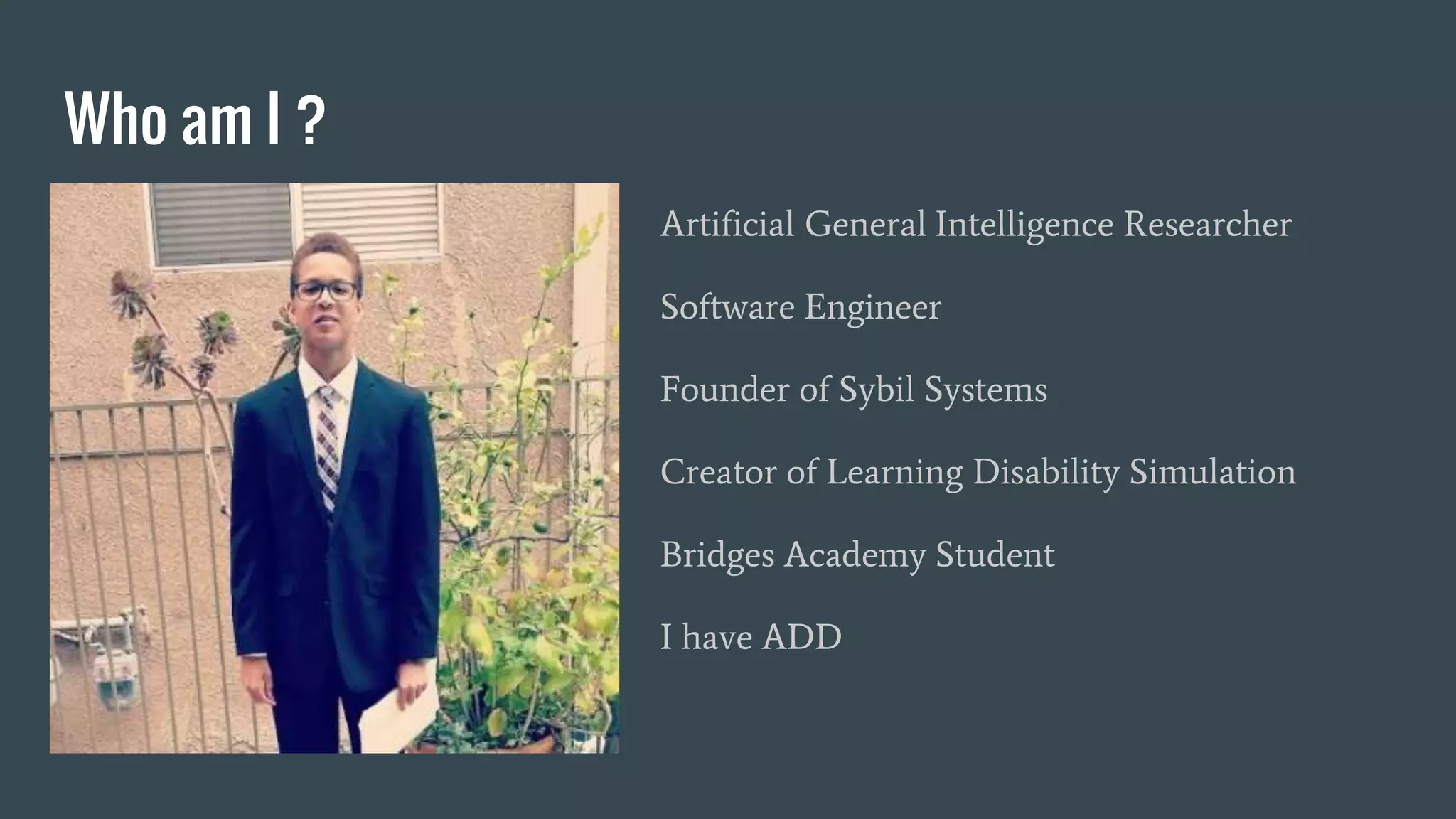
Who am I ?
Artificial General Intelligence Researcher
Software Engineer
Founder of Sybil Systems
Creator of Learning Disability Simulation
Bridges Academy Student
I have ADD
Talk Agenda
1. Background on Machine Intelligence
1. Conversations that I had with experts and industry leaders
1. My own work
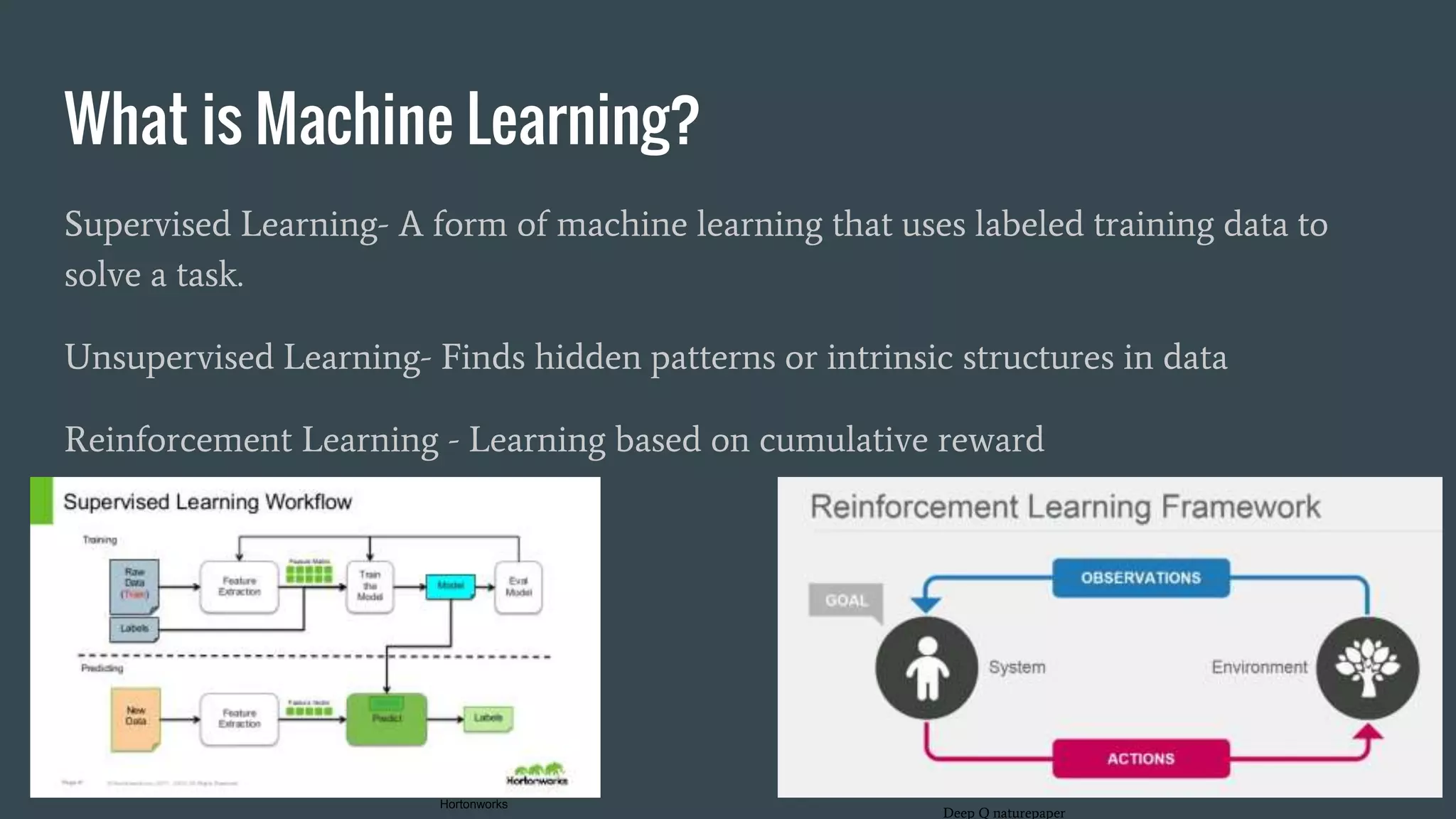
What is Machine Learning?
Supervised Learning- A form of machine learning that uses labeled training data to
solve a task.
Unsupervised Learning- Finds hidden patterns or intrinsic structures in data
Reinforcement Learning - Learning based on cumulative reward
Deep Q naturepaper
Hortonworks
Neural Networks
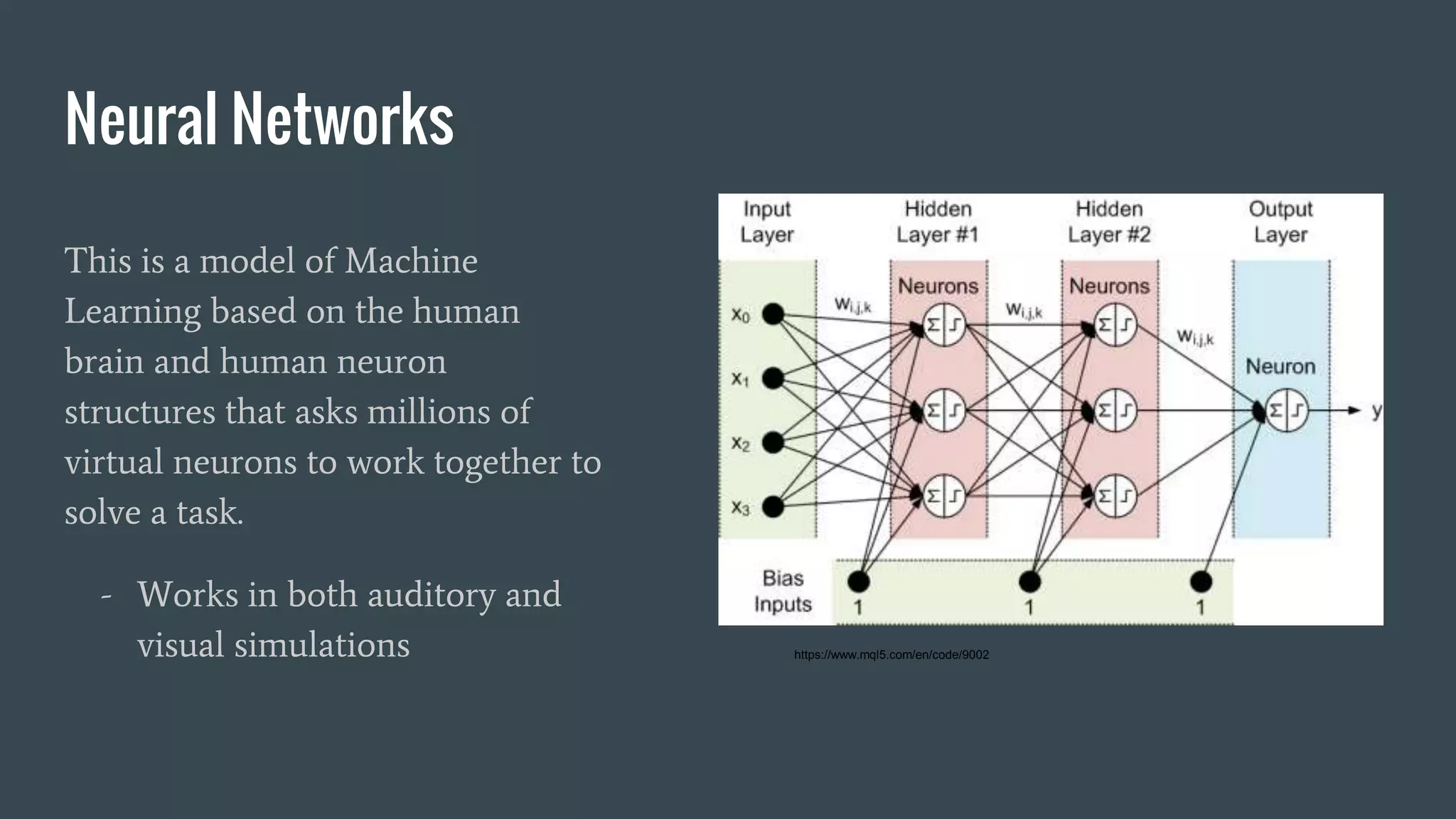
This is a model of Machine
Learning based on the human
brain and human neuron
structures that asks millions of
virtual neurons to work together to
solve a task.
- Works in both auditory and
visual simulations https://www.mql5.com/en/code/9002
What is Artificial Intelligence?
Artificial Machine Intelligence - An AI algorithm that is able to perform a specific task
that requires human intelligence.
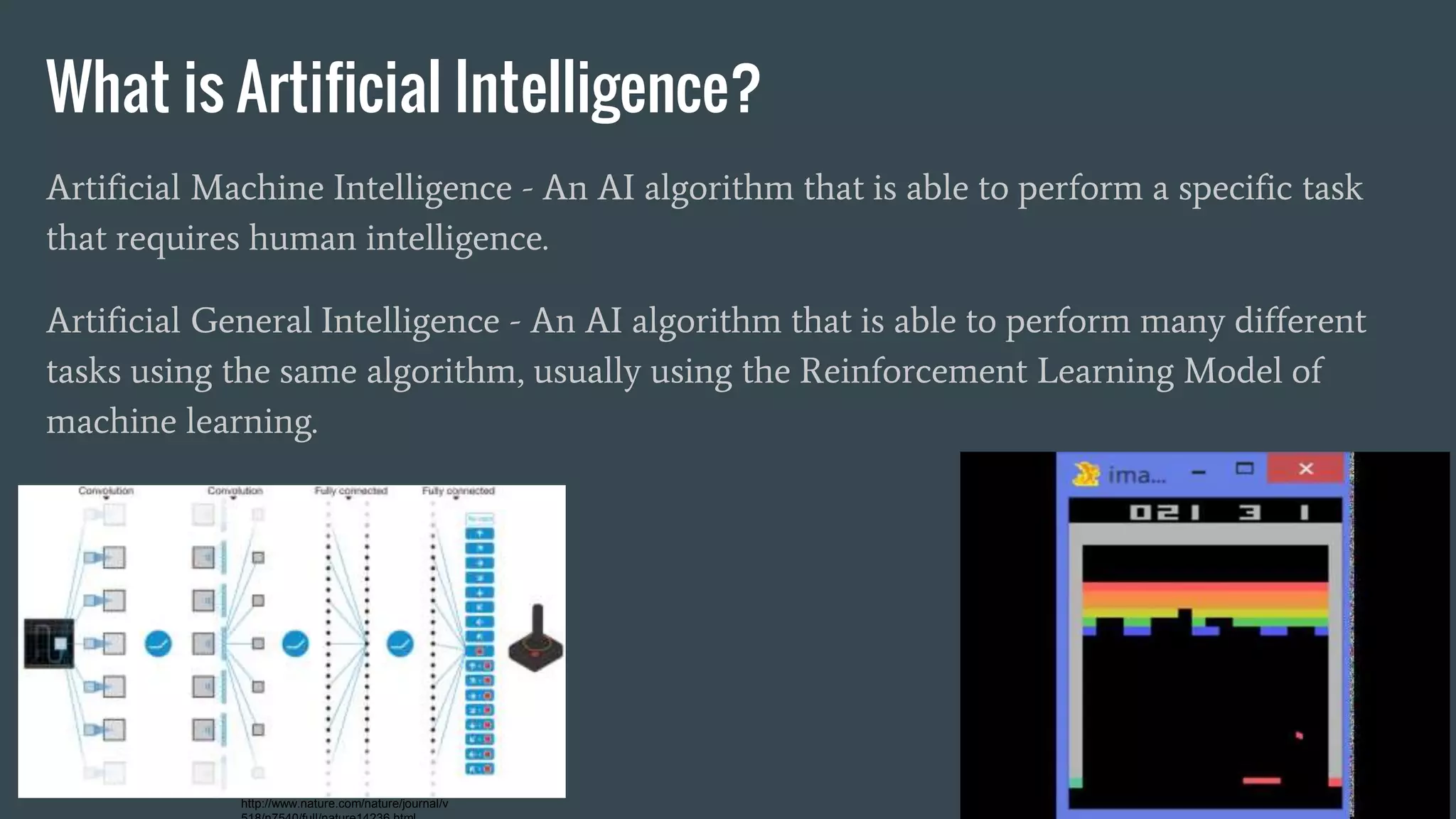
Artificial General Intelligence - An AI algorithm that is able to perform many different
tasks using the same algorithm, usually using the Reinforcement Learning Model of
machine learning.
http://www.nature.com/nature/journal/v
What does it mean for a machine to be intelligent?
Multiple Intelligences
“A big issue is that while it is simple to build a model to learn a specific task, such as
translation, by providing examples of human translations and minimizing an error
metric in those examples, there is no clear quantification of what it means to be
creative.”
- Wang Ling, Scientist at Google's DeepMind
Can ask questions
Must understand what it is doing
Interview with Lucas Baker
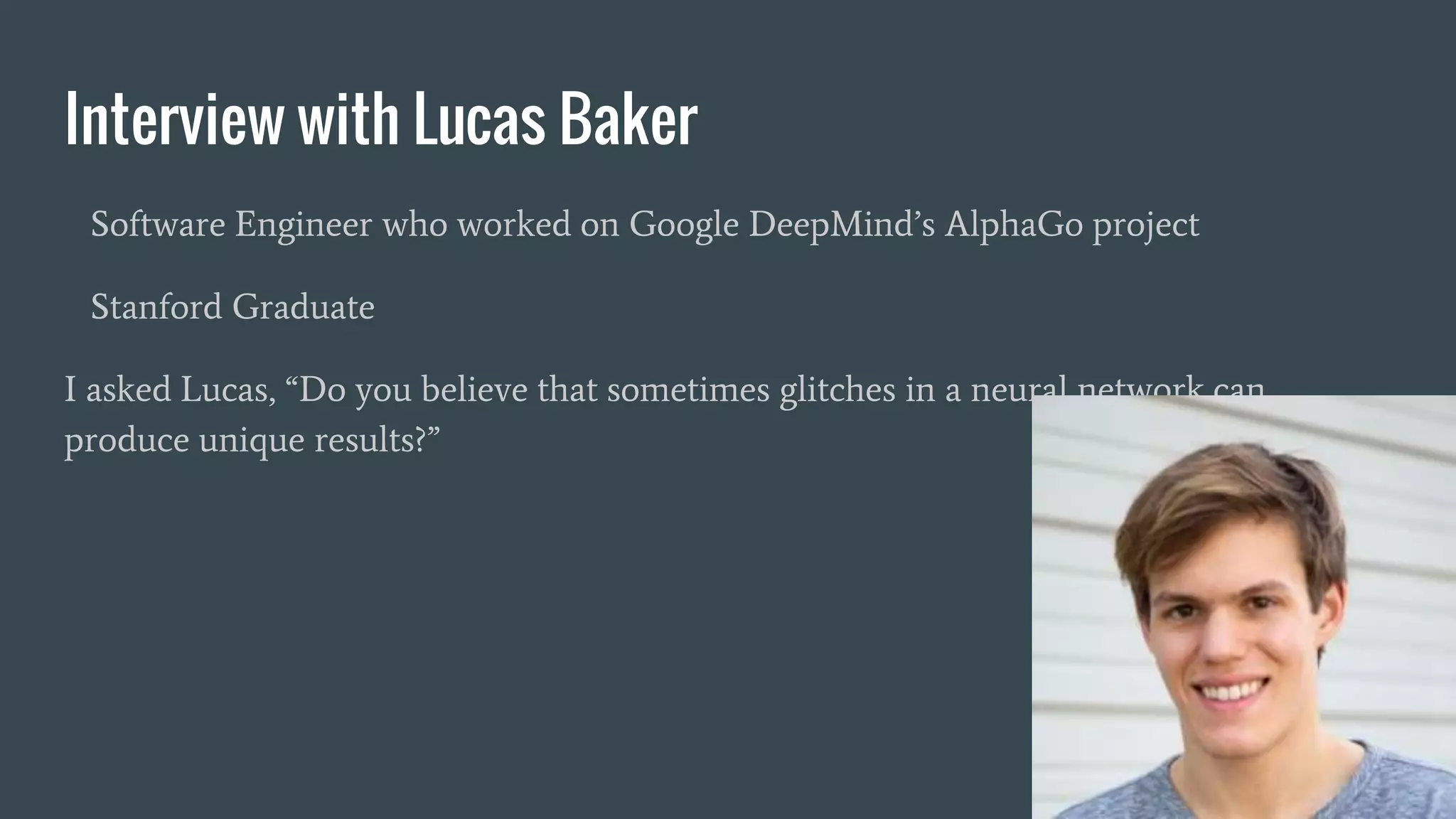
Software Engineer who worked on Google DeepMind’s AlphaGo project
Stanford Graduate
I asked Lucas, “Do you believe that sometimes glitches in a neural network can
produce unique results?”
Interview with Lucas Baker
“The entire human brain is a large neural network, though more complex than
anything we can currently build, and our "glitches" and mistakes often inspire new
approaches. In the same way as the random mutations of evolution usually harm but
sometimes help, the imperfections in a neural network usually produce a lesser reward
but sometimes yield a greater one. As neural networks become more powerful and
intricate, however, they will almost certainly give us further insight into the workings
of our own minds.”
- Lucas Baker, Google DeepMind
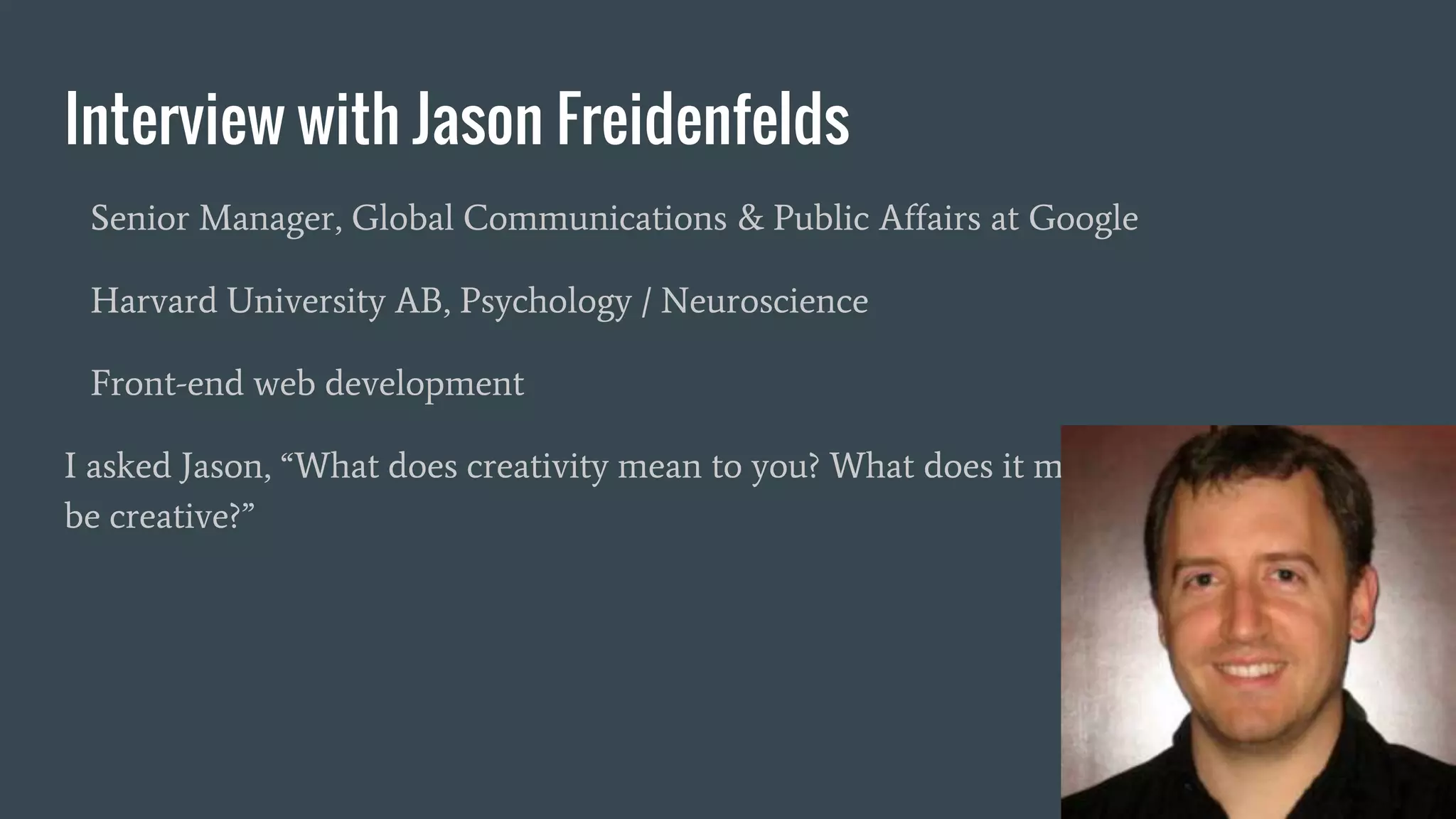
Interview with Jason Freidenfelds
Senior Manager, Global Communications & Public Affairs at Google
Harvard University AB, Psychology / Neuroscience
Front-end web development
I asked Jason, “What does creativity mean to you? What does it mean for a machine to
be creative?”
Interview with Jason Freidenfelds
“We hope someday to build much more generalizable machine intelligence, where we
give a general goal -- "help me optimize this health care system" -- and the machine
figures out novel solutions we hadn't thought of. That could extend to art as well -- we
could tell the machine, "Come up with something new and beautiful," and it might be
able to produce a style we've never seen before that is indeed beautiful.”
- Jason Freidenfelds, Senior Communications Manager, Google
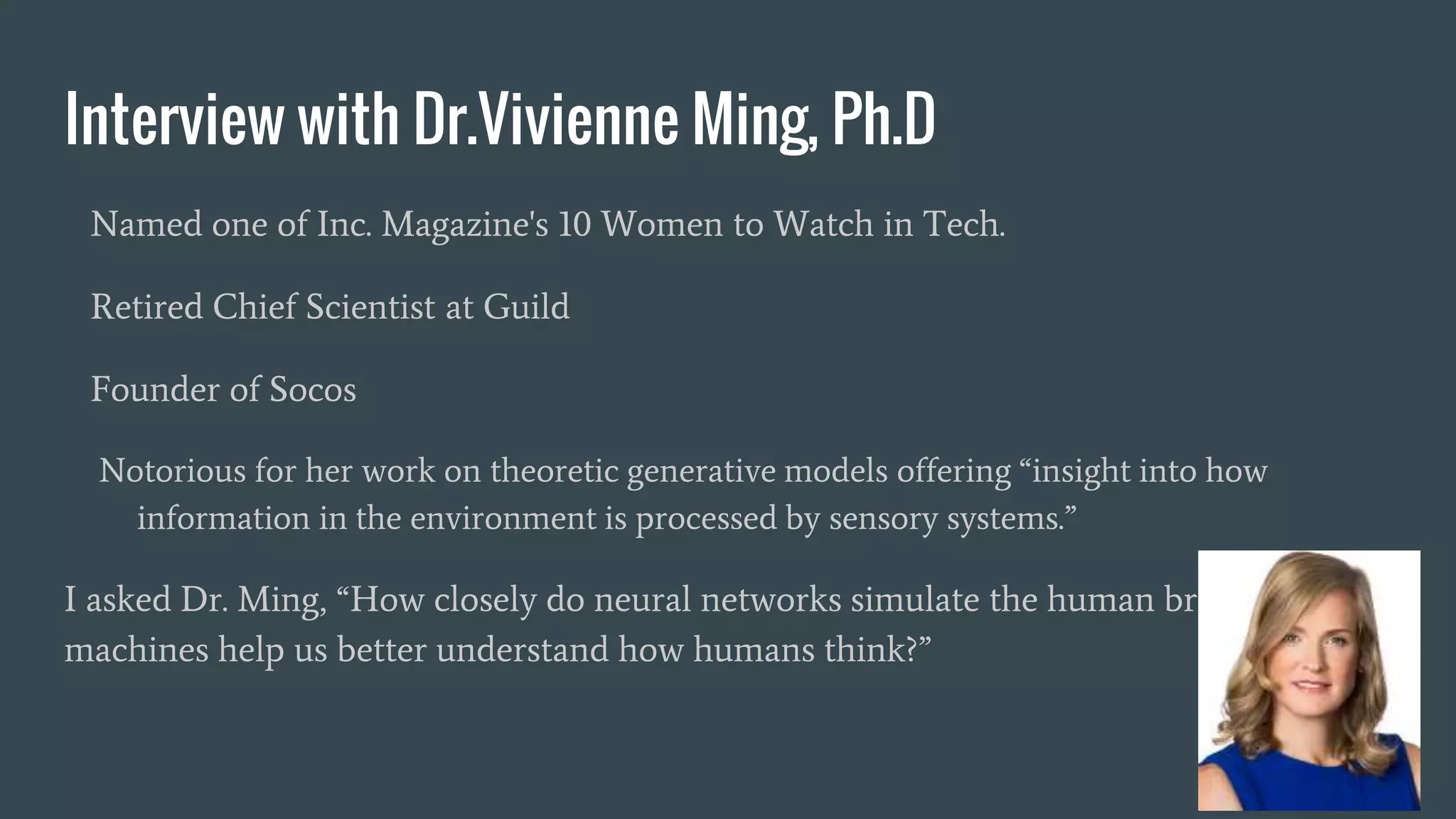
Interview with Dr.Vivienne Ming, Ph.D
Named one of Inc. Magazine's 10 Women to Watch in Tech.
Retired Chief Scientist at Guild
Founder of Socos
Notorious for her work on theoretic generative models offering “insight into how
information in the environment is processed by sensory systems.”
I asked Dr. Ming, “How closely do neural networks simulate the human brain? Will
machines help us better understand how humans think?”
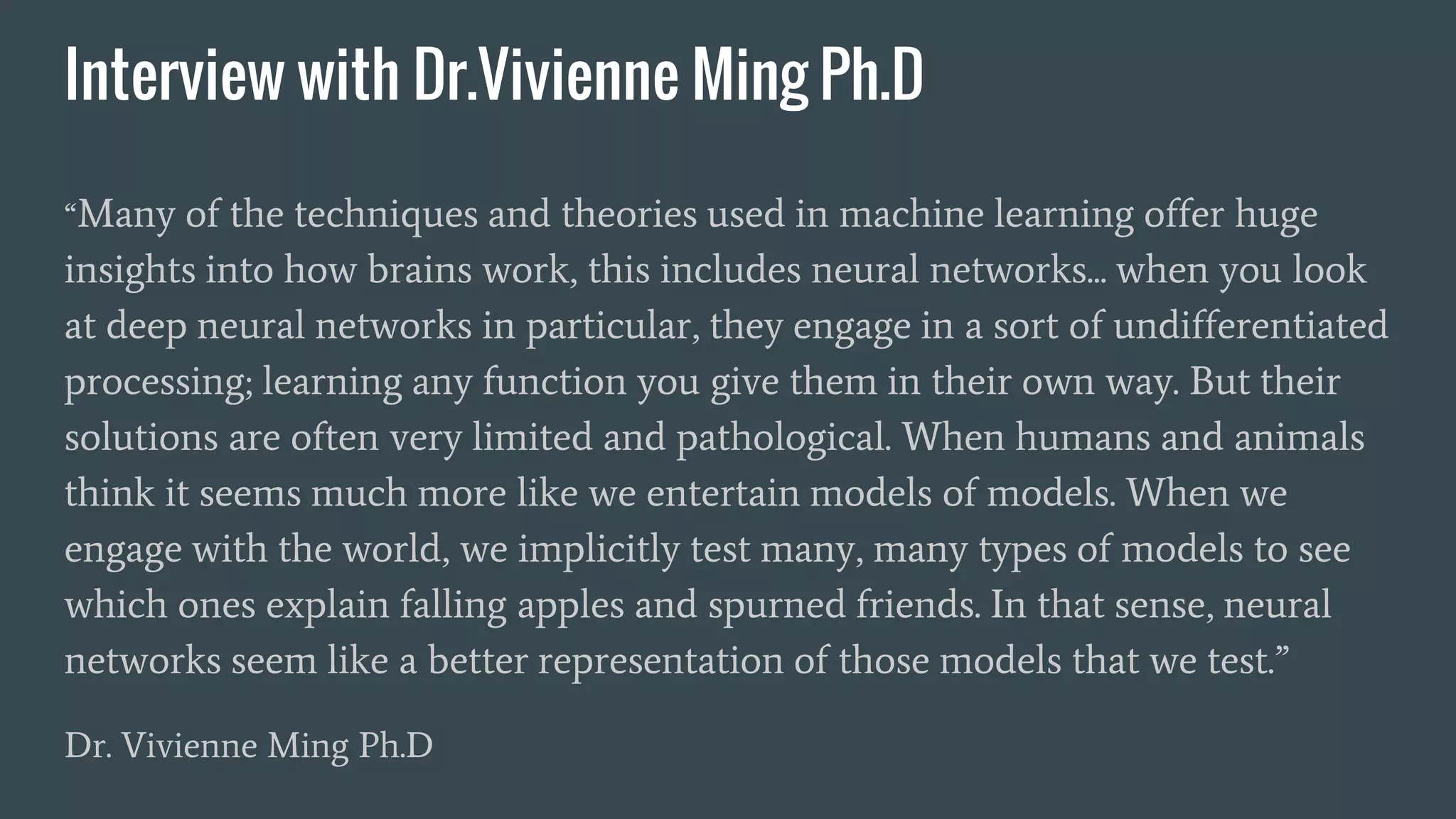
Interview with Dr.Vivienne Ming Ph.D
“Many of the techniques and theories used in machine learning offer huge
insights into how brains work, this includes neural networks... when you look
at deep neural networks in particular, they engage in a sort of undifferentiated
processing; learning any function you give them in their own way. But their
solutions are often very limited and pathological. When humans and animals
think it seems much more like we entertain models of models. When we
engage with the world, we implicitly test many, many types of models to see
which ones explain falling apples and spurned friends. In that sense, neural
networks seem like a better representation of those models that we test.”
Dr. Vivienne Ming Ph.D
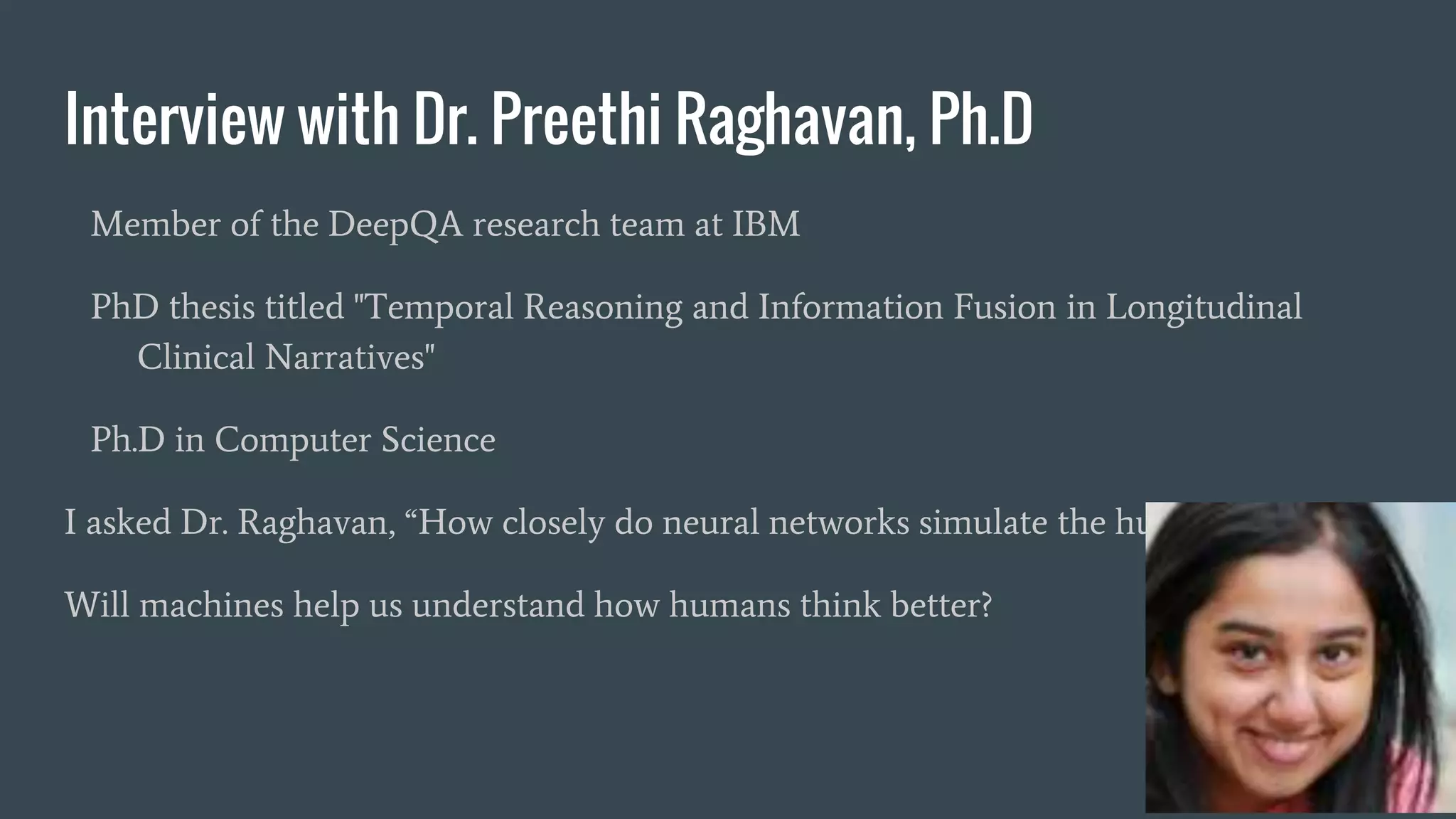
Interview with Dr. Preethi Raghavan, Ph.D
Member of the DeepQA research team at IBM
PhD thesis titled "Temporal Reasoning and Information Fusion in Longitudinal
Clinical Narratives"
Ph.D in Computer Science
I asked Dr. Raghavan, “How closely do neural networks simulate the human brain?
Will machines help us understand how humans think better?
Interview with Dr. Preethi Raghavan Ph.D
“It is possible to create neural networks that try and mimic
biological neural networks i.e. the human brain, thus allowing
scientists to understand brain connectivity. They may also be
trained to assist in expert human tasks like disease diagnosis and
identifying students with learning disabilities.”
- Dr. Preethi Raghavan Ph.D
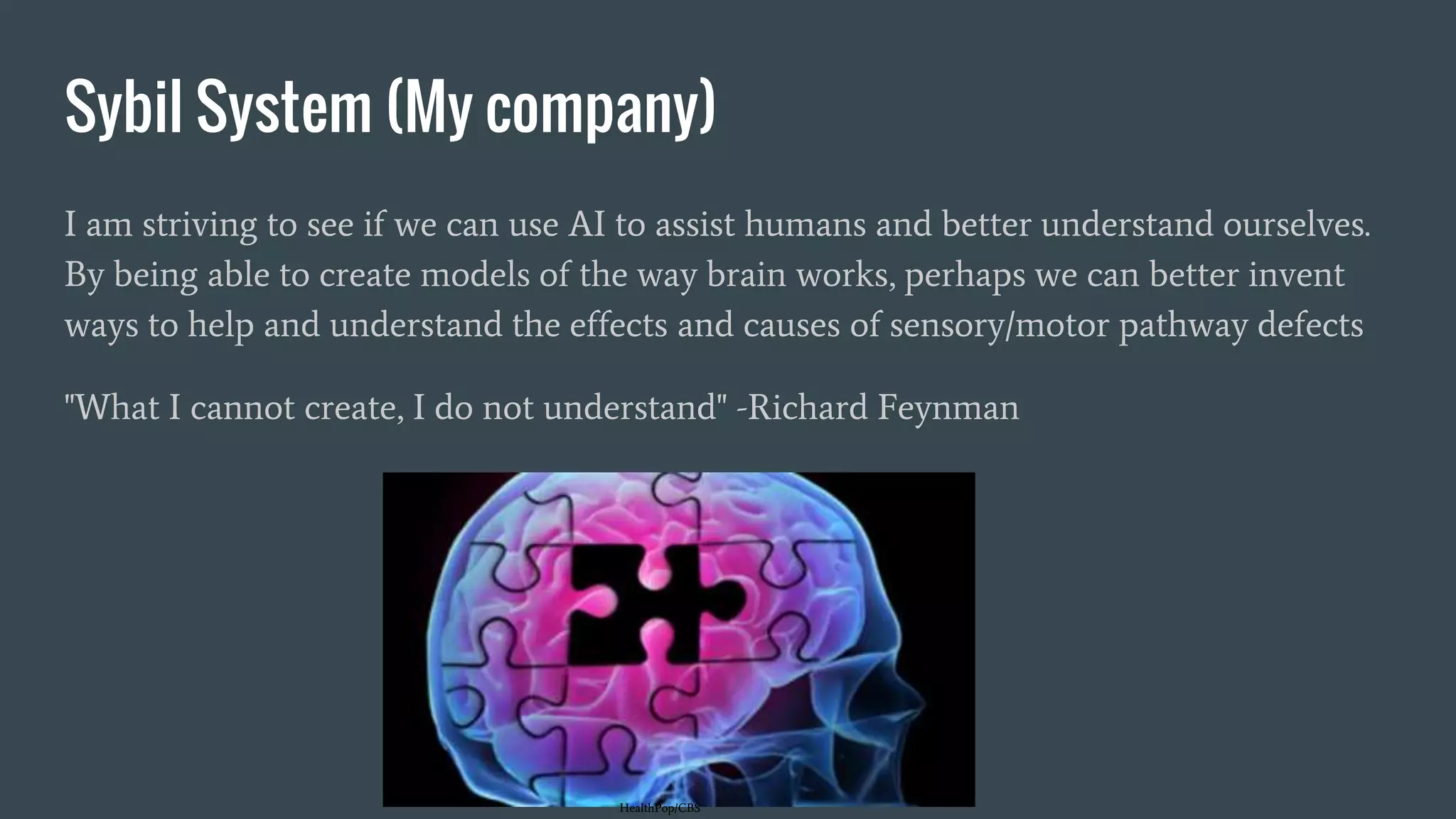
Sybil System (My company)
I am striving to see if we can use AI to assist humans and better understand ourselves.
By being able to create models of the way brain works, perhaps we can better invent
ways to help and understand the effects and causes of sensory/motor pathway defects
"What I cannot create, I do not understand" -Richard Feynman
HealthPop/CBS
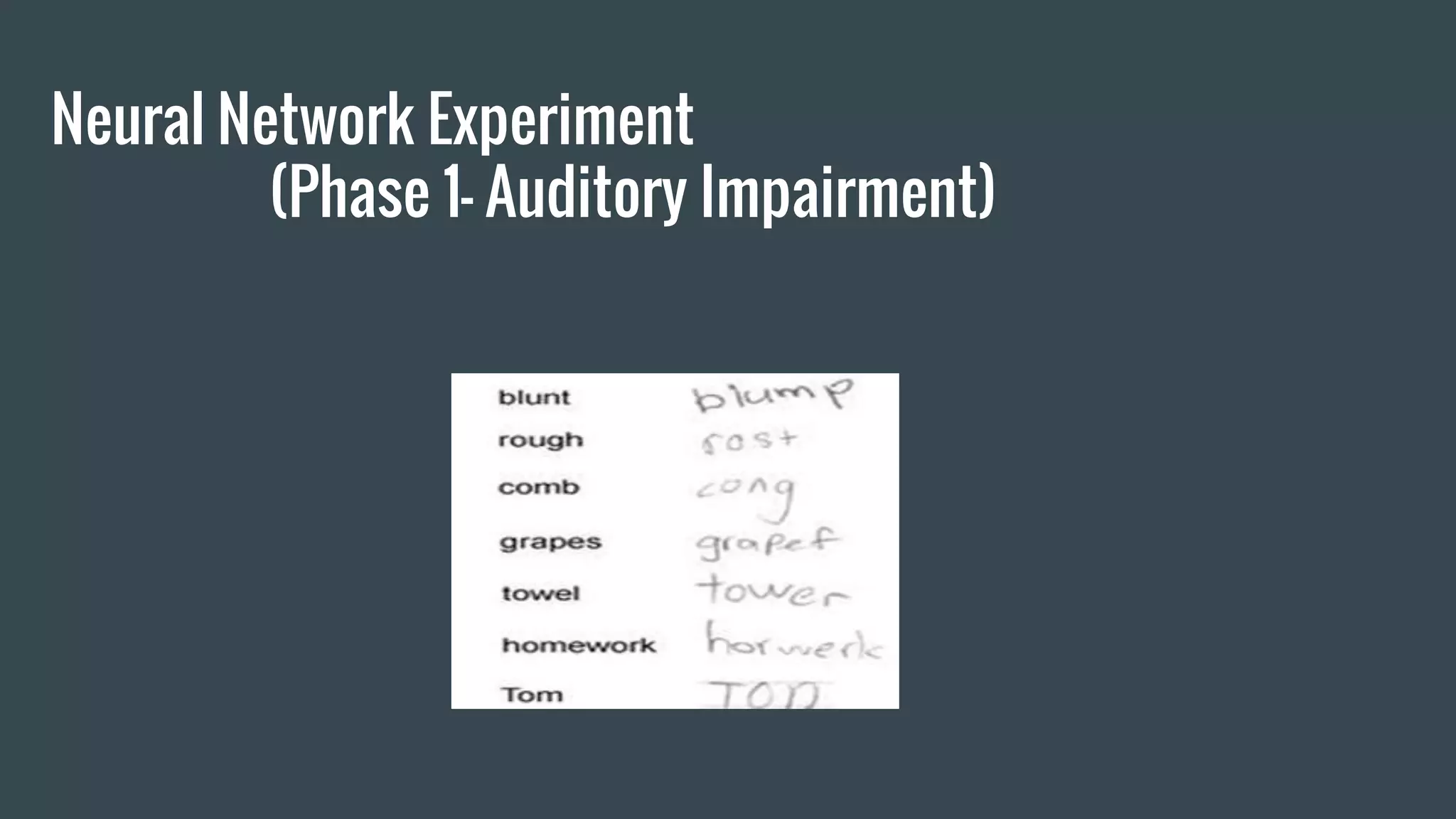
Neural Network Experiment
(Phase 1- Auditory Impairment)
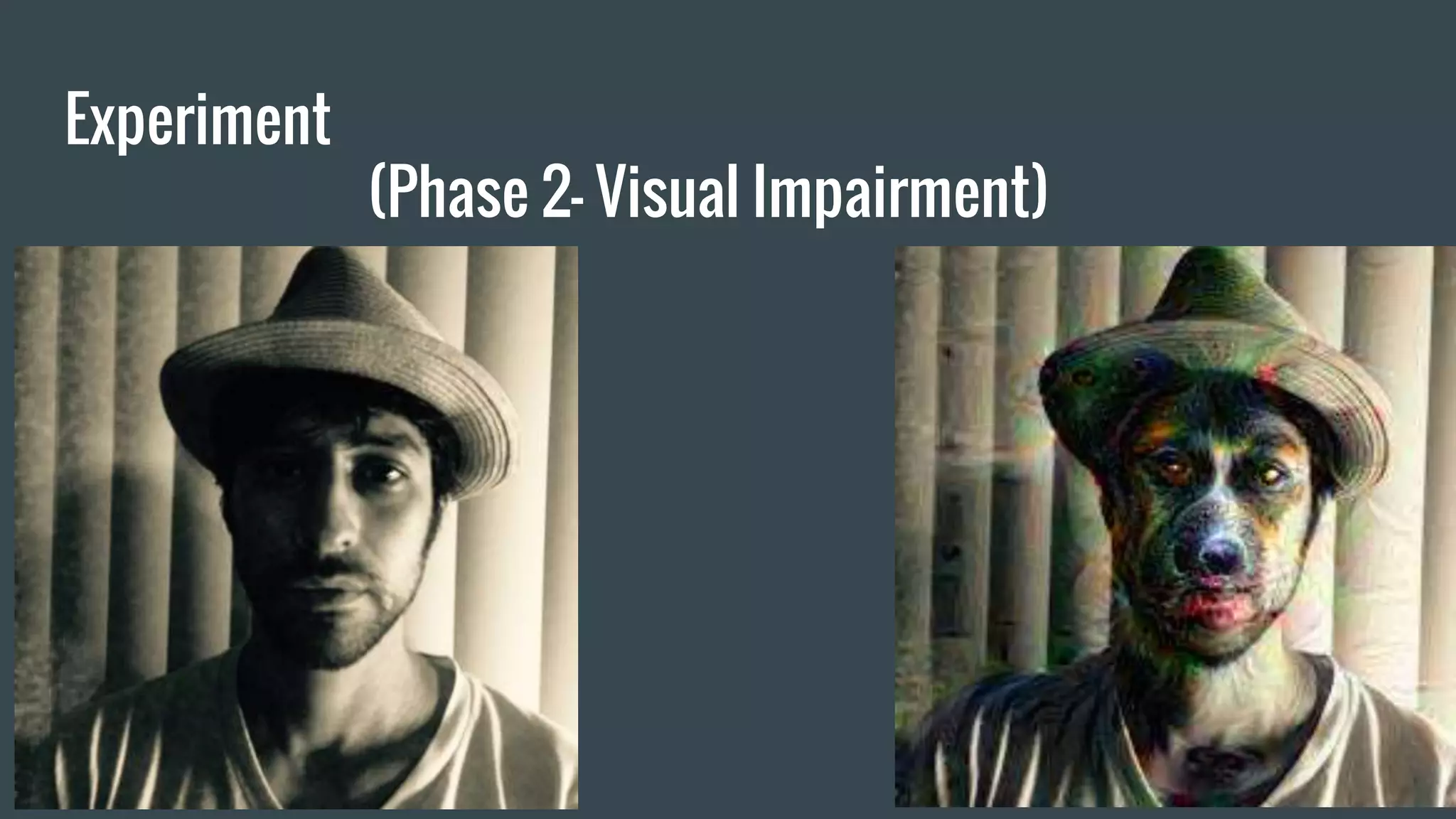
Experiment
(Phase 2- Visual Impairment)
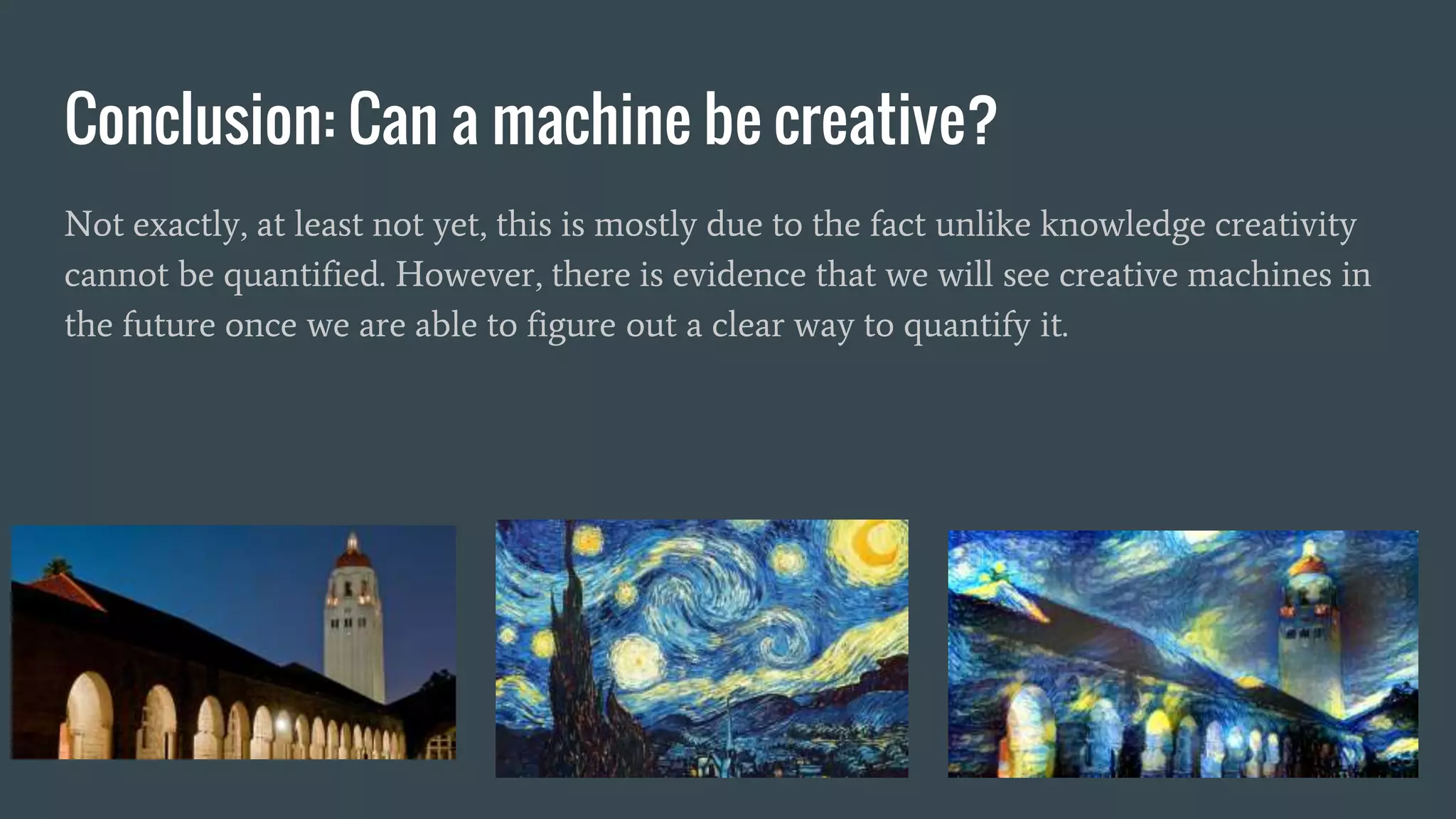
Conclusion: Can a machine be creative?
Not exactly, at least not yet, this is mostly due to the fact unlike knowledge creativity
cannot be quantified. However, there is evidence that we will see creative machines in
the future once we are able to figure out a clear way to quantify it.
Special Thanks!
Special thanks to:
Susan Baum
Dr. Vivienne Ming
Lucas Baker
Miriam Singer
Wang Ling
Jason Freidenfelds
Dr. Preethi Raghavan
Citation
Works Cited
"Deep Blue." IBM100 -. N.p., n.d. Web. 28 Apr. 2016.
"The Era of Citizen Doctors." RSS. N.p., n.d. Web. 28 Apr. 2016.
"IBM Research: Computational Creativity." IBM Research: Computational Creativity. N.p., n.d. Web. 28 Apr. 2016.
Ling, Wang, Lucas Baker, Dr.Vivienne Ming, Ph.D, Jason Freidenfelds Freidenfelds, and Dr. Preethi Raghavan, Ph.D. "Machine
Creativity." E-mail interview. Apr.-May 2016.
"Result Filters." National Center for Biotechnology Information. U.S. National Library of Medicine, n.d. Web. 28 Apr. 2016.

Machine creativity TED Talk 2.0

  • 1.
    Can Machines BeCreative? A Look into Machine Intelligence By: Cameron Aaron
  • 2.
    Who am I? Artificial General Intelligence Researcher Software Engineer Founder of Sybil Systems Creator of Learning Disability Simulation Bridges Academy Student I have ADD
  • 3.
    Talk Agenda 1. Backgroundon Machine Intelligence 1. Conversations that I had with experts and industry leaders 1. My own work
  • 4.
    What is MachineLearning? Supervised Learning- A form of machine learning that uses labeled training data to solve a task. Unsupervised Learning- Finds hidden patterns or intrinsic structures in data Reinforcement Learning - Learning based on cumulative reward Deep Q naturepaper Hortonworks
  • 5.
    Neural Networks This isa model of Machine Learning based on the human brain and human neuron structures that asks millions of virtual neurons to work together to solve a task. - Works in both auditory and visual simulations https://www.mql5.com/en/code/9002
  • 6.
    What is ArtificialIntelligence? Artificial Machine Intelligence - An AI algorithm that is able to perform a specific task that requires human intelligence. Artificial General Intelligence - An AI algorithm that is able to perform many different tasks using the same algorithm, usually using the Reinforcement Learning Model of machine learning. http://www.nature.com/nature/journal/v
  • 7.
    What does itmean for a machine to be intelligent? Multiple Intelligences “A big issue is that while it is simple to build a model to learn a specific task, such as translation, by providing examples of human translations and minimizing an error metric in those examples, there is no clear quantification of what it means to be creative.” - Wang Ling, Scientist at Google's DeepMind Can ask questions Must understand what it is doing
  • 8.
    Interview with LucasBaker Software Engineer who worked on Google DeepMind’s AlphaGo project Stanford Graduate I asked Lucas, “Do you believe that sometimes glitches in a neural network can produce unique results?”
  • 9.
    Interview with LucasBaker “The entire human brain is a large neural network, though more complex than anything we can currently build, and our "glitches" and mistakes often inspire new approaches. In the same way as the random mutations of evolution usually harm but sometimes help, the imperfections in a neural network usually produce a lesser reward but sometimes yield a greater one. As neural networks become more powerful and intricate, however, they will almost certainly give us further insight into the workings of our own minds.” - Lucas Baker, Google DeepMind
  • 10.
    Interview with JasonFreidenfelds Senior Manager, Global Communications & Public Affairs at Google Harvard University AB, Psychology / Neuroscience Front-end web development I asked Jason, “What does creativity mean to you? What does it mean for a machine to be creative?”
  • 11.
    Interview with JasonFreidenfelds “We hope someday to build much more generalizable machine intelligence, where we give a general goal -- "help me optimize this health care system" -- and the machine figures out novel solutions we hadn't thought of. That could extend to art as well -- we could tell the machine, "Come up with something new and beautiful," and it might be able to produce a style we've never seen before that is indeed beautiful.” - Jason Freidenfelds, Senior Communications Manager, Google
  • 12.
    Interview with Dr.VivienneMing, Ph.D Named one of Inc. Magazine's 10 Women to Watch in Tech. Retired Chief Scientist at Guild Founder of Socos Notorious for her work on theoretic generative models offering “insight into how information in the environment is processed by sensory systems.” I asked Dr. Ming, “How closely do neural networks simulate the human brain? Will machines help us better understand how humans think?”
  • 13.
    Interview with Dr.VivienneMing Ph.D “Many of the techniques and theories used in machine learning offer huge insights into how brains work, this includes neural networks... when you look at deep neural networks in particular, they engage in a sort of undifferentiated processing; learning any function you give them in their own way. But their solutions are often very limited and pathological. When humans and animals think it seems much more like we entertain models of models. When we engage with the world, we implicitly test many, many types of models to see which ones explain falling apples and spurned friends. In that sense, neural networks seem like a better representation of those models that we test.” Dr. Vivienne Ming Ph.D
  • 14.
    Interview with Dr.Preethi Raghavan, Ph.D Member of the DeepQA research team at IBM PhD thesis titled "Temporal Reasoning and Information Fusion in Longitudinal Clinical Narratives" Ph.D in Computer Science I asked Dr. Raghavan, “How closely do neural networks simulate the human brain? Will machines help us understand how humans think better?
  • 15.
    Interview with Dr.Preethi Raghavan Ph.D “It is possible to create neural networks that try and mimic biological neural networks i.e. the human brain, thus allowing scientists to understand brain connectivity. They may also be trained to assist in expert human tasks like disease diagnosis and identifying students with learning disabilities.” - Dr. Preethi Raghavan Ph.D
  • 16.
    Sybil System (Mycompany) I am striving to see if we can use AI to assist humans and better understand ourselves. By being able to create models of the way brain works, perhaps we can better invent ways to help and understand the effects and causes of sensory/motor pathway defects "What I cannot create, I do not understand" -Richard Feynman HealthPop/CBS
  • 17.
    Neural Network Experiment (Phase1- Auditory Impairment)
  • 18.
  • 19.
    Conclusion: Can amachine be creative? Not exactly, at least not yet, this is mostly due to the fact unlike knowledge creativity cannot be quantified. However, there is evidence that we will see creative machines in the future once we are able to figure out a clear way to quantify it.
  • 20.
    Special Thanks! Special thanksto: Susan Baum Dr. Vivienne Ming Lucas Baker Miriam Singer Wang Ling Jason Freidenfelds Dr. Preethi Raghavan
  • 21.
    Citation Works Cited "Deep Blue."IBM100 -. N.p., n.d. Web. 28 Apr. 2016. "The Era of Citizen Doctors." RSS. N.p., n.d. Web. 28 Apr. 2016. "IBM Research: Computational Creativity." IBM Research: Computational Creativity. N.p., n.d. Web. 28 Apr. 2016. Ling, Wang, Lucas Baker, Dr.Vivienne Ming, Ph.D, Jason Freidenfelds Freidenfelds, and Dr. Preethi Raghavan, Ph.D. "Machine Creativity." E-mail interview. Apr.-May 2016. "Result Filters." National Center for Biotechnology Information. U.S. National Library of Medicine, n.d. Web. 28 Apr. 2016.

Editor's Notes

  • #3 I am a bridges academy student and Research scientist at Sybil Systems. I have devoted my work to creating AI that can help us learn more about our own minds
  • #5 Supervised learning is like reading a book to a child and pointing out what animals are in the book unsupervised learning is finding hidden patterns. Reinforcement learning is teaching itself via cumulative reward
  • #6 A neural network is a system of neuronal connections based on the human brain. Specifically, this mimics the neurons in the visual cortex of the brain. In the network, it takes an entire image then applies mathematical transformations on it.
  • #7 There are two main types of AI Artificial machine intelligence (that is good at a single task such as chess) and Artificial general Intelligence ( that is good across many tasks Such as deep Q playing all atari games )
  • #8 Howard Gardner coined the term Multiple intelligences- to explain that we are we are well rounded creatures. We have many skills and can be better in some areas than others. Some of the intelligences that human have are musical, kinesthetic, naturalistic, mathematical, logical, and linguistic. Machines excel at mathematical and Logical intelligence. The problem is that things like creativity are not quantifiably so it hard to program creative into the machine (Howard Gardener).
  • #9 Lucas Baker Is a stanford graduate and A software engineer at google's deep mind He helped create the first ever AI that can consistently play the game go and beat Go masters around the world
  • #10 The human brain is a neural network and by learning more about neural networks we will be able to learn more about our own minds. The glitches in neural networks often yield a greater reward as far as showing us what is going on in an intricate system
  • #11 Jason Freidenfelds is a senior Global communications manager at google
  • #12 We are able to see computers create very intricate and interesting art by looking at a photo and creating more of what it sees.
  • #15 Part of the Deep QA reserch team Dr. Preethi is working on medical question answering for IBM watson
  • #17 "What I cannot create, I do not understand" -Richard Feynman
  • #18 So I figured what would happen if a deep neural network that simulated the Auditory cortex of the brain but I gave a few of the nodes a bug causing them to not be able to analyze their parts of audio file (A minute long clip of Charlotte's Web) the result was the network that analyzed it with the bug gave an output that was unexpected to me it instead of just leaving blank spaces or giving a terribly bad result seemed to fill the spaces in a way that was still coherent and logical in the way it was read.
  • #19 In the human brain, visual data is processed by the visual cortex of the the brain and the brain starts to learn the information from what it perceives via the dopamine system. The same goes with machines when they learn via reinforcement learning. They learn using a pre-programed reward system. When building a neural network that recreates an image, it is possible to simulate a visual processing issue by handicapping the neural network so that some of the nodes pass on information that is either inaccurate or insufficient. This creates a result that is unique, many times resulting in creative adaptations, allowing us to better understand those with learning disabilities.
  • #20 Not exactly, at least not yet, this is mostly due to the fact unlike knowledge creativity cannot be quantified. However, there is evidence that we will see creative machines in the future once we are able to figure out a clear way to quantify it.